In a report published in 2005, it was estimated that there were approximately 15.6 million prevalent cases of rheumatic heart disease globally.Reference Carapetis, Steer, Mulholland and Weber1 Rheumatic heart disease continues to be an important cardiac problem in many developing nations, particularly in the Pacific region.Reference Steer, Carapetis, Nolan and Shann2 In general, data on rheumatic heart disease from developing nations are scarce, and autopsy data are particularly scarce.
The report from 2005 calculated the number of deaths due to rheumatic heart disease to be 233,000, based upon an annual mortality rate of 1.5%.Reference Carapetis, Steer, Mulholland and Weber1 This figure of 1.5% was necessarily conservative because of a lack of good quality mortality data from countries where rheumatic heart disease is common. Mortality rates from rheumatic heart disease in other countries are far higher than this figure. In Ethiopia, for example, one study found an annual mortality rate 8 times higher, at 12.5%.Reference Gunther, Asmera and Parry3 Mortality rates can be ascertained from well-collected death certificates, or from carefully monitored populations. In most developing countries there is poor data relating to cause of death because of missing or inaccurate death certification. Autopsy data may not necessarily improve ascertainment of cases from death certificates,Reference Carapetis and Currie4 but it does provide an indication of the distribution of rheumatic heart disease in a given population, and is accurate. There have been few autopsy reports of rheumatic heart disease in developing nations in the past 20 years. Our aim, therefore, was to analyse cases of rheumatic heart disease identified through hospital and forensic autopsies over the past 17 years in Fiji. We aimed specifically to describe the demographic distribution of rheumatic heart disease, in particular in terms of age and ethnic distribution. We also aimed to describe the pattern of valvar involvement of cases of rheumatic heart disease over this period.
Methods
We conducted a retrospective review of the records of autopsies performed at the Colonial War Memorial Hospital, in Suva, Fiji, during the period from 1990 through 2006.
The setting
Fiji is located in the Western Pacific, North of the Tropic of Capricorn, and is made up of over 300 Islands. The population is currently estimated at approximately 849,000 people.5 There are 2 main ethnic groups, Indigenous Fijians and Indo-Fijians. The Indo-Fijian population first came to Fiji from India in the 1870s under the British indentured labour scheme to work on sugarcane farms. Indigenous Fijians comprise approximately 51% of the population, and Indo-Fijians comprise approximately 43%. The capital of Fiji, Suva, is located in the Central Division of Fiji on the main island of Viti Levu. The Colonial War Memorial Hospital is located in Suva and serves the Central Division. It is the tertiary referral centre for the whole country. The most recent estimated data in 2005 indicated that the population of the Central Division is 330,247, with 61% (201,511) being Indigenous Fijians and 31.5% (104,020) being Indo-Fijians. These ethnic proportions are similar to those found in the official 1996 census.5, 6 In 2006, Colonial War Memorial Hospital had a total of 20,542 admissions.
Autopsies
The Pathology Department of the Colonial War Memorial Hospital conducts autopsies on both forensic and hospital deaths in the Central Division. Over the period studied, there was a mean of 371 autopsies, with a range from 280 to 412, performed in each year, with a mean of 282 (76%) of these being forensic autopsies. Over the period from 1991 until 2005, there was a mean of 1988 deaths, with a range from 1522 to 2329, per year in the Central Division. In men there was a mean of 263 autopsies performed per year out of a mean of 1146 total deaths (22.9%), as compared to women, in whom there was a mean of 108 autopsies performed per year out of a mean of 872 deaths (12.4%). In Indigenous Fijians, there was a mean of 227 autopsies performed per year out of a mean of 1255 total deaths (18.1%), as compared to Indo-Fijians, in whom there was a mean of 119 autopsies performed per year out of a mean of 648 deaths (18.4%).
In general, the autopsy process in the Department involves macroscopic examination only, with histology performed on selected tissues in selected cases. Forensic autopsies are performed on people who die outside a hospital and in whom a death certificate cannot be issued. During the period, autopsies were conducted by several different pathologists working in the Department. All autopsies were recorded by hand in a register which is kept in the Department. Information contained in the records includes demographic data, a description of the gross macroscopic pathological findings of the autopsy, and the cause of death.
Review of autopsy records
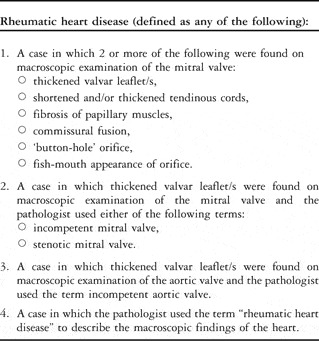
All records were reviewed by a pathology registrar (P.S.), and cases of rheumatic heart disease were defined by criterions based upon standard pathological definitions of the disease,Reference Kumar, Fausto and Abbas7 or by the opinion of the pathologist (Table 1). Further data was extracted from the autopsy records once a case was identified as satisfying the criterions for rheumatic heart disease. This included demographic data, cause of death, the pattern of valvar involvement, and the valvar lesion. Because valves that appear to be stenotic on macroscopic examination may have double dysfunction on Doppler echocardiogram, we categorized valvar lesions as being predominantly stenotic or predominantly incompetent, unless specified as a mixed lesion by the pathologist. We also attempted to ascertain whether cases had a previous diagnosis of rheumatic heart disease by searching through the electronic hospital admission database for cases found in the years 2004 through 2006. This was restricted because not all medical records were able to be retrieved.
Criterions for inclusion as an autopsy case of rheumatic heart disease.

Statistical methods
We used the 1996 census population figures as mid-study population figures for relative risk calculations. We used the two sample t-test for comparison of means and the two-sample test of proportions for comparison of proportions. Statistical analysis was performed using the STATA v8.0 statistical package (StataCorp, Texas).
Ethical approval
Approval for this study was granted by the Fiji National Research Ethics Review Committee and the Fiji National Health Research Committee.
Results
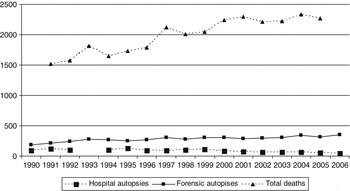
We reviewed a total of 6218 autopsy records. Records from hospital autopsies for 1993, however, were not available. There were 1419 hospital autopsy records (23%) and 4799 forensic autopsy records (77%). Over the period of 17 years, there was a steadily increasing number of forensic autopsies performed, and a somewhat declining number of hospital autopsies, despite an increasing number of deaths overall (Fig. 1).
Number of autopsies performed at the Colonial War Memorial Hospital 1990–2006, and the total number deaths in the Central Division of Fiji 1991–2005.

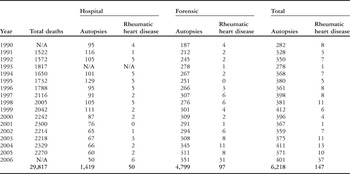
A total of 147 cases (2.4%) satisfied the criterions for inclusion as cases of rheumatic disease at autopsy (Table 2). There were also 23 cases (0.4%) of isolated aortic stenosis found at autopsy. We did not include these as cases of rheumatic heart disease because of the uncertainty in assigning rheumatic involvement as the cause of stenosis, particularly in older patients. It is possible that a proportion of these cases were due to rheumatic heart disease cases. Of these 23 cases, 5 patients were aged under 32 years at death, and the mean age at death was 48.9 years, with a range from 17 to 82 years. There were 50 cases of rheumatic heart disease (3.5%) amongst the hospital autopsies, and 97 cases (2%) in those considered forensic. Over the period of 17 years, there was a relatively constant number of cases of rheumatic heart disease detected by hospital autopsy, but there was an apparent increase in the number of cases detected on forensic autopsy between 2002 and 2006. Of note, there was a very large number of cases detected on forensic autopsy in 2006, accounting for 25% of all cases for the 17 year period, and equating to 9.2% of all autopsies for that year (p < 0.0001). When we analysed only the records from 1990 to 2005, the number of cases of rheumatic heart disease was 110 out of 5817 autopsies (1.9%).
Total number of deaths in the Central Division of Fiji 1991–2005, and cases of rheumatic heart disease in hospital and forensic autopsies performed at the Colonial War Memorial Hospital 1990–2006 (N/A is data not available).

Cause of death
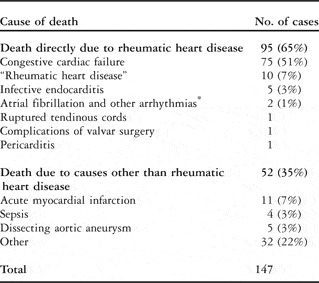
Rheumatic heart disease was the direct cause of death in 95 of the 147 cases (65%) (Table 3). In the hospital autopsies, there were 35 deaths that were directly attributable to rheumatic heart disease out of a total of 50 cases (70%). In the forensic group, there were 60 deaths that were directly attributable to rheumatic heart disease out of a total of 97 cases (62%). The most common cause of death at autopsy was congestive cardiac failure, in 75 of the 95 cases (79%), where rheumatic heart disease was the direct cause of death. In 3 instances, congestive cardiac failure had occurred in pregnant women who died at 26, 27 and 31 years of age, respectively. All three women had mitral stenosis. Infective endocarditis was the primary cause of death in 5 cases, but 5 of the patients with congestive cardiac failure also had macroscopic pathological evidence of infective endocarditis. Rheumatic heart disease accounted for 10 of 17 cases (59%) of infective endocarditis found on autopsy during the period.
Causes of death in cases of rheumatic heart disease diagnosed at autopsy at the Colonial War Memorial Hospital in Fiji 1990–2006.

*Both arrhythmic cases were hospital cases where additional clinical information was available to the pathologist.
Demographics: gender, ethnicity and age
Of the 147 cases, 101 were males (69%) and 46 females (31%). When adjusted for the number of autopsies as a proportion of total deaths in both groups as well as adjusting for mid-study population proportions, the relative risk for rheumatic heart disease found on autopsy was similar in women and men (relative risk 1.12, 95% confidence interval 0.77–1.6).
Of the cases, 98 (67%) were Indigenous Fijians, followed by 41 Indo-Fijians (28%), with other races accounting for a further 8 cases (5%). When adjusted for the number of autopsies as a proportion of total deaths in both groups, as well as the mid-study population proportions, the relative risk for rheumatic heart disease found on autopsy in Indigenous Fijians when compared with Indo-Fijians was 1.26 (95% confidence interval 0.87–1.86). Of the 95 cases where rheumatic heart disease was the direct cause of death, 62 were Indigenous Fijian (65%) and 26 were Indo-Fijian (27%); relative risk 1.25, 95% confidence interval 0.78–2.07.
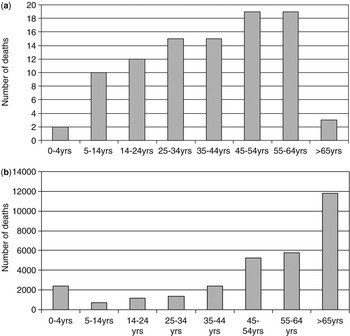
The mean age at death of cases of rheumatic heart disease was 40 years, with a standard deviation of 17.7 years, and a range of 4 years to 80 years. The mean age at death when death was directly attributable to rheumatic heart disease was 38.1 years of age, with standard deviation of 17.8 years, and range from 4 to 72 years. There was an increasing number of deaths due to rheumatic heart disease with increasing age, reflecting the cumulative nature of rheumatic heart disease (Fig. 2). Of note there were 12 deaths due to rheumatic heart disease (13%) in children aged less than 15 years, and 24 deaths in people aged between 5 and 24 years (25%). When adjusted for autopsy numbers and mid-study population proportions, the adjusted relative risk for death due to rheumatic heart disease found on autopsy in those aged between 5 and 24 years was 1.08 (95% confidence interval 0.64–1.77) when compared with those aged 25 years and over. The mean age of death for Indigenous Fijians was 35.8 years and the mean age at death for Indo-Fijians was 43.1 (p = 0.08).
Age distribution (a) of autopsy cases of rheumatic heart disease (where rheumatic heart disease was the direct cause of death) at the Colonial War Memorial Hospital 1990–2006. Age distribution (b) of total deaths in the Central Division of Fiji 1991–2005.

Previous admission for rheumatic heart disease
There were 38 cases of rheumatic heart disease in the years 2004 through 2006 where rheumatic heart disease was the cause of death. Of these, 10 had been admitted for management of illnesses related to rheumatic heart disease since the establishment of the electronic admissions database in April, 2002. In 21 instances, the patients had not been admitted for rheumatic heart disease in this period, and 7 were not registered on the electronic system.
Pattern of valvar involvement
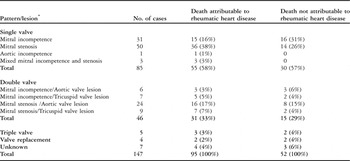
The most frequent pattern was that of single valvar disease, in 85 of 147 cases (58%) (Table 4). Two valves were involved in 46 cases (31%), but triple valvar involvement was less common (3%). Predominant mitral valvar stenosis was the most common single lesion in 50 cases (31%), followed by predominant mitral incompetence in 31 cases (21%). Mitral stenosis was more common in cases where rheumatic heart disease was the cause of death when compared with cases where rheumatic heart disease was not the direct cause of death, either as an isolated predominant lesion (38% versus 26% cases, p = 0.09) or in combination with other valvar lesions (65% versus 46%, p = 0.012). In contrast, mitral incompetence was less common (16% versus 31%, p = 0.016). There was a similar distribution of cases between forensic and hospital cases, and between Fijian and Indo-Fijian cases.
Pattern of valvar lesions in cases of rheumatic heart disease diagnosed at autopsy at the Colonial War Memorial Hospital in Fiji, 1990–2006.

*Mitral stenosis and mitral incompetence lesions are predominantly stenotic or predominantly incompetent.
Discussion
We found that 2.4% of all autopsies performed between 1990 and 2006 at the Colonial War Memorial Hospital in Fiji showed evidence of rheumatic heart disease. There has been an apparent decrease in rheumatic heart disease in industrialised nations over the past 50 years.Reference Shulman, Stollerman, Beall, Dale, Tanz and Sriprakash8 We found no such decrease in the number of cases found on autopsy in the 17 year period of our study. In fact, there was an increase over the last 5 years. These findings concur with those of other investigators working in disadvantaged populations, including those living in Mumbai in India, and in Aboriginal people in the Northern Territory of Australia.Reference Carapetis and Currie4, Reference Deshpande, Vaideeswar, Amonkar and Vasandani9 We noted a large and statistically significant increase in the number of cases in 2006. We cannot be sure if this was a real increase or not. The rise in the number of cases also coincided with the appointment of a new pathologist whom had trained in India and been exposed to large numbers of cases of rheumatic heart disease. The number of admissions for rheumatic heart disease appeared to be similar to previous years, and there was no dramatic increase in the general population. Whatever the reason, it underlines the importance of implementing prospective active surveillance of deaths due to rheumatic heart disease.
Of our ascertained cases, two thirds died of rheumatic heart disease rather than of another cause. Nearly four-fifths of deaths were due to congestive cardiac failure, which is similar to experience in other areas where rheumatic heart disease is common.Reference Oli and Asmera10 Infective endocarditis is well recognised as an important cause of death in patients with rheumatic heart disease. Of our patients, 10 had evidence of infective endocarditis. Because histological examination is the most definitive method of detecting infective endocarditis at autopsy, and only macroscopic examination was performed in our study, it may be that we underestimated the number of cases of infective endocarditis. There were 3 deaths in pregnant women due to rheumatic heart disease. The maternal mortality rate in Fiji in 2003 was 61.4 per 100,000 with rheumatic heart disease as the second most common cause of maternal death (personal communication, Dr J. Fong). Rheumatic heart disease is notoriously difficult to manage in pregnancy, with a mortality rate of up to 10%, and it is not unusual for rheumatic heart disease to be first diagnosed in pregnancy.Reference Naidoo, Desai and Moodley11
We found that rheumatic heart disease is an important cause of premature death in Fiji, with one-quarter of the deaths directly attributable to rheumatic heart disease occurring in people aged under 25 years. The mean age at death was 38.1 years, which is 26 years below the 1996 national average life expectancy age of 64.5 years.Reference Fong12 The mean age at death due to rheumatic heart disease in our study was similar to that found in Aboriginal people in the Northern Territory of Australia (36 years), but older than that found in rural Ethiopia (25.9 years).Reference Gunther, Asmera and Parry3, Reference Carapetis and Currie4 Comparison of the graphs in Figure 2 highlights the high burden of the disease in the young.
There was a trend towards a predominance of rheumatic heart disease found on autopsy in Indigenous Fijians compared with Indo-Fijians. Indigenous Fijians also had a mean lower age of death due to rheumatic heart disease, though this was not statistically significant. In other research being conducted by our group, we have noted higher rates of invasive group A streptococcal disease in Indigenous Fijians,13 and other studies have found higher rates of other bacterial infections in Indigenous Fijians.Reference Macgree, Russell and Sa’aga-Banuve14 The socio-economic status of Indigenous Fijians does not appear to be significantly worse than Indo-Fijians. A survey of household income and expenditure in 2002 found that 29.7% of Indigenous Fijian adults and 33.4% of Indo-Fijian adults were in full time employment.6 This raises the possibility that Indigenous Fijians may have an increased susceptibility to particular infections including group A streptococcal infections.
It is likely that rheumatic heart disease is a significant cause of unattended cardiac death in Fiji. There were 60 deaths due to rheumatic heart disease found on forensic autopsy. We were unable to ascertain how many of these cases had a previous diagnosis of rheumatic heart disease. Of the 38 deaths due to rheumatic heart disease found on autopsy in the past 3 years, 28 had not been admitted to hospital, or indeed registered with the National Health Service. In the Northern Territory of Australia, a number of cases of sudden death occurring in patients with relatively mild rheumatic heart disease clinically has been described, despite the generally accepted pattern of gradual deterioration of chronic rheumatic heart disease.Reference Norton15 We believe that rheumatic heart disease, in addition to causing unattended cardiac death, may also be a cause of sudden cardiac death in Fiji, similar to that described in Australia.
The most common valvar lesion found on autopsy was mitral stenosis. Mitral stenosis was significantly more common in people whose death was directly attributable to rheumatic heart disease. This is because mitral stenosis is at the severe end of the spectrum of rheumatic mitral valvar pathology, and tends to occur after severe or repeated episodes of acute rheumatic fever. Similarly, over one third of cases had 2 or more valves involved. The high prevalence of mitral stenosis, and the large number of cases with more than one valve affected, may reflect the high incidence of recurrent acute rheumatic fever.
Rheumatic heart disease is a preventable illness. Primary prophylaxis, treatment of group A streptococcal pharyngitis, can effectively prevent primary episodes of acute rheumatic fever. Secondary prophylaxis, regular penicillin injections in patients who have had a primary episode of rheumatic fever or have established rheumatic heart disease, aims to prevent recurrent episodes of acute rheumatic fever thereby preventing worsening of valvar dysfunction or the appearance of new lesions. The potentially high number of sudden deaths due to rheumatic heart disease, and the severity of valvar lesions found in our study, indicate the failure of early detection of rheumatic heart disease, and the failure of good compliance with secondary prophylaxis.
The main limitation of this study was its retrospective nature. There were multiple observers, and no prospectively determined case definitions, no histological diagnosis and no additional clinical information. Our results, nonetheless, reflect the high burden of rheumatic heart disease in Fiji, and confirm the large number of deaths at a young age due to the disease. It is likely that there are a significant number of unattended cardiac deaths due to rheumatic heart disease in people without a prior diagnosis of rheumatic heart disease. These findings underline the importance of increased efforts in Fiji and in the Pacific region of improving early diagnosis of rheumatic heart disease and increasing compliance with secondary prophylaxis.