Each year an estimated 720,000 healthcare-associated infections (HAIs) or more occur in US acute-care hospitals.Reference Magill, Edwards and Bamberg 1 More than 30% of HAIs are caused by gram-negative bacteria.Reference Sievert, Ricks and Edwards 2 In addition, gram-negative bacteria are the most common source of nosocomial urinary tract infections and pneumonia.Reference Peleg and Hooper 3 Infections with methicillin-resistant Staphylococcus aureus (MRSA), a gram-positive bacterium, are also a source of substantial morbidity and mortality in the United States, and more than 14,000 invasive hospital-onset infections occur annually.Reference Schweizer, Eber and Laxminarayan 4 Infections with these resistant organisms often have limited treatment options.
In October 2008, the Centers for Medicare and Medicaid Services (CMS) implemented a policy of not paying for healthcare-associated adverse events determined to have been “reasonably preventable,” including central line-associated bloodstream infections (CLABSIs) and catheter-associated urinary tract infections (CAUTIs).Reference Umscheid, Mitchell, Doshi, Agarwal, Williams and Brennan 5 Recent evidence suggests that these efforts have led to a significant decrease in nosocomial infections of these types.Reference Waters, Daniels and Bazzoli 6 To evaluate this and other policies designed to reduce HAIs, it is important to have accurate estimates of the consequences of HAIs, including mortality attributable to the infection. Several existing studies have identified an increased risk of mortality associated with nosocomial infections due to gram-negative bacteria, including a high crude mortality rate for Acinetobacter baumanii ranging from 15% to 55%.Reference Abbo, Carmeli, Navon-Venezia, Siegman-Igra and Schwaber 7 – Reference Sunenshine, Wright and Maragakis 11 However, these studies have been limited to patients from just 1 or 2 hospitals.
The purpose of this study was to estimate the 30- and 90-day mortality risks attributable to HAIs with multidrug-resistant (MDR) gram-negative bacteria, specifically Acinetobacter, Pseudomonas aeruginosa, and Enterobacteriaceae, and an important gram-positive bacteria, MRSA, relative to a control group of hospitalized patients in more than 100 hospitals in the United States. These estimates are important for estimating the deaths that could be prevented with more aggressive interventions to prevent HAIs. This study adds to the existing literature by examining both in-hospital and overall mortality during these 2 time windows.
METHODS
Study Design and Population
We used a historical cohort design with data from the US Department of Veterans Affairs (VA) system. The VA is the largest integrated healthcare system in the United States, with more than 5 million veterans receiving care annually.Reference Neily, Mills and Young-Xu 12 Our study population was drawn from veterans admitted to a VA hospital at least once between October 1, 2007, and November 30, 2010.
Patients could have been hospitalized multiple times during the time frame of our study, but we included only the first such hospitalization in this analysis. Because our study was focused on hospital-onset infections that could potentially have been prevented with additional prevention efforts, we excluded patients with a positive culture for MRSA, Acinetobacter, Pseudomonas aeruginosa, or Enterobacteriaceae on admission or during the first 48 hours after admission. Finally, we excluded patients who died within the first 48 hours after admission and those who did not have at least 365 days of observation in the VA prior to their hospital admission.
Data
The results from microbiology tests performed in the VA are entered into a patient’s electronic medical record in the form of free text. In its original form, this unstructured data cannot be used for statistical analyses. However, our team developed a natural language processing tool to extract information regarding organism, antibiotic susceptibility, and specimen location.Reference Jones, DuVall, Spuhl, Samore, Nielson and Rubin 13 Mortality was assessed using data from the VA Corporate Data Warehouse (CDW), a national repository for electronic data from several different administrative and clinical data sources in the VA. The VA CDW was also the source for patient demographic data. Finally, International Classification of Disease, Ninth Revision (ICD-9) codes were obtained from VA Medical SAS datasets.
Outcome
The outcome of interest in our study was all-cause mortality. We identified this outcome within several different settings and time frames following the index date (ie, the positive culture for MRSA, Acinetobacter, Pseudomonas aeruginosa, or Enterobacteriaceae): in hospital any time, in hospital within 30 days, in hospital within 90 days, within 30 days regardless of location (in hospital or postdischarge), and within 90 days regardless of location.
Independent Variables
The key independent variable in our analyses was a positive culture for MRSA, Acinetobacter, Pseudomonas aeruginosa, or Enterobacteriaceae during hospitalization. Using the historical Centers for Disease Control and Prevention (CDC)’s National Healthcare Safety Network (NHSN)’s surveillance definition for hospital-onset infections, we considered positive cultures identified more than 48 hours after hospital admission.Reference Horan, Andrus and Dudeck 14 We considered positive gram-negative cultures to be MDR if they were resistant to 3 or more drug classes. Supplemental Table 1 lists the antibiotics identified in our data as well as the drug classes to which they belong.
The positive cultures that we identified may have been evidence of a true infection, or they may have indicated noninfection-related colonization. For gram-negative bacteria, we categorized positive cultures by whether they were invasive or noninvasive based on whether the site from which they were obtained is typically a sterile site or not. An invasive antibiotic-resistant positive culture was defined as a culture taken from one of the following sterile sites: blood, bone, bone marrow, cerebrospinal fluid, pleural fluid, synovial fluid, and lymph node. Positive cultures from all other sites were considered noninvasive. For patients with both an invasive and noninvasive positive culture, we considered only the invasive culture when the cultures were taken within 7 days of each other. Otherwise, we considered only a patient’s first positive culture.
For MRSA, we used a recently published algorithm that classifies positive MRSA cultures as infections based on site (blood, bone, or device) or if the patient was treated with MRSA-active antimicrobials (vancomycin, daptomycin, linezolid, clindamycin, doxycycline, and trimethoprim-sulfamethoxazole) in the 5 days prior to or following the positive culture using electronic data in the VA.Reference Branch-Elliman, Strymish and Gupta 15 Using this algorithm, we classified positive cultures as either an MRSA colonization or HAI.
Other independent variables in our analyses included demographic characteristics (age, race, marital status, insurance status, gender); body mass index (BMI); VA outpatient costs in the 365 days prior to admission; admitting diagnosis; indicator for surgery prior to the index date as well as the type of surgery (abdominal-pelvic; cardiothoracic; head, neck, or brain; orthopedic; or other); number of days in the medical or surgical intensive care unit prior to the index date, indicator for mechanical ventilation; peritoneal dialysis or hemodialysis prior to index date; and comorbidities as measured using a risk index that combines the Charlson and Elixhauser indices.Reference Gagne, Glynn, Avorn, Levin and Schneeweiss 16
Statistical Analysis
Descriptive statistics were used to summarize the baseline demographic and clinical characteristics of patients with and without positive cultures. Covariate balance was evaluated using standardized differences of means, a comparison method that is not influenced by sample size.Reference Austin 17
For each patient with a positive culture, up to 4 patients were selected from the pool of patients who had not had a positive culture up to that point during their hospitalization using a propensity score matching technique. Through this method, called exposure density sampling, patients who were selected as controls early in their hospitalization remained eligible to have a positive culture later in their hospitalization.Reference Wolkewitz, Beyersmann, Gastmeier and Schumacher 18 For example, we matched up to 4 patients who had not had a positive culture on or before day 3 to each of the patients who had a positive culture on day 3, and so on, for each day of the hospitalization until day 40. Matching was done using a nearest neighbor matching method. The date of a positive test was assigned as an index date to each patient with a positive test result. The index date for each of the control patients without a positive test was the index date of the patient to whom each was matched. The propensity score was generated using a multivariate logistic regression to model the probability of a positive test using the independent variables listed above. By matching the likelihood of having a positive clinical culture for the antibiotic-resistant organism, important pre-index factors associated with both infection and mortality risk were balanced across patients with and without a positive culture, thus reducing the bias due to measured confounding in our mortality estimates.Reference Eagye, Kuti and Nicolau 19
After matching, a log-binomial regression was performed to examine the association between positive clinical cultures and mortality. The results from these regressions are presented as risk differences, which we define as the attributable mortality rate, as well as risk ratios (RRs).
RESULTS
Patient Characteristics
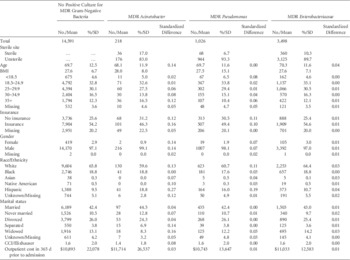
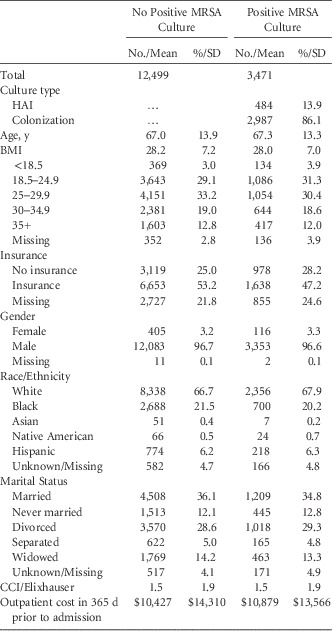
Table 1 shows the characteristics of the gram-negative analysis cohort, which included 14,591 control patients, 218 patients with an MDR Acinetobacter HAI, 1,026 patients with an MDR Pseudomonas HAI, and 3,498 patients with an MDR Enterobacteriaceae HAI. The average age in these groups ranged from 68.1 to 70.3 years. Most of the patients in each group were male (97.0% to 99.1%), and the most frequent races were white (59.6% to 65.8%) and black (17.6% to 18.8%). The patient characteristics of the 12,499 patients without a positive culture and the 3,471 patients with a positive culture included in the MRSA analysis are shown in Table 2. Average age (67.0 vs 67.3), percent male (96.7% vs 96.6%), and race (66.7% vs 67.9% white, 21.5% to 20.2% black) were similar between the 2 groups.
Characteristics of Patients With Positive Cultures for Gram-Negative Bacteria and Propensity Score-Matched Controls

Note. MDR, multidrug resistant; SD, standard deviation; BMI, body mass index; CCI, Charlsom comorbidity index.
Characteristics of Patients With Positive Cultures for Methicillin-Resistant Staphylococcus Aureus and Propensity Score-Matched Controls

note. MRSA, methicillin-resistant Staphylococcus aureus; SD, standard deviation; BMI, body mass index; CCI, Charlson comorbidity index.
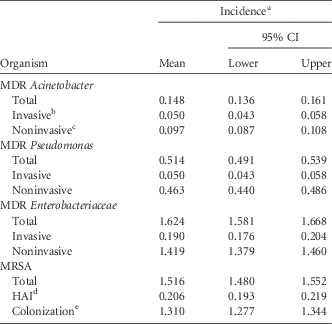
As shown in Table 3, of the pathogens examined, the incidence was highest for positive cultures of MDR Enterobacteriaceae (1.624 per 1,000 patient days at risk; 95% CI: 1.581–1.668) and MRSA (1.516 per 1,000 patient days at risk; 95% CI, 1.480–1.248).
Incidence of Positive Clinical Cultures by Organism

note: CI, confidence interval; MDR, multidrug resistant; MRSA, methicillin-resistant Staphylococcus aureus; HAI, healthcare-associated infection.
a Per 1,000 patient days at risk
b Culture obtained from a typically sterile site including blood, bone, bone marrow, cerebrospinal fluid, pleural fluid, peritoneal fluid, synovial fluid, lymph node.
c Culture obtained from a site other than those listed for invasive cultures.
d Using algorithm developed by Branch-Elliman et al (Reference Branch-Elliman, Strymish and Gupta2014), culture obtained from sterile site (blood, bone, or device) or patient was treated with MRSA-active antimicrobials in the 5 days prior to or following the positive culture.
e Positive culture not classified as HAI by Branch-Elliman algorithm.
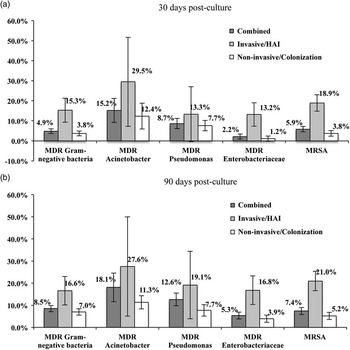
Figure 1 shows the attributable mortality rate for both the 30- and 90-day time windows regardless of location (ie, either in hospital or postdischarge). For the 30-day time window, patients with a positive culture for a gram-negative bacteria from a sterile site had a 4.9% (95% CI, 3.7%–6.1%) risk of mortality within 30 days, while those with an MRSA HAI had a 5.9% (95% CI, 4.5%–7.2%) risk of mortality during this time period, respectively. In general, the magnitude of risk for mortality from positive cultures from sterile sites was substantially greater than those from unsterile sites. In addition, among the gram-negative bacteria, MDR Acinetobacter was associated with the largest risk of death. These trends held true for both the 30- and 90-day time windows.
Risk differences for attributable mortality 30 and 90 days post-culture for patients with a positive culture relative to patients without a positive culture Abbreviations: MDR=multi-drug resistant, RR=risk ratio, CI=confidence interval, HAI=healthcare-associated infection, MRSA=methicillin-resistant Staphylococcus aureus. Definitions: Gram-negative Invasive=culture obtained from a typically sterile site including blood, bone, bone marrow, cerebrospinal fluid, pleural fluid, peritoneal fluid, synovial fluid, lymph node, Gram-negative Non-invasive=culture obtained from a site other than those listed for invasive, MRSA HAI=using algorithm developed by Branch-Elliman et al (2014), culture obtained from sterile site, (blood, bone, or device) or patient was treated with MRSA-active antimicrobials in the 5 days prior to or following the positive culture, MRSA colonization=positive culture not classified as HAI by Branch-Elliman algorithm

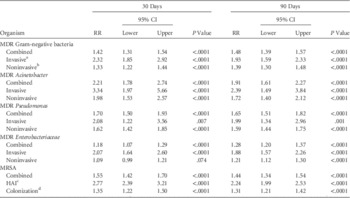
The RRs for mortality are shown in Table 4 for both the 30- and 90-day time windows. For the 30-day time window, the RR was 2.32 (95% CI, 1.85–2.92) for patients with an invasive positive culture for a gram-negative bacterium, while this RR was 1.33 (95% CI, 1.22–1.44) for those with noninvasive positive cultures. For the specific antibiotic-resistant bacteria, patients with MDR Acinetobacter had the highest risk of death (3.34; 95% CI, 1.97–5.66), while the estimate was similar for patients with MDR Pseudomonas aeruginosa (2.08; 95% CI, 1.22–3.56) and MDR Enterobacteriaceae (2.07; 95% CI, 1.64–2.60) invasive positive cultures. The RRs for death for patients with noninvasive positive cultures were significant for all but MDR Enterobacteriaceae, but they were smaller in magnitude than those for invasive positive cultures. The RR was 2.77 (95% CI, 2.39–3.21) for positive MRSA cultures classified as infections and 1.35 (95% CI, 1.22–1.50) for positive MRSA cultures classified as colonizations by the electronic algorithm. The results were similar for the 90-day time window.
Risk Ratios for Mortality 30 and 90 Days After Culture for Patients With Positive Cultures Relative to Patients Without Positive Cultures, Regardless of Location Status (Hospitalized or Postdischarge)

NOTE. MDR, multidrug resistant; RR, risk ratio; CI, confidence interval; HAI, healthcare-associated infection; MRSA, methicillin-resistant Staphylococcus aureus.
a Culture obtained from a typically sterile site including blood, bone, bone marrow, cerebrospinal fluid, pleural fluid, peritoneal fluid, synovial fluid, lymph node.
b Culture obtained from a site other than those listed for invasive cultures.
c Using algorithm developed by Branch-Elliman et al (Reference Branch-Elliman, Strymish and Gupta2014), culture obtained from sterile site (blood, bone, or device) or patient was treated with MRSA-active antimicrobials in the 5 days prior to or following the positive culture.
d Positive culture not classified as HAI by Branch-Elliman algorithm.
Supplemental Tables 2 and 3 show similar results for in-hospital mortality at 30 days, 90 days, and any time. For the most part, the effect estimates were smaller when the mortality time window extended beyond discharge.
DISCUSSION
Using a propensity-score matching method, we found that a positive culture for MDR bacteria significantly elevated the 30- and 90-day risk of mortality. This was true for both invasive cultures, which are likely to be true infections, and noninvasive cultures, which may represent infection or colonization. The increased mortality effect was significant and substantial across all antibiotic-resistant pathogens studied, with a slightly greater effect among patients with invasive cultures than those with noninvasive cultures. Comparing differences in mortality in this study population, we estimate that 4.9% of patients with an MDR gram-negative and 5.9% of patients with a MRSA infection die within 30 days as a consequence of the organism being antibiotic resistant. This attributable mortality increases slightly, to 8.5% and 7.4%, respectively, when patients are followed for 90 days.
These results are important because they underscore the mortality burden attributable to antimicrobial-resistant infections and because they provide a baseline that can be used to assess the impact of improvements in infection control, such as methods to improve hand hygiene adherence, improved surveillance and patient isolation techniques, or antimicrobial stewardship programs. Evaluations of the effectiveness of these interventions should include economic evaluations of both the costs of the resources required to undertake the interventions and the benefits of prevented mortality and morbidity.
The measures of attributable mortality that we found improve upon estimates reported elsewhere in the published literature. For example, we recently published a study that used a simulation model parameterized using published data to estimate the mortality and cost burden of healthcare-associated MDR Acinetobacter infections. Using estimates from several published studies, we estimated an attributable mortality risk of 10.6 (95% CI, 2.5%–29.4%).Reference Ababneh, Harpe, Oinonen and Polk 20 – Reference Reddy, Chopra and Marchaim 22 In addition, a study by Eagye et alReference Eagye, Kuti and Nicolau 19 found that the attributable risk of death in patients with healthcare-associated MDR Pseudomonas infections was 22.2%. However, the data used to generate each of these mortality estimates came from single facilities, and in each case, the analyses did not control for confounders in the relationship between infection and mortality. Our estimates for combined invasive and noninvasive positive cultures were lower than these previous estimates in part because we were able to control for confounders including not only post-hospitalization but also preindex events that can increase the risk of HAI and mortality such as surgery, number of days in the ICU, mechanical ventilation, peritoneal dialysis, and hemodialysis. In addition, our detailed microbiology data allowed us to differentiate between invasive and noninvasive positive cultures.
A study by Roberts et alReference Roberts, Hota and Ahmad 23 reported an attributable mortality rate of 6.5% using data from a single hospital in Chicago. This estimate was calculated by pooling patients with resistant infections due to a number of different organisms (including Staphylococcus aureus, Enterobacter, Pseudomonas, Klebsiella, or Acinetobacter) and the statistical analyses controlled for a number of important confounders including the Acute Physiology and Chronic Health Evaluation (APACHE) III score as calculated during the first 24 hours of hospitalization. Our study improves upon this estimate in several important ways. First, because our data came from more than 100 hospitals throughout the United States, we had a sufficient sample size to calculate organism-specific mortality estimates. Second, our data allowed us to follow patients postdischarge. And finally, although we were unable to calculate physiology-based severity of illness scores (eg, APACHE), we included a number of important additional covariates in our model along with an estimate of the comorbidity burden (the Charlson and Elixhauser hybrid index).
It is well-known that a substantial proportion of US veterans who receive care through the VA system also receive care through other healthcare systems.Reference Borowsky and Cowper 24 – Reference Liu, Bolkan, Chan, Yano, Rubenstein and Chaney 26 A recent paper demonstrated that surgical patients who were readmitted to a different hospital than the one at which their surgery was performed were at higher risk for mortality compared to those who were readmitted to the same hospital.Reference Brooke, Goodney, Kraiss, Gottlieb, Samore and Finlayson 27 Given that many of the patients in our analysis had outside insurance, future research should examine the impact of care coordination between different healthcare systems on mortality risks among those with infections due to MDR gram-negative bacteria or MRSA.
This study has several limitations to. First, our exposure of interest was a positive clinical culture for 1 of several MDR organisms. While these cultures may not all be indicative of true infections, we identified whether the cultures were obtained from a site that is usually considered sterile (eg, blood, bone, bone marrow, cerebrospinal fluid, pleural fluid, synovial fluid, and lymph node) or unsterile. Positive cultures from sterile sites are much more likely to be infections. Second, our analyses used administrative and clinical data from the VA. These data were not produced for the purposes of research but in the process of providing care to patients in the VA system. Thus, these results may not be generalizable to other settings to the extent that differences exist between patients and healthcare delivery systems. Also, our analyses may include residual confounding related to severity of illness during the index hospitalization, which we were unable to control for using administrative data. Third, for the purposes of this analysis, we focused solely on a patient’s first hospitalization during our time period of interest. And finally, patients receiving care in the VA system may not be representative of healthcare overall in the United States. A similar analysis using non-VA data would be useful and may yield more generalizable results.
Our study has several strengths. First, this is the largest study to estimate the attributable mortality associated with HAIs due to MDR gram-negative bacteria with patients from more than 100 hospitals in the United States. Second, we used a propensity-score matching approach to select control patients in which we matched patients based on the length of stay prior to infection. Thus, we avoided introducing time-dependent bias to our estimates that would have occurred in an analysis and did not explicitly take into account the time-varying nature of HAIs.Reference Suissa 28 By incorporating important postadmission confounders (eg, indicators for surgery, mechanical ventilation, peritoneal dialysis, and hemodialysis, and days spent in both the medical and surgical ICU) in our propensity score estimation, our mortality estimates are likely to more accurately represent the true mortality effect. Third, unlike other data sources, the VA dataset allowed us to follow patients beyond discharge to ascertain whether they died within 30 or 90 days of the index date regardless of patient locations; thereby, we avoided informative censoring. Estimates from analyses that are restricted to the in-hospital period may be biased due to the competing risk of discharge because patients with an HAI are less likely to be discharged and because patients are also at risk of death after leaving the hospital.
In conclusion, using clinical and administrative data from the VA, we identified a significant and substantial increase in mortality attributable to HAIs due to 4 different antibiotic-resistant organisms of 4.9% for MDR gram-negative bacteria and 5.9% for MRSA. Important future work will include evaluating interventions to prevent resistant HAIs to determine their effect on mortality.
ACKNOWLEDGMENTS
The views expressed in this article are those of the authors and do not necessarily reflect the position or policy of the Department of Veterans Affairs or the United States government.
Financial support: This study was conducted through a contract with the Centers for Disease Control and Prevention and was supported by the Department of Veterans Affairs, Veterans Health Administration, Office of Research and Development, Health Services Research and Development Service (grant nos. CDA 11-210 and I50HX001240). This report is the result, in part, of work supported with resources and the use of facilities of the George E. Wahlen Department of Veterans Affairs Medical Center, Salt Lake City, Utah.
Potential conflicts of interest: All authors report no conflicts of interest relevant to this article.
SUPPLEMENTARY MATERIAL
To view supplementary material for this article, please visit https:/doi.org/10.1017/ice.2017.83