This article explores the local context of the prominence of Sufism and sanctity in the late medieval period (1250–1500) through an examination of the diffusion of the Qādirī spiritual path in the spatial frame of Palestine. The geographical spread of the major spiritual paths (ṭarīqas) and the emergence of their shaykhs as charismatic figures in the course of the late medieval period has received considerable attention by historians of Sufism.Footnote 1 Although the study of the social historical dimensions of the universal evolution and its nuances and variations is in order, patiently asked questions remain open regarding the establishment of the ṭarīqas into locally embedded associations around charismatic shaykhs in particular historical and geographical settings, as well as the role local leaders of the ṭarīqas played in shaping a communities' life and space.
One of the earliest spiritual paths, as well as the most significant ṭarīqas for the development of institutional Sufism, the Qādiriyya extended its reach to Syria-Palestine (Bilād al-Shām), and its various local groups became active in Palestinian cities from the late Mamluk period, fourteenth-fifteenth centuries, onwards.Footnote 2 While tied vertically to a chain of spiritual authority (silsila), and horizontally to cosmopolitan networks that cut across geographical and political boundaries, the local Sufi shaykh diffused his spiritual method among his fellow believers and played a prominent role in the evolution of devotional Sufism as a focus of local communal life. Authors of sacred biographies, while creating a reservoir of universally idealised saintly figures, portrayed the life and activities of the Sufi “friend of God”, the walī Allāh, within his community, thereby further reasserting his local ties. The examination of this process of localisation of centres on three intertwined aspects: the establishment and growth of the local branch of Qādirī ṭarīqa around the shaykh, the physical setting of the Qādirī shaykh and his local community of followers, and the local spaces that emerged around the venerated shaykh and commemorated his memory.
In studying the biographies of the shaykhs, leaders of the ṭarīqa in fourteenth to fifteenth-century Palestine, I look beyond the introductory formula that places the Sufi ‘friend of God’ within a normative cultural model, and analyse the narratives that embed him in the local community of believers and render his elevated figure concrete. In examining the sites and spaces that emerged around the shaykhs of the ṭarīqa and their transformation into a focus of communal life, I use the rich complementary non-narrative source materials available to the historian of Sufism. These include endowment-deeds establishing the physical place of the shaykh of the ṭarīqa, inscriptions affixed to Sufi lodges and saintly tombs, and physical remnants. Drawing on these source-materials, this article seeks to advance an understanding of the local manifestations of the expansion of Sufism in medieval Islam and offers additional perspective on the ‘missing links’ of the social historical dimensions of Sufism between the formative and modern period.
The Shaykh and the Locally Embedded Ṭ arīqa
The patterns of the establishment of the so-called collective of the ṭarīqa were not, of course, monolithic at any point in time or place or even in regard to individual leaders and their followings. Similarly, spiritual routes did not simply branch out as chains of authority and as practices and rituals. Nor were the modes and frameworks of operation applied by the shaykh of the ṭarīqa simply replicated.Footnote 3 Rather, as I attempt to show, the shaykh of the ṭarīqa must have functioned within the local community, accommodating himself to, and profiting from its specific social and political order. Furthermore, he must have operated in ways that made his followers perceive him to be ‘their shaykh’, suited to meet their beliefs, concerns and expectations.
Greater Syria, it should be noted, did not constitute the cradle of the major ṭarīqas that evolved in the course of the late medieval period. The overwhelming majority of the ṭarīqas which appeared on its soil during this period were branches of mystical paths and spiritual chains that originated in other parts of the Muslim world. Having its origins in Iraq, the Qādiriyya was one of the most prominent among them. Its appearance in the Syrian region is often ascribed to the great thirteenth-century Ḥanbalī families of Ibn Qudāma and Yunīnī.Footnote 4 But it was only in the subsequent two centuries due to the activities of lineage-descendants of the alleged founder ‘Abd al-Qādir al-Jīlānī that branches of the ṭarīqa spread extensively and rapidly in the entire Syrian region and were locally established independently of each other. Two prominent shaykhs, claiming descent to this affiliation, are credited with playing a major role in the establishment of the Qādiriyya in the urban centres of the region during this period: Sharf al-Dīn Yaḥyā (d. 734/1333), grandson of ‘Abd al-Razzāq (the noteworthy son of al-Jīlānī), in Hama, and al-Shihāb al-Dīn Aḥmad, known as Ibn Arslān (d. 844/1440), in Palestine.
Though the introduction of the Qādiriyya into Greater Syria was closely linked with the rise of the Ḥanbalī madhhab in cities such as Damascus and Aleppo and their environs, the great shaykhs of the latter phase of its expansion affiliated with the Shāfi‘ī school of law – the dominant Sunni rite in this part of the Muslim world at that time. Affiliation with the firmly established Shāfi‘ī school in the domains of legal scholarship and intellectual life and, even more importantly, integration into the scholarly circles and state-supported institutions of the madhhab, no doubt provided the Qādirī shaykhs with an additionally meaningful resource of authority which facilitated their social ascent. However, whereas the Qādirī shaykhs of Hama emerged as members of a powerful family-based ṭarīqa,Footnote 5 the leading contemporary shaykhs of the ṭarīqa in Palestine did not base their charismatic authority and prestigious social status on familial affiliation, nor did they transmit their spiritual knowledge within family circles or pass on their positions and wealth from father to son.
Aḥmad b. Arslān, the first reputable local representative of the Qādirī ṭarīqa in Palestine of the late medieval period was born in Ramla but later moved to Jerusalem. An astute Sufi and Shafi‘ī legal scholar (faqih), who claimed to be a descendant of no lesser personage than al-Jīlānī, he is credited with making Jerusalem into another “great hearth of the Qādiriyya in Bilād al-Shām”. His disciple and successor as leader of the Palestinian Qādiriyya, Shams al-Dīn Muḥammad Abū l-‘Awn al-Jaljūlī (d. 910/1504), was born in Ghaza, settled first in Jaljuliyya and finally moved to Ramla, where he lived to the end of his days. So great was his renown, he was proclaimed to be “the Qādirī of his epoch”. Apparently, however, the fame of later Qādirī shaykhs in Jerusalem and Ramla, though they bore the appellation shaykh al-shuyūkh al-qādiriyya, does not seem to have extended beyond the limits of these cities. Thus, the Palestinian branch of the Qādiriyya remained a local association centred on its shaykh, his lodge (zāwiya) and his tomb. The term ṭarīqa, when it appears in the biographies of its leading shaykhs, normally denotes a method of spiritual guidance practiced by the particular shaykh, rather than designating an institutionalised Sufi order or even a well-established spiritual route in terms of doctrine, rules and rituals. Similarly, the sets of people called “people of the way” (ahl al-ṭarīqa, or ahl al-ṭarīq) were those who gathered around the charismatic shaykh, rather than members of the ṭarīqa as a social organisation.
Mujīr al-Dīn's history of Jerusalem and Hebron and the comprehensive biographical dictionaries by al-Sakhāwī and al-Ghazzī are the main literary sources for the study of the lives and activities of the two great Qādirī shaykhs of late medieval Palestine.Footnote 6 The biographies these authors composed provide accounts about the shaykhs' resources of authority, the example they set, their local following and the sites and spaces that grew up around the transmission of their knowledge and guidance and the bestowal of their divine grace. When piecing together the personalities of the Qādirī shaykhs through their biographies, one must first acknowledge the rich variety of terms and expressions used by the authors to designate them. Thus Ibn Arslān bears the appellations quṭb al-rabbānī (God's spiritual pole), al-‘ālim al-‘ārif bi-Allāh (one who possesses both religious and intuitive knowledge of God), al-imām (the religious leader), amīn al-dīn (the upright), and ṣāḥib al-karāmāt al-ẓāhira (the worker of visible and outstanding deeds).Footnote 7 The biographer of Abū l-‘Awn al-Jaljūlī uses similar adjectives to describe him; even designates him as the unique ‘help’, that is the highest spiritual guide of the faithful (al-ghauth al-faradānī).Footnote 8 In what follows, biographers laud the asceticism and piety of the shaykhs, as well as their legal scholarship and outstanding traits and deeds (manāqib, karāmāt). Taken together, the descriptions of the Qādirī shaykhs yield multifaceted figures, bringing together a variety of ‘high’ and ‘popular’ traditions and acting in various dimensions.
Ibn Arslān's piety and keen interest in religious learning was apparent already as a youth; he knew the Quran by heart when he was ten years old. His father, a merchant and an expert in Quranic recital himself, sent him off to a shop owned by a local cloth merchant to serve an apprenticeship. However, the young Ibn Arslān was so much engaged in reading and studying, that he neglected the shop's affairs, and when the cloth merchant blamed him for loss in revenues, he excused himself by saying he was not good for anything except for studying. Thereupon, Ibn Arslān set out on his own, dedicating himself to the acquisition of profound knowledge in religious matters. He studied first Arabic literature and grammar, and proceeded with the study of the law of distributive shares and calculation. As he gained esteem for his firm grasp of Shafi‘ī jurisprudence, he assumed the professorship in the Shafi‘ī madrasa of al-Khāṣakiyya – a position which, as we shall see, he relinquished later. Next he moved to Jerusalem, where he combined legalism and mysticism in his own study and scholarly pursuits and in his teaching and training of others. The most notable masters of the law and the secrets of Sufism were the Qādirī-Shafi‘ī shaykhs Muḥammad al-Quramī, who moved from Damascus to Jerusalem and died in the city (in 788/1389), and Abū Bakr al-Nawṣilī of Mosul (d. 797/1394), the founder of the Mawṣiliya branch of the Qādiriyya, who lived in Jerusalem for several years. While in Jerusalem, they adorned Ibn Arslān with their cloaks (khirqas), as an indicator of his authoritative incorporation into the spiritual lineage (silsila) of the ṭarīqa, and trained him in the ritual practice of the dhikr. It was also al-Quramī who transmitted to his close disciple al-Bukhārī's canonical compilation of prophetic traditions that he himself had heard from trustworthy ḥadīth transmitters in Damascus, thereby tying him to this chain as well. In addition, Ibn Arslān studied the other five canonical ḥadīth compilations, as well as al-Shafi‘ī's compilation of sound prophetic traditions, under several religious scholars of Jerusalem. Thus, he accumulated vast knowledge and excelled in the study of all of the Islamic sciences, until he gained recognition as an authoritative religious leader (imām).
A prolific author, Ibn Arslān composed many treatises on Quranic exegesis, ḥadīth commentaries, Arabic literature and grammar, and on Islamic law, above all, his treatise on jurisprudence (fiqh), Matn al-zubad.Footnote 9 His ascetic and pious practices made him a model of virtue. “He never touched the deemed unlawful food and drink (ḥaram), never cursed or abused anyone or harboured feelings of hatred against anyone, and treated with gentleness anyone who tried to dispute with him”.Footnote 10
Al-Ghazzī, author of al-Kawākib al-sā'ira, a biographical compilation with a strong emphasis on the manifestations of sanctity and the spiritual virtues of the biographees (composed in the seventeenth-century),Footnote 11 is more concerned with Abū l-‘Awn al-Jaljūlī's resources of authority as a charismatic figure, a channel to God, than with his resources of authority as a Shafi‘ī legal scholar. People related to his splendorous appearance as a walī, which revealed itself in his numerous wondrous deeds (he performed 50 karāmāt daily). He had many sound mystical revelations (kashf), and attained elevated mystical states (aḥwāl) and spiritual perfection, until he became the highest spiritual guide of the faithful.Footnote 12
It was due to the various elements of their persona, their resources of authority, and their actual venues – a combination so characteristic of the great Sufi shaykhs of their epoch – that the Qādirī shaykhs assumed charismatic leadership over the local branch the ṭarīqa and attracted a local following beyond the small circle of wayfarers and disciples. To define them as shar‘ī - mystics or ‘orthodox’ - Sufis would be simply to play down another most important element of their persona, that of a spiritual and charismatic authority, the focus of veneration of disciples and followers who orbited round them. Scrupulous observance of the Islamic religious law and adoption of the legalist approach of incessant concern with the regularisation and shaping of communal and social life must have helped establish their increasingly intensifying position and fame. More important, however, were the embodiment of their spiritual and ethical virtues (manāqib) within society, and the manipulation of their divine grace (baraka) in ways that benefited their fellow believers.
The renowned Ibn Arslān is a good example of a Sufi shaykh of well-established spiritual and charismatic authority. Believers from various Muslim countries set out on journeys to visit him and the number of disciples and novices devoted to him grew constantly wherever he went. He educated a number of disciples (jamā‘a), and advanced each aspirant on the Path in accordance with his spiritual state regardless of his inherited virtues (wa-shaghala kullān fīmā yarā ḥālahu yalīqu bihi fī al-najāba wa-‘adamihā). He then dressed a group of disciples from al-Shām and Egypt in his khirqa, and bestowed his baraka upon them.Footnote 13 His transmission of knowledge, as with other awliyā', extended to include many besides aspirants and novices. One anecdote, in particular, illustrates this point. It tells of a disciple of Ibn Arslān who appealed for his help against acts of injustice (maẓālim) inflicted by the district chief (kāshif) of Ramla. The governor refused to deal with the case unless Ibn Arslān's supernatural forces were manifested in the palm trees standing in front of him. At that moment, the trees were uprooted by a sudden storm. Accompanied by his entourage, the governor then turned to Ibn Arslān in repentance. Attributing the miraculous deed to God alone, Ibn Arslān demanded that they should turn to Him and renew their religious belief.Footnote 14
The virtuous and charismatic benefactor is further exemplified in Abū l-‘Awn al-Jaljūlī. It was related that God made him visible in the “dark tenth century”, and that his splendorous appearance as a walī was due to his many sound mystical revelations (kashf) as well as to his training (tarbiyya) of the Sufis (fuqarā') and his benefiting the people in general (al-nās). He bestowed gracious benefits upon those seeking to be near to him and was hospitable toward all fellow believers who approached him to receive his blessing and intercession (shafā‘a) on their behalf. People flocked to his doorstep with gifts to make oaths and receive his blessing. He was the intercessor of the oppressed before kings and the princes, and he dispensed as charity all the gifts he received from royalty, never taking, or even wishing to take, anything for himself.Footnote 15
Abū l-‘Awn al-Jaljūlī, who had among his following several distinguished religious scholars (‘ulamā’) alongside people from the very fringes of society, even law-breakers, took under his protection Qāsim b. Zanlal, a soldier and one of the “valiant and ill-tempered people”. He killed a Mamluk officer, who was in the service of the governor of Aleppo, to rescue a woman the officer was about to violate. Fleeing along the coast, Qāsim arrived in Jaljuliyya and sought the shaykh's help. The shaykh invoked God in his favour. He rebuked Qāsim for the killing (which his special powers gave him knowledge of) but interceded for him with the authorities and saved him from punishment: “Allāh shielded him from the persecutors through the baraka of the shaykh”. Qāsim's encounter with the shaykh led to his repentance and transformation: thereafter he refrained from the ways of the villainous and ill-tempered. The shaykh assigned to him the job of water-carrier, and Qāsim persisted in the work and in adhering to the prescribed behaviour (ṭaur) of the Sufis (fuqarā') until he became a renowned figure.Footnote 16
These stories afford a glimpse of the dynamic of growth of the Sufi walī's following and the diverse circles that gathered around him. The more his extraordinary virtues were publicly manifested, the more his fellow believers turned to him; the more he met their spiritual and non-religious needs by using his divine powers, the greater became his following and authority as a charismatic guide. A select few disciples and colleagues sought his spiritual advice in the hope of achieving an elevated mystical state. A much more numerous following turned to him for instruction in the essentials of their religion, for guidelines in correct Islamic behaviour and for a word of blessing. Shared by all local believers, veneration of the Sufi ‘friend of God’ cut across social boundaries and blurred the distinctions between the so-called ‘popular’ and ‘elitist’ varieties of religion. In view of the shaykh's growing following locally, members of the city's ruling and religious institutions joined in, fitting themselves into the existing practices enacted by others. Participation of a Mamluk governor in the spiritual life of the local community did not of course transform him into a native member of that society, but it did provide him with an entry into the public sphere. At the same time, worship of the Sufi walī, by being open to the active participation of the political authorities, rendered the barriers between the official and public spheres at least bridgeable or possibly it obliterated them.Footnote 17
The available sources use the expression ahl al-ṭarīqa, or ahl al-ṭarīq, to designate the set of people attached to a certain Sufi walī of well-established spiritual authority. Their accounts suggest the existence of at least two circles around him. One, a small inner group, which consisted of his committed disciples (the aṣḥāb or murīdūn or talāmīdh); the other is a wider circle of occasional visitors to his lodge or tomb who came to seek his blessing or simply to be close to him. For all its diffusive affiliations and informal, fluid social networks, the ahl al-ṭarīqa, during the late medieval period, developed into the prime association, religiously based and led, within the public sphere of Islamic societies.
Disciples and intimates expressed their admiration and gratitude to the walī by clinging to him wherever he settled or travelled, by relating and recording stories about his life and miraculous deeds, and by erecting a tomb over his grave. Commoners provided the walī with the food necessary for his subsistence, while local governors established charitable endowments for the construction of his lodge and tomb, others set up the revenues of a village as waqf for his benefit. While experiencing their encounters with the Sufi saint in a variety of ways, local believers of all social classes shared the belief in his ability to manipulate divine forces which shaped his perception as a charismatic figure. Whether seeking spiritual guidance or blessing, or to take part in the growing practices surrounding local holy men, they all flocked around whoever they believed to be their ‘channels to God’, frequenting their lodges and tombs.Footnote 18
One anecdote, in particular, conveys the notion of the inclusiveness and flexibility of the locally embedded ṭarīqa that orbited round the shaykh. It tells that when a certain faqih paid a visit to al-Jaljūlī in his lodge (zāwiya) in Ramla, he found among his group (jamā‘a) “the poor and the affluent, the righteous and the corrupt (literally, unruly) alike”.Footnote 19 The faqih considered the presence of the latter inappropriate since, in his view, only the righteous deserved to be included in a shaykh's companionship (ṣuḥbat al-shaykh). Reading the faqih's thought, the shaykh referred to the model of the revered ‘Abd al-Qādir al-Jilānī, whose jamā‘a always included both the righteous and evildoers: the first became more zealous, while in the case of the evildoers, “God turned them from their sins through companionship with him (ṣuḥbatihi)”.Footnote 20
The Physical Setting
The intense establishment of pious institutions – mosques, madrasas, and Sufi lodges variously called khānqāhs or ribāṭs or zāwiyas – during the Mamluk reign and under their patronage has attracted much interest in scholarship about the Mamluks, yielding a considerable data of their nature and functions as revealed in legal documents and physical remnants.Footnote 21 However, the study of the religious and social context of the construction and growth of pious establishments is in order. This is particularly relevant with regard to Sufi and other pious institutions in Mamluk Palestine. Several historians have meticulously employed a wealth of information derived from the study of buildings and documents, mainly legal documents of various types discovered on the Ḥaram (in 1974 and 1976), in order to reconstruct the names, locations, benefactors, beneficiaries and stipulations of pious institutions. The study, written mainly in Arabic and Hebrew, is still scattered,Footnote 22 and there is scope for further research of the distinctive characteristics of Sufi establishments and their significance in the overall institutionalisation and expansion of Sufism in the specific setting. The foundation of Sufi lodges of various types, I argue, must be seen as the institutional dimension of the broader process through which Sufi shaykhs integrated Sufism into the fabric of social and communal life and made a prominent role in consolidating an Islamic society and space.
The piety and traditional generosity with which the Mamluks behaved toward the institutions of Sunni Islam across their domains is well known. Like the Ayyubids before them, Mamluk Sultans and officials displayed their support of the “righteous Sufis” – members of the mainstream Sunni camp – through the foundation of establishments of various types, where they could lodge or sojourn and conduct their rituals. In addition to the elaborate khānqāhs that were lavishly endowed for the benefit of groups of local and foreign Sufis and zāwiyas for particular shaykhs, the rulers and other wealthy individuals built hostels (ribāṭs) and soup kitchens in Jerusalem for devout poor people – Sufis and non-Sufi fuqarā' alike – to supply their basic needs. Extracts from the endowment charters of the lodges founded in Jerusalem and Hebron, as recorded by Mujīr al-Dīn, contain valuable information about their founding, their building, their administration, and the functions that they were expected to perform.Footnote 23 Such was their construction in Jerusalem, that by the end of the Mamluk period Sufi establishments had become an integral part of the urban landscape dotted with pious establishments of various types.
While it was around a particular Sufi shaykh rather than around institutional frameworks or physical settings that the locally embedded ṭarīqa consolidated and extended its social horizons, the intensive construction of endowed establishments designed for the Sufis and their rituals played a significant role in this process. Similarly, while the Sufi-inspired community developed out of internal dynamics, independent of the official sphere, by patronising and sponsoring Sufi lodges, the ruling elite helped structure the Sufi experience and extend its horizons.
Revealed already in the Ṣalāḥiyya Shāfi‘ī madrasa and khānqāh founded by Saladin in Jerusalem about two years after its liberation from the Christian ‘yoke’,Footnote 24 the institutional rapprochement between legalists and mystics reached its peak in the cities ruled by the Mamluks. Not only did Shafi‘ī-Sufis of the Mamluk period continue to hold the position of a mudarris (teacher of the legal and Islamic sciences) in a madrasa and that of shaykh al-ṣūfiyya in the Sufi establishment of the khānqāh, it also became common for madrasas to house Sufis and their rituals, and for the endowment of Sufi establishments, especially the magnificent khānqāhs, to make provisions for the support of lessons in jurisprudence according to one or more of the madhhabs. The fusion of educational and devotional activities in the royal institutions founded in Jerusalem and other great cities ruled by the Mamluks was so complete that by the end of the Mamluk period it became increasingly difficult to distinguish the institutions that supported the activities of the jurists as opposed to the mystics. Similarly, the terms madrasa and khānqāh (and, at times, “mosque”) often appear interchangeably.Footnote 25
Notwithstanding the growing combination of legalist and mystical learning, several Sufi shaykhs – the most legally erudite included – seem still to have oscillated between the two streams, seeking an alternative to religious attainment and devotion in the Sufi Way. Viewing the madrasa as the representative of formal knowledge, book learning and worldliness, they would refrain from teaching or studying in the institution, or would resign their paid teaching positions at a certain phase of their lives. One of the most famous examples in the context studied here is that of Ibn Arslān. Having relinquished the position of mudarris of al-Madrasa al-Khāṣakiyya, he settled in the residence chamber of the Ḥanthaniyya zāwiya, which stood behind the minbar of al-Aqṣā mosque, and there he lived to his last day devoting himself to advancing on the stages of the Path, training others to approach God more directly and intimately at the same time.Footnote 26
By this time, zāwiyas proliferated both in al-Ḥaram al-Sharīf of Jerusalem and outside its walls, as well as in other Palestinian cities. Several of these Sufi lodges were associated with the local Qādiriyya, most famously the zāwiya of Muḥammad al-Quramī, master of Ibn Arslān, in Harat Marzubān west of the Ḥaram,Footnote 27 and that mentioned above of his own disciple, Abū l-‘Awn al-Jaljūlī, in Ramla. Accounts about these zāwiyas are indicative of trends in their development as physical settings. In particular, they point at the characteristics of the zāwiya distinct from those of the khānqāh, and the significance of this Sufi establishment in the world of the shaykh and his local following.
The foundation of the great khānqāhs is a clear indication of the process by which Sufism moved from the margins of intellectual and social life to become part of the social order and the fabric of Muslim devotion. These magnificent buildings are physical evidence of the growing recognition of Sufis as members of a mainstream Sunni camp alongside religious scholars of the established legal schools. However, the formal institutional structure of the khānqāh could hardly contain the activities and energy of the growing numbers of medieval Muslim men and women who identified themselves in some way as Sufis. No less important, it seems, was the wish of Sufis pursuing an ascetic way of life to avoid the patronage of the ruling elite and distance themselves from an establishment founded by the powerful and closely associated with the official sphere. Unsurprisingly, it was around the much more modest and less institutionalised Sufi establishment of the zāwiya that shaykhs and their groupings gathered.
Zāwiyas, originally signifying particular corners of or spaces in large mosques, in late medieval Jerusalem and Hebron developed into independent buildings serving as a residence for their shaykh and as a forum for the transmission of his guidance and knowledge. Moreover, unlike the royal institutions of the madrasa and the khānqāh, the zāwiya was always built for a particular Sufi shaykh, leader of a particular ṭarīqa, and his successors thereafter with funds provided either by the shaykh himself or by the rulers or other notables.Footnote 28 The description of the foundation of al-Ḥanthaniyya, residence of Ibn Arslān and the centre of his activities, demonstrates the individual pattern for establishing and endowing the zāwiya that became increasingly apparent in his lifetime. It is noteworthy that the Ḥanthaniyya, originally a prayer chamber, is the first Sufi establishment in Ayyubid Jerusalem specifically and consistently called a zāwiya, as Mujīr al-Dīn relates:
As for the madrasas and zāwiyas [in and] around the mosque [of al-Aqṣā]: the earliest is al-Zāwiya al-Ḥanthaniyya, inside the mosque behind the minabr. Al-Malik Ṣalāḥ al-Dīn, may God protect him with His grace, bequeathed it as waqf for one of the people of virtue. This is the honourable, ascetic and pious man, Shaykh Muḥammad b. Aḥmad b. Muḥammad Jalāl al-Dīn al-Shāshī, an inhabitant of Bayt al-Muqqadas, and, after him, for whoever would follow him. A group of the distinguished shaykhs has presided over it ever since.Footnote 29
Leonor Fernandes was the first to observe the development of a new type of zāwiya in Mamluk Egypt during the fifteenth century. Along with the traditional zāwiyas that persisted in Egypt throughout the Mamluk period as residences for Sufi shaykhs and as centres for their disciples and other followers of their ṭarīqas, other zāwiyas took on the character of ribāṭs and mosques in which Sufis and non-Sufis alike could conduct their communal devotional life. As mosques, they provided facilities for prayer and sermons; as ribāṭs, they provided food and shelter for the poor.Footnote 30 This observation may be well applicable to the development of the zāwiya in Palestine. One example concerns Ibn Arslān. In addition to the zāwiya that he had in Jerusalem, he restored an ancient mosque in Ramla that served as a type of zāwiya, being a sojourn place for whoever sought his guidance. He provided for those forsaking their material possessions and social connections to join him (inqaṭā‘a ilayhi) generously, and imparted knowledge to them in this zāwiya. Moreover, he built a congregation mosque in Ramla for the conduction of the Friday sermon and public prayer.Footnote 31
As the realm of the shaykh of the ṭarīqa, a physical symbol of his presence and authority, the zāwiya developed into the prime physical setting of the local ṭarīqa's leadership and community. As such, the proliferation of zāwiyas in Palestinian cities, towns and villages in the late medieval period made a significant contribution to the growth of local followings around pious and charismatic leaders who lived in lodges among their fellow believers. Moreover, by taking on the characteristics and functions of other pious establishments, the zāwiya transformed into a public space central for the life of the community as well as a centre around which a local space emerged. This extension of the realm and ambiance of the Sufi shaykh and the ṭarīqa he represented was closely related to the affinity between Sufism and sanctity.
The Holy Site
The thirteenth century marked a new phase in the history of Christian and Islamic sainthood: more than ever before some men and women were celebrated by their contemporaries as holy – either during their lifetimes or after their deaths. In contrast with the new ‘holy’ men in western Christendom, however, the importance of the new ‘friends of God’ in the Islamic Near East found its most salient expression in pilgrimage to their shrines, rather than in transmitting their holy example in hagiography or seeking their powers of intercession in private devotional prayer.Footnote 32 Indeed, the environment in which Ibn Arslān and Abū l-‘Awn al-Jaljūlī lived had long been saturated with Islamic holy sites, the object of pilgrimage of Muslims from all social strata. In the course of the crusades and the counter-crusade period that was marked by an overall intense religious attitude, new sacred sites were added on to the traditional inventory at an unprecedented pace, due to the appropriation and transformation of older sacred sites, as well as the establishment of new ones. Under the Zangids and the Ayyubids, memorial structures (mashhads) and monuments (maqāms) that commemorate events in the life of a saintly figure or harbour a relic associated with him were established, and structures were built around them.Footnote 33
Under the Mamluk regime, the number of saintly tombs continued to grow dramatically, this continuous proliferation was an integral part of a more systematised and broader process of cultural transformation and Islamisation of landscape.Footnote 34 Mamluk sultans and their officials initiated the building of new shrines or the renovation or transformation of old ones and provided the necessary funding. The accounts in al-Uns al-jalīl are abundant with examples of the endowments that rulers donated. Still, shrines, like other buildings in the public sphere supported by waqf, became an integral part of an Islamic public space that came into being and expanded not so much due to the rulers as to local venerated figures. Sufi shaykhs and their institutions played a significant role as agents of Islamisation of landscape.Footnote 35 In addition to turning their lodge's local space into public domain, the two Qādirī shaykhs of Mamluk Palestine whose biographies are studied here, constructed or reconstructed, as well as supervised shrines that developed into holy sites being the focus of pilgrimage common to all members of society.
Through their presence and manifested virtues, Ibn Arslān and Abū Abū l-‘Awn al-Jaljūlī became associated with the history of Jerusalem, Ramla and the Palestinian coastal frontier towns, where ascetic and learned-warriors combining worship with holy war had settled or gathered from earliest times.Footnote 36 Meanwhile, through their public activities, the charismatic shaykhs made a significant contribution to the shaping of local and regional holy sites in the coastal towns and to developing religious and social practices around them.
Deriving their aura of sanctity from historical circumstances or events relating to the holy warfare on the coastal or land frontier (al-ribāṭāt al-baḥriyya; al-ribāṭāt al-thughūriyya) between the Islamic and non-Islamic domains, the ribāṭ towns were considered to be a perfect place for the attainment of religious realisation of the Islamic faith. Such was their extolment in prophetic traditions and in literature in praise of Muslim cities (faḍā'il), sojourning there, even for a short stay while facing the enemy (murābaṭa), was raised to the rank of settling or spending time in the vicinity of a holy place (mujāwara), normally attributed to Mecca and Medina, and the murābiṭ equalled with the mujāwir.Footnote 37 Surely, at the end of the Mamluk period, the ribāṭ lost its strictly military connotation, and the term referred to a residence for Sufis or, more frequently, a hospice for the poor.Footnote 38 Accordingly, the title murābiṭ, when it appears in descriptions of ascetic Sufi shaykhs living in the late Mamluk period (such as Ibn Arslān) no longer denotes a zealous warrior fighting for the sake of Islam in the fortified frontier town. By this time, the last crusaders had long evacuated, the Mamluks destroyed the coastal towns along the eastern Mediterranean to leave no bridgehead for their potential return, and Christian naval forces no longer posed a threat to Islam (let alone the Knights of St John whose attacks launched from their castle in Rhodes continued up to the sixteenth century).Footnote 39 Regardless of the changing balance of power between Christians and Muslims along the eastern Mediterranean, the association of the coastal and land frontier towns with Holy War and the idealisation of settling or staying in them seem to have remained intact. A string of Mamluk authors wrote in support of jihad in the ribāṭs and in praise of the murābaṭa – Kitāb al-jihād fī ṭalab al-jihād by Ibn Kathīr, Mas'ala fī al-murābaṭa bil-thughur afḍal min al-mujāwara bimaka by Ibn Taymiyya, and Arba‘ūn ḥadīthan fī faḍl al-jihād, the later contribution to this genre by al-Suyūṭī – are some among other noteworthy examples.
Significantly, from the very beginning, ascetics, Sufis and holy figures played a major role in disseminating the praise of the ribāṭ towns and in creating their glorious tradition. A unique form of asceticism that manifested itself in supererogatory acts of worship, self-imposed mortification and incessant search for purity especially in dietary matters, evolved along the Arab-Byzantine frontier in earliest times.Footnote 40 In common with the sacred cities of Jerusalem and Hebron in the aftermath of the crusades, the Palestinian coastal towns continued to constitute magnets for Sufis seeking retreat from the material world and devoting themselves to contemplation and pious practices. It was to the glorious heritage of the murābaṭa tradition, imbued with practices and values often attributed to Sufis, around which the activities of the two Qādirī shaykhs, referred to in the following accounts, revolve. The terminology used in the accounts – in particular, the use of the verbal noun r-b-ṭ (in the third form) – highlights their association with the tradition.
Ibn Arslān's ascetic piety manifested itself in constant praying, fasting and prayer at night, as well as in murābaṭa, which appears to be one of the shaykh's virtues. His biographer relates:
Having erected a small castle (burj)Footnote 41 in the harbour of Jaffa, he spent much time there (kānā kathīr al-ribāṭ fīhi). No year passed without him dwelling by the sea engaging days and nights in constant prayer secretly and openly, preferring obscurity and passionate love of God to ostentation, and refusing any worldly benefits and paid positions offered to him.Footnote 42
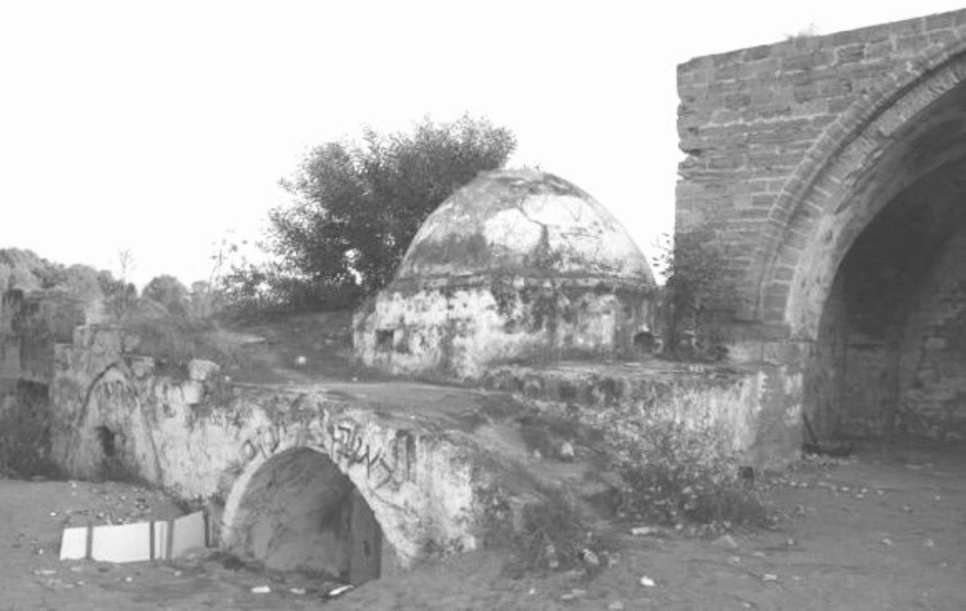
The pious endeavours of the Qādirī shaykh as a murābiṭ extended beyond striving for self-spiritual perfection in the worship of God through seclusion and retreat. Rather, the shaykh seems to have been attentive to the beliefs of his fellow believers and to have catered for their religious and communal life. Mujīr al-Dīn, recording the major of events of 900/1495 (the last year covered by his History), tells that “our shaykh and walī”, Shihāb al-Dīn b. Arslān, built the mashhad of sayyidunā Rūbīl (Nabi Rūbīn) son of Ya'qūb west of Ramla close to the sea”.Footnote 43 Though no other literary or material evidence supports this account, it may be surmised that the stories about the site and the shaykh were linked together, if not in reality, then at least in the mind of contemporary inhabitants and observers. According to an inscription above the gate, the mashhad was built under the orders of the Mamluk governor of Ghaza Timrāz al-Mu'ayyadī (around 1437). This is the oldest part of the complex around which the other structures were built: the arcade used as a prayer hall, the minaret, a side room, the walls and wells. Located on the shore between of Jaffa and Yavne and standing to this day, the tomb of Rūbīn became one of the major shrines of Palestine during the Ottoman period.Footnote 44
General view of Nabi Rūbīn.

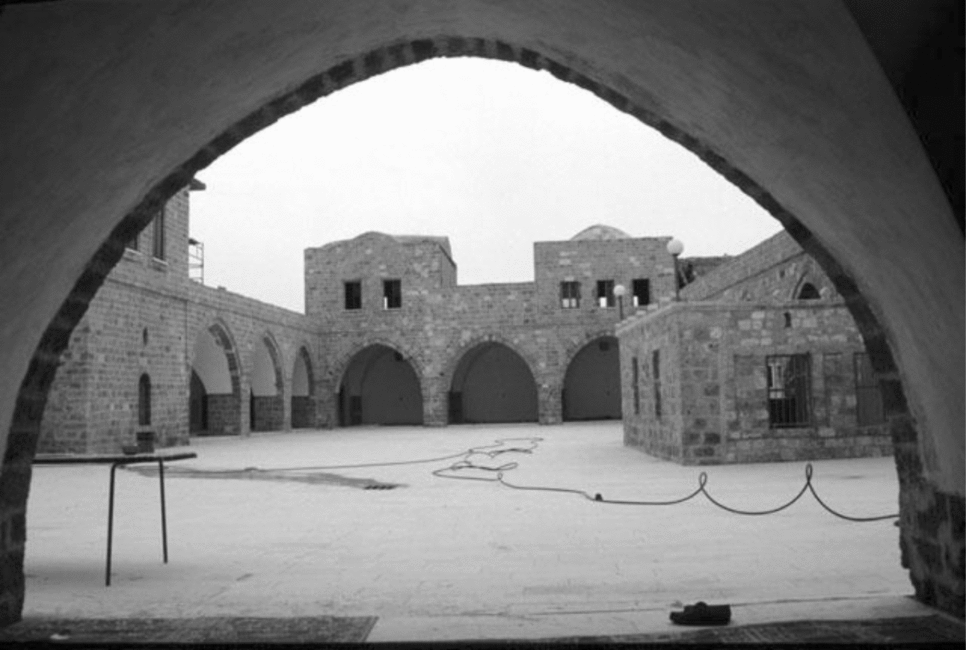
A more detailed and historically grounded account of the Sufi shaykhs' contribution to the shaping of public holy sites is that relating to Abū l-‘Awn al-Jaljūlī and the mashhad of Sayyidunā ‘Alī (known as Sidna ‘Alī) in Arsuf-Apollonia. A memorial structure, with a high minaret, developed around the tomb of ‘Ali b. ‘Ulaym or ‘Ulayl, a descendant of the caliph ‘Umar b. al-Khaṭṭāb (d. 474/1081), who, in Mujīr al-Dīn's words, “was among the famous holy figures in the land of Palestine, venerated by Muslims and Franks alike”.Footnote 45 The identity of ‘Alī b. ‘Ulaym and the date of the building of his mashhad have remained obscure, but the renovation of the holy site at the end of the Mamluk period and its growth are well documented. During the Ottoman period, the rooms on the second floor of the present site and the inscription now located opposite the miḥrāb were added.Footnote 46 Mujīr al-Dīn, noticing that ‘Alī b. ‘Ulaym's tomb (ḍarīḥ) was located in a large mashhad with a tall minaret, credits Abū l-‘Awn al-Jaljūlī with the renovation of the site:
In our day, the mashhad was under the supervision of our master and lord, our shaykh, a model for the servants of God, the leader (imām) of the ascetics (zuhhād) and the blessing of God's servants, adherent of the Shafi‘ī school, Shams al-Dīn Abū l-‘Awn Muḥammad al-Ghazī, a resident of Jaljuliyya, head of the Qādiriyya ṭarīqa in the Islamic realm. He reconstructed the mashhad, restored it, organised the pilgrimages and turned the place into a beautiful site. He covered the holy tomb with marble in the year ah 886; previously there had been a wooden tomb. He dug a well in the courtyard of the mosque, until he reached the spring water. Thereafter, he built, atop the iwān (sitting room), a tower (burj) for the purpose of the holy war, for the sake of Allāh, may He be glorified. . . . [The tower] was completed after the year ah 890.Footnote 47
Sayyidunā ‘Alī: view of the courtyard.

This was how the Qādirī shaykh became identified with the glorified tradition of the anti-Frankish jihad conducted on the coast of Arsūf from the time of the famous “Battle of Arsuf” in 1191 to the town's salvation from infidel rule in 1265.Footnote 48 In the case of Abū l-‘Awn, too, the building of the shrine was another manifestation of the Sufi shaykh's contribution to creating a public religious space for the sake of his fellow believers. Indeed, as Mujīr al-Dīn puts it: this was “one of his deeds of charity by virtue of which Allāh dressed him in glorious garments and lengthened his life”.Footnote 49 Moreover, Abū l-‘Awn was not only the renovator of the shrine; he was also keeper of the site in charge of the upkeep of the building and the pilgrimage and rites conducted there.
In common with other cultural traditions, a building was made holy in Islamic tradition not only by being the site of events central to the faith, but also through the religious practices conducted there, be they private devotions or public rituals performed by pilgrims and visitors over time.Footnote 50 Medieval Muslim pilgrims and visitors did not leave journey-diaries or firsthand testimonies that allow a reconstruction of pilgrimage as an individual or group experience, as did Christians of late antiquity and the Middle Ages who recorded their experience of the sacred. But guides to Muslims pilgrims and travellers and historical accounts of pilgrimage allow us to discern general trends. The best available information suggests that ziyāra (visitation, pilgrimage) to tomb-sanctuaries as an organised group activity at fixed times (as opposed to the customary private and occasional endeavour) was commonplace at the end of the Mamluk period. The sources also show that seasonal festivals (mawsims) and saints' days (mawlids) drew large crowds to shrines scattered around Syria-Palestine from around the middle of the thirteenth century.Footnote 51 Mujīr al-Dīn provides a glimpse of the Nabi Rūbīn shrine as an object of ziyāra: Every year, in a certain season, believers from Ramla, Gaza and other places in the region gather around the tomb. They stay there several days, spend large amounts of money, and read the Quran.Footnote 52 A similarly typical ceremonial rite took place every summer beside the mashhad of Sayyidunā ‘Alī, where countless people took the opportunity of their stay there to read the story of the birth of the Prophet (mawlid an-nabi).Footnote 53
Significantly, both the mashhads of Nabi Rūbīn and Sayyidunā ‘Alī seem to have been local or regional sites, and ziyāra to them performed by local devotees of the immediate vicinity and nearby towns, as opposed to long-distance travel to the universally venerated sites in Jerusalem and Hebron. As a public space – the focus of rituals common to “the people” (al-nās) and members of the religious and civilian elite – the local shrine must have contributed to deepening and sustaining the sense of communal identity and the community's cohesion.
The acceleration in the popularity of the collective-organised ceremonial rite around the holy site went hand-in-hand with the growing importance of the Sufi shaykh in society. Affiliation of laypeople with Sufi ṭarīqas was thus often through the so-called ‘cult of saints’ – an association so prominent in Islamic society and culture from around the thirteenth century and thereafter. Biographers praise many of the new ‘friends of God’ in Islamic societies for virtues, above all asceticism and altruism, based on the Prophetic model and usually ascribed to the Sufis. The proliferation of the tombs of these figures and their transformation into a focus of pilgrimage to receive the shaykhs' blessing at their graves reveal the linkage between Sufism and sanctity in its full light.
At the close of the Mamluk period, Palestinian cities and their hinterland were dotted with tombs of Sufi ‘friends of God’ as evidenced in pilgrimage guides and travellers' accounts. Mujīr al-Dīn, in al-Uns al-Jalīl, tells of successive generations of families and individual tombs that were built side by side in zāwiyas or in the cemetery areas outside the gates of Jerusalem, clustering around a walī whose tomb had become an important focus of pilgrimage. Of the tombs of Ibn Arslān and one of his spiritual ancestors, ‘Abd Allāh al-Qurashī, lying side-by-side in al-Māmillā cemetery (west of the Ḥaram), the resting-place of the remains of Muslims warriors and martyrs, Mujīr al-Dīn declared: “Whoever invokes God's name while standing between the graves of Ibn Arslān and al-Qurashī, God will grant all his wishes”.Footnote 54
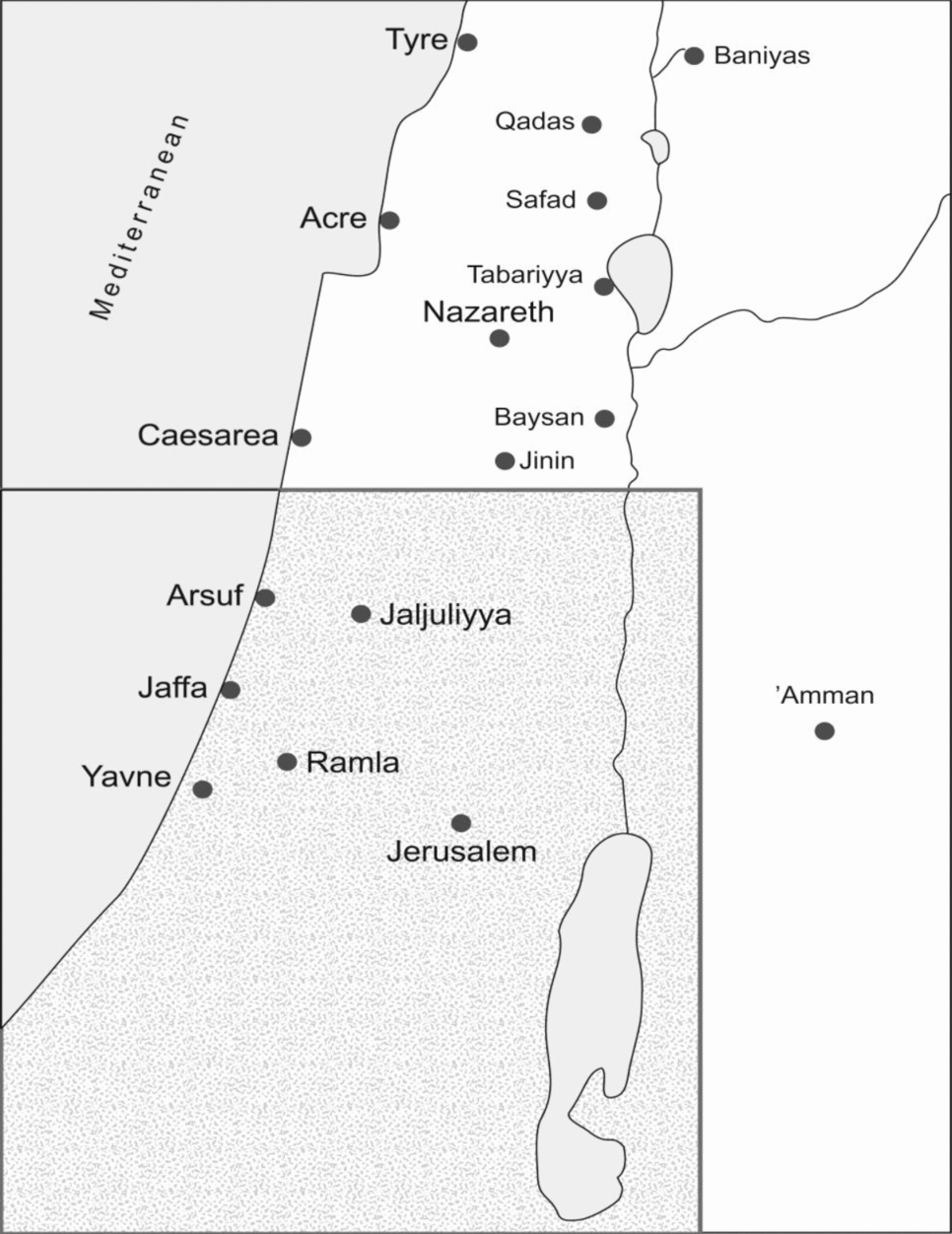
Centres of the Qādiriyya in Palestine at the end of the Mamluk Period.

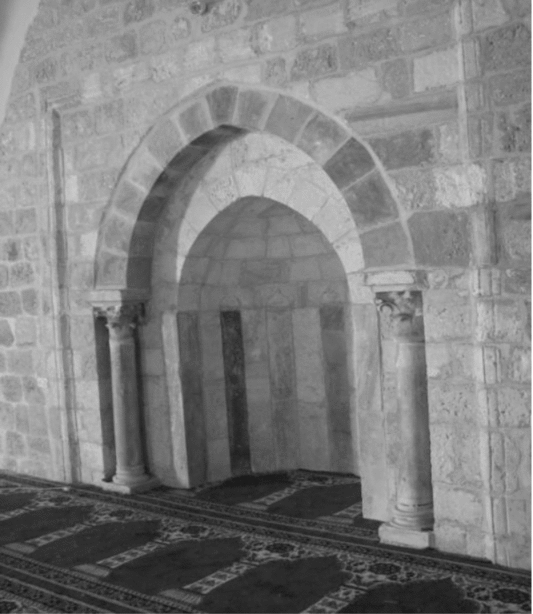
The prayer niche in the mosque of Abū l-‘Awn al-Jaljūlī in Ramla.

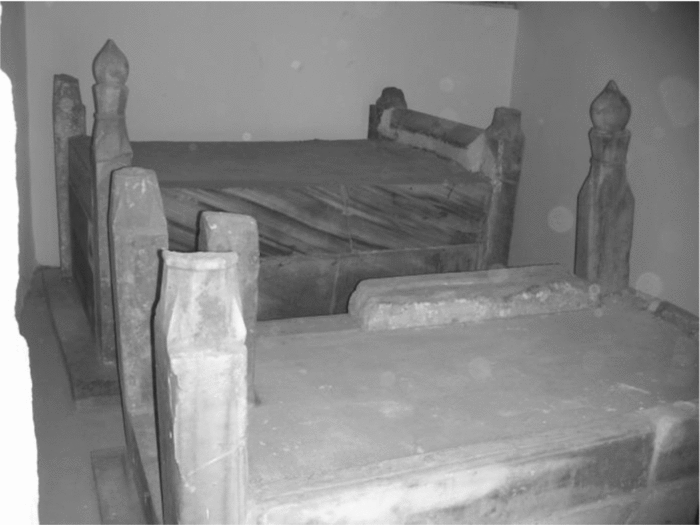
The tomb of Abū l-‘Awn al-Jaljūlī (behind is the tomb of a family member).

Tombs developed into mausoleums and shrines in stages, parallel to the spread of the belief in the baraka of the holy men buried there and their appropriation by a prominent shaykh and his community of followers, ‘the people of his path’. Moreover, mosques were built to commemorate the memory of the Sufi ‘friends of God’, and in some cases, prayer halls were added to their mausoleum and shrines turning them into neighbourhood mosques. The story about the development of the tomb of Abū l-‘Awn al-Jaljūlī illustrates this point as well. Two public religious spaces, which stand to our day, were named after him: his mausoleum in Ramla, and a mosque in his place of origin of Jaljuliyya. Sometime during the Ottoman period, Abū l-‘Awn al-Jaljūlī's burial place developed into a compound as a great prayer room was erected on the top of and around his grave. According to al-Ghazzī, this is the Jami‘ Abū l-‘Awn, and a pilgrimage site where his blessings might be received.Footnote 55 White marble columns, carrying a pointed arch of coloured stones, flank the miḥrāb of the mosque. Inlaid vertical marble strips decorate the niche itself, to the right of which stood not long ago a minbar with a small dome. At the northeast corner outside stairs lead to the domed roof and to a high minaret, rising over this corner. The courtyard has been used as a cemetery for those seeking to be close to the walī after death.Footnote 56 The inscription on Abū l-‘Awn al-Jaljūlī's tombstone, dating from ce 1504, reads as follows:
This is the burial place of the servant yearning to God, the exalted arbiter of righteous religious learning and practice (‘ālim and ‘āmil), the trustworthy, the humble, the ascetic, guide of the seekers of the path, model of kings, the great pole, possessor of divine knowledge, Abū l-‘Awn al-Jaljūlī. . . head of the Qādiriyya on the borders of Palestine and the Muslim kingdom. May God spread on all Muslims his blessing in this world and in the hereafter through Muḥammad and his family.
****
Focusing on the diffusion of the Qādiriyya in late medieval Palestine, this article has explored the process by which the shaykhs of the ṭarīqa established their charismatic position and shaped local religious life and public space. My central proposition is that only through the localisation or appropriation of the shaykh of the ṭarīqa did his charismatic position become established and the perpetuation of his spiritual method become guaranteed? For his disciples and followers, the shaykh must have been – by his very nature – an utterly localised individual, his figure must have been concrete, and his extraordinary traits and gratuitous marvels embodied within his specific community and publicly manifested.Footnote 57 The modes and frameworks of operation through which the shaykh performed and diffused his charisma and enlarged his following are substantial to any discussion of the local context of medieval Sufism.
At the heart of the process of localisation of the Qādirī path in late medieval Palestine resided the operation of the shaykhs of the ṭarīqa within the local community and the sites and spaces that grew up and around the transmission of their knowledge and divine blessing. Living among their fellow believers, the Qādirī shaykhs enlarged their following and turned their lodges into centres of communal life. Their tombs and the holy sites they harnessed further tightened the affinity between the ṭarīqa, the local community and the land, and set a tangible and lasting mark on the physical environment. By highlighting the process of the localisation of the particular spiritual path in the particular historical and geographical setting, my hope is to contribute to a new avenue of research that brings the local context of medieval Sufism into the centre of inquiry.