



%20--%3e%3c!DOCTYPE%20svg%20PUBLIC%20'-//W3C//DTD%20SVG%201.0//EN'%20'http://www.w3.org/TR/2001/REC-SVG-20010904/DTD/svg10.dtd'%3e%3csvg%20version='1.0'%20id='Layer_1'%20xmlns='http://www.w3.org/2000/svg'%20xmlns:xlink='http://www.w3.org/1999/xlink'%20x='0px'%20y='0px'%20width='64px'%20height='64px'%20viewBox='5.5%20-3.5%2064%2064'%20enable-background='new%205.5%20-3.5%2064%2064'%20xml:space='preserve'%3e%3cg%3e%3ccircle%20fill='%23FFFFFF'%20fill-opacity='0'%20cx='37.785'%20cy='28.501'%20r='28.836'/%3e%3cpath%20fill='%23595959'%20d='M37.441-3.5c8.951,0,16.572,3.125,22.857,9.372c3.008,3.009,5.295,6.448,6.857,10.314%20c1.561,3.867,2.344,7.971,2.344,12.314c0,4.381-0.773,8.486-2.314,12.313c-1.543,3.828-3.82,7.21-6.828,10.143%20c-3.123,3.085-6.666,5.448-10.629,7.086c-3.961,1.638-8.057,2.457-12.285,2.457s-8.276-0.808-12.143-2.429%20c-3.866-1.618-7.333-3.961-10.4-7.027c-3.067-3.066-5.4-6.524-7-10.372S5.5,32.767,5.5,28.5c0-4.229,0.809-8.295,2.428-12.2%20c1.619-3.905,3.972-7.4,7.057-10.486C21.08-0.394,28.565-3.5,37.441-3.5z%20M37.557,2.272c-7.314,0-13.467,2.553-18.458,7.657%20c-2.515,2.553-4.448,5.419-5.8,8.6c-1.354,3.181-2.029,6.505-2.029,9.972c0,3.429,0.675,6.734,2.029,9.913%20c1.353,3.183,3.285,6.021,5.8,8.516c2.514,2.496,5.351,4.399,8.515,5.715c3.161,1.314,6.476,1.971,9.943,1.971%20c3.428,0,6.75-0.665,9.973-1.999c3.219-1.335,6.121-3.257,8.713-5.771c4.99-4.876,7.484-10.99,7.484-18.344%20c0-3.543-0.648-6.895-1.943-10.057c-1.293-3.162-3.18-5.98-5.654-8.458C50.984,4.844,44.795,2.272,37.557,2.272z%20M37.156,23.187%20l-4.287,2.229c-0.458-0.951-1.019-1.619-1.685-2c-0.667-0.38-1.286-0.571-1.858-0.571c-2.856,0-4.286,1.885-4.286,5.657%20c0,1.714,0.362,3.084,1.085,4.113c0.724,1.029,1.791,1.544,3.201,1.544c1.867,0,3.181-0.915,3.944-2.743l3.942,2%20c-0.838,1.563-2,2.791-3.486,3.686c-1.484,0.896-3.123,1.343-4.914,1.343c-2.857,0-5.163-0.875-6.915-2.629%20c-1.752-1.752-2.628-4.19-2.628-7.313c0-3.048,0.886-5.466,2.657-7.257c1.771-1.79,4.009-2.686,6.715-2.686%20C32.604,18.558,35.441,20.101,37.156,23.187z%20M55.613,23.187l-4.229,2.229c-0.457-0.951-1.02-1.619-1.686-2%20c-0.668-0.38-1.307-0.571-1.914-0.571c-2.857,0-4.287,1.885-4.287,5.657c0,1.714,0.363,3.084,1.086,4.113%20c0.723,1.029,1.789,1.544,3.201,1.544c1.865,0,3.18-0.915,3.941-2.743l4,2c-0.875,1.563-2.057,2.791-3.541,3.686%20c-1.486,0.896-3.105,1.343-4.857,1.343c-2.896,0-5.209-0.875-6.941-2.629c-1.736-1.752-2.602-4.19-2.602-7.313%20c0-3.048,0.885-5.466,2.658-7.257c1.77-1.79,4.008-2.686,6.713-2.686C51.117,18.558,53.938,20.101,55.613,23.187z'/%3e%3c/g%3e%3c/svg%3e)
%20--%3e%3c!DOCTYPE%20svg%20PUBLIC%20'-//W3C//DTD%20SVG%201.0//EN'%20'http://www.w3.org/TR/2001/REC-SVG-20010904/DTD/svg10.dtd'%3e%3csvg%20version='1.0'%20id='Layer_1'%20xmlns='http://www.w3.org/2000/svg'%20xmlns:xlink='http://www.w3.org/1999/xlink'%20x='0px'%20y='0px'%20width='64px'%20height='64px'%20viewBox='5.5%20-3.5%2064%2064'%20enable-background='new%205.5%20-3.5%2064%2064'%20xml:space='preserve'%3e%3cg%3e%3ccircle%20fill='%23FFFFFF'%20fill-opacity='0'%20cx='37.637'%20cy='28.806'%20r='28.276'/%3e%3cg%3e%3cpath%20fill='%23595959'%20d='M37.443-3.5c8.988,0,16.57,3.085,22.742,9.257C66.393,11.967,69.5,19.548,69.5,28.5c0,8.991-3.049,16.476-9.145,22.456%20C53.879,57.319,46.242,60.5,37.443,60.5c-8.649,0-16.153-3.144-22.514-9.43C8.644,44.784,5.5,37.262,5.5,28.5%20c0-8.761,3.144-16.342,9.429-22.742C21.101-0.415,28.604-3.5,37.443-3.5z%20M37.557,2.272c-7.276,0-13.428,2.553-18.457,7.657%20c-5.22,5.334-7.829,11.525-7.829,18.572c0,7.086,2.59,13.22,7.77,18.398c5.181,5.182,11.352,7.771,18.514,7.771%20c7.123,0,13.334-2.607,18.629-7.828c5.029-4.838,7.543-10.952,7.543-18.343c0-7.276-2.553-13.465-7.656-18.571%20C50.967,4.824,44.795,2.272,37.557,2.272z%20M46.129,20.557v13.085h-3.656v15.542h-9.944V33.643h-3.656V20.557%20c0-0.572,0.2-1.057,0.599-1.457c0.401-0.399,0.887-0.6,1.457-0.6h13.144c0.533,0,1.01,0.2,1.428,0.6%20C45.918,19.5,46.129,19.986,46.129,20.557z%20M33.042,12.329c0-3.008,1.485-4.514,4.458-4.514s4.457,1.504,4.457,4.514%20c0,2.971-1.486,4.457-4.457,4.457S33.042,15.3,33.042,12.329z'/%3e%3c/g%3e%3c/g%3e%3c/svg%3e)
1. Introduction
A Thorne-Żytkow Object (TŻO) is a hypothetical class of stars where there is a neutron star (NS) at the core of large, diffuse envelope. These objects are believed to be formed in one of three ways: (1) through a stellar collision within a globular cluster (Benz & Hills (Reference Benz and Hills1992)), (2) through a common envelope phase where there is double-core evolution (Taam et al. (Reference Taam, Bodenheimer and Ostriker1978); Reference Ablimit, Podsiadlowski, Hirai and WickerAblimit et al. (2022)), and (3) a newly formed NS recieves a “kick” that results in a collision with its secondary companion (Leonard et al. (Reference Leonard, Hills and Dewey1994)). Here we refer to scenario (3) as the “impact scenario”. Modeling the formation of these objects is crucial for us to understand the physics of these systems. Recently there have been efforts modeling their formation (Everson et al. (Reference Everson, Hutchinson-Smith, Vigna-Gómez and Ramirez-Ruiz2024); Hutchinson-Smith et al. (Reference Hutchinson-Smith, Everson and Twum2024)). While these are important studies into scenario (2), there are fewer studies investigating the “impact scenario” (Reference Hirai and PodsiadlowskiHirai & Podsiadlowski (2022)). Using a moving-mesh (MM) solver on top of the N-body code ChaNGa, we simulated the mergers of a 1.4 M
 $_{\odot}$
NS and a 5-15 M
 $_{\odot}$
main sequence (MS) star with 3 periastron distances,
 $r_p$
, for the orbit of the NS (
 $r_p = 0, 0.5, 1 R_{\star}$
).
2. Methods
2.1. Setup and Initial Conditions
The
 $r_p$
values are chosen to represent three different potential dynamical interactions: a direct collision, envelope disturbance, and a grazing encounter, respectively. We use the MM hydrodynamical solver MANGA (Chang et al. (Reference Chang, Wadsley and Quinn2017); Reference Prust and ChangPrust & Chang (2019)) integrated onto parallel-code Charm N-body GrAvity solver (ChaNGa; Menon et al. (Reference Menon, Wesolowski and Zheng2015); Reference Wadsley, Keller and QuinnWadsley et al. (2017)). For detailed information about ChaNGa and MANGA see Menon et al. (Reference Menon, Wesolowski and Zheng2015); Wadsley et al. (Reference Wadsley, Keller and Quinn2017); Jetley et al. (Reference Jetley, Gioachin, Mendes, Kale and Quinn2008); Chang et al. (Reference Chang, Wadsley and Quinn2017); Prust & Chang (Reference Prust and Chang2019).
We create our initial conditions by constructing a zero-age MS star of a given mass using MESA (Paxton et al. (Reference Paxton, Bildsten and Dotter2011); Paxton et al. (Reference Paxton, Cantiello and Arras2013); Paxton et al. (Reference Paxton, Marchant and Schwab2015); Paxton et al. (Reference Paxton, Schwab and Bauer2018); Paxton et al. (Reference Paxton, Smolec and Schwab2019); Jermyn et al. (Reference Jermyn, Bauer and Schwab2023)), and take the resulting radius and mass to construct a polytropic star with polytropic index
 $\Gamma = 4/3$
, matching the mass and radius to within about 1%. We map the constructed temperature and density profile to mesh points to define the simulated star.
We choose MS masses of
 $M_{\star} = 5,7,9,12,15 M_{\odot}$
, and the 1.4
 $M_{\odot}$
NS is modeled as a dark-matter particle, that is, a point mass that feels only gravitational forces and is not affected by hydrodynamics. The NS starts at a distance of 2
 $R_{\star}$
, to ensure the initial conditions are not significantly different from an isolated star and to be outside the star’s Roche lobe by a factor of 2 in terms of tidal gravity. We give the NS an appropriate velocity vector to achieve the desired
 $r_p$
, set to 0, 0.5, or 1
 $R_{\star}$
for a parabolic (energy,
 $E = 0$
). Each simulation has approximately 265,000 total mesh points (
 $N_{tot}$
) of which roughly 104,000 mesh points define the initial star,
 $N_{\star}$
.
3. Results
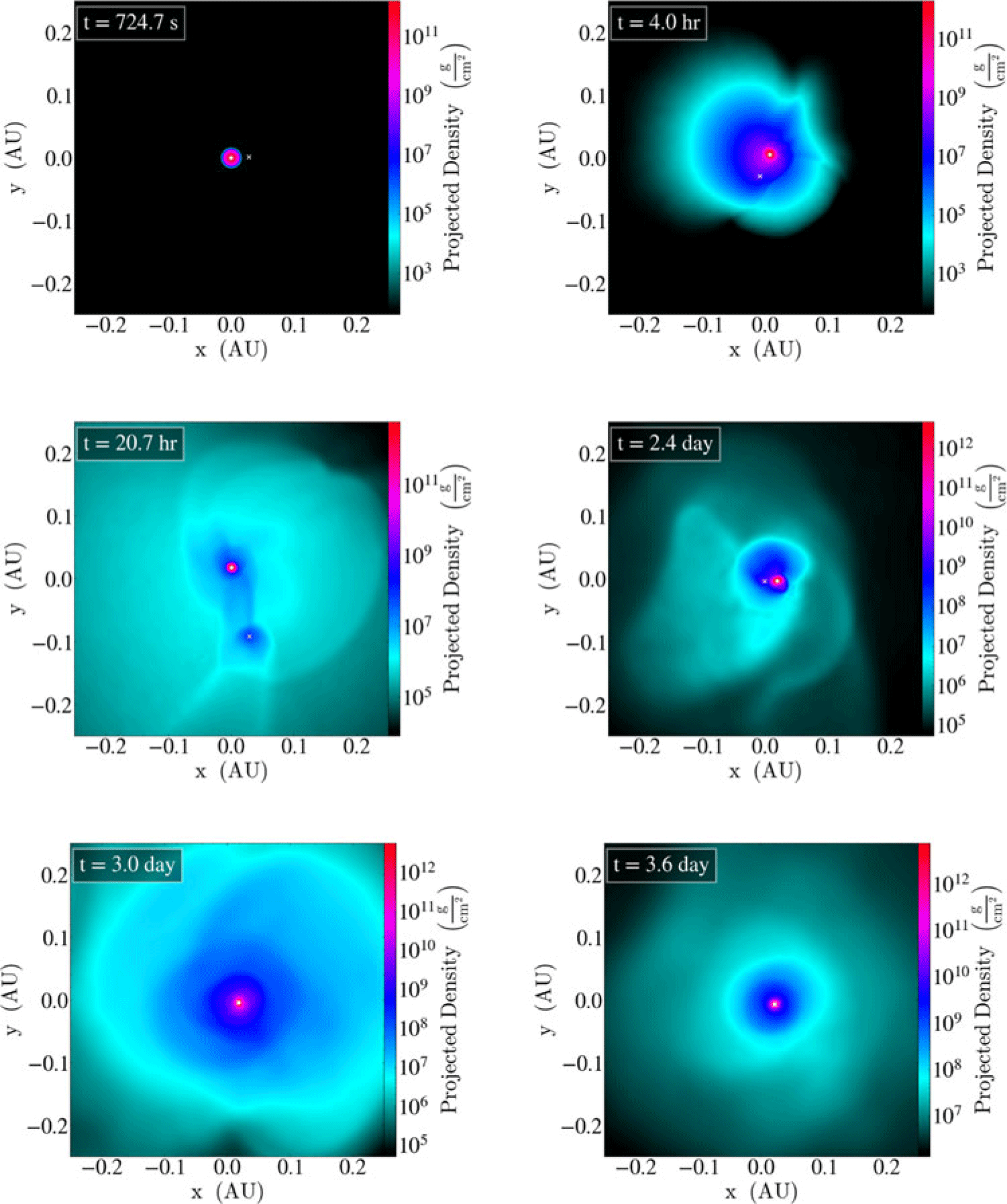
Figure 1 shows a series of density projection plots from our high resolution simulation
 $(N_{\star}(N_{tot}) = 575K(980K))$
of a 7
 $M_{\odot}$
MS star successfully merging with the NS, becoming dynamically stable after 3.6 days. We call this object a dynamical TŻO (dTŻO) to reflect their nature as being dynamically formed TŻOs while not yet assuming all the complex physical processes that define a classical TŻO.
Frames from our 7
 $M_\odot$
MS star merging with the NS: the highest density point, representing the core of the MS star, is indicated by the pentagon and the NS is indicated by the cross. The color bar denotes the density of the gas. The NS successfully merges with the MS star at
 $t = 3$
days.

4. Conclusion
We found that stable dynamical TŻOs can be robustly formed through MS-NS collisions for small periastron distances,
 $r_p \le 1 R_{\star}$
. This work represents an important first step using a flexible and powerful code capable of capturing their key dynamical features. For further details on the dynamical stability of these objects and a discussion surrounding the resulting simulation parameters, see Williams et al. (Reference Williams, Chang, Levesque and Quinn2025). Further research will include simulating periastron distances larger than
 $1 R_{\star}$
to examine other products of these binary interactions (Reference Hirai and PodsiadlowskiHirai & Podsiadlowski (2022)).
Supplementary material
To view supplementary material for this article, please visit https://doi.org/10.1017/S174392132610550X
 M⊙
 t=3


 Open access

