1. Introduction
The affix-clitic distinction is one frequently appealed to in historical linguistics. Indeed, a standard grammaticalization cline makes reference to it (Hopper & Traugott Reference Hopper and Closs Traugott1993:7):Footnote 1
(1) content word > grammatical word > clitic > affix > (zero)
On the basis of this cline, one can demonstrate that grammaticalization has taken place by showing that an element has changed from being a clitic to being an affix. Examples of this strategy being employed abound in the literature. Based on similar assumptions, if an element can be shown to have developed from an affix to a clitic, then degram-maticalization has taken place. This type of change has not been claimed as frequently as grammaticalization, but the Swedish possessive s is assumed by some to be an example (see Norde Reference Norde1997 and, for a different interpretation of the data, Börjars Reference Börjars2003). More or less explicitly in the grammaticalization cline is the assumption that morphosyntactic changes from word to clitic to affix are normally associated with a weakening in semantics. Changes to form and function are assumed to occur in parallel.
In this literature, the characteristics of clitics and affixes put forward in Zwicky & Pullum Reference Zwicky and K. Pullum1983 are frequently used as criteria for establishing the status of a bound element. We return to these criteria in section 5, but they can roughly be divided into three types: (i) morphophonological integration with its host element, (ii) placement within the phrase, and (iii) semantic function. The assumption is that for each of these types of criterion, there is a clitic-like behavior and an affix-like behavior and an element will show consistent behavior with respect to all criteria; for instance, if it shows clitic behavior with respect to (i) and (ii), then it also shows clitic behavior with respect to (iii).
The purpose of this paper is to show that the dichotomy clitic-affix involves an oversimplification. The expectation that there are two relatively clear-cut categories can lead to a situation where justice is not done to data. We argue instead that a distinction needs to be made in several dimensions, with “affix” and “clitic” being justified terms only in cases where the properties in all dimensions come together in a particular way. We use the development of the Scandinavian bound definiteness marking to illustrate our point. There is a substantial amount of data available to illustrate the historical development of this element and the modern varieties provide excellent comparative data. The fact that there are two recent articles that come to opposite conclusions as to its historical development and clitic-affix status (Abraham & Leiss Reference Abraham and Leiss2007 and Faarlund Reference Faarlund2007) also makes it fertile ground for this discussion. In section 2, we clarify the terminology used throughout this article, and in section 3, we provide an overview of what is known about the early development of definiteness marking in the Scandinavian languages. Section 4 outlines the analyses of Faarlund (Reference Faarlund2007) and Abraham & Leiss (Reference Abraham and Leiss2007) and the disagreement between them. We show that the dis-agreement is partly due to theory-internal issues and that the assumption that there are two discreet categories—“clitics” and “affixes”—also leads to difficulties, particularly when this formal distinction is assumed to go hand in hand with a difference in function. In section 5, we consider the bound definiteness marker of Old Norse and of the Modern Scandinavian languages in the light of the clitic-affix criteria applied by Faarlund. Section 6 contains the conclusions we draw on the basis of our discussion. A consequence of our conclusions is that a formal architecture for modeling grammar and changes to it needs to be able to represent different types of linguistic information (for example, morphology, syntax, and semantics) in separate dimensions. In section 6.2, we outline an analysis within such an architecture, namely Lexical-Functional Grammar (LFG, see Bresnan Reference Bresnan2001, Dalrymple Reference Dalrymple2001, and Falk Reference Falk2001).
2. A Note on Terminology
Before we start our discussion, a word about language names and terminology is in order. Collectively, all the older forms of the modern Scandinavian languages can be traced back to common Old Norse, the language spoken in mainland Scandinavia before its divergence into two distinct dialects: West Norse, which subsequently developed into Old Norwegian and Old Icelandic, and East Norse, which developed into Old Swedish and Old Danish.Footnote 2 The term Old Norse, as used in grammars and primers offering an introduction to the language, usually refers almost exclusively to West Norse, namely the language of Norway, Iceland, and all West Norse settlements from around the ninth to the fourteenth century. Given the geographical spread and the extended period we are dealing with, there can be little doubt that the language we think of as West Norse must comprise a number of synchronic and diachronic variants. Despite this, the different forms are thought to be close enough, certainly in written literary form, to justify treatment as a single unified language.Footnote 3 The term Old Norse itself, found in Faarlund Reference Faarlund2007, is often used interchangeably in the literature with Old Icelandic, which is the term found in Abraham & Leiss Reference Abraham and Leiss2007. In the present paper, following Faarlund we adopt the term Old Norse as it is the more neutral of the two terms. When referring to other historical data, we employ the description found in the original source, for example, Old Swedish rather than East Norse. For the modern varieties, we just use the name, for example, Danish rather than Modern Danish, and we make a distinction between the two types of Norwegian, Nynorsk and Bokmål, only when it is necessary. For generalization over the two, we use Norwegian. In order to avoid committing to a particular analysis of the definiteness markers, either as articles or agreement markers or as clitics or affixes, we refer to the free marker as free-def and to the bound one as bound-def. Throughout the period we are considering here, two elements have functioned as free-def, and we use this term to refer to both of them when further detail is not relevant.
3. Historical Development of Scandinavian Bound Definiteness
The facts relating to marking of definiteness in early varieties of the Scandinavian languages are crucial to the arguments discussed in this paper, so we start with a brief summary of some of the literature on the topic. The historical development of the Scandinavian bound definiteness marking has been the subject of many studies, ranging from thorough traditional philological work (as exemplified by Noreen Reference Noreen1892 and Seip Reference Seip1958) to work informed by more recent approaches to linguistic analysis, (see, for instance, Dyvik Reference Dyvik1979 and Perridon Reference Perridon1989), or indeed analyses couched within a specific syntactic theory, such as Faarlund Reference Faarlund2007 and Abraham & Leiss Reference Abraham and Leiss2007. In spite of this attention, the exact details of the origin and development of the bound definite marker are not entirely clear, as illustrated by the disagreement between Faarlund (Reference Faarlund2007) and Abraham & Leiss (Reference Abraham and Leiss2007). Both provide analyses of the definite ending and its development within Minimalist theory, but disagree about the data and about how to interpret and analyze the development.
The earliest attestation of bound-def is generally agreed to be one found in a runic inscription in Uppland, Sweden, ca. 1040.Footnote 4 There are also a number of early examples from Norwegian inscriptions, but only one example has been found in Denmark (which is assumed to have been carved by a Norwegian).Footnote 5 The first attestation of free-def is generally held to be in an inscription on the Rök stone from the ninth century. This might be interpreted as evidence that the bound element developed from the free one. However, the data are sufficiently scant from this time not to allow any certain conclusions. At the same time, we argue below that there is other indirect evidence to support this conclusion.
Bound-def remains rare even in later inscriptions and also in the earliest texts. It is generally assumed that as an innovation, it is likely to have been more common in the spoken language. With reference to the written language, Jónnsson (Reference Jónnsson1901:80) states that “it is thus clear that it is not until the 12th c that the article has become firmly attached to a noun,” but adds: “However, in the daily language this must have happened some way into the 11th c […].”Footnote 6 In the early texts, definiteness is not explicitly marked as frequently as it is in the modern Scandinavian languages. There is evidence that explicit marking of definiteness is used mainly when the definite noun phrase occurs in an environment that would otherwise normally be associated with indefiniteness (Leiss Reference Leiss2000). When definiteness is overtly marked, a separate article is used more frequently than the bound form. Interestingly, the bound element is more frequent in texts where it can be assumed that the style was influenced by the spoken language.Footnote 7
According to Wessén (Reference Wessén1956:32), at least in the earliest sources for Old Swedish and Old Danish, bound-def and the free-def that derived from sá were used in very similar contexts, so that no clear distinction was made between the noun phrases in each example in 2.
- (2)
a.

b.

Though many controversial issues remain in this debate, we con-clude that the early emergence of bound-def predates our earliest preserved sources. It is unlikely then that incontrovertible evidence of its origin and development can be found; only its spread can be studied on the basis of the sources. Instead, hypotheses about its origin and develop-ment must be based to a great extent on what we know about linguistic change in general and the development of definiteness markers in particular.
It seems most likely to us that the development of bound-def took place in Proto-Nordic, rather than as independent developments in the daughter languages.Footnote 8 Seip (Reference Seip1958:233) argues that this is not a necessary conclusion, since there are other developments, such as the loss of case or the loss of person marking on the verb that occurred independently in the Scandinavian languages. Our conclusion may not be a necessary one, but it seems to us to be the more plausible one. The development of a bound definiteness marker is not unique to the Scandinavian languages, but it is a relatively unusual phenomenon (see Lundeby Reference Lundeby1965 and Dahl Reference Dahl and Kortmann2007a for brief overviews).Footnote 9 By contrast, the general loss of inflection, such as case or person marking is a more general phenomenon and has taken place in a number of other Germanic languages. It seems im-probable to us then that the Scandinavian bound-def would have arisen as a number of independent changes or even as a contact phenomenon (similarly, Delbrück Reference Delbrück1911 and Hansen Reference Hansen1927, but for a different view, see Kock Reference Kock1919:89–91).Footnote 10 However, our argument in this paper does not hinge on this view of things.
As Perridon (Reference Perridon1989:129) points out, many early grammars assume on the basis of their similarity in form that the indefinite article and bound-def are actually the same element (an idea taken up in Nilsson Reference Nilsson1968). This hypothesis, however, lacks support from philological evidence. Perridon (Reference Perridon1989:129–135) sums up the more plausible hypotheses about the possible origin of bound-def. Here the development of the bound marker is linked to a free—originally demonstrative—element, but there is some dispute as to the details of the development.
The two most plausible hypotheses of how bound-def arose in the Scandinavian languages derive it from the demonstrative (h)inn (for a summary of the literature on both hypotheses and a third—to our minds less plausible—hypothesis, see Perridon Reference Perridon1989:143–149). The two developments can be sketched as in 3.
- (3)
a.
b.
Example 3a implies a less direct link between the noun and bound-def than 3b since (h)inn does not form a constituent with the noun, but with the adjective. Under 3a, the demonstrative is assumed to have gram-maticalized to a free definite article. This article is used especially when the noun phrase contains an adjective, and since word order is still relatively free, free-def and the adjective frequently follow the noun. Examples of both orders are provided in 4.Footnote 11
- (4)
a.
b.
The assumption is that from examples such as 4b, the prosodically weak definiteness marker ends up attaching to the preceding noun. Evidence to support this hypothesis comes from early examples with the same order as in 4b, where the definiteness marker is attached to the noun, as in 5.
(5)
Under 3b, the link between the demonstrative and bound-def is in a sense more direct.Footnote 12 The demonstrative is frequently placed after the noun, as Perridon (Reference Perridon1989:143–144) states: “In Scandinavian the position after the noun came to be the regular position for unstressed (h)inn.” As an argument against the model in which the adjective positioning was significant, Perridon (Reference Perridon1989:146) cites an investigation by Musinowicz (Reference Musinowicz1911), which showed that the vast majority of the instances of the structure in 3a contained a proper noun, rather than a common noun. Under the assumption that such noun phrases have a different structure, they are assumed not to have provided the right environment for the change in 3a. Since the environment required for 3a would not be sufficiently frequent, this would make it an unlikely scenario. However, there are examples similar to 5 that contain a proper noun and in which the definiteness marker associated with the adjective is attached to the noun, as in 6.
(6)
As observed above, the assumption underlying 3b is that (h)inn was postnominal, especially when it was unstressed. Assuming that an unstressed demonstrative may have been developing into a definiteness marker, the difference between the two developments suggested in 3 is not of great significance to the point we are making; under either 3a or 3b, bound-def has developed from a free-def, not the other way around. We can also assume that under 3b the pre-nominal free definite article developed from the pre-nominal demonstrative (h)inn, not from the post-nominal bound definite marker. As discussed below, this makes a difference to the debate between Faarlund (Reference Faarlund2007) and Abraham & Leiss (Reference Abraham and Leiss2007). Under both analyses, the relatively free word order in Scandinavian noun phrases played a crucial role in the development. According to Wéssen (Reference Wessén1956:29–30), for instance, the word order flex-ibility was greater in Scandinavian than in other Germanic languages.
4. Two Analyses: Faarlund Reference Faarlund2007 and Abraham & Leiss Reference Abraham and Leiss2007
One of the reasons the Scandinavian bound-def is of special relevance to a discussion of historical development and the categories of clitic and affix is that two recent theoretical analyses have come to opposite conclusions with respect to the direction of the change and how to model it. In this section, we sum up their arguments. Both papers are written broadly within the Minimalist program (Chomsky Reference Chomsky1995), so we also consider some of the ideas underpinning this framework.
The disagreement between Faarlund (Reference Faarlund2007) and Abraham & Leiss (Reference Abraham and Leiss2007) as to the development of definiteness markers from Old Norse to Norwegian is rather a complex one. It relates to the direction of change empirically, but also to the direction of change in theoretical terms. As pointed out in section 1, a change from clitic to affix is generally seen as an example of grammaticalization, a type of change that is often assumed to be (near) unidirectional. A change from an affix to a clitic would be counter-directional to grammaticalization, constituting an example of the less common phenomenon of degrammaticalization.Footnote 13
Within Minimalist theory, the directionality of grammaticalization is generally captured as “frozen” upward movement; moving an element from a lexical category up to a functional category is costly and hence principles of economy predict that this may lead to the element being inserted directly—technically Merged—in the higher position. Footnote 14 This has been expressed as Merge-over-Move or Late Merge (see Roberts & Roussou Reference Roberts and Roussou2003, van Gelderen Reference van Gelderen2004b). Under this view, a movement downwards in the tree over time would be counter-directional to grammaticalization.
Faarlund (Reference Faarlund2007) follows the Scandinavian tradition reviewed in section 3 and assumes that bound-def in Old Norse developed from the free definite/demonstrative marker. In his analysis, however, this involves a downward movement diachronically, and hence degram-maticalization theoretically. By contrast, Abraham & Leiss (Reference Abraham and Leiss2007) assume that the preposed free-def developed from the postposed bound-def. Empirically, this would be an example of degram-maticalization, since a bound element develops into a free element. Oddly, Abraham & Leiss (Reference Abraham and Leiss2007:17) claim that assuming “the preposed article developed from the postposed, enclitic one […] has the advantage of bringing in line the probing directions as well as the grammatical-ization cline.”Footnote 15 We are not aware of any interpretation of the grammaticalization cline in which a development from a clitic to an independent word would not be viewed as counter-directional to grammaticalization. The main argument to support Abraham & Leiss's unorthodox position is that under this view of the data, a theoretical analysis can be provided within Minimalism that does not involve diachronic downward movement. It is not, however, entirely clear how this particular historical change is captured in their analysis. As we discuss further below, they assume that the demonstrative developed into a definiteness marker through diachronic movement from specifier position to head position, but no details are given for the alleged development from a postnominal bound marker to a prenominal free marker of definiteness. Regardless of the details, theoretically, Abraham & Leiss's analysis would not involve degrammaticalization as defined within the models of Roberts & Roussou (Reference Roberts and Roussou2003) and van Gelderen (Reference van Gelderen2004b).Footnote 16
We have, then, the paradoxical situation in which Faarlund (Reference Faarlund2007) assumes that empirically the development of the definite marking is standard grammaticalization (clitic > affix), while theoretically it is not since it involves downward movement diachronically. In Abraham & Leiss's (Reference Abraham and Leiss2007) analysis, this is standard grammaticalization theoretically, but in order to achieve this they have to make the assumption that it is degrammaticalization empirically, namely a shift from a clitic to an independent element. As demonstrated above, the timing of the change is such that it is unlikely that we will be able to settle the dispute on the basis of reasonably unambiguous data. We now consider the theoretical analyses that give rise to this paradox.
For a basic noun phrase consisting of just a definite noun in Old Norse, like hestrinn ‘the horse’, Faarlund (Reference Faarlund2007:31) assumes the structure in 7.
(7)
The noun root is Merged in N, but moves up to I in order to check its number feature.Footnote 17 The bound definiteness marker -inn is Merged in D, much as an independent word would be, but because of its status as a phonologically dependent element, it requires a host. The noun then raises from I to D to satisfy the requirement for a host for -inn. In this analysis, the definiteness of hestrinn derives from the bound element found in D. As discussed below, this is assumed to be different for Norwegian.
For a noun phrase containing an adjective, such as 8a, Faarlund (Reference Faarlund2007:32) assumes the structure in 8b.
- (8)
a.
b.
In 8b, the free definite article is Merged in D and since it is independent, there is no requirement for a host and no motivation for movement of the noun up to D. The noun only moves to I; as in 7 it does so to check its number feature. One issue that arises is what prevents the free definite article from combining with a noun when there is no adjective present, which Faarlund assumes to have been ungrammatical in Old Norse (though see our example 2). Faarlund assumes a selectional restriction stating that the free determiner cannot combine directly with an IP, but only with an αP, which is present only when the noun phrase contains an adjective.
In line with Julien (Reference Julien2005), Faarlund assumes that the adjective phrase itself fills the Specifier of αP and that the head α is obligatorily empty. The assumption that the head of αP is empty is crucial to his analysis of Old Norse noun phrases such as those in 9a, where the definite noun has raised from I to D past the adjective in αP, which is the structure Faarlund (Reference Faarlund2007) would assign to 9a (see 9b). This would not be possible under standard assumptions about movement and blocking in Minimalism, if the head of αP had been filled by any material, including a trace or a copy of a moved element.
- (9)
a.
b.
Under this analysis of Old Norse noun phrases, there is a bound-def and a free-def—both of which are Merged in D—above the inflectional node I. Accordingly, there is no inflectional definiteness in Old Norse and no definiteness agreement (the weak/strong marking is excluded from the discussion).
A further characteristic of Old Norse relevant in the discussion of clitic and affix criteria is the fact that the demonstrative sá can co-occur with free-def(h)inn, as in 10 where þau is a form of sá.
- (10)
a.
b.
These are the only two determiners that can co-occur and when they do, they always occur in this order so that one might expect an analysis in which there is a DemP taking a DP as its complement. However, Faarlund analyzes this as DP recursion, since this has the perceived advantage that all noun phrases are DPs. Faarlund (Reference Faarlund2007:33) considers “the question of whether the higher projection is a DemP or a DP a rather insignificant terminological one.” This does not seem an entirely ap-propriate description to us. If DP recursion is assumed, then there need to be specifications to ensure the correct order, so that *in þau stru skip is not generated alongside 10.
Though the order between sá and (h)inn seems to be fixed, there does, in fact, appear to be more variation in the ordering of elements within the DP than is acknowledged by Faarlund. For instance, as Barnes (Reference Barnes2004:85) shows, examples can also be found in which independent syntactic elements—demonstrative, definite article, and adjective—are postposed in Old Norse, as demonstrated in 11. Some form of stylistic-ally motivated movement would have to be assumed to account for such examples within Faarlund's analysis. However, the crucial point here is that the generalization that sá always precedes (h)inn does hold.
(11)
A further potential issue with the recursive DP analysis is that we cannot see directly what would prevent the free definite article (h)inn or indeed þau from co-occuring with -inn. Still, Faarlund assumes that double definiteness—that is, the co-occurrence of bound-def with free-def, see section 5.6—arises at a later stage in Norwegian; indeed this is one of the major differences he wants his analysis to account for. The existence of double definiteness in Norwegian is one of the factors motivating the distinction he makes between clitic in Old Norse and affix in Norwegian. As we discuss in section 5.6 below, though double definiteness is uncommon in early forms of the Scandinavian languages, examples in which bound-def and free-def co-occur can still be found. In fact, Barnes (Reference Barnes2004:85) states that double definiteness is attested most frequently in Norwegian, as opposed to Icelandic, sources of Old Norse. As we further observe below, Norwegian has double definiteness, whereas Icelandic does not.
If Faarlund's assumption that double definiteness is essentially a modern phenomenon is true, so that the early examples of double definiteness are disregarded for the purposes of modeling the noun phrase, the free elements þau and sá must be prevented from co-occurring with bound-def. Presumably, additional restrictions would also be required to rule out (h)inn combining with noun phrases like 9, where the definite noun has moved to D. As we observe below, if a free determiner is used with this order, it follows the noun and precedes the adjective. Accordingly, the distinction between DemP and recursive DPs seems more than just a terminological issue.
Let us consider now Faarlund's analysis of Norwegian. Faarlund assumes that the analysis needs to capture the following changes to definiteness marking that took place between Old Norse and Norwegian; (i) bound-def changed from being a clitic to being an affix, (ii) double definiteness arose, and (iii) the possibility of combining two free determiners was lost. Given Faarlund's assumptions about the relation between form and function, change (i) implies a change also in function, from a determiner to an inflection; hence it is Merged under I, not D. We argue in section 6 below that this link between function and form is not a necessary conclusion.Footnote 18 The third of the changes leads to the conclusion that DP is no longer recursive, but since the bound ending is no longer assumed to be Merged under D, change (ii) can still be accommodated. Empirically, the independent (h)inn has been lost, but it has been re-placed as a free-def by a form of the originally demonstrative sá, den. This is the case in all Mainland Scandinavian languages and Faroese, though in Faroese hinn survives in formal written language. In all these languages, den also survives as a demonstrative. An independent definiteness marker—be it free-def or a demonstrative—is normally required when the noun is preceded by an adjective phrase, as in Old Norse, but this element typically co-occurs with the definite form of the noun in Norwegian, unlike in Old Norse. According to Faarlund and Abraham & Leiss, constructions with two free determiners as in 10 are no longer permitted. We return to this issue in section 5.6.
Faarlund's assumption that the definiteness feature realized by -inn occurs in I in Norwegian, rather than in D as in Old Norse, means that it has been “lowered” diachronically. The formal representation of a definite noun in Norwegian is as in 12a (Faarlund Reference Faarlund2007:40); compare with 7, repeated here as 12b.
- (12)
a.
b.
According to Faarlund, the noun is Merged in N with an unvalued definiteness feature.Footnote 19 It moves from N to I, this time to check both definiteness and number. The feature is then finally valued through an agree relation with the valued definiteness feature belonging to a covert determiner in D. The result is that the noun is realized as hesten. Unlike some previous analyses of Scandinavian definite noun phrases, the definite noun does not move to D. Compared to the analysis of Old Norse, the noun does have marking for definiteness in Norwegian, but this is now an agreement feature. In a noun phrase like hesten ‘horse.def’, the referential definiteness comes from a covert determiner in D, not from the definite noun. To support this analysis, Faarlund (Reference Faarlund2007:37–39) argues that the bound inflectional definiteness marker in Norwegian is not as strongly referential as it was in Old Norse, when it had the status of a clitic. We return to this issue in section 6.3.
When the noun phrase contains an adjective, as in den gamle hesten ‘the old horse’, the [+def] feature in D has to be realized phonetically, by den. It is not clear which properties of the covert determiner or of den force this distribution with respect to adjectives, but possibly—given Faarlund's assumptions about Old Norse—the covert determiner is associated with selectional restrictions, which means it can only combine with an IP, not with an αP (see the discussion of 8). Just as in 12a, it is the determiner in D that values the definiteness feature; the definiteness on the noun is only an agreement feature. Since Faarlund assumes that a noun never moves beyond I, he does not have to account for the fact that the definite noun cannot move to D when there is premodification. How to account for this distribution has been a perennial problem for analyses of Scandinavian noun phrases.
To sum up, in Faarlund's analysis, the feature realized as a bound-def is associated with D in Old Norse and with I in Norwegian. Since D is higher in the tree than I, this is lowering and hence degram-maticalization theoretically. This is assumed to be directly related to the alleged change from a clitic to an affix and the associated change in function from determiner to agreement marker. When the definiteness feature is found in I, it is an agreement affix only and hence will appear in all definite noun phrases, giving rise to the double definiteness characteristic of Norwegian and Swedish. We can then assume that Danish, which does not have double definiteness, would be different in this analysis in not having definiteness in I. Under Faarlund's assumptions, this ought to entail that the Danish bound definiteness marker is less affix-like. We are not aware of any such evidence.
Turning now to Abraham & Leiss Reference Abraham and Leiss2007, they assume a development in the opposite direction: “the preposed article developed from the cliticized article” (p. 39). They state further: “the empirical basis for this venture is the fact that there is no clear, convincing evidence that the pre-posed demonstrative-derived article occurred before the clitic definite article” (p. 18). As we argued in section 3, this is indeed true, since both the free and the bound element appear to have arisen before the earliest preserved sources. However, given the (near) unidirectionality of grammaticalization, we would expect positive evidence to be required to assume that this development does indeed exemplify degram-maticalization. The traditional philological literature also supports the grammaticalization analysis; for example, Lundeby (Reference Lundeby1965:14–16) argues—with reference to Heinrichs (Reference Heinrichs1954) and Hodler (Reference Hodler1954)—that there is clear evidence that the free-def with adjectives is an older construction than bound-def.
A crucial difference between Abraham & Leiss (Reference Abraham and Leiss2007) and Faarlund (Reference Faarlund2007), apart from, but related to, the hypothesis about the direction of the change, lies in the assumption of the location of the true referential definiteness.Footnote 20 As we have seen, Faarlund (Reference Faarlund2007:37–39) argues that bound-def in Norwegian is not fully referential, as it was in Old Norse, but that it is now just a “grammatical feature.” By contrast, Abraham & Leiss (Reference Abraham and Leiss2007:19–21) argue that bound-def in Norwegian marks the real definiteness in their preferred sense of marking known referents; it is “the thema continuant.” Since the prenominal article can occur only when the noun is preceded by premodification, it is described as a “set-choice marker in the sense that it singles out those Ns that have the property of the attributed adjectival” (2007:20). We return to this issue in section 6.4.
Abraham & Leiss (Reference Abraham and Leiss2007:29) then argue on the basis of “the referential potentials of the preposed and the postposed articles” that neither Old Norse nor Norwegian has N to D movement. In this they differ from Faarlund (Reference Faarlund2007), who assumes that only Old Norse had N to D movement. Since the absence or presence of this movement depends on the status of the [def] feature, this means that Abrahams & Leiss assume that there has been no change to the nature of the feature, whereas Faarlund does. Abraham & Leiss (Reference Abraham and Leiss2007:29) conclude: “the only grammaticalizing process to be considered would be Spec-to-head (van Gelderen 2004)—i.e, in particular, no ‘downward grammaticalization’ would have to be assumed—no small methodological advantage, it appears.” This argument would then refer only to the grammaticalization of the demonstrative in Old Norse to the prenominal definite article of Norwegian. As far as we can tell, the formal analysis does not capture the historical relation between -inn and (h)inn, where, as we have seen, Abraham & Leiss assume that the latter developed from the former.
Abraham & Leiss agree with Faarlund that Norwegian does not permit two free determiners, whereas Old Norse did. Their analysis of Old Norse double free determiners does, however, differ from that of Faarlund. They account for the co-occurrence by assuming that the demonstrative is in SpecDP of the DP headed by the free definite article, giving the schematic analysis in 13b of 10a, repeated here as 13a. This can be contrasted with Faarlund's analysis, which would be as in 13c.
- (13)
a.
b.
c.
This difference is described by Abraham & Leiss (Reference Abraham and Leiss2007:29) as “a minor technical point.” As we saw above, Faarlund describes the difference between a recursive DP and a third approach—DemP with a DP complement—also as a minor difference. However, the fact that only two Ds can occur and that they occur only in the order given in 13 would receive different explanations under the two approaches.
Clearly, it is difficult to define precisely how the formal analysis proposed by Abraham & Leiss captures their disagreement with Faarlund's analysis. However, their general idea is that, historically, the prenominal free-def developed from postnominal bound-def. Though this development goes against the traditional grammaticalization cline, under these assumptions the analysis does not involve movement downwards in the tree and hence this is not degrammaticalization theoretically. The only change that could be described as downwards is that of the demonstrative, which is assumed to originate in SpecDP, but when it has developed into a pure definiteness marker, an article, it is found in the head, D. However, this is not assumed to constitute downward movement in the technical sense (see note 16). We have argued that there are problems with both analyses but, empirically, we believe that Faarlund's characterization of the diachronic development is correct, though we do not agree that his theoretical analysis is the most appropriate one.
5. Affix-Clitic and Scandinavian Bound Definiteness Marking
In section 4, we discussed how two analyses couched within the same theoretical framework can come to opposite conclusions about the nature of the changes that took place to yield the definiteness marking pattern found in Norwegian; one concludes that a clitic developed into an affix and another concludes that a clitic developed into a word. In this section, we consider the Scandinavian bound-def in the light of some com-monly assumed clitic-affix criteria. Our conclusion below is that a simple dichotomy cannot do justice to the data; a more subtle categorization is required.
Faarlund (Reference Faarlund2007:25–30) applies four criteria to bound-def in Old Norse and Norwegian and concludes on the basis of the outcome that the element was a clitic in Old Norse and is an affix in Norwegian. Though we are in agreement with his interpretation of the general direction of the change, below we dispute some details and come to a different con-clusion. In particular, we argue that a simple dichotomy between clitic and affix misrepresents the data and that the difference between Old Norse and Norwegian is not as great as Faarlund's interpretation of the data would imply. We also broaden the data set to include all the modern Scandinavian languages and show that if only two categories are assumed, the subtly different developments that have taken place cannot be captured.
Generally, the criteria used by Faarlund (Reference Faarlund2007) form part of a tradition that started with Zwicky (Reference Zwicky1977), where Zwicky & Pullum (Reference Zwicky and K. Pullum1983) is the most commonly cited exponent. The criteria proposed within this tradition are based on a particular model of grammar in which the Principle of Lexical Integrity is a cornerstone; that is, syntax is blind to morphology. This position follows from a linear approach to grammar in which elements in the lexicon may be combined by morphology. The resulting complete words enter the syntax as units, with any internal structure obscured to syntactic processes. Clitics are assumed to be added in the syntax, not in the morphology, and from this follows a number of properties; for example, the fact that there can be no arbitrary gaps in clitic-host combinations. Arbitrariness of that nature exists only in the lexicon and the morphology. It should be pointed out that the theoretical framework within which Faarlund formulates his analysis does not normally assume the Principle of Lexical Integrity and does not recognize a difference between morphology and syntax in a way that makes the notions of affix and clitic useful (for an explicit refutation of the distinction within Minimalism, see Embick & Noyer Reference Embick and Noyer2001:560).Footnote 21
5.1. Morphophonological Changes in the Host
Zwicky & Pullum (Reference Zwicky and K. Pullum1983:505) argue in their Criterion C that morpho-phonological idiosyncracies are more characteristic of affixed words than of clitic groups. This follows from their assumption that irregularities can only arise in the morphology, and clitics are attached to their hosts in the syntax. Zwicky & Pullum include under irregularities any changes in the host or the bound element that are not predictable from general rules. Faarlund (Reference Faarlund2007:27) rephrases it to state that clitics do not normally cause morphophonogical changes to the host. He argues that there were no such changes in Old Norse, but that they do occur in Norwegian. Faarlund's formulation is in line with the spirit of Zwicky & Pullum Reference Zwicky and K. Pullum1983, but it crucially differs in two ways: first, Faarlund only considers changes to the host and, second, he omits the qualification “idiosyncratic.” In Zwicky & Pullum's terms, changes to the stem or the bound element count as evidence and only changes that are arbitrary would indicate affix status.
The examples Faarlund (Reference Faarlund2007:27–28) gives from Norwegian are provided in 14 and 15. He contrasts such examples with the Old Norse data in 16.
(14) Norwegian
a.
b.
(15) Norwegian
a.
b.
c.
(16) Old Norse
a.
b.
The issue then is what this set of data shows about clitic-affix status and about differences between Old Norse and Norwegian. The data in 14 exemplify a process common to large areas of Norway and Sweden (for a map, see Haugen Reference Haugen1976:276). Combinations of /r/ and one of the dental consonants /t, d, n, l, s/ are realized as a retroflex version of the dental [ʈ, ɖ, ɳ, ɭ, ʂ] (for a theoretical analysis of the historical development, see Hamann Reference Hamann2005). This happens word internally, as in barn ‘child’, across word-internal morpheme boundaries, as in stort ‘big.nt’, and across word boundaries, as in far sin ‘father his.refl’. The spelling in 14 is most likely a reflex of a regular phonological process, not an idio-syncratic irregularity. With respect to the examples in 14, it is interesting to note that in Swedish, r remains in the orthography (see 17), though the cluster is realized as a retroflex in the standard language.
- (17)
a.
b.
There would appear to be similar cases of the final r of the stem being lost before the n of bound-def in the orthography—and presumably then also in the pronunciation—in early varieties of Scandinavian, as the examples from Swedish in 18 illustrate (18a is from Wessén Reference Wessén1956:35, and 18b from Noreen Reference Noreen1892:143).
- (18)
a.
b.
The type of alternations illustrated by 15b and 15c are quite regular at morpheme boundaries in the Modern Scandinavian languages. Examples showing that this happens also with other affixes in Norwegian are provided in 19 and similar examples from Swedish are given in 20.
(19) Norwegian
a.
b.
(20) Swedish
a.
b.
Icelandic, which is the modern Scandinavian language that shows closest affinity with Old Norse, displays a similar simplification process, as does Faroese, as illustrated in 21a,b.
- (21)
a.
b.
This is then not an idiosyncratic change associated with bound-def, but a regular phonological change.
As for the Old Norse data in 16, the fact that the regular simplifi-cation in 16a is by means of deletion of the vowel in the ending rather than the stem, as in 15a, is not relevant to Zwicky & Pullum's criteria. In 16b, since the stem lacks the vowel compared to Norwegian 15c, the fact that there is no change is not surprising.
There is a potential irregularity in Old Norse that could be taken to indicate the affix status of bound-def at this stage, but is dismissed by Faarlund (Reference Faarlund2007). In Old Norse, as in Icelandic, an m is irregularly deleted in dative plural; for example, hest-um ‘horse.pl.dat’ and hestu-num ‘horse.pl.dat.def'. Faarlund (Reference Faarlund2007:27) recognizes this as a potential problem for the clitic analysis of Old Norse bound-def, but dismisses it by pointing out that “this is a single instance among 17 distinct cells of definite forms.” We do not assign any great significance to this example, but in a sense it is a more plausible example of idiosyncrasy exactly because it does involve just one cell.
In sum, our conclusion with respect to this criterion is that the older forms and the modern forms of the Scandinavian languages behave in quite similar ways. There are some simplifications across the boundaries that may affect elements of the stem or of the bound element, but they are of a regular nature. There appears to be no evidence of the kind of idiosyncratic changes that Zwicky & Pullum (Reference Zwicky and K. Pullum1983) had in mind; for instance, vowel changes in the root or a suppletive root being used. However, this does not have to be taken as counterevidence to the hypothesis that Norwegian bound-def is an affix, it is just that this criterion does not help us define the status of bound-def in either earlier or modern forms. What we can say is that there is no evidence of a change having taken place.
5.2. Arbitrary Gaps
With respect to arbitrary gaps, Faarlund (Reference Faarlund2007:28) writes:
Among the clitics there is a certain group, first termed special clitics by Zwicky (Reference Zwicky1977), which have their own special syntax. This means that the clitic attaches to a certain class of hosts. In the case of the definite article, this is the noun. This means that as long as the definite article is a clitic, we expect it potentially to attach to any noun, which also seems to be the case.
This seems to us a misinterpretation of Zwicky Reference Zwicky1977. We return to the categories of clitics recognized by Zwicky (Reference Zwicky1977) in section 5.4 and show that “special clitics” are not the only type with special syntax. More importantly at this point, as we interpret Zwicky's discussion of “special syntax,” it still assumes that a clitic is positioned with respect to a phrase. The difference lies in the fact that the rules that govern this particular positioning are different from those rules of the language in question which position full words. We would not conclude on the basis of Zwicky Reference Zwicky1977 that a special clitic would be expected to attach to a special class of hosts; to the contrary, it should display the “promiscuity” that is indeed a criterion for general clitic status in Zwicky & Pullum Reference Zwicky and K. Pullum1983. Empirically, bound-def attaches only to a head noun in Old Norse as in Norwegian.
Arbitrary gaps in the distribution of the bound element are considered evidence of affix status, but this is unrelated to whether or not special clitics are expected to attach to more than one category. It should also be pointed out that this holds only under a particular view of the relation between the lexicon and morphology. Di Sciullo & Williams (Reference Di Sciullo and Williams1987) and Williams (Reference Williams, Ramchand and Reiss2007), for instance, argue that irregularities do not form evidence of a particular morphological status. They assume that the lexicon as a list of irregularities is separate from the lexicon as morph-ology. They use the term “listeme” for the former and assume that it can also contain syntactic constructs, such as idioms. Under this view, irregularities could not be taken as evidence of affix status.
Faarlund (Reference Faarlund2007:29) provides the examples in 22a and 22b to indicate that there are arbitrary gaps in Norwegian noun-def combinations (compare 22c).
- (22)
a.
b.
c.
The indefinite article varies with gender in Norwegian as it does in the other Scandinavian languages. The exact shape it takes also varies between the two types of Norwegian; for a masculine noun, Nynorsk would use ein (22a), whereas Bokmål would use en (22b). The two examples provided by Faarlund are interesting because the indefinite noun in both cases ends in -en, and since the words are non-neuter this is identical to bound-def. It is possible, then, that this is just an example of haplology or perhaps of speakers misinterpreting the en of eksamen as an instance of bound-def. Verden as an indefinite noun is particularly interesting since this is actually a reinterpretation of an originally definite form, compare Swedish en vrld, Dutch een wereld, or indeed Nynorsk ei verd. Furthermore, the Oslo corpus of Norwegian Bokmål does in fact yield examples of verdenen and eksamenen, as well as verden and eksamen as definite forms. Some examples using the forms that Faarlund marks as ungrammatical or questionable are provided in 23.Footnote 22
- (23)
a.
b.
It is interesting to consider a monosyllabic word ending in en here, where there is no possibility of confusion with bound-def-en. Gren ‘branch’ is such a word and there is no use of the form gren where a definite form would have been expected, except four examples of the expression på den grönne gren, literally ‘on the green branch’ but roughly equivalent to ‘in clover’. By contrast, there are numerous examples of den grenen. We conclude that to the extent that the examples in 22a,b are genuine gaps, they are not completely arbitrary but motivated by the identical shape of the final sounds of the stem and the bound-def and the confusion this may give rise to. However, it is still not a completely predictable pattern, since the corpus data show some variation.
Börjars (Reference Börjars1998:52–56) provides what are argued to be examples of irregularities from Swedish and Hankammer & Mikkelsen (Reference Hankammer and Hove Mikkelsen2002:145–153) for Danish. Some of the Swedish examples are parallel to those given by Faarlund, as in 14 and 15 above. As the discussion in section 5.1 above indicates, our conclusion is that these exceptions actually apply to an identifiable set of examples and hence do not exemplify arbitrariness. Other examples provided for Swedish and Danish refer to proper nouns or morphologically definable sets. Accordingly, we are not aware of any convincing examples of true arbitrariness in any Mainland Scandinavian languages of the kind that count as unambiguous evidence of the affix status of bound-def according to the criteria introduced by Zwicky & Pullum (Reference Zwicky and K. Pullum1983).
Faarlund claims that there is no example similar to 22 in Old Norse, and hence this can be argued to be a difference between the two stages of the language. However, interpreting the absence of something in available historical texts is a notoriously difficult issue. Furthermore, we have seen that the search of a corpus gives different results for Norwegian than those predicted on the basis of native speaker intuition in that the form predicted to be absent by Faarlund is attested in the corpora. Since there is no corpus of early texts of the same scale as the modern texts, a similar search cannot be carried out for Old Norse. How-ever, given our suspicion that there are no examples of truly arbitrary gaps in Norwegian or Swedish, we conclude that there is little or no dif-ference between Old Norse and Norwegian in this respect. The potential absence of arbitrary gaps should not lead to the conclusion that these elements are clitics though, since it is only positive evidence that should lead to a conclusion.
5.3. Inflection
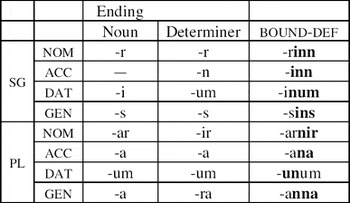
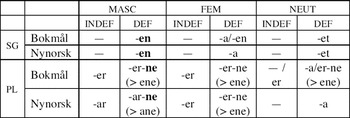
One of the criteria used by Faarlund (Reference Faarlund2007:29) is formulated as: “clitics may have their own inflection, while affixes are inflections.” The data used to support this claim can be summed up as in tables 1 and 2 (summarized from his tables 1–3).Footnote 23
Case and number marking on masculine nouns and bound-def in Old Norse.

Forms of bound-def in Bokmål and Nynorsk.

The point Faarlund (Reference Faarlund2007:29–30) makes with respect to table 1 is that the relative regularity of the endings of nominal and determiner forms allows us to describe bound-def as a form that is inflected.Footnote 24 From this he concludes that it is an independent lexical item, a clitic. The point he makes with respect to the data from Norwegian in table 2 is that the endings “have no identifiable common root, and can not [sic, cannot, KEB/PH] be analyzed as a stem + suffix” (Faarlund Reference Faarlund2007:30). This means that the points made with respect to the Old Norse and the Norwegian data are slightly different in nature: one refers to the inflection on bound-def in relation to nominal inflection (Old Norse) and one to the similarity in the basic shape of bound-def throughout the paradigm (Norwegian). We return to the point of inflection below, but with respect to the identifiable common shape to bound-def, we can compare the bold part of bound-def in tables 1 and 2. Given that Norwegian does not have a case system, the issue of consistency essentially becomes one of consistency between singular and plural, where the two forms are -en and -ne. The singular forms in the Old Norse data are quite consistent through the presence of -in in every form, but the notion of an “identifiable root” for bound-def does not stretch into plural in Old Norse any more than it does in Norwegian. We do not provide data here, but the situation is the same across genders; there is no more an identifiable part in Old Norse than there is in Norwegian.
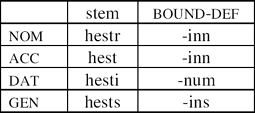
As mentioned in relation to table 1, Faarlund argues that Old Norse bound-def can have its own inflection on par with that of the noun. A related difference between the two stages referred to by Faarlund (Reference Faarlund2007: 23–24) is the fact that in Old Norse, bound-def is added to an inflected stem, whereas in Norwegian the stem is invariable. Faarlund views the separate marking on the stem in Old Norse as an indication of independence between the stem and bound-def, which is evidence of clitic status. We repeat the data from table 1 for masculine singular forms in table 3, with a full stem to make comparison with modern data easier.
Singular masculine stems and bound-def in Old Norse.
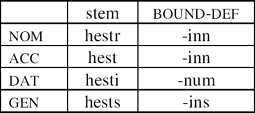
In Norwegian, there is one stem form, hest, for all singular forms. The erosion of the case system between Old Norse and Norwegian makes a comparison between the data in table 3 and Norwegian data difficult. However, the genitive can still serve to illustrate the reduced independ-ence of bound-def from its host: in Norwegian, the stem and bound-def are no longer marked independently for case, as illustrated in 24.
(24)
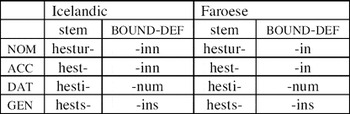
The situation in Danish and Swedish is the same, with the forms hestens and hstens, respectively. By contrast, Faroese and Icelandic retain a pattern similar to that of Old Norse, as illustrated in table 4 (as in table 3, only singular forms are provided).Footnote 25
Singular stems and bound-def in Icelandic and Faroese.

This independent marking of the stem is a property that appears to split the Scandinavian languages into Mainland Scandinavian and Insular Scandinavian. If the data presented in this section are taken as evidence that bound-def in Old Norse was a clitic—whereas it is an affix in Norwegian—then it would follow that it is an affix in all Mainland Scandinavian languages but a clitic in Insular Scandinavian. However, as we discuss below, not all properties cluster in this way. We also return to the connection Faarlund establishes between function (status as deter-miner) and morphosyntactic category (status as clitic). To our mind, the connection is not as direct as Faarlund assumes.
5.4. Relation to Free Definite Article
Faarlund (Reference Faarlund2007:25) claims that one criterion for clitic status is that “clitics have free word counterparts, affixes do not.” He attributes this position to Zwicky (Reference Zwicky1977). This is not an entirely accurate description: Zwicky (Reference Zwicky1977) recognizes three types of clitics; (i) simple clitics, prosodically weak variants of a full word that have the same distribution as their full counterparts; (ii) special clitics, also prosodically weak variants of full words that have a different distribution from their full counterpart, and (iii) bound words, prosodically weak elements that do not have a full counterpart. Accordingly, from Zwicky's perspective it has to be established by separate morphophonological criteria whether or not an element should be described as a clitic. Its possible relation to a full form will only determine what type of clitic it is. It is not clear that Zwicky (Reference Zwicky1977) makes any predictions about whether an affix could have a corresponding full form.
Faarlund's argument is that in Old Norse the free article (h)inn was the full variant of the bound -inn: since -inn has a different distribution from (h)inn, it must be a special clitic. In Norwegian, where the independent article den developed from a different Old Norse form, sá, Faarlund argues that bound-def lacks a corresponding full form. Under Faarlund's interpretation of Zwicky (Reference Zwicky1977), this is evidence that the element in question was a clitic in Old Norse and is an affix in Norwegian. However, given Zwicky's (Reference Zwicky1977) trichotomy, it would also be possible in principle to conclude on the basis of this set of data that the Old Norse element was a special clitic and the Norwegian one a bound word.
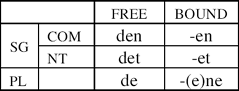
It is interesting here to consider Danish in particular. For Norwegian and Swedish, which have double definiteness, it may be inappropriate to refer to an alternative full form, since the two can co-occur. However, Danish shows complementary distribution between the free and the bound form, and the forms are also similar in shape (see table 5).
Forms of free-def and bound-def in Danish.
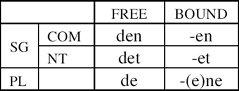
The issue, then, is how one judges whether these should also be considered free and bound variants of the same form, and hence whether the data in table 5 can be taken as evidence for the special clitic status of Danish bound-def under Faarlund's interpretation of Zwicky's (Reference Zwicky1977) criteria. The etymologies of the two elements are different, but we are quite confident that this is obscured to a native speaker by the similarity in shape: if the relation between the two forms is a property of the grammars of native speakers, then they may well be considered related in Danish, in spite of the etymology.
Under our interpretation of the distinctions made by Zwicky (Reference Zwicky1977), the presence or absence of a corresponding free form is not directly relevant to the morphosyntactic status of the bound element. Our conclusion is that whereas the historical relation or phonetic similarity between free-def and bound-def may determine what type of clitic it is, it does not distinguish between affix and clitic. Hence, the issue of whether the prenominal articles are or are not free versions of the bound article will not concern us further here. In section 5.6, we return to the issue of double definiteness, regardless of etymology or phonetic form, and what it can tell us about the morphological status of the elements.
5.5. Positioning
Bound-def in all varieties of Scandinavian referred to in this paper attach to the head noun and do not have their positioning defined with respect to the whole phrase. In the examples discussed so far, bound-def always appeared on the right edge, but this is only because the head of the noun phrase was the rightmost element. Old Norse, Icelandic, and Swedish examples containing postmodification are provided in 25–27, which show that bound-def is on the head even when this is not the rightmost elements.
(25) Old Norse (Valfells & Cathey Reference Valfells and Cathey1981:371)
a.
b.
(26) Icelandic
a.
b.
(27) Swedish
a.
b.
On the basis of such data, Faarlund (Reference Faarlund2007:30) proposes not to “establish a separate category of ‘phrasal affixes’ with their fixed pos-ition within the phrase.” However, in the literature to which Faarlund refers, one of the core criteria for clitic-hood is that clitics are placed with respect to a phrase and are thus in the domain of syntax, whereas affixes are placed with respect to a stem. Phrasal placement also entails that the clitic is less selective with regard to its host word, whereas an affix is highly selective. The fact that bound-def in Old Norse and all the modern varieties always occurs on the head noun would then normally be considered evidence of affix status. This should be contrasted with languages such as Romanian or Bulgarian, where bound-def essentially occurs in second position (see, for instance, Halpern Reference Halpern, Buszard-Welcher, Wee and Weigel1992). Anderson (Reference Anderson1993:77) does propose the Optimality Theo-retic constraint in 28, which brings the phrasal positioning and the head positioning together in one parameter.
(28) anchor {first vs last vs head}
However, this is done in the context of unifying the categories of affix and clitic (see Anderson Reference Anderson1992:199–210; Reference Anderson1993:76–80), and in particular to argue for an approach to “clitics” in terms of phrasal morphology. Under this approach, the distinctions that Faarlund attempts to make between affixes and clitics would not apply since they are aimed at distinguishing one as morphological and the other as syntactic.Footnote 26
Our conclusion is that from the assumptions that underlie Faarlund's criteria in general it follows that the positioning facts define bound-def as an affix in all Scandinavian languages, both early and modern. Given our suspicion that a dichotomy between clitic and affix would unfairly simplify the variation that exists, we just note here that positioning is a property with respect to which all bound-defs under discussion behave in the same way.
5.6. Co-occurrence of Definiteness Markers
So-called double definiteness—the co-occurrence of bound-def and free-def or another definite determiner— is a well-described property of Norwegian and Swedish.Footnote 27 It could be described as definiteness agree-ment, and though it is not a frequent property typologically, it is also not unknown (see note 9). Plank (Reference Plank and Plank2003), who uses the term “double articulation,” and Dahl (Reference Dahl and Kortmann2007a) provide overviews of different types of double definiteness marking. As demonstrated in section 4, Faarlund assumes that one of the crucial differences between Old Norse and Norwegian is that double definiteness developed between the two stages. Indeed, for Faarlund this distributional fact is intimately linked to the function and the morphosyntactic status of the marker; when it co-occurs with a syntactic determiner, bound-def no longer has the full status of a determiner functionally—in Faarlund's analysis, it can no longer fill D—and hence it is an affix rather than a clitic.
It is indeed true that the double definiteness, which is characteristic of Norwegian and Swedish, has developed since the first preserved sources. Examples of double definiteness are rare in the earliest texts, but not completely unattested. In 29, there are Old Norse and Old Swedish examples in which the demonstrative, a form of sá, co-occurs with bound-def. As 29c shows, double definiteness was also possible when the demonstrative followed the definite noun.
- (29)
a.
b.
c.
In examples with premodifying adjectives in Old Norse, by far the most common pattern is for definiteness to be marked only by the free pronominal article. However, early examples of double definiteness involving free-def can also be found, as in the Old Norse and Old Swedish examples in 30.
- (30)
a.
b.
The ON examples in 31 are particularly striking, since they exemplify what can be referred to as triple definiteness. The examples both combine the free demonstrative sá, the free demonstrative/definite article hinn, and bound-def; in 31a this is with a prenominal adjective and in 31b with a postnominal one (Barnes Reference Barnes2004:85, 86).
- (31)
a.
b.
All the examples of triple definiteness that we have found involve adjectival modification. This is not surprising given that there is a typo-logical tendency to have more definiteness marking in noun phrases with modifiers than in those without (see Dahl Reference Dahl and Kortmann2007a, and discussion in section 6.4). In light of Faarlund's discussion and what we say about the distribution in modern varieties of the Scandinavian languages below, it is interesting to note Barnes's (Reference Barnes2004:85) observation that examples with double definiteness are attested most frequently in Norwegian, as op-posed to Icelandic, sources of Old Norse.
Our conclusion with respect to older forms of the Scandinavian languages is that double definiteness was rare, but that there are enough examples of definiteness being marked more than once to serve as an indication that the development toward the modern double definiteness had already started.
In the case of the modern languages, the default mechanism in all varieties for the marking of definiteness for an unmodified noun is by means of bound-def.Footnote 28 These languages also share the property of normally requiring free-def when there is premodification, as in the examples in 32.Footnote 29
- (32)
a.
b.
All of these languages permit premodification without a syntactic determiner in some environments. Delsing (Reference Delsing1993:118–119), Börjars (Reference Börjars1998:203–212), and Julien (Reference Julien2005:31–34) provide overviews of such environments in Mainland Scandinavian. There are also dialects, particu-larly in the north of Sweden, in which adjectives are generally not preceded by free-def (see particularly Dahl Reference Dahl2007b). Though the descriptions by Thráinsson et al. (Reference Thráinsson, Petersen, í Lon Jacobsen and Svabo Hansen2004:96) and Julien (Reference Julien2005:26) of Faroese as a double definiteness language are correct (see data on de-monstratives below), there are more environments in which an adjective need not be preceded by free-def in Faroese than in the Mainland Scandinavian languages. Exactly which environments permit this is less well understood for Faroese than for the other languages, but they partly overlap with those of Mainland Scandinavian. (Lockwood Reference Lockwood1955 and Barnes & Weyhe Reference Barnes, Weyhe, König and van der Auwera1994 provide some relevant data.)
Icelandic is not a double definiteness language, as indicated in 33a.Footnote 30 In noun phrases with prenominal modification, the free article is optional and alternates with bound-def as in 33b,c. The use of the independent hinn in this environment is more often found in formal written language.
- (33)
a.
b.
c.
In Danish, free-def is obligatory when there is premodification, but free-def and bound-def are in complementary distribution much as in Icelandic.Footnote 31 When a demonstrative is used, the noun occurs without bound-def. The Danish pattern is illustrated in 34.
- (34)
a.
b.
c.
The examples in 32 showed that Faroese and Swedish have double definiteness when the pronominal article is used with an adjective.Footnote 32 Norwegian and Swedish have double definiteness also with demonstratives, as in 35.Footnote 33
- (35)
a.
b.
In Faroese, the demonstratives generally combine with the definite form of the noun, as in 36.
- (36)
a.
b.
With relative clauses, Faroese may have double definiteness even when no premodification is present (Lockwood Reference Lockwood1955:107). However, examples with just free-def are also permitted:
- (37)
a.
b.
In relation to demonstratives, Icelandic behaves as would be ex-pected for a language that does not show double definiteness. If the phrase contains a demonstrative, then the noun does not carry bound-def.
(38)
Largely, then, double definiteness defines two groups; Icelandic and Danish on the one hand and Swedish, Norwegian, and Faroese on the other. This is different from the groups defined by some of the other properties we have discussed and hence evidence that the behavior of bound-def does not divide the Scandinavian languages neatly into two categories.
Related to double definiteness is the possible co-occurrence of two free determiners. As we saw in section 4, both Faarlund (Reference Faarlund2007) and Abraham & Leiss (Reference Abraham and Leiss2007) assume that free definite determiners could co-occur in Old Norse, but cannot in Norwegian. However, empirically this is not entirely accurate; examples of combinations of a demonstrative and free-def can still be found in Norwegian, as in 39a,b. This is also the case in Danish and Swedish; an example from the latter is provided in 40.
- (39)
a.
b.
(40) Swedish
a.
b.
It is indeed true that such examples are rare in modern varieties of the languages, but the construction is still reasonably productive; the example in 39a is from a 1996 newspaper report on cross-country skiing and 40b is from a recent blog (fotolasse.se).Footnote 34 It would be quite plausible to analyze the examples in 39 and 40 as apposition, consisting of two separate noun phrases, with the demonstrative being used pronominally, so that DP recursion is not required. However, this would then also be an option for Old Norse, so that we would not want to see this as a clear difference between Old Norse and Norwegian, or indeed other modern varieties of the Scandinavian languages.
6. Form, Function, and Change
6.1. Summarizing the Scandinavian Data
Given the data surveyed here, we conclude that the differences between Old Norse and Norwegian and between the modern varieties of Scandinavian cannot be appropriately represented if it is assumed that there is a strict dichotomy between affixes and clitics. The criteria do not divide the languages into two distinct sets. We agree with Faarlund that the directionality of the change that took place in Scandinavian lan-guages is from a demonstrative to a free definite article to a bound definite article. However, we consider Faarlund's claim that bound-def was a clitic in Old Norse and developed into an affix in Norwegian an oversimplification. More generally, the slightly different paths of development the definiteness elements have taken in the modern languages mean that a division into two types of bound elements, each with its associated function, will not capture the data. Instead, it should be expressed in terms of change and variation in separate dimensions. In particular, the historical development of form and function should be kept separate; an element can develop from a less bound element (“clitic”) to a more bound element (“affix”) without its function neces-sarily changing. Similarly, an element can maintain the same degree of boundedness, while changing its function from a semantic definiteness marker to an agreement marker. A potential example of this would be the varieties of Spanish that have clitic doubling. Where the clitic occurs as the single exponent of a particular function, it has argument status, whereas in a doubling construction it can be assumed not to be an argument. However, as far as we are aware, there is no evidence of a difference in the morphosyntactic status of the element between the two environments.
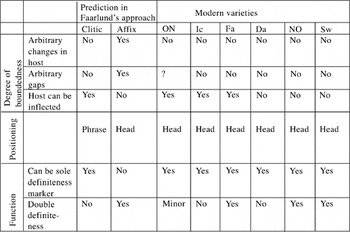
Slightly simplifying matters, we can describe the differences be-tween Old Norse and the modern standard varieties of the languages as in table 6.Footnote 35
Overview of differences between old and modern varieties of Scandinavian languages.

A first conclusion from the data is that there is little evidence of a radical change in category from Old Norse to Norwegian. Another conclusion that can be drawn, which also runs contrary to Faarlund's conclusions, is that as far as degree of boundedness goes, we have no evidence from any variety for either clitic or affix status. All varieties fail to display a set of properties described by Zwicky & Pullum (Reference Zwicky and K. Pullum1983) as “more characteristic of affixes than of clitics.” However, from the absence of these criteria, we cannot conclude that the elements are better described as clitics. Whether or not the genitive s is marked both on the stem and on bound-def is a property that divides the languages into two sets; Old Norse and Insular Scandinavian, on the one hand, and Mainland Scandinavian on the other. We interpret the intervening genitive marker in Old Norse and the Insular Scandinavian languages as evidence of more independence of bound-def. However, given the other data relating to boundedness and position, we do not wish to conclude that it is a clitic in these languages. Instead, we take it as evidence that a simple dichotomy into two categories is an oversimplification.
A second property that is clear for all varieties is that bound-def only attaches to the head noun, regardless of where in the noun phrase the head noun is situated.Footnote 36 This would normally be interpreted as evidence of affix-like behavior, but again we prefer not to use these categories. An overarching conclusion we draw from the application of the traditional clitic-affix criteria is that there is less of a clear-cut difference between Old Norse and Norwegian than Faarlund assumes.
Turning now to the properties relating to the function of bound-def, it is clear that in all languages there are some noun phrases in which bound-def is the only overt marker of definiteness. In most theoretical analyses of Scandinavian noun phrases, this is interpreted as evidence that bound-def, or the noun containing bound-def, shares some structural property with free-def—in particular that they are generated in, or move to, the syntactic position in the tree where free determiners are found; for example, head of DP or head of RP (see Delsing Reference Delsing1993, Embick & Noyer Reference Embick and Noyer2001, Lohndal Reference Lohndal, Stark, Leiss and Abraham2007, among others). Hankammer & Mikkelsen (Reference Hankammer and Hove Mikkelsen2002), in an analysis based on very different theoretical assumptions, posit a morphological rule that adds the definite ending and at the same time converts an N to a D. The result is an analysis in which the definite noun is a determiner and hence fills the D position. Faarlund differs from all these analyses in assuming that a noun phrase such as boka ‘book.def’ is a full referential noun phrase because D is filled by a zero definite determiner in D. All of these analyses have in common that semantic determiner status is associated with a structural position or category; a nominal phrase is a full referential noun phrase because a certain position is filled (albeit by a covert element in Faarlund's (Reference Faarlund2007) analysis). In the analysis we outline below, we make different assumptions.
All languages also have a free-def, and they divide into two sets with respect to the use of this element; those that allow bound-def to co-occur with it—Faroese, Norwegian, and Swedish—and those that do not—Icelandic and Danish. Old Norse would seem to be closer to the latter set, but developing toward the former. There are examples of double definiteness in early texts, though there are claims that this may have been a dialectal feature of Norwegian varieties. In all languages there are also other free determiners that are definite, such as demonstratives, and the pattern of co-occurrence with bound-def for these elements tends to be the same as for free-def.Footnote 37 In the theoretical accounts, the distribution in Danish and Icelandic is generally the one predicted in a straighforward way. The position that accounts for definiteness and referentiality is unique and can host either bound-def or free-def, but not both; hence the two cannot co-occur.Footnote 38 For languages displaying double definiteness, the issue arising is which of the two definiteness markers is the “real” determiner, free-def or bound-def. As discussed above, for Faarlund bound-def is never the true determiner in the modern varieties, so that there is always a free-def in the determiner positions—only sometimes it is not overt. For all other analyses we have considered, when there is double definiteness, free-def fills the determiner position and bound-def is reduced to some secondary status. This precedence of free-def appears to be a shared assumption, rather than a position argued for. In these models, where single marking of definiteness is the expected situation, an explan-ation needs to be offered for why some of the languages have double definiteness. We return to this issue below after we have considered a radically different approach to analyzing definiteness in the Scandinavian languages that avoids requiring either bound-def or free-def to be the real semantic determiner.
6.2. Analysis of Form and Function
It is not our intention in this paper to provide a detailed analysis of Scandinavian noun phrases. We only want to show that it is possible to provide a formal analysis that can capture the non-one-to-one relation between form and function which we have seen in the relation to Scandinavian definiteness marking. Since our model does not assume that there is a one-to-one relation between formal properties and functional properties, the issue of whether an element functions as a determiner is distinct from whether it fills a D position. Deciding whether or not an element functions as a determiner is a complex issue, but we can say that an element is a determiner functionally if it can combine with a singular count noun to form a referential noun phrase that is capable for instance of filling the subject argument role of a verb. Simplifying, we assume that referentiality is associated with a functional feature [def]. Bound-def in all these languages is a determiner functionally since a singular definite noun carrying the definite ending can function as a full referential noun phrase.Footnote 39
We use Lexical-Functional Grammar (LFG; Bresnan Reference Bresnan2001, Dalrymple Reference Dalrymple2001, Falk Reference Falk2001), in which separate dimensions of linguistic information are assumed. The two most relevant to our account are c-structure and f-structure. C-structure is represented as trees capturing constituent structure and category status, and an f-structure is represented as a feature matrix, capturing grammatical functions like subject and object, but also features such as definiteness. The two dimensions are related by a mapping function that permits non-one-to-one relations. A definite noun in Swedish such as grodan ‘frog.def' would then be associated with features as in 41a—ignoring most features not relevant to the discussion at hand—and with the resulting partial categorial structure in 41b.
- (41)
a.
b.
The arrows in this representation capture the mapping between c-structure and f-structure. With each node in the c-structure tree is associated an f-structure. An arrow at a node makes reference to a particular f-structure: [up-arrow] to the f-structure associated with the mother node and [down-arrow] to the f-structure associated to the node itself. The information associated with the lexical entry in 41a then ensures that the f-structure information with respect to its meaning (through the pred feature) and its definiteness becomes associated with the f-structure of the mother of the node under which grodan is inserted. In 41b, the annotation under N is introduced through phrase structure rules.Footnote 40 “↑=↓” should be interpreted as: the f-structure associated with this node's mother node is the same as the f-structure associated with this node. This means that f-structure features of the lexical element are, so to speak, passed on up the tree: in other words, two nodes in the c-structure are associated with the same f-structure. In 41, it is the feature belonging to grodan that ensures that the f-structure associated with its mother phrase contains [+def] and hence is a full noun phrase.
Under this approach, definiteness is not associated with a position, but with a feature and hence it is not necessary to determine which of the two definiteness markers is the determiner functionally in double definiteness constructions. Since definiteness is not expressed through one position, both elements can contribute the same information. A parallel would be a language with both subject-verb agreement and case marking—for example, Latin—so that grammatical relations can be said to be indicated in two ways. We see this as an advantage of this model. As we saw, in all analyses of double definiteness referred to here, the free article is deemed to be the one that contributes the crucial feature. Given that in most of these languages it is only bound-def that can actually occur in noun phrases where definiteness is expressed only once, this strikes us as odd. There is an inflection in these languages that corresponds to definite-indefinite, but which generally does not have the function of a determiner, namely the weak-strong marking on adjectives. As the example in 42 shows, for an adjective to be used nominally it has to carry bound-def, as on högern; the weak ending is not sufficient (except in elliptic constructions). This should be contrasted with an adjective that is part of a definite noun phrase, such as vnstra in 42.
(42)
It would seem inappropriate then for bound-def to be analyzed in the same way as weak, as a non-functional agreement marker.
Accordingly, the lexical entry for free-defden is as in 43a, the tree structure for den lilla grodan as in 43b, and the resulting f-structure as in 43c.
- (43)
a.
b.
c.
As in 41, the annotations not associated with lexical elements are introduced through the phrase structure rules that license the tree. D and NP both have ↑=↓, which means that their respective f-structures contribute equally to the f-structure of the mother DP. This means that in an English noun phrase like the dogs, the value for the number feature comes from the noun, whereas in those sheep it comes from the determiner. In LFG terms, D and NP are f-structure co-heads. The annotation for the AP is slightly more complicated since an adjunct becomes a member of the set of adjuncts. This detail should not obscure the general idea behind this solution. The feature value [def +] in 43c is contributed to in equal measures by free-def and by bound-def.
The type of analysis sketched here differs crucially from those referred to above in this section in that determiner status is not defined structurally, but is a functional property. It is captured here by a feature [def], which can be contributed by a noun in N or by a determiner in D. This means that the representation does not require us to assign priority to either free-def or bound-def, unless there are independent reasons to do so.
6.3. Accounting for Double Definiteness
If all bound-defs in the standard Scandinavian languages are functional determiners, does this not make it more difficult to make a distinction between those languages that have double definiteness and those that do not? It strikes us that no principled explanation has been offered for this distinction in the literature. For example, Julien (Reference Julien2005:4,24,65–9) assumes that in all Scandinavian languages except Danish the definite ending is acquired by means of movement through nP. By contrast, Danish has an obligatorily empty n in nP, with the definite ending in-stead being found in D and hence competing with a free determiner. This means that Danish and Icelandic lack double definiteness for very different reasons in Julien's account (for Icelandic, see Julien Reference Julien2005:54–57). Embick & Noyer (Reference Embick and Noyer2001:580–584) distinguish between the double definiteness of Swedish and the complementary distribution of Danish by assuming a constraint on Swedish; “The head N must be marked with definiteness when D is [def],” which does not hold for Danish. This seems to offer little more insight than a purely descriptive statement of the difference between Danish and Swedish. All analyses of the differ-ence between double and single definiteness appear to be somewhat stipulative and we have no insightful analysis to add. In Börjars Reference Börjars1998, it was captured by means of subcategorization. This may be because it is a relatively superficial phenomenon, not associated with deep semantic properties, and hence there may not be any fundamental principled explanation. For example, Faroese, which in many ways sides with Icelandic in being rather conservative morphosyntactically, has double definiteness even though Icelandic does not have it to any greater extent. The main contact influence on Faroese is Danish, also a language that lacks double definiteness. At the same time, Faroese is most likely a descendant of a variety of Old Norse spoken in Norway, and Barnes (Reference Barnes2004:85) states that double definiteness might be more common in forms of Old Norse from the east—Norway—than those from the west—Iceland. As an anonymous referee pointed out to us, Falk & Torp (Reference Falk and Torp1900:63–64) state that Danish showed double definiteness until the 16th century. A better understanding of the extent and spread of double definiteness in varieties of earlier forms of Scandinavian might help us understand the differences between languages in which bound-def can co-occur with free-def and those in which it cannot.
Not only historical data but also variation in modern varieties of the languages can help us understand the phenomenon of double definite-ness. Dahl (Reference Dahl and Kortmann2007a, Reference Dahlb) shows that in what he terms “peripheral Swedish” bound-def has a stronger standing as the main marker of definiteness than in the standard language, or indeed than in Danish. In many Northern Swedish dialects, for instance, there is no need for a free-def with a pronominal adjective. Instead the adjectives are incorporated into the noun and the only marking of definiteness is bound-def, as illustrated in the examples in 44.
- (44)
a.
b.
In Germanic languages spoken further south in Europe, including English, Dutch, German, and the South and West Jutlandic dialects of Danish, free-def is the only option. Dahl (Reference Dahl and Kortmann2007a:178) refers to this as two distinct grammaticalization patterns, arguing that “it is natural to see ‘double determination’ as one possible outcome of the competition be-tween two different grammaticalizing definite articles.” With reference to Stilo Reference Stilo, Csató, Isaksson and Jahani2005, Dahl suggests that the double definiteness area constitutes a “buffer zone,” that is, an area in which two or more grammaticalization patterns meet and the result is a variety in which both patterns are incorporated. (This idea is developed in Kuteva & Heine Reference Kuteva, Heine and Good2008:222–228.) Seen this way, double definiteness in the Scandinavian languages is the “accidental” result of a mixture of two grammaticalization patterns. An analysis within which the distribution is accounted for in a relatively “superficial” manner (for example, as morphosyntactic selection restrictions) may then be the most appropriate.
6.4. Accounting for free-def with Adjectives
All analyses of Scandinavian noun phrases, except those dealing exclusively with Icelandic, require an explanation for why free-def is required when there is premodification. As we have seen, most analyses assume that bound-def, or the noun carrying bound-def, move to fill the position of the determiner. The question then arises as to why it cannot do so when there is premodification—why is a free-def required under these circumstances? Generally, the explanation lies in some prohibition on a definite noun moving past an adjective phrase into the D position (for example, Delsing Reference Delsing1993, Julien Reference Julien2005). Faarlund differs from the other movement-based accounts in that no special provision is required for noun phrases with adjectives, since definite noun phrases always contain a determiner in D. The only difference when there is no premodification is that the syntactic determiner is covert. In Hankammer & Mikkelsen Reference Hankammer and Hove Mikkelsen2002, the definite noun is of category D and hence projects a DP rather than an NP. The reason a noun phrase such as r⊘de hesten ‘red.wk horse.def’ is ungrammatical is that APs adjoin to NPs and in this example there is no NP to adjoin to. This explanation would not be transferrable to the Scandinavian languages that have double definite-ness, since definite nouns in these languages are still assumed to be of category N. Börjars (Reference Börjars1998) captures the obligatory presence of free-def with adjectives by means of a selectional restriction on adjectives, requiring them to combine with a nominal, which then combines with a free-def.Footnote 41
An explanation for the obligatory presence of free-def with adjectives might be sought in what is known about the development of definiteness markers. Dahl (Reference Dahl and Kortmann2007a) suggests that the development of a definite article frequently starts with APs requiring a definiteness marker as a consequence of the semantics of restrictive modification. Indeed, Dahl argues that typologically it is the case that noun phrases with modification will often have more definiteness markers than noun phrases without modification and never less. If Dahl is correct in this—and there is certainly one interpretation of the development of the Scandinavian definiteness marker that supports his assumption—then we can distinguish the following stages in the development of definiteness:
Stage 1: no dedicated definiteness marking.
Stage 2: dedicated definiteness marking with (restrictive) modification only.
Stage 3: dedicated definiteness marker with all noun phrases.
As Dahl points out, the definiteness marker at stage 1 tends to be adjacent to the modification. A language like Russian can be said to be at stage 1 and English at stage 3. All the Scandinavian languages except Icelandic would then have gone through to stage 3 with respect to (h)inn; it developed from a demonstrative to a definiteness marker associated with the premodification, but then generalized as a marker of definite-ness and became associated with the head noun rather than the modifier. In all these languages, the demonstrative sá appears to have reached stage 2. One could speculate that this is because the development of (h)inn meant that it was no longer associated with modification. Icelandic, by contrast, appears to have remained stable at stage 3, with bound-def being a general noun phrase marker of definiteness, and there being no separate definiteness marker particularly associated with modification. Dahl (Reference Dahl and Kortmann2007a:152) suggests that the association between modification and extra definiteness marking may be related to the semantics of modified nouns:
As a possible explanation of such a development [of extra definiteness marking with modified noun phrases, KEB/PH], consider the fact that an adjective or a relative clause (used restrictively) commonly singles out a subset within the set denoted by the head noun, contrasting it to its complement set.
Whereas his conclusion about the existence of double definiteness relates it to geographical accident, the account for the extra definiteness marking with modifiers would then be more principled. It should be noted though that Dahl's account has nothing to say about why it is specifically in the case of prenominal modification that extra definiteness is required in the Scandinavian languages other than Icelandic.
Dahl (Reference Dahl2007b) shows that there are varieties of Swedish in which bound-def has been generalized in meaning to occur in generics and non-delimited (“partitive”) uses.Footnote 42 We could then add stage 4 to the development of definiteness:
Stage 4: the original definiteness marker has generalized to environments not normally associated with definiteness.
If the generalization process develops to this stage, then the meaning will have been weakened to the extent that it can be said to lack definiteness marking; the language is back at stage 1. We may then have a “cycle of determination,” similar to Jespersen's cycle of negation (Jespersen Reference Jespersen1917).
7. Conclusion
We hope to have shown that a direct link between formal and functional properties cannot be maintained as far as definiteness marking in the Scandinavian languages is concerned. If the existence of double definite-ness is taken as evidence of the agreement marker status of bound-def, as most analyses in the literature do, then it can be shown that this cannot be correlated directly with the affix, as opposed to clitic, status of the element. To the extent that there is any difference between the degree of boundedness of bound-def, it is less bound, and hence less affix-like, in Icelandic and Faroese. Yet, Icelandic does not have double definiteness whereas Faroese does. Norwegian, Swedish, and Danish all have a more strongly bound bound-def, but whereas Norwegian and Swedish have double definiteness, Danish does not. Our conclusion is also that the difference between Old Norse and Norwegian is not as profound as argued by Faarlund—essentially it lies in the fact that double definiteness has become a more dominating pattern. However, this has not been accompanied by any drastic changes in the boundedness of bound-def.