Introduction
Evidence has accumulated to indicate that monitoring and treating individuals developing schizophrenia as early as the prodrome improves outcomes (Kane et al. Reference Kane, Robinson, Schooler, Mueser, Penn, Rosenheck, Addington, Brunette, Correll, Estroff, Marcy, Robinson, Meyer-Kalos, Gottlieb, Glynn, Lynde, Pipes, Kurian, Miller, Azrin, Goldstein, Severe, Lin, Sint, John and Heinssen2016). Given the low population prevalence of schizophrenia, screening all children/adolescents is presently not feasible. However, adolescents engaging in antisocial behaviour are at elevated risk of schizophrenia (Hodgins, Reference Hodgins2008; Hodgins et al. Reference Hodgins, Piatosa and Schiffer2014), and additionally for persistent substance misuse and offending, that in turn reduces compliance with treatment for psychosis. Therefore, screening antisocial adolescents within health and justice services would potentially allow for the initiation of antipsychotic medication as symptoms emerge, and also for treatments targeting co-morbid substance misuse and antisocial behaviour.
Five lines of evidence suggest that adolescent substance misusers may be at elevated risk, as compared with other teenagers who do not misuse substances, to subsequently develop schizophrenia. The first line of evidence shows that between 20% and 40% of individuals who develop schizophrenia present conduct disorder in childhood/adolescence (Hodgins, Reference Hodgins2008; Hodgins et al. Reference Hodgins, Piatosa and Schiffer2014). Almost all adolescents with conduct disorder misuse substances from a young age (Robins & McEvoy, Reference Robins, McEvoy, Robins and Rutter1990; Compton et al. Reference Compton, Conway, Stinson, Colliver and Grant2005; Costello, Reference Costello2007; Hasin & Kilcoyne, Reference Hasin and Kilcoyne2012). Among those who develop schizophrenia, childhood conduct disorder is associated with an increased risk of heavy use of cannabis before the age of 14 years (Malcolm et al. Reference Malcolm, Picchioni, DiForti, Sugranyes, Cooke, Joseph, McQueen, Paparelli, Stilo, O'Connor, Morgan, Murray and Hodgins2011).
A second line of evidence that includes a meta-analysis (Large & Nielssen, Reference Large and Nielssen2011) and subsequent studies (Hodgins et al. Reference Hodgins, Calem, Shimel, Williams, Harleston, Morgan, Dazzan, Fearon, Morgan, Lappin, Zanelli, Reichenberg and Jones2011; Winsper et al. Reference Winsper, Singh, Marwaha, Amos, Lester, Everard, Jones, Fowler, Marshall, Lewis, Sharma, Freemantle and Birchwood2013) confirms that large proportions of first-episode patients have a history of criminality and substance misuse (Hodgins et al. Reference Hodgins, Calem, Shimel, Williams, Harleston, Morgan, Dazzan, Fearon, Morgan, Lappin, Zanelli, Reichenberg and Jones2011; Winsper et al. Reference Winsper, Singh, Marwaha, Amos, Lester, Everard, Jones, Fowler, Marshall, Lewis, Sharma, Freemantle and Birchwood2013). Among patients at the Early Psychosis Prevention and Intervention Centre in Melbourne, 30% were reported to have a record of offending and, of them, three-quarters presented a substance use disorder (SUD) (Marion-Veyron et al. Reference Marion-Veyron, Lambert, Cotton, Schimmelmann, Gravier, McGorry and Conus2015).
A third line of evidence shows that antisocial and aggressive behaviour may precede the prodrome. Based on the findings reported above, the Melbourne Centre established a pilot forensic satellite clinic embedded within an early intervention service for patients with emerging psychosis, mood disorder and/or personality disorders. Two-thirds of the patients were referred due to violent behaviour and 38% due to homicidal ideation. More than three-quarters had a history of aggressive behaviour and 51% criminal offending (Purcell et al. Reference Purcell, Fraser, Greenwood-Smith, Baksheev, McCarthy, Reid, Lemphers and Sullivan2012). Another recent study reported that more than one-third of ultra-high-risk patients had a history of violent behaviour (Hutton et al. Reference Hutton, Parker, Bowe and Ford2012). Additionally, studies of community samples of adolescents show a positive association between psychotic-like-experiences and violent behaviour (Kinoshita et al. Reference Kinoshita, Shimodera, Nishida, Kinoshita, Watanabe, Oshima, Tatsuo Akechi, Sasaki, Inoue, Furukawa and Okazaki2011).
A fourth line of evidence focuses on psychotic disorders among juvenile delinquents. A meta-analysis of studies of mental disorders among detained juvenile offenders in the USA, UK, Australia, Russia, Holland, Denmark, Canada and Spain reported that psychotic illness was present in 3.3% of boys and 2.7% of girls (Fazel et al. Reference Fazel, Doll and Långström2008). While a study of juvenile offenders in the USA reported that few developed schizophrenia in the following 48 months (Teplin et al. Reference Teplin, Welty, Abram, Dulcan and Washburn2012), a study that examined all the offenders aged 15–19 years old in Denmark reported that 3.3% subsequently developed schizophrenia, as compared with the expected 0.7%, with the highest risk among those who had committed violent offences (Gosden et al. Reference Gosden, Kramp, Gabrielsen, Andersen and Sestoft2005).
Finally, prospective, longitudinal investigations show that heavy use of cannabis in early adolescence is associated with an increased risk of schizophrenia (Arseneault, Reference Arseneault2002; McGrath et al. Reference McGrath, Welham, Scott, Varghese, Degenhardt, Hayatbakhsh, Alati, Williams, Bor and Najman2010).
Taken together, this evidence led us to hypothesize that a disproportionate number of adolescents misusing substances would subsequently develop schizophrenia. To test this hypothesis, we compared individuals who had been treated at the only clinic for adolescents with substance use problems in a large urban centre in Sweden with individuals of the same age and sex who had no history of treatment for substance misuse in adolescence. One clinical sample (CS1) included 1992 adolescents treated at the clinic from 1968 to 1971, and 1992 matched participants randomly selected from the general population (GP1) followed to the age of 50 years. A second clinical sample (CS2) included 1576 individuals treated from 1980 to 1984 and a matched GP2 followed to the age of 35 years. A third, smaller, CS3 was recruited at the clinic in 2004, followed for 5 years and compared with age- and sex-matched peers in the general population (GP3). National registers were used to document diagnoses of schizophrenia and SUDs, physical disorders related to substance misuse, criminal convictions, poverty and death.
The study aimed to determine: (1) whether adolescents seeking treatment for substance misuse were at elevated risk to subsequently develop schizophrenia compared with age- and sex-matched peers in the general population; (2) whether this risk has changed since the late 1960s; (3) whether cannabis use specifically predicted the subsequent development of schizophrenia; and (4) whether substance misuse in adolescence predicted SUDs, physical disorders related to substance misuse, criminal convictions, poverty and death among those who developed schizophrenia. All analyses were conducted separately for females and males.
Method
Participants
The clinical samples included individuals treated at the only clinic for adolescent substance misuse in a large urban centre in Sweden. CS1 included 1992 individuals, 1660 males and 332 females, who had been treated from 1968 to 1971. CS2 included 1576 individuals, 1010 males and 566 females treated from 1980 to 1984. CS1 and CS2 included all cases treated at the clinic except for a few cases with missing files and/or person identification numbers. Statistics Sweden created general population (GP) samples 1 and 2 by randomly selecting for each individual in CS1 and CS2 an individual in the general population with the same sex, month and year of birth, and birth place (city, outside city, outside Sweden) (for further details, see Larm et al. Reference Larm, Hodgins, Larsson, Samuelson and Tengström2008; Hodgins et al. Reference Hasin and Kilcoyne2009 Reference Hodgins, Larm, Molero-Samuleson, Tengström and Larssonb14). CS1 and GP1 were followed to the age of 50 years, and CS2 and GP2 to the age of 35 years. CS3 was recruited in 2004. It is a random sample of clinic clients (see Hodgins et al. Reference Hodgins, Tengström, Engström, Bylin, Göranson, Hagen, Jansson, Larsson, Lundgren-Andersson, Lundmark, Norell and Pedersen2007), 81 males and 99 females, who were assessed at admission to the clinic, and at 6, 12 and 60 months later. GP3 included all males and females aged 15–24 years in Stockholm county from 2000 to 2009. At intake to the clinic males were aged, on average, 17.8 years (CS1 and GP1), 17.3 years (CS2 and GP2) and 16.9 years (CS3). The mean ages of females were 16.8 years (CS1 and GP1), 16.9 years (CS2 and GP2) and 16.5 years (CS3).
Measures
Information about adolescent substance misuse for CS1 and CS2 was extracted from clinic files. Drug use severity was rated as: 0 = no or sporadic drug use (<1 time/month); 1 = steady drug use (1–8 times/month or unspecified); 2 = frequent drug use (>3 times/week) or drug abuse; 3 = dependence. Socio-economic status (SES) of the family was indexed by parents’ occupation. For CS3, drug use severity was assessed by interviews using the Kiddie-Schedule for Affective Disorders and Schizophrenia for School-Aged Children – Present and Lifetime Version (K-SADS; Kaufman et al. Reference Kaufman, Birmaher, Brent, Rao, Flynn, Moreci, Williamson and Ryan1997) for participants 17 years or younger, and the Structured Clinical Interview for Diagnostic and Statistical Manual of Mental Disorders, fourth edition (DSM-IV) Axis I and II Disorders (SCID-I and -II; First et al. Reference First, Spitzer, Gibbon and Williams1996, Reference First, Gibbon, Spitzer, Williams and Benjamin1997) for participants 18 years and older and rated as: 0 = no or sporadic drug use (<2 times/month); 1 = steady drug use (2–10 times/month); 2 = frequent drug use (>10 times/month) or drug abuse; 3 = dependence.
Information about mental disorders up to the age of 50 years for CS1 and GP1, and to the age of 35 years for CS2 and GP2, was obtained from the Hospital Discharge Register. The Hospital Discharge Register, maintained by the National Board of Health and Welfare, includes files for all persons in Sweden. Each file includes the personal identification number, dates of each hospitalization and the International Classification Disease codes (World Health Organization, 1968, 1978, 1990) for the primary disorder requiring treatment. The accuracy of the register is estimated to be between 85 and 95% (Ludvigsson et al. Reference Ludvigsson, Andersson, Ekbom, Feychting, Kim, Reuterwall, Heurgren and Olausson2011).
For CS3, diagnoses were obtained from the Hospital Discharge Register and from interviews conducted four times during the 60-month follow-up using either the K-SADS (Kaufman et al. Reference Kaufman, Birmaher, Brent, Rao, Flynn, Moreci, Williamson and Ryan1997) or the SCID-I and -II (First et al. Reference First, Spitzer, Gibbon and Williams1996, Reference First, Gibbon, Spitzer, Williams and Benjamin1997). Data from the health register for CS3 were extracted on the last day of 2009. GP3 included all males and females aged 15–29 years in Stockholm county. Aggregated data for GP3 were downloaded from the webpage of the National Board of Health and Welfare (Swedish National Board of Health and Welfare, 2014). The incidence of schizophrenia was the sum over 10 years (2000–2009). The mean age of CS3 was 21.7 years when the health records were collected, which is significantly younger than the mean age (22.5 years) of GP3 (t 179 = −6.1, p < 0.001).
For CS1, GP1, CS2 and GP2, Statistics Sweden de-identified all data including information from the old clinic files, and merged files for the clinic and general population samples. Additionally, for CS1 and GP1 information was obtained up to the age of 50 years from national registers on criminal convictions, welfare payments and death, and for CS2 and GP2 up to the age of 35 years (see Hodgins et al. Reference Hodgins, Larm, Molero-Samuleson, Tengström and Larsson2009).
Ethical approval
Studies of CS1, GP1, CS2 and GP2 were approved by the Ethics Committee of the Karolinska Institute. All waves of data collection for CS3 were approved by the Karolinska Institute Research Ethics Committee Nord and/or the Regional Board for Research Ethics in Stockholm.
Statistical analyses
Odds ratios were computed to compare the prevalence of schizophrenia in the CS and GP samples and outcomes in adulthood of participants with schizophrenia who had and who had not received treatment in adolescence for substance misuse. We used χ2 tests to compare proportions of participants using various substances and analyses of variance to compare scores for severity/frequency of use. SES of the parents of individuals in CS1 and CS2 was not associated with the subsequent development of schizophrenia and therefore not included in statistical comparisons.
Results
Are adolescents treated for substance misuse at elevated risk to develop schizophrenia?
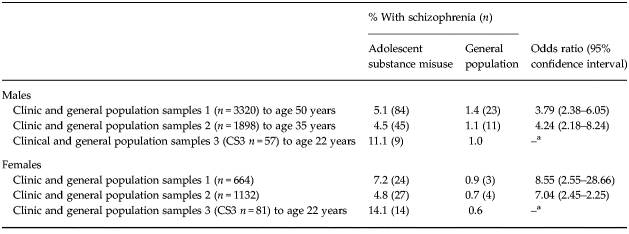
As presented in Table 1, the prevalence of schizophrenia was higher among CS1 up to the age of 50 years and CS2 up to the age of 35 years than in GP1 and GP2. While the odds ratios in males in CS1 and CS2 hovered around 4, in females they rose to 7 and 8. In CS3, diagnostic interviews and health files indicated that at an average age of 21.7 years, 11% of the males and 14% of the females had a diagnosis of schizophrenia as compared with 1.0% of the males and 0.6% of females of similar age in Stockholm country.
Odds ratios for the subsequent development of schizophrenia among individuals treated for substance misuse in adolescence compared with age- and sex-matched peers not treated for substance misuse

a Odds ratios could not be calculated for CS3 compared with GP3 as GP3 was aggregated data for all 15- to 29-year-olds in Stockholm county.
Has this risk changed over time?
Among both males and females, the percentages that developed schizophrenia in CS1 and CS2, and in GP1 and GP2, were similar as confirmed by statistical comparisons. Among females, fewer in CS2 than in CS1 developed schizophrenia, though the difference was not statistically significant. Among both males and females in CS3, by an average age of 22.4 years, among males, the prevalence of schizophrenia was higher than in the older samples that had been followed to the age of 50 or 35 years. CS3 is small and, unlike participants in CS1 and CS2, they completed diagnostic interviews four times from adolescence to early adulthood. Consequently, the most cautious interpretation of the results is that among individuals treated in adolescence for substance misuse there has been no change in risk of developing schizophrenia since the late 1960s.
Is adolescent cannabis use associated with a higher risk of developing schizophrenia?
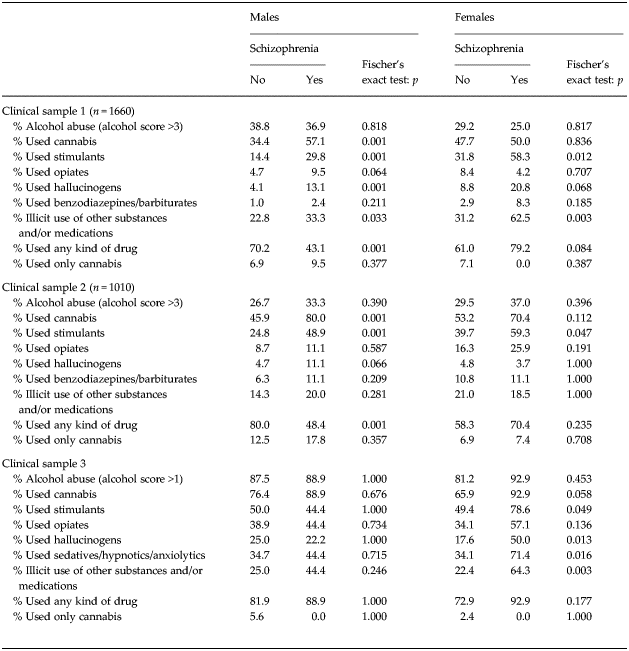
From the late 1960s until 2004, the proportions of participants treated for substance misuse who used cannabis rose from 37.6% in CS1, to 49.8% in CS2, and to 73.3% in CS3. Table 2 presents the substances used by participants in the clinical samples in adolescence comparing those who did and who did not develop schizophrenia. Only among males in CS1 and CS2 had greater proportions of those who developed schizophrenia, than those who did not, used cannabis. Additionally, the development of schizophrenia was associated with use of stimulants in CS1 and CS2 males and CS1, CS2 and CS3 females, hallucinogens in CS1 males and CS3 females, and illicit use of other drugs and medications in CS1 males, CS1 and CS3 females, and sedatives in CS3 females. Few participants in any of the samples used only cannabis with no difference between those who did and did not develop schizophrenia.
Use of substances during adolescence of males and females who did and who did not subsequently develop schizophrenia

Evidence shows that it is heavy use of cannabis in adolescence that is associated with the subsequent development of schizophrenia (Arseneault, Reference Arseneault2002; McGrath et al. Reference McGrath, Welham, Scott, Varghese, Degenhardt, Hayatbakhsh, Alati, Williams, Bor and Najman2010). Therefore, participants who did and who did not develop schizophrenia were compared as to the severity of drug use in adolescence. Among males in both CS1 and CS2, the proportions that subsequently developed schizophrenia increased as a function of the adolescent substance use severity score for any drug use. CS1: score 0 – 2.9%; score 1 – 7.8%; score 2 – 10.2%; score 3 – 6.5% [χ2(3, n = 1660) = 29.623, p < 0.001]; CS2: score 0 – 1.9%; score 1 – 6.2%; score 2 – 7.5%; score 3 – 12.5% [χ2(3, n = 1010) = 148.245, p < 0.001].
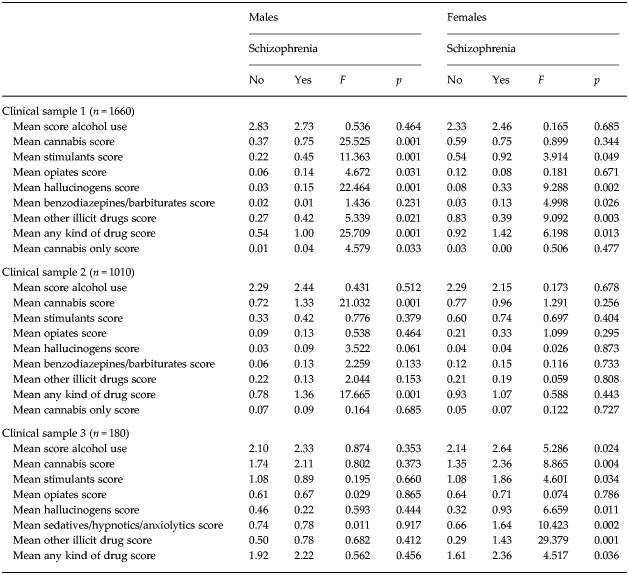
As presented in Table 3, among males in CS1, those who developed schizophrenia by the age of 50 years, as compared with those who did not, obtained higher severity scores for use of cannabis, stimulants, opiates, hallucinogens, and illicit use of other substances and/or medications. CS2 males who developed schizophrenia by the age of 35 years, as compared with those who did not, obtained higher severity scores only for use of cannabis.
Severity of use of substances in adolescence of males and females who subsequently did and did not develop schizophrenia

Among females in CS1 and CS2, the proportions of participants who developed schizophrenia generally increased with the severity score for any drug use, with no statistically significant differences. CS1 females who developed schizophrenia by the age of 50 years, as compared with those who did not, obtained higher severity scores for use during adolescence of stimulants, hallucinogens, sedatives, and illicit use of other substances and/or medications. CS2 females who did and who did not develop schizophrenia by the age of 35 years, in adolescence obtained similar severity scores for the use of all substances. Among CS3 females, those who developed schizophrenia, as compared with those who did not, obtained higher severity use scores for alcohol, cannabis, stimulants, hallucinogens, sedatives, and illicit use of other substances and/or medications.
In summary, among males, not females, in CS1 and CS2 greater proportions of those who did, as compared with those who did not, develop schizophrenia used cannabis and obtained higher severity ratings for cannabis use. Among males and females in CS1 and CS2, and females in CS3, greater proportions of those who subsequently developed schizophrenia had used stimulants.
Among those who develop schizophrenia, is adolescent substance misuse associated with an increased risk of SUDs, physical disorders linked to substance misuse, criminal convictions, poverty and death in adulthood?
SUDs were more common among participants with, than without, schizophrenia: males CS1 + GP1, 23.4% v. 5.8% [Fisher's exact test (FET), p < 0.001]; males CS2 + GP2, 35.7% v. 8.0% (FET, p < 0.001); females CS1 + GP1, 18.5% v. 6.3% (FET, p = 0.030); females CS2 + GP2, 35.5% v. 7.7% (FET, p < 0.001).
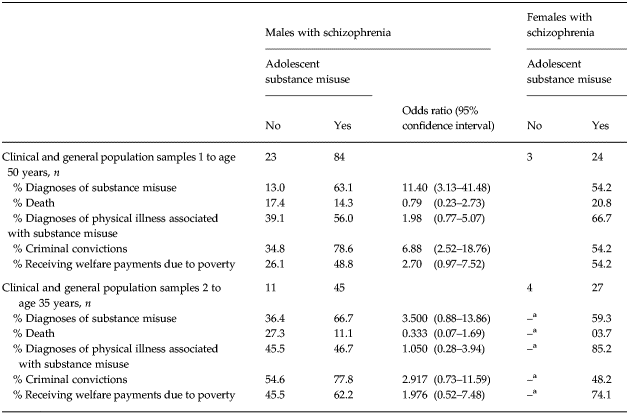
Table 4 includes all participants with schizophrenia in CS1, GP1, CS2 and GP2. Among males with schizophrenia in the oldest cohorts (CS1, GP1), treatment for substance misuse in adolescence was associated with an 11-fold increase of SUDs in adulthood. Among males with schizophrenia in CS2 and GP2, two-thirds of those in CS2 had acquired a diagnosis of SUDs by the age of 35 years as compared with 36.6% of GP2. The difference was not statistically significant.
Comparisons of adult outcomes of men and women with schizophrenia who did and who did not receive treatment for substance misuse in adolescence

a There were too few cases in GP3 to allow comparisons.
Among the men with schizophrenia in CS1 and GP1, those treated for substance misuse in adolescence were six times more likely to have been convicted of a criminal offence by the age of 50 years. By contrast, among the men with schizophrenia in CS2 and GP2, there were no significant differences in the prevalence of adult outcomes. Among the females in GP1 and GP2, too few developed schizophrenia to allow comparisons with females in CS1 and CS2 who developed schizophrenia. In both CS1 and CS2 almost half of the women with schizophrenia had been convicted of at least one crime, at least half had a diagnosis of SUDs and the majority were poor.
Discussion
The present study followed 7136 individuals, half of whom had sought treatment for substance misuse in adolescence, through decades of adulthood. More of those treated for substance misuse in 1968–1971 and 1980–1984, than their age- and sex-matched peers who did not seek substance misuse treatment as adolescents, subsequently developed schizophrenia. Among males, the odds ratios were approximately 4, and among females above 7. In a small sample recruited in 2004 at the same clinic, 5 years later the proportion that had developed schizophrenia far exceeded that among age- and sex-matched peers. Further, among those who developed schizophrenia, treatment for substance misuse in adolescence was associated with elevated rates of co-morbid SUDs in adulthood. Males with schizophrenia in CS1 were 11 times more likely to have a diagnosis of SUDs than males with schizophrenia in GP1. While the CS2–GP2 comparison was not statistically significant, of the males with schizophrenia, two-thirds of those treated for substance misuse in adolescence presented SUDs in adulthood as compared with one-third of those not treated in adolescence. Further, among those with schizophrenia who had been treated for substance misuse in adolescence the proportions with criminal convictions and who were poor were elevated.
These findings point to the importance of screening adolescents misusing substances for developing schizophrenia in order to provide optimal care as early as possible thereby enhancing response to antipsychotic medication when it is needed (Amminger et al. Reference Amminger, Henry, Harrigan, Harris, Alvarez-Jimenez, Herrman, Jackson and McGorry2011). Consistent with previous evidence, the present study showed that through adulthood greater proportions of individuals with, than without, schizophrenia acquired SUDs diagnoses. These disorders, co-morbid with schizophrenia, are associated with a significantly increased risk of violence towards others (Fazel et al. Reference Fazel, Långström, Hjern, Grann and Lichtenstein2009). Consequently, effective treatment of substance misuse, and other forms of antisocial behaviour, while monitoring the developing psychosis, could potentially prevent further substance misuse, antisocial behaviour and criminal offending (Marion-Veyron et al. Reference Marion-Veyron, Lambert, Cotton, Schimmelmann, Gravier, McGorry and Conus2015). Such programmes have been proposed (Purcell et al. Reference Purcell, Fraser, Greenwood-Smith, Baksheev, McCarthy, Reid, Lemphers and Sullivan2012).
There was no evidence of a change in the risk of schizophrenia among individuals treated from 1968 to 1971 and those treated from 1980 to 1984, nor among the comparison groups. However, the small clinical sample recruited in 2004 showed higher rates of schizophrenia than the older cohorts even though the follow-up period was only 5 years, but this may well be due to the fact that they underwent clinical assessments multiple times. Further research is needed to determine whether there has been an increase.
Within the clinical samples, there were differences in substance misuse of the males and females who developed schizophrenia. Among males, a smaller proportion of those who subsequently developed schizophrenia, than those who did not, used drugs. The opposite pattern was observed among females. Among both males and females in the older samples, and females in the youngest sample, greater proportions of those who developed schizophrenia had used stimulants in adolescence.
Within the clinical samples, the proportions using cannabis in adolescence increased over the years both among those who did and those who did not develop schizophrenia. Among those who did not develop schizophrenia, in 1968–1971, 34% used cannabis, in 1980–1984, 46%, and in 2004, 76%. Among those who did develop schizophrenia, comparable figures were 57, 80 and 88%. Among males, but not the females in CS1 and CS2, greater proportions of those who developed schizophrenia, than those who did not, had used cannabis. These findings suggest that there may be a sex difference in the propensity to use cannabis of individuals vulnerable for schizophrenia (Power et al. Reference Power, Verweij, Zuhair, Montgomery, Henders, Heath, Madden, Medland, Wray and Martin2014; Di Forti et al. Reference Di Forti, Vassos, Lynskey, Craig and Murray2015). Additionally, among CS1 and CS2 males, those who developed schizophrenia obtained higher severity scores for cannabis use than those who never developed the disorder. In CS3, the proportions using cannabis did not differ between those who did and did not develop schizophrenia, but the females who developed schizophrenia showed more severe use of cannabis than those without schizophrenia.
Among males in CS1 and CS2, larger proportions of those without than with schizophrenia used any drug, while proportionately more of those who developed schizophrenia than those who did not used cannabis and stimulants. This could be interpreted to suggest that males developing schizophrenia are at elevated risk to misuse specific types of drugs. Few males and females in all three clinical samples used only cannabis and use of cannabis only was not associated with the development of schizophrenia. Recent evidence of an association between cannabis use and genetic risk is contradictory (Power et al. Reference Power, Verweij, Zuhair, Montgomery, Henders, Heath, Madden, Medland, Wray and Martin2014; Di Forti et al. Reference Di Forti, Vassos, Lynskey, Craig and Murray2015).
The results of the present study show that within clinical services for adolescents misusing substances, a disproportionate number of clients are developing schizophrenia that will be complicated by co-morbid SUDs and criminality through adulthood. Within such services, questionnaires could be used to identify adolescents presenting the known antecedents of schizophrenia (Laurens et al. Reference Laurens, Hodgins, Maughan, Murray, Rutter and Taylor2007; Kelleher et al. Reference Kelleher, Connor, Clarke, Devlin, Harley and Cannon2012) including psychotic-like experiences; the few showing known antecedents could complete diagnostic interviews to confirm ultra-high-risk criteria or prodromal symptoms, and monitored and treated as necessary.
Strengths and limitations
Two of the three clinical samples were large and complete. Two of the clinical samples were compared with age- and sex-matched samples selected randomly from the general population, and CS3 was compared with all youth in Stockholm county. CS1 and GP1 were followed to the age of 50 years beyond the age of risk for schizophrenia, and CS2 and GP2 to the age of 35 years which would cover most of the age-risk period. However, this shorter follow-up period had little effect on results: schizophrenia developed after the age of 36 years in 0.2% of GP1 males, 0.97% of CS1 males, 0.23% of GP1 females and 1.17% of CS1 females. A limitation of the study is that the only information available on GP1 and GP2 in adolescence is that they were not treated for substance misuse. Further, rates of schizophrenia may be underestimated in CS1, GP1, CS2 and GP2 as only hospitalized cases were identified. The comparison between CS3 and GP3 may have underestimated the difference as the GP3 aggregated data included the hospitalized cases of schizophrenia from CS3.
Conclusions
The results of the present study show that clinical services for adolescents with substance misuse problems include a disproportionate number who are developing schizophrenia. Identifying these teenagers and providing optimal treatments for both the developing psychosis and substance misuse may increase treatment compliance, improve long-term outcomes, and thereby reduce costs to both health and justice systems.
Acknowledgements
This study was funded by grants from the Stockholm County Council. The authors would like to thank the clinic, Statistics Sweden and the national registers for their contributions.
Declaration of Interest
None.