Introduction
Clinical practice is a complex interaction between physicians and patients, which requires medical mastery and exceptional communication skills (Choudhary and Gupta, Reference Choudhary and Gupta2015). However, medical school tends to focus on pure biomedical knowledge rather than on the quality of communication with patients (Yedidia et al., Reference Yedidia, Gillespie and Kachur2003). As such, becoming a good physician involves not only clinical knowledge, but also achieving a proper relationship with patients through adequate communication skills (Graf et al., Reference Graf, Loda and Zipfel2020). Fortunately, effective communication and management of patients’ and their relatives’ emotional responses has become one of the core clinical skills in medicine in the last few decades (Duffy et al., Reference Duffy, Gordon and Whelan2004). In fact, in 1999, an international consensus statement about assessment in medical education and communication teaching considered that proper communication between a doctor and a patient was a component of quality medical care. The statement stressed the need for formal training programs at undergraduate, postgraduate, and even continuing education levels (Makoul and Schofield, Reference Makoul and Schofield1999).
It is crucial to understand that satisfactory communication results in better care as it enhances treatment adherence and better health outcomes (Epstein and Street, Reference Epstein and Street2007). For this reason, making efforts to design an optimal communication skills training program (CSTP) is critical for improving the well-being of patients and their families. The benefits are not limited to these groups. They also affect physicians (Joekes et al., Reference Joekes, Noble and Kubacki2011), as providing them with valuable communication resources may prevent burn out, especially when it comes to breaking bad news (Messerotti et al., Reference Messerotti, Banchelli and Ferrari2020). Along the same lines, previous studies have reported that physicians may benefit from CSTP as it boosts communication skills such as clarity and empathy, according to patients’ psychosocial needs (Fallowfield et al., Reference Fallowfield, Jenkins and Farewell2002; Jenkins and Fallowfield, Reference Jenkins and Fallowfield2002; Tanriverdi, Reference Tanriverdi2013). Understandably, every physician may develop their own set of communication techniques, but these are not always optimal, and physicians’ dexterity does not seem to be related to increased experience (Reed et al., Reference Reed, Kassis and Nagel2015) or a medical specialty (Cheon et al., Reference Cheon, Fu and Agarwal2017). Some CSTP have been developed in recent years to build up clinical competence among physicians, especially in MR, showing satisfying results (Stewart, Reference Stewart1995; Tallman, Reference Tallman2007; Szmuilowicz et al., Reference Szmuilowicz, El-Jawahri and Chiappetta2010; Johnson and Panagioti, Reference Johnson and Panagioti2018). Clearly, communication skills can be taught and learnt effectively (Joekes et al., Reference Joekes, Noble and Kubacki2011).
Opinions vary widely regarding how CSTP should be implemented in terms of specific goals, structure, teaching resources and length, among other factors. Nonetheless, some guidelines do exist. Merckaert et al. (Reference Merckaert, Libert and Razavi2005) stated that practicing and giving feedback is easier in smaller groups of trainees. Barth and Lannen (Reference Barth and Lannen2011) concluded that the optimal length of CSTP should be at least three days. These authors also highlighted the use of role playing for practical training and assessment of communication skills. Likewise, the use of video recordings and real-time demonstrations has proven to be effective tools to train communication skills (Jones et al., Reference Jones, Barge and Steffy1988; Brown et al., Reference Brown, Dunn and Byrnes2009). In turn, Deveugele (Reference Deveugele2015) presented some advice reported by the European Association for Communication in Healthcare in relation to communication skills programs, including the need for these to be planned and have a coherent framework, the need for them to be consistent and complementary, the need to foster personal and professional growth among students, and the need to assess their communication skills, as well as the effectiveness of the teaching program.
Although some skills training programs have been developed in the US or Northern Europe, little data is available on Southern European countries (Travado et al., Reference Travado, Grassi and Gil2005). As such, in the case of Southern Mediterranean countries, CSTP need to be created to train physicians with a definite psychosocially oriented approach in medical care (Grassi et al., Reference Grassi, Travado and Gil2005; Travado et al., Reference Travado, Grassi and Gil2005), considering plurality and cultural differences in these countries. Previous studies such as those from Bruera et al. (Reference Bruera, Neumann and Mazzacato2000), Centeno-Cortés and Núñez-Olarte (Reference Centeno-Cortés and Núñez-Olarte1994), Seo et al. (Reference Seo, Tamura and Shijo2000), or Grassi et al. (Reference Grassi, Giraldi and Messina2000) found some peculiarities about the communication between physicians in different countries, such as the reluctance of physicians to provide full disclosure, or the barriers to a full discussion that arise as a result of cultural and familiar resistance. In fact, Centeno-Cortés and Núñez-Olarte (Reference Centeno-Cortés and Núñez-Olarte2000), in a study carried out in Spain, found that, among the 97 terminal cancer patients included, 68% had not been informed about their diagnosis; and, however, 42% of the non-informed patients reported that did not want to receive further information.
With this in mind, we designed and implemented a three-phase CSTP for MR, focused on implementing a psychosocially oriented approach and with great emphasis on increasing confidence in communication skills.
Method
Study design
Between May and November 2019, we carried out a cohort study in four public hospitals in Spain (Hospital Sant Joan de Déu de Manresa, Hospital Universitari Germans Trias i Pujol, Hospital Universitari Dr. Josep Trueta and Hospital de Mataró). All second-year MR at these hospitals were invited to participate through their hospitals’ teaching commission. Selection criteria included the need for participants to be in their second-year MR at their hospital, with no restrictions on their medical specialty, age, gender, or precedence.
Informed consent of all participants was obtained prior to baseline assessment. Institutional Review Board approval was obtained from our institution (Hospital de Bellvitge – Institut Català d'Oncologia). We longitudinally assessed the cohort of residents for 6 months, during which three separate assessments (or phases) were performed: at baseline — T0; 3 months after the first session of the program — T1; and at the end of the last session of the program — T2.
The communication skills training program (CSTP) for medical residents
The CSTP was an ad hoc training program based on that devised by Travado et al. (Reference Travado, Grassi and Gil2005) and adapted in the Spanish population, considering the peculiarities of the Spanish physicians, such as communication barriers, taking care on the full disclosure, or the lack of agreement between pateints and as breaking families. Furthermore, our program was adapted from the original, as it was intended to provide a psychosocial approach and to interiorize the relevance of comprehensive care for patients and their families when teaching communication skills to second-year MR of different medical specialties. As a result, it was intended to reinforce the own communication skills among participants. The total duration of the program was 6 months. It consisted of 16 h of active workshops and skills appliance, distributed in three separate phases: T0 (12 h of workshop), T1 (3 months after T0, online contact to assess difficulties on the skills appliance), and T2 (4 h of workshop, 3 months after T1). Through the study period, each session was taught by two clinical psychologists and one psychiatrist facilitator, with no more than 20 participants per class. It was taught with a combination of didactics followed by small group skills practice with direct feedback from facilitators and participants. The second session of the program also included the performance of an actress to better create the scenarios.
First phase (T0)
The first phase of the program lasted 12 h over two consecutive days. It was aimed at introducing four relevant communication scenarios with patients and their families. Thus, the contents of the first phase of the program covered the following: communicating breaking bad news, considering the context of the disease and the patient (personal, emotional, and familial). Learning to deal with the barriers sometimes posed by family, considering the medical and psychosocial context of both family and patient; providing information to children of sick parents, considering their cognitive age and emotional situation; communicating and offering psychosocial support at the time of transition from curative to palliative treatments. Contents were initially taught through a lecture in a large-group presentation format, followed by role playing in small groups to practice skills through specific and simulated scenarios. Specifically, trainees were distributed in groups of three and performed the scenarios proposed by their instructor. Each trainee, in their group, role played either the physician, the patient/family companion, or the observer. The latter used an observation sheet to register skills used during role playing, to give feedback to trainees when they performed as physicians. Roles were switched in each scenario. After completing the role plays, a general discussion was carried out about difficulties and strategies during practice, what was aimed at reinforcing the own confidence in communication skills. In the end, under the supervision of an instructor, trainees reached general conclusions regarding the best way to cope with each scenario.
Second phase (T1)
The second phase of the training comprised the period of 3 months between T0 and T1. During this phase, trainees were instructed to apply the skills learned in T0 in their day-to-day clinical practice. Additionally, they were asked to register their performance on an online open-ended questionnaire sent to them. The aim of this phase was to reinforce the psychosocial approach taught in the first phase through actual practice and to identify their difficulties in applying the skills.
Third phase (T2)
The last phase of the program consisted of representing the most challenging scenarios reported by our trainees in T1. It was aimed at addressing their most challenging situations and reinforcing their psychosocial approach when treating their patients, as well as the confidence on their own communication skills. This third phase lasted 4 h and was carried out with the collaboration of an actress. Prior to the initiation of role plays and to ensure high quality performances, information sheets about the communication skills explained in T1 were given to trainees. In addition, before simulations started, the scenarios were briefly introduced with an introductory video. Then, the actress role played the scenarios one by one, with a different trainee each time, so that every trainee had at least conducted one medical interview with the actress, while the others observed the performance in situ. To facilitate the discussion at the end, role played medical interviews were video recorded for feedback and evaluation.
Measures
During the 6 months that the program lasted, participants were asked to complete two questionnaires on three separate occasions: just before beginning the program (T0), 3 months later (T1), and immediately after completing the last phase of the program (T2). In these questionnaires, trainees were asked about their beliefs in the psychosocial aspects of patient care using the Physician Belief Scale (PBS; Ashworth et al., Reference Ashworth, Williamson and Montano1984) and their confidence in their own communication skills with the Self-Confidence in Communication Skills (SCCS; Maguire et al., Reference Maguire, Faulkner and Booth1996) questionnaire. Separately, in T1, participants were asked to complete a questionnaire about their use in real practice of the communication skills learned in the first phase of the program and to share the most difficult scenarios they had encountered, which would be approached in the last phase, as mentioned before.
Socio-demographic characteristics
An ad hoc questionnaire was built to determine participants’ socio-demographic and professional characteristics including age, sex, hours of training in communication skills, and medical specialty.
Physician's beliefs about psychosocial aspects of patient care
Physician's beliefs about psychosocial aspects of patient care were evaluated using the PBS (Ashworth et al., Reference Ashworth, Williamson and Montano1984), which consists of 32 items. On the PBS, physicians are asked to rate on a 5-point Likert scale (from 1 = strongly disagree to 5 = strongly agree), the degree of agreement with a series of beliefs regarding their role as physicians (e.g., “I cannot treat psychosocial problems”), their own reactions to their patients (e.g., “Exploring psychosocial issues with the patient often causes me pain”), and their perception of patients’ attitudes toward psychosocial issues (e.g., “My patients do not want me to investigate psychosocial problems”). After completion, a PBS total score is obtained by summing up the response to the 32 items (ranging from 32 to 160). Lower scores correspond to high psychosocial orientation. The scale proved a reliable, valid measure of the psychosocial orientation of physicians.
Confidence in their own communication skills
Communication skills were assessed using the SCSS (Maguire et al., Reference Maguire, Faulkner and Booth1996). The SCSS is a 12-item instrument which expresses, on a 0 to 100 scale, the confidence of physicians in rating their ability to communicate with patients and the successful management of a series of clinical scenarios (e.g., “to initiate a discussion with a patient about their illness and concerns”; “to assess a patient's knowledge and understanding about their disease”; “to break bad news”; “to help a patient's management of uncertainty”). In addition, a single question on the amount of previous communication skills training (in hours) was included, separated into four categories: 24 h or less, 25–50 h, 50–100 h, and over 100 h.
Use of learned communication skills in real practice
A survey was sent to trainees 3 months after completion of the first session (at T1). The aim of the survey was to explore the use of communication skills learned in Session 1 in the real practice of our trainees. It had four questions:
(1) Have you used the strategies provided during the course in any of your visits as a doctor during these months? If so, how many times have you used them?
(2) For most of the time, in which communication situations have you used the course communication strategies? You can select more than one option from the following: Communication with family members, Diagnosis, Prognosis, Limitation of therapeutic effort, Communication at the end of life, Curative to palliative treatment, Communication barriers with the patient imposed by family members.
(3) At which of the following times did you find it most difficult to apply communication strategies? You can select more than one option from the following: Communication with family members, Diagnosis, Prognosis, Limitation of therapeutic effort, Communication at the end of life, Curative to palliative treatment, Communication barriers with the patient imposed by family members.
(4) Briefly describe the case in which you have had most communication difficulties with the patient or their relatives. This case could be addressed in the second session of the course.
Statistical analysis
Central tendency and frequency measures were used for sample description and analyses of learned communication skills used in real practice. The non-parametric Friedman test was used to assess differences between T0–T1 and T1–T2, together with a longitudinal analysis among T0–T1–T2 to measure changes in PBS (Ashworth et al., Reference Ashworth, Williamson and Montano1984) and SCCS (Maguire et al., Reference Maguire, Faulkner and Booth1996) questionnaires. All statistical analyses were carried out using SPSS for Windows, version 21. Findings were denoted as statistically significant at p < 0.05.
Complying with ethics
The authors of the present study carefully followed the guidelines of the Declaration of Helsinki (1964). The commissions of all four hospitals approved the implementation of the training program. All participants (medical residents) voluntarily participated in the study and signed their consent to participate.
Results
Sample description
From the 92 residents enrolled into the formation, 86 completed the whole formative period. Of these, 67 (77.9%) were female and 19 (22.1%) were male. The mean age of participants was 28.16 (3.79) years. Given that there were no restrictions in participants’ medical specialties, the number of each varied, as the following frequencies show: 10 medical oncology (11.6%), 9 pediatrics (10.5%), 7 family medicine (8.1%), 6 intensive care medicine (7%), 6 cardiac surgery and cardiology (7%), 5 neurosurgery and neurology (5.8%), 4 internal medicine (4.6%), 4 hematology (4.6%), 4 anesthesiology (4.6%), 4 gynecology and obstetrics (4.6%), 4 dermatology (4.6%), 3 radiology (3.5%), 3 orthopedic surgery and traumatology (3.5%), 3 pneumology (3.5%), 3 gastroenterology and gastric surgery (3.5%), 2 clinical medicine and rehabilitation (2.3%), 2 endocrinology (2.3%), 2 clinical pharmacology (2.3%), 2 nephrology (2.3%), 1 rheumatology (1.2%), 1 psychiatry (1.2%), 1 aesthetic and restorative plastic surgery (1.2%). Before the start of the course, most trainees had accomplished less than 24 h in communication skills training (n = 55; 63.9%), or 24–50 h (n = 20; 23.2%). Only seven (8.1%) had done more than 50 h, and three (3.5%) reported more than 100 h. One student did not answer the question.
Changes in physician's beliefs about psychosocial aspects of patient care at T0, T1, and T2
A comparison between T0 and T1 of PBS total scores was performed. The results are reported in Table 1 and showed no significant differences between these two times of assessment (χ 2 = 2.08; p = 0.149). However, when T1 and T2 were compared, statistically significant differences were found, showing a higher psychosocial approach of residents after the second session (χ 2 = 12.32; p = <0.001). Furthermore, when the three assessments (T0–T1–T2) were compared, the significant differences increased (χ 2 = 28.96; p < 0.001).
PBS comparison between T0–T1, T1–T2, and T0–T2

a χ 2 from Friedman test.
* Significance at p < 0.05.
Changes in confidence in their own communication skills at T0, T1, and T2
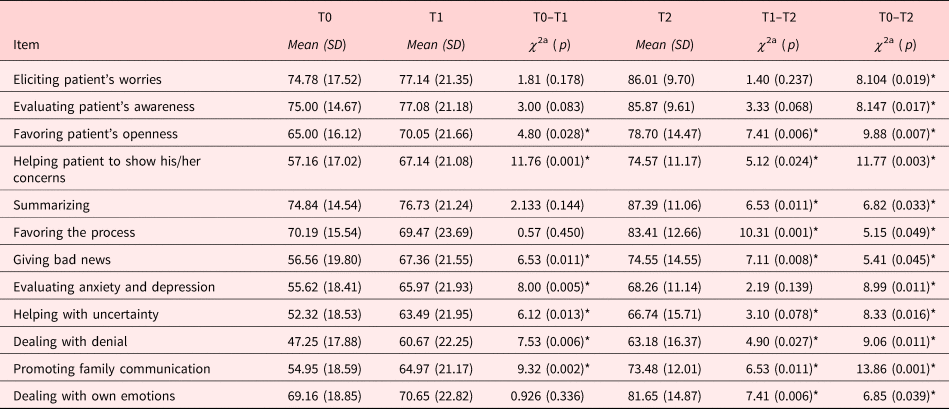
The T0–T1 comparison reflected significant improvements in 7 of the 12 areas in the SCCS questionnaire. These areas were: Favoring patient's openness (p = 0.028), Helping patients to describe their concerns (p = 0.001), Giving bad news (p = 0.011), Evaluating anxiety and depression (p = 0.005), Helping with uncertainty (p = 0.013), Dealing with denial (p = 0.006), and Promoting family communication (p = 0.002). Furthermore, when the results were compared between T1 and T2 more areas improved. Additional areas were Summarizing (p = 0.011), Favoring the process (p = 0.001), and Dealing with emotions (p = 0.006). Only the area Evaluating anxiety and depression lost its significance in this evaluation. However, once they had concluded the second session of the training program (T2), participants reported significant improvements in all 12 assessed areas (see Table 2).
Confidence in the own communication skills

a χ 2 from Friedman test.
* p < 0.05.
Use of learned communication skills in real practice
As mentioned above, 3 months after the first session (T0), we asked residents about the use of learned communication skills in T0 and the most challenging situations they had experienced in terms of communication with their patients or relatives through T1.
Nearly all respondents (n = 78; 90.7%) reported having used learned strategies in their real practice. Of these, 46 (59%) had used them between 2 and 10 times, 19 (24.3%) from 11 to 20 times, 11 (14.1%) over 20 times, and 2 responders (2.6%) had used them only once.
The most common scenarios in which they had used these skills were Communication with patients’ relatives (n = 52; 66.6%), Giving bad news (diagnosis information) (n = 40; 51.2%), Giving prognosis information (n = 35; 44.8%), and Information about therapeutic effort limitation (n = 32; 41%). However, participants considered the most difficult scenarios to be Informing about therapeutic effort limitation (n = 29; 37.2%); Informing about the end of life (n = 20; 25.6%), Giving prognosis information (n = 19; 24.3%), and Informing about the change from curative to palliative care (n = 17; 21.8%).
Finally, six groups of situations emerged of cases in which doctors had found the greatest difficulties when communicating. These groups were: Dealing with family, Breaking bad news, Unexpected complications, Fetal and infant deaths, Patient decisions that make treatment difficult, and Limitation of therapeutic efforts. As mentioned before, these scenarios were addressed in Phase 3 (T2) of the program with the help of an actress.
Discussion
The study was designed to assess the efficacy of a communication skills training program for MR during their second year of residency. Results of the study highlight the relevance of this type of training among medical residents considering the positive progression of participants along the three-time assessment. Regarding the suitability of the year of residence and considering that Molinuevo et al. (Reference Molinuevo, Aradilla-Herrero and Nolla2016) did not find significant differences in the efficacy of CSTP between MR from different years, our sample selection might appear arbitrary. However, over the second year of residency, trainees start taking real responsibility in the diagnosis and treatment of patients. For this reason, second-year MR might find guidance in a CSTP, especially when they are breaking bad news, as seen in this study. Nonetheless, other programs have been applied to other years of residency, such as fourth-year trainees (Chandawarkar et al., Reference Chandawarkar, Ruscher and Krajewski2011). In fact, it could be interesting to explore in future studies the different needs in terms of communication skills in different years of residency. Thus, a more concise and personalized program could be designed.
The structure of our program was in accordance with previous programs (Chandawarkar et al., Reference Chandawarkar, Ruscher and Krajewski2011; Epner and Baile, Reference Epner and Baile2014; Yamada et al., Reference Yamada, Fujimori and Shirai2018; Barbosa et al., Reference Barbosa, Del Piccolo and Barbosa2019). A minimum optimal length of at least three days for CSTP was described previously (Barth and Lannen, Reference Barth and Lannen2011). In this study, we investigated further how CSTP phases should be designed. In accordance with our results, we found that it is important to provide a time gap between training sessions to let trainees use learned communication skills in their real practice, and to determine which are the most difficult situations they encounter. This way, in subsequent sessions of the program, weaknesses can be addressed. Specifically, this gap between sessions may be suggested as, in the present study, we found that with the first session (T0) alone, only half of the areas of confidence improved in trainees. Likewise, with T0 alone, we could not change participants’ beliefs about psychosocial aspects of patient care. However, at the end of the course (T2), MR improved in all 12 competence areas explored, and significantly changed their beliefs on psychosocial aspects of patient care, showing more interest in providing emotional care to their patients. A possible explanation for these results is that trainees had had time to practice communication skills for 6 months in their real practice and could address difficult cases in the last part of the course (T2). Besides, the inclusion of a trained actress to perform role plays with MR might have been another factor that contributed to such improvements. According to a recent review, the most common teaching techniques for communication skills are didactic sessions, video recordings, interactive discussions, role plays, performance feedback by standardized patients and/or faculty (Lamba et al., Reference Lamba, Tyrie and Bryczkowski2016). In our study, we consider that the main factors to have contributed to the improvement in communication skills in our sample of MR are: a time gap to practice between different sessions of the course, follow-up of the evaluation of beliefs and competences of trainees during the course, role plays to address the most difficult scenarios found in real practice, and the collaboration of actresses for the role plays.
This study makes many novel contributions. First, the study population was MR from different specialties. However, today most southern European MR do not acquire communication skills during their residency (Grassi et al., Reference Grassi, Travado and Gil2005). Nonetheless, our findings indicate an improvement in competence and confidence in medical trainees after participation in the course.
Second, in our study, we observed an improvement in communication skills between the first (T0) and last sessions (T2) of the course, with time to practice communication skills between them. Continuing sequential education is essential as residents can practice skills during sessions and with real patients between phases (Epner and Baile, Reference Epner and Baile2014).
Third, the use of role plays in the last session on challenging cases found by MR in their day-to-day practice and the collaboration of professional actresses could contribute greatly to improvements in competences and confidence in communication skills.
Fourth, the course and the practice using a role play with an actress facilitated a process of debriefing, as it provided a supervised, secure environment in which residents could practice the most difficult cases encountered in their clinical practice.
As for the clinical implications of this study, these results highlight the importance and support the need to involve MR in training programs on communication skills. As seen in our study, after the CSTP, participants feel more confident in their communication skills and more interested in approaching the psychosocial care of patients. Both the former and latter could potentially improve clinical mastery and render a lower rate of burn-out in MR when they address challenging cases.
Nonetheless, our study has several limitations. First, the limited sample size and the overrepresentation of women may bias the results. Second, the lack of a control group means that we cannot determine causal effects of the program in improving second-year MRs’ communication skills. Third, we were unable to distinguish the specific effect of the training program from a more general effect of the progression of the residency. Fourth, the high variability of medical specialties among participants did not provide the opportunity to reach conclusions on specialties that are more prone to develop communication skills than others. Finally, in the data collection, we used self-report surveys to assess confidence in communication skills, which may be subject to social desirability bias.
In conclusion, the results of this study support the efficacy of a three-phased communication skills training program in second-year MR, centered on the most difficult scenarios reported by the trainees, with the assistance of a trained actress. A training approach should be centered on MR needs with follow up after an initial season to evaluate progress and determine challenging scenarios that participants may encounter during daily practice. According to the results in this study, it seems that one of the ingredients of having adequate communication skills is to reinforce the psychosocial approach on the care of patients, as well as the physicians’ confidence on their own communication skills. This, as a result, can positively affect both the patients and physicians.
Acknowledgments
The research group wishes to thank all members of the Educational Committee of the Hospital Universitari Dr. Josep Trueta, Hospital Universitari Germans Trias i Pujol, Hospital de Sant Joan de Déu de Manresa and Hospital de Mataró for their collaboration in the study.
Funding
This work was supported by the Private Foundation “Nous Cims”.
Conflict of interest
There are no conflicts of interest.