Why do some rebel groups provide services inclusively, even to unlikely supporters, while most other insurgencies either restrict their service provision to core allies, or offer nothing? The Eritrean People's Liberation Front (EPLF) began its campaign for Eritrean independence from Ethiopia in the early 1970s, and until it achieved final victory in 1993, the EPLF provided inclusive goods, offering education and healthcare to almost all people in the areas it controlled. By 1978, the EPLF's medical services provided care to almost 1.6 million Eritreans,Footnote 1 and in 1982 alone, nearly 10,000 Eritreans enrolled in the EPLF's literacy courses.Footnote 2 Even people who would likely never support the insurgency benefited from the EPLF's social service provision: by 1990, tens of thousands of Ethiopian prisoners of war were given “medical treatment, food, shelter and basic education” despite the fact that they were “a strain on Eritrean resources.”Footnote 3
By contrast, the Revolutionary United Front (RUF) viciously tore through Sierra Leone for nearly a decade, leaving a trail of destruction and mass violence. They even engaged in cannibalism.Footnote 4 Despite this violence, and much like the EPLF, the RUF also provided some welfare services. The rebel group offered free medical care to its fightersFootnote 5 and provided free education and medical services in “safe areas,”Footnote 6 or territories where support for the RUF was “sufficiently stable and firmly controlled.”Footnote 7 Yet unlike the EPLF, the RUF did not provide services inclusively. Instead, it restricted access to these goods to a small and inconsistent slice of the population, and even then, the implementation of the group's welfare apparatus resonated “of patrimonial principles.”Footnote 8
These cases illustrate the diversity in the exclusivity of rebel services. This variation in access to goods presents a striking empirical puzzle: most rebel groups (about 70 percent of groups with territorial control) offer no services or limit their service provision to active or likely supporters (e.g., the RUF). Yet some insurgencies divert critical financial and personnel resources to provide benefits to virtually all people, even unlikely supporters (e.g., EPLF, Hezbollah). Although existing research concludes that rebels use social services as selective incentives to facilitate recruitment,Footnote 9 a desire to recruit cannot alone explain an insurgency's decision to provide goods inclusively. Inclusive provision is not an efficient recruitment tool: when rebel groups provide inclusive services, they knowingly channel precious resources to help unlikely supporters. Moreover, inclusive service provision exacerbates the free-rider problem and actually disincentivizes potential combatants from joining the rebellion: by providing services to all people regardless of their commitment to the insurgency, civilians have no reason to make costly sacrifices on behalf of the rebel group.
Instead, secessionist insurgencies are more likely to provide inclusive goods than nonsecessionist insurgencies (conditional on territorial control). Nonsecessionist organizations strive to overtake existing institutions, and for these groups, a military victory alone is typically sufficient for success. To mobilize a force needed to overthrow the government, nonsecessionist rebels use exclusive services as a recruitment tool. In contrast, secessionist insurgents cannot achieve victory through military success alone and need recognition of their statehood. Therefore, secessionist rebels must legitimate their claim of territorial sovereignty to an international and domestic community. Inclusive goods provision, because it entails providing services to almost all people living within the space where insurgents seek to be sovereign, legitimates this claim. Inclusive goods provision is thus a strategic tool secessionist insurgencies use to attain their ultimate objective of independence.Footnote 10
To test this hypothesis, I use secondary and primary sources to create an original data set of the annual level of insurgent education and healthcare provision globally from 1945 to 2003. I conduct a large-N analysis using these original data, as well as other insurgency and state-level variables. The statistical results strongly support this hypothesis: secessionist insurgencies are over 300 percent more likely to provide inclusive goods than nonsecessionist rebels. The results are robust to several alternative specifications. Unlike much of the current civil war scholarship that has focused on ideology, resources, or path-dependent processes, these findings underscore how an insurgency's long-term goals shape and constrain the strategies (both violent and nonviolent) a rebel group chooses to deploy. Ultimately, these results highlight the importance of nonviolent rebel group activities, have implications for the process of state building in civil wars, and address important concepts such as governance and sovereignty.
Existing Explanations
Since the People's Liberation Army's victory over the Kuomintang, insurgencies across the globe have followed Mao's “liberation” strategy and provided social services to civilians who would become the sea-like masses in which the rebel “fish” would swim. Prior to providing these services, however, insurgents generally need to control territory. When rebels gain territory, they are able to work with civilians and form a “territorially based anti-state” with “its own core areas and administrative units.”Footnote 11 In other words, once they control territory, insurgents become “stationary bandits” and are incentivized to establish governing institutions.Footnote 12 These stationary-bandits-as-insurgents effectively become a competitive alternative governing actor to the existing state.Footnote 13
Yet within these anti-states, considerable variation exists in insurgent governing behaviors: rebels may provide no services, they may provide exclusive goods, or they may provide inclusive goods. Exclusive service provision refers to limited or targeted social service provision that certain members of a population are explicitly prevented from accessing. On one hand, exclusive provision occurs when rebel groups provide services to combatants, supporters, and/or civilians who may be more likely to join the rebel group (i.e., co-ethnics/religionists or peasants for communist groups). On the other hand, inclusive service provision refers to goods from which almost anyone can benefit, including unlikely supporters. In this case, in addition to providing services to people in a rebel group's core coalition, the insurgency also provides welfare to those who will likely never join the rebel group (such as non-co-ethnics/religionists, supporters of rival insurgencies, wealthier merchants, or the bourgeoisie for communists).Footnote 14 Insurgents may exclude people from services by simply barring access to goods, by expelling them from a territorial space, or by killing them. For example, insurgencies like the National Union for the Total Independence of AngolaFootnote 15 provided education and healthcare to a conquered town or village after purging the territory of anyone suspected of being a potential danger to the insurgency. By contrast, after Amilcar Cabral's African Party for the Independence of Guinea and Cape Verde (PAIGC) controlled territory in 1963, it immediately began to develop a national health and education service for all to use, thus providing inclusive services.Footnote 16
This variation in the exclusivity of insurgent social service institutions has not been studied previously, and existing arguments cannot easily explain the provision of inclusive services specifically. One explanation is that insurgents use inclusive services as extractive tools.Footnote 17 During the course of a domestic conflict, insurgencies need to extract resources ranging from recruits,Footnote 18 to information,Footnote 19 compliance,Footnote 20 finances or weaponry and equipment from a civilian population in exchange for access to services.Footnote 21 However, both categories of services could be used by insurgents to extract certain resources: For example, Berman and Laitin argue that to “extract” a particular type of recruit, rebels target or limit their social service provision to attract highly dedicated members more willing to commit greater acts of violence, such as suicide terrorism.Footnote 22 Similarly, Weinstein argues that insurgencies without economic resources use social services to attract highly dedicated people.Footnote 23 In both cases, selective social service provision, or exclusive goods, serves as a tool to “extract” a certain type of resource (recruits) from a civilian population, so a desire to extract resources cannot explain variation in the provision of exclusive versus inclusive goods. Moreover, inclusive service provision exacerbates the free-rider problem: civilians have no incentive to make sacrifices on behalf of an insurgency when they may receive many benefits without making costly commitments.Footnote 24 A desire to recruit and extract resources alone cannot explain inclusive service provision.
Inclusive service provision could also serve as an attempt by insurgent groups to prevent out-migration. During the course of domestic conflicts, civilian populations may attempt to escape violence by fleeing a country. The declining civilian population strips insurgents of their protective cover and removes insurgents from their economic base. To counteract this out-migration, rebels may provide inclusive services. However, all conflicts and all insurgents face the potential for out-migration, and indeed, many rebels continue to restrict their service provision even in the face of massive out-migration. Currently, the Islamic State continues to limit its social services as thousands of refugees flee Syria. Despite calls for doctors and other professionals to provide needed services in the areas it controls, the Islamic State refuses to adjust its governing strategy and provide inclusive goods.Footnote 25 A reaction to out-migration cannot alone explain why rebels choose to provide inclusive goods specifically, over exclusive goods or no services.Footnote 26
Finally, insurgents could provide inclusive goods as a way to compete with and outbid the state and rival combatants: insurgents use the welfare institutions they create to demonstrate that they are a better alternative governor to the status quo.Footnote 27 Yet all conflicts are ultimately competitions between insurgents and the state (or insurgent rivals). Competition is not unique to groups that provide inclusive services versus exclusive services, and competition alone cannot explain variation in social service provision across rebel groups. For example, both the RUF and the Popular Front for the Liberation of Saguia el-Hamra and Río de Oro (POLISARIO) of Western Sahara were the primary insurgencies in their conflicts, yet the RUF restricted its services and the POLISARIO provided inclusive goods. Similarly, the Oromo Liberation Front (OLF) was far from the only insurgency operating in Ethiopia at the time, and yet it provided inclusive services. As a result, this mechanism cannot explain why some groups are more likely to provide inclusive goods specifically, as opposed to no goods or exclusive goods.Footnote 28
Instead, what explains variation in the accessibility of services (exclusive versus inclusive goods) is the long-term strategic objectives of rebel groups. Long-term goals shape and constrain the strategies rebel groups may choose to deploy.Footnote 29 Mampilly argues that secessionists, ethnonationalists, and Maoist rebels will be particularly more inclined to develop insurgent governing apparatuses, conditional on state-level factors.Footnote 30 Similarly, I contend that conditional on territorial control, secessionist rebels specifically are more likely to provide inclusive goods while nonsecessionist rebel groups are more likely to exclude others from their services.
Secessionism Determines Inclusive Service Provision
War has been theorized to be the primary impetus of state formation,Footnote 31 and for secessionist insurgencies that (by definition) seek to form a new state, civil wars are no different: war is a more successful path to statehood than peaceful processes.Footnote 32 Secessionist rebels—insurgencies that seek to create an independent, territorially based state—face a unique obstacle in pursuit of victory, namely that military victory alone is almost never sufficient for a secessionist insurgency to be successful. Instead, secessionist insurgents must be recognized as the legitimate sovereign of a territorial space by both the domestic and international community. Unlike nonsecessionist rebels (center-seeking insurgents who want to overthrow the government in the capital), secessionist insurgents are fully reliant on the international community to achieve their long-term objective of statehood.Footnote 33 As a result, secessionist rebel groups rely on a toolkit of both militaryFootnote 34 and nonmilitaryFootnote 35 strategies to legitimate—in other words, to generate “a widespread consensus” that their form of rule and the exchanges they make are fairFootnote 36 —their claim of territorial sovereignty to both a domestic constituency and an international audience. Inclusive goods provision is one such strategy that simultaneously generates the requisite domestic and international legitimacy.
Domestically, inclusive service provision generates legitimacy because it demonstrates that rulers “care for ‘the people.”’Footnote 37 Inclusive rebel services “offer the population an alternative entity in which to place their loyalty.”Footnote 38 Mampilly notes that “it is only by replicating some of the functions and forms of the nation-state … that will allow an insurgent organization to derive attitudinal support for its political authority and achieve some form of legitimacy.”Footnote 39 By providing inclusive services to almost all people within a fixed, typically diverse territorial space that includes multiple ethnicities (thus providing inclusively),Footnote 40 secessionist insurgents demonstrate their capacity to govern the entire space they claim as independent. For example, the New Mon State Party (NMSP) provided inclusive services throughout the Mon State in Burma/Myanmar. Although the NMSP claimed to represent all ethnic Mons, the NMSP also governs other ethnic groups, such as the KarensFootnote 41 and derived its “legitimacy … from the number of people,” not just co-ethnic Mons, “and extent of territory under its control.”Footnote 42
Yet, without recognition or support from international actors, secessionist insurgents cannot succeed. Coggins and Grant emphasize that international recognition is the ultimate requirement for statehood, and secessionist insurgents understand that the state “is viewed as having its genesis in recognition.”Footnote 43 Unlike center-seeking rebels that more easily acquire international recognition, the importance of the international community's support motivates secessionist insurgents to behave in ways that appeal to and mimic the behaviors practiced by the actors that make up the international community: states. For example, like states, secessionist rebels abide by international norms of combatFootnote 44 or sign international treatiesFootnote 45 to generate legitimacy internationally.
Likewise, inclusive service provision is performative.Footnote 46 Inclusive governance mirrors the state's provision of public welfare goods and demonstrates a rebel group's economic viability and capacity to behave as an independent state. Inclusive provision bolsters a secessionist insurgency's claim to be the legitimate authority of an independent territorial space to the international community because public goods provision is what states do, or at least aspire to do.Footnote 47 According to Olson, “a state is first of all an organization that provides public goods for its members.”Footnote 48 Although the state may have played a more limited role in social service provision historically, in the post-World War II era a state “retains a distinctive role in providing the public goods that promote economic and social development,”Footnote 49 and is the “legitimate provider of specified political goods, over which it has sole and universal jurisdiction.”Footnote 50 When insurgencies provide services inclusively, they mimic public goods provision by nation-states and thus act as if they were states.
As an example, since 1975 the POLISARIO and the Sahrawi Arab Democratic Republic (SADR) “have developed and administered” the refugee camps in the territories it controls “to such a degree to prove that they are ready for self-rule—a practice-run for statehood.”Footnote 51 The POLISARIO recognizes that by administering services inclusively, it is acting as if it were a state. By providing inclusive goods, the POLISARIO hopes to lend legitimacy to their claim of independence in the eyes of the domestic constituency as well as the international community.
Similarly, the EPLF's extensive and inclusive welfare apparatus served to generate considerable domestic and international legitimacy for the movement's claim of independence. Because these inclusive services were “on offer to all people” within the territorial space of Eritrea, they represented “one crucial means of showing the people that the EPLF cares about them.”Footnote 52 Internationally, the EPLF invited foreign visitors from governments, newspapers, or NGOs to view their work in the liberated territories, and went to great lengths to show these visitors the inclusive education and health institutions it had created.Footnote 53 The EPLF's inclusive service provision was so successful that, as Müller argues, the EPLF secured “legitimacy and hegemony” domestically and regionally through these governing institutions.Footnote 54 As robust as the EPLF's service provision was, one of the group's key allies, the center-seeking Tigrayan People's Liberation Front (TPLF), provided services exclusively. Although the two insurgencies operated simultaneously and coordinated attacks against a common enemy, the TPLF offered education and healthcare to ethnic Tigrayans likely to join the insurgency.Footnote 55
Only inclusive service provision, and not exclusive service provision, will satisfy concerns about a secessionist insurgency's viability as an independent state.Footnote 56 An inability or refusal to provide goods inclusively not only detracts from the legitimacy of the quasi-state, but it also represents a failure to project governing power over the entire territory. Therefore, unlike inclusive service provision, exclusionary service provision cannot legitimate the secessionist insurgency's claim of sovereignty over a bounded territorial space, and all people within that space.
Importantly, not all secessionist groups that provide inclusive services also receive international recognition, and several factors affect a state's decision to recognize another entity as independent.Footnote 57 However, viability as a state seems to be a key component: when East Timor sought independence in 1974–75, Indonesia persuaded the United States against recognition because an independent East Timor “would hardly be viable.”Footnote 58 While inclusive service provision is no guarantee of success, secessionist rebel groups like the EPLF, the PAIGC, and Revolutionary Front for the Liberation of Mozambique (FRELIMO) all provided inclusive services and have gained independence, receiving universal international recognition. Indeed, in reviewing why certain Portuguese colonies would be recognized as independent, the Australian government noted that the PAIGC would be recognized because of “the peoples [sic] alleged/demonstrated support of the PAIGC, and the administrative structure which PAIGC had built.”Footnote 59 Later secessionist insurgencies then turned to these successful groups for guidance in the construction of their own education and healthcare services.Footnote 60 Many more individual countries have separately recognized as independent several inclusive-service-providing secessionist projects. The POLISARIO, for example, has been recognized as independent by as many as eighty-seven UN Member States and counting. Even if rebels do not gain outright secession, inclusive service provision may help them achieve autonomy as an initial step in that process.Footnote 61
Together, this suggests that inclusive service provision is a crucial, but ultimately insufficient condition for recognition. While inclusive services cannot guarantee success,Footnote 62 new and original data on rebel governance presented here suggest that an inability or refusal to provide these goods almost certainly leads to failure.Footnote 63 Indeed, of the groups that failed to provide inclusive goods, almost none received international recognition and many were ultimately crushed by government and competing forces.Footnote 64
On the other hand, nonsecessionists have little need to provide inclusive goods. Once nonsecessionist insurgents secure the capital city, other countries generally recognize these rebels as state leaders.Footnote 65 Even if other countries do not recognize the government that victorious rebels form, these (former) insurgents nevertheless control the levers of state. To maximize their return on investment, nonsecessionist insurgencies are thus incentivized to channel resources to people likely to help them achieve military victory, and will avoid wasting resources or exacerbating free-rider problems by providing inclusive goods. Exclusive services are sufficient to legitimate nonsecessionist insurgencies to the core supporters who will both fill their combatant ranks and support them as the state's governing leaders.Footnote 66
The Ethiopian People's Revolutionary Party (EPRP), for example, provided education and healthcare,Footnote 67 even specializing in acupuncture,Footnote 68 but limited services to only “peasants [who] had stopped paying taxes to the regime and had identified themselves as the EPRP” for the explicit purpose of “[raising] their (the peasants) awareness, to get their support, and to facilitate recruitment of peasant fighters.”Footnote 69
The argument outlined here suggests that (conditional on territorial control) secessionist insurgencies are more likely to provide services inclusively because they are strategic tools that will help them achieve sovereignty over a bounded territorial space. Because only secessionist rebel organizations need international recognition of sovereignty, and because only inclusive provision (and not exclusionary services) will allow insurgents to demonstrate their viability as an independent state, secessionist insurgencies are thus more likely to provide inclusive goods than nonsecessionist groups. This logic implies the following hypothesis:
H1
Secessionist insurgencies are more likely to provide inclusive services than nonsecessionist insurgencies.
Data and Methods
Few data sets exist with information on nonstate governance, and no data sets exist that identify the degree of insurgent provision's exclusivity. To address this deficiency, I created a new and original data set that includes variables on whether an insurgency offered education or healthcare, when an insurgency offered these services, and whether the group excluded certain classes of people from their services (see Appendix 6). To identify the universe of cases, I rely on Cunningham, Gleditsch and Salehyan's Non-State Actor (NSA) data set that defines insurgencies as armed nonstate participants in a conflict that causes at least twenty-five battle deaths per year from contestation over either central government control or territory.Footnote 70 The NSA data set contains several key insurgency-level variables and includes a total of 327 insurgencies covering 2,426 insurgency years. For consistency when coding the inclusive services variable, I exclude coups, coup attempts, or groups that allied with the government and did not oppose it,Footnote 71 leaving over 300 groups covering more than 2,300 insurgency-years.Footnote 72
I then coded whether groups provided inclusive, exclusive, or no education and healthcare. I used both primary and secondary sources primarily in English but also Spanish and French. Sources ranged from secondary case histories to archival documents, testimonies, memoirs, feminist accounts, newspaper articles, magazine articles, reports, or journal articles. I examined these texts for evidence of inclusive healthcare and education provision. To determine exclusion (or inclusion) of certain categories of people, I conceive of support for an insurgency as a spectrum, with most of the population in the political center but some people deeply committed to either the rebel group or the state. To disaggregate this broad center, I examined the stated political goals and mobilization targets of each insurgency. I then identified classes of people that were more or less likely to support and join a rebel group. For example, noncoethnics or noncoreligionists would be unlikely to support certain ethno-secessionist rebel groups. When communist rebel groups direct services to wealthier merchants, traditional or religious leaders, the bourgeoisie or intellectuals, they direct services outside the core political community, and thus provide inclusive services.Footnote 73 These categories paint in broad brush strokes and cannot identify idiosyncratic, individual experiences that might make specific people more supportive of an insurgency, but on average these categories accurately capture recruitment trends. The way I conceive of this spectrum is not dissimilar from the way some US military officials have conceived of support for a rebel group,Footnote 74 suggesting that this concept may have practical utility.
Examples of textual evidence of inclusive provision include instances where organizations provided services to former rivals or supporters of rivals (such as the EPLF mentioned previously). Similarly, the PAIGC's education services have been succinctly described as “literacy for all, quality education for some,” and the PAIGC provided basic education for the broad population (inclusive services) as well as intensive schooling for insurgent members (exclusive services).Footnote 75 The Karen National Union (KNU), composed of primarily Karen ethnic fighters, provided healthcare and education to Mons living in the territory the KNU controlled, even though the KNU sometimes fought against a primarily Mon insurgency.Footnote 76 For the nonsecessionist group Hezbollah, evidence of inclusive goods provision included testimony from a father who works for the United Nations Interim Force in Lebanon (UNIFIL) and backs Hezbollah's arch-rivals, Amal, but sends his son to a Hezbollah school. The father says many who attend Hezbollah's schools “are not Hezbollah, nor are we in the least affiliated with their ideologies or political views, but we … realize that their schools are currently better than anything else in the area.”Footnote 77 Additionally, if an insurgency were communist, the group would demonstrate inclusive service provision by providing education and healthcare to landlords, intellectuals, or wealthy business people, as the nonsecessionist People's Liberation Army did after 1948 when it began a “national unity” campaign.Footnote 78
The data are time variant and capture changes in the level of inclusivity.Footnote 79 Typically, the case evidence listed the date that insurgencies developed these services and when these services ended. Occasionally, these sources would state that by a certain year, an insurgency had built service institutions without indicating whether the rebel group had previously provided these services. If no earlier date could be found, all observations prior to the year given were coded as missing. For example, if the text states that “by 1976” an insurgency had built schools, but no earlier date is listed, all observations before 1976 are coded as missing.Footnote 80 Finally, for observations that are questionable, I offer a secondary, alternative coding of the case, and I use this alternative measure in a robustness check.Footnote 81
Because these data are original and hand coded, they may be subject to questions of reliability. To address this uncertainty, I use existing data sets to measure the validity of the coding efforts.Footnote 82 The data that I collected mirrors trends in the other data sets, increasing the confidence in the accuracy of the data. These data are also sensitive to instances that appear to be inclusive provision but are not (provision in refugee camps, systematic purges).Footnote 83 All coding procedures summarized here are described in greater detail in Appendix 6.
Dependent Variable
The dependent variable is inclusive service provision. A 1 indicates that the group provided both inclusive healthcare and inclusive education, and a 0 indicates otherwise. The binary construction minimizes assumptions about the nature of social service provision.Footnote 84 Of the ninety-three insurgencies that controlled territory, twenty-seven groups in the data set provided inclusive services, about 29 percent.Footnote 85
Key Independent Variable
The key independent variable is whether a group's long-term strategic goal is to secede. The secessionist variable originates from the “Conflict Type” variable in the NSA data set.Footnote 86 The “Conflict Type” variable indicates the purpose of an insurgent groups’ struggle. This data set offers twenty-one different conflict types, and four include the term secessionist. Insurgencies listed either fully or partially as “secessionist” conflict types are coded as 1, while all other conflicts are coded as 0. Unlike the data I collected, the variables from the NSA data set are not time variant.Footnote 87
I hypothesize that secessionist insurgencies (conditional on territorial control) are more likely than nonsecessionist groups to provide inclusive goods because of their strategic, long-term goals. A positive and statistically significant secessionist coefficient supports the hypothesis. Table 1 presents an initial tabulation of groups by inclusive service provision and long-term goals, conditional on territorial control. The raw data suggest that the majority of secessionist rebels provide inclusive goods while the majority of nonsecessionist insurgencies do not provide inclusive goods. The percentage of secessionist insurgencies providing inclusive goods is nearly three times the percentage of nonsecessionist insurgencies providing inclusive services.
Inclusive service provision by long-term objective

Notes: These values present the count of groups by goods provision and long-term goals, conditional on territorial control. The percentage of secessionists groups that provide inclusive service is almost 200 percent greater than the percentage of nonsecessionist groups that provide inclusive services.
Controls
In most models, I include insurgency-level and country-level controls that may confound results. Because of Mao's influence, whether an insurgency is communist could affect the group's likelihood to provide governance and to engage in certain military strategies, so I include the variable communist. To account for ethnicity and not secession driving inclusive governance, I include the measure ethnic war. The military capacity of a rebel group could correspond to an increased capacity to provide governance, so I include an ordinal variable that measures the strength of the insurgency (rebel strength). Finally, some insurgencies may not provide inclusive services because they have simply existed for a longer period of time, so I include the variable duration to account for how many years an insurgency was operational.Footnote 88
In terms of country-level controls, people living in stronger or more developed states could have less need for social services, meaning that rebels operating in states with a low infant mortality rate (infant mortality) or high GDP per capita (gdp per capita) might be less likely to provide inclusive goods. A large population could mean it is more challenging for rebels to provide services, decreasing the likelihood of inclusive service provision. I thus include a measure for population (logged). Because democracies have more inclusive and open political systems that foster greater competition for political authority,Footnote 89 insurgencies operating within democracies may need to develop a broad and robust coalition of supporters, and they may use inclusive services to generate this coalition. I include a binary variable for whether a state is a democracy (democracy). If a country's geography is mountainous or challenging, insurgents may operate in depopulated, isolated areas and it may be more difficult to build service institutions there. I thus include the measure rugged terrain. In some models, I also include the variable competition signifying the count of insurgencies simultaneously operating in a country to test the outbidding mechanism, and I replace population (logged) with population (change) to test the out-migration mechanism. Because of space constraints, I include a more in-depth discussion of the controls and the reasons for their inclusion in Appendix 2.
Model Specification
Although the NSA data set uses insurgency-year as its unit of analysis, these insurgent-level variables are not time variant. To account for non-independent observations, I reformat the data set as a cross-section with each insurgency as the unit of analysis. The time-variant inclusive service provision variable takes its maximum value, signifying any inclusive service provision by a rebel group at any point in their history. Time-variant state-level variables retain their value during the year that conflict began. In Appendix 5, I replicate the entire cross-sectional analysis but use the full panel data as both an additional robustness check and as a way to measure the impact of important time-variant measures, such as inclusive rebel services, population (change), and competition.
Because territorial control is a near precondition for widespread inclusive service provision, I limit my sample to insurgencies that controlled territory because these insurgencies could have plausibly provided inclusive goods. To determine which insurgencies controlled territory, I use the binary territorial control variable from the NSA data set. This variable is time invariant.
Although the inclusive service provision variable is binary, I use a Linear Probability Model (LPM) because of the small sample size.Footnote 90 In all models, standard errors are clustered by country.
Results and Discussion
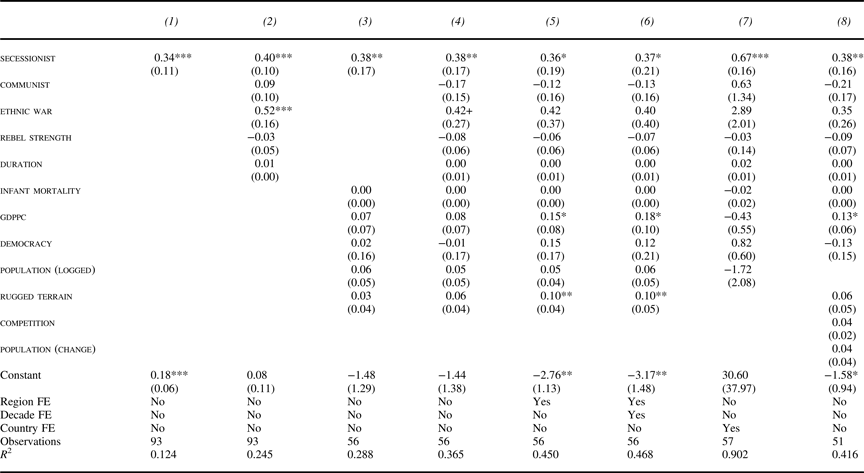
Table 2 presents the results of the analysis. Model 1 is a bivariate model that uses only the secessionist variable to predict inclusive service provision. In Models 2 and 3, I incrementally introduce key insurgency-level (Model 2) and state-level (Model 3) control variables. In Model 4, I include all variables. This model serves as my base model. In Models 5 through 7, I add geographic and temporal fixed effects to account for unobserved variation in the place an insurgency operated or in the decade a rebel group began. Finally, in Model 8 I add competition and replace population (logged) with population (change) to account for the outbidding and out-migration mechanisms, respectively. Across all specifications, secessionist is large, positive, and statistically significant, consistent with my hypothesis.
Secessionism predicts inclusive services

Notes: Standard errors in parentheses. Standard errors clustered by country in all models. +p < .15; *p < .10; **p < .05; ***p < .01.
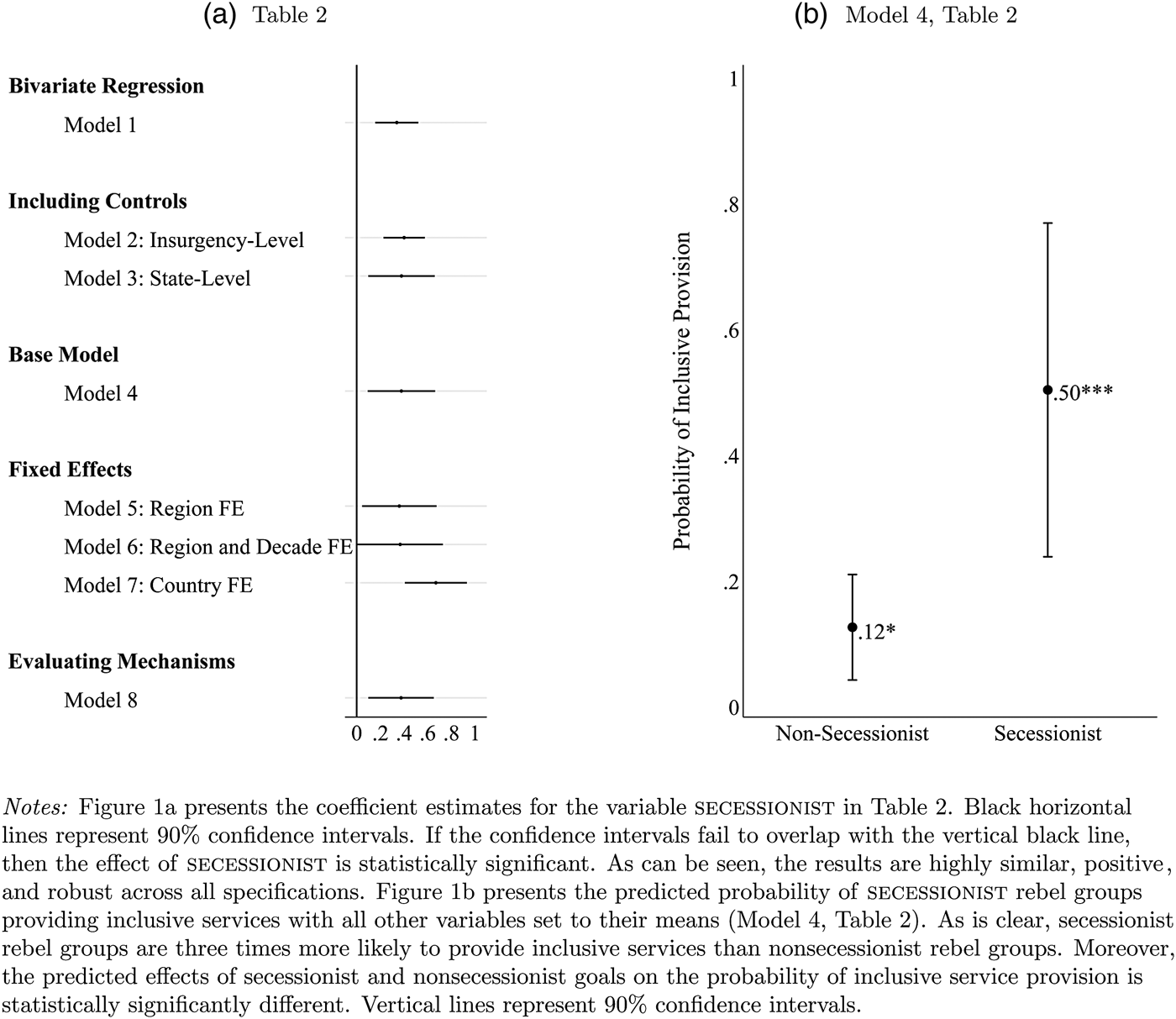
Figure 1 presents the secessionist coefficient estimates from Table 2 (Figure 1a) and the predicted effects of secessionist goals on inclusive provision (Model 4 in Table 2, Figure 1b) graphically. With all variables set to their means, secessionist groups are over three times more likely to provide inclusive services than nonsecessionist insurgencies: a statistically significant and substantively meaningful difference between the two groups.
Secessionist goals predict inclusive services

Robustness Checks and Predictive Accuracy
To ensure results are robust to alternative model specifications and to evaluate the predictive accuracy of the model, I include additional diagnostics in Appendices 3 to 5. Results are robust to using the full sample of insurgencies without conditioning on territorial control; including additional controls; excluding influential observations (outliers, jackknifing); using the unaltered, original NSA data set; accounting for information bias in coding; using alternative specifications of the independent variable; using alternative specifications of the dependent variable; using both ordered logit and logistic regression estimators; imputing missing data; and replicating the entire analysis (both main tables and appendix tables) using the full NSA panel data set (Appendix 5). Each of these tests is described in great detail in Appendices 3 to 5. I evaluate model accuracy using a Receiver Operator Characteristic (ROC)Footnote 91 and the bootstrapping technique.Footnote 92 The combined results indicate that the predictive accuracy of both the model and the secessionist variable is very high.
Conclusion
Inclusive goods provision is a technology of rebellionFootnote 93 employed by secessionist insurgencies to achieve their long-term goal of independence. When secessionist rebels engage in inclusive service provision, they perform the role of the state and legitimate their sovereign authority domestically and internationally. The results here offer considerable support for this hypothesis.
While much civil war research has focused on territorial control, financial resources, ideology, or the path-dependent processes that encourage insurgents to develop governing institutions, this work demonstrates how the long-terms goals of insurgencies can shape rebels’ strategic calculus and incentivize them to rely on certain technologies as opposed to others. For example, this research echoes recent scholarship that finds that because of secessionist insurgents’ long-term goals, they eschew certain types of violenceFootnote 94 and may be more likely to abide by international norms.Footnote 95 Taken together, this suggests that secessionist insurgencies may operate differently from nonsecessionist rebels. Disaggregating between these two categories of civil war may be an important next step in furthering our understanding of intrastate conflict.Footnote 96 These results also speak to the importance of understanding how and why secessionist insurgencies might eventually be recognized by members of the international community. When secessionist insurgencies provide inclusive goods and control territory, they exercise sovereignty. If other states recognize this sovereignty, then providing inclusive goods could potentially explain why some secessionist groups are more likely to receive international recognition of sovereignty, while others do not. In addition, these findings imply that insurgents deploy both nonviolent and violent strategies in tandem, both aimed at achieving their long-term goals. Future research on this topic might turn to explaining subnational variation in rebel governance, or importantly, why secessionist movements might eschew legitimacy-generating behaviors in favor of violence or ethnic cleansing.
In terms of US foreign policy implications, this work offers insights into which insurgencies will provide services, and to whom—something that may be critical when addressing the humanitarian consequences of civil war. It also contributes to peace-building policy because it offers new insights into how existing insurgent institutions may be co-opted in the post-civil-war context so that governance vacuums do not arise and critical services continue to be provided to a needy population.
Ultimately, although civil war is frequently understood as anarchical periods of state breakdown, in certain cases, civil wars are actually a conduit for state making. The research presented here offers one potential pathway through which states are born in the post-1945 era.
Supplementary Material
Supplementary material for this research note is available at <https://doi.org/10.1017/S0020818317000418>.