Introduction
CHD often requires transcatheter or surgical intervention early in life, during ongoing somatic growth. Improvements in surgical and perioperative care have increased survival, resulting in a growing population of repaired or palliated patients who require repeated interventions and lifelong follow-up. Reference Lui, Saidi and Bhatt1 Unlike adult coronary interventions, congenital implants must function in a dynamic environment shaped by growth, evolving haemodynamics, proximity to the conduction system, and long life expectancy. Stent implantation is central to interventional CHD for relieving vascular obstruction; Reference Welch, Nugent and Veeram Reddy2 however, permanent metallic stents do not accommodate growth and may complicate future interventions and imaging surveillance. Similarly, permanent nitinol-based occluders used for atrial septal defect and patent foramen ovale closure have been associated with late complications, including erosion, thrombosis, and persistent inflammatory responses. Reference Shi, Kang and Zhang3,Reference Li, Xie and Xie4
These limitations have driven interest in biodegradable cardiovascular devices designed to provide temporary mechanical support during healing and remodelling, followed by controlled resorption. In paediatric CHD, minimising permanent intracardiac or intravascular implants represents a clinically relevant goal. Accordingly, biodegradable stents and occluder devices have been developed for congenital and paediatric applications. Reference McElhinney, Quartermain, Kenny, Alboliras and Amin5 Figure 1 summarises key paediatric constraints and the intended device lifecycle, highlighting the potential mismatch between required mechanical support, degradation kinetics, vascular healing, and growth across a long follow-up horizon.
Conceptual overview of the unique clinical context of CHD, the intended lifecycle of biodegradable cardiovascular devices, and key factors limiting clinical translation. The left panel highlights paediatric-specific considerations, including somatic growth, complex anatomy, early-life intervention, and lifelong follow-up. The central panel illustrates the shared lifecycle of biodegradable stents and septal occluders, from implantation and temporary mechanical support to progressive degradation, emphasising the temporal mismatch between device resorption, vascular healing, and growth. The right panel summarises major contributors to the translational gap, including idealised computational modelling, discrepancies between in vitro and in vivo degradation behaviour, immune and inflammatory responses, and limited long-term clinical data.

Figure 1 Long description
Panel A: The left panel highlights paediatric-specific considerations, including somatic growth, complex anatomy, early-life intervention, and lifelong follow-up. Panel B: The central panel illustrates the shared lifecycle of biodegradable stents and septal occluders, from implantation and temporary mechanical support to progressive degradation, emphasizing the temporal mismatch between device resorption, vascular healing, and growth. Panel C: The right panel summarizes major contributors to the translational gap, including idealized computational modeling, discrepancies between in vitro and in vivo degradation behavior, immune and inflammatory responses, and limited long-term clinical data.
Review methodology
A structured literature review was performed using PubMed, Scopus, and Web of Science to identify English-language studies on biodegradable cardiovascular devices in CHD, including experimental, preclinical, early feasibility, clinical, and relevant regulatory reports. Studies were assessed by translational stage with focus on material properties, mechanical performance, degradation behaviour, immune response, and clinical relevance in the context of growth and long-term follow-up. Given heterogeneity in design and outcomes, a critical comparative approach was used to identify translational gaps rather than quantitative meta-analysis.
Unique clinical needs of patients with CHD
A defining challenge in CHD interventions is treatment of cardiovascular structures that continue to grow throughout childhood. Permanent metallic implants provide durable mechanical support but restrict somatic growth, frequently necessitating repeat interventions. Reference Law, Shamszad and Nugent6,Reference Breinholt, Nugent and Law7 Biodegradable stents have therefore been proposed as temporary scaffolds that maintain vessel patency during healing and subsequently resorb to permit growth and remodelling. Reference Welch, Nugent and Veeram Reddy2,Reference Hou, Li and Pan8 This approach introduces a temporal constraint: scaffolds must preserve adequate mechanical integrity during early healing while degrading in a controlled manner. Premature loss of support may result in recoil or restenosis, whereas delayed degradation may negate the intended benefit of resorption. Reference Welch, Nugent and Veeram Reddy2,Reference Onuma and Serruys9,Reference Serruys, Chevalier and Sotomi10
Congenital cardiovascular anomalies are characterised by complex morphology, heterogeneous vessel wall properties, and altered flow patterns that differ substantially from adult cardiovascular disease. Reference Grogan, O’Brien and Leen11,Reference Fischman, Leon and Baim12 These features impose increased biomechanical demands on implanted devices, including resistance to recoil, fatigue, and deformation under pulsatile loading. Reference Robaina, Jayachandran and He13–Reference Wentzel, Gijsen and Stergiopulos15 For biodegradable stents, achieving sufficient radial strength while limiting strut thickness remains challenging, as thicker struts required for mechanical support may impair deliverability and promote inflammation, neointimal hyperplasia, and restenosis, particularly in small paediatric vessels. Reference Welch, Nugent and Veeram Reddy2,Reference Onuma and Serruys9,Reference Serruys, Chevalier and Sotomi10,Reference Robaina, Jayachandran and He13
Growth-related considerations differ for septal occluders. Rather than luminal constraint, long-term interaction occurs between the device framework and evolving septal geometry, particularly near the atrioventricular conduction system. Persistent intracardiac material or prolonged degradation may contribute to conduction disturbances, septal remodelling, and late arrhythmias, recognised complications of conventional metallic occluders. Reference Shi, Kang and Zhang3,Reference Li, Xie and Xie4,Reference Tenekecioglu, Farooq and Bourantas16–Reference Butera, Carminati and Chessa18 Biodegradable septal occluders must maintain stable defect closure while accommodating cyclic septal motion and minimising stress on adjacent structures; excessive rigidity or prolonged persistence has been associated with conduction disturbances and arrhythmias following transcatheter closure. Reference Shi, Kang and Zhang3,Reference Li, Xie and Xie4,Reference Carminati, Chessa and Butera19–Reference Mullen, Devellian and Jux22
Management of CHD is further distinguished by a prolonged clinical horizon and anticipated need for repeated interventions across the lifespan. Reference Lui, Saidi and Bhatt1,Reference Law, Shamszad and Nugent6 Device-related complications, including fracture, chronic inflammation, or interference with future catheter or surgical access, may therefore have amplified long-term consequences in congenital populations. Reference Law, Shamszad and Nugent6,Reference Breinholt, Nugent and Law7 For biodegradable stents, uncertainties remain regarding vessel integrity, remodelling, and feasibility of reintervention after complete scaffold resorption, with current evidence largely limited to preclinical and early feasibility studies. Reference Hou, Li and Pan8,Reference Mullen, Hildick-Smith and Giovanni23 In septal occluders, long-term concerns extend to late arrhythmias, conduction disturbances, and the impact of residual or slowly resorbing material on subsequent transseptal or left-sided procedures. Reference Tenekecioglu, Farooq and Bourantas16–Reference Butera, Carminati and Chessa18,Reference Morgan, Lee and Chaturvedi20 Although early- and mid-term results for biodegradable occluders are encouraging, systematic surveillance beyond the resorption phase remains essential. Reference Lui, Saidi and Bhatt1,Reference Shi, Kang and Zhang3,Reference Li, Xie and Xie4
Lifelong imaging surveillance is integral to CHD care, with cardiac MRI and CT central to assessment of ventricular function and vascular patency. Reference Lui, Saidi and Bhatt1 Permanent metallic implants may generate imaging artefacts and complicate repeat procedures, whereas biodegradable stents may reduce long-term interference following resorption, despite reliance on radiopaque markers during deployment and follow-up. Reference Welch, Nugent and Veeram Reddy2 Residual framework and device thickness in septal occluders may similarly affect echocardiographic windows and MRI assessment, particularly in paediatric patients requiring repeated imaging. Reference Tenekecioglu, Farooq and Bourantas16–Reference Butera, Carminati and Chessa18
Taken together, biodegradable cardiovascular devices share the goal of temporary mechanical support with reduced long-term foreign material burden, but their translational challenges differ by location and function. In CHD, biodegradable septal occluders have progressed to early clinical use with short- to mid-term safety and efficacy data, Reference Lui, Saidi and Bhatt1–Reference Li, Xie and Xie4,Reference Serruys, Chevalier and Sotomi10,Reference Farah, Anderson and Langer24 whereas biodegradable vascular stents remain earlier in translation, with evidence largely confined to preclinical and early feasibility studies. Reference Welch, Nugent and Veeram Reddy2,Reference Hou, Li and Pan8,Reference Mullen, Hildick-Smith and Giovanni23
Materials used in biodegradable cardiovascular devices
Conventional cobalt–chromium and nickel–titanium stents provide high radial strength and elastic recoil and therefore serve as mechanical benchmarks for biodegradable alternatives. Reference Hou, Li and Pan8 Their permanent nature, however, has driven the exploration of resorbable materials capable of providing temporary support.
Degradation behaviour varies substantially between in vitro and in vivo conditions and is influenced by device geometry, local haemodynamics, and host response. Most biodegradable cardiovascular devices are based on synthetic polymers or degradable metals. Reference Welch, Nugent and Veeram Reddy2,Reference Hou, Li and Pan8 Commonly used polymers include polyglycolide, poly(L-lactide), polycaprolactone, polydioxanone, and polypropylene fumarate, each with distinct mechanical and degradation profiles relevant to specific applications (Table 1). Poly(L-lactide) offers relatively high tensile strength with slower degradation, whereas polyglycolide and polydioxanone degrade more rapidly but may lose mechanical integrity earlier. Reference Welch, Nugent and Veeram Reddy2,Reference Farah, Anderson and Langer24 Polycaprolactone provides greater flexibility and prolonged degradation but limited radial strength when used alone. Reference Onuma and Serruys9
Mechanical and degradation-related properties of materials used in biodegradable cardiovascular devices

Biodegradable metallic systems have been developed to more closely replicate the mechanical behaviour of permanent stents. Magnesium alloys degrade rapidly and may lose support prematurely, whereas iron-based stents exhibit very slow corrosion and prolonged structural persistence, often exceeding the desired resorption window. Reference Miglani, Morris and Chiastra25 Zinc-based alloys have therefore emerged as an intermediate option, demonstrating more favourable and predictable degradation while maintaining acceptable biocompatibility and radiopacity in preclinical models. Reference Mullen, Hildick-Smith and Giovanni23,Reference Miglani, Morris and Chiastra25 A zinc-based stent developed within the PediaStent study showed promising mechanical performance and low thrombogenicity in preclinical studies, although evidence remains limited to experimental evaluation. Reference Mullen, Hildick-Smith and Giovanni23 Overall, no currently available material fully combines optimal mechanics, predictable degradation, and proven long-term safety in paediatric CHD (Table 1).
Computational modelling, device design, and emerging technologies
Computational modelling plays a central role in the development and optimisation of biodegradable stents and occluder devices by enabling systematic assessment of mechanical behavior, degradation processes, and device–tissue interaction under controlled conditions. A schematic overview of the biodegradable stent development and computational evaluation workflow is provided in Supplementary Figure S1.
Finite element analysis is widely used to simulate stent crimping, deployment, and in situ loading, allowing quantitative evaluation of stress, strain, elastic recoil, and radial strength. Reference Lui, Saidi and Bhatt1,Reference Welch, Nugent and Veeram Reddy2 In biodegradable stent design, relatively small changes in strut geometry or scaffold architecture have been shown to substantially influence acute mechanical performance, and simulations provide a standardised benchmark for comparison with permanent metallic stents. However, most models rely on idealised geometries and boundary conditions, limiting clinical translatability in CHD, where complex anatomy, asymmetric loading, and somatic growth are common. Experience from coronary bioresorbable scaffolds has demonstrated that favourable computational or bench-top performance does not necessarily predict long-term clinical safety or efficacy. Reference Onuma and Serruys9,Reference Robaina, Jayachandran and He13,Reference Bowen, Guillory and Shearier26 Finite element analysis has therefore been widely applied to characterise stent expansion and mechanical behaviour under controlled conditions. Finite element analysis can visualise deployment-related deformation and identify strain concentrations within the lattice, supporting iterative design refinement (Figure 2).
Representative finite element analysis (FEA) output illustrating deformation metrics during stent deployment. (a) Displacement magnitude distribution and (b) total strain magnitude distribution across the stent lattice. Colour scales indicate the magnitude range (units as shown), highlighting regions of relatively higher deformation/strain that may inform geometric refinement and mechanical optimisation.

Figure 2 Long description
Panel A: A heat map representing displacement magnitude distribution across a stent lattice. The x and y axes are not labeled. The color scale ranges from blue to red, indicating displacement magnitude in meters, with blue representing lower values and red representing higher values. The stent lattice shows a gradient of colors, with higher displacement magnitudes concentrated towards the top of the lattice. Panel B: A heat map representing total strain magnitude distribution across the same stent lattice. The x and y axes are not labeled. The color scale ranges from blue to red, indicating total strain magnitude in meters per meter, with blue representing lower values and red representing higher values. The stent lattice shows a gradient of colors, with higher strain magnitudes concentrated towards the top of the lattice.
Biodegradable devices undergo progressive material degradation, prompting the development of computational models that simulate time-dependent loss of mass, stiffness, and load-bearing capacity during healing and remodelling. Reference Shi, Kang and Zhang3 In polymer-based systems, degradation models incorporate hydrolytic chain scission and molecular weight reduction, whereas in biodegradable metals, they are based on corrosion-driven material loss. Reference Li, Xie and Xie4,Reference Tang, Su, Sun, Wu, Xing and Li27 To address these competing requirements, multiple locking and anchoring concepts have been proposed for biodegradable septal occluders, each reflecting different trade-offs between elasticity, stability, and degradation behaviour. As schematically shown in Figure 3, these models aim to capture the evolution of mechanical integrity as degradation progresses, although most assume spatially uniform material loss and incompletely represent heterogeneous corrosion, inflammatory response, or patient-specific hemodynamics. Experimental–computational comparisons suggest that such simplifications may underestimate localised mechanical failure and adverse tissue reactions, particularly in biodegradable metallic systems. Reference Serruys, Chevalier and Sotomi10,Reference Tang, Su, Sun, Wu, Xing and Li27,Reference Bowen, Drelich and Goldman28
Schematic comparison of locking mechanisms in biodegradable occluders. The “double umbrella” design emphasises elasticity and coverage, while the “Chinese Lantern” design offers improved stability and anchoring. Both concepts aim to balance safety with retrievability, though reliability in routine paediatric use remains under investigation.

Computer-aided design enables parametric generation and iterative optimisation of stent and occluder geometries, facilitating evaluation of key design variables such as strut thickness, cell configuration, and connector orientation. When combined with finite element analysis, these workflows support balancing flexibility, radial strength, and deliverability. Advanced optimisation strategies, including multi-objective and genetic algorithms, have been applied to identify mechanically favourable configurations, although their relevance in CHD remains constrained by limited incorporation of growth-adaptive conditions and long-term biological response. Reference McElhinney, Quartermain, Kenny, Alboliras and Amin5
Patient-specific computational modelling, based on three-dimensional reconstructions from CT or MRI, allows virtual device deployment within individualised anatomies and provides insight into expansion behaviour, wall apposition, and local stress distribution. Reference Law, Shamszad and Nugent6 At present, such approaches remain largely exploratory, with limited validation against procedural outcomes or long-term follow-up in congenital populations, restricting their role as routine clinical decision-support tools. Reference Law, Shamszad and Nugent6,Reference Farah, Anderson and Langer24
Emerging technologies further expand these modelling frameworks. Poly(p-dioxanone) has attracted interest because of favourable biocompatibility and predictable degradation, while shape-memory polymers and additive manufacturing techniques, including 3D and 4D printing, have been proposed to improve deployability, anchoring, and patient-specific design. Reference Moore, Hegde and El-Said29–Reference Kladovasilakis, Kyriakidis and Tzimtzimis34 Artificial intelligence–based methods can accelerate exploration of design spaces, predict degradation behaviour, and support iterative geometry optimisation. Reference Breinholt, Nugent and Law7 The conceptual integration of computational modelling, advanced materials, patient-specific design, and data-driven optimisation strategies is summarised in Figure 4, highlighting potential future pathways for biodegradable cardiovascular device development. However, reliable clinical translation remains challenging, particularly in CHD, where complex anatomy, evolving haemodynamics, and ongoing growth must be accommodated. Integration of computational modelling, advanced materials, and data-driven approaches is therefore likely to remain a key focus of future device development.
Future perspectives for biodegradable cardiovascular devices. Integration of 3D/4D printing, shape-memory polymers, artificial intelligent-driven computational modelling, and finite element simulations may enable patient-specific, resorbable stents and occluders with optimized performance and predictable degradation profiles.

Figure 4 Long description
A diagram illustrating the development of patient-specific biodegradable stents and occluders using various advanced technologies. Panel A: AI and Computational Modeling. Predictive modeling, degradation kinetics. Panel B: 3D/4D Printing. Rapid prototyping, patient-specific design. Panel C: Shape-Memory Polymers. Miniaturized delivery, controlled expansion. Panel D: Regulatory and Clinical Translation. Pediatric safety, long-term trials. Panel E: Finite Element Analysis. Stress-strain mapping, mechanical validation.
Immune response and host–device interactions in biodegradable cardiovascular implants
Host immune response is a critical determinant of outcomes in biodegradable cardiovascular implants. Unlike permanent metallic devices, progressive degradation results in sustained exposure to degradation products, generating a time-dependent immune response. Reference Li, Chen and Xie35–Reference Williams37 Excessive inflammation may impair endothelialisation and promote thrombosis or restenosis, particularly in paediatric patients with small vessels and altered flow patterns. Reference Gorbet and Sefton38,Reference Tang and Eaton39 Degradation by-products from polymer- or metal-based systems can further modulate local inflammatory signalling, with material-specific profiles observed for magnesium, iron, and zinc alloys. Reference Lin and Anseth36,Reference Williams37 In congenital populations, developmental immune differences and prolonged exposure during growth underscore the need for paediatric-specific evaluation of immune compatibility. Reference Li, Chen and Xie35,Reference Lin and Anseth36
Biodegradable stents in CHD
Stents are widely used in CHD to treat vascular stenoses such as pulmonary artery branch stenosis and aortic coarctation. Reference Grogan, O’Brien and Leen11,Reference Fischman, Leon and Baim12 Compared with balloon angioplasty alone, metallic stents provide more durable lumen expansion but may induce vessel injury, inflammation, and neointimal proliferation, contributing to restenosis. Reference Robaina, Jayachandran and He13–Reference Wentzel, Gijsen and Stergiopulos15 Although drug-eluting stents reduce proliferative responses, the persistence of a permanent metallic scaffold and the need for prolonged antiplatelet therapy remain important limitations in paediatric patients. Reference Finn, Joner and Nakazawa40 Conventional metallic stents used for aortic coarctation, shown in Figure 5, therefore serve as the mechanical benchmark for biodegradable scaffold evaluation.
Conventional stents used for aortic coarctation in paediatric patients. Fluoroscopic images of (a) Andra Stent (Andramed GmbH, Reutlingen, Germany) implanted in a 13-year-old patient and (b) Cheatham–Platinum Stent (NuMED Inc., Hopkinton, NY, USA) implanted in a 10-year-old patient.

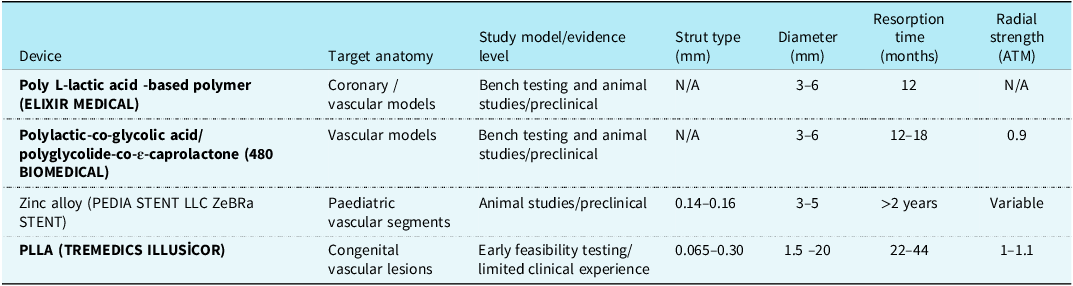
Biodegradable stents were developed to provide temporary vascular support during healing, followed by resorption that may permit subsequent growth and remodelling. Reference Hou, Li and Pan8 Polymer-based biodegradable stents have been extensively assessed in preclinical models and degrade primarily through hydrolysis; however, limited radial strength and radiolucency remain key challenges, often requiring thicker struts and radiopaque markers. Reference Welch, Nugent and Veeram Reddy2,Reference Hou, Li and Pan8,Reference Farah, Anderson and Langer24 Metal-based biodegradable stents, particularly zinc-based systems, more closely approximate the mechanical properties of conventional metallic stents, but evidence in paediatric CHD is largely restricted to preclinical and early feasibility studies. Reference Mullen, Hildick-Smith and Giovanni23,Reference Miglani, Morris and Chiastra25 An o4n congenital and paediatric settings is provided in Table 2. Reference Grogan, O’Brien and Leen11–Reference Butera, Carminati and Chessa18,Reference Bowen, Guillory and Shearier26–Reference Moore, Hegde and El-Said29,Reference Finn, Joner and Nakazawa40
Representative biodegradable stent platforms evaluated for congenital and paediatric cardiovascular interventions, summarising target anatomy, evidence level, key dimensions, and reported resorption and mechanical performance metrics

Biodegradable septal occluders in CHD
Transcatheter occlusion devices are widely used for closure of atrial septal defect and patent foramen ovale. Conventional nitinol-based occluders provide reliable defect closure but remain permanently implanted near the atrioventricular conduction system, raising concerns regarding long-term intracardiac foreign material burden and conduction-related complications. Representative examples of commonly used metallic occluders are shown in Figure 6, illustrating the clinical reference devices that have motivated the development of biodegradable alternatives.
Conventional occluders used for atrial septal defect closure in paediatric patients. (a) Ceraflex septal occluder (Lifetech Scientific Corporation, Shenzhen, China) implanted in a 4-year-old patient and (b) Amplatzer septal occluder (AGA Medical Corporation, Golden Valley, MN, USA) implanted in a 5-year-old patient for atrial septal defect closure.

Partially and fully biodegradable septal occluders have therefore been developed to achieve stable defect closure during early healing while allowing gradual resorption over time. These devices typically combine a structural framework and sealing membrane with radiopaque markers and dedicated locking mechanisms, requiring careful balance between deliverability, anchoring stability, cyclic septal motion, and controlled loss of mechanical integrity during degradation.
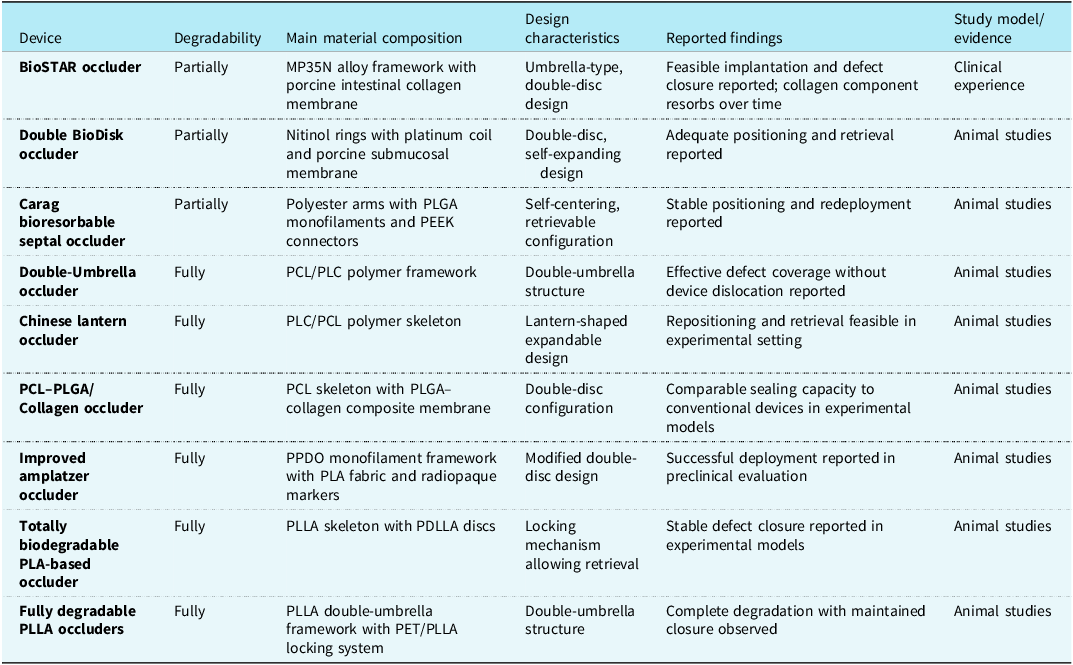
Preclinical studies have demonstrated the technical feasibility of biodegradable septal occluders but have also reported device-related thrombus formation, inflammatory response, and incomplete endothelialisation. As a result, clinical evidence remains largely limited to early feasibility experience, and biodegradable devices evaluated for septal defect closure are summarised in Table 3. Reference Li, Xie and Xie4,Reference Carminati, Chessa and Butera19–Reference Mullen, Devellian and Jux22,Reference Kang and Benson30,Reference Wu41–Reference Kosan, Gonulalan and Ozturk57
Biodegradable occluder concepts investigated for septal defects and PFO, summarising degradability, material composition, design features, and available preclinical/clinical evidence

ASD = atrial septal defect; PFO = patent foramen ovale; PCL = polycaprolactone; PLLA = poly(L-lactide); PDLLA = poly(D,L-lactide); PLGA = poly(lactic-co-glycolic acid); PPDO = poly(p-dioxanone); PET = polyethylene terephthalate; PEEK = polyether ether ketone; PLC = poly(L-lactide-co-caprolactone).
Clinical translation has been most advanced for septal occluders. A fully biodegradable polydioxanone ventricular septal defect occluder demonstrated effective closure and favourable degradation in preclinical models, with high procedural success reported in early paediatric series. Reference Welch, Nugent and Veeram Reddy2,Reference Serruys, Chevalier and Sotomi10,Reference Sabino, Albuerne, Müller, Brisson and Prudhomme58 In a randomised trial including 108 patients, closure efficacy at 24 months was comparable to nitinol devices, while persistent conduction block occurred less frequently with the biodegradable occluder (0/54 vs 6/54). Reference Farah, Anderson and Langer24 Similarly, a fully biodegradable poly(L-lactic acid) atrial septal defect occluder achieved non-inferior closure rates with comparable adverse events in early human and randomised multicentre studies, while eliminating permanent intracardiac metal. Reference Lui, Saidi and Bhatt1,Reference Li, Xie and Xie4
In contrast, biodegradable stents, despite encouraging preclinical results, have not yet achieved comparable clinical translation in congenital populations, and long-term outcomes following complete scaffold resorption remain insufficiently defined. Reference Shi, Kang and Zhang3,Reference McElhinney, Quartermain, Kenny, Alboliras and Amin5,Reference Law, Shamszad and Nugent6,Reference Hou, Li and Pan8,Reference Wentzel, Gijsen and Stergiopulos15,Reference Mullen, Hildick-Smith and Giovanni23
Translational lessons from coronary bioresorbable scaffolds and drug-eluting stents
Experience with coronary polymeric bioresorbable scaffolds, particularly the ABSORB platform, has highlighted important safety limitations relevant to congenital applications. Large randomised trials demonstrated higher rates of target lesion failure and device thrombosis compared with cobalt–chromium drug-eluting stents, with adverse events clustering before complete scaffold resorption. Reference Robaina, Jayachandran and He13,Reference Miglani, Morris and Chiastra25,Reference Bowen, Guillory and Shearier26 Similar safety concerns led to early termination of the COMPARE-ABSORB trial in high-risk populations. Reference Robaina, Jayachandran and He13,Reference Miglani, Morris and Chiastra25
In contrast, newer thin-strut biodegradable-polymer drug-eluting stents have shown favourable mid- to long-term outcomes with low thrombosis rates, underscoring the importance of strut minimisation, predictable degradation, and optimised implantation technique. Reference Robaina, Jayachandran and He13,Reference Rogers and Edelman14,Reference Miglani, Morris and Chiastra25 These coronary data emphasise that long-term follow-up beyond complete resorption is essential. Although biodegradable septal occluders in CHD demonstrate encouraging early- and mid-term safety, continued surveillance is required to detect late arrhythmias, conduction abnormalities, and delayed device-related events. Reference Lui, Saidi and Bhatt1,Reference Welch, Nugent and Veeram Reddy2,Reference Li, Xie and Xie4,Reference Serruys, Chevalier and Sotomi10–Reference Fischman, Leon and Baim12,Reference Farah, Anderson and Langer24,Reference Moore, Hegde and El-Said29
Clinical translation, regulatory challenges, and limitations
Clinical translation of biodegradable cardiovascular devices is currently limited. No fully biodegradable occluder has achieved widespread regulatory approval, and biodegradable stents continue to face challenges related to predictable degradation and long-term safety. Reference Veerubhotla and Lee33,Reference Anderson and Rodriguez59 Paediatric-specific regulatory requirements further complicate development, as devices must be evaluated in the context of growth, evolving anatomy, and prolonged follow-up. In addition, the lack of standardised biodegradation testing and robust in vitro–in vivo correlation frameworks remains a major barrier to regulatory acceptance and future clinical trials.
Despite their conceptual advantages, biodegradable stents and occluders face limitations that restrict wider adoption in CHD. Lower radial strength compared with permanent alloys often necessitates thicker struts, impairing deliverability and increasing inflammation, delayed endothelialisation, and restenosis risk. Reference Welch, Nugent and Veeram Reddy2,Reference Onuma and Serruys9,Reference Serruys, Chevalier and Sotomi10 Additional challenges include the need for larger, customised geometries, radiolucency requiring markers Reference Welch, Nugent and Veeram Reddy2 , variable degradation kinetics, and limited long-term clinical data.
Clinical practice implications and future directions
Current evidence indicates that biodegradable septal occluders for atrial septal defect and perimembranous ventricular septal defect achieve closure efficacy and short- to mid-term safety comparable to metal devices, with potential advantages in reducing persistent conduction block and avoiding lifelong intracardiac metal. Reference Lui, Saidi and Bhatt1–Reference Li, Xie and Xie4,Reference Serruys, Chevalier and Sotomi10–Reference Fischman, Leon and Baim12,Reference Farah, Anderson and Langer24–Reference Moore, Hegde and El-Said29 Biodegradable vascular scaffolds appear technically feasible and acutely safe in paediatric stenoses, but available data remain limited by small cohorts and short follow-up. Future studies should focus on long-term outcomes beyond complete resorption, growth compatibility, and multicentre registries to capture rare but clinically relevant events. Reference Lui, Saidi and Bhatt1,Reference Law, Shamszad and Nugent6,Reference Mullen, Hildick-Smith and Giovanni23,Reference Miglani, Morris and Chiastra25,Reference Bowen, Guillory and Shearier26
Conclusion
Biodegradable stents and occluders offer a potential alternative to permanent implants in CHD, particularly in paediatric patients with ongoing growth and long life expectancy. Current evidence indicates that biodegradable septal occluders achieve closure efficacy and short- to mid-term safety comparable to metal devices, with possible reductions in long-term foreign-body burden and conduction-related complications. In contrast, biodegradable stents remain largely limited to preclinical and early feasibility studies, with ongoing challenges related to mechanical strength, degradation control, and vascular remodelling. Progress will require paediatric-specific design and robust long-term clinical evaluation before broader clinical adoption can be considered.
Supplementary material
The supplementary material for this article can be found at https://doi.org/10.1017/S1047951126111974.