Apogonidae (cardinalfish), a speciose marine family, has about 23 genera and 347 valid species. Mostly shallow water inhabitants of pan tropical/subtropical marine environments, a few are found in brackish and freshwater environments (Nelson, Reference Nelson2006; Fraser & Allen, Reference Fraser and Allen2010; Froese & Pauly, Reference Froese and Pauly2010). Apogonid fish are usually smaller in size (<100 mm, total length) but a few species of genus, Apogon, Holapogon, Apogonichthyoides, Cheilodipterus, Glossamia and Pseudamia grow to larger sizes (Fraser, Reference Fraser1973; Froese & Pauly, Reference Froese and Pauly2010).
Boulenger (Reference Boulenger1888) described a new species Apogon maximus based on three specimens from the Persian Gulf. For a long time the validity of Apogon maximus was questionable and was synonymized by Day (Reference Day1888) and Fowler & Bean (Reference Fowler and Bean1930). Boulenger (Reference Boulenger1889) and Norman (Reference Norman1939) stated that A. maximus is a valid and distinct species (Fraser, Reference Fraser1973). The genus Holapogon was specifically described for Apogon maximus (Boulenger, Reference Boulenger1888) by Fraser (Reference Fraser1973) where he confirmed the validity of species giving a redescription and commenting on the evolutionary significance of the species considering this as the primitive genus near the ancestor from which all living apogonids evolved. Holapogon is a monotypic genus.
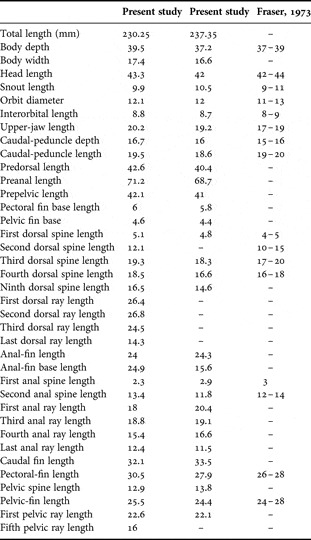
Holapogon maximus (Boulenger, Reference Boulenger1888) is known only from a few specimens recorded from the Arabian coasts off Oman and Muscat (Fraser, Reference Fraser1973; Randall, Reference Randall1995; Froese & Pauly, Reference Froese and Pauly2010). On 13 August 2010 two specimens of H. maximus were collected from demersal fish trawl landings at Calicut (Puthiyappa) Fisheries Harbour, south-western India. The main catch was Nemipterus spp., and by-catch recorded was Chelidoperca spp., Pseudanthias spp, Parascolopsis spp, Uranoscopus archionema, Epinephelus aereolatus etc. and H. maximus. The morphometric and meristic characters of the specimens collected agree well with the description of Fraser (Reference Fraser1973) and Randall (Reference Randall1995) (Table 1).
Morphometric measurements of Holapogon maximus (Boulenger, Reference Boulenger1888) from the south-west coast of India (in % SL).

This report of H. maximus from the south-western coast of India indicates a considerable extension from its known locality. Several species known from the Red Sea and Oman coast have been reported along the south-west coast of India, such as Sacura boulengeri, Liopropoma cf. lunulatum, Pseudanthias marcia and P. fasciatus (Nair, Reference Nair2008; Thomas et al., Reference Thomas, Sreeram, George, Naomi and Sanil2008; George et al., Reference George, Naomi and Sreeram2010).
DIAGNOSIS
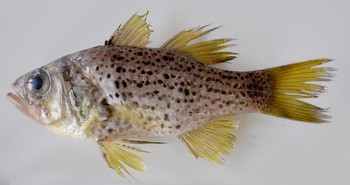
A large sized Apogon, with black spots all over the body (Figure 1). Dorsal-fin rays VIII + I, 9 (8th spine reduced and hidden); anal fin rays II, 7; pectoral fin rays 13, lateral line on to caudal, LL 25 (see Table 1 for morphometrics). Very large ctenoid scales on body, predorsal scales 4–5, dorsal origin to LL 2. Total gillrakers 23 (7 + 16) developed gillrakers 17 (4 + 13), branchiostegal rays 7, LL 25 (+ 3 on caudal). Preopercle finely serrated, serrae at the angle of preopercle slightly larger. Preopercular and post-temporal spine present. Pelvic bases connected by a scale (interpelvic space covered). Large mouth, villiform teeth. A small ridge running to supramaxilla, supramaxilla large. Pectoral fin nearly reaches to anal fin origin in vertical. Large cheek scales. Principal caudal fin rays 18.
Holapogon maximus, Arabian Sea, collected off Cochin.

COLOUR
Pinkish to light violet which fades fast. Black spots all over the body. Basal region of first and second dorsal spine and with a clear black membrane. Membranes of dorsals, pelvics, anal and caudal, yellowish. Rear tips of caudal fin, last pelvic ray with a blackish fade. Lateral lines scales large with a circular design. Caudal emarginate. In formalin, body pale with dark spots, pelvic dark.
ACKNOWLEDGEMENTS
The authors are grateful to the Director, CMFRI for the support and encouragement. CMLRE/MoES is acknowledged for financial support of junior authors. Our sincere thanks to Dr Thomas H. Fraser, Florida Museum of Natural History, USA for sending valuable publications required for manuscript preparation and support.