


Introduction
Health care innovation is undergoing a profound transformation driven by advances in science, technology, and systems thinking. The convergence of engineering, data science, and clinical medicine has created unprecedented opportunities to address complex health care challenges, yet translating these advances into patient-centered solutions remains challenging. Academic medical centers (AMCs) and research universities occupy a pivotal position in this evolving ecosystem. They possess the scientific depth and clinical insight necessary to identify unmet needs, but they often lack the translational infrastructure, interdisciplinary culture, and commercialization pathways needed to convert discovery into deployment [Reference Kosiol, Silvester, Cooper, Alford and Fraser1,Reference McGuier, Kolko and Aarons2].
Despite increased emphasis on innovation in AMCs, multiple barriers persist. Traditional academic reward structures prioritize grant acquisition and publication over entrepreneurial activity or product development [Reference Carter, Mundorff and Risien3]. In addition, regulatory complexity, limited internal capability, and the absence of integrated partnerships across clinical, technical, and business domains further constrain progress. As a result, promising ideas frequently fail to advance beyond the conceptual stage [Reference Schot, Tummers and Noordegraaf4,Reference Smye and Frangi5]. Addressing this translational gap requires not only financial investment but also deliberate cultural change, leadership alignment, and structured mechanisms that connect discovery with design, development, and dissemination.
Texas Biodesign was created to meet an educational need to teach an innovation skill set. By emphasizing clinical observation, need identification, concept generation, and iterative prototyping, Biodesign reframes innovation as a teachable, systematic discipline rather than a serendipitous occurrence [Reference Yock6]. Developed jointly by The University of Texas MD Anderson Cancer Center (Department of Breast Surgical Oncology) and the University of Texas at Austin (UT Austin, the Cockrell School of Engineering, the McCombs School of Business, and the Texas Innovation Center), Texas Biodesign is the first cross-university, cross-industry Biodesign collaboration within the University of Texas System. The program aims to equip clinicians, engineers, scientists, and entrepreneurs with shared tools and a common language to address their shared goals in innovation. Its objectives are to train participants to follow a structured, needs-driven innovation process [Reference Wall, Hellman and Denend7]; foster interdisciplinary teamwork across geographically distributed campuses; and create a sustainable, system-wide pipeline that advances medical technologies from clinical insight to commercial impact. Successful implementation of this model, however, depends on tailoring it to institutional context and fostering collaboration across disciplines and industries.
This manuscript therefore contributes implementation-level insights, early outcome data, and operational design principles for adapting Biodesign methodologies to geographically distributed academic systems. By detailing this proof-of-concept effort, we aim to provide a replicable framework for AMCs seeking to build sustainable innovation capacity, integrate entrepreneurial training into medical education, and accelerate translation of unmet clinical needs into patient-impacting technologies. Together, these elements contribute new knowledge on adapting Biodesign principles to resource-variable institutional settings. Texas Biodesign demonstrates how a fully virtual, cross-campus program can train interdisciplinary teams within a flat, non-hierarchical structure integrating faculty, staff, and students, an approach not commonly described in existing literature.
Program description
Program design and development
Texas Biodesign was conceived as a collaborative initiative between MD Anderson Cancer Center, UT Austin, and cross-industry partners, including NASA’s Center of Excellence for Collaborative Innovation. NASA’s participation extended across all of its directorates and centers, with its organizational resources, engineers, and technical capabilities made available to program participants. This enabled innovation teams to engage directly with NASA engineers and technical subject matter experts on design challenges, systems integration, feasibility considerations, and technology development approaches relevant to emerging healthcare solutions. This cross-sector collaboration provided participants with access to expertise and perspectives not typically available within academic medical innovation programs. The program was designed to teach the needs-driven Biodesign innovation process within an academic medical environment and to evaluate the feasibility of a geographically distributed, cross-disciplinary model.
A steering committee of clinical, academic, and industry leaders from MD Anderson’s Department of Breast Surgical Oncology and from UT Austin’s Texas Innovation Center, the Cockrell School of Engineering, and the McCombs School of Business co-developed the curriculum. The committee identified mentors who are experienced innovation leaders and startup founders with deep expertise in needs-driven innovation, collectively having created over 200 jobs and raised more than $200 million in venture funding. Mentors were selected through faculty-led vetting and interviews and all had completed the Stanford Biodesign Fellowship and had ties to the Texas innovation ecosystem. Their role was intentionally defined as process guidance rather than idea generation or project leadership. Mentors focused on helping teams refine need statements, apply value-based filters, and avoid premature ideation. Each team interacted with at least three different mentors over the course of the program, and mentors engaged with multiple teams, meeting weekly to provide individualized guidance. The committee also finalized the educational modules and recruited participants through targeted announcements distributed across participating institutions and a competitive application review. Candidate selection emphasized multidisciplinary representation, a demonstrated interest in innovation, and commitment to collaboration. Participation was voluntary, did not confer academic course credit, and there was no fee to participate.
The primary goals of Texas Biodesign were to shift the institutional culture toward a needs-driven innovation mindset, establish a shared framework across clinical, technical, and business domains, and train interdisciplinary participants in structured needs-driven innovation methodology. An additional objective was to create a scalable model that could function despite geographic separation and time constraints, enabling meaningful participation from faculty, staff, and students without requiring full-time commitment, and to demonstrate that collaboration was achievable across geographically separated campuses in a fully virtual format. Long-term goals centered on building a sustainable innovation ecosystem across the University of Texas System, creating a replicable model for cross-institutional Biodesign training, and cultivating a pipeline from unmet clinical need identification to commercialization. At program inception, success was defined by sustained team engagement throughout the 8-week pilot, successful completion of all curriculum milestones and learning the Biodesign process, generation of well-scoped need statements, delivery of credible final presentations to an expert panel, and continued collaboration by at least one team post-program. Failure would have been indicated by low engagement, inability to complete deliverables, or absence of any continued development.
Curriculum structure
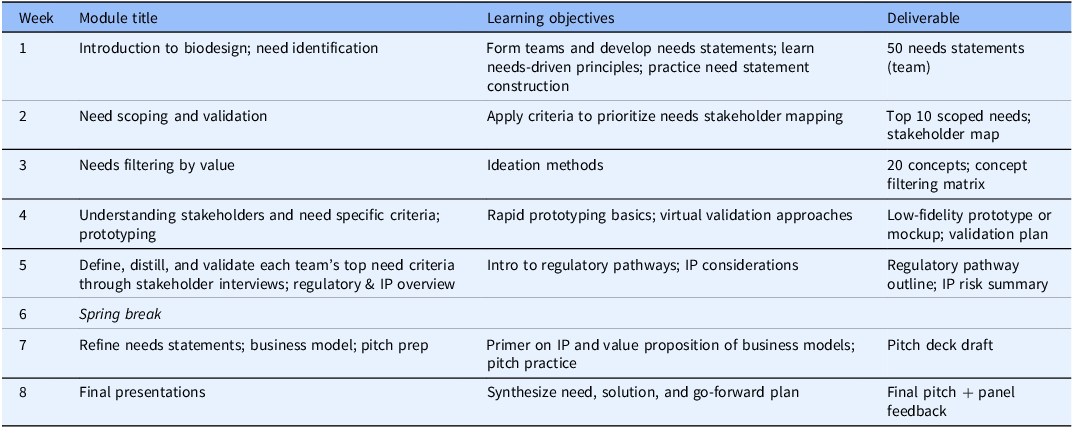
The pilot program employed an eight-week, fully remote curriculum hosted by the Texas Innovation Center. The course was modeled on the Stanford Biodesign framework [Reference Augustin, Yock and Wall8] and adapted for participants with varied prior experience in innovation. Each week included a 90-minute, synchronous, didactic session covering the core instructional modules (Table 1), a mentor-guided team meeting, and independent small-group work totaling approximately 3–5 hours. Each interdisciplinary team applied these modules to the unmet need selected by the team and progressed from need identification to concept development over the course of the program.
Curriculum modules and learning objectives

Table 1. Long description
A table with eight rows and four columns. The columns are labeled Week, Module title, Learning objectives, and Deliverable. The rows are as follows: Row 1: Week 1, Module title Introduction to biodesign; need identification, Learning objectives Form teams and develop needs statements; learn needs-driven principles; practice need statement construction, Deliverable 50 needs statements (team). Row 2: Week 2, Module title Need scoping and validation, Learning objectives Apply criteria to prioritize needs stakeholder mapping, Deliverable Top 10 scoped needs; stakeholder map. Row 3: Week 3, Module title Needs filtering by value, Learning objectives Ideation methods, Deliverable 20 concepts; concept filtering matrix. Row 4: Week 4, Module title Understanding stakeholders and need specific criteria; prototyping, Learning objectives Rapid prototyping basics; virtual validation approaches, Deliverable Low-fidelity prototype or mockup; validation plan. Row 5: Week 5, Module title Define, distill, and validate each team’s top need criteria through stakeholder interviews; regulatory & IP overview, Learning objectives Intro to regulatory pathways; IP considerations, Deliverable Regulatory pathway outline; IP risk summary. Row 6: Week 6, Module title Spring break, Learning objectives, Deliverable. Row 7: Week 7, Module title Refine needs statements; business model; pitch prep, Learning objectives Primer on IP and value proposition of business models; pitch practice, Deliverable Pitch deck draft. Row 8: Week 8, Module title Final presentations, Learning objectives Synthesize need, solution, and go-forward plan, Deliverable Final pitch + panel feedback.
IP, intellectual property.
Participant composition
The acceptance process included an application and a competitive interview process. Following applicant interviews, participants were chosen and organized into three teams. Each team included at least one clinician from MD Anderson, one MBA student from UT Austin’s McCombs School of Business, one engineering or physical-science graduate, doctoral student, or faculty from the Cockrell School of Engineering or the College of Natural Sciences, and one early-career researcher or fellow. Teams were intentionally balanced to represent clinical, technical, and business expertise, as well as a range of career stages (from graduate trainee to faculty member). This deliberately non-hierarchical team structure fostered psychological safety by valuing all perspectives equally, encouraging open dialogue, and enabling participants to contribute without regard to title or seniority.
Virtual delivery and collaboration tools
Because of geographic distance and COVID-19-related restrictions on in-person clinical observation, the program adopted a fully virtual model. All required components of the pilot program, including didactic sessions, mentor meetings, and team collaboration activities, were delivered through videoconferencing and digital collaboration tools. Teams used secure videoconferencing platforms, shared digital whiteboards, and collaborative document tools to conduct meetings, iterate designs, and maintain project documentation. Clinical vignettes and recorded case scenarios were substituted for direct observation when necessary. While not required, some teams independently organized optional in-person interactions, including travel between cities and informal clinical observation experiences to enhance their needs-finding process. These were entirely participant-driven and not part of the formal program structure.
Evaluation and outcomes
Program effectiveness was evaluated through qualitative and quantitative metrics, including structured application and interview assessments, the number and scope of need statements generated, weekly deliverables, team progression through the Biodesign framework, mentor observations and feedback, final presentations, and participant follow-up after program completion. The interview process provided qualitative baseline assessment of participant motivation, interdisciplinary communication, and prior innovation experience. Formal pre-and post-program surveys or validated educational instruments were not administered during the pilot cohort.
Each team progressed through structured weekly deliverables aligned with the Biodesign process (Table 1), providing consistent checkpoints for evaluation. Final presentations were assessed by a multidisciplinary panel of clinical and innovation experts based on clarity of need statement, clinical relevance, feasibility, innovation potential, and commercial viability. These presentations served as proxy assessments of participant learning and application of the Biodesign methodology.
Outcomes
Texas Biodesign was created in less than five months in 2021 as a collaborative initiative between MD Anderson and UT Austin, augmented by cross-industry partnership with NASA. This program represents the first of its kind within the University of Texas System. The development of this workshop specifically addressed an educational need and a barrier to health care innovation at our institution, namely, that MD Anderson is geographically separated from the professional schools at UT Austin. By establishing a joint, cross-campus innovation program, Texas Biodesign provided a mechanism to bridge this divide and enable meaningful collaboration among clinicians, engineers, scientists, and business experts. Furthermore, cross-industry partners were intentionally incorporated into the program to leverage complementary resources and perspectives from sectors such as aerospace and energy, enriching the educational experience for participants learning and applying Biodesign innovation principles.
A defining characteristic of the Texas Biodesign model was its geographically distributed nature. Team members at MD Anderson in Houston and at UT Austin were separated by over 170 miles. To bridge this gap, the program implemented a fully virtual structure that enabled real-time engagement, instruction, mentoring, and feedback while maintaining accessibility across campuses. Remote observation, clinical need discovery, and iterative concept development were facilitated through digital collaboration tools, which mitigated the physical distance between Houston and Austin; provided equal access to mentors, resources, and expertise across sites; and created an interactive environment for all participants. This structure enabled continuous engagement and demonstrated the feasibility of remote collaboration across a university system-wide innovation network.
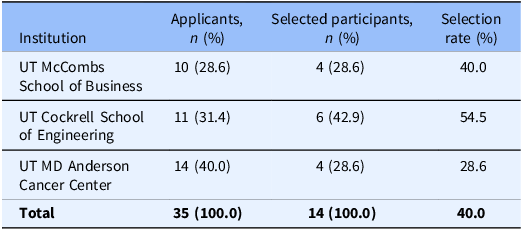
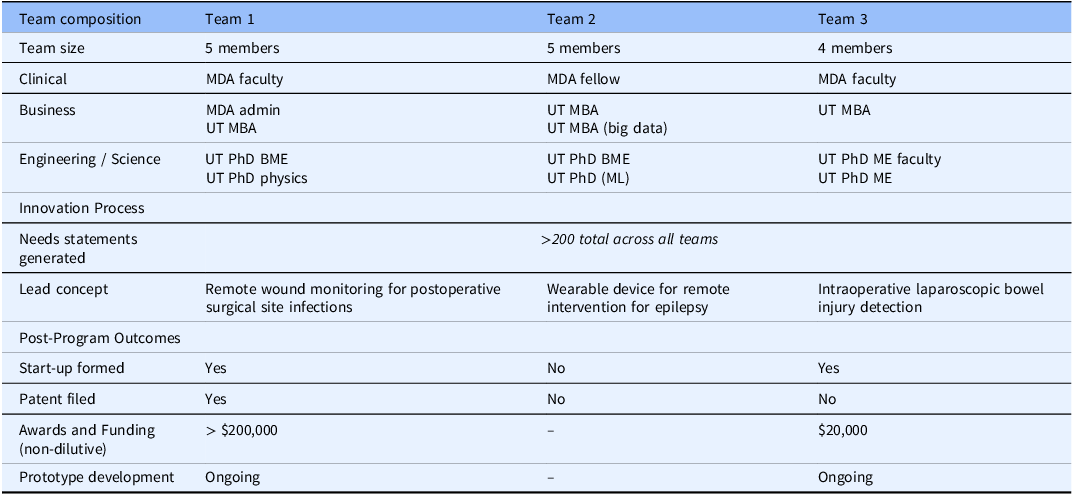
The 8-week pilot workshop was designed to teach Biodesign’s needs-driven innovation process to multidisciplinary teams composed of clinicians, engineers, scientists, and business professionals. A total of 35 individuals applied, including 14 from MD Anderson, 11 from UT Austin’s Cockrell School of Engineering, and 10 from UT Austin’s McCombs School of Business (Table 2). The inaugural cohort included fourteen participants organized into three interdisciplinary teams, each consisting of a clinical expert, engineer, business specialist, and scientist (Table 3). The program introduced a unique participant composition model in which approximately 29% of participants are faculty, 7% staff, and 64% students, all working within the same teams. This created a bidirectional learning environment where expertise is shared across domains rather than dictated by hierarchy, fostering both mentorship and peer learning simultaneously.
Applicants for Texas biodesign pilot cohort

Table 2. Long description
A table comparing applicants and selected participants from different institutions. The table has four rows and four columns. The columns are labeled Institution, Applicants, n (%), Selected participants, n (%), and Selection rate (%). The row labels are UT McCombs School of Business, UT Cockrell School of Engineering, UT MD Anderson Cancer Center, and Total. Row 1: UT McCombs School of Business, Applicants, 10 (28.6 percent), Selected participants, 4 (28.6 percent), Selection rate, 40.0 percent. Row 2: UT Cockrell School of Engineering, Applicants, 11 (31.4 percent), Selected participants, 6 (42.9 percent), Selection rate, 54.5 percent. Row 3: UT MD Anderson Cancer Center, Applicants, 14 (40.0 percent), Selected participants, 4 (28.6 percent), Selection rate, 28.6 percent. Row 4: Total, Applicants, 35 (100.0 percent), Selected participants, 14 (100.0 percent), Selection rate, 40.0 percent.
UT, The University of Texas.
Percentages in the applicants column are based on 35 total applicants. Percentages in the selected participants column are based on 14 selected participants. Selection rate = selected participants divided by applicants within each institution.
Team composition and outcomes

Table 3. Long description
A table comparing team composition and outcomes for three teams. The table has 14 rows and 4 columns. Column headers are Team composition, Team 1, Team 2, and Team 3. Row labels include Team size, members, MDA faculty, Business, Engineering / Science, Innovation Process, Needs statements generated, Lead concept, postoperative surgical site infections, Intraoperative laparoscopic bowel injury detection, Post-Program Outcomes, Start-up formed, Patent filed, Awards and Funding (non-dilutive), $200,000, Prototype development. Row 1: Team size, 5, 5, 5. Row 2: members, 5, 5, Clinical. Row 3: members, 4, 4, faculty. Row 4: members, MDA fellow, MDA, admin. Row 5: MDA faculty, MDA, UT MBA, UT MBA. Row 6: Business, MDA, UT MBA (big data), UT MBA. Row 7: Engineering / Science, UT PhD, UT PhD, physics. Row 8: UT MBA, UT PhD BME, UT PhD ME, faculty. Row 9: UT PhD BME, UT PhD (ML), UT PhD ME. Row 10: Innovation Process, Needs statements generated, >200 total across all teams, Remote wound monitoring for. Row 11: Lead concept, postoperative surgical site infections, Wearable device for remote intervention for epilepsy. Row 12: Intraoperative laparoscopic bowel injury detection. Row 13: Post-Program Outcomes, Start-up formed, Yes, No, Yes. Row 14: Patent filed, Yes, No, No. Row 15: Awards and Funding (non-dilutive), >$200,000, —, $20,000. Row 16: Prototype development, Ongoing, Ongoing.
Participant roles, interdisciplinary composition, and post-program innovation outcomes for the three teams of Cohort 1 (pilot).
BME, biomedical engineer; MBA, master of business administration; ME, mechanical engineer; PhD, doctor of philosophy; ML, machine learning; TX, Texas; UT, The University of Texas at Austin; MDA, The University of Texas MD Anderson Cancer Center.
Teams had a weekly didactic lecture and also met weekly with mentors who provided practical, high-impact guidance to the teams. The three teams generated more than 200 needs statements which were further scoped and filtered to generate one lead concept per team. Two of the three teams continued to collaborate following program completion, resulting in two early-stage startups focused on novel clinical solutions in various stages of development. Teams that continued beyond the program demonstrated strong alignment in participant motivation, complementary expertise, and sustained engagement outside scheduled sessions. Differences in continuation appeared more closely related to participant goals (educational experience vs startup formation) and post-program commitment than to team performance during the workshop itself. This divergence was not a reflection of team performance, as all three teams developed competencies in need identification, stakeholder mapping, value analysis, concept generation, prototyping, and early-stage commercialization strategy and presented to the final panel. Panel feedback assessed clarity and specificity of the need statement, clinical relevance and unmet need magnitude, feasibility of the proposed solution, and commercial viability. Findings from this process directly informed revisions to subsequent program iterations.
The program outcomes were notable (Table 3). Two teams evolved into early-stage startups, securing nondilutive funding and advancing prototype development. The success of these projects validated the program’s educational and operational model, demonstrating that a virtual, multi-campus innovation framework could effectively teach the Biodesign process, foster cross-disciplinary collaboration, train interdisciplinary teams, and catalyze early-stage health care innovations across a university system.
Discussion
The central challenge in health care innovation is not idea generation but the advancement of ideas from concept to meaningful clinical and commercial impact [Reference Westfall, Mold and Fagnan9,Reference Woolf10]. While the Biodesign process is well established, the primary contribution of this work is demonstrating how a Biodesign-based innovation program can be adapted and implemented across a geographically distributed, cross-university, and cross-industry ecosystem, a setting that introduces logistical, cultural, and infrastructural complexities not typically encountered in traditional single-institution programs. Innovators frequently lack access to commercialization, regulatory, and market expertise, while institutional culture, resource limitations, capability gaps, and funding constraints further hinder progress [Reference Barnett, Vasileiou, Djemil, Brooks and Young11–Reference Loewe and Dominiquini15]. Traditional academic structures often fail to reward innovation-oriented activities, and many innovators lack the specialized expertise needed to evaluate intellectual property (IP), navigate commercialization pathways, or access critical market insights [Reference Vanderford and Marcinkowski16,Reference Nearing, Rainwater and Neves17]. Our findings suggest that successful implementation depends less on the curriculum itself and more on how institutional, operational, and cultural barriers are addressed, an insight that has implications for any institution seeking to replicate or scale this model.
A major strength of this work is its description of a structured, replicable model for healthcare innovation that integrates clinical, technical, and entrepreneurial expertise across institutions. Texas Biodesign addresses persistent gaps in translational infrastructure through an experiential, team-based approach and cross-industry collaboration, supporting the development of solutions that are both clinically relevant and commercially viable. Innovation in health care is inherently experiential; success is achieved through doing, iterating, experimenting, and learning from failure [Reference Berwick18,Reference Singer, Benzer and Hamdan19]. The Biodesign approach emphasizes this by immersing teams in cycles of observation, ideation, prototyping, and testing [Reference Yock6,Reference Augustin, Yock and Wall8]. Consistent with these principles, Texas Biodesign provided participants with structured training in unmet clinical need identification, need statement development, stakeholder analysis, value assessment, concept generation and filtering, prototyping, early-stage regulatory and IP considerations, business model development, and commercialization planning. Participant and mentor feedback suggested strong gains in clinical need identification and interdisciplinary collaboration, with comparatively less development in technical feasibility assessment and commercialization strategy, reflecting the early-stage focus of the pilot program.
A distinguishing feature of Texas Biodesign was the creation of a distributed innovation ecosystem linking academic medicine, engineering, business, and industry partners. The collaboration between MD Anderson and UT Austin leveraged complementary institutional strengths, combining clinical expertise and patient access with engineering, business, and entrepreneurial capabilities. In addition, NASA served as a unique cross-sector partner. All NASA directorates and centers were made available as organizational resources and program participants were granted access to NASA engineers and technical expertise on an as-needed basis, providing perspectives from outside the biomedical domain and exposing teams to alternative approaches to clinical concept development and problem solving. Beyond providing technical expertise, these cross-sector interactions helped address a common challenge in health care innovation, cultural insularity [Reference Kreindler, Dowd, Dana Star and Gottschalk20,Reference Greenhalgh, Robert, Macfarlane, Bate and Kyriakidou21]. By exposing participants to perspectives from engineering, aerospace, technology, and other disciplines, the program encouraged alternative approaches to clinical problem-solving and reinforced the value of convergent innovation, whereby insights from one field can inspire solutions in another [Reference Greenfield, McCurdy, Brown and Elkins22,Reference Youn, Strumsky, Bettencourt and Lobo23]. This cross-sector resource model therefore represents not only a mechanism for expanding innovation capacity but also a strategy for overcoming disciplinary silos that often limit translational progress.
Several operational, cultural, and structural barriers emerged during the pilot. First, limited awareness of the Biodesign methodology within the institutional ecosystem constrained initial applicant recruitment and required targeted outreach efforts. Second, the absence of dedicated funding and protected participant time created constraints on participation and limited scalability despite strong participant interest. Third, geographic separation between institutions limited opportunities for direct clinical immersion and required greater reliance on virtual engagement and clinical vignettes. Finally, participants entered the program with varying levels of innovation experience and differing goals, requiring careful team composition and expectation management throughout the program.
Several lessons emerged that may inform similar programs. Despite initial concerns, the fully virtual format proved to be an operational strength, enabling broad participation and sustained engagement across geographically separated campuses. Institutions considering similar initiatives should not assume that in-person delivery is required for meaningful experiential innovation training. Structured mentorship also emerged as a critical determinant of team progression and process fidelity. Deliberate mentor vetting, including requiring prior Biodesign training, proved essential to maintaining process fidelity and preventing mentors from inadvertently redirecting teams toward premature ideation. The program’s flat, non-hierarchical structure further promoted psychological safety, encouraging contributions from participants regardless of career stage and facilitating interdisciplinary problem-solving.
These experiences suggest that institutions seeking to implement similar programs should prioritize access to clinical environments that enable robust need identification, cultivate partnerships across medicine, engineering, and business, invest in mentor development to maintain process fidelity, and establish clear expectations regarding both educational and entrepreneurial objectives. Extending program duration or providing post-program incubation support may further facilitate stakeholder validation, concept refinement, and sustained project advancement beyond the initial training experience.
An important observation from the pilot was the heterogeneity of team outcomes. Two teams progressed beyond the workshop into sustained collaboration, startup formation, and acquisition of non-dilutive funding, whereas one team did not continue. Teams that advanced were characterized by strong alignment between clearly defined clinical needs and technically feasible solutions, as well as continued interdisciplinary engagement beyond scheduled program activities. These observations reinforce the importance of sustained commitment and team cohesion in translational innovation efforts. Importantly, startup formation should not be viewed as the sole measure of program success. Participants whose projects did not continue beyond the program nonetheless acquired innovation skills and learned the Biodesign methodology, which they could apply to future clinical, research, and professional activities. These observations suggest that educational outcomes, including innovation skill acquisition, behavioral change, and downstream application of innovation methods, represent meaningful indicators of impact alongside entrepreneurial outcomes.
Several limitations should be considered when interpreting these findings. This study describes a single pilot cohort with a limited number of participants and projects within a specific institutional context. Additionally, the institutional resources available through MD Anderson, UT Austin, and NASA may not be readily available in all settings, potentially limiting direct generalizability. Formal pre-and post-program educational assessments were not conducted, limiting objective measurement of knowledge acquisition and skill development. While informal feedback was obtained through mentor interactions and panel evaluations, the interview process provided a qualitative baseline of participant mindset, including motivations (academic learning versus startup interest), problem-solving approaches, and interdisciplinary communication ability. This allowed informal observation of progression through improved problem framing, structured need statements, and more rigorous value-based decision-making. Final presentations and panel evaluations further served as proxy assessments of learning, demonstrating participant ability to apply the Biodesign framework. We acknowledge the absence of formal evaluation instruments as a limitation. Startup formation and follow-on funding represent early indicators of translational success, and longer-term follow-up is needed to determine whether projects ultimately achieve commercialization success, clinical adoption, or measurable patient impact. As Texas Biodesign continues to evolve, future efforts will include formal assessment of educational outcomes, longitudinal evaluation of participant development, and measurement of downstream translational, commercialization, and patient-impact outcomes.
Despite these limitations, Texas Biodesign has continued beyond the pilot cohort and has experienced increasing applicant demand and expanded participation, requiring adaptation of mentorship and support structures to preserve instructional quality as the program scaled. Early outcomes suggest that distributed innovation training can be successfully implemented across geographically separated institutions when supported by structured mentorship, interdisciplinary collaboration, and appropriate institutional infrastructure. Long-term sustainability will require formal institutional support, including dedicated funding, protected participant time, integration with commercialization resources, and recognition of innovation activities within academic advancement pathways. Although IP generation remains a commonly reported innovation metric, IP alone does not ensure societal or clinical benefit [Reference Luke, Sarli and Suiter24,Reference Errington25]. Successful translation depends on complementary support systems, including management expertise, access to capital, regulatory guidance, commercialization infrastructure, and opportunities for venture formation [Reference Pienta26,Reference Rose, Wills and Bourassa-Shaw27]. Embedding innovation as a core academic mission, alongside research, education, and clinical care, may be essential for sustaining translational ecosystems capable of converting discovery into patient impact.
Conclusion
The novel contribution of this work is not the validation of the Biodesign process itself, but the demonstration of how it can be adapted, implemented, and sustained across geographically and institutionally distinct organizations. The primary insight from this pilot is that successful scaling of Biodesign depends less on curriculum content than on the ability to align institutional culture, mentorship, infrastructure, and collaborative networks. By integrating clinical insight with engineering, business, and industry expertise, Texas Biodesign illustrates how AMCs can function not only as sites of discovery, but also as engines of translational innovation capable of accelerating the development of clinically relevant and commercially viable solutions that ultimately benefit patients.
Author contributions
Scott K. Alpard: Conceptualization, Data curation, Formal analysis, Methodology, Writing - original draft, Writing – review & editing; Rush L. Bartlett: Conceptualization, Formal analysis, Methodology, Writing – review & editing; Ashley J. Jennings: Conceptualization, Methodology, Writing – review & editing; Kelly K. Hunt: Supervision, Writing – review & editing; Cristina M. Checka: Conceptualization, Formal analysis, Methodology, Writing – review & editing.
Funding statement
This research received no specific funding from any funding agency, commercial, or not-for-profit sectors.
Competing interests
Scott Alpard: Co-founder (equity), Longhorn Life Sciences, Inc.
Cristina Checka: Co-founder (equity), Longhorn Life Sciences, Inc.

 Open access

