Introduction
According to Sidney Pollard, the predominant business organizational form in preindustrial England was subcontracting, and the building industry was most renowned for its usage.Footnote 1 Generally, Pollard and other historians and management scholars have given premodern subcontracting bad press, highlighting its negative business and social impacts. Pollard categorized it as cheap substitute for management in an era of personal capitalism, one that threatened to deprive emerging businesses of the specialist expertise and skills required for innovation.Footnote 2 Eric Hobsbawm saw that subcontracting systems enabled enterprises to respond to variations in supply and demand without increasing fixed costs, but viewed them as “co-exploitation,” and highlighted the lack of bargaining power of labor within subcontracted hierarchies.Footnote 3 More recently, British economic and social historians have argued for more varied research into production and business organization before industrialization. Riello and others have made a case for “rehabilitating” subcontracting as a tool of organization flexibility.Footnote 4 However, although the link between subcontracting and the building trades is widely acknowledged, the reasons for and specification of subcontracting in construction are not well understood.
This article seeks to clarify the roles of contracting and subcontracting in the building trades in London in the late seventeenth century. It uses the records of the largest building projects of the period, mostly commissioned and managed through Sir Christopher Wren, to argue that such building contracts were specified to allow strategic choice of coordination and mechanism in response to financial and management conditions. Moreover, they were used to meet financial objectives.
Construction has always relied on the cooperation of discrete specialists—those in the traditional “trades” such as carpentry, joinery, masonry, metals, and so on—and varied design specialists in engineering and architecture. Thus, the industry has always leaned toward vertical disintegration, or a subcontracting model.Footnote 5 However, historians have traditionally treated builders as “artisans,” and thought that firms formed only in the nineteenth century.Footnote 6 Since Elizabeth McKellar shattered artisan myths about seventeenth-century London construction, there has been a general understanding that throughout the seventeenth century those who undertook the financial risk for work may not have been those who carried out the craftsmanship.Footnote 7 However, even if disintegration was the norm, the form of resulting sub (or subsequent) contracts cannot be assumed, and the evidence here will show that a number of contracting forms and coordination mechanisms were used, which had various and complex purposes.
The discussion of whether or not subcontracting and contracting systems were strategic is important because coordination mechanisms and the form of the firm in early modern England are under-researched. Economic historians tend to think of coordination mechanisms as undeveloped or “simple structures” before industrialization.Footnote 8 Although notions of English preindustrial management as absent are longstanding, scholars have recently begun to understand the late seventeenth century to have been an important period of economic growth.Footnote 9 Historians of management usually view the period before 1770 as the era of personal capitalism, as defined by Chandler. The characteristics of personal capitalism were a lack of separation between ownership and control of a commercial enterprise and a “general unwillingness to delegate responsibility to salaried managers.”Footnote 10 Since later modern economic growth in the nineteenth century is naturally associated with the increasing scale and scope of industrialized business, the question arises as to whether late seventeenth century growth was affected by changes in management.
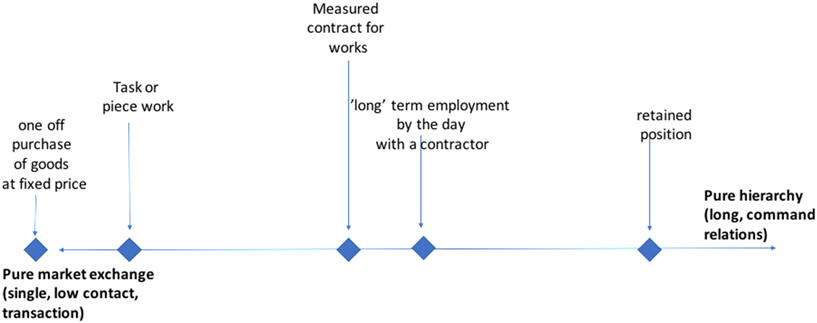
Of course, the Chandlerian perspective of business history in regard to the United States has been consistently challenged by Scranton.Footnote 11 Lamoreaux, Temin, and Raff subsequently subsumed the associated opposition of markets versus hierarchies with a one-dimensional scale between pure market exchange and complete hierarchy, based on the permanence of the resulting relationships of the transacting parties. They proposed a broad scope typology of coordination, in which independent transacting parties form long-term relationships but do not integrate.Footnote 12 Their continuum offers a conceptual solution to a problem encountered by economists and historians who have always noted the low occurrence of hierarchies in early modern business. If the relative costs of transacting on the market or in the firm dictate the organizational response, a high number of transactions in the market implies that the costs of transacting in that market are lower than in the firm.Footnote 13 The usual perception of early modern transaction costs is that they were very high.Footnote 14
This article tries to establish the view that the costs of transacting were well understood by those taking part in contracts for work in Restoration London, and that those contracts were a strategic and purposeful response to the transaction costs. Rather than an industry that relied on subcontracts as a dereliction of management, as Pollard suggested, contracting was a complex and strategic affair in which conditions and claims were actively managed.
The article proceeds in three sections. The first describes the contracts used by Christopher Wren and the City and Crown in the rebuilding of London. The following section examines the responses of contractors to business conditions through use of archival evidence of the organizational forms used by entrepreneurs who took up these contracts. The final section examines the implications of the findings that advanced and specified contingent claims contracting enabled a high level of trade credit to facilitate works, and that projects could not have been carried out without such credit. It seeks to place seventeenth-century construction contracting on Lamoreaux, Raff, and Temin’s continuum.
The Contract for Works
After the Great Fire of London, the Crown and City invested approximately £1.5 million in new churches—including the new St. Paul’s Cathedral—improvements to the Thames waterside, Fleet River, and other projects to improve the city and replace lost infrastructure.Footnote 15 The huge works were contracted to various firms in three broad types of contract that denominated and mitigated risk in various ways. In practice, these contracts for construction protected clients’ and contractors’ interests and incentives.
Monitoring building work in the seventeenth century was just as problematic as it is now.Footnote 16 Construction is tremendously capital-intensive, yet the quality of the result can only be known after the construction process is completed. Construction then and now presents problems of agency, asymmetries of information positively correlated with technical complexity, associated asset specificity, sunk costs, and moral hazard. Large-scale projects create even larger asymmetries of information. Prior performance or even very good information may not indicate whether the money will be best spent on one contractor over another. Moreover, as some of the industry-specific literature attests, the process of building creates more than resolves problems.Footnote 17 The associated relations are complicated further due to necessarily intensive capital needs. Colvin, Mordaunt Crook, and Downes put it plainly when they wrote: “War and building are two of the most expensive activities in which governments can engage.”Footnote 18
A further challenge in large-scale infrastructure or architectural development more generally, especially in the period under review, is idiosyncrasy. Large buildings are by definition usually one-offs—for example, most of Wren’s projects were unique and untried designs—which brings further complexity to organization. Various aspects of technical development and design will call for the expertise and management services of consultants, architects, surveyors, or engineers. These agents act for and on behalf of clients or owners, but they can compound agency problems through clan-like relationships with contractors.Footnote 19 Information and other assets developed specific to one development may not be tried or as useful again to other clients. Such idiosyncrasies add to risk and to cost. It is well recognized that some of these costs are peculiar to the building industry.Footnote 20
Accurate estimation of the cost of works was a challenge throughout most of the eighteenth century, even though it was a stated goal of those who commissioned new building early in the seventeenth century.Footnote 21 As Roger Pratt, one of the most influential architects of the seventeenth century said: “That all expenses be reduced to a certainty, both as to Materials and Worke, as far as possible may be & no man to be left at Random of ye Day Labour; whose artifice will be so to protract ye Work as to make it an inheritance.”Footnote 22 As greater investment was made in construction, participants mitigated the problems of risk and asymmetry of information through applying varied “ways of working,” which were, for all intents and purposes, organizational responses to the risks of investing in construction. As Sir Christopher Wren explained:
There are 3 ways of working: by the Day, by Measure and by Great; if by day it tells me when they are Lazy. If by measure it gives me light on every particular and tells me what I am to provide. If by the Great I can make a sure bargain neither to be overreached nor to hurt the undertaker; for in things they are not every day used to, they doe often injure themselves and when they begin to find it, they shuffle and slight the work to save themselves. I think the best way in this business is to worke by measure: according to the prices in the estimate or lower if you can and measure the work in 3 or 4 measurements as it rises. But you must have a trusty measurer, there are few that are skilled in measuring stone worke, I have bred up 2 or 3.Footnote 23
Sir Wren wrote the above in 1681 to John Fell, Bishop of Oxford, when he was undertaking the erection of Tom Tower at Christchurch College, Oxford. The “three ways of working” are oft-quoted but less as a statement of management strategy than as a description of seventeenth-century custom. Wren recognized that possible means of contracting had different incentives and costs associated with them, which he identified as different types of transaction costs.Footnote 24 In “day work,” the client paid for labor on an ongoing basis, but the lack of an incentive to finish quickly was obvious: the client might have paid unproductive workers, with few monitoring opportunities to prevent this lack of work. In contracting “by the great,” the risk was that a contractor misestimated or knowingly underbid to win the work. This risked unfinished work, large sunk costs, and poor workmanship when the contractor realized the potential loss.
In “measured work,” contractors agreed to supply both materials and labor to produce finished work measured in units. Wren advised negotiating a price as low as possible for agreed units of finished work, ongoing evaluation of work, and paying out in stages. In essence, measured work was a “payment by results” contract with a stop option. This option offered a system of buying fixed amounts of specified work with associated costs and built-in monitoring. Thus, contractors built the required end-product in given units; a rod of brickwork, a foot of carving, and so on, and clients only paid for the work when the units had been measured or surveyed as complete as per the contract by a qualified measurer.Footnote 25 If all was as specified, the clients paid the agreed price. If, however, the work was found unsatisfactory, the client reserved the right to reduce the price or have the work made good at the contractor’s expense. A measured contract incentivized a contractor to provide the best-quality materials and the best skills within the price offered, but no more. If he over-promised skills or materials, then he would lose margin on the unit price, but if he under-delivered he might lose the cost of the whole unit. Because the measures could be small or large units, any deviation from the costs of input or quality of output could be rectified before large sunk costs were incurred. An experienced or knowledgeable contractor would work to get the output at acceptable inputs, as monitoring was both time-consuming and expensive.
Later in the eighteenth century, measures and prices became standardized and the Office of the King’s Works monitored projects on a basis of “measure and value.” However, in the seventeenth century, measurement was adapted to individual conditions and projects.Footnote 26 Measurement was the process of verifying or evaluating the measures or units of work completed. It was carried out for the client’s benefit by surveyors or clerks-of-works, usually at fixed or preagreed points in the work schedule, such as monthly or quarterly.Footnote 27 Given the risk to their profit, contractors also hired their own measurers.Footnote 28 Thus, the practice of measuring was the predecessor to modern quantity surveying.Footnote 29
For the client, one of the benefits of working through a measured contract was that the system was essentially self-monitoring.Footnote 30 The contractor’s risk of already incurred costs going unpaid or prices being renegotiated ensured quality workmanship for the client; however, good quality might lead to further contracting work for the contractor. Measured work not only divided large contracts or tasks into measured pieces but also allowed for the transfer of information between the parties on performance and costs.Footnote 31 Contractors working under measured contracts were incentivized to drive down the costs of inputs, but only to the point at which quality could still be assured. If the contractors found they could not keep to the terms of the contract and still earn profits, then they could choose to not complete further measures; essentially this stopped a continuing loss, which would not be possible if they were tied to contracts by the great or by the task.
Obviously, a key benefit of measured work for the client was financial. Little to no money was paid until the work was verified as completed to the required standard. The contractor bore all the risks of construction, which, in the cases reviewed below, they knew could be easily overcome through their skill, networks, and experience. By agreeing to work now and accepting payment later, the contractor bore the costs of financing of the construction, but measured contracts allowed for effective pricing of these costs.
Thus, complexity and flexibility were built into the system before any type of subcontracts were considered. It seems likely that the type of contract for works determined how a subcontract would proceed. Day, measure, and great types of contract were modified to suit individual clients and projects. Campbell identified six types of contracts: (1) straight day work, (2) day rates advanced and then deducted, (3) by measure with and (4) without materials, (5) by great solely for labor, and by (6) great with materials.Footnote 32 The six types—and there were probably subsets and variations even of these—strongly indicate that contracting for high-value building work was the product of not just advanced engineering and aesthetic design but also advanced sets of organizational techniques and process designs. Both clients and contractors thought in strategic ways about the best way to design the process of building, which would affect the most profitable outcome and, of course, included value for money. As I will show, it probably also included the price of money itself, because in the Stuart period, the entire system rested on the use of these contracts as credit agreements.
For St. Paul’s Cathedral and Greenwich Hospital, two large Wren projects, the written contracts show clearly how measurement, or risk management, was at the center of the arrangement. Contracts gave the client the right to monitor work, to appoint an inspector of work externally (if need be), and to reduce or not pay the full amount if the quality stipulated was not met.Footnote 33 Contracts for several parts of a project were written to specify the contractor’s duties to supply work at specific prices until the building was completed. Contracts for building St. Paul’s, for example, were renewed frequently or passed on to a subsequent contractor. This type of contracting gave clients a further mechanism to discipline contractors. By renewing contracts for the same work, a single, large project turned into one in which a contractor needed to retain the client’s trust across repeated transactions, which offered a counterweight to contractor opportunism.Footnote 34
The key elements of a typical contract of the period can be observed in one dated July 1675, in which Joshua Marshall undertook to lay the foundations of St. Paul’s Cathedral:
When one hundredth Rod is wrought, & ye same certified by Mr Edward Woodruff & allowed by Sir Christopher Wren Knt, so much lawful English money as ye said one hundred Rods of Work shall amount to after ye Rates foresaid, and so proportionally for every one hundred Rods of Work, as ye work goes on until measurement be made of the whole, & when the said severall works shall be well and sufficiently done, & approved of, then the said J. M., his Exors, or Assigns, shall receive so much more as the said Work upon a Just measurement thereof had made & shall justly amount.Footnote 35
The contract specifies the stone to use and the dimensions, and that Marshall would be paid by measurement and be able to claim funds. The degree to which the authority in measured contracts was put in the hands of a client’s agents was by no means unusual. Also not unusual were the idiosyncratic stipulations, which was a prevailing characteristic in the contracts. For example, the contract with Thomas Gilbert and Thomas Wise to provide the Portland stone to St. Paul’s stipulates:
At their own proper cost and charges, for and in consideration of the rates and prices hereafter mentioned, raise, scaple, prepare, and cause to be delivered on board such vessels as they can procure to take ye freight such and so much Portland Stone, as they shall be directed to prepare & send from the Isle of Portland to such Wharfe in the Port of London below Bridge as shall be appointed. And shall scappell the said stone according to the moulds and directions both for the fashion and the number of stones[…]. […] [A]and give account from time to time of the Marks and Measures of the said stone therein […]. […] [A]nd shall take care that all Stone by truelly scappelled, not wanting of ye moulds at the corners or sides, also that the said stone be well conditioned and proper for use intended, without flinty beds or rag beds or clay holes near the faces of the stone.”Footnote 36
In other words, Gilbert and Wise bore all the risks of producing the product to the cathedral’s exact specification. Other than to try to amend the terms in subsequent contracts or tasks, they had no recourse to ask for costs to be covered if production did not go according to plan. In March 1685, it was noted that Gilbert and Wise billed the cathedral for “mending of wayes, for Crain ropes, and other such like Charges.” The cathedral’s commissioners were of the opinion that these costs were to be borne by the contractors. Disputes over charges and costs are a consistent theme in the accounting records of constructing St. Paul’s.Footnote 37
At Greenwich Hospital, a similar approach can be seen in contracts, which clearly specified monitoring, incentives, and deduction systems. On June 5, 1696, the Hospital Fabric Committee recorded that “agreement was made with Daniel Foe of the Parish of Islington, Brick maker’ to ‘burn and supply’” from time to time:
[B]ricks, delivering the same to the wharf near the workes, and if a considerable part of any load … appear to be clinkered or otherwise unprofitable for the use of the work it shall be lawfull for the clarke of the works to reject or turn back such ill goods, 14 shilling the thousand for stock and 25 shillings the thousand for rubbing bricks contract in force for this summer only.Footnote 38
In other words, the hospital avoided the risk of paying for defective goods that might be accidently included or hidden in large-scale deliveries, including damages that arose from transportation. Presumably, everyone involved was clear about when the season ended, which was probably Michaelmas. Also on June 5, Thomas Hues and Richard Billinghurst, bricklayers, agreed to a price of £1 7s per rod for new brickwork. Again, the contract included a quality specification, for which failure to comply meant nonpayment:
Rubbing and setting the straight arches being brick and half deep and one brick thick twelve pence a foot running and they shall find all workmanship making up of mortar well-tempered mixed and beaten and all scaffolding and towards scaffolding they are to be allowed £15.Footnote 39
On June 13, 1696, a contract was made with Thomas Hill and Edward Strong “to perform that masons worke.” A condition of the contract was that Strong and Hill would manage their supply and work schedule with other contractors: “[T]he said masons do agree to keep as many workmen and labourers as the surveyor of the said work shall think reasonable for the carrying on the same with the brickwork so that they not be obstructed.”Footnote 40 It is not known when Hill stepped away from the partnership, but by May 1698 Strong was contracting alone for the stone work at the wharf next to the hospital.Footnote 41 There was also a contract with James Grove, a carpenter, who was expected to retain other contractors: “James Grove by himselfe servants and workmen finding all materials, workmanship and labour will performe and finish in goode, such carpenter work as shall be directed by the surveyor of the said work.”Footnote 42
As noted above, the predominant approach to contracting for building projects appears to have been for clients to write detailed contracts for set amounts of work and then either to renew them or add contracts as the project moved on to new parts of the work. As also noted above, clan-like relationships occurred. The records of St. Paul’s show that sometimes contracts were inherited or passed from one contractor to another. For example, in 1700, Edward Pearce’s contract succeeded Joshua Marshall’s contract; Thomas Wise Junior and Thomas Hill’s contract succeeded Thomas Wise Senior’s contract; Nathanial Rawlins’s contract succeeded Joshua Latham’s contract; and William Kempster’s contract succeeded John Thompson’s contract.Footnote 43
Individual contractors also could have several contracts in force at any one time for a single client. As with brickmaker Foe’s contract with Greenwich Hospital, a contract could be limited but with risks clearly set out. For another example, an agreement with Edward Strong Senior and Edward Strong Junior included:
The said Masons in consideration of such sums of money to be paid them […] as that become due to them … upon the several admeasurements of their work and stating the accounts for the same according to the rates and prices […] do for themselves […] agree with the said Directors […] that they will perform the same well and workmanlike according to their deft skill and ability finding all materials of stone, Lime sand, making of mortar, scaffolding, hoisting, lifting and all other necessary relating thereto except iron work which shall be found by the Hospital.
Although the father and son had already committed to giving detailed accounts for measurement only for monies to become due to them (but not paid), the contract then stated exact prices for worked Portland marble, paving, and other specific works, which negated any possibilities for extra margin. The contract ends with the Strongs agreeing to an open-ended penalty if they and the commissioners could not agree on the quality of the work, even if they had already incurred the costs of labor and supplies.
And the said Masons do further agree that if any part of the work when performed shall appear to be deficient either in goods [or] materials performance or quantity they will submit to such […] action as Sir Chris Wren and the Directors for the said Hospital shall think fit. In with & whereof the said Edward Strong Snr and Edward Strong Jun. have hereunto set their hand this 10th day of October 1706.Footnote 44
In summary, in seventeenth-century London, building contracts were not uniform, but carefully specified and idiosyncratic. Some were deceptively simple. There seem to have been few standard clauses, although there was an increasing reliance on a mutually agreed system of measurement (discussed below). Today’s reader will notice that many of the expectations provided for in contemporary contracts are absent. For instance, time-dependant clauses are conspicuously uncommon: By what date would the work be completed? Contracts of the period also did not specify how disagreements would be resolved, or who would arbitrate: Was the client always right? There is one consistent theme, however. The contracts identify and specify the perceived risks to the client in the process of building, and they make the contractor responsible for those risks. Contracts clearly stated that clients would not pay until they deemed the work done to be satisfactory or problems overcome. Only contractors with large amounts of capital, strong networks, and reliable supply chains could bear such risks, financially or operationally.
Contractors
At the organizations and in the networks run by Wren, his protégés, and the Office of the King’s Works, there was a clear preference for working with contractors and suppliers already known, which reduced the costs of transacting by drawing on relational capital.Footnote 45 The firms contracted to build St. Paul’s were some of the most established business in the building trades. As the project evolved over time, the relationships were notable. The first contracted masons were Joshua Marshall, who ran one of London’s largest workshops, and Thomas Wise, an established player in the London market. The largest proportion of the contracted works (over £50,000) went to Thomas Strong and his brother, Edward. Edward and his son (also Edward) created a powerful construction dynasty that survived into the 1730s. Edward Strong (the father) is well known for partnerships with Christopher Kempster, who Wren esteemed highly, and the Kempsters and the Strongs often partnered, as did their apprentices, protégés, and offspring; this occurred so frequently that the two firms are often coupled by researchers.Footnote 46 Other contractors that worked for Wren were similarly well networked. Edward Tufnell, master mason at Westminster Abbey, had apprenticed with Christopher Kempster, and his daughter married the son of Samuel Fulkes, another St. Paul’s contractor. The result was probably a network of relations with several features of bilateral monopoly (which is often discussed as a feature of construction contracting) and collusion.Footnote 47
There were a surprising number of female building contractors. Most were widows of contracted craftsmen, but the institutional invoices dispel traditional ideas of widows as passive caretakers of family capital waiting for a son to take over the business. The records of Westminster Abbey show that Elizabeth Gregory was contracting, estimating, attending meetings, and carrying out carpentry work throughout the 1710s with her son. Likewise, Sarah Spoore, widow of a smith, was contracted for Westminster Abbey in the same period as her son, who was a separate contractor.Footnote 48
It is apparent that many of these firms were dynastic, but assumptions about “personal capitalism” are not useful in analyzing business practices because it is also apparent that these business owners used many different forms of coordination mechanism. For instance, the day books of William Kempster (son of Christopher), a major contractor at St. Paul’s from 1700 to 1715, show that he paid large numbers of men by the day in ongoing employment relationships, even when his contract was by the measure.Footnote 49 Some men worked a very high number of days for him—in excess of 260 per year, which could be described as regular employment. Others worked for him only for a small number of days—less than 100—and other names appear for only four or six days total. These men may have been specialists or simply did work out as part of the team. Such variation is typical of stage-dependent production and implies a flexible hierarchy. Such flexibility in employment terms and practice applied both to laborers and highly skilled carvers, free of the City of London (i.e., having citizenship and a right to trade), who had their own apprentices and possibly had their own task-based contracts.
There is evidence that there were subteams,Footnote 50 and that some men worked for several contractors. There are also indications that ancillary services as well as specialist work were carried out on subcontracts. Marshall and many others operating in and around the City had significant statuary mason businesses that sold commemorative and decorative stonework and sculpture. In fact, many of the well-known contractors who worked on large projects, such as the London Bridge, City churches, or Westminster Abbey were described as artists and sculptors. However, given the time it took to run their businesses, it seems likely that the work attributed to these contractor-artists was actually done by employees or subcontractors.Footnote 51 Their workshops would have had carvers, foremen, and assisting staff who were hired regularly or by piecework contract. Many of these large contractors were also involved in residential building leases and speculative development, which added to their responsibilities.Footnote 52
Also, many took up positions with large institutions to manage works or be approved suppliers. For instance, at London Bridge, contractors paid hundreds of pounds to secure positions such as “Tide Carpenter,” “Land Carpenter,” or “Purveyor.” This not only entitled the contractor to employ men and supply materials but also to subcontract others to fulfill maintenance requirements at the bridge, presumably at a rate to offer return on investment. However, in taking up the position the contractor became subject to the hierarchy of the bridgemaster’s administration and to scrutiny over business affairs generally.Footnote 53 This does not seem to have put a brake on subcontracting, however. Thomas Wise was a mason on London Bridge while supplying stone to St. Paul’s Cathedral.
These large contractors were entrepreneurs in the Knightian sense, as margin on many of the measures or tasks could only be gained by making experienced calculations for both uncertainty and risk.Footnote 54 As seen in the contracts discussed above, clients specified risks they wished to avoid. However, they were also contracting out the uncertainty that the process of building entailed by stipulating that payment would be made only when the work was done to order. Many contractors, possibly in response to such uncertainty, were involved in multiple joint ventures on construction contracts. For instance, Tufnell partnered with Strong on six City churches after 1712, even as Strong maintained other contracts and Tufnell was contracted at Westminster Abbey. In each of Strong’s partnerships, different carpenters and bricklayers were involved.Footnote 55 This might give the impression that contracts were easy to enter into. However, some contractors new to a client relationship appear to have paid a bond to secure a contract. For instance, Edward Stanton, who owned an established statuary and mason yard in Holborn, put up £2,000 to become the contracting mason to Westminster Abbey after 1719.Footnote 56 As with London Bridge, presumably the profits earned justified the bond.
Although it seems that contractors took on all the risk and covered their margin alone, they could profit through measurement. A measured contract fixed an upper bound of profitability on any one job because if the price of the goods or inputs were bounded, profit could not exceed the difference between those prices at supply and at sale, less overhead, labor, financing, and operating costs; however, it also acted as a stop-loss because the potential loss was limited to the scope of only that measurement. In agreeing to a measured contract, the contractor would have to know how to get the inputs at a price low enough to make the measurement profitable and how to calculate costs to meet projected margins. If costs remained low as compared with the client’s set price, or competitor’s prices, a contractor could profit enormously. Experienced contractors priced a measured contract to ensure enough margin to operate and profit either immediately or in the long run through future contracts after relations were established. If one measurement lost the contractor a large sum, then prices, measures, and inputs would be adapted in the next contract, or the contract might simply be rescinded. Thus, for contractors, measurement was a long-term risk-management strategy that limited sunk costs and enabled them to monitor and manage production to meet margins.
Not all building contracts followed the simplicity adhered to by Wren and his protégés, as illustrated in the examples above. City contracts for the building of the Mansion House in the 1730s show a high specificity in listing exact requirements and obligations.Footnote 57 Records do not show if complete contracts were performed or renegotiated, but the case is highlighted here to show that contracting outside of the Office of the King’s Works or for the Crown may have been costlier. Making further conclusions about the development in contract specificity, accuracy, or efficiency would require research with a large universe of contracts. However, the general method for contracting work was found in all enterprises, not just construction. Bills and contracts for “worke done” or goods supplied at fixed prices per unit were how everything, from peas and salt delivered to Greenwich Hospital to experimental metallurgy for the Monument to the Great Fire of London, was contracted.Footnote 58
One of the quirks long noted about the accounts of these types of projects is the high incidence of extremely late payments to contractors.Footnote 59 In effect, the form of contract provided project finance for the client. After an estimate was agreed and work had started, contractors submitted measured or task bills monthly, quarterly, or biannually. At Westminster Abbey, payment was made biannually for most of the eighteenth century. At St. Paul’s, there were monthly and quarterly reckoning and payment systems. The paymaster or treasurer would receive a bill and pass it to the surveyor or the clerk of the Office of the King’s Works for approval. To approve a measured bill, a clerk had to ensure the work met the specifications by appointing a surveyor to measure and evaluate the work done, or measure it if himself if qualified.Footnote 60 Only after everything was measured did the bill get passed (or money deducted), and it went back to the treasurer to be signed and eventually paid by the paymaster.
Delays in payment were so common as to be ordinary, persistent, and, it seems, expected. In fact, late payment or trade credit was part and parcel of the system of contracting. Colvin and colleagues wrote that at the Office of King’s Works, no works account was ever audited, no final sums were paid in less than two years of finalization of work, and there were some delays of up to ten years: “It was the artificers who bore the problem.”Footnote 61 There was even more credit overdue than Colvin et al. supposed. In 1702 the Office of the King’s Works owed £57,910 to 106 suppliers, but £46,854 of it was due to just eighteen of them. Payments at Westminster Abbey from 1712 to 1719 varied from seven to twenty-three months after a bill was submitted, and work would have been carried out up to six months before that.Footnote 62 In 1720 Edward Strong was still owed £8,461 on his 1715–1716 contract for Greenwich Hospital. In 1713 Christopher Wren and two other surveyors noted late payment for repairs of the Mews at Charing Cross to thirteen contractors between 1709 and 1711. By the time payment was made, contractors for this work had waited more than four years for payment and had also agreed to substantial deductions.Footnote 63
In 1692 a deal was offered to contractors whereby the Office of the King’s Works would pay 6 percent to those who would advance double the amount outstanding by way of a loan to that office.Footnote 64 In other words, late payments had become so bad the Office of the King’s Works was forced to pay 6 percent interest to maintain credit—but these interest rates were available only to those contractors who were already out of pocket and could advance more capital to the office. Contractors who awaited payment were paid in Treasury “tallies”—tickets or vouchers—which were like a form of promissory note. Those who could not afford any further delay in getting paid could sell these tallies—at a discount—as a secondary market developed, of which some officers of the Office of the King’s Works took advantage.Footnote 65 The consequences for clients’ perennial lack of cash and late payments were “bad credit and disadvantageous terms.”Footnote 66
However, given the scale of the problem, the degree to which credit seems to have been extraordinarily good is notable. Contractors who were owed large sums, with no firm date for payment or debt agreement, continued to lend to the Crown—or the Office of the King’s Works—and bid for work at prices competitive enough to be awarded contracts over competitors. It is likely that cash flow from other parts of their businesses such as materials supply or residential building projects subsidized the long-term credit owed to their public works business.Footnote 67
Further consequences for the contractors are likely to have been problems in their supply chain or subcontracts. How did they manage payment terms with suppliers and subcontractors when they themselves were not paid? A letter book of Andrews Jelfe, a principal mason contractor on Westminster Bridge, gives some insight. It shows that in 1735, Jelfe was still dealing with unpaid bills for work done in 1727 from a previous partnership with Christopher Cass (the contracting mason on St. Martin in the Fields). It also shows the intricacies and complexities of managing supply chains over distance and with various parties. In the first part of the book, there are payment records for a stable team of masons and workers for 1734–1735. The second half of the book is mostly taken up with copies and drafts of correspondence, sometimes many times a week, to Mr. Roper, who was Jelfe’s agent in the West country after 1738. Jelfe faced ongoing problems with quarrymen Messrs. Tizard and Bryer over the delivery of stone for Westminster Bridge. Many of the letters include instructions to Roper on evaluating sourcing alternatives or how Tizard and Bryer could be persuaded to produce what was needed. Roper received instructions on sizes of stone, cutting, and carriage directions. Jelfe also wrote to him regularly to advise him of contract developments. In July and August 1743, work on the bridge was not going according to plan, and Jelfe warned Roper to lay off men (his “many hands”): “I am sorry there is no work for them here.”Footnote 68 It is not clear what the contractual arrangement between Roper and Jelfe was, and whether Roper was paid for his time or on some kind of commission, but the correspondence does highlight the varied coordination arrangements required of Jelfe.
Although the role of book credit is frequently referred to, its effects on the economy more generally are still to be pinned down by either economic, financial, or business historians.Footnote 69 Contracting institutions and businesses of any kind were engaged in a wholesale exchange of negotiable paper credit, much of which may have been resold or reconciled without ever becoming monetized. In some sense, a contract was only the right to carry out work, and the right to bill for it, and the residual claims that the contractor could extract were a result not only of the product of their work but also the ability to enforce those claims. Effective contracting was both a matter of keeping the costs of inputs low to ensure margin, but primarily to keep the terms of credit running. The contractor with the best price and the highest margin would be one whose supply chain held up and who could trade bills without having to take any deductions.
Implications
There are a number of implications in the building contracts of the late seventeenth and early eighteenth centuries related to the institutions and organizations of business and finance in London before 1800.
First, although there has not been a great deal of inquiry into the “simple structures”Footnote 70 of personal capitalism in England before 1750, the evidence here suggests that just as Scranton showed for the nineteenth century in the United States, the road to later “scale and scope” was paved with varied, flexible, and innovative enterprises (of course, the construction industry has always featured small enterprises).Footnote 71 Enterprises remained multifarious even in periods of booming demand and consumption. Moreover, although one can discern a clear relationship between the contracts and costs of transacting, the resultant organizational forms were affected by multiple contingencies—personal, institutional, social, and financial, among others.Footnote 72
Although the rebuilding of London coincided with the beginning of England’s Financial Revolution, these enterprises seem to have garnered and leveraged large capital sums without resort to capital markets or banks; indeed, they were sources of finance for the City and Crown. Evidence indicates firmly that contracts for work were really contracts for work and finance; that is, transactional costs of capital and management were transferred into financial risk, which was priced and undertaken by experienced building contractors.
It is possible to gain insight into management and productivity in this period by examining measured contracts rather than “firms.” Individual contractor entrepreneurs were often involved in multiple contracts, but due to their differing limits and specifications, the boundaries of the firm were indistinguishable. The contractor-entrepreneur had a number of possible organizational and flexible employment responses, along with high levels of finance. It is thus unsurprising that they helped make institutional changes that influenced contracting. In particular, a system of measurement led to innovation and changes in construction productivity. In today’s world, institutional measurement is the foundation for all modern quantity surveying, valuation, and design in architecture and construction.
The system of measurement, first developed in the seventeenth century, allowed clients and contractors to price and transact highly idiosyncratic, expensive work with a high percentage of sunk costs at the outset, which benefitted both parties. It allowed clients to make terms; monitor progress; reduce negligence and agency problems; and pass many of the search, transactional, and operational costs to the contractor. Measurement also allowed a primary contractor to adequately price costs and risks in units and charge for finance, and so effectively subcontract and fix bounds to a downside or loss in any ongoing project or relationship. In the period of rebuilding after the Great Fire, it also allowed clients to borrow from contractors, because the process of measurement was sufficiently protracted to delay payment under the auspices of “process,” which thus delayed admitting to a lack of funds. It allowed lenders to set the price for their money or capital, and it encouraged them to do so competitively. However, although the system of measurement provided an effective monitor and easier funding for the client, it will never be possible to accurately quantify what it cost them.
Measurement and the type of building contracts discussed here were not customary ways to account for building work; instead, they were management tools used to minimize risk, secure financing, and ensure quality with a minimum of monitoring and bargaining. Although a great deal is written about early modern credit, the scale of the lending and duration of loans to the Office of the King’s Works are a world away from the smaller-scale trade credit that features predominantly in the literature.Footnote 73 Mutually agreed practices and institutions financed large-scale investment without any banking support or financial intermediaries. Credit was part and parcel of contracting, so financial valuations of interest are only partially useful in understanding the costs of this kind of early modern trade credit.
Seventeenth-century building contractors had a number of coordination mechanisms at their disposal, and their choice was related to the contract terms under which work was to be carried out. Most contracts were agreed and governed outside of a what is understood as a hierarchy (Figure 1). Costs were minimized through relational capital and the evolution of and cooperation in new systems, such as measurement. The financing of work was also dependent on the contract type. Seventeenth-century building contracts should be seen as forming an emergent system that has minimized transaction costs in a highly capital-intensive business, through to today’s architectural practice and quantity surveying. Measurement and building contracts belie the view that seventeenth-century English business organizations were simple structures before industrialization.
Types of exchange and contracts, markets, and hierarchy scale.
Source: Lamoureaux, Raff, and Temin (Reference Lamoreaux, Raff and Temin2003).