Introduction
The importance of public finance control has increased over time, as many countries are currently facing record debt and deficit levels associated with structural economic imbalances. These circumstances enhance the importance of sound institutional system growth and highlight the need to reinforce fiscal rules and budgetary procedures (Spilimbergo et al. Reference Spilimbergo, Symansky, Blanchard and Cottarelli2008; Cottarelli and Schaechter Reference Cottarelli and Schaechter2010; Hauptmeier et al. Reference Hauptmeier, Sanchez-Fuentes and Schuknecht2011). But, no rule is effective without reliable fiscal forecasts. Fiscal forecasts are, in fact, the main signals relied upon by forward-looking private agents, forecasters and analysts and for implementing fiscal discipline under domestic and supranational fiscal rules, such as the stability and growth pact (SGP) for Economic and Monetary Union (EMU) countries.
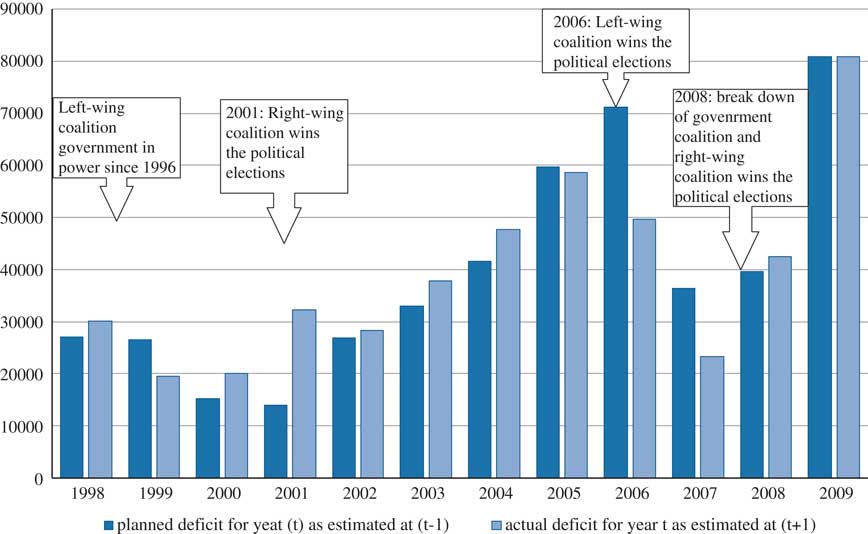
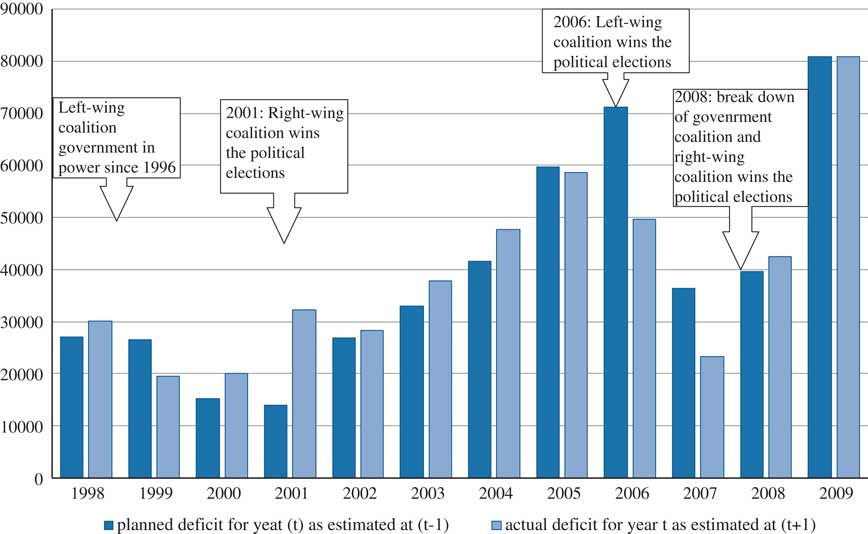
A large and growing literature has analysed the nature and the causes of errors in fiscal forecasting, mainly by comparing aggregate revenues, expenditures and budget balances in different countries (for the United States, see Krause and Corder Reference Krause and Corder2007; Krause and Douglas Reference Krause and Douglas2013; for the Eurozone, see Pina and Venes Reference Pina and Venes2011; Frankel and Schreger Reference Frankel and Schreger2013). However, little attention has been paid to the forecasts of single budgetary lines and the detailed modelling of the different stages of the budget process. Both omissions are addressed in this paper. To enhance precision, we focus on one country – Italy – from 1998 to 2009. Italy’s tendency towards biased forecasts has been observed in other studies (e.g. Jonung and Larch Reference Jonung and Larch2006; Strauch et al. Reference Strauch, Hallerberg and von Hagen2009; Balassone et al. Reference Balassone, Momigliano and Rizza2011b), and is apparent even at first scrutiny. For example, Figure 1 shows that, since 2000, the country’s actual deficit has systematically deviated from its planned value, with average variations of about 10 per cent of the target value.
(color online) General Government: planned and actual deficit (1998–2009, million EUR). Source: Authors’ elaborations.
Accurate modelling of the budgetary process is obtained from real-time data (as in Golinelli and Momigliano Reference Golinelli and Momigliano2006; Beetsma et al. Reference Beetsma, Giuliodori and Wierts2009, Reference Beetsma, Bluhm, Giuliodori and Wierts2012), which are similar to data made available to policymakers when they form plans and implement policies. Data are collected from official documents published throughout Italy’s four-step budgetary process: (1) the budget draft, which is presented to the Parliament for discussion and approval; (2) the approved budget; (3) the first-release outcomes data, published towards the end of the year of implementation; and (4) the ex post outcomes data, which is published after the budget year has ended. The first two steps are often taken together as the first step in three-step budgetary process – the planning stage – including in the article upon which we rely most (Beetsma et al. Reference Beetsma, Giuliodori and Wierts2009). To the best of our knowledge, our approach of considering these first two steps separately is new.
Our approach leads to a more detailed analysis of the budget, which provides new insights on the evolution of the Italian government’s fiscal plans. Biased forecasts in the draft budget are the consequence of a mix of ambition and profligacy: ambition is required by fiscal rules (in particular, the SGP for EMU countries) and market scrutiny, while profligacy satisfies the interests of electoral constituencies. We find that, while the former incentivises overly optimistic budget balance targets and revenue forecasts, the latter favours the over-budgeting of expenditure items that can be used as a reservoir for fiscal space during the budget discussion. The Parliament’s session then provides the opportunity for fiscal drift: allocative pressures from political parties and electoral constituencies require a reshuffling of the budget and fiscal space to accommodate requests. The budget that is finally approved reveals diminished ambitions in fiscal targets and the exploitation of the fiscal reservoirs.
Initial plans that are biased are more likely to be reneged during budget implementation. Indeed, budget execution often deviates from announced plans, not only as updated information and material errors require the forecast’s revision, but also as excessive ambition in the initial stages proves unsustainable and requires downsizing. Further, the need to comply with fiscal rules, social groups’ resistance to spending cuts and/or revenue increases and political instability impact on the adherence to approved fiscal plans. Fiscal space is opened again by in-year policy measures and under-spending on non-compulsory expenditure items.
While addressing the problem of measuring budgetary forecast errors, i.e. the variations between actual and planned values, our paper also tries to identify their potential causes: among others, the strategic over-/under-estimation of government revenues and expenditures, errors in forecasting GDP growth, ex post discretional fiscal adjustments and non-compliance in the budget execution.
By investigating the nature and sources of budgetary slippages in Italy, we contribute to the literature on the determinants of both fiscal plans and actual policies (e.g. Forni and Momigliano Reference Forni and Momigliano2004; Cimadomo Reference Cimadomo2008; Beetsma and Giuliodori Reference Beetsma and Giuliodori2009; Beetsma et al. Reference Beetsma, Giuliodori and Wierts2009). Moreover, we draw a comprehensive picture of the characteristics of fiscal forecasting, which is paradigmatic and could be usefully applied to other countries. Indeed, we identify the features of policymakers’ behaviour in preparing and implementing annual fiscal policy, and we discover regularities and potential determinants in the formation of implementation errors. Thus, we offer insights on the reliability of the data released at the different budgetary stages, the impact of the Parliament’s drift, the role played by non-compliance in the budget execution, the under-/over-budgeting of discretionary and non-discretionary expenditures and the pro-cyclicality of the fiscal stance during budget implementation.
Our paper is structured as follows. “A review of the literature” section surveys the literature and highlights our contribution to it. “Data and methodology” describes our conceptual framework and adopted methodology. “Planned changes and implementation errors in fiscal policy” presents the results from the decomposition of observed fiscal outcomes into planned changes and implementation errors for aggregated and disaggregated budgetary items. “Decomposing fiscal outcomes and implementation errors” includes the analysis of fiscal outcomes variability and the decomposition of implementation errors to identify their systematic components. “The determinants of the implementation errors” section discusses the potential determinants of the implementation errors. Finally, some reflections on policy implications and conclusions are proposed in “Policy implications” and “Conclusions” sections, respectively.
A review of the literature
The literature on budgetary forecast evaluation has been developed along many strands, covering a variety of areas: the quality and choice of the forecasting institution, the efficient or rational use of the information at forecasting time and the direction of forecast biases and the potential factors influencing those biases (e.g. electoral cycles, political orientation and supranational fiscal rules).
There is evidence that biases in fiscal forecasts depend on the political structure of the country – in particular, the way in which the government is formed. For instance, if it is formed on a commitment or delegation basis, this seems to play a role in guiding the biases direction to be either cautionary or optimistic, respectively (Hallerberg and von Hagen Reference Hallerberg and von Hagen1999; Strauch et al. Reference Strauch, Hallerberg and von Hagen2004). Moreover, the political orientation also seems to count, with governments moving to the right making more pessimistic fiscal forecasts and vice versa (Bretschneider et al. Reference Bretschneider, Gorr, Grizzle and Klay1989; Brück and Stephan Reference Brück and Stephan2006).
Beyond this, countries with relatively good budgetary institutions have significantly more precise expenditure and revenue forecasts. Pina and Venes (Reference Pina and Venes2011) show that, besides reflecting GDP growth surprises, budget balance forecast errors are also responsive to the institutional framework of fiscal policy and opportunistic political motivations. More generally, projections for economic growth and fiscal parameters are strategic variables that are likely to represent governments’ fiscal intentions given their medium-term economic forecasts (see von Hagen Reference von Hagen2010). In this framework, one may expect that the implementation of the budget is better when positive growth surprises take place, as they normally facilitate adherence to plans.
Given the strategic character of the projections for economic growth and fiscal parameters, a basic institutional aspect of fiscal forecasting is the assignment of the forecasting task to specific institutions. This role is usually entrusted to the Minister of Finance, who can strategically use fiscal forecasts to influence the behaviour of other spending ministers and the assessments of supranational and independent authorities (e.g. European Commission, European Central Bank, IMF and Consensus Group Commissions in the United States). There is evidence that the accuracy of the GDP and revenues forecasts is positively associated with the independence of the forecasting institution (Artis and Marcellino Reference Artis and Marcellino2001; Jonung and Larch Reference Jonung and Larch2006; Buettner and Kauder Reference Buettner and Kauder2010). In addition, Krause and Douglas (Reference Krause and Douglas2013) prove that revenue-forecast accuracy in the United States is likely to increase when the independent commissions responsible for the forecasts are smaller in size and have more organizational homogeneity. On the other hand, detractors of this position (e.g. Leal et al. Reference Leal, Pérez, Tujula and Vidal2008) remind us that independent agencies usually lack sufficient inside information to provide accurate and detailed forecasts of expenditures.
As for the relevance of electoral cycles, they can impinge on the quality of fiscal forecasting because of both window dressing operations on the real state of the budget and pre-election expansionary fiscal policies. Afonso and Hauptmeier (Reference Afonso and Hauptmeier2009) affirm that electoral cycles can affect a country’s fiscal position since, when there is an election, governments choose to deliver a more expansionary fiscal policy, thereby allowing for a more mitigated response by the primary balance to increases in government debt. Likewise, previous findings by Afonso (Reference Afonso2008) highlight that primary balances react positively to government debt only when there are no parliamentary elections in the next period – but this is not the overall case if there are elections. Finally, Brück and Stephan (Reference Brück and Stephan2006) find that, in periods shortly before elections, European governments provide budget balance forecasts with significant upwards biases.
In the United States, a crucial element in the relationship between revenue forecasting and the electoral horizon is the presence or absence of term limit restrictions. “Legislators and governors that are eligible for seeking reelection are more likely to offer conservative revenue forecasts because they are acutely concerned about the impending fallout associated with unanticipated budgetary shortfalls or tax increases” (Krause et al. Reference Krause, Lewis and Douglas2013, 278). On the other hand, policymakers not subject to term limits are more likely to manipulate revenue forecasts for myopic reasons linked to a shorter electoral horizon.
The presence of fiscal rules and their strength also explain forecasting errors. There is evidence of a generally overly optimistic trend in fiscal projections in European countries subject to the SGP (Jonung and Larch Reference Jonung and Larch2006). This is particularly true when the budget deficit breaches the 3 per cent limit at the time the forecasts are made (Frankel and Schreger Reference Frankel and Schreger2013). And, this is mostly true when a country’s fiscal governance follows the “delegation approach” (see Hallerberg et al. Reference Hallerberg, Strauch and von Hagen2007) and the Minister of Finance is responsible for the budget as a whole. In this context, governments are allowed a wider margin within which to manoeuvre, and it can be easier for them to adjust in-year fiscal policy and use optimistic forecasts to formally respect the SGP. Over-optimism seems to be strongly pronounced in Italy (Strauch et al. Reference Strauch, Hallerberg and von Hagen2009; Marinheiro Reference Marinheiro2011) and is particularly evident in economic growth projections. On the other hand, stronger fiscal rules could foster excessively cautious fiscal forecasts and limit the government’s ability to react to unforeseen changes in economic circumstances. Therefore, errors in fiscal forecasts are not necessarily avoided by strong fiscal rules, and the type of fiscal governance actually adopted should be taken into account.
Supranational fiscal rules, such as the Stability and Convergence Pact, can also impact on the quality of fiscal forecasting. In this framework, Mora and Martins (Reference Mora and Martins2007) studied deficit and debt figures reported in Excessive Deficit Procedure (EDP) notifications for the period 1990–2005. They found that, for several countries – Italy included, data on the yearly changes in debt have been more reliable than those on the deficit. In turn, Strauch et al. (Reference Strauch, Hallerberg and von Hagen2004), focusing on SCPs over the period 1991–2002, show that fiscal forecasts exhibit different patterns of accuracy and biases across countries, which can be attributed to the country’s size, the different timing of the forecasts, the use of macro models and the number of taxes.
While the above strands of literature constitute the conceptual framework, our paper is more directly related to recent studies that estimate fiscal forecasting using real-time data. Until recently, empirical research on fiscal policy behaviour has been largely based on ex post (i.e. latest available or revised) data of fiscal outcomes, which were mainly employed to estimate fiscal policy reaction functions (Favero Reference Favero2003; Balassone and Francese Reference Balassone and Francese2004; Annett Reference Annett2006).
Indeed, real-time data are similar to data available to policymakers when they form plans and implement policies. Further, they provide the fiscal framework that the national Parliaments discuss and approve. However, ex post data may differ from the real-time data available to policymakers as new and more precise information (e.g. on potential output growth) becomes available in time and as construction methodologies change in time.
Studies based on first-release or real-time data are those of Forni and Momigliano (Reference Forni and Momigliano2004), Cimadomo (Reference Cimadomo2008), Beetsma and Giuliodori (Reference Beetsma and Giuliodori2009) and Beetsma et al. (Reference Beetsma, Giuliodori and Wierts2009, Reference Beetsma, Bluhm, Giuliodori and Wierts2012). Beetsma and Giuliodori (Reference Beetsma and Giuliodori2009) explore the determinants of fiscal plans and their implementation for OECD countries over the period 1995–2006, including how fiscal policy responds to new information, especially on the business cycle. They find that the empirical distinction between the two fiscal stages is crucial. In turn, Beetsma et al. (Reference Beetsma, Giuliodori and Wierts2009) analyse the determinants of both budgetary plans and the first-release deviations from those plans in the EU countries using data from the Stability and Convergence Programmes. They highlight that implemented budgetary adjustment falls systematically short of planned adjustment, and that the variability in the eventual fiscal outcomes is dominated by the implementation errors, especially on the spending side of the budget. In a more recent paper, again using the data from the Stability and Convergence Programmes, Beetsma et al. (Reference Beetsma, Bluhm, Giuliodori and Wierts2012) explore the determinants of the deviations of ex post budget outcomes from the first-release outcomes. They add to previous studies by offering an explicit framework for decomposing overall errors and analysing the “revision error” related to the budgetary components and GDP. They find that first-release data are biased estimators of the final figures, which impinge on the programming of the next budget and on fiscal surveillance. Finally, Forni and Momigliano (Reference Forni and Momigliano2004) and Cimadomo (Reference Cimadomo2008) focus on the importance of estimating fiscal reaction functions including real-time information on the output gap at the moment the budget was prepared.
Some studies also combine real-time with ex post data (Hughes Hallet et al. Reference Hughes Hallet, Kattai and Lewis2007; Bernoth et al. Reference Bernoth, Hughes Hallett and Lewis2008; von Hagen Reference von Hagen2010) to explain why fiscal policies, which are counter-cyclical at the planning stage when measured in real-time data, turn out to be pro-cyclical when measured with revised ex post data. Hughes Hallet et al. (Reference Hughes Hallet, Kattai and Lewis2007), for example, investigate the extent of these differences for the output gap and cyclically adjusted budget balances for OECD countries, concluding that fiscal surveillance based on real-time information may be misleading. Von Hagen (Reference von Hagen2010) also affirms that real-time data in the Stability and Convergence Plans are not reliable (unbiased) projections. As for the United States, recent contributions use the real-time revenue forecasts made by the Consensus Group commissions in each American state (Krause and Douglas Reference Krause and Douglas2013) and the real-time macroeconomic forecasts published by executive branch agencies (Krause and Corder Reference Krause and Corder2007).
Our paper adds to this literature and evaluates fiscal projections on the basis of real-time data for Italy. While previous studies employed real-time data from international organizations (OECD, Europe’s SCPs), our data set comes from two distinct official Italian reports issued at two different stages of the budgetary process: (1) the preparation of the annual budget and (2) the Parliament’s approval of a final budget. Thus, our real-time data allow us not only to capture more accurately the information set upon which policymakers’ decisions are based, but also to take into account the different phases of the budgetary process, subsequently enriching the evidence for Italy (Balassone et al. Reference Balassone, Momigliano and Rizza2011b).
Our focus on Italy is justified by the fact that the country severely suffers from many of the pitfalls in fiscal forecasting that have been outlined in the literature. Therefore, we expect fairly imprecise revenue forecasts, as shown by von Hagen and Harden (Reference von Hagen and Harden1994) for EU high-debt/high-deficit countries. In addition, the precision of revenue forecasts seems to increase in the absence of government manipulation (Buettner and Kauder Reference Buettner and Kauder2010). As such, we may expect systematic revenue shortfalls in Italy, where the Minister of Finance is responsible for the forecasts and the political expediency has usually led to excess optimism (see also Artis and Buti Reference Artis and Buti2000).
Beyond this, the size of fiscal forecast errors in Italy is likely to be affected by mistaken output growth projections, as previously pointed out by Balassone et al. (Reference Balassone, Franco and Zotteri2011a). We also expect that most of the shortfalls of implementation from planned adjustments are in public expenditures, as Italian governments have been characterised as having a poor capacity to control spending over time (see Balassone et al. Reference Balassone, Momigliano and Rizza2011b).
Data and methodology
The data
Our analysis focuses on the General Government annual plans, as they are relevant for Italy’s public finance sustainability and, in particular, for compliance with the SGP rules. Moreover, disaggregated real-time data for each tier of government are not available in the governments’ budgetary plans, and consolidated variables are usually adopted in practice.
The reference period 1998–2009 covers the years following admission to the EMU: public finances were constrained by the SGP targets and by a domestic incremental balanced budget rule for the state budget (Law 362/1988). The latter provides that any change in public revenues and expenditures should leave the target budget balance unchanged. No domestic fiscal rule is applied to the General Government as a whole. This allows us to perform our analysis over a relatively stable period. Likewise, the years of the deepest economic recession are also excluded. The Italian budget process to which we refer is the one in force until 2009 (Figure 2), before the Budget Reform Law (Law 196/2009), which incurred formal but unsubstantial changes.Footnote 1
The budget process in Italy. Note: The figure represents the budgetary process until 2009, excluding both the 2009 and 2011 reforms. The subscript refers to the year t under analysis. Source: Authors’ elaborations.

In detail, we employ two sets of real-time data for the planning of the budget of year (t):
-
1. Data released in the autumn of year t−1 in the Draft budget presented to the Parliament for discussion and approval. These data are reported in the Forecast and Planning Report Footnote 2 and are preferable to those released in the summer programming document (Economic and Financial Programming Document), which seldom includes details for revenues and expenditures and often requires substantial updates owing to the frequent mid-year budgetary adjustments.
-
2. Data released in the spring of year t in the Approved budget voted on by the Parliament. These data are presented in the Report on the General Government Consolidated Cash Accounts.Footnote 3
For the budget execution and the real-time preliminary results, we employ the data released in the Draft budget in the same year (t). In turn, the Approved budget of year t+1 accounts for outturn data.
The methodology
In order to evaluate fiscal plans and their execution, we employ a systematic decomposition of the actual fiscal outcomes of the plans and their implementation. Further, we investigate the impact of other factors (basically GDP projections and the parliamentary session) on the extent to which outcomes deviate from initial plans. In line with Beetsma et al. (Reference Beetsma, Giuliodori and Wierts2009), the decomposition framework we adopt allows us to disentangle the role of the different budgetary steps – the planning stage and budget execution – and their crucial interactions in order to identify any implementation errors linked thereto. This approach differs from the standard analysis of the determinants of the overall fiscal outcomes through fiscal reaction functions.
Focusing on a single country enables us to provide greater detail and to distinguish budgetary information coming from both the Draft and the Approved budgets. When using the data from the Draft budget, the differences observed between outcomes and plans are caused not only by limitations on time but also by changes decided during the Parliament’s budgetary session. Data from the Approved budget already include these changes and, thus, the reported differences are determined by several factors influencing the budget’s execution (e.g. updated information, in-year policy measures).
In detail, the actual budgetary adjustment (A), which is measured by the change in a fiscal variable (Y) in absolute values,Footnote 4 can be expressed as the sum between a planned change (P) and the deviation from it (E):
 $$\mathop{\underbrace{{\left( {Y_{{t{\plus}1}}^{{t{\plus}1}} {\minus}Y_{t}^{{t{\plus}1}} } \right)}}}\limits_A=\mathop{\underbrace{{\left( {Y_{{t{\plus}1}}^{t} {\minus}Y_{t}^{t} } \right)}}}\limits_P{\plus}\mathop{\underbrace{{\left[ {\left( {Y_{{t{\plus}1}}^{{t{\plus}1}} {\minus}Y_{t}^{{t{\plus}1}} } \right){\minus}\left( {Y_{{t{\plus}1}}^{t} {\minus}Y_{t}^{t} } \right)} \right]}}}\limits_E$$
The superscript refers to the year of the document publication, while the subscript refers to the year under analysis. The term on the left-hand side,
 $$A=\left( {Y_{{t{\plus}1}}^{{t{\plus}1}} {\minus}Y_{t}^{{t{\plus}1}} } \right)$$
, is the observed (or actual) fiscal outcome, which measures the actual change observed between years t and t+1, given the information available in year t+1. The term A can be decomposed into:
-
i) a planned change,
 $$P=\left( {Y_{{t{\plus}1}}^{t} {\minus}Y_{t}^{t} } \right)$$
, which measures the changing of plans between years t and t+1, given the information available in year t;
-
ii) the deviation from it,
$$E=\left( {Y_{{t{\plus}1}}^{{t{\plus}1}} {\minus}Y_{t}^{{t{\plus}1}} } \right){\minus}\left( {Y_{{t{\plus}1}}^{t} {\minus}Y_{t}^{t} } \right)$$
, which is defined as the implementation error.


The reference to changes in variables rather than to their levels allows us to mitigate the base effect derived from the incorrect assessment of the initial conditions. Therefore, methodological changes that affect, for example, the construction of
 $$Y_{{t{\plus}1}}^{{t{\plus}1}} $$
should also affect the construction of
 $$Y_{t}^{{t{\plus}1}} $$
, and thus they largely cancel out when the differences are taken.
Equation (1) is estimated over the period 1998–2009 using data from both the Draft and the Approved budgets. (The main results are described in the “Decomposing fiscal outcomes and implementation errors” section.) We focus on one-year ahead projections because, in Italy, a large fraction of the budgetary slippages occurs in the first year of the plan (see Balassone et al. Reference Balassone, Momigliano and Rizza2011b). Besides, we explore the effects of subsequent fiscal plan revisions in a given year, as in De Castro et al. (Reference De Castro, Pérez and Rodríguez2011).
More generally, the implementation error reminds us that the policymaker is actually a complex forecaster. For certain variables, such as GDP, we might assume that he acts as an ordinary forecaster who tries to make predictions as precise as possible. For other items, his forecasts instead include the implementation of his political agenda and make a strategic use of the data. Specifically, the plan can be subject to change, due not only to updated information, unexpected events and/or economic shocks, but also fluctuations in priorities and the political agenda. This is the reason why the differences between planning and actual changes can be defined not simply as “errors” but also as “implementation errors”. To sum up, we are interested in studying the size and variability of the implementation errors with respect to the planned adjustments in order to evaluate the information content of the annual budget.
Planned changes and implementation errors in fiscal policy
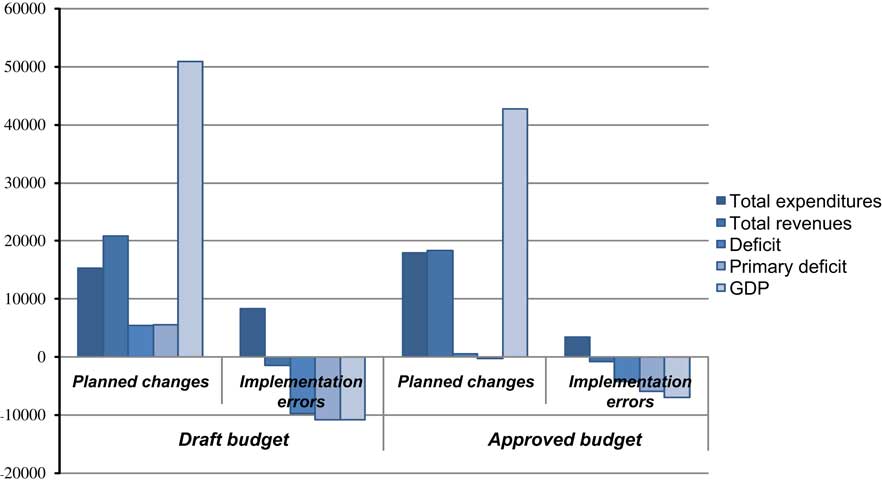
In this section, we present the results from the decomposition as described by equation (1). Governments tend to be ambitious in their initial plans. However, their ambitions gradually fade when they conflict with the Parliament’s requests and the realities of budget execution. In fact, our decomposition of the actual changes into one-year ahead planned changes and implementation errors shows that, when drafting the budget that will be submitted to the Parliament (i.e. the Draft budget), the government targets an average substantial improvement in the deficit and in the primary balance of 5.5 billion EUR in the whole period (Figure 3). Improvements in the balances are the result of positive planned changes both in revenues (20.9 billion EUR on average) and, more moderately, in expenditures (15.4 billion EUR on average). At this stage, the government does not seem to use cautious revenue forecasts to try to counterbalance the foreseeable spending pressures from the Parliament. The optimism that pervades this stage of the budget process ranges from intentionality and objective limits to a rational decision-making process.Footnote 5
(color online) General Government: planned changes and implementation errors (average 1998–2009, million EUR). Source: Authors’ elaborations.
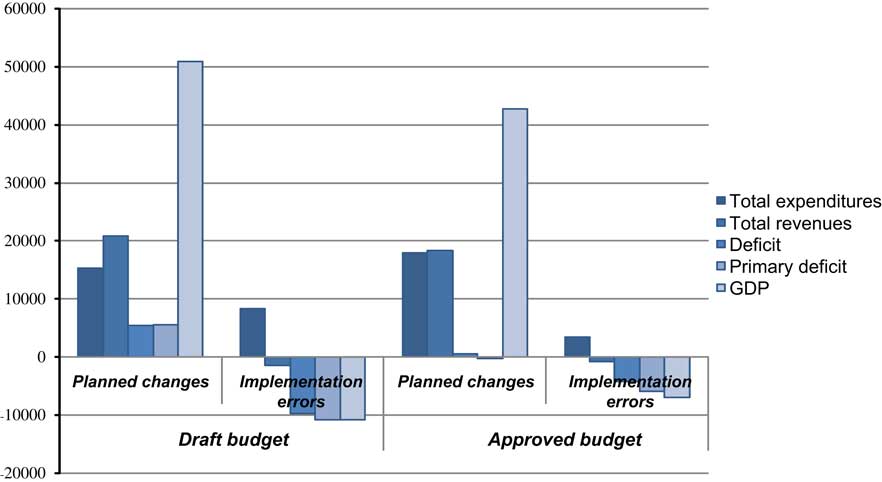
The parliamentary discussion of the budget drastically impacts on the government’s initial ambitions, injecting more realism, pressures from the parties’ constituencies and better information on macroeconomic and fiscal variables. Real-time data from the Approved budget show much less impressive targets for the budget balances: on average, an improvement of 0.5 billion EUR in the total balance and a worsening by −0.23 million EUR in the primary balance. This much weaker correction is the result of a downward revision in the planned revenue (18.4 billion EUR on average) and of an upward revision in the planned expenditures (17.9 billion EUR on average).
The excess optimism under which the Draft budget was prepared manifests as large implementation errors for the budget balances (9.7 and 10.8 billion EUR for the total and primary deficit, respectively). This results from actual revenues being lower than planned (with an implementation error of, on average, −1.4 billion EUR)Footnote 6 and actual expenditures being higher than planned (with an implementation error of, on average, 8.3 billion EUR).Footnote 7 As a consequence of the government’s diminished and more realistic ambitions, the Approved budget shows implementation errors of approximately half those observed for the Draft budget: on average, 4.2 and 6.0 billion EUR for the total and primary deficit, respectively, −0.7 billion EUR for the revenues and 3.5 billion EUR for the expenditures.
GDP forecasts are a key ingredient for fiscal variable projections. We observe that GDP implementation errors (Figure 3) are, on average, negative for both the Draft and Approved budgets. This means that the government tends to consistently be overly optimistic in its predictions for growth:Footnote 8 the lower than “expected” growth, which will materialise in the next months, will be invoked to justify lower than expected revenues and higher than expected deficits.
Inefficiency in budget deficit forecasting arises more from the expenditure lines than from the revenue lines (Figure 3). Indeed, the average implementation error for the aggregate expenditures is larger, signalling that the policymaker is, in general, not able to stick to his initial plans and repeatedly resorts to ex post increases, as previously stated in Balassone et al. (Reference Balassone, Momigliano and Rizza2011b).Footnote 9
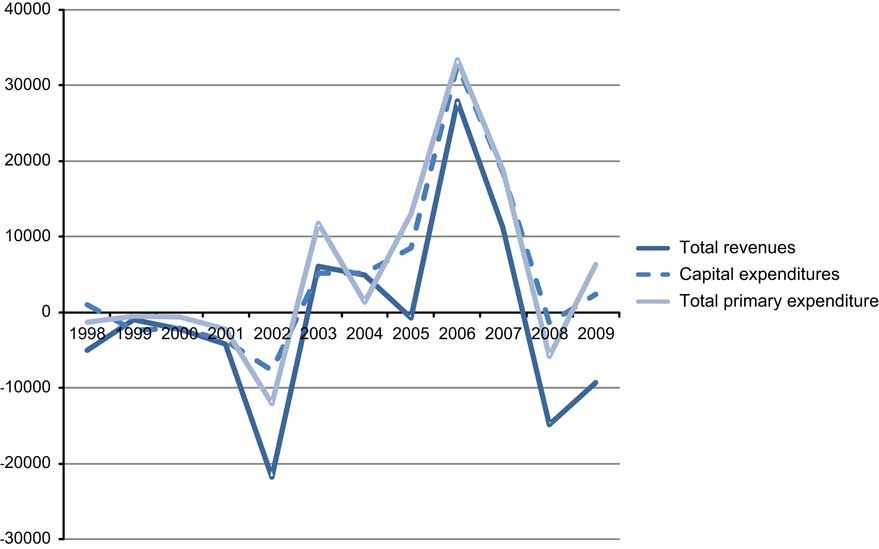
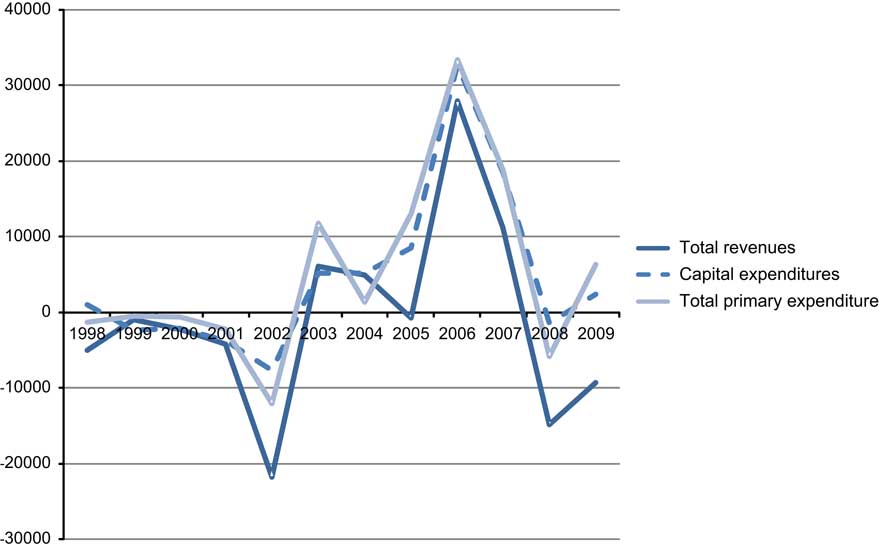
Even at superficial scrutiny, the Approved budget data show evidence of a pro-cyclical fiscal stance in the presence of the implementation errors on revenues, i.e. unexpected revenue windfalls/shortfalls. In Figure 4, we observe parallel trends in the implementation errors of both sides of the budget, accounting for in-year expenditure changes that accommodate the changes in revenues. The pro-cyclical stance in budget execution is driven by capital expenditures,Footnote 10 which are usually compressed during budget preparation and subsequently inflated/deflated according to budget control exigencies. Analysis should be improved by following the suggestions of Barrios and Rizzo (Reference Barrios and Rizza2010): by using real-time errors instead of ex post data (as in Cimadomo 2008), we could provide evidence of actual pro-cyclical fiscal policies, even when the planned stance is neutral or counter-cyclical.
(color online) General Government: implementation errors from the approved budget (1998–2009, million EUR). Source: Authors’ elaborations.
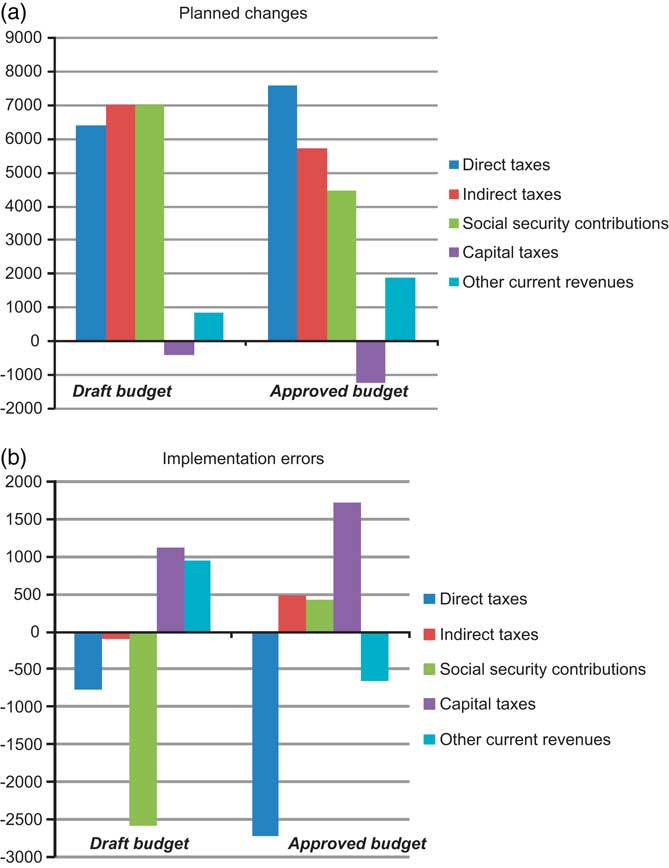
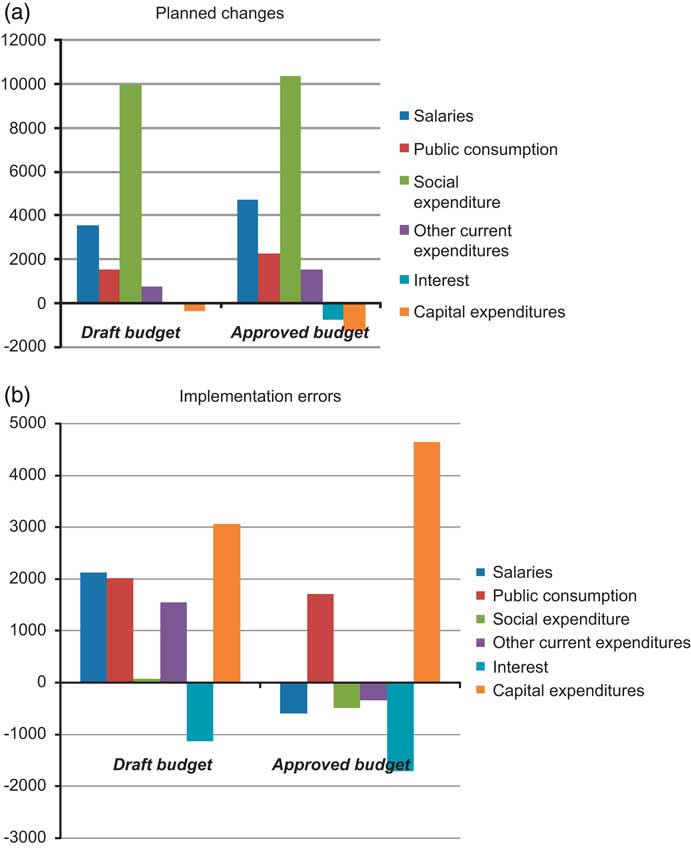
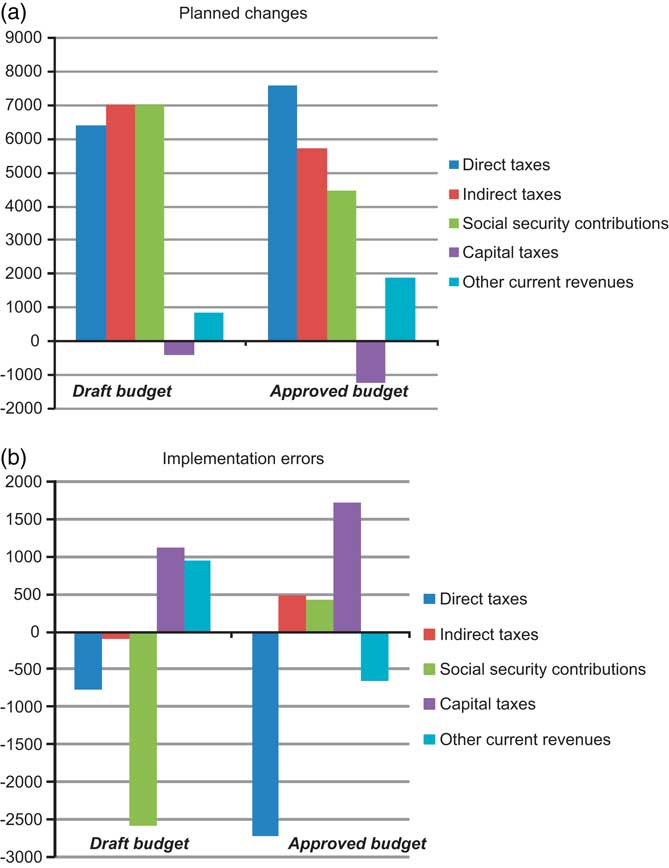
When we look into the details of the government’s fiscal plans, we observe that the ambitious fiscal correction envisaged in the Draft budget is mainly made out of large planned changes in all revenue items on the one hand (direct and indirect taxes, social security contributions; see Figure 5a, 5b), and in salaries, public consumption and social expenditures on the other hand (Figure 6a, 6b). The parliamentary session plans further increases for these same expenditure items, notwithstanding a less optimistic evolution of nominal GDP, indirect taxes and social security contributions; fiscal space to accommodate these corrections is obtained by downsizing planned capital and interest expenditures and by planning larger increases in direct taxation and other current revenues.
(color online) General Government: the revenue composition (average 1998–2009, million EUR). Source: Authors’ elaborations.
(color online) General Government: the expenditure composition (average 1998–2009, million EUR). Source: Authors’ elaborations.
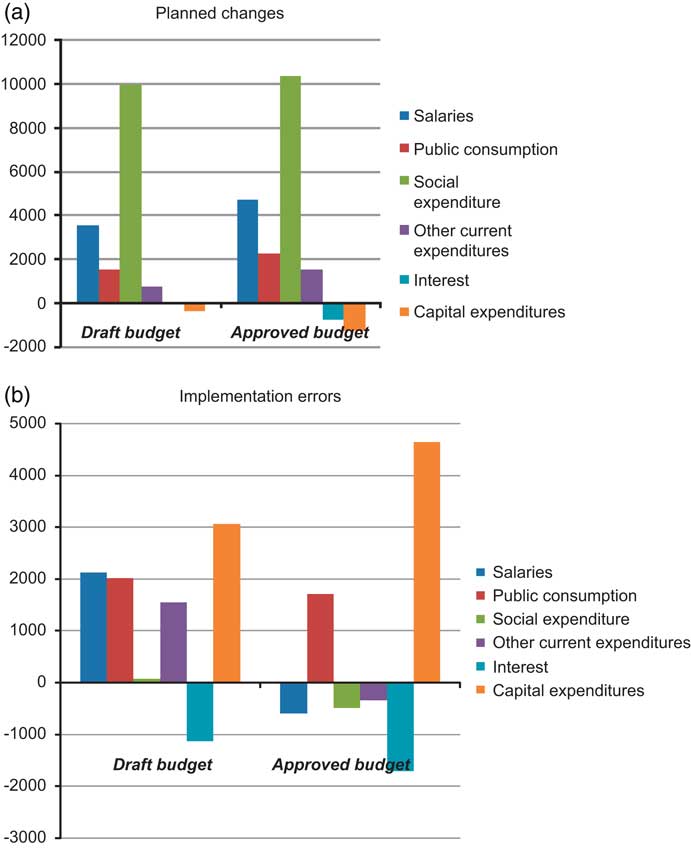
The implementation errors in the Draft budget are, on average, positive for the main lines of expenditure (salaries, public consumption, capital expenditures) and negative for interest expenditure (−1.3 billion EUR). On the revenue side, the implementation errors result in lower than planned direct taxes and social security contributions, partially compensated by higher than planned capital taxes and other current revenues, as the result of in-year policy interventions.
The parliamentary discussion manages to fix issues regarding the planned amount of salaries and other current expenditures and the corresponding implementation errors in the Approved budget to less than −0.5 billion EUR. The expenditure drift is, thus, to be ascribed to excess increases in public consumption (1.7 billion EUR) and capital expenditures (4.6 billion EUR), which are only partially covered by increases in capital taxes, indirect taxes and social security contributions.
A final consideration concerns the expenditure item that is seen as out of the government’s control – interest expenditure. The interest expenditure is largely over-estimated both in the Draft and in the Approved budgets; indeed, it presents large negative errors by 1.1 and 1.7 billion EUR, respectively. This systematic over-estimation could be the result of unforeseeable changes in interest rates or, at least partly, the attempt to provide a buffer to accommodate expenditure increases during the budget discussion and execution.
To sum up, this first scrutiny confirms that the fiscal forecasts suffer heavily from fiscal illusion. Preliminary data releases for salaries and public consumption (i.e. in the Draft budget) are biased estimators of the final data. In addition, capital expenditure seems more a buffer variable than a real planning target; it is moved at the policymaker’s convenience and according to the fiscal space opened/closed by revenue windfalls/shortfalls. As for revenues, there is greater difficulty in correctly forecasting direct revenues than indirect taxes and social security contributions.Footnote 11 The large negative implementation errors in direct taxesFootnote 12 in the period can be explained by, among other things, excess optimism in forecasting the revenues from increased auditing against tax evasion and the yield from the withholding tax on participation and firm disposals and from the revaluation of firm capital assets. Besides, excess optimism seems to be functional to the opening of fiscal space during the budget discussion.
We do not test for electoral cycles. However, we observe that inefficiency in forecasting and executing fiscal policy is unevenly spread in the period (Figure A.1, a–e of Supplementary Material). It is modest in the years 1998–2001 – under left-wing governments. It grows considerably in the years 2001–2009, most of which are dominated by right-wing governments.Footnote 13 Correspondently, deficit and primary balance results in the election year 2001 show adherence to fiscal plans. On the contrary, the large implementation errors for the election year 2006 reveal the government’s ambitions in terms of announced fiscal discipline (Italy was put under the EDP in September 2005 for excess deficits in 2003 and 2004), as well as its generosity towards its constituencies in the voting population. Elections in 2008 are not relevant for our analysis, as they were called after an unexpected crisis of government and could not influence the budget programming.
Decomposing fiscal outcomes and implementation errors
Before analysing the potential determinants of the implementation errors (see “The determinants of the implementation errors” section), we perform some statistical scrutiny on the decomposition of both fiscal outcomes (A) and implementation errors (E). In the first case, we are interested in identifying factors determining fiscal outcomes variability (see “The variance decomposition” section). Our analysis also provides information on the reliability of the data released at different stages of the budgetary process. In the second case, we decompose the implementation errors in order to identify their systematic components (see “Regularities in fiscal forecasting”). This analysis furthermore gives information on the direction of error correction.
The variance decomposition
The variance decomposition method allows us to determine the main factor affecting the variance of actual fiscal changes between planned changes and implementation errors, i.e. Var(A). This term can be decomposed into the covariance with its planned change, cov(A;P), plus the covariance with its implementation error, cov(A;E):
 $$Var(A)={\mathop{cov}} (A;P){\plus}{\mathop{cov}} (A;E)$$
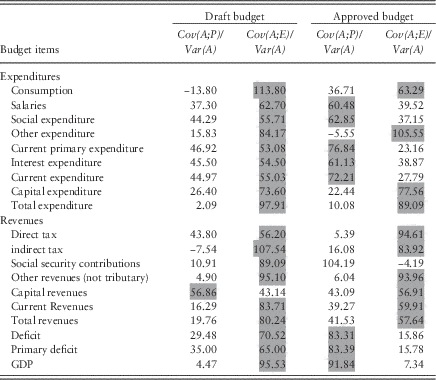
This decomposition is applied to each fiscal item of the budget (Table 1). Results for the Draft budget (first column) show that the covariance of outcomes with the implementation error, cov(A;E), is dominant in explaining the variability of all the fiscal variables and GDP. This implies that data released at this stage of the budget process are rather uninformative about final fiscal outcomes.
The variance decomposition (percentage values)
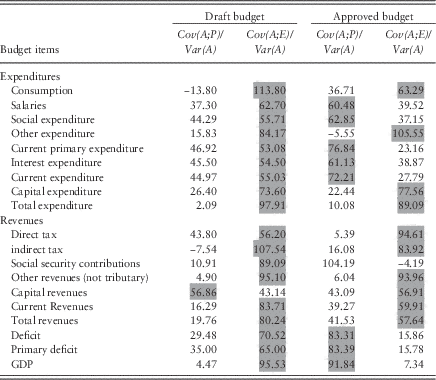
Note: The grey colour highlights which one of the two covariance components prevails over the other (i.e. its value is more than 50 per cent) and thus determines the variance of the actual fiscal outcome Var(A). The analysis is based on General Government data over the period 1998–2009.
Source: Authors’ elaborations.
Results for the Approved budget (second column) show that the implementation error still remains the main determinant of the variability in the budget revenues. However, for the current expenditures, the budget balances and GDP, the main contribution to the variability in the outcomes is caused by its covariance with the planned change, cov(A;P). This suggests that fiscal plans at this stage are more reliable. Total expenditure variability is thus heavily dependent upon the variability in capital and consumption expenditures. Analysis confirms that interest expenditure variability is concentrated in the Parliament’s session decisions: although a non-discretionary and exogenous item, interest expenditure seems to be forecasted so as to provide a reservoir for fiscal space.
Regularities in fiscal forecasting
In order to investigate the existence of systematic errors affecting fiscal forecasts, we apply the Mincer and Zarnowitz’s (Reference Mincer and Zarnowitz1969) decomposition, which is based on a theoretical relationship between planning (P t ) and outcomes (A t ):
 $$A_{t} \,\equiv\,P_{t} {\plus}u_{t} $$
where u
t
is null when a forecast is perfect. The accuracy of forecasts is expressed by the dispersion around this line and is measured by the mean square error of the difference between outcomes and predictions:
 $$E\left( {A{\minus}P} \right)^{2} $$
.
Three possible causes for such dispersion can be identified:
-
i) Bias: the error caused by considering the average of the predictions instead of the outcomes. The sign of the mean component gives an indication of the outcomes being systematically over- or under-estimated.
-
ii) Inefficiency: if in presence of the bias, the regression line explaining outcomes in terms of predictions has a different slope from the perfect forecast line.
-
iii) Random component: represents the information on the part of the variance of the outcomes not explained by the least square regression line.
The three components can be described by the following equation:
 $$\mathop{\sum}\limits_{t=1}^n {\left[ {\left( {A_{t} {\minus}A_{{t{\minus}1}} } \right){\minus}\left( {P_{t} {\minus}A_{{t{\minus}1}} } \right)^{2} } \right]} =\mathop{\underbrace{{\left[ {E(u)} \right]^{2} }}}\limits_{{\rm bias}}{\plus}\mathop{\underbrace{{\left( {1{\minus}\beta } \right)^{2} S_{p}^{2} }}}\limits_{{\rm inefficiency}}{\plus}\mathop{\underbrace{{\left( {1{\minus}r^{2} } \right)S_{A}^{2} }}}\limits_{{\rm residual}}$$
where S A and S P indicate the sample variances of outcomes and predictions changes; r Footnote 14 is the correlation coefficient between actual and planned changes; and β Footnote 15 is the slope coefficient of the regression line of A t on P t .
While the first two terms of the right-hand side of equation (4) express a systematic error in forecasts, the third term is a residual component that technically cannot be corrected, capturing a sort of random pattern in forecasting errors.
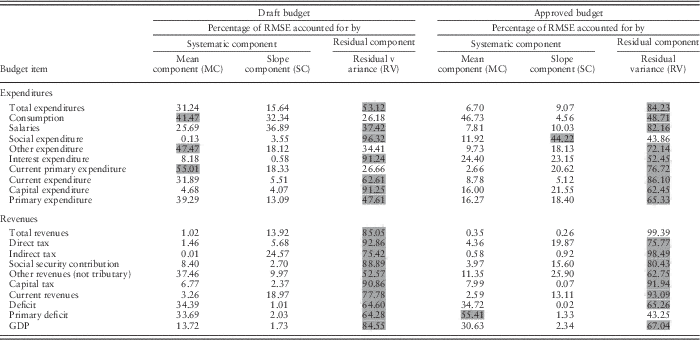
The results of the decomposition (Table 2) show that the residual component plays a major role in determining the implementation error. The two other components exert only a minor impact for both the Draft and the Approved budgets. These results clearly stress the direction from which to solve the implementation error problem: improved accuracy of the forecasts cannot be obtained by technical corrections, but rather mainly by inserting more discipline on the institutional side.
Decomposition of the implementation errors (percentage values)
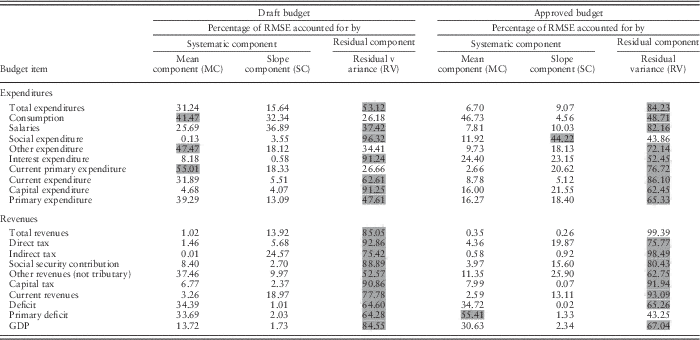
Note: The grey colour highlights which one of the three components prevails over the others (i.e. its value is the highest). The analysis is based on General Government data over the period 1998–2009.
Source: Authors’ elaborations.
The determinants of the implementation errors
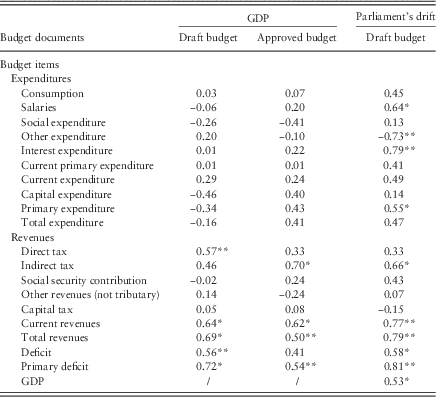
After having checked on the existence, role and nature of the implementation errors, we search for their main determinants. According to the literature (Balassone et al. Reference Balassone, Momigliano and Rizza2011b), the natural candidates are the GDP implementation error and the autumn Parliament’s budgetary session. We concentrate on them in the “GDP forecasts” and “The Parliament’s drift” sections, respectively. We also assess the hysteresis effects of the first-release outcomes on planned adjustments (see “The correlation between implementation errors and future fiscal plans” section). Throughout the analysis, the level and significance of the dependence are synthesised by the Spearman correlation.
GDP forecasts
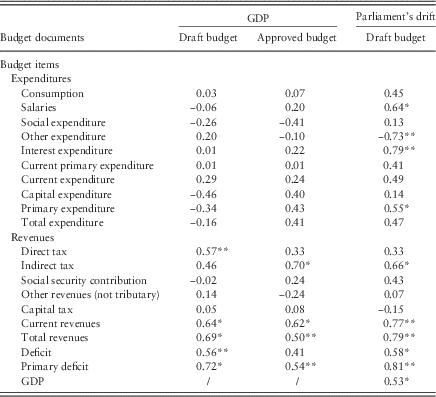
GDP forecasts are crucial inputs for forecasting revenues and cyclically related expenditures; thus, we expect a significant and positive correlation with these budgetary items. The primary deficit (Table 3) shows positive and significant correlations in both documents. No correlation emerges in the case of the expenditure items. As expected, both in the Draft and in the Approved budgets, errors in total revenues (the first and second columns) are positively and statistically correlated with the GDP surprises (0.69 and 0.50, respectively).
The determinants of the implementation error for fiscal items: GDP errors and the Parliament’s drift (Spearman correlations)
Note: Significance level: **p<0.05; *p<0.1. The analysis is based on General Government data over the period 1998–2009.
Source: Authors’ elaborations.
Interestingly, only errors in direct and indirect taxes are correlated with GDP surprises. In particular, errors in direct taxes are significantly and positively correlated with the GDP errors only in the Draft budget, but not in the Approved budget; the contrary holds for indirect taxes. This implies that, at the early stages of the budget preparation, the policymaker is guided by the forecasted evolution in the business cycle to determine the direct taxes yield. However, this is no longer true for the Approved budget data, meaning that other-than-growth factors then intervene (see also Buettner and Kauder Reference Buettner and Kauder2010): the search for fiscal space to accommodate the corresponding increases in expenditures, as previously observed in the “Planned changes and implementation errors in fiscal policy” section in-year one-off measures, is determined by significant changes in the economic environment that the policymaker cannot control (e.g. increases in international oil prices, changes in asset prices) and by the composition of GDP growth (Barrios and Rizza Reference Barrios and Rizza2010).Footnote 16
The Parliament’s drift
During the Parliament’s budgetary session, political constituencies, the government’s ideology and lobbies exert powerful pressures on the Draft budget, which is presented and discussed. We approximate these influences by computing the difference between the data released in the Draft and in the Approved budget in the same year for each fiscal item. This variable is called Parliament’s drift.
Insightful results emerge when considering the dependence between the implementation errors of the Draft budget Footnote 17 forecasts and the Parliament’s drift (Table 3, third column), which also confirm the findings of the “Planned changes and implementation errors in fiscal policy” section. In detail, the Parliament’s drift is correlated with the errors in fiscal variables, like salaries, which are compulsory expenditures and cannot be easily modified during budget execution. For these items, the data in the Approved budget are quite reliable estimates. Moreover, the significant correlation for interest expenditures implies both an update of the data and the progressive downsizing from over-estimation to open fiscal space during the budget discussion. Errors in the other expenditure items are linked more to the budget execution. Finally, the Parliament’s drift is highly correlated with the implementation errors in indirect taxes, meaning that data released in the Approved budget are quite reliable estimates of final outcomes.
The correlation between implementation errors and future fiscal plans
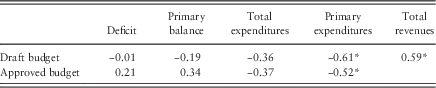
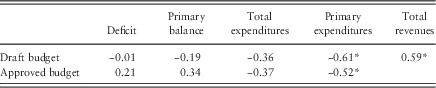
An interesting point concerns the link between the implementation errors and subsequent budgetary plans, which hints to the relevance of errors in current budget implementation when drafting the budget for the following year. In general, we observe a negative but very feeble correlationFootnote 18 between the budget balances targeted in the Draft budget for the subsequent year and the implementation errors for the current year (−0.01 for the deficit and −0.18 for the primary balance; see Table 4). Thus, future plans would seem to insignificantly correct for current budgetary slippages. In the Approved budget, the correlation – although still weak – becomes positive (0.21 for the deficit and 0.34 for the primary balance), indicating no consideration of past implementation errors. This result could be interpreted by a mix of possible reasons: government would not rely on current implementation errors, knowing that data collected at the first-release stage are heavily affected by creative accounting (De Castro et al. Reference De Castro, Pérez and Rodríguez2011; Beetsma et al. Reference Beetsma, Bluhm, Giuliodori and Wierts2012), deliberate manipulation or imprecise measurement and uncertainty related to the use of accrual data (Balassone et al. Reference Balassone, Franco and Zotteri2006).
The Spearman correlations between implementation errors and future fiscal plans
Note: Significance level: *p<0.05. The analysis is based on General Government data over the period 1998–2009.
Source: Authors’ elaborations.
However, the picture is different for revenues and expenditures. Primary expenditure target changes in both the Draft and Approved budgets for the following year would seem to be, at least partially, linked to current year errors, as shown by the negative and significant correlations. Large expenditure implementation errors in the current year are associated with smaller planned variations for the following year and vice versa. On the contrary, current errors in revenues are associated with a planned change of the same sign in the Draft budget for the following year, as if the policymaker would consider these unexpected variations permanent. This result reinforces previous findings about plans in the Draft budget as being rather uninformative about the final fiscal outcomes. This hysteresis effect of revenue windfalls/shortfalls fades away after the parliamentary session.
Policy implications
Our decomposition of fiscal outcomes sheds some light on fiscal policymaking in Italy, which can be of interest to other countries. The planned changes of fiscal variables and their implementation errors provide some insight into the government’s mix of ambition and profligacy while preparing the budget and into its pitfalls while implementing it.
First, data released at the budget draft stage are biased predictors of the final figures. Their poor quality derives from their position in the decision-making process: they are based on the first-release estimates of the budget implementation in the current year, which are, in turn, inputs for fiscal surveillance and which the government has an incentive to manipulate, as remarked by Beetsma et al. (Reference Beetsma, Giuliodori and Wierts2009, Reference Beetsma, Bluhm, Giuliodori and Wierts2012) and De Castro et al. (Reference De Castro, Pérez and Rodríguez2011). Improvements in their reliability could come from increased transparency in the budget process along the guidelines required for the national fiscal frameworks in the recently reformed SGP.
Second, the strong and positive correlations between the revenue and expenditure implementation errors (capital expenditure, in particular) reveal a pro-cyclical stance: in-year expenditure changes tend to accommodate the changes in revenues. Accommodation is functional to budget balance control. When revenue outcomes are lower than those planned, in-year downward revisions of expenditures must be enacted to avoid excessive overruns of the deficit targets. On the other hand, expenditure increases respond to revenue windfalls, meanwhile avoiding breaching the deficit targets. This pro-cyclical stance is inhibited neither by the SGP nor by the domestic budget rules. It would rather require addressing the source of the bias, i.e. the excess optimism of revenue forecasts and the expenditure drift.
Third, we observe that current year errors in fiscal forecasting partially influence the setting of targets for future budgets and, sometimes, with the wrong sign. As a matter of fact, while expenditure forecasts for the next year seem to partially compensate for the current year’s expenditure drift, implementation errors in revenues tend to be translated into future revenue changes of the same sign, at least in the Draft budget. This hysteresis effect severely corrupts the quality of revenue forecasting. Both the discovery and monitoring of this kind of systematic implementation error could be entrusted to an independent fiscal council. Alternatively, independent forecasting of GDP and revenues could be used as an input in the budget preparation. This would contribute to the quality of the budget and improve the transparency of fiscal data reporting, as independent commissions, guided by technical considerations, tend to produce more reliable and valid predictions (Debrun et al. Reference Debrun, Hauner and Kumar2009; Krause et al. Reference Krause, Lewis and Douglas2013).
The strong correlation between errors in expenditure items and the Parliament’s drift proves that the autumn budgetary session is, to some extent, an additional source of fiscal indiscipline. Indeed, it provides both the Government and the Parliament’s members with the opportunity to expand public expenditures with respect to the initial proposals contained in the Draft budget and, thus, to excessively accommodate demands from their constituencies. Large planned changes and corresponding implementation errors in some lines of expenditures (e.g. interest and capital expenditures) reveal that these are systematically employed as buffers to accommodate increases in other more politically sensible expenditure items. The Parliament’s drift can be accounted for by the government’s dependence on its supporting coalition, whose appetite for spending is supposed to be, at least partially, satisfied by the executive. In turn, the Parliament is highly dependent on the government’s data and advice, thus giving to the executive large margins for manipulation. We expect that different institutional and political settings change the relevance of the Parliament’s drift: legislatures of the Westminster System type, for example, approve the government’s budget without amendments, while those of legislatures like those in the United States Congress, which are endowed with their own budget staff, independently establish their own budget policy and advance several amendments to the budget tabled by the government.
Finally, the presence of systematic forecasting errors is favoured by the current set of fiscal rules, which does not actually impose any corrections in relation to the revenue and expenditure drifts. No provision requires that the budgetary slippages incurred in one year will be compensated for in the following years and, until recently, the “safeguard clause”Footnote 19 to avoid expenditures in excess of the initial legislative forecast has not been applied. Only as of 2009 did the accounting reform law (Law 196/2009) introduce an automatic and administrative process of expenditure drift correction for in-year legislation.
Substantial improvements of the current scenario may not be obtained simply by introducing new and more sophisticated forecasting techniques, as demonstrated by our decomposition of the implementation errors. In fact, they could instead be obtained by acting on the institutional system. We deem that a reduction in the margins of opaqueness that the present system allows could contribute to higher accountability and reliability in the budget documents. In this perspective, the Parliament could debate and vote for a binding fiscal framework or set strict ceilings on spending decisions (Ljungman Reference Ljungman2008) before the government tables the budget, as the legislature’s endorsement of fiscal targets should help the enforcement of and compliance with fiscal limits. Besides, an independent and well-organized budgetary officeFootnote 20 could provide autonomous and reliable data as well as useful advice to the Parliament, thus reducing the scope for opaqueness in the budget drafted by the government. Finally, provisions for error corrections would reduce the scope for forecast manipulations. The final paragraph will provide further details.
Conclusions
Our analysis has shown the relevance of expenditure drifts and the poor quality of the revenue forecasts in Italy, highlighting what seems to be the idiosyncrasy of the Italian budget. Indeed, our results reflect the tensions in the country’s political structure, the opaqueness of its data formation process and the rigidity of its administrative structure. However, systematic errors, i.e. the multifaceted expressions of a fiscal illusion component in fiscal forecasts, likely would be uncovered in other countries if a similar exercise (using real-time data for the whole budgetary process) were performed.
The correction of the distorted representation of the financial facts must address the public decision-makers’ scope for data manipulation, which subtly impinges on the budgetary process. Certainly, while the current appetite for fiscal rules (i.e. the new version of the SGP and the ongoing reforms of the domestic lawsFootnote 21 in many European countries) could contribute to strengthening the controls on fiscal policy targets, we are not sure that such rules will be impermeable to forecasting inefficiency whose correction requires the acceptance of narrower margins of opaqueness in the political and administrative decision-making process. In this sense, we deem that, in general, the correction of fiscal illusion in the budgetary process would benefit from mechanisms and institutions that commit the decision-maker to greater transparency, accountability and an open and thorough discussion of the fiscal proposals and public accounts.
In such a framework, the correction of the expenditure drift would be eased by the adoption of binding fiscal frameworks or expenditure ceilings. A binding commitment on total public spending would engender the automatic stabilisation of the budget more than rules formulated for the overall balance or debt. Further, if both the executive and the legislative bodies committed to the ceiling, this upper boundary would provide a useful support in the formulation of fiscal policy. Therefore, the Parliament’s budgetary session should not impact on the ceiling, which must be set before the annual budget negotiations begin. The budget execution should also respect the ceiling, while unexpected expenditure needs should be accommodated for without surpassing the ceiling or compensated in the following years. A larger ceiling could be allowed in the case of natural disasters or extraordinary and emergency situations. Finally, the ceiling would favour – and, in some cases, impose – the rethinking of the public spending allocation and better prioritisation. Similar observations could apply to binding fiscal frameworks.
As expenditure ceilings are generally imposed on the state budget, specific constraints should be applied to the other institutional subsectors (e.g. local governments, social security funds) to ensure that the overall General Government targets are attained. The temptation to set excessively high ceilings can be mitigated by the introduction of timely, perhaps automatic, corrections of systematic budgetary slippages and expenditure overruns.Footnote 22 A compensation account, for instance, in the vein of the Swiss debt brake,Footnote 23 does not only impose sanctions for overspending, but also provides a learning mechanism for revenue estimates (Bodmer Reference Bodmer2006). Moreover, the correction mechanisms could differ according to the type of error (Mayer and Stälher Reference Mayer and Stälher2013). Discretionary government spending overruns should be corrected as soon as possible, while all other errors (generating expectation errors) should be gradually compensated over time.
As for the inefficiency of revenue forecasts, we argue that an independent commission or fiscal council entrusted with the forecasting of the basic macro and fiscal scenario could improve the quality of the released data, as affirmed by Debrun et al. (Reference Debrun, Hauner and Kumar2009), Balassone et al. (Reference Balassone, Momigliano and Rizza2011b) and Krause et al. (Reference Krause, Lewis and Douglas2013). The forecasts from such a commission or council could be a benchmark against which government forecasts are compared and discussed, or they could be directly employed in the budget preparation. In any case, the council or commission should not be subject to the incentives that normally bias the current fiscal forecaster. In particular, they should be characterised by the largest status of independence. Otherwise, detecting and correcting the systematic patterns of errors could instead be entrusted to an independent fiscal council as part of an enhanced fiscal surveillance.
No single receipt can break the mix of profligacy and ambition that lies at the core of fiscal illusion in public decision-making, but the compound effect of different provisions could help reduce the margins of opaqueness in budgeting and restore official documents’ reliability.
Acknowledgements
The authors would like to thank the participants at the XXIII Conference of the Italian Association of Public Economics (September 2011) for their comments. Special acknowledgements are due to Fabrizio Balassone, two anonymous referees and the editor, Peter John, for their insightful suggestions on a previous version of this paper. The usual disclaimer applies.