The costs and consequences of interstate wars incentivize leaders to respond to external threats. For example, external threats may prompt states to industrialize, strengthen institutions, and centralize power (Acemoglu and Robinson Reference Acemoglu and Robinson2006; Gibler Reference Gibler2010). This study focuses on an alternative consequence of external threats: States' abuse of physical integrity rights. We argue that external threats directly increase repression because threats allow leaders to crack down on dissent and opposition. Yet external threats can indirectly decrease repression through increased state capacity. In sum, external threats both increase and decrease government repression, but through different causal pathways.Footnote 1
Consider the example of Ukraine. When Russia seized Crimea in 2014, Ukraine's low capacity prevented the government from mobilizing resources to fight. Ukraine's weakness also facilitated human rights abuses by state agents. Reports by the United States Department of State, Human Rights Watch, and the UN all note that in 2013 and 2014 a number of transgressions by Ukrainian security forces were not prosecuted.Footnote 2 Overall, Ukraine lacked the capacity to control state agents from committing physical integrity rights abuses.
In response to the growing Russian threat, Ukraine implemented several capacity-building policies, such as a new war tax in 2015, a new civil service, and administrative reforms in 2016. Recent fiscal assessments by the IMF and the EU note improvements in Ukraine's tax collection measures, resulting in tax revenue percentages comparable to EU member countries (Dimitrova et al. Reference Dimitrova2021). On the one hand, the improvement in Ukraine's capacity increases the likelihood that the state can monitor and prosecute physical integrity rights abuses. On the other hand, the looming threat of Russia provided Ukrainian leaders with the political justification to crack down on political opponents and supporters of Russia. For example, pro-Russian politician, Viktor Medvedchuk, was imprisoned on charges of treason in 2021.
The Ukrainian example demonstrates that leaders may react to external threats by increasing capacity, which may decrease repression. External threats may also motivate leaders to use repression against political opponents. To test our argument, we first developed a new latent measure of external threats through a Bayesian measurement model. With this measure, we then used mediation analysis to examine the direct and indirect effects of external threats on repression. Using data from developing countries for the period 1980 to 2016, we found that external threats directly increase repression. However, external threats also increased state capacity, which reduced government repression.
Our findings help us understand how external threats affect one subcategory of human rights: Physical integrity rights. Following Cingranelli and Richards (Reference Cingranelli and Richards1999, 407), we define physical integrity rights as ‘the entitlements individuals have in international law to be free from arbitrary harm and coercion by their government’. Governments violate these rights through political imprisonment, torture, disappearances, or extrajudicial killing (Cingranelli and Richards Reference Cingranelli and Richards1999, 407). Existing human rights literature already recognizes how either external or domestic political factors explain varying repressive behaviour (Cingranelli, Fajardo-Heyward, and Filippov Reference Cingranelli, Fajardo-Heyward and Filippov2014a; Liou, Murdie, and Peksen Reference Liou, Murdie and Peksen2021). Our study adds to this understanding by demonstrating how external conditions work through domestic factors to explain repressive behaviour.
In addition, by focusing on external threats and capacity, we can revisit the important consequences of the bellicist theory of state building (Tilly Reference Tilly1992). Like others before, we find a positive relationship between external threats and state capacity (Gibler and Miller Reference Gibler and Miller2014; Thies Reference Thies2004), but we also evaluate the consequences of this relationship. Capacity is not solely an outcome but is also a causal factor in many literatures in the social sciences, including human rights (Cole Reference Cole2015; Englehart Reference Englehart2009; Liou, Murdie, and Peksen Reference Liou, Murdie and Peksen2021). We find that the factors that lead to capacity building may undermine a leader's incentives to respect physical integrity rights. Identifying these divergent effects between threats and repression provides a fuller picture of the relationship between political development and physical integrity rights.
Furthermore, we believe our new measure of external threat better captures the latent concept of threat compared to previous measurement strategies. Threats play a pivotal role in international relations research, yet scholars disagree on measurement approaches (Trubowitz and Watanabe Reference Trubowitz and Watanabe2021). We conceptualize external threat as the heightened risk of another state infringing on a given state's sovereignty. Previous research on external threats usually used observable indicators to operationalize the concept (Colaresi, Rasler, and Thompson Reference Colaresi, Rasler and Thompson2008; Gibler and Miller Reference Gibler and Miller2014; Goldsmith Reference Goldsmith2007). Instead of relying on one indicator to measure threat, the Bayesian latent measurement model uses several variables that existing research identifies as being associated with threat. This approach allows us to determine which observable indicators contribute the most to our latent measure (Quinn Reference Quinn2004).
Finally, our new measure could assist existing research programmes interested in the effects of external threats. For example, scholars have looked at the role of external threats on domestic processes such as state centralization, economic development, industrialization, and military spending (Acemoglu and Robinson Reference Acemoglu and Robinson2006; Gibler Reference Gibler2010; Gibler and Sewell Reference Gibler and Sewell2006; Zielinski, Fordham, and Schilde Reference Zielinski, Fordham and Schilde2017) Others have examined the external consequences of threats, such as alliance formation (Edry, Johnson, and Leeds Reference Edry, Johnson and Leeds2021; Johnson Reference Johnson2017). Our measure provides a means to study these or related topics with a latent variable that has both temporal and spatial variance. Given the changing international threat environment, we expect that external threats will remain a focus in international relations and political economy research.
External Threats and Physical Integrity Rights
Why do some states respect physical integrity rights while others do not? International factors explain part of the variance. For example, previous research shows that international organizations (Greenhill Reference Greenhill2015), international law (Simmons Reference Simmons2009), international NGOs (Bell, Clay, and Murdie Reference Bell, Clay and Murdie2012; Murdie and Davis Reference Murdie and Davis2012), and greater international financial flows (Clay and Digiuseppe Reference Clay and Digiuseppe2017) all help reduce physical integrity rights abuses. On the other hand, military interventions (Peksen Reference Peksen2012), troop deployment (Bell, Clay, and Machain Reference Bell, Clay and Machain2017), and sanctions (Liou, Murdie, and Peksen Reference Liou, Murdie and Peksen2020) increase repression under certain conditions.Footnote 3
Besides external factors, scholars look to domestic factors to explain physical integrity rights violations. For example, democratic institutions provide citizens with a low-cost mechanism to remove abusive leaders, thus democratic leaders have incentives to refrain from repression (Davenport Reference Davenport2007; Hafner-Burton, Helfer, and Fariss Reference Hafner-Burton, Helfer and Fariss2011). In addition, democracies usually provide citizens with more avenues to peacefully express dissent, which reduces the demand for repression. However, democratic institutions do not guarantee physical integrity rights because states do not always have the capacity to prevent, detect, or punish violations (Anaya-Munoz and Murdie Reference Anaya-Munoz and Murdie2022; Cole Reference Cole2015; Englehart Reference Englehart2009). A leader might want to respect physical integrity rights but state agents' preferences may diverge without proper compensation (Clay and Digiuseppe Reference Clay and Digiuseppe2017). Poorly paid state agents have less incentive to follow rules if they can extract higher rents from civilians through repressive behaviour (Clay and Digiuseppe Reference Clay and Digiuseppe2017; Englehart Reference Englehart2009). If leaders cannot monitor, control, or punish agents, then abuses increase. Given this, capacity affords states more ability to comply with international human rights standards (Cole Reference Cole2015).
It is not a question of whether international factors or domestic factors explain repression. Both matter. What this study focuses on is the link between international factors and domestic conditions. Specifically, we ask how external threats of war affect state capacity, which subsequently affects government repression. The bellicist theory of state building, articulated by Tilly and others, connects external threats and capacity (Thies Reference Thies2004; Tilly Reference Tilly1992). The threat of war prompts a state to consolidate and build its forces to protect state sovereignty. To pay for and manage this force, states need revenue-generating capacity. Consistent with this, Gibler and Miller (Reference Gibler and Miller2014) find that external territorial disputes increase capacity, while Thies (Reference Thies2004) finds that rivalries prompt capacity building.
External threats can also affect repression through other pathways. External conflict and repression may be seen as complements to leaders: Threats increase repression while domestic discontent may provide leaders diversionary incentives (Enterline and Gleditsch Reference Enterline and Gleditsch2000). Under the threat of war, leaders have more political opportunities to target domestic opposition groups under the guise of national security concerns. In general, leaders facing threats use repressive strategies to maintain power (Bak, Chávez, and Rider Reference Bak, Chávez and Rider2020; Heffington Reference Heffington2020). Consistent with this, Heffington (Reference Heffington2020) shows that threatening international conflicts adversely affects physical and civil rights.
Building off existing literature, we argue that external threats affect physical integrity rights through two pathways. First, threats incentivize leaders to invest in state capacity. Higher state capacity increases states' adherence to physical integrity rights. Second, threats also provide leaders incentives to repress opposition groups. These varying effects follow different pathways to repression. We outline those pathways in the next section.
The Direct and Indirect Effects of External Threats
We begin our argument by focusing on how external threats lead to greater state capacity. We conceptualize external threats as the likelihood of a state being targeted in military conflict by another state in the international system. Though wars start for many reasons, researchers focus on several core correlates of war, such as rivalries (Colaresi, Rasler, and Thompson Reference Colaresi, Rasler and Thompson2008). Even rivalries that do not result in war, such as between the Soviet Union and the United States, involve repeated hostile interactions that make their leaders believe in the possibility of war (Bak, Chávez, and Rider Reference Bak, Chávez and Rider2020; Thies Reference Thies2004). In addition, territorial disputes between states increase the threat of war (Gibler and Miller Reference Gibler and Miller2014; Hensel et al. Reference Hensel2008).
To address external threats, leaders must generate more fiscal resources for military preparedness. Unpreparedness against a threat invites opposition and criticism of the government. For example, Saudi Arabia was ill-prepared for the threat of an Iraqi invasion in 1990, thus prompting the government to host American troops as a deterrent. Saudi Arabia's decision to allow American troops within its borders was widely criticized by religious leaders and was one of the main grievances of Osama Bin Laden (Riedel and Saab Reference Riedel and Saab2008). Questions were also raised about how the Saudi government misallocated its resources (Abalkhail Reference Abalkhail1993).
To pay for military preparedness, leaders may shift resources toward the military while taking money from domestic spending programmes. These social programmes are usually popular and help leaders build legitimacy and support (Taydas and Peksen Reference Taydas and Peksen2012). This leaves leaders in a precarious position when facing threats: Allocating sufficient fiscal resources to meet the threat without creating discontent among important constituents (Carter, Ondercin, and Palmer Reference Carter, Ondercin and Palmer2021).
To solve the problem, states may generate more resources. To do so, they must increase their extractive capacity to draw more fiscal resources from the general population. Under normal political conditions, attempts to build their states' extractive capacity face resistance as citizens are reluctant to provide financial resources to the state. Under external threats, however, we expect citizens to offer greater support to the leader who is in power. Greater support changes the bargaining dynamic between the leader and the populace, which means a leader can draw upon citizens' resources without as much resistance. Even if the opposition does not support the leader's decision to expand state capacity, we expect the general public to provide more support for the leader in the face of an external threat.
Consistent with this expectation, previous research finds an association between conflict and increased state expansion, as measured by taxes (Rasler and Thompson Reference Rasler and Thompson1989; Scheve and Stasavage Reference Scheve and Stasavage2010).Footnote 4 Wars do not need to materialize, however, to motivate states to increase extractive capacity. For example, Thies argues that even the threat of war, specifically through the presence of international rivalries, increases capacity. Developing states experience a similar development process as European states (Lu and Thies Reference Lu and Thies2013; Thies Reference Thies2004).
As a result of this discussion, we expect external threats to increase state capacity. This expectation has been effectively argued and tested elsewhere (Gibler and Miller Reference Gibler and Miller2014; Lektzian and Prins Reference Lektzian and Prins2008; Lu and Thies Reference Lu and Thies2013; Thies Reference Thies2004). Rather than repeat this argument, we instead focus on the consequences of external threats and increased capacity for physical integrity rights. To do so, we follow Cingranelli, Fajardo-Heyward, and Filippov's (Reference Cingranelli, Fajardo-Heyward and Filippov2014a) principle-agent framework for explaining human rights. In this framework, the principals are the citizens who, we assume, want their physical integrity rights protected. Government bureaucrats, including leaders, are the agents and will respect or abuse these rights depending on how it affects their positions of power. Cingranelli, Fajardo-Heyward, and Filippov (Reference Cingranelli, Fajardo-Heyward and Filippov2014a) argue that fiscal rules affect this principal-agent dynamic in two ways. First, the more reliant leaders are on tax revenue the less likely they will repress (Conrad and DeMeritt Reference Conrad and DeMeritt2013; DeMeritt and Young Reference DeMeritt and Young2013). Second, higher tax revenue allows for higher compensation for state agents, lessening the likelihood they will abuse physical integrity rights. With these expectations in mind, we examine how external threats and state capacity affect this principal-agent dynamic.
Focusing on external threats first, we expect external threats to increase state repression. While we assume citizens generally demand physical integrity rights, we expect demand to decrease in the face of external threats (Conrad et al. Reference Conrad2018).
External threats tend to produce ‘rally effects’, prompting citizens to value safety, conformity, and deference to leaders (Gibler Reference Gibler2010, 520). As a result, citizens provide leaders more leeway to address security risks, particularly risks from groups that may be viewed as supporting the aggressor. Minority rights and inclusion become less of a priority (Davenport Reference Davenport2007). Thus, external threats provide leaders with more opportunities to repress with less fear of reprisal. The leader may go to extremes to silence the opposition, including targeting journalists, imprisoning the opposition, or making dissenters ‘disappear’. External threats also provide leaders more opportunities to limit the physical rights of groups perceived as undermining states' defensive efforts. For example, the US began planning the construction of Japanese internment camps as early as 1936 to limit the possibility of domestic subversion (Robinson Reference Robinson2001).
Moreover, external threats may produce more dissent, which prompts leaders to repress. If leaders reallocate fiscal resources away from popular social spending programmes toward their military, citizens may become upset with the government. Military spending tends to slow general economic growth in the developing world by substituting programmes that provide employment, income, or subsidies (Adeola Reference Adeola1996). As the government rescinds popular social programmes, citizens may dissent against the government, which triggers repression (Ritter and Conrad Reference Ritter and Conrad2016). In addition, increased military preparedness provides the government with more coercive means to repress citizens or produce more state agents that will likely commit abuse. Consistent with this, previous research connects rivalries, conflict, and territorial disputes with repression (Bak, Chávez, and Rider Reference Bak, Chávez and Rider2020; Heffington Reference Heffington2020; Wright Reference Wright2014). From this discussion, we derive the following hypothesis:
Hypothesis 1: External threats increase government repression
While external threats directly increase repression, we expect an alternative effect along an indirect path. If external threats increase state capacity, the increased state capacity decreases repression for several reasons. First, leaders' need for more taxes makes them more deferential to citizens' preferences on physical integrity rights (Cingranelli, Fajardo-Heyward, and Filippov Reference Cingranelli, Fajardo-Heyward and Filippov2014a). Second, with more state capacity, citizens can better monitor state agents, dissuading these agents from committing atrocities. Monitoring mechanisms require information collection and more hired agents, all of which need funding. Greater capacity increases the chances that states can fund these efforts.
In addition, increased capacity provides the state with greater potential fiscal resources with which to pay state agents more money. Better-paid agents have incentives to adhere to physical integrity rights norms. Agents do not necessarily prefer to repress. Rather, they do so when the cost of avoiding abuse is too high. Higher pay can offset these costs and serve as punishment for agents should they lose their position due to abuse (Cingranelli, Fajardo-Heyward, and Filippov Reference Cingranelli, Fajardo-Heyward and Filippov2014a; Clay and Digiuseppe Reference Clay and Digiuseppe2017; Englehart Reference Englehart2009). Thus, we expect state agents to increase their effort and protection of physical integrity rights with higher compensation.
With more fiscal resources, leaders will pull fewer resources away from popular social spending programmes, thereby mitigating dissent. More capacity lessens the ‘guns and butter’ dilemma of governments, allowing their leaders to address both social spending and external threats. In general, capacity affords governments more fiscal flexibility, which reduces repression (Clay and Digiuseppe Reference Clay and Digiuseppe2017).
Finally, with more capacity, the state can better train agents to uphold international standards of physical integrity rights, which they may not be aware of. Alternatively, agents may be aware of these standards but do not understand how to perform their duties without violating them. Training provides agents with more information and resources on how to best adhere to these standards. Training should also help with monitoring, as it teaches agents to identify and prevent situations where violations are most likely to occur. From this discussion, we derive the two following hypotheses:
Hypothesis 2: External threats increase state capacity
Hypothesis 3: State capacity decreases state repression
Thus far we have identified two paths through which external threats affect state repression. Directly, external threats increase repression. Indirectly, external threats can reduce repression through the mediating variable of state capacity. We suspect that since these two paths lead to contradictory results, we can explain why previous empirical research, focused on interstate war and repression, found a weak or mixed relationship (Davenport Reference Davenport2007; Hill and Jones Reference Hill and Jones2014; Wright Reference Wright2020). To disentangle this relationship, we argue that capacity has a mediating relationship between external threats and state repression.
Empirical Analysis
To test our argument, we analyzed non-OECD state data from 1980 to 2016 with country-year as the unit of observation.Footnote 5 We focused on developing states for several reasons. First, developing states have yet to fully consolidate their state capacity and thus have the ability to improve capacity. If states have developed advanced capacity, we do not expect external threats to affect this. In addition, many OECD states have security agreements with the USA, which may mitigate the effects of threats.Footnote 6
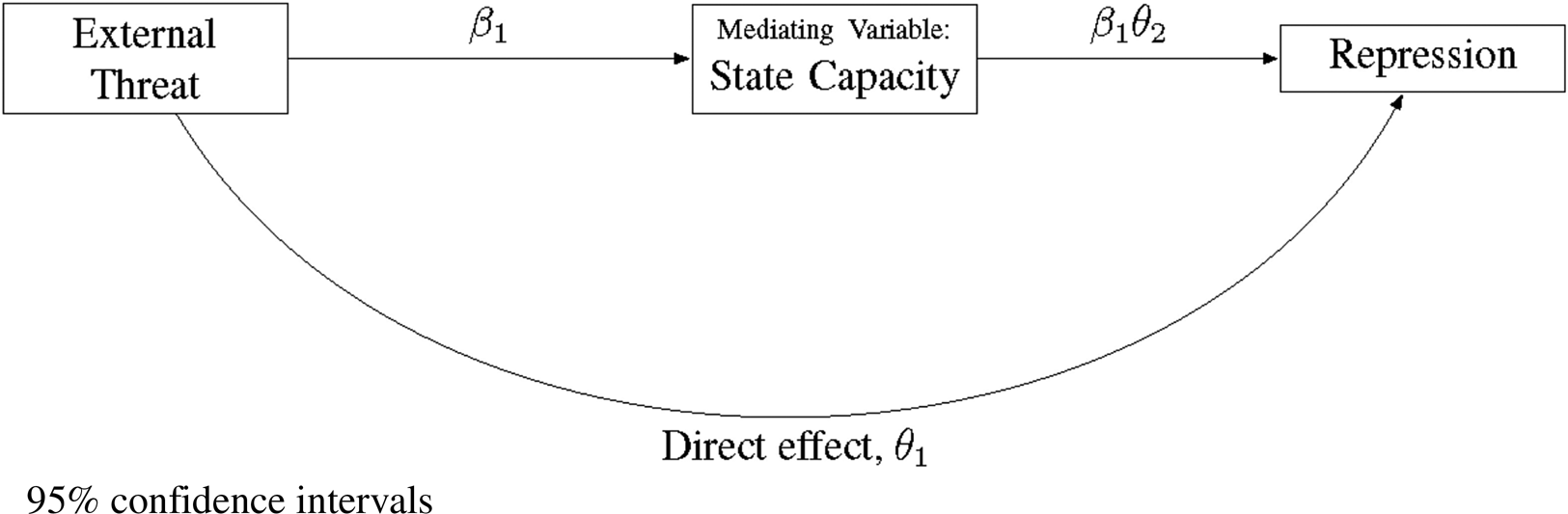
Figure 1 illustrates the relationships between external threat, capacity, and repression.Footnote 7 We first verify whether external threats increase state capacity. Then we test whether the increased capacity decreases state repression.
Direct and indirect effects of external threats.

External threat has two expected effects on repression. The direct effect is expected to be positive, represented by θ 1, as increased external threats increase state repression. This effect can be estimated through a single equation where we regress repression directly onto an external threat. The indirect effect follows two stages. In the first stage, we estimate the effects of external threats on capacity, represented by β 1:
 $$E[ {{\rm Capacity}{\rm \mid }{\rm External\;Threat}, \;C} ] = \beta _0 + \beta _1\;{\rm External\;Threat} + \beta _jC + \upsilon $$
where C is a set of control variables and their corresponding estimates, β j. Then we regress repression on both the external threat and the mediating capacity variable:
 $$\eqalign{E[ {{\rm Repression}{\rm \mid }{\rm External\;Threat}, \;{\rm Capacity}, \;C} ] = \theta _0 + \theta _1\;{\rm External\;Threat} + \theta _2{\rm Capacity} + \theta _jC + \mu} $$
The indirect effect is then calculated from the estimates of the two stages using the product-of-coefficients method, β 1 × θ 2 (VanderWeele Reference VanderWeele2016).
We make several assumptions about the data to estimate the relationship between the treatment (external threat), the mediator (state capacity), and the outcome (repression). First, we assume the mediator is an intermediate step between the treatment and the outcome. In other words, levels of external threat should affect state capacity and state capacity, in turn, should have a separate effect on state repression. Second, we assume the mediator variable does not cause the treatment variable (VanderWeele Reference VanderWeele2016). That is, we argue that the mediator and the treatment do not have a confounding relationship. While this is a strong assumption, external threats generally arise due to factors external to the threatened state, such as the interests, resources, or alliances between aggressor states. Third, we assume we have included potential confounding variables in our estimation. We provide support for this assumption by using previous research to inform our choice of covariates. Finally, we assume that the covariates in the model, except capacity, are not mediators that would introduce post-treatment bias (Imai and Yamamoto Reference Imai and Yamamoto2013).
We account for both within and between-country comparisons to difference away variation across state and year, respectively. The within-country comparisons allow us to compare the variance within a given country. By using these within estimates, we control the variation that arises due to time-invariant differences across states, such as culture or history (Zorn Reference Zorn2001). The between variance, or year fixed effects, are also particularly important given any temporal changes that affect multiple observations. In addition, we lag the covariates to ensure the correct temporal ordering of the variables. This results in an auto-distributive lag model that focuses on long-term and non-contemporaneous effects.
Data
To estimate the mediation relationship between external threats and repression, we use Fariss, Kenwick, and Reuning's (Reference Fariss, Kenwick and Reuning2020) latent measure of abuse of physical integrity rights.Footnote 8 Measuring state repression is difficult as state actors have incentives to obfuscate such behaviour. To address this problem, Fariss, Kenwick, and Reuning (Reference Fariss, Kenwick and Reuning2020) developed a Bayesian latent measure that accounts for the potential under-counting of repressive events while incorporating standards-based coding of physical integrity rights abuses.
States' behaviour towards physical integrity rights constitutes a variety of behaviours. Even repression can take many forms, ranging from imprisonment, kidnapping, torture, and killings. Some measures only focus on one behaviour (Taylor and Jodice Reference Taylor and Jodice1983). Others focus on a standards-based approach, coding the degree of abuses into categorical values (Cingranelli and Richards Reference Cingranelli and Richards1999; Gibney et al. Reference Gibney2018). Finally, some measures take an events-based approach that counts abuses and records the severity (Eck and Hultman Reference Eck and Hultman2007). Instead of relying upon one approach over the other, Fariss, Kenwick, and Reuning's (Reference Fariss, Kenwick and Reuning2020) model incorporates several different physical integrity rights variables into a single measure, leveraging agreements and disagreements between measures.Footnote 9 Fariss, Kenwick, and Reuning's (Reference Fariss, Kenwick and Reuning2020) measure builds upon previous latent measures of physical integrity rights (Fariss Reference Fariss2014; Schnakenberg and Fariss Reference Schnakenberg and Fariss2014) but incorporates the uncertainty in count data related to government one-sided killings. State killings may be the result of leaders using external threats as a pretext to eliminate political opponents. Alternatively, state killings may be carried out by state agents in weak states without their citizens' knowledge.
To ensure our results are robust for our choice of dependent variable, we also analyze alternative physical integrity rights outcomes. First, we examine Fariss's (Reference Fariss2014) latent measure of physical integrity rights.Footnote 10 In addition, we examine the standards-based Political Terror Scale (PTS) coding of US State Department reports (Wood and Gibney Reference Wood and Gibney2010). Higher values of this measure indicate more physical integrity rights violations. Finally, we also examine an event-based approach using Fariss, Kenwick, and Reuning's (Reference Fariss, Kenwick and Reuning2020) estimate of government killings, which is derived from their latent measurement model.
Like repression, external threat is latent. We conceptualize external threats as the heightened risk of another state forcefully infringing on another state's sovereignty. Existing research uses several alternative measures to capture this concept. For example, Heffington (Reference Heffington2020) uses conflict as a measure of threat. A drawback of this approach is that conflict is the realization of risk to states but not the risk itself. Threats should also reflect leaders' expectations of conflict (Johnson Reference Johnson2017).
Alternatively, scholars have used rivalries or territorial disputes to capture the risk of threat (Bak, Chávez, and Rider Reference Bak, Chávez and Rider2020; Gibler and Miller Reference Gibler and Miller2014; Thies Reference Thies2004). The advantage of these variables is that states in these conditions are more likely to perceive themselves in a threatening environment without conflict necessarily appearing. One drawback is that the measures do not capture the variance of threat within these conditions. The tensions between rivals rise and fall while the measures themselves remain constant. Similarly, territorial disputes are not always hotly contested. Non-rivalry and non-dispute states may feel threats from alternative sources, such as being a buffer state (Fazal Reference Fazal2004) or when experiencing a border crisis (Schultz Reference Schultz2015).
Nordhaus, Oneal, and Russett (Reference Nordhaus, Oneal and Russett2012) developed a latent measure of international threat by estimating the probability that a state is in a fatal militarized dispute within a dyad, and aggregating that probability to create a monadic measure of threat. Nordhaus, Oneal, and Russett's (Reference Nordhaus, Oneal and Russett2012) conceptualization of threat is, however, different from our own. We view threat as the risk of being targeted in conflict by another state. Nordhaus, Oneal, and Russett (Reference Nordhaus, Oneal and Russett2012) view threat as a risk of conflict regardless of the aggressor. Leaders preparing to be attacked versus leaders initiating a war may trigger different political economy mechanisms.Footnote 11
Given the lack of an existing threat measure that fits our needs, we construct a new measure of external threat using a Bayesian latent measurement approach. We follow Quinn's (Reference Quinn2004) Bayesian approach, which uses Markov chain Monte Carlo (MCMC) for model fit.Footnote 12 This particular approach allows for the indicators to be either categorical or continuous. We provide more details of the estimation technique in the appendix but, in general, this approach incorporates both standard normal theory factor analysis and item response theory.
To fit our measurement model, we use observable indicators that previous studies have identified as proxies for an external threat. The first component of our novel threat measure includes the existence of a rivalry with another state for a country-year observation. We adapt the first component of our new measure from Colaresi, Rasler, and Thompson (Reference Colaresi, Rasler and Thompson2008), who argue that rivalries involve state leaders who believe they compete with other states.Footnote 13
Rivalries have far-reaching implications, including for states not directly involved. Because of this, we include a binary measure that indicates whether a state acts as a buffer between at least two rival states (Fazal Reference Fazal2004). Buffer states are an important component of threat as rivals often hope to acquire control of buffers to gain strategic advantages over one another. Thus, buffer states are at a high risk of being invaded. We code a state as a buffer state if it offers a land-based path between rivals without having to enter another non-rival state.
Next, we include Gibler and Miller's (Reference Gibler and Miller2014) territorial claim measure. This measure codes threat when a state leader makes a territorial claim to land in another state. These territorial threats indicate a higher risk of a military dispute as states either prepare to take the land or defend it.
A state's neighbouring conditions are another component of threat. We include (non-allied) neighbours' military spending, gathered from SIPRI, because higher military spending signals to other states that a neighbour may be preparing for conflict (Goldsmith Reference Goldsmith2007). This variable is coded as the mean level of military expenditures as a percentage of GDP for all bordering states that do not have a defensive security agreement with the state in question.Footnote 14 In addition, we include the number of borders a state shares with other states. We expect multiple borders to represent a greater threat (Schultz Reference Schultz2015).
Finally, we include a temporal measure of conflict behaviour. This log-linear time trend counts the number of years since a state has been targeted in a militarized dispute. We expect that shorter timespans predict a higher threat. The longer a state is removed from being targeted, the lower the threat. We use the Correlates of War (COW) Militarized Interstate Dispute (MID) data to code dispute targeting (Palmer et al. Reference Palmer2015).
The measurement model searches for patterns among the component variables. The stronger the association between the input variables, the more information those indicators provide about the latent threat measure. So, even imperfect proxies for threats contribute some information to the latent measure. Instead of arbitrarily deciding how much an input variable contributes to the measure, the association between input variables indicates how much the variables contribute to the measure. We constrained rivalry's contribution to the model to be positive, meaning positive values of the latent measure indicate a more external threat. See the appendix for a more technical discussion of the model.
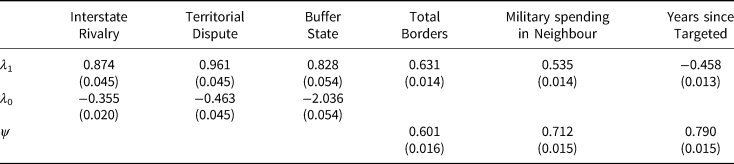
Table 1 provides a summary of the posterior distributions for the respective components. For the categorical variables, we can interpret λ 1 akin to an item discrimination parameter from an item response theory (IRT) model. Each of the categorical variables is positive and at least 2 standard deviations from zero, which is consistent with our expectation that each of these variables contributes some information to the states' threat environment. Comparing variables to each other, territorial disputes contribute the most to the overall threat measure, followed by rivalries and the buffer state status.
Posterior density summary of the measurement model for external threat

Means are reported without parentheses; standard deviations are reported with parentheses.
We interpret λ 0 as a negative item difficulty parameter from IRT. Variables with lower λ 0 values mean that states with lower threat levels will be more likely to possess that attribute. So while being a buffer state contributes to the threat level (λ 1), the low λ 0 level means that states with low threat levels could be classified as buffer states. Conversely, we expect states with higher threat levels to have rivalries.
For the continuous variables, λ 1 should be interpreted as a factor loading. We standardized these variables to ease comparability. As expected, higher military spending for non-allied neighbours and more borders positively contribute to the threat. In addition, the longer the time since a state has been targeted in a conflict, the lower the threat.
The ψ values are the estimated error variances for the continuous input variables. These values indicate that the latent level of threat explains the high amount of individual variables. This substantiates our expectation that these variables contribute to a state's threat environment.
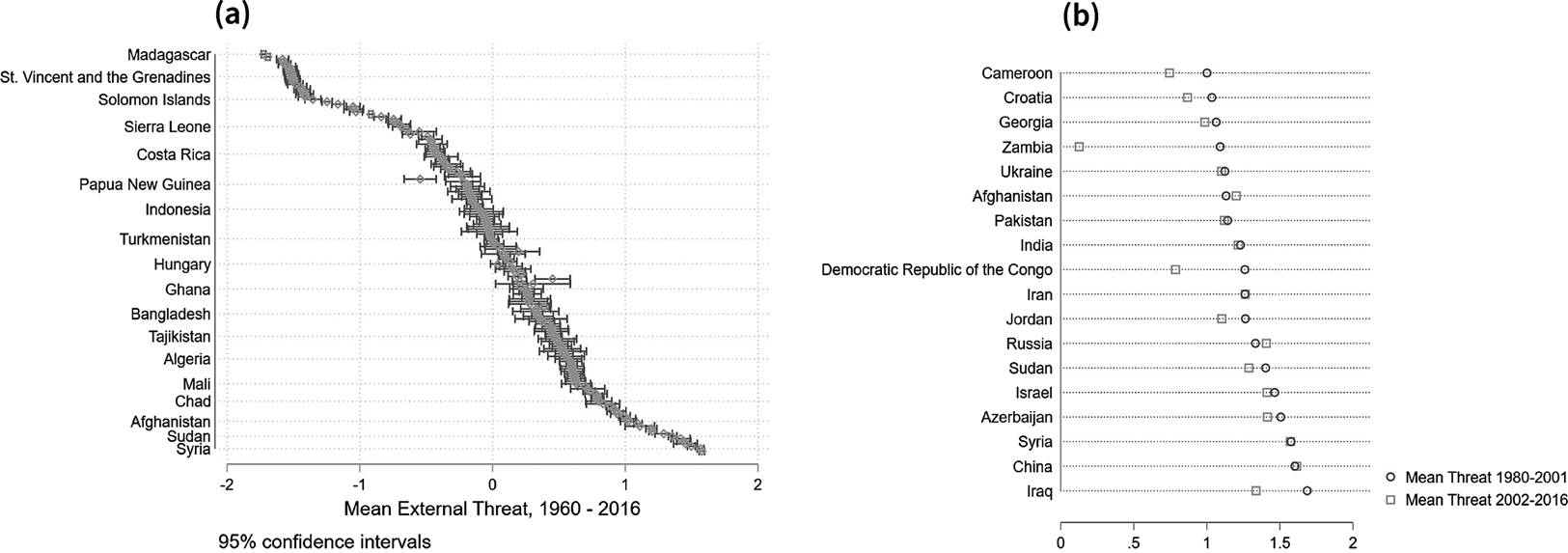
In sum, the results from the posterior distributions in Table 1 support our expectations that the variables we identified as proxies for threat contribute to the overall measure. Before we use our latent measure of threat in the main analysis, we validate the measure by demonstrating that the values for threat are reasonable. We then plot the mean values of threat across the temporal span of the measure (1960–2016) in Fig. 2a, labelling a subset of countries.Footnote 15 Countries that have not experienced many external conflicts – such as Madagascar – are found on the lower end of the spectrum. Conversely, countries that experienced a high number of conflicts – such as Syria and Iraq – are at the higher end of the spectrum. In Fig. 2b we zoom into the highest values of threat and observe how these countries vary before and after 2001. Again, the countries we expect to be under the highest threat have the highest values.
Descriptive graphs of external threat. (a) Mean external threat 1960–2016. (b) External threat changes 1980–2016.

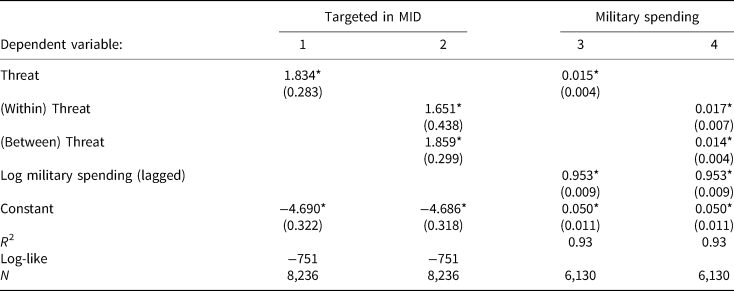
We further validate the measure by examining how well it predicts observable state behaviour. First, we examine how well the threat measure predicts whether a state is targeted in a militarized interstate dispute. Using MID data, we find that threat has a positive and statistically significant relationship with being targeted. Substantively, a one-unit increase in threat increases the odds of being targeted by 526 per cent. We also perform receiver operating characteristic (ROC) analysis, comparing the sensitivity and specificity of the threat measure across varying thresholds. In our bivariate model, we observe an Area Under the Curve (AUC) of 0.83. In addition, we find the relationship between threat and MID targeting holds across within and between variations. Following Zorn (Reference Zorn2001), we include both the within and between estimators in a model predicting MID targeting. We derive the between estimator by taking the mean value of threat for a given country across all years in the panel data. We derive the within-estimator by taking the country-year threat value and subtracting the unit mean. Both estimates are positive and statistically significant, which suggests no one type of variance dominates our new measure.Footnote 16
Next, we examine threats and military spending. States' military budgets are comprised of a myriad of external and domestic factors but we expect they react to threats (Zielinski, Fordham, and Schilde Reference Zielinski, Fordham and Schilde2017). We again use military spending data from the Stockholm International Peace Research Institute (SIPRI) and take the natural log, given military spending is positively skewed. Model 3 in Table 2 finds a positive relationship between threat and military spending. Model 4 again examines the within and between effects and finds both in the expected direction.Footnote 17
Validation of latent external threat measure

*p < 0.05; Standard errors clustered on countries reported in parentheses.
Another key variable in our study is state capacity, which can be measured in multiple ways (Hendrix Reference Hendrix2010). We focus on states' fiscal capacity to be consistent with bellicist state-building literature, using the fiscal capacity measure provided by V-Dem (v12).Footnote 18 Fiscal capacity relates to the state's ability to extract resources from its residents or generate other forms of revenue. This differs from other measures, such as tax or bureaucratic capacity, because it does not directly measure whether a state extracts resources but rather its latent ability to extract these resources.
We include a series of control variables to address potential confounding between threat and repression. We first include the log of the GDP, measured in millions of dollars (US). States with greater GDP often have the means to spend more on their military as well as having a greater fiscal capacity. Data are drawn from the World Bank (World Bank 2019). The natural log transformation helps correct the skewness of the data. Similarly, states with stronger democratic institutions may have the means to implement better taxation systems, which leads to greater fiscal capacity. Accordingly, we include the V-Dem electoral democracy index as a control variable (Coppedge et al. Reference Coppedge2020, v12). The index measures key components of democratic institutions, such as freedom of association, fair elections, and suffrage, among others. We also include a binary measure for whether the state is involved in an ongoing civil war, taken from the CDP/PRIO's Armed Conflict Dataset (Strand Reference Strand2006). State capacity may decrease during outbreaks of civil war (Liou, Murdie, and Peksen Reference Liou, Murdie and Peksen2020; Thies Reference Thies2010). We include the natural log of the size of the population as our last covariate.
We address both unit heterogeneity and temporal variation. To do so, we rely on a within-unit estimator by subtracting the country-year observation from the unit average in each of our statistical models. The estimator accounts for time-invariant confounders. This approach is akin to including country fixed effects but provides more flexibility for mediation interpretation. In addition, we include year dummies in each model to account for temporal shocks and variation.
Results
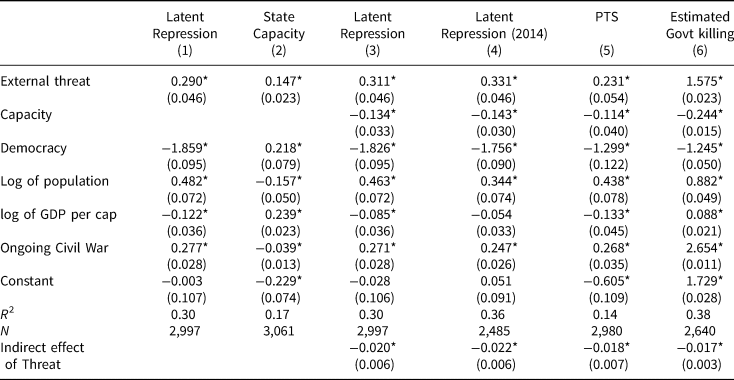
Table 3 reports our main results. Model 1 shows the total effect of external threats on repression using Fariss, Kenwick, and Reuning's (Reference Fariss, Kenwick and Reuning2020) latent measure. The coefficient for threat is statistically significant and represents the combined indirect and direct effects of a threat on repression – we expect these two effects to act in opposite directions. To separate these two effects, we first regress state capacity on external threat and control variables in Model 2. This model is consistent with our expectation that external threats increase state capabilities. Model 2 constitutes an intermediate step in the indirect path between external threats and repression. Model 3 replicates Model 1 but now treats capacity as a mediating variable. The coefficient for threat represents the direct effect of threat on repression. As an external threat increases, state killings increase, consistent with our expectations. Substantively, a one standard deviation increase in threat increases repression by 14 per cent of a standard deviation.
External threats, capacity, and state killings, 1980–2016

*p < 0.05; Robust standard errors in parentheses. Year fixed effects included but not reported. Estimates represent within-unit fixed effects.
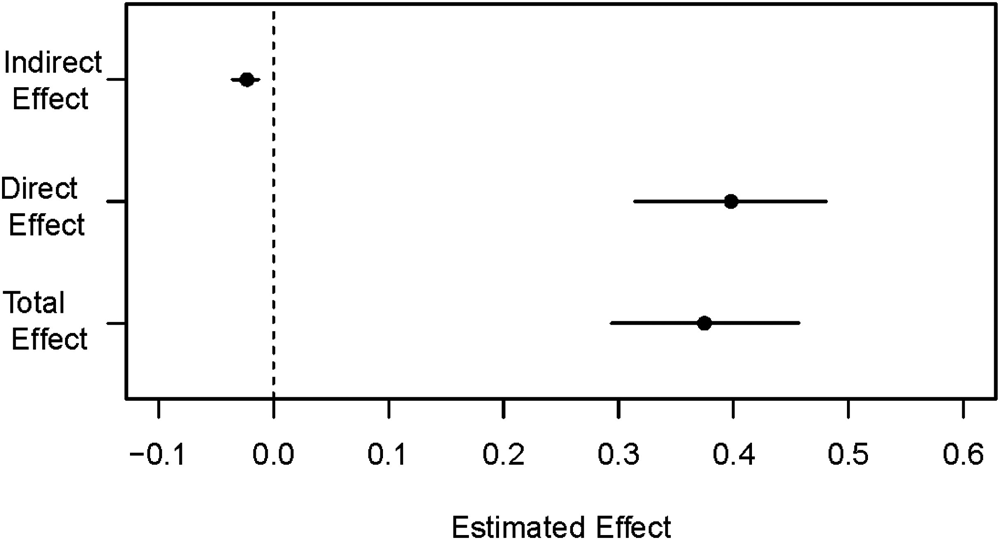
To calculate the indirect effect, we use the product-of-coefficients mediation approach (VanderWeele Reference VanderWeele2016). We multiply the coefficient of external threat in Model 2 by the coefficient for capacity in Model 3 in Table 3.Footnote 19 We observe that external threats decrease state repression through increased capacity. To further illustrate the direct and indirect effects of external threats, we graph the effects with Imai, Keele, and Tingley's (Reference Imai, Keele and Tingley2010) non-parametric bootstrapping approach using the ‘mediate’ package in R to estimate standard errors. The results, illustrated in Fig. 3, are substantively similar to the product-of-coefficient results.
Mediation effects with 95 percent confidence intervals.

The direct and indirect effects are consistent with our expectations, with each pushing in opposite directions. However, the indirect direct effects are small relative to the direct effects. So while external threats may incentivize leaders to invest in state capacity, the resulting decrease in repression, because of this increased capacity, is outpaced by state agents' incentives to use repression under the cover of an external threat. As a result, the total effect of external threats on repression is positive. How do these results translate to observable behaviour? Given the results, we expect that leaders facing increased external threats have more opportunities and incentives to repress political opponents, dissidents, or any perceived collaborators of the threatening state. At the same time, the threatened leaders have incentives to increase their states' capacity to help address the increased threat. Any benefits for physical integrity rights, because of the increased capacity, are outweighed by the direct effects. Overall, physical integrity rights are more at risk when external threats increase.
To ensure the robustness of our results, we re-analyze the mediation models with alternative measures of repression. In Model 4, Table 3, we use an earlier version of the latent measure of repression from Fariss (Reference Fariss2014). We observe similar direct and indirect effects as in Model 3. Model 5 examines the standards-based Political Terror Scale from Wood and Gibney (Reference Wood and Gibney2010), based on US State Department reports. Again, we observe substantially similar direct and indirect effects. Finally, we consider the estimated count of government killing from Fariss, Kenwick, and Reuning (Reference Fariss, Kenwick and Reuning2020) using a Poisson model.Footnote 20 External threats directly increase one-sided killing and indirectly decrease one-sided killing through capacity. Again, the direct effects of threats of government killing are substantially larger than the indirect effects.
In summary, these results demonstrate that external threats affect repression along two pathways. Directly, external threats increase repression, while external threats indirectly decrease repression through the mediator state capacity. However, the direct effects of external threats are larger than the indirect effects, which means that the total effect is positive. These results are consistent across a range of repression outcomes.
We conduct additional analysis to ensure our results are robust to alternative model specifications. These results are consistent with our main inferences so we relegate them to the appendix. We briefly summarize them here. To begin with, we examine the heterogeneous effects of threats by regime type, specifically analyzing differences between democracies and non-democracies. Given previous research, it is plausible that the relationship between threats, capacity, and repression differs in democracies and non-democracies. For example, democracies may enjoy better access to sovereign credit, which allows them to address threats without seeking added capacity (Queralt Reference Queralt2022). In addition, democratic leaders may be too constrained to use repression even in times of heightened threat (Davenport Reference Davenport2007). Similarly, autocratic leaders may prefer repression but low capacity allows state agents to avoid fulfilling these demands. We test these possibilities and find suggestive, yet inconclusive, evidence of a conditional effect. If the effect of threats on repression is conditioned by the continuous polyarchy measure, the effect is non-constant: Repression is highest in the most autocratic and democratic regimes. The indirect effects are, however, stronger in non-democracies. Increased capacity in democracies does decrease repression, but at a smaller rate with more uncertainty.
We also considered alternative measures of threat. Specifically, we examined the component variables that were input into our latent threat measures. We also examined a broader measure of capacity that incorporates states' provisional services. These additional results do not change our main inferences and are discussed in more detail in the appendix.
Conclusion
This study furthers our understanding of three important concepts in international relations: physical integrity rights, capacity, and external threats. Our results show external threats increase leaders' incentives to use repression against their own people. We show that external threats are associated with higher levels of killings; however, this is slightly offset by leaders' incentives to increase capacity when facing such threats. Yet, the incentives to use repression outpace the mollifying effects on increased capacity.
Empirically, we make two contributions to the existing literature. First, we develop a latent measure of external threat that should interest scholars focusing on the international threat environment. Threats play a prominent role in international relations research as threats change states' behaviour concerning alliances, spending behaviour, and domestic political outcomes. Second, we show how threats can affect states' repressive behaviour in direct and indirect ways. If we only focus on the total effect, we would underestimate the external threat's effect on repression.
We see this as a first step and envision future research that will address the role of threats and repressive behaviour. For example, we focus on governments’ respect for physical integrity rights in our empirical analysis, but external threats may persuade leaders to violate other types of human rights, such as civil liberties. Another potential research extension could be to identify which physical integrity rights violations are occurring the most in relation to external threats.
Finally, future research could explore the heterogenous effects of external threats. We briefly examined the conditional effects of threat across regime types, revealing a complex, non-linear relationship. Other domestic factors may moderate the threat, such as ethnic fractionalization or political polarization. Alternatively, international factors such as alliances or integration into the global economy may also matter. For example, Queralt (Reference Queralt2022) shows that states borrowing from international credit markets under extreme conditionality may not need to augment capacity. We hope future research on repression, political and economic development, and alliance politics can make use of our new latent measure of threat and explore these possibilities.
Supplementary Material
Online appendices are available at https://doi.org/10.1017/S0007123422000692.
Data Availability Statement
Replication data for this article can be found in Harvard Dataverse at: https://doi.org/10.7910/DVN/RYUSL4.
Acknowledgements
We thank Eduardo Alemán, Francisco Cantú Mustafa Kirisci, Lydia Tiede, and the participants of the UH Brownbag workshop and Southern Political Science Association conferences for their feedback, along with two anonymous reviewers and BJPS editors for their helpful comments and suggestions.
Financial Support
None.
Conflicts of Interest
None.