The Photograph
He stands against the background of the bleak expanse of Pusan prisoner-of-war camp—a sea of frozen mud with a barbed wire fence on its perimeter, an armed guard eying him warily from a distance (see figure 1). It is a late afternoon in November 1951. The shadows stretch long across the earth, and the cold is palpable. He wears an army greatcoat that seems several sizes too large for his diminutive frame. His face is thin and wind-darkened; his head barely reaches the shoulder of the tall European who stands beside him, looking down at him with a benign but slightly awkward expression on his face.
Pusan prisoner-of-war camp ICRC delegate Frédérique Bieri with Japanese prisoner of war Matsushita Kazutoshi (photographer unknown). Copyright International Committee of the Red Cross (ICRC), Geneva. Reproduced with the kind permission of the ICRC.

The European, Frédérique Bieri, is a representative of the International Committee of the Red Cross (ICRC) from Geneva. The small man in the greatcoat is Prisoner Number 600,001. The “6” stands for Japan; the “00,001” indicates that he is the first (and, as it will transpire, the only) Japanese soldier to be captured and held prisoner by the United Nations forces during the Korean War. What is he doing here? Why was a Japanese soldier fighting with Chinese and North Korean forces on the communist side in the war? How did he become a prisoner of the United Nations Command, and what happened to him afterwards?
When I first encountered him, Prisoner Number 600,001 was just a statistic, a bewildering cypher in the grim arithmetic of the Korean War: number of prisoners of war (by nationality) held in United Nations POW Camp no. 1 Koje-Do and POW Enclosure no. 10 Pusan, January 1952—
But over the course of several years of research, the image of the person behind the cypher began to emerge from archives and newspaper articles in several countries. Much of his story remains obscure, but the parts that can be pieced together open windows onto unexpected landscapes of war.
For Prisoner Number 600,001—Matsushita Kazutoshi, to give him his full name—Pusan prisoner-of-war camp must have seemed a long way from his home in rural Japan, and from the family of ten children of which he was the eldest son. His painful journey through hot and cold wars is just one of a mass of threads linking Japan's imperial expansion in Asia to the Korean War. Though his story is exceptional, indeed astonishing, it offers a perspective on important facets of history that often pass unremarked. His travels take us through the back roads of war, enabling us to see interactions and connections that are normally hidden from sight.
Hidden Warscapes
Most vividly, Matsushita Kazutoshi's journey exposes a history of violence that flows seamlessly from the Asia-Pacific War to the Korean War. Too often, August 15, 1945, is inscribed in history books as a moment of total rupture between “war” and “postwar.” The image of grim-faced Japanese listening to the Emperor's surrender broadcast at the stroke of noon that day evokes a sense of finality, of inseparable division between past and present. But for Matsushita and tens of thousands more—Japanese, Chinese, Korean—news of Japan's surrender marked only a momentary hiatus in their continuing experience of war. Conflicts fed by Japanese imperial expansion and the Asia-Pacific War continued to rage across China; the forces of the Soviet Union, which had declared war on Japan on August 9, were sweeping into Manchuria and southern Sakhalin. The old struggles of Korean independence fighters against their colonial rulers were merging into the new guerrilla conflicts that, by 1948, would plunge parts of southern Korea into internecine violence.
If August 15, 1945, is too often seen as a universal endpoint, June 25, 1950, is too often depicted as a definitive beginning: the moment when North Korean troops crossed the 38th parallel into South Korea, and the Korean War—the first great “hot war” within the “Cold War”—began. But the roots of the violence were multiple, and extended much more deeply into Northeast Asian history. Bruce Cumings suggests that the origins of the Korean War might be traced back to the period from 1931 to 1932, when Japan invaded northeast China and established the client state of Manchukuo (Cumings Reference Cumings2010, 44). In 1910, when Korea became a Japanese colony, there were already over 100,000 Korean migrants living in Manchuria, and by the middle of the twentieth century, their number had grown to almost two million (Lee Reference Tsuneo2002, 119–20). Most had crossed the loosely controlled border, escaping poverty at home, but for some, the wilder regions of Manchuria provided a stage on which they could continue the struggle against the Japanese colonization of their homeland.
As Cumings (Reference Cumings2010, 44) writes, the Japanese in early 1930s Manchukuo “quickly faced a huge if motley army of guerrilla, secret society and bandit resistance in which Koreans were by far the majority, constituting upward of 90 percent of entities such as the Chinese Communist Party” in the region. Among the guerrilla leaders were Kim Il Sung and his comrades-in-arms, who were to form the core of the post-independence leadership of North Korea. Meanwhile, other Koreans in Manchuria were training with Japan's Kwantung Army or participating in militia groups created to root out the communist subversives (Esselstrom Reference Esselstrom2009, 78–85; Fujitani Reference Fujitani2011, 44–45). The bitterness of the Korean War cannot be understood unless we see how inextricably the war was entwined in the tangled Chinese, Korean, and Japanese conflicts of the colonial era.
Matsushita's story challenges our spatial sense of the emerging Cold War order. The common image of the Cold War is of a world divided into “blocs”: chunks of territory color-coded by ideology. China and North Korea lie firmly in the “communist bloc”; Japan, South Korea, and Taiwan in the “non-communist bloc.” The Korean War is seen as a collision of these two blocs, igniting sparks that turn Cold War into raging inferno. But this granitic image conceals the other Cold War/Hot War—the fluid and ubiquitous ideological war that took place in the Korean mountains and on the Japanese waterfronts, in Chinese villages and in the backstreets of Taipei. This war crossed spatial borders, and human beings in turn traversed its dividing lines, sometimes out of intellectual conviction, at other times driven by the demands of survival. It was a war that could be fought out within a family, within a single room, or within the mind of one individual, and the more personal it became, the more agonizing its consequences (Kwon Reference Kwon2010).
The East Asian odyssey of Matsushita Kazutoshi also casts light on two other neglected aspects of Korean War history. It reminds us of the fact that Japanese, who were not officially combatants in the war, were in fact drawn into its violence in a multitude of roles. Lastly, Matsushita's experiences cast a sharp light on the history of the bizarre war that was fought out within the United Nations POW camps in South Korea between 1950 and 1953: a shadow war that proved to be the greatest stumbling block to peace.
Into an Unending War
Matsushita Kazutoshi was born in 1923 and spent his childhood in a quiet fishing hamlet in Miyazaki Prefecture on the east coast of Kyushu: a village whose gray wooden houses, weathered by the salt wind, looked out across a bay sheltered from storms by a forested and rocky island. Matsushita's birthplace was remote and beautiful, but life there was not idyllic. Eastern Kyushu was and still is one of Japan's poorest regions. By the time Matsushita was at school in the 1930s, the depression had struck, and times were harder than ever. And then came war, and one by one the village's young men were cheered on their way by flag-waving groups of friends and family as they set off for the battlefront, until at last only the women, the children, and the old men remained. After leaving school in his mid-teens, Matsushita too moved away from his home village—though not, initially, to the war zone, but rather to work in a steel plant in Osaka. Then in January 1944, at the age of twenty, he was conscripted into the Kwantung Army's railway brigade based in the eastern Manchurian town of Mudanjiang, and sent to join “Operation No. 1” (Ichigō Sakusen), Japan's final and most massive military offensive in China (Hyūga nichinichi shinbun, January 26, 1952; Mainichi shinbun, January 29, 1952).
The aim of this offensive was to drive a wedge through Chinese territory to the borders of Indochina, and to open up a rail link from Southeast Asia to Beijing and Dalian. For eight months, starting in April 1944, Japanese troops forced their way southward through the Chinese provinces of Hubei and Hunan. The conflict was devastating. In the historic city of Guilin, which fell in October 1944, Nationalist Chinese resistance crumbled before the Japanese advance, and the inhabitants were ordered to abandon the city, which was then looted by Nationalist soldiers and burnt to the ground to prevent it from falling into Japanese hands. Matsushita's introduction to war was a posting to the village of Lingui, a little to the southwest of Guilin, where he labored with a railway construction unit (Hyūga nichinichi shinbun, January 26, 1952). He must have witnessed the columns of desperate refugees who flooded along the railway tracks in trains crammed to the roofs with passengers, or sometimes on foot, only to be bombed from the air and attacked from the ground by Japanese forces, or crushed underfoot as their panicked throngs attempted to flee their attackers (Lary Reference Lary2010, 154–55).
Operation No. 1 was a humiliation for the Nationalist Chinese forces of Chiang Kai-shek (Jiang Jieshi) and, on paper at least, a victory for Japan. But by the end of the campaign Japanese troops were exhausted and overstretched. They had captured several major cities, but their grip on the countryside was much more tenuous, and the chaos in the areas they had invaded was providing fertile ground for the growing influence of Chinese Communist forces. In December 1944, the railway construction corps in which Matsushita worked was ordered to return northward towards Wuchang, a march of some 800 kilometers through a ruined landscape. On December 20, about halfway into the march, the corps set off at night to cross a bridge near the city of Hengyang. When the morning light dawned, Matsushita Kazutoshi had vanished from their ranks. No trace of him, alive or dead, could be found. His Japanese military comrades never saw him again, and his family was informed that he had been killed in combat. Like many other Japanese families of that time, they clung to the hope that his face might yet appear among the columns of demobilized soldiers who returned to a defeated and occupied Japan, but almost two years after Japan's surrender, his parents accepted the fact that he was not coming home, and on June 23, 1947, Matsushita Kazutoshi was officially declared dead (Hyūga nichinichi shinbun, January 26, 1952).
But he was not dead; he had deserted, though it remains uncertain whether this was a response to the horrors he had seen on the battlefield or simply a desperate effort to survive. In the chaos of the Asia-Pacific War's final months, Matsushita managed to find a hideout in an abandoned village, where he was still living when the war ended (Hyūga nichinichi shinbun, August 4, 1954). Soon after, the victorious Chinese Nationalist Army arrived, captured him, and promptly enrolled him into a transport unit of their own 74th Division, where he was known by the Chinese name Han Yisheng (Linyi xingshu chubanban gongshi 1980, 186–87). By that time, the Soviet Union had occupied Manchuria, and the fragile alliance of Chinese Nationalists and Communists, held together until then by the common struggle against the Japanese enemy, had collapsed. As of October 1945, China was again in a state of war—a renewed civil war whose military balance had been profoundly altered by the devastation wrought by Japan's invasion and by the Soviet military presence in Manchuria (which remained until the spring of 1946). For Matsushita, as for millions of Chinese, Japan's surrender did not bring peace, but only a change in the name and nature of the war.
The Other Side of the Line
Matsushita Kazutoshi was just one of thousands of Japanese soldiers who participated in the renewed conflict. His Nationalist Chinese division included another Japanese man named Katō, who had fought with the Japanese army in Nanjing, but had either deserted or been captured by Nationalist Chinese forces and was enrolled into their ranks under the Chinese name Huang (Linyi xingshu chubanban gongshi 1980, 186–87). From the point of view of the Chinese army, such captured Japanese were a source both of potentially valuable intelligence and of much-needed manpower.
Indeed, as the civil war reignited, both Nationalist and Communist sides made enthusiastic use of the Japanese remaining in China. Chiang Kai-shek treated defeated Japanese soldiers with leniency, in the hope of being able to use the services of at least some of them in the ongoing struggle against his Communist enemies (Gillin and Etter Reference Gillin and Etter1983). The most memorable participation of Japanese forces in the Chinese Civil War occurred in Shanxi Province, where Chiang Kai-shek's ally, the warlord Yan Xishan, persuaded some 2,600 Japanese soldiers and civilians stranded in China to join the fight against communism. Of these, around 550 were killed in the Chinese Civil War, and over 700 became prisoners of war of the Chinese People's Liberation Army (Gillin and Etter Reference Gillin and Etter1983, 500–501, 506–8; Ikeya 2007, 2–3). Meanwhile, Chinese Communist forces themselves were also mobilizing the services of many Japanese who had remained in the country after August 1945. Between 8,000 and 10,000 Japanese soldiers and civilians are believed to have worked with the People's Liberation Army in the years immediately following Japan's defeat, around 3,000 of them serving on the front line (Furukawa 1994, iv).
Some Japanese joined the Chinese side out of ideological conviction. In 1938, the left-wing Japanese novelist Kaji Wataru fled to Chongqing, where he organized a Japanese People's Anti-War League (Nihon Jinmin Hansen Dōmei), and in 1940 political activist Nosaka Sanzō was sent from the USSR to Yenan and set up a Japanese People's Liberation League (Nihon Jinmin Kaihō Renmei). Both groups recruited Japanese soldiers who defected to the Chinese side, and trained them to conduct anti-war propaganda missions (Furukawa 1994, 9; Kaji 1982). But for the great majority of Japanese, including Matsushita Kazutoshi, joining the Chinese forces was not a matter of ideological commitment but rather a question of survival or force majeure.
By the middle of 1946, the reorganized Chinese Nationalist 74th Division, in which Matsushita now served, was engaged in repeated armed clashes with Communist forces, and in August they scored a victory when they drove the Communists out of their main base in central Jiangsu Province, northwest of Shanghai, but the advantage was short-lived. In mid-May, the Communist East China Field Army lured the 74th Division into the rugged terrain of the Menglianggu Mountains, where they surrounded and crushed the Nationalist force. The 74th Division suffered 15,000 casualties, and the survivors were captured and incorporated into the ranks of the Communist forces' East China Field Army (Lew Reference Lew2009, 61).
Matsushita and Katō survived the carnage, but now found themselves on the Communist side of the civil war (Cui and Tang 1999, 329; Linyi xingshu chubanban gongshi 1980, 186–87). Chinese Communist reports mention that Matsushita had unsuccessfully requested the Nationalist forces to allow him to return to Japan (Linyi xingshu chubanban gongshi 1980, 186–87). There was a certain irony here. While Mao's forces used the presence of Japanese like Matsushita and Katō to discredit their civil war enemy's nationalist credentials, they too needed all the manpower they could get in their struggle for control of China. They were, therefore, equally unwilling to send their Japanese prisoners home. Matsushita would later recall, though, that his Communist captors, having realized that he was Japanese, treated him with “hospitality.” Rather than sending him back to the battlefront of the ongoing civil war, they initially put him to work cultivating sweet potatoes and pumpkins for army rations (Hyūga nichinichi shinbun, August 4, 1954). So it was that, in the summer of 1947, as his family in Kyushu completed the process of officially declaring their son dead, Matsushita Kazutoshi was embarking on a new round of training and political education that would transform him into a member of the nascent Chinese People's Liberation Army.
Meanwhile, Communist forces were consolidating their victory over the Nationalists, and on October 1, 1949, Mao Zedong declared the establishment of the People's Republic of China. But, as Matsushita Kazutoshi was soon to discover, his war was not yet over.
From Civil War to Korean War
Other Japanese still in China were making the same discovery, among them Ōhaba Hiroyuki, a young man from Nagano Prefecture who had been sent to Manchuria as a “youth volunteer” in 1944 at the age of fourteen. When Soviet forces arrived after the Japanese surrender, Ōhaba was taken prisoner but, along with other children and teenage prisoners of war, was released in the town of Qiqihar, while the Japanese adult prisoners were taken to camps in Siberia. Liberation was no cause for rejoicing. During the winter of 1945–46, the young Japanese were abandoned in Qiqihar without food or shelter. Many died of cold and starvation. When Chinese Communist forces arrived in Qiqihar in April 1946, Ōhaba cooperated with them “as a matter of survival.” He later volunteered for service with the 136th Division of the Chinese Fourth Field Army, and was first sent south to transport supplies to the civil war front line, and then redeployed to Dandong. From there, in the spring of 1951, he crossed into Korea with the Chinese People's Volunteers to fight on the North Korean side in the Korean War (Ōhaba 2009; Furukawa 1994, 99–114).
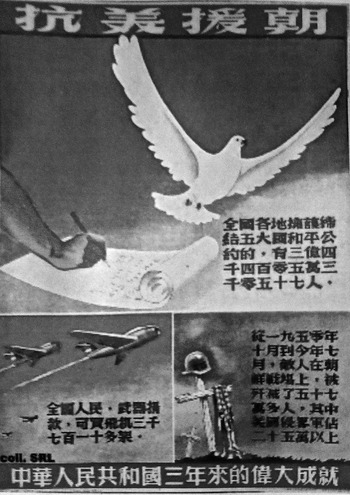
The Korean War broke out at a time when, although Mao had declared victory in the civil war, the embers of conflict still smoldered in China's borderlands. Chiang Kai-shek's forces remained in control of Taiwan, and were still engaged in conflict with Communist forces around the island of Quemoy in the east and on the Burmese frontier in the west. From the perspective of the new Chinese Communist regime, the Korean War was an extension of this ongoing struggle, in the sense that a North Korean victory would consolidate their own position, while, in Mao Zedong's words, “if the American imperialists are victorious, they will become dizzy with success, and then be in a position to threaten us” (Shen Reference Shen and Silver2012, 140). This belief helps to explain the Chinese government's willingness to send a total of over two million troops (euphemistically termed “volunteers”) to support the North Korean side in the war while their own country was exhausted and despoiled by years of war and civil war (see figure 2).
“Oppose America, Support Korea”: Korean War era Chinese propaganda poster. Public domain.

The Chinese Civil War flowed into the Korean War in another way, too. A substantial number of the Chinese People's Volunteers sent to support North Korea from October 1950 onward were former members of the Nationalist Chinese army, who had surrendered towards the end of the civil war and received “special reindoctrination” (Meyers and Bradbury Reference Meyers, Bradbury, Meyers and Biderman1968, 228). Their loyalties were uncertain, and their presence was central to the ferocious conflicts—in effect a continuation of the Chinese Civil War in miniature—which erupted within the prisoner-of-war camps in South Korea amongst captured members of the Chinese People's Volunteers.
The Volunteers also included, in much smaller numbers, Japanese who had served in the Imperial Army in China or been sent to Manchuria as settlers. Details are hazy, but Japanese historian Furukawa Mantarō suggests that anywhere between several dozen and three hundred Japanese stranded in China after the end of the Asia-Pacific War served with the Chinese People's Volunteers on the Korean front (Furukawa 1994, 98). Oral accounts recall that some were killed in action (Ōhaba 2009). Other Japanese worked behind the lines in Northeastern China as doctors and nurses caring for the war wounded. A cemetery near the city of Dalian contains the graves of fourteen Japanese medical workers and others who, as a monument by the gateway records, “gave their lives for the cause of victory in the War to Resist America and Aid Korea” (Gomi 2010).
Initially, it seems, there were plans for a larger Japanese presence in the Chinese People's Volunteers. In the weeks before China entered the Korean War, troops from all over the country gathered in the border city of Dandong in preparation for the Chinese mission to reinforce the crumbling North Korean military. Among them were Japanese recruits, including Japanese propaganda officers, who were being vigorously trained in the skills of cooperation with the North Korean comrades; but at the last moment, the Chinese high command had second thoughts (Furukawa 1994, 91–98).
By September 1950, the issue of a Japanese military presence in the Korean War was emerging as a topic of fierce international propaganda battles. In August 1950, Senator Warren Magnuson had attempted to secure the passage of a law allowing the US military to recruit Japanese volunteers for service on the Southern side of the Korean War (Kim Reference Kim1997, 62–64). The measure did not succeed, and the US command publicly insisted that there were no plans to use Japanese soldiers in the war, but the debate about a Japanese military role helped to fuel reports in the Soviet Union and its allies that Japanese soldiers were indeed secretly being recruited by the United States and sent into battle in Korea.
In November 1950, the Russian newspaper Trud published an indignant article claiming that “Japan, at present under the heel of the murderer of Korean women and children, MacArthur, and his lackey Yoshida has, in effect, been involved in the war. The occupiers, grossly violating the Potsdam Declaration and other international agreements, are sending Japanese servicemen to Korea” (Australian Embassy, Moscow 1950). The same claims were also made by Soviet representatives in debates in the Far Eastern Commission and other international forums. Though exaggerated, these claims were not entirely unfounded. Despite widespread public denials, the United States, with the cooperation of the Japanese government, had recruited some 1,200 members of the Japanese Coast Guard, almost all of them former sailors in the Imperial Navy, for minesweeping duties in Korean waters. Thousands more Japanese seamen and stevedores were employed in such roles as transporting explosives to the Korean front and manning landing vessels (including many of the vessels used in the Incheon Landing). Dozens were killed in the war (though no official figure has ever been published) and at least two were taken prisoner of war by North Korea (Asahi shinbun, August 2, 1952, and August 17, 1952; Ishimaru 2008, 35; Ōnuma Reference Hisao2006).
In public statements, propaganda posters, and even in popular songs, the new Chinese regime evoked the specter of resurgent Japanese imperialism to rally support for involvement in the Korean War (Cathcart Reference Cathcart2010). Against this background, Chinese authorities became alarmed that the presence of Japanese soldiers in the People's Volunteer Force in Korea would undermine their ability to take the moral high ground, and might offer a propaganda coup to the United States and its allies. Most of the Japanese soldiers who had been deployed to Dandong and nearby were abruptly informed that their service in the Korean War would not, after all, be needed. In some cases at least, though, the decision not to send Japanese recruits to Korea failed to reach the troops on the ground (Furukawa 1994, 98). A number slipped through the cracks and found themselves serving on or just behind the Korean front line, among them Matsushita Kazutoshi.
In November 1950, Matsushita was deployed to a transport corps carrying 13,000 artillery troops belonging to the 58th Division of the Chinese 20th Army into battle, and in December he crossed the frozen Yalu River into North Korea (Hyūga nichinichi shinbun, August 4, 1954). From November to December 1950, the 58th Division was engaged in the ferocious Battle of Changjin (Chosin) Reservoir, an attempt to block the advance of US forces up the eastern side of Korea towards the Korea-China border. The battle halted the American momentum, but the Chinese forces could not prevent a breakout by US troops, who retreated to the port of Hŭngnam, from where they were evacuated en masse. The cost in human lives was enormous: some 35,000 Chinese soldiers are believed to have been killed or injured in the Battle of Changjin Reservoir, and many more died of frostbite or froze to death as they slept in the extreme cold of the rugged area surrounding the reservoir (Sloan Reference Sloan2009, 326).
Matsushita's unit pushed on south as far as the port of Wonsan, but the force was poorly trained and desperately short of supplies and equipment, their main weapon being aging Type 38 rifles left behind in China by the departing Japanese. Even these were insufficient to go round, and one rifle was sometimes shared by three or four soldiers (Hyūga nichinichi shinbun, August 4, 1954). It was at this point that Matsushita deserted again, and set off walking alone but determinedly southward towards the 38th parallel and enemy lines. Remarkably, he survived the journey, and on May 24, 1951, in a state of collapse, surrendered to UN forces not far from Seoul (Hyūga nichinichi shinbun, August 4, 1954). From a temporary prison camp near the front, he was transported to Pusan prisoner-of-war camp in the far south of the peninsula, where he first appears in the official records on July 18, 1951, in a brief and bureaucratic memo transmitting to the Provost Marshal, General Headquarters, UN Command, the basic personnel record of the recently captured Matsushita, Prisoner Number 600,001. His given name is mistakenly written “Kazuyoshi,” which, ironically, was the name of his younger brother, killed fighting with the Japanese Imperial Army in the Pacific War (Office of the Provost Marshal 1951).
Pusan and Koje-Do
The United Nations forces in Korea were ill-prepared to handle large numbers of prisoners of war, and their first POW camps, at Inchǒn and Pusan, were soon full to overflowing. By the end of 1950, Pusan camp was the size of a small city, containing over 135,000 prisoners of war, including more than 6,000 sick and wounded, and sections of the camp were severely overcrowded (Bieri Reference Bieri1950, 1; Meyers and Bradbury Reference Meyers, Bradbury, Meyers and Biderman1968, 222). To solve the problem, over the following few months the majority of prisoners were transferred in shiploads to the large offshore island of Koje-Do, where a great tent city was constructed on requisitioned paddy fields sloping down the hillsides towards the sea.
By the time Matsushita Kazutoshi arrived in Pusan POW camp, it had been greatly reduced in size but still held over 16,000 prisoners (Bieri Reference Bieri1951b, 1). The hospital remained, but the camp now mainly housed women POWs (as well as a few small children incarcerated with their mothers), and served as a reception and short-term detention center for male prisoners on their way to Koje-Do (see figure 3). Spread over a wide expanse of farmland at the foot of the mountains on the northern side of the city of Pusan, the camp consisted of a jumble of tents and tin-roofed wooden huts, each tent often housing fifty or more prisoners, most of whom slept on straw mats on the ground (Bieri Reference Bieri1951a, 18). A cluster of cottages outside the perimeter wire was occupied by local people who specialized in selling black-market goods to the POWs, despite intermittent efforts by the authorities to remove them (Bieri Reference Bieri1951d). For most prisoners, Pusan POW camp was just a stopping-point on their journey to Koje-Do. But Matsushita was not transferred to the island; instead, he remained in Pusan camp from his capture in May 1951 until June 1953. For the UN Command, he was a troubling anomaly. He fitted none of their categories, but, at a time when the entire POW system was descending into chaos, he was too small an anomaly to attract serious attention.
Korean and Chinese prisoners in Pusan prisoner-of-war camp (photographer unknown). Public domain.

Some aspects of life in the camp must have been surprisingly familiar. Many of the everyday items used there, such as mess kits and toothbrushes, were supplied from Japan (Rubli Reference Rubli1953, 4). More curiously, most of the interrogations of prisoners of war were conducted via the medium of the Japanese language. When the Korean War broke out, the US military found itself facing an “almost complete lack of Korean military linguists,” as well as a severe shortage of officers capable of speaking Chinese. MacArthur asked the Pentagon to provide thirty Korean-speaking US army officers, but only seventeen could be found (Knight Reference Knight2006, 126; Military History Section 1955, 27). To fill the gap, the UN Command turned to Japanese-American soldiers. Since Japanese had been imposed on Korea during the colonial era, most educated Koreans could speak the language of the former colonizers. Korean POWs were therefore often questioned through a trilingual process, with English questions being translated into Japanese by Japanese-American interrogators, and (where necessary) then translated from Japanese to Korean by a Korean interpreter. This, of course, more than doubled the length of interrogations, and often meant that important pieces of information were lost in translation (Military History Section 1955, 26–27).
The longer the camps existed, the more simmering tensions came to the surface. About six weeks after Matsushita arrived in Pusan, Korean prisoners celebrated the sixth anniversary of Japan's defeat in the Pacific War and of Korea's liberation. Around 9:00 that night, the “singing of political songs commenced and was taken up by one compound after the other.” The POWs had been ordered to be in their tents by 10:00 p.m., but some stayed outside in the dark and began charging at the fences surrounding the camp. Around 10:30 p.m., the South Korean guards, reportedly fearing a breakout, started firing into the throng of prisoners. They also fired shots into one of the women's tents where singing was loudest. Six prisoners, including one woman, were killed outright, and twenty-four were injured, of whom three later died of their wounds (Bieri Reference Bieri1951c).
This was among the earliest instances of upsurges of violence that would be repeated on a growing scale between mid-1951 and the end of the war. The 1949 Geneva Conventions, adopted less than a year before the outbreak of the Korean War, envisaged prison camps contained within national borders. POWs were to be grouped according to nationality, with officer POWs maintaining control over common soldiers from the same army. Prisoners had the right to elect their own representatives; the Third Convention also stated that “prisoners of war shall be released and repatriated without delay after the cessation of active hostilities” (International Committee of the Red Cross 1949). The authors of these provisions had not envisaged a conflict like the one in Korea, where national frontiers were transected by complex ideological borders. Simultaneously a Korean civil war and a proxy world war, this was a conflict within which the last battles of the Chinese Civil War were also being fought out behind the barbed wire of UN POW camps.
Korean prisoners included people whose places of origin lay both north and south of the 38th parallel. There were Koreans from the North who had fought with the (North) Korean People's Army, and Koreans from the South who had either volunteered or been forced to join the North Korean forces as they swept south in 1950. Some, for ideological or personal reasons, were deeply disturbed at the prospect of being sent to North Korea when the war was over. Some Chinese POWs who had until recently been fighting with the Nationalist forces wanted (not surprisingly) to be sent to Taiwan rather than being returned to the People's Republic. According to Frédérique Bieri, even Chinese POWs who embraced the Communist cause were often reluctant to be repatriated to the PRC because they believed that they would be punished for having allowed themselves to fall into the hands of the enemy (Bieri Reference Bieri1951c).
The communists are convinced that on their return they will have to have good reasons for having surrendered. . . . Failing “good reasons”, a collection of “good points” received in camp might give a better chance of survival. “Good points” are obtained by carrying out a number of subversive actions, amongst them the organization of People's Courts (in which political opponents are sentenced to beatings with sticks or stones, sometimes resulting in death). . . . Anti-Communists (both North and South Koreans) are also not idle. They too have People's Courts and mete out punishment. (Bieri Reference Bieri1951c)
In September 1951 alone, twenty prisoners in Koje-Do and Pusan camps were listed as having been “beaten to death by persons unknown” (Bieri Reference Bieri1951c, annex no. 7). Intervention by prison guards, both South Korean and US, often intensified, rather than restraining, the violence. In May 1952, a riot on Koje-Do, in which the camp commandant was briefly taken captive by the prisoners, ended in the deaths of sixty-nine POWs; in October 1952, sixty-one Chinese prisoners of war were killed by guards in Cheju-Do prison camp during riots that followed the celebration of Chinese national day; and in December of the same year eighty-five Korean prisoners in Pongam-Do camp were shot dead and more than a hundred injured after a demonstration which, the authorities claimed, threatened to turn into a mass breakout (Bieri et al. Reference Bieri1952; Hoffmann Reference Hoffmann1952b; Hermes Reference Hermes1966, 405–6). The US/UN Command had decided that all prisoners would be screened to determine their wishes about repatriation. But the screening process only inflamed the internecine battles between different groups within the prison population. Meanwhile, both North Korea and China insisted that all POWs should be repatriated to their territory after the war, and from the first half of 1952 onward, disputes over the issue of repatriation became the main stumbling block delaying the signing of an armistice.
Back from the Dead
In the midst of this mayhem, Matsushita took the one possible step to try to secure his survival: he attempted to write to his family in Japan, but his letter apparently failed to arrive, and he received no reply. When Bieri visited Pusan camp in late November 1951, Matsushita appealed to him to help make contact with his family, and provided their address, which Bieri passed on to the Japan Red Cross Society (Bieri Reference Bieri1951d). Even then, the process was slow. Matsushita's position was fraught with political complications, and it is likely that there were quiet consultations between the Red Cross, the Japanese government, and the UN Command before, two months later, news of Matsushita's whereabouts finally made its way to his home in Kyushu.
On a rainy January day in 1952, the Matsushita family, who had recently completed the rituals to mark the seventh anniversary of the death of their eldest son, were astonished to receive a letter signed by Otto Lehner, chief representative of the International Committee of the Red Cross to Japan and Korea. “Your son,” wrote Lehner, “is alive and well, and would like to hear news of his family.” Matsushita's father Haruyoshi was so excited by the news that he rushed out bare-headed into the rain to announce to his neighbors that his son was miraculously back from the dead. “I can't believe Kazutoshi is alive,” he told a newspaper reporter who interviewed him a few days later. “Now I'm just praying that he'll come back home as soon as possible” (Mainichi shinbun, January 29, 1952). The following month, Bieri returned to Pusan POW camp bearing a letter from one of Matsushita's brothers, a photograph of Kazutoshi taken in 1939, and a copy of an article on Prisoner Number 600,001 which had been published in January by the Mainichi newspaper. It was the first news of his family that Kazutoshi had received for almost a decade (Bieri Reference Bieri1952b). But his father's prayer remained unanswered.
Soon after his story was reported in the newspapers, Matsushita's plight was taken up by one of the most interesting figures in postwar Japanese politics: Nakayama Masa. The half-Japanese daughter of an American merchant, Rodney H. Powers, who had settled in Nagasaki in the 1860s, Nakayama had received part of her education in the United States before returning to Japan, where she married an Osaka-based lawyer and politician. In 1947 she became one of the first women elected to Japan's parliament (Hastings Reference Hastings and Imamura1996, 276). Having experienced the difficulties and dangers of being a half-American woman in wartime Japan, Nakayama was particularly sensitive to the problems of people displaced by war.
On January 30, 1952, she made a brief but impassioned appeal on Matsushita's behalf in a question to the Foreign Affairs Committee of the Lower House of the Japanese Parliament. Nakayama spoke of an unnamed “compatriot of ours” from Miyazaki Prefecture who had “turned up in a Korean prisoner of war camp” after remaining in postwar China and joining the Chinese forces in North Korea. In her address to the House, Nakayama spoke of the sufferings endured by the Japanese who remained in China, and expressed fears that, if he were caught up in a prisoner exchange scheme, the Japanese POW in Pusan might be sent back to China. Her plea to the Japanese government was to deliver a message to the UN Command via a Japanese delegation then in Geneva, asking for Matsushita to be sent home to Japan instead (Lower House Foreign Affairs Committee 1952a).
The government's initial response was cautious and bureaucratic. It replied that no “concrete steps” had yet been taken to deal with the case of the Japanese prisoner of war, but promised that the problem was being discussed with Japan's repatriation authorities (Lower House Foreign Affairs Committee 1952a). Three weeks later, the government spokesman came back with much more encouraging news, and with a statement to parliament that named Matsushita Kazutoshi as the prisoner concerned. Foreign affairs officials, he reported, “have been in touch with the repatriation office, the necessary enquiries are complete, and on this basis, a request to GHQ for [Matsushita's] return to Japan is in progress.” Despite the delicate state of international negotiations on the POW issue, the UN military authorities had indicated that “they would do their best, as this is a Japanese person,” and it seemed likely that they would respond positively to Japan's request to send Matsushita home (Lower House Foreign Affairs Committee 1952b).
But then, as suddenly as he had appeared in Japanese public debate, Matsushita Kazutoshi disappeared again. Even more mysteriously, knowledge of his existence seems abruptly to have been expunged from official consciousness. On May 27, 1952, Foreign Minister Okazaki Katsuo, answering a general parliamentary question about the possibility that there were Japanese soldiers fighting on the North Korean side in the war, replied:
We have heard rumors that there are one or two such Japanese amongst the prisoners of war being held by the United Nations, but at present our efforts to confirm this have not met with success. Therefore at present we cannot see any such people amongst the prisoners of war. We often hear these rumors, but that's all I can say. And, well, even if there are such people, the rumors suggest that there are very few of them. (Lower House Committee on the Repatriation of Overseas Compatriots 1952)
Matsushita had even disappeared from the statistics of POWs. In late 1951, he had been identified by nationality in Red Cross lists of prisoners of war, but by January 1952 he had mysteriously been reclassified as Korean, and thereafter he is no longer visible in the officially recorded figures.Footnote 1
Media attention now shifted to reports of Japanese who had been captured while fighting with US troops on the South Korean side in the war, and were imprisoned in North Korea. As armistice negotiations progressed, excitement about these stories mounted. There were some suggestions that ten or more Japanese prisoners of war were being held by North Korea (Asahi shinbun, April 11, 1953). But when, in July 1953, the P'anmunjŏm Armistice finally opened the way to a large-scale return of POWs, only two Japanese citizens were identified among the prisoners awaiting return (Asahi shinbun, August 2, 1952, and August 17, 1952). No one asked what had happened to Matsushita Kazutoshi.
Just one terse official document gives an enigmatic clue to his fate. More than half a year after the armistice, on April 1, 1954, the General Headquarters of the US Far Eastern and United Nations Command drew up a final accounting of the numbers of prisoners captured by UN forces, and their ultimate destinations. At the foot of a tabulation of the destiny of some 150,000 Korean POWs, grouped in batches and identified by their prisoner numbers, someone has appended an extra line written in pencil: “Prisoner no. 600,001—escaped” (Office of the Provost Marshal 1953).
The Great Escape
After the mass uprising on Koje-Do in May 1952, POW camps in South Korea were drastically reorganized. Korean prisoners who originated from the South but wanted to be repatriated to the North were moved to a separate camp at Pongam-Do, just to the south of Koje-Do, and Chinese prisoners were concentrated in a camp on the island of Cheju. “Pro-communist” prisoners were to be confined in offshore camps, while “anti-communists” were concentrated in camps on the Korean mainland, including Pusan (Headquarters, Prisoner of War Command 1952). The mood in the Pusan camp now changed dramatically, as ICRC delegate Georg Hoffmann, who visited soon after, discovered:
The delegate found the camp in an agitated state of anticommunist demonstrations (flags, marches, music, songs). The prisoners’ representatives in the two compounds declared to the delegate: we don't consider ourselves prisoners of war any more. We demand to be set free. We want to join the army of the Republic of Korea (South) and fight for the United Nations and the free world. . . . The delegate is persuaded that these camps of “good boys” will soon create considerable difficulties and inconveniences for the detaining power. (Hoffmann Reference Hoffmann1952a, 5)
For bodies like the ICRC, the dilemma was profound. Forcibly repatriating reluctant prisoners to mainland China or North Korea would clearly be inhumane, but the situation in camps like Pusan allowed the more fanatical of the “good boys” to influence and intimidate others with the enthusiastic encouragement of their South Korean guards. South Korean President Syngman Rhee (Yi Seungman) vehemently opposed the signing of an armistice, and insisted that the war could only end with the reunification of Korea under South Korean rule. He was particularly determined to block any moves to repatriate reluctant POWs to North Korea. As the armistice discussions approached their climax in 1953, with fierce debates over the repatriation continuing, President Rhee chose to take matters into his own hands, creating precisely the “difficulties and inconveniences” that Hoffmann had foreseen.
After top-secret preparations within the South Korean army, in the early hours of June 18, 1953, South Korean military police, who had taken over control of the camps holding the anti-communist Korean prisoners, cut the wire and allowed the mass “escape” of over 27,000 prisoners, surely the largest single breakout of POWs in modern history (Paik 1999, 229–30). This act was, as much as anything else, an attempt to sabotage the armistice talks, and produced predictable expressions of outrage from North Korea, China, and the Soviet Union; but truce negotiations continued, and despite the mass “escape,” the armistice was signed at P'anmunjŏm on July 27 by North Korea, China, and the UN Command. South Korea refused to sign (Paik 1999, 323).
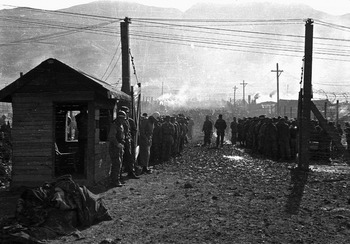
For many, the “great escape” was truly a moment of liberation, but thirty-nine POWs were killed and more than one hundred injured in the chaos, and, for those whose origins were complex or whose sympathies were mixed, it must have been a moment of confusion and anxiety. Of the 3,385 prisoners in Pusan camp in June 1953, all but eighty-six escaped (Burckhardt and Hoffmann Reference Burckhardt and Hoffmann1953; see figure 4). Among them was Matsushita Kazutoshi, who walked out of the dark and rapidly emptying camp straight into the waiting arms of the South Korean military, and was, willingly or otherwise, enrolled into their ranks. Having served successively in Japan's Kwantung Army, the Chinese Nationalist Army, the Chinese People's Liberation Army, and the Chinese People's Volunteers, Matsushita was to end his unusual military career as a member of the Republic of Korea's 1928th Army Corps (Hyūga nichinichi shinbun, August 4, 1954).
The entrance to Pusan prisoner-of-war camp (photographer unknown). Copyright International Committee of the Red Cross (ICRC), Geneva. Reproduced with the kind permission of the ICRC.

South Korean forces appear to have treated him mainly as a source of information and propaganda. In May 1954, a series of curious reports appeared in the Korean media, and were picked up by English-language newspapers as far away as Pittsburgh, where the local Post-Gazette ran an article headlined “Japs Forced to Fight for Reds in Korea War.” This cites a South Korean army intelligence report based on information from “a Japanese sergeant who says he was forced to fight for the Chinese Red Army in the Korean War.” The sergeant in question was Matsushita Kazutoshi, who is quoted as “saying the Communists pressed into service some fifty thousand Japanese soldiers after World War II. He also claimed another two hundred thousand were being trained by the Russians on the Kamchatka Peninsula of Siberia” (Pittsburgh Post-Gazette, June 1, 1954).
Korean media reports were more detailed and lurid. Purportedly quoting Matsushita, two national newspapers proclaimed not only that 200,000 Japanese were being trained in Kamchatka but also that most of the Japanese women remaining in China had been forced into working as “comfort women” in Chinese military brothels. The account they gave of Matsushita's life was inventive. The story begins accurately enough, describing Matsushita as coming from Kyushu and having gone to Manchuria, where he joined a Kwantung Army railway division. But his desertion from the Japanese army and his time fighting with the Chinese Nationalist forces are expunged from the record. Instead, readers are told that he served with the Japanese military until Japan's surrender at the end of the Pacific War, when he became a prisoner of war of the Chinese Communists. Stranger still, Matsushita is described as having been sent into battle in Korea with Chinese Communist forces in December 1950, and having fought with them continuously across the length and breadth of the Korean Peninsula until May 1953, before deserting and surrendering directly to South Korean Military Intelligence: no mention here of his two years as a prisoner of war in Pusan POW camp, nor of his participation in the great escape (Kyǒnghyang sinmun, May 31, 1954; Tonga ilbo, May 31, 1954).
It is unclear how much of this report actually came from Matsushita himself, and how much was simply ghost-written by his captors. The account Matsushita gave a couple of months later, after his release and return to Japan, was a very different one. But the timing suggests that, having extracted something useful from their unlikely Japanese recruit, the South Korean army was now finally willing to send him home. At the end of July 1954, a year after the end of the Korean War and almost ten years after he had reportedly been killed in action, Matsushita was discharged in the city of Taegu by an officer of the 1928th Corps, who presented him with the gift of a South Korean military uniform, exhorting him to “wear this as you labor for the reconstruction of Japan” (Hyūga nichinichi shinbun, August 4, 1954).
Going Home
Matsushita Kazutoshi then boarded the ferry Onjin to Osaka, and from there made his way by boat and train to his home region, arriving on the afternoon of August 3, 1954, to be greeted by his family and a cheering crowd of 300 villagers. Interviewed by the local newspaper immediately after his return, Matsushita gave a straightforward personal account of his time with the Chinese Communist forces: an account which bears no resemblance to the information published by South Korean military intelligence. He recalled that his Chinese unit had received intensive ideological indoctrination, but hardly any training in practical military skills, and that it was very poorly equipped. He made no mention of any Soviet training of Japanese soldiers, saying only that he had occasionally encountered Soviet military on the Chinese side of the border, but never seen any in North Korea. He had, though, been impressed by the discipline that governed relations between the Chinese People's Liberation Army and the civilian population: looting and pilfering were strictly forbidden, and crimes against women were taboo (Hyūga nichinichi shinbun, August 4, 1954).
The story briefly made headlines in the local news. His homecoming came on the eve of the last large-scale returns of remnants of the imperial army from mainland Asia. China was preparing to repatriate Japanese former soldiers whom it held as war criminals, and the Soviet Union was negotiating the release of Japanese prisoners of war still in its hands (the last of whom were to be repatriated at the beginning of 1957). Matsushita's astonishing return from the dead gave hope to families still praying for the return of missing relatives. The local Hyūga nichinichi shinbun, which followed these human dramas with close interest, fêted his return, referring to him as a “living spirit of the glorious dead” (ikita eirei; Hyūga nichinichi shinbun, August 4, 1954). From the local perspective, his extraordinary experiences and survival provided a story whose emotional impact clearly outweighed any inconvenient political questions about his desertion and service with Chinese forces. But the metropolitan media, which had briefly taken up Matsushita's story in 1952, and which reported the homecomings of Japanese prisoners of war held by the North Korean side, remained silent about his homecoming. Perhaps the complexity of his story made it difficult to fit into any of the contending views of the Asia-Pacific War and the Korean War that dominated the national discourse of the day.
After his long war, Matsushita Kazutoshi lived for decades in his Kyushu birthplace, where he found work as a plumber. He married and had two sons, but barely spoke about his wartime experiences.Footnote 2 The fisherman's son from Miyazaki Prefecture had passed through the hands of all the major military forces in Northeast Asia, but, beyond the brief interview with the local paper in 1954, his own feelings towards them are shrouded in silence. When he died, his story, long forgotten by all except those who knew him personally, disappeared with him. In this respect too, Matsushita seems symbolic. His journey strikes a discordant note, which cannot be harmonized with the major narratives of the war. It spreads untidily over the national and temporal borderlines with which we tame and constrain history. It sheds an uncomfortable light on the ideological certainties of mid-twentieth-century Northeast Asia, and on the history of the treatment of prisoners of war by the forces of the United Nations. For all these reasons, it readily slips through the cracks of national memories of war.
In remembering his life we can, I think, find new ways to remember the Korean War.
Acknowledgments
The research on which this article is based was supported by the generosity of the Australian Research Council (Discovery Project no. DP120100801). The author gratefully acknowledges the assistance of Dr. Keiko Tamura and Dr. Catherine Churchman in locating documents for this project, and the helpful comments of the article's peer reviewers.