Introduction
The family Acarosporaceae occurs around the world, usually in xerothermic habitats on rock or in biotic soil crusts (Magnusson Reference Magnusson1929). It is characterized primarily by crustose growth forms distinguished by polyspory (30–300 simple, hyaline ascospores per ascus) and asci usually with a non-amyloid tholus (Magnusson Reference Magnusson1929; Reeb et al. Reference Reeb, Lutzoni and Roux2004; Gueidan et al. Reference Gueidan, Monnat, Navarro-Rosinés and Roux2014; Westberg et al. Reference Westberg, Millanes, Knudsen and Wedin2015a ). The family currently includes eight genera confirmed by molecular phylogenies: Acarospora, Glypholecia, Myriospora, Pleopsidium, Sarcogyne, Thelocarpella, Timdalia, and Trimmatothelopsis (Reeb et al. Reference Reeb, Lutzoni and Roux2004; Gueidan et al. Reference Gueidan, Monnat, Navarro-Rosinés and Roux2014; Westberg et al. Reference Westberg, Millanes, Knudsen and Wedin2015a ). Polysporina was found to be polyphyletic with the type of the genus, P. simplex (Taylor) Vězda, recovered in Acarospora. The other taxa studied in Polysporina were divided between the genus Acarospora and a well-supported clade that was sister to the rest of Sarcogyne (Westberg et al. Reference Westberg, Millanes, Knudsen and Wedin2015a ). The sister relationship of this Polysporina clade to Sarcogyne was weakly supported and needs further phylogenetic study. The genus Polysporina was characterized primarily by apothecia with carbonized epihymenial accretions and lecideine apothecia (Vězda Reference Vězda1978; Kantvilas Reference Kantvilas1998; Knudsen Reference Knudsen2007; Knudsen & Kocourková Reference Knudsen and Kocourková2008). Two undescribed taxa with carbonized epihymenial accretions from North America (Polysporina sp. 1 and Polysporina sp. 2) were included in the recent phylogeny of the family, and were recovered in Sarcogyne and Acarospora, respectively (Westberg et al. Reference Westberg, Millanes, Knudsen and Wedin2015a ). These two species are new to science and we describe them in this paper. We name one in honour of the eminent North American lichenologist Irwin M. Brodo.
Materials and Methods
Specimens from UCR and GZU were studied in mounted hand cut sections with measurements made in water using standard microscopy. Measurements were made to the nearest 0·5 μm and the ranges given here exclude the extreme observed values. Amyloid reactions were tested with Lugol’s reagent (IKI) with or without pretreatment with KOH. Secondary metabolites were studied in solvent C by J. C. Lendemer (NY) using standardized thin-layer chromatography (Culberson & Kristinsson Reference Culberson and Kristinsson1970, modified following Lendemer Reference Lendemer2011). Photographs were taken with a Pentax K-3 DSLR, mounted on a StackShot rail, and combined in Helicon Focus.
Results
Acarospora brodoana K. Knudsen, Kocourk. & M. Westb. sp. nov.
MycoBank No.: MB816447
Similar to Polysporina gyrocarpa but differing especially in having a higher hymenium and black hypothecium.
Type: USA, California, San Bernardino Co., San Bernardino Mountains, San Gorgonio Wilderness Area, Dollar Lake, steep terraced slope above the cirque, 34°17'43·7''N, 117°12' 49·9''W, 2678 m, on schistose rock, 5 July 2012, K. Knudsen 14703 & J. Kocourková (UCR—holotype; S—isotype).
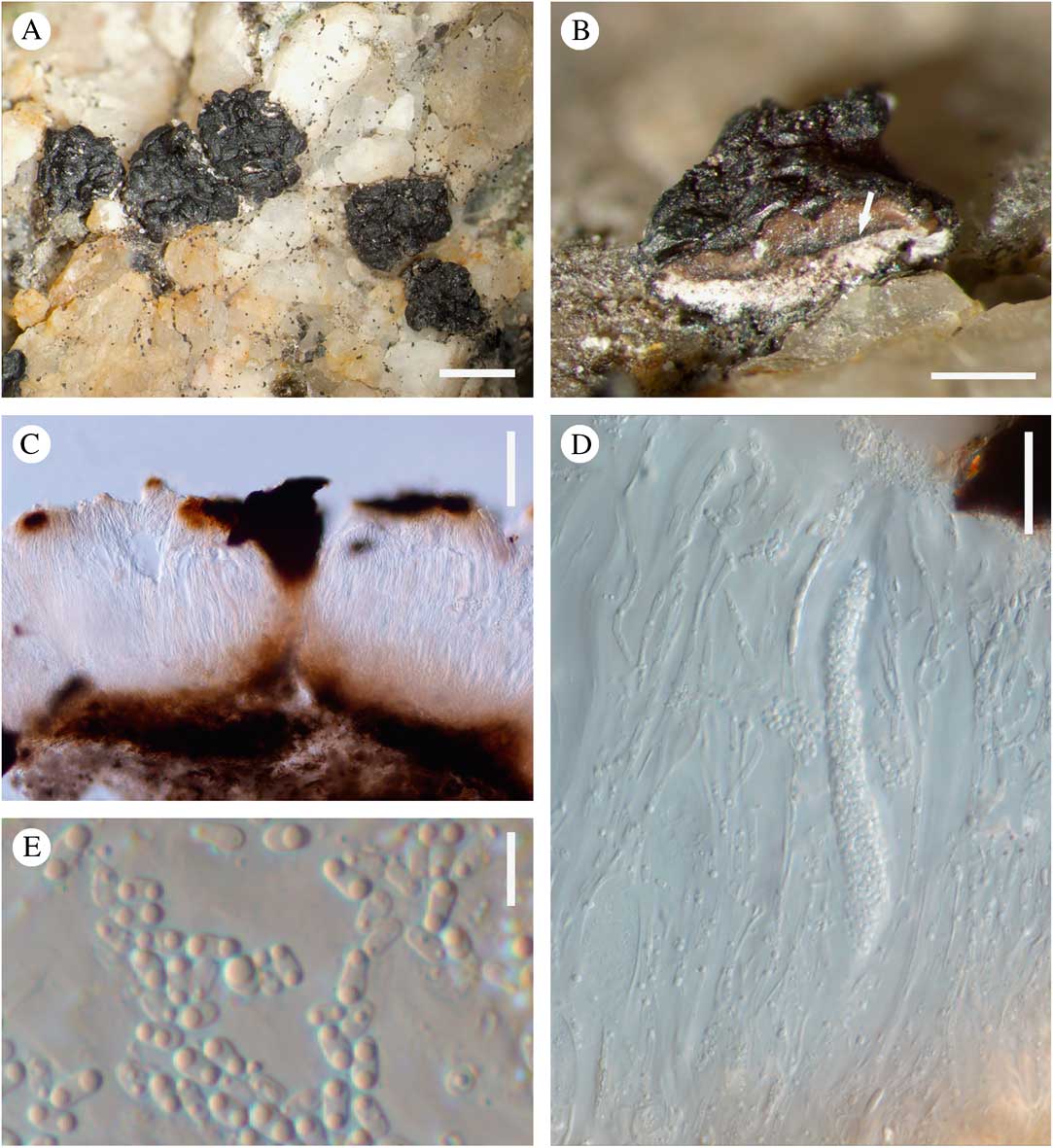
(Fig. 1)
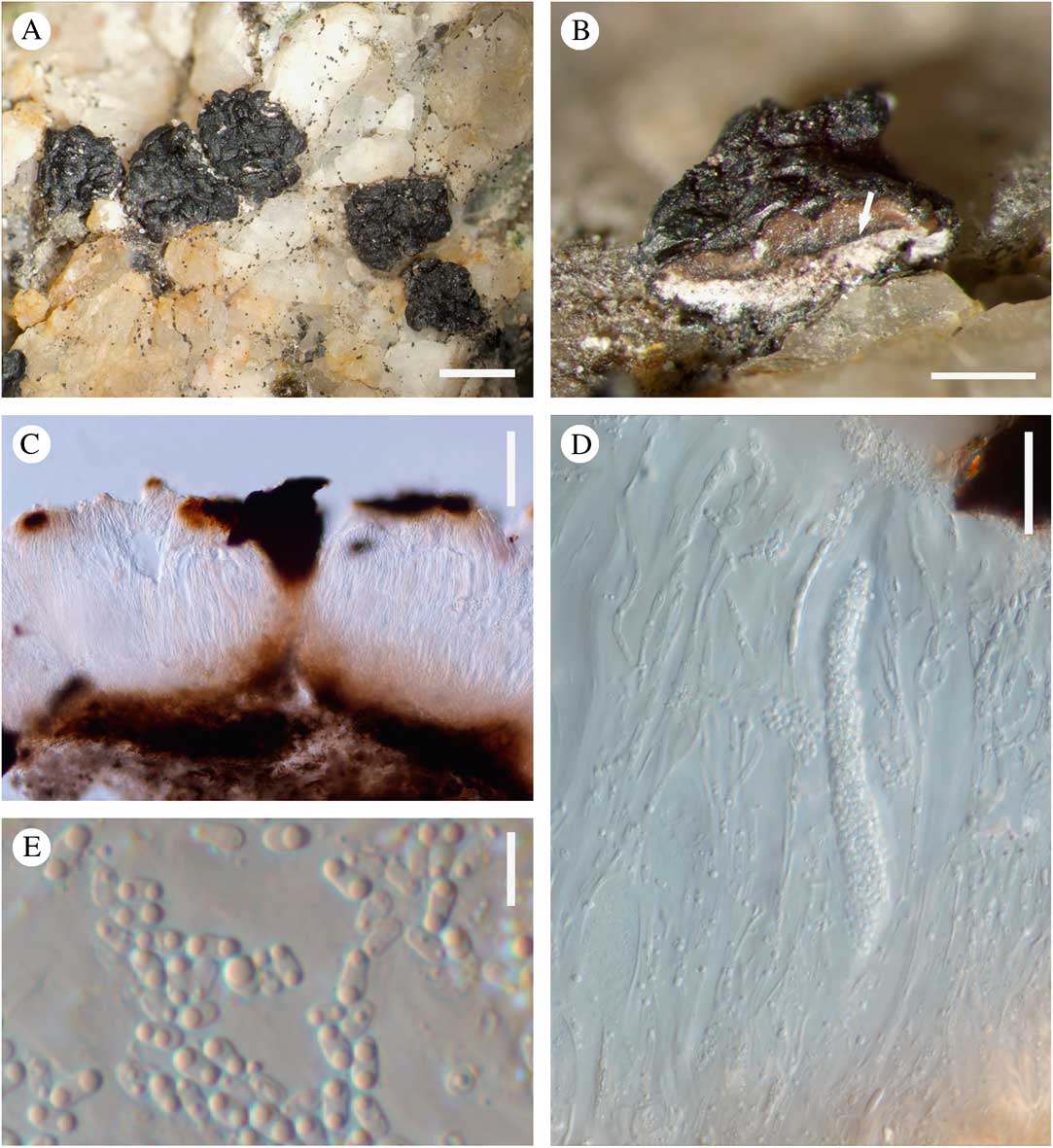
Acarospora brodoana, Knudsen 16926 (paratype, NY, UCR); A, thallus habit; B, section of apothecium showing black hypothecium (arrow) and white apothecial base; C, thin section of central part of apothecium with accretions; D, hymenium with nearly mature ascus and branched paraphyses; E, ascospores. Scales: A=1 mm; B=0·5 mm; C=100 µm; D=20 µm; E=50 µm. In colour online.
Thallus endolithic, algal layer scattered in the rock beneath the base of the apothecia or not apparent, algal cells chlorococcoid, mostly 10–14 μm.
Apothecia lecideine, dispersed, round and convex, 1·0–1·5 mm diam., 0·3–0·5 mm tall, black, dull, epruinose, carbonized, with a poorly formed margin becoming excluded, replicating by division. Carbonized melanin forming a continuous upper layer covering the disc, without exposed patches of non-melanized disc, engulfing all or part of the epihymenium below, 10–110 μm thick, the topography uneven forming a rugulose surface. Parathecium of thin hyphae, 1–2 μm thick. Epihymenium c. 20 μm thick, sometimes the upper 10 μm not visible, rarely completely obscured in the melanin of the upper carbonized accretion. Paraphyses 1·5–2·0 μm wide with unexpanded apices. Hymenium 150–170 μm tall, inspersed in the lower part, hemiamyloid, streaked with scattered thin bands of melanin extending from epihymenium to subhymenium, the probable beginning of the replication of apothecia by division. Asci clavate, 60–80×13–22 μm, tholus non-amyloid, containing several hundred ascospores per ascus. Ascospores simple, hyaline, usually biguttulate, 3·0–4·5×1·5–2·0 μm. Subhymenium 40–50 μm tall, hemiamyloid. Hypothecium black, 50–60 μm thick, of thin hyphae, 1–2 μm thick. Below hypothecium white apothecial base of hyphae above algal layer in substratum, up to 200 μm thick, I−, outer surface thinly melanized.
Pycnidia not observed.
Chemistry. No secondary metabolites detected.
Distribution and ecology. On granite and schistose rock at elevations above 1400 m in the San Bernardino Mountains in southern California, western North America. The population at the lowest elevation is in the chaparral-covered Pinnacles in the upper south-western edge of the Mojave Desert. The other populations occur in arid montane habitats covered with conifer woodlands.
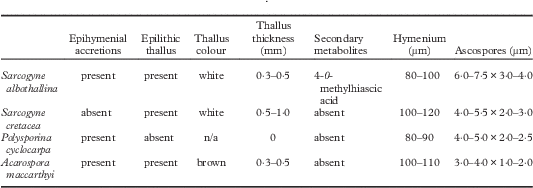
Notes. Acarospora brodoana (Table 1) was found to belong to an early divergent lineage in Acarospora (see Polysporina sp. 2 in phylogeny in Westberg et al. Reference Westberg, Millanes, Knudsen and Wedin2015a ). In the past, because it has lecideine apothecia with carbonized accretions covering the disc, it would have been included in the genus Polysporina but that genus is polyphyletic and the type of the genus, P. simplex, belongs in Acarospora (Westberg et al. Reference Westberg, Millanes, Knudsen and Wedin2015a ). A black hypothecium distinguishes A. brodoana from all other species of Acarospora or Sarcogyne that have discs with carbonized accretions. A dark hypothecium is rare in Acarosporaceae but is known from two other species, Sarcogyne clavus (DC.) Kremp. and Sarcogyne hypophaeoides Vain. ex H. Magn., both of which have discs lacking carbonized accretions (Westberg et al. Reference Westberg, Timdal, Asplund, Bendiksby, Haugan, Jonsson, Larsson, Odelvik, Wedin and Millanes2015b ). Sarcogyne hypophaeoides can occasionally have a central carbonized umbo which could be an ontogenic remnant or the beginning of an apothecium splitting into two or more apothecia. In the southern Californian mountains, on granite, A. brodoana can only be confused with P. gyrocarpa (H. Magn.) N. S. Golubk., which has equally large discs but differs especially in having a shorter hymenium, a thin hyaline hypothecium and broader ascospores (Knudsen & Kocourková Reference Knudsen and Kocourková2009). The presence of A. brodoana above 1400 m suggests that it may occur elsewhere in the Northern Hemisphere at middle to high elevations in arid montane habitats. For instance, P. gyrocarpa occurs in Asia and western North America.
Summary of the characteristics which distinghish Acarospora brodoana from similar species

Specimens examined. USA: California: San Bernardino Co., San Bernardino Mountains, below Hwy 38, 34°10'17·8''N, 116°43'12·1''W, 2450 m, on granite boulder, 2014, K. Knudsen 16926 (UCR, NY); The Pinnacles, above Trail 2W16, 34°10'43·7''N, 117°12'49·9''W, 1426 m, on granite outcrop, 2013, K. Knudsen et al. 16351 (UCR).
Sarcogyne albothallina K. Knudsen, T. B. Wheeler, Kocourk. & M. Westb. sp. nov.
MycoBank No.: MB816448
Similar to Sarcogyne cretacea but with rugulose discs with carbonized accretions, longer ascospores, and producing 4-0-methylhiascic acid.
Type: USA, Montana, Chouteau Co., Missouri River Breaks, Hole in the Wall, 47°47'57''N, 110°02'36''W, 853 m, on Virgelle formation (HCl+), 6 September 2011, T. Wheeler 3582 (UCR—holotype).
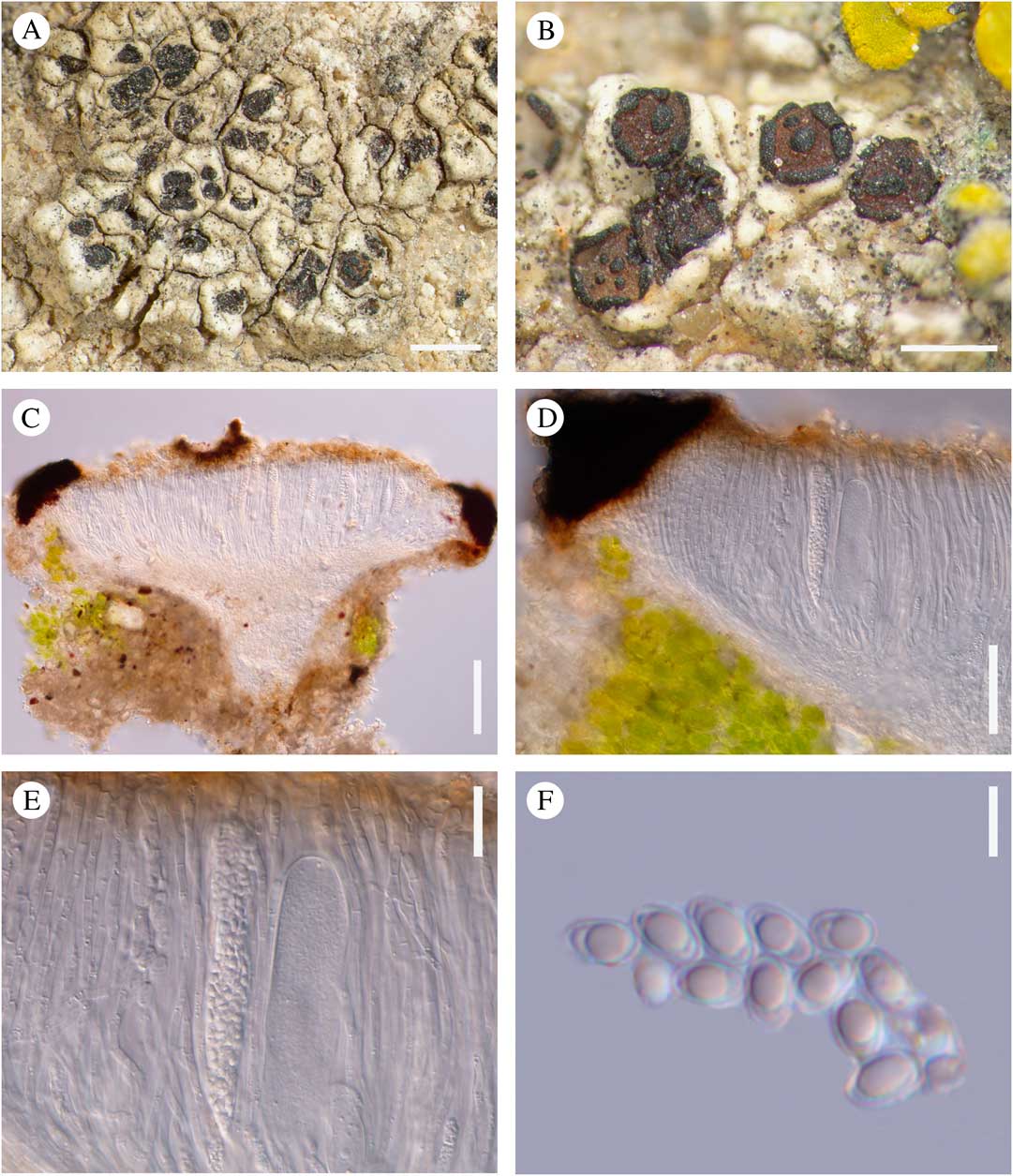
(Fig. 2)
Sarcogyne albothallina, Wheeler 3582 (holotype, UCR); A, thallus habit; B, apothecia with accretions; C, thin section of apothecium with tall hypothecium; D, hymenium and algal layer below hypothecium; E, asci and poorly branched paraphyses; F, ascospores. Scales: A=1 mm; B=0·5 mm; C=100 µm; D=50 µm; E=20 µm; F=5 µm. In colour online.
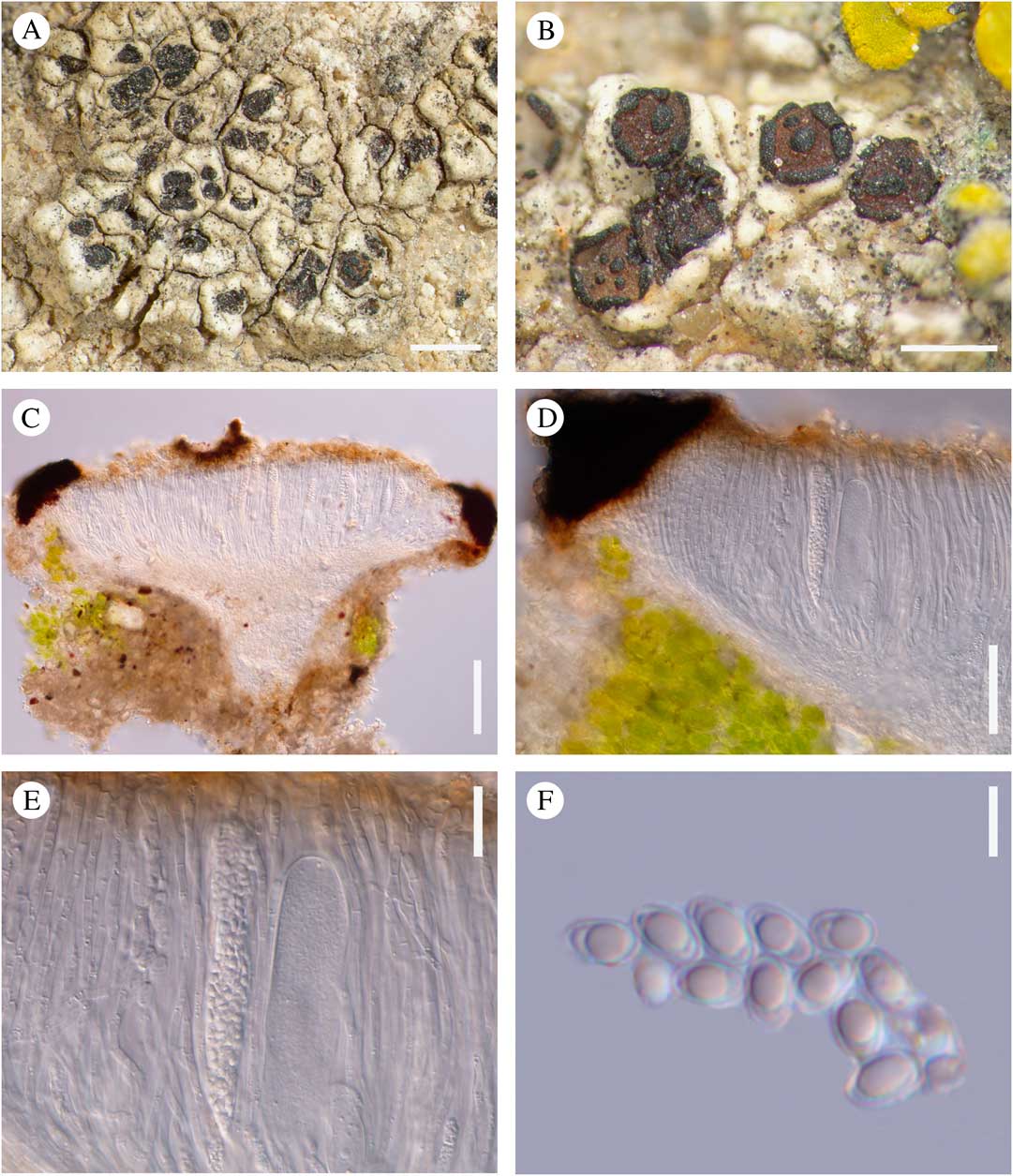
Hypothallus endosubstratal, IKI−, continuous with medullary hyphae. Thallus rimose to rimose areolate, replicating by the division of areoles, non-determinate, up to 3 cm diam. Areoles white, epruinose, mostly round, usually 1 mm diam., 0·3–0·5 mm thick, with a single apothecium. Upper surface not farinose, 30–40 μm thick, obscure in water, an unstratified gelatinized matrix of anticlinal branching hyphae, thin-walled and 2–3 μm wide; cells 4–5 μm long, mixed with dead algal cells and abundant crystals, up to 2 μm thick, only partially dissolving in K and HCl. Algal layer not continuous, uneven, 30–40 μm thick, algal cells chlorococcoid, mostly 10 μm diam. Medulla obscure, c. 200 μm tall, inspersed with large crystals not dissolving in HCl, of anticlinal and branching hyphae, continuous with the attaching hyphae and the hyphae in the upper gelatinized layer.
Apothecia one per areole (rarely 2–4), black, lecideine, round with thin margin, immature disc plane and epruinose, mature disc rugulose with carbonized accretions, 0·5–1·0 mm diam. Carbonized accretions of melanin 10–40 μm tall, with scattered areas of non-melanized disc, blackish red. Parathecium of radiating hyphae 1–2 μm wide, expanding around the disc 80–100 μm wide, outer layer carbonized, inner layer hyaline. Epihymenium 10 μm tall, reddish brown. Paraphyses 1·5–2·5 μm wide, sparingly branched, apices expanded up to 4 µm. Hymenium 80–100 μm, hemiamyloid. Asci cylindrical to narrowly clavate, 60–70×10–20 μm, tholus non-amyloid, c. 100 ascospores per ascus. Ascospores simple, hyaline, 6·0–7·5×3–4 μm, broadly ellipsoid. Subhymenium 40–50 μm, IKI+ blue, amyloid. Hypothecium 10 μm tall, narrow hyphae, 1–2 μm wide.
Pycnidia not observed.
Chemistry. 4-O-methylhiascic acid in trace amounts. Spot tests negative in several samples tested with C and KC. All samples tested were from the holotype.
Distribution and ecology. Sarcogyne albothallina is currently known from three localities along the Upper Missouri River Breaks in Central Montana. A population was observed within a kilometre of the type locality. It was collected a second time 100 km upriver from the type locality. At the first two localities it was found growing on the top flat surface of HCl+ sandstone hoodoos (a tall spire of rock). At the third locality it was found growing on an HCl+ sandstone conglomerate cobble weathering out from glacial till on a coulee slope. All three sites were dry, at low elevation and windy, and the lichen communities were strongly influenced by the surrounding gypsiferous soils.
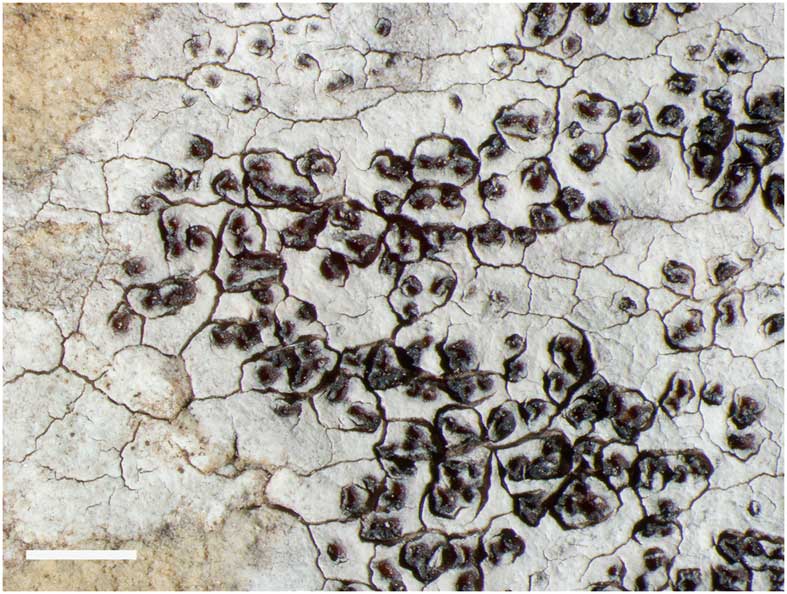
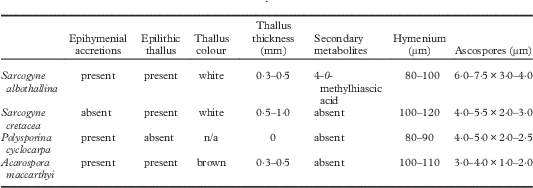
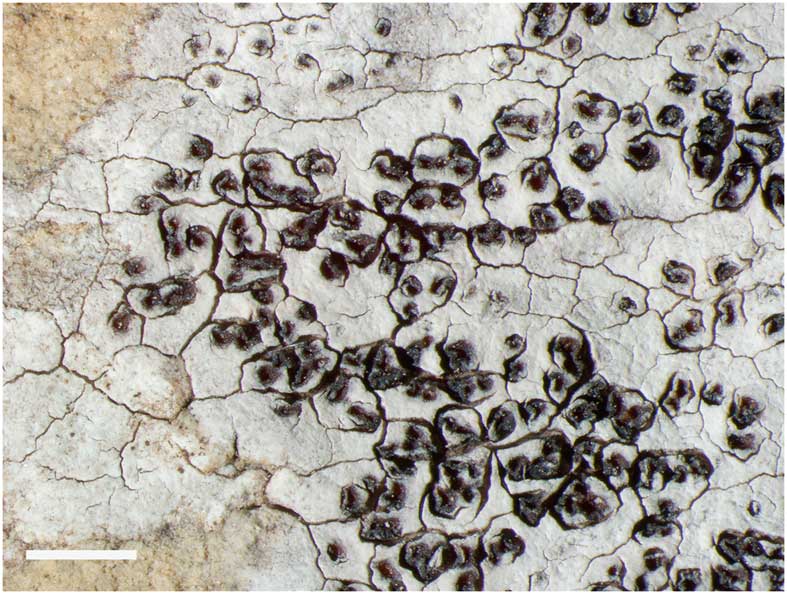
Notes. Sarcogyne albothallina (Table 2) is closely related to Polysporina cyclocarpa and P. subfuscescens in a strongly supported clade that is weakly supported as sister to the rest of Sarcogyne (see Polysporina sp. 1 in the phylogeny of Westberg et al. Reference Westberg, Millanes, Knudsen and Wedin2015a ). Both species are calciphiles and have discs covered with carbonized epihymenial accretions (Knudsen & Kocourková Reference Knudsen and Kocourková2009). Polysporina cyclocarpa has an endolithic thallus and does not produce secondary metabolites, while S. albothallina has a thick (0·5 mm) white non-farinose thallus and produces 4-O-methylhiascic acid. Eight other species of Sarcogyne have thin (0·1–0·3 mm thick) white or dun-coloured thalli, including two from North America, S. arenosa (Herre) K. Knudsen & Standley and S. magnussonii B. de Lesd. (Knudsen et al. Reference Knudsen, Halıcı and Kocakaya2009; Knudsen & Kocourková Reference Knudsen and Kocourková2012). All of these species have apothecial discs without carbonized epihymenial accretions and do not produce secondary metabolites. The calciphile S. cretacea Poelt (Fig. 3) from the Alps in Europe has a non-farinose white thallus like the thallus in S. albothallina, but it differs especially in having immersed apothecia without carbonized epihymenial accretions, shorter ascospores, and in not producing any secondary metabolites (Poelt Reference Poelt1964). The recently described A. maccarthyi K. Knudsen & Kocourk. from eastern Canada differs in having reddish brown epihymenial accretions on an immersed disc and a dull brown thallus with a stratified cortex, and it is the only other species with an epilithic thallus as thick as S. albothallina in North America (Knudsen & Kocourková Reference Knudsen and Kocourková2015).
Sarcogyne cretacea, Poelt s. n. (GZU); thallus habit. Scale=1 mm. In colour online.
Summary of the characteristics which distinghish Sarcogyne albothallina from similar species
Additional specimens examined. USA: Montana: Chouteau Co., same date and locality as type, T. Wheeler 3583 (S); Carter Ferry, 47°45'15·30''N, 110°54'33·59''W, 884 m, on sandstone conglomerate cobble, 2012, T. Wheeler 3908 (hb. Wheeler).
Selected specimen used for comparison: Sarcogyne cretacea Poelt (Fig. 3). Austria: Lechtaler Alpen, Felsrigel am Wege südlich der Simmshütte im Suzltal bei Stockach, auf nordseitigen Dachflächen, Kieselkalk, 2100 m, 13 vii 1966, J. Poelt s. n. (GZU).
Discussion
A global key to the Acarosporaceae that have carbonized epihymenial accretions is premature at present as the European research group led by M. Westberg (UPS) is currently revising the taxa previously described in Polysporina. Nonetheless, the two new species are easily distinguished from other species still included in Polysporina. The black hypothecium of Acarospora brodoana is unique among all other described species of Polysporina. The thick white thallus of Sarcogyne albothallina that produces 4-O-methylhiascic acid is also unique among all other described species of Polysporina. Thus in the new key to Polysporina and Sarcogyne in North America (Brodo Reference Brodo2016), the two recently described species would need new couplets, one for a black hypothecium, and another for a species with an epilithic white thallus which produces long ascospores and 4-O-methylhiascic acid in low levels.
Currently 91 species of Acarosporaceae are reported from North America north of Mexico (Esslinger Reference Esslinger2015; Knudsen & Kocourková Reference Knudsen and Kocourková2015). The two newly described species bring the total to 93 and we are still in the process of monographing the family for North America. As we write, we have seen several collections of Myriospora new for North America that have not been reported yet by their collectors, and at least six taxa from Alaska, Colorado, Montana, the Pacific North-West and Texas that appear to be new to science and need further study. The diversity of the Acarosporaceae in North America south of the United States in Mexico is poorly known and new taxa and range extensions should be expected. The total diversity of the family for the whole of North America is an intriguing unknown.
We thank our anonymous reviewers, and also J. C. Lendemer (NYBG) and Walter Obermayer (GZU) for their assistance. The work of Jana Kocourková and Kerry Knudsen was financially supported by the grant ‘Environmental aspects of sustainable development of society’ 42900/1312/3166 from the Faculty of Environmental Sciences, Czech University of Life Sciences, Prague. Kerry Knudsen thanks Scott Eliason, the US Forest Service, and the Southern California Mountains Foundation for supporting fieldwork in the San Bernardino National Forest. Martin Westberg was financed by the Swedish Taxonomy Initiative administered by the Swedish Species Information Centre (ArtDatabanken).