Introduction
Agriculture has historically met global demand for food (Tilman et al., Reference Tilman, Balzer, Hill and Befort2011). However, future prospects are uncertain as climate change and natural resource exhaustion make feeding the world more challenging (Valin et al., Reference Valin, Sands, van der Mensbrugghe, Nelson, Ahammad, Blanc, Bodirsky, Fujimori, Hasegawa, Havlik, Heyhoe, Kyle, Mason-D'Croz, Paltsev, Rolinski, Tabeau, van Meijl, von Lampe and Willenbockel2014). In this context, Brazil needs to address the challenge of balancing natural resource conservation with agricultural production and expansion. Brazil has the world's largest tropical forest reserve, water resources and biodiversity (VanWey et al., Reference VanWey, Spera, de Sa, Mahr and Mustard2013) and significant potential for the production of beef, feed, food, fiber and fuel (Moreira et al., Reference Moreira, Kureski and Pereira Da Veiga2016).
The Legal Amazon covers 522 million hectares with 61% in Brazil (Sudam, 2018). Due to low cost of land and labor, and favorable soil and climate, Amazon beef production has expanded (Nepstad et al., Reference Nepstad, Stickler and Almeida2006; Martha Júnior et al., Reference Júnior GB, Alves and Contini2012). Amazon livestock production has been characterized by low investments in technologies, facilities, management and feed supplementation, but guaranteed possession of large tracts of land during initial settlement (Garcia et al., Reference Garcia, Filho, Mallmann and Fonseca2017). Legal Amazon beef cattle expansion raises issues and challenges for Brazilian agribusiness (Ruviaro et al., Reference Ruviaro, Barcellos and Dewes2014) to increase commodity market revenues while reducing environmental impacts from agricultural production (Strassburg et al., Reference Strassburg, Latawiec, Barioni, Nobre, da Silva, Valentim, Vianna and Assad2014; Cordeiro et al., Reference Cordeiro, Vilela, Marchão, Kluthcouski and Júnior2015; Bergier et al., Reference Bergier, Souza Silva, De Abreu, De Oliveira, Tomazi, Teixeira Dias, Urbanetz, Nogueira and Borges-Silva2019).
Since 2004, Brazil's commercial cattle herd has been the largest in the world and Mato Grosso state is Brazil's beef industry leader (Rosales, Reference Rosales2006) and a major international supplier of beef at 6.8% of the state's total exports (AGROSTAT, 2018). According to IBGE (2017), Mato Grosso's cattle herd of 24.12 million animals was largest among Brazil's states at 17% of national production. Beef cattle (Bos indicus, Nelore breed) have contributed significantly to the economic growth of the region, however deforestation, commodity row crops, and poorly managed pastures generate greenhouse gas (GHG) (CO2, N2O, CH4) emissions (Göpel et al., Reference Göpel, Schüngel, Schaldach, Meurer, Jungkunst, Franko, Boy, Strey, Strey, Guggenberger, Hampf and Parker2018), impact water, soil and air quality, and accelerate biodiversity loss and climate change (Tilman et al., Reference Tilman, Balzer, Hill and Befort2011).
About 28% of Legal Amazon deforestation in Brazil has occurred in Mato Grosso state with 142,714 km2 of forest lost between 2004 and 2017 (Sudam, 2018). Over the past several years, Brazil's government has established rules and limits to ensure the preservation of the Amazon (Assunção et al., Reference Assunção, Gandour and Rocha2015). Initiatives from government, private institutions such as trading companies and slaughterhouses, and farmers investing in technologies to increase productivity all have contributed to more sustainable production (le Polain de Waroux et al., Reference Le Polain de Waroux, Garrett, Graesser, Nolte, White and Lambin2017).
The Brazilian Agricultural Research Company (Embrapa) and the Low Carbon Agriculture Program have encouraged reducing deforestation via sustainable beef intensification using degraded pasture recovery, crop–livestock–forest integration (CLFI), no-tillage, biological nitrogen fixing cover crops, reforestation and manure management (Amaral et al., Reference Amaral, Cordeiro and Galerani2012). Such intensification reduces GHG emissions using grain supplementation (Florindo et al., Reference Florindo, de Medeiros Florindo, Talamini, da Costa and Ruviaro2017a; Reference Florindo, Florindo, Talamini and Ruviaro2017b), pasture improvement (Dick et al., Reference Dick, Da Silva and Dewes2015a; Reference Dick, Da Silva and Dewes2015b), sequestering carbon in commercial CLFI timber (De Figueiredo et al., Reference De Figueiredo, Jayasundara, de Oliveira Bordonal, Berchielli, Reis, Wagner-Riddle and La Scala2017), and rotational grazing (Palermo et al., Reference Palermo, de d'Avignon and Freitas2014; Dick et al., Reference Dick, Da Silva and Dewes2015a). Brazil has recently committed to reducing 36% of its GHG emissions by 2020 and the livestock sector is one of its main targets (Mazzetto et al., Reference Mazzetto, Feigl, Schils, Cerri and Cerri2015).
We hypothesize sustainable agricultural intensification (SAI) of Brazil's beef cattle production system can increase beef production and profitability. However, SAI practices need to be practical to be adopted by farmers. Therefore, our study evaluates the economics of a cooperating farm in Mato Grosso's Amazon biome that recently transitioned over 3 years from an extensive grazing system (industry status quo) to using five SAI practices, including grain supplementation for cattle, pasture fertilization, pasture re-seeding, crop–livestock integration (CLI) and irrigated and fertilized pasture that is rotationally grazed. Our specific research objectives are to (1) evaluate the transition from extensive to more sustainable beef cattle systems on our case study farm in Brazil's Amazon and (2) to compare the relative costs of the five SAI strategies used on this cooperating farm.
Methods
Case study justification and background
The case study of a representative entity from a broader population allows for in-depth knowledge acquisition and general comprehension. Case studies can lay the groundwork for further, more representatively accurate research (Gillham, Reference Gillham2010), especially where the selected case facilitates enough knowledge contribution to be framed as an ideal type (Godoy, Reference Godoy1995; Camelo et al., Reference Camelo, Marques, Roque, Vieira and Bellido2017). We conducted in-depth agronomic and economic data collection over three production years (2015–16 to 2017–18) on and from our case study beef cattle farm and farmers in northwestern Mato Grosso state's Amazon biome. This farm is classified as a large-scale commercial producer with a comprehensive production system (INCRA, 2013). Our case study farm is the most dynamic and complex for meat production in this eco-region because of its management technologies and practices, such as cattle genetics and breeding.
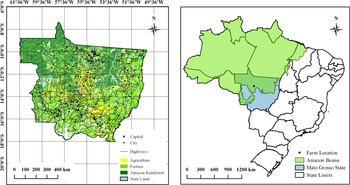
Our cooperating beef farm (Fig. 1) has made recent investments in order to adopt SAI practices to improve productivity and profitability. The technologies adopted are being disseminated to the farmer's community, encouraging other farmers to intensify their production. The dynamism of the region triggered government investments in road paving and railroad construction reducing transportation costs and increasing the competitiveness of the agricultural sector. Our cooperating farm is associated with the Universidade Federal de Mato Grosso's agricultural extension, affiliated researchers, and undergraduate and graduate students.
Location of the cooperating farm in Amazon biome, Mato Grosso, Brazil (IBGE, 2014).

Cooperating Amazon beef cattle farm data collection
Background information for the farm is summarized in Table 1. The data for this study were collected monthly from July 2015 to June 2018, including land use, resource inventories, predominant soil characteristics (fertility, type and slope), crop and pasture management including fertilizer application rates, dates and number of operations such as tillage, grazing period and pasture quality. Animal and feeding data included cattle type, breed, numbers and management plus facilities, labor for animal handling and annual livestock costs. Weather data (solar radiation, precipitation, minimum and maximum temperature) were also collected from a weather station set up on-farm (Supplementary Materials, Table S1). The farm operates a full-cycle system where Nelore and Aberdeen Angus cattle are industrial crossbred to raise future replacements. Beef cattle diet is pasture-based with supplemental minerals. Some stocker and fatting phase groups are fed with grain supplements composed of corn grain, soybean meal and minerals.
Precipitation, land use and cattle herd and feeding for cooperating farm in Mato Grosso, Brazil's Amazon biome

a Percentage of legal forest reserve did not change since additional crop land was rented in the third year.
b About 84% of the pasture area has Brachiaria spp. while 16% has Panicum spp.
c The predominant soil is the dystrophic red-yellow latosol (DRYL), but also part of the farmland has quartzarenic neosol (QN).
d Irrigation system was used in a separate rotational grazing area during the dry season only, May to September.
e Grain feed supplementation of only stockers and finishing cattle of soybean and corn meal, cottonseed and minerals. Daily feed in kg of dry matter (DM).
f Pasture intake estimated at 2% of cattle live weight.
g Silage was fed only to finishing cattle.
SAI improvements were made using grain supplementation for cattle, pasture fertilization and re-seeding, integration of livestock with cash crops such as soybeans and rice, and irrigated, fertilized and rotationally grazed pasture with the goal to improve production efficiency and profitability. Information related to timing of fertilizer application, fertilizer types, quantities of nutrients applied and application methods are summarized in Supplementary Materials, Table S2.
Grain supplementation of soybean and corn meal, cottonseed and minerals were only fed to stockers and finishing cattle. Cattle diets changed during different periods of the year due to the quality of the pasture. Concentrated feed supplements and minerals were fed in separate plastic bins and were openly available in pastures and re-filled once a week.
Two SAI practices involved pasture improvements. First, pastures were fertilized with 100 kg ha−1 urea (45% nitrogen) applied by rear-mounted fertilizer disk spreaders during the rainy season (October–March). Second, pasture re-seeding involved desiccating degraded pasture using glyphosate and 2,4-dichlorophenoxyacetic acid (2,4-D). Lime was then applied (1.5 metric tons ha−1) with 120 kg ha−1 nitrogen, phosphorus and potassium (6-30-6) and then incorporated with a harrow. This was followed by sowing the tropical pasture grass, Brachiaria brizantha cv. Marandú, using a seed spreader which was then disked to incorporate seed.
Integration of crop–livestock was another practice used to improve pasture in the long run. Here soybeans were no-till cropped in degraded pasture areas. Grass was desiccated in the whole area using glyphosate and 2,4-D after applying lime (1.5 metric tons ha−1). Soybeans were no-till seeded with fertilizer (7-37-6 NPK, 300 kg ha−1), and then top dressed with KCl (150 kg ha−1) plus micronutrients. After soybeans were harvested in February, tropical pasture grass, Brachiaria ruziziensis, was sown using rear-mounted disk spreaders.
Irrigated, rotationally grazed and fertilized pasture was used during the dry season (April–September) for replacement heifers, stockers and finishing cattle. Irrigation involved water application of 10 mm daily, with water application efficiencies for surface irrigation ranging from 60 to 80%. Irrigated pasture paddocks for beef cattle were also fertilized using the same procedures as for CLI. The cattle were rotationally grazed depending on the height of the pasture, typically moved around twice a week in 15 rotational modules.
Economic evaluation
Economic data including production costs were collected directly from the farm owner and managers. We analyzed the technical and economic indicators using Microsoft Excel® spreadsheets. Capital, sales, cattle and crop inventories, and production processes were also analyzed for the entire production system. Our economic survey methods and types of data collected are diagramed in Figure 2.
Schematic diagram of data collection and processing for cooperating farm in Mato Grosso, Brazil's Amazon biome.

Whole-farm budgets included production costs subtracted from farm revenues (beef, cattle and other sales) to derive returns over variable costs (VC) (short-run accounting profit) and net farm income (long-run accounting profit). Whole-farm budgets were also calculated subtracting all revenues and expenses related to commodity crop (soybeans, rice) production in order to better isolate whole-farm impacts of SAI vs shifting from rice to soybean production from 2015–16 to 2017–18. In order to calculate farm profitability, production costs must be meticulously calculated (CONAB, 2018) to verify if resources used for production are being adequately paid.
Cost analysis is fundamental to good management, identifying strengths and weaknesses of farm activities to guide better decision making. The cooperating farm's data over all three production years was analyzed by cost center (Table 2), based on comprehensive cost analysis methodology of Matsunaga et al. (Reference Matsunaga, Bemelmans, de Toledo, Dulley, Okawa and Pedroso1976). Each production year was defined running from July 1st from June 31st for the Southern Hemisphere agricultural year. Data collected underwent a consistency analysis, which verified economic data accuracy. Total costs (TC) equal VC plus fixed costs (FC). VC include labor, maintenance of pastures and crops, seed, fertilizer, pesticides, fuel, feed (supplements, minerals), vaccines, medicine, land rent and bank interest on operating loans to finance variable expenses.
Methodology for calculating accounting budget line items used to analyze the agricultural production system of the cooperating farm in Mato Grosso, Brazil's Amazon biome

a TR (total revenue) consists of annual revenue of animals and crops sold, and other revenue such as sale of semen and machinery & equipment.
b In the methodology used to calculate the cost of production we use salvage value equal to zero, in order to reduce the subjectivity at the time of the calculations of depreciation and opportunity cost.
c Interest rates of 6% is used for the calculation of the opportunity cost of the capital invested in the activity, which is equivalent to the savings interest.
VC need to be covered by farm revenues in the short run, else the farm may go out of business. If FC are not covered in the long run, capital cannot be adequately replaced. VC vary annually with the level of farm production, while FC does not. FC includes equipment depreciation over useful life of capital such as machinery and farm implements (15 years) and structures (20 years), depreciation on non-annual crops and breeding stock, and service animals used for production. Remuneration of fixed capital investment is not included in depreciation (Sartorello et al., Reference Sartorello, Bastos and Gameiro2018).
Total adjusted costs (TAC) equal TC plus remuneration (i.e., 6% interest) that could be earned on fixed capital investments. The percentage of interest is based on Brazilian savings and this reference percentage is the minimum used to judge whether livestock is economically viable. TAC consider the opportunity cost of all capital invested in the business, including both explicit and implicit costs. This better captures the values that the factors of production (machines, implements, improvements, animals and non-annual crops) would generate if used for alternative investments other than farming. Net profit (NP) was calculated as TR minus TAC. Three returns over investment (ROI) measures were also calculated by dividing each profitability measure (ROVC, NFI, NP) by total capital invested (TCI). TCI required to operate the farm include the total value of capital improvements and equipment, as well as pasture establishment costs spent during the first year of an assumed 15-year stand life before re-seeding.
Partial budgets were calculated for each SAI practice. The TC of each SAI practice was divided by the total cooperating farm area that was devoted to each practice. Economic values in Brazilian reals (R$) were converted to US dollars (US$) using the exchange rate on June 4th, 2018 (Banco Central, US$1 = R$3.76). Adoption of SAI practices is expected to diversify and/or increase crop and/or beef yields and profitability measures.
Results
Beef and crop productivity
Beef yield and average daily gain (ADG), cattle stocking density and crop yields are summarized in Table 3. Beef cattle productivity (kg animals sold per ha) was 228 kg ha−1 during the first (2015–16) year. Productivity was highest in the second year (2016–17) at 257 kg ha−1 but was 6.7% lower in the third year third (2017–18) at 241 kg ha−1. ADG of finishing cattle (kg per animal per day) increased steadily (0.476 to 0.511 to 0.531). Herd numbers were highest in 2015–16, which when combined with lower average precipitation and high average temperatures (Supplementary Materials, Table S1), resulted in pasture degradation. Thus, more land was rented in 2016–17 to lower cattle stocking density and silage was purchased to feed animals. Beef productivity increased in 2016–17 and 2017–18, despite herd reductions of 12 and 6% respectively.
Beef cattle and crop productivity (2015–18) for cooperating farm in Mato Grosso, Brazil's Amazon

a Live-weight (kg) of animal sold per hectare.
b ADG calculated as typical live weight (kg) per animal divided by average days at slaughter.
c One AEU (animal unit equivalent) equals 1000 kg of animal live weight.
There was a 26% reduction in rice yields between the first and second years due to late control of a fungal (Pyricularia oryzae) pathogen (Koutroubas et al., Reference Koutroubas, Katsantonis, Ntanos and Lupotto2009). The cooperating farm's average rice yield was 14.9% higher than the Brazilian national average in the first year, yet 7.9% lower in the second year (CONAB, 2018). Soybean yields decreased 13% between the second and third years. In the second year, soybeans were planted in areas previously cultivated with rice, while most soybean areas in the third year were degraded pastures with low soil quality. Also in the third year, some soybean planting was late which reduced yield. The farm's average soybean yield was 28.2 and 35.9% lower in second and third years respectively compared to Brazil's national average for this crop in these years (CONAB, 2018).
Economics of cooperating farm
Economic whole-farm budgets from all crop years are contrasted (Table 4; Supplementary Materials, Tables S3 and S4), showing results per hectare and per head (of all animals). Revenues from crop sales were not enough to initially cover both fixed and variable expenses in the first year after SAI adoption. However after the second and third years, short-run (returns over VC) and long-run (net farm income or NFI) profits were positive. NFI improved from negative returns to positive profitability in the third crop year (US$29.79 ha−1, US$19.07 head−1). NP in the third crop year was 71.2% greater than the first crop year due to only a slight reduction in VC (3.34%) combined with a 59.8% increase in total revenue.
Economic whole-farm budgets for the cooperating farm (2015–2018) in Mato Grosso, Brazil's Amazon

Economic results adjusted for livestock production alone without crops (soybeans, rice) were consistent with combined livestock production with these crops albeit with faster pay back (Supplementary Materials, Tables S5 and S6). Adding both of these crops increased TAC 9.9% in the first year, 18.5% in the second year and 21.8% in the third year. Production costs were highest for labor (~25%) followed by crop expenses (~13%) and grain fed (~7%). In all three years, the opportunity cost of capital remuneration was not covered resulting in negative values for NP (Table 4). TCI ranged from US$1747 to $1875 ha−1 with long-run return (NFI) over investment turning positive (1.59%) by the third year (Table 5).
Capital investment and economic ROI indicators for the cooperating farm (2015–2018) in Mato Grosso, Brazil's Amazon

Economics of sustainable agricultural intensification practices
The variable and TC per hectare of SAI practices are ranked in Table 6. The least expensive SAI practice was grain supplementation (US$187 ha−1), followed by pasture fertilization (US$476 ha−1) and pasture re-seeding (US$649 ha−1). The most costly practice was irrigation (US$1600 ha−1), followed by CLI (US$672 ha−1). The main cost component is labor making up 23.1 to 25.35% of TAC (Supplementary Materials, Table S4). Labor was followed by crop expenses for CLI (up to 14.6% of TAC) and grain feed for grain supplementation (up to 9% of TAC).
Sustainable intensification practices and ecological intensification practice variable fixed and TC per hectare for cooperating farm in Mato Grosso, Brazil's Amazon

a Only stockers and finishing animals are fed supplemental feed, comprising 48% of the herd.
b Maintenance includes machinery and equipment repairs and improvements.
cAgricultural and farm land not included in FC due to variable values per hectare.
Discussion
Whole-farm sustainable agricultural intensification transition
Beef cattle productivity (kg animals sold per ha) and ADG for our cooperating farm using all five SAI practices were either higher or lower compared to prior studies focusing on just one of these five practices (Supplementary Materials, Table S7). For example, our 11.5% ADG increase from 0.476 to 0.531 kg per animal per day over 3 years was within ADG range of 0.25 to 0.6 kg per animal per day estimated for grain supplementation (Tonello et al., Reference Tonello, Branco, Tsutsumi, Ribeiro, Coneglian and Castañeda2011; Fernandes et al., Reference Fernandes, de Almeida, Carvalho, Neto, Mota, de Resende and Siqueira2016; Guerra et al., Reference Guerra, Mizubuti, De Azambuja Ribeiro, Prado-Calixto, Das Dores Ferreira Da Silva, Pereira, Massaro, Guerra, Fernandes and Henz2016) and ADG range of 0.26 to 1 kg per animal per day for pasture improvements (Supplementary Materials, Table S7). However, the ADG on our cooperating farm was lower than 0.581 kg per animal per day for Angus cattle in southern Brazil grazed on fertilized pasture (Ferreira et al., Reference Ferreira, Nabinger, Elejalde, de Freitas, Carassai and Schmitt2011) and lower than 0.75 to 0.81 kg per animal per day for CLI (Salton et al., Reference Salton, Mercante, Tomazi, Zanatta, Concenço, Silva and Retore2014).
Improved profitability of our cooperating beef farm during transition to SAI is supported by Strassburg et al. (Reference Strassburg, Latawiec, Barioni, Nobre, da Silva, Valentim, Vianna and Assad2014) who highlight adoption of SAI practices and technologies should increase beef production profitability while also limiting frontier development deforestation and other associated environmental impacts, though see Merry and Soares-Filho (Reference Merry and Soares-Filho2017). Economic results were consistent with several prior studies evaluating implementation of only one or two SAI strategies (Supplementary Materials, Table S7). Prior studies have not contrasted relative costs of all five SAI practices adopted by our cooperating farm.
Improvement in our cooperating farm's beef production may be due to increased average weight gain of cattle as well as herd composition changes (Table 1). In the first year, animals were not fed supplements such as grain, which is a typical management strategy for beef cattle in Brazil (Ferraz and Felício, Reference Ferraz and Felício2010). Bad weather conditions in 2015–16 (Supplementary Materials, Table S1) resulted in low grass productivity and consequently restricted feed availability. This was compensated over the next 2 years by high-energy intake and high-quality pastures to avoid compromising the compensation capacity of cattle (Creighton et al., Reference Creighton, Wilson, Klopfenstein and Adams2003).
The cooperating farm's stocking rate in 2015–16 (0.80 AEU ha−1) was greater than the pasture's carrying capacity (0.54 AEU ha−1), resulting in overgrazing, low plant vigor and pasture degradation (Lorena Pedrosa, unpublished data; da Silva et al., Reference Da Silva, de Moraes, Carvalho, da Fonseca and Dias2012). Pasture management entails adjusting animal numbers per hectare (i.e. lower stocking density to reduce grazing pressure), which can improve pasture regrowth and seed production (Cardoso et al., Reference Cardoso, Brito, Janusckiewicz, Morgado, Barbero, Koscheck, Reis and Ruggieri2017). Animals can also be removed at strategic times to ensure forage species resilience (Pereira et al., Reference Pereira, Augusto, Agostini, Lima, Silva and Santos2013).
In order to recover degraded pasture and improve soil quality, our cooperating farm integrated grazed areas with annual crops such as rice and soybeans. Historically, rice enables cultivation even in areas with lower soil quality (Pinheiro et al., Reference Pinheiro, Castro and Guimarães2006). In the future, farm productivity may be further enhanced as some soil quality measures were improved with the addition of annual crops such as rice and soybeans. Soil pH remained in an ideal range (4.6–5.4) which neutralized aluminum saturation and increased base saturation. However, soil disturbance during soybean and rice production decreased organic matter content (Supplementary Materials, Table S8).
Contrasting costs of sustainable agricultural intensification practices
CLI (US$672 ha−1) and irrigation of rotationally grazed pasture (US$1600 ha−1) are the most expensive practices (Table 6) and may not be as practical for adoption by Brazilian beef cattle farmers. For example, only 1.5% of pasture and cropland is integrated in Mato Grosso (Gil et al., Reference Gil, Siebold and Berger2015). Our results are in line with Peres et al. (Reference Peres, Chabaribery, Justo, Coutinho Filho, Mendes and Oliveira2014) and Martha Júnior et al. (Reference Martha Júnior, Alves and Contini2011) showing that production costs can increase with CLI adoption, deferring economic benefits to the medium and long term. CLI has been demonstrated to be more profitable than extensive pasture and competitive with soybeans (Martha Júnior et al., Reference Martha Júnior, Alves and Contini2011; Gil et al., Reference Gil, Garrett, Rotz, Daioglou, Valentim, Pires, Costa, Lopes and Reis2018). Although irrigated pasture is less prevalent in Brazil, irrigation has great potential to increase pasture yields by 25 to 52% (Antoniel et al., Reference Antoniel, do Prado, Tinos, Beltrame, de Almeida and Cuco2016). Our estimated annual cost of $1600 ha−1 for in-ground irrigation for permanently-fenced rotational grazing was higher than Soares et al. (Reference Soares, Barcellos, Queiroz Filho, Oaigen, Canozzi, Camargo, Drumond and Braccini Neto2015) who estimated US$930 to US$1201 ha−1 for pastures irrigated using center-pivot. This was due to higher labor costs of rotating cattle between paddocks (Table 6).
Our cost estimates (Table 6) for grain supplementation, pasture fertilization and pasture re-seeding that were less costly were somewhat consistent with estimates from past studies. Our grain supplementation cost of US$162 ha−1 was higher than US$22 ha−1 (Pereira et al., Reference Pereira, Patino, Hoshide, Abreu, Alan Rotz and Nabinger2018) and US$68 ha−1 (Florindo et al., Reference Florindo, de Medeiros Florindo, Talamini, da Costa and Ruviaro2017a), but lower than US$325 to US$332 ha−1 (Ruviaro et al., Reference Ruviaro, da Costa, Florindo, Rodrigues, Bom de Medeiros and Vasconcelos2016). It was also more expensive than pasturing cattle on soybean crop residues (US$124 ha−1, Pashaei Kamali et al., Reference Pashaei Kamali, van der Linden, Meuwissen, Malafaia, Oude Lansink and de Boer2016). Our pasture fertilization cost of US$463 ha−1 was between US$437 ha−1 calculated by Santana et al. (Reference Santana, Barbosa, de Andrade, Molina, Filho and Leão2016) and US$494 ha−1 from De Oliveira Silva et al. (Reference De Oliveira Silva, Barioni, Pellegrino and Moran2018). Our pasture re-seeding cost of US$639 ha−1 falls within the ranges of (1) US$410 to $2180 ha−1 estimated by Zu Ermgassen et al. (Reference Zu Ermgassen, de Alcântara, Balmford, Barioni, Neto, Bettarello, de Brito, Carrero, de Florence, Garcia, Gonçalves, da Luz, Mallman, Strassburg, Valentim and Latawiec2018) and (2) US$619 to $1335 ha−1 calculated by Garcia et al. (Reference Garcia, Filho, Mallmann and Fonseca2017), though is greater than US$99 to $510 ha−1 from De Oliveira Silva et al. (Reference De Oliveira Silva, Barioni, Hall, Moretti, Fonseca Veloso, Alexander, Crespolini and Moran2017).
Adoption challenges for sustainable agricultural intensification
Brazilian beef cattle producers are less likely to invest in the SAI practices we evaluated due to scarcity of labor required for improved techniques as well as financial constraints (Latawiec et al., Reference Latawiec, Strassburg, Silva, Alves-Pinto, Feltran-Barbieri, Castro, Iribarrem, Rangel, Kalif, Gardner and Beduschi2017). Despite the benefits of SAI practices, the most important challenges for farmers looking to adopt these practices are lack of financial resources (Börner et al., Reference Börner, Mendoza and Vosti2007), lack of skilled workers and technical assistance, as well as cultural preferences and knowledge (Gil et al., Reference Gil, Siebold and Berger2015). Another SAI adoption challenge is training people throughout the beef supply chain, from those who directly deal with livestock management to those working for slaughterhouses (McDermott et al., Reference McDermott, Staal, Freeman, Herrero and Van de Steeg2010).
Irrigated pasture may be limited by high initial capital investment at ~$10,000 ha−1 for center pivot systems (Soares et al., Reference Soares, Barcellos, Queiroz Filho, Oaigen, Canozzi, Camargo, Drumond and Braccini Neto2015) similar to ~$9600 ha−1 for the in-ground system used by our cooperating farm. Such investment may not be financially feasible for many farmers. Irrigation can also put strains on limited water resources (Lathuillière et al., Reference Lathuillière, Coe and Johnson2016), exceeding countries' freshwater availability (Davis et al., Reference Davis, Rulli, Garrassino, Chiarelli, Seveso and D'Odorico2017). Intensive, well-managed rotational grazing, where cattle are systematically moved at appropriate intervals, controls forage height. This improves the efficiency and persistence of pasture preventing overgrazing, erosion and soil compaction. Eaton et al. (Reference Eaton, Santos, do Santos, Lima and Keuroghlian2011) found average weight gain of cattle and pregnancy rates were 15 and 22% higher, respectively, for herds using rotational grazing systems in Brazil. Rotational grazing cattle stocking rates (head ha−1) were two to six times greater than for extensive continuous grazing. However, rotational grazing on either rain-fed or irrigated pasture is management intensive and may not be favored by many producers (Gil et al., Reference Gil, Garrett, Rotz, Daioglou, Valentim, Pires, Costa, Lopes and Reis2018).
Crop revenues are a critical factor to determining the favorability of CLI, since economic favorability of such integration is very sensitive to prices paid to producers (Martha Júnior et al., Reference Martha Júnior, Alves and Contini2011; Peres et al., Reference Peres, Chabaribery, Justo, Coutinho Filho, Mendes and Oliveira2014). Forages in rotation with high-value cash crops need to be of high enough value relative to cash crops to make integration favorable (Hoshide et al., Reference Hoshide, Dalton and Smith2006). Thus CLI should be adopted in regions with agricultural production suitability and stability. CLI has been shown to improve soil physical and chemical properties, increasing pasture fertility, nutrient cycling and fertilizer efficiency, driven by different needs of rotated crops (Debiasi and Franchini, Reference Debiasi and Franchini2012; Beutler et al., Reference Beutler, Pereira, Loss, Perin, Figueira and Silva2016). CLI also increases stability of soil aggregates, soil microbial biomass and diversity, and crop productivity and profitability while reducing economic risk (de Moraes et al., Reference de Moraes, Carvalho, Anghinoni, Lustosa, Costa and Kunrath2014).
CLI economic benefits have been questioned by Brazilian farmers (Gil et al., Reference Gil, Garrett and Berger2016), due to the large financial investment required in diversified agricultural machinery and implements, road infrastructure and storage structures. This complex system also requires producer knowledge of diversified farm enterprises, technology and commodity markets in addition to potential complex contractual arrangements to insure CLI can take place beyond the farm level involving anything from neighboring farms to regional exchanges coordinated by third-party entities (Asai et al., Reference Asai, Moraine, Ryschawy, de Wit, Hoshide and Martin2018). CLI also benefits from higher farmer education levels, technical assistance and proximity to Embrapa CLI experiments (Gil et al., Reference Gil, Garrett and Berger2016).
Pasture improvement via re-seeding requires maintenance fertilization where farmers have adequate training on soil sampling and interpretation of soils analyses to apply optimal amounts of fertilizer (Bogaerts et al., Reference Bogaerts, Cirhigiri, Robinson, Rodkin, Hajjar, Costa Junior and Newton2017). Pasture fertilization is an efficient SAI practice to increase pasture productivity and forage quality by increasing crude protein content (Venturini et al., Reference Venturini, de Menezes, Montagner, Paris, Schmitz and Molinete2017; Oliveira et al., Reference Oliveira, Corte, Silva, Rodriguez, Sakamoto, Pedroso, Tullio and Berndt2018). However, Cardoso et al. (Reference Cardoso, Berndt, Leytem, Alves, de Carvalho, I. das, de Barros Soares, Urquiaga and Boddey2016) showed that once nitrogen (N) fertilizer is applied to pasture, it can increase fossil fuel CO2 and N2O emissions derived from the manufacture and application of N fertilizer which can increase total greenhouse emissions per animal.
Livestock supplementation is the cheapest SAI practice and can increase production quickly but requires more managerial skills related to livestock feed utilization (Clark et al., Reference Clark, Delcurto, Vavra and Dick2018). Weight gain of cattle on tropical pastures is typically low and supplemental feed (e.g. soybeans, corn grain, cottonseed) may be needed to supply limiting nutrients such as crude protein (Detmann et al., Reference Detmann, Valente, Batista and Huhtanen2014). Supplementation should be used according to professional recommendations during more responsive animal growth stages such as stockers and finishing so there is less financial risk (Poppi et al., Reference Poppi, Quigley, Alves Corrêa Carvalho da Silva, McLennan and Brasileira de Zootecnia2018). Inadequate management of low productivity pastures requires supplementation to ensure nutritional balance. This not only improves animal health, but also results in higher productivity (Clark et al., Reference Clark, Delcurto, Vavra and Dick2018) and lower GHG emissions (Pereira et al., Reference Pereira, Patino, Hoshide, Abreu, Alan Rotz and Nabinger2018).
Given optimization of sustainable agricultural systems in Brazil are necessary, investments in rural education and credit lines are currently in progress. The Brazilian Federal Government has earmarked US$53.5 billion to agriculture for the 2018–19 crop-year in addition to US$51.6 billion that will be made available as rural credit. Interest rates were reduced from 7.5 to 5.25% per year for producers adhering to the ABC Plan (Low Carbon Agriculture Plan), for projects that finance the recovery of permanent preservation and legal reserve areas, in line with environmental legislation (Maggi and Vaz de Araújo, Reference Maggi and Vaz de Araújo2018). Investments are also constantly being made in research centers such as Brazil's Federal Universities and Embrapa as well as rural extension programs sponsored by SENAR (National Rural Learning Service) and other institutions.
These investments have allowed livestock to achieve gains in productivity and also contributed to the growth of agriculture, with emphasis on soybeans (Barros, 2014). Productivity improvements to the whole-farm beef production system are essential to reduce GHG emissions from all relevant sources (Crosson et al., Reference Crosson, Shalloo, Brien, Lanigan, Foley, Boland and Kenny2011). Brazil has recently committed to reduce GHG emissions 36% by 2020 and the livestock sector is one of the main focal industries for such reductions via intensification (Mazzetto et al., Reference Mazzetto, Feigl, Schils, Cerri and Cerri2015). Lathuillière et al. (Reference Lathuillière, Coe, Castanho, Graesser and Johnson2018) reported a decline in pasture area from 2000 to 2014, which when combined with increasing cattle population, led to an increase in cattle stocking density in Mato Grosso state: 0.57 head ha−1 in 2001 compared to 0.97 head ha−1 in 2015. Despite recent improvements in beef system intensification, productivity of Brazil's pastures is only 32 to 34% of its potential. Increasing productivity to 49 to 52% of its potential would meet forage demands until at least 2040, without the need to increase area (Strassburg et al., Reference Strassburg, Latawiec, Barioni, Nobre, da Silva, Valentim, Vianna and Assad2014). Intensification can increase farm revenue 62% and live weight gains 20%, thus reducing the time before cattle are slaughtered (Cepea/Esalq, 2012).
The SAI practices adopted by our cooperating farm can improve productivity and profitability while reducing beef's carbon footprint (Supplementary Materials, Table S7). While these practices are being disseminated locally, other farmers may not be able make such investments. In order to ensure that Brazil's livestock industry develops in a sustainable manner, continued federal government incentives for farmers and investment in agricultural extension education on sustainable livestock systems are required (Zu Ermgassen et al., Reference Zu Ermgassen, de Alcântara, Balmford, Barioni, Neto, Bettarello, de Brito, Carrero, de Florence, Garcia, Gonçalves, da Luz, Mallman, Strassburg, Valentim and Latawiec2018). Varying types of credit to cover sustainable agricultural practice operating expenses may encourage more producers to adopt these practices through close collaborations between Brazil's beef producers, academic researchers, the Brazilian government and the private sector.
Conclusions
Despite the challenges of adopting five SAI practices, such intensification and diversification improved our cooperating beef cattle farm's net farm income per hectare by ~130% over 3 years. Environmentally, there was recovery of degraded pasture areas. Effective beef cattle farm management and evaluation of production and economic indicators are important to determine if SAI is an appropriate pathway for other Brazilian cattle farmers to follow. In addition to more capital intensive and managerially complex sustainable intensification practices such as irrigated rotational grazing and CLI, it is important to encourage other alternatives that are less costly such as grain supplementation of beef cattle as well as extensive pasture improvements via fertilization and re-seeding.
Supplementary material
The supplementary material for this article can be found at https://doi.org/10.1017/S1742170519000413.
Acknowledgements
We first and foremost thank our cooperating farm for allowing our research team to collect economic and agronomic data on sustainable agricultural intensification practices in addition to meteorological data over the 3 years of our study. We thank the Coordenação de Aperfeiçoamento de Pessoal de Nível Superior (Capes) and Serviço Nacional de Aprendizagem Rural de Mato Grosso (Senar-MT) for financial support. Special thanks to the AgriSciences program at the Universidade Federal de Mato Grosso for information and resources. Thanks also to Ronaldo Alves for contributing to map building, and to Dr Eric Gallandt at The University of Maine for support during the lead author's study abroad in the United States.