Introduction
Epidemiological data in human and experimental studies in animals have revealed a close association between early nutrition and the subsequent development of metabolic disorders. These findings have led to the developmental origins of health and adult disease hypothesis, which states that insults during perinatal life program the development of several tissues, permanently modifying physiological responses and ultimately producing dysfunctions and diseases later in life.Reference Barker 1 – Reference Langley-Evans 4 Several reports suggest that modification of the kinetic growth during the perinatal period may have long-lasting consequences and predispose to the subsequent development of diseases. For example, it has been reported that both IUGR and macrosomia have detrimental consequences in humansReference Hales 5 and in experimental animal models.Reference Holemans, Aerts and Assche 6 In addition, it has been reported that modification of the growth curve during early postnatal period may also exert long-term physiological effects,Reference Plagemann, Harder and Rake 7 – Reference Bieswal, Ahn and Reusens 10 indicating that the period of lactation is also an important contributor to metabolic programming, although the mechanisms involved are unclear.
In this context, we have developed an experimental model on maternal perinatal undernutrition called food-restricted 50% (FR50), which consists of reducing half the diet of rat mothers during the last week of gestation and during lactation until weaning.Reference Lesage, Blondeau and Grino 11 FR50 offspring present both intrauterine (IUGR) and extrauterine growth restriction (EUGR), which persist in adulthood.Reference Delahaye, Breton and Risold 12 FR50 adult animals exhibit increased plasma levels of vasopressin, aldosterone and changes in density of adrenal atrial natriuretic peptide (ANP)-binding sites, and ANP-C receptors in both the adrenals and kidneys.Reference Sebaai, Lesage and Alaoui 13 Under resting conditions, these animals also show hyperactivity of the hypothalamic pituitary adrenal (HPA) axis with enhanced plasma glucocorticoid level,Reference Vieau, Sebaai and Léonhardt 14 whereas blood catecholamine concentration and excretion are reduced.Reference Laborie, Molendi-Coste and Breton 15 Interestingly, maternal food restriction during lactation only also modifies the activity of the HPA axis, indicating that this early postnatal period is a very sensitive target of the perinatal programming, irrespective of the prenatal nutrition environment.Reference Léonhardt, Lesage and Croix 16 In line, several studies on humans suggest that an accelerated growth velocity in early life may increase the risk of developing further metabolic disorders such as type 2 diabetesReference Singhal, Fewtrell, Cole and Lucas 17 and cardiovascular diseasesReference Eriksson, Forsen and Tuomilehto 18 in adult life. Similarly, low birth weight newborns who exhibit a rapid catch-up growth have a higher risk of developing obesity.Reference Ong 19 , Reference Ravelli, van der Meulen and Osmond 20 Thus, it is important to better understand the way by which early nutrition, via modification of perinatal growth, may participate to the programming of later health and disease risks.
Among the molecules putatively involved in perinatal programming and in the regulation of early body weight, some data indicate that leptin could be a good candidate. Its action is well known in the arcuate nucleus of the hypothalamus where it stimulates the activity of anorexigenic pro-opiomelanocortinReference Kristensen, Judge and Thim 21 , Reference Elias, Lee and Kelly 22 neurons and inhibits orexigenic neuropeptide Y neurons.Reference Hahn, Breininger, Baskin and Schwartz 23 , Reference Broberger, Johansen and Johansson 24 Thus, there is a feedback loop between the adipose tissue and the brain via the action of leptin to maintain body weight. In addition, via the adipoinsular axis, leptin is involved in the regulation of glycemia. Indeed, the adipogenic insulin stimulates the production and secretion of leptin, whereas leptin suppresses insulin secretion by both central actions and direct effects on β-cells.Reference Kieffer and Habener 25
Interestingly, it has been shown that there is a plasma leptin surge during the first 2 weeks of life in rodents,Reference Delahaye, Breton and Risold 12 , Reference Ahima, Prabakaran and Flier 26 which does not seem to be involved in the regulation of food intake or body weight during this period. The use of ob/ob mice, which are genetically deficient in active leptin, revealed an unexpected role of this hormone during the early postnatal period. Indeed, these mice exhibit alterations in the development of connections between the hypothalamic arcuate nucleus and hypothalamic areas of the second order, also involved in the control of energy homeostasis.Reference Bouret, Draper and Simerly 27 These defective connections could, at least partly, contribute to the metabolic disorders such as obesity observed in adult ob mice. In contrast, injection of exogenous leptin into newborn ob miceReference Bouret, Draper and Simerly 27 or into rat pupsReference Vickers, Gluckman and Coveny 28 mimics the leptin plasma surge that can restore hypothalamic connections. As leptin supplementation outside this critical period has no effect, these elegant experiments indicated for the first time that leptin also exerts a crucial role in neurodevelopment during early postnatal period. In line, FR50 pups exhibit a drastic decrease in their leptin plasma levels during the early postnatal period,Reference Delahaye, Breton and Risold 12 suggesting that this adipokine may participate in the alterations observed in FR50 male rat offspring.
In this study, to delineate the respective importance of prenatal v. early postnatal nutrition on the programming of health and diseases, we conducted cross-fostering experiments between controls and FR50 newborns. We examined the impact of early cross-fostering during lactation on both short- and long-term key metabolic and physiological parameters, as well as on leptin plasma levels in blood of mothers and offspring.
Methods
Animals and housing conditions
The experiments were conducted in accordance with European Communities Council Directive of 1986 (86/609/EEC) and approved by the French Departmental Direction of Veterinary Services Committee (DDSV/59-009228). Animal use accreditation by the French Ministry of Agriculture (No. 04860) has been granted to our laboratory for experimentation with rats.
Adult Wistar rats were purchased from Charles Rivers Laboratories (L’Arbresle, France) and housed five per cage. Animal rooms were maintained on a 12-/12-h dark/light schedule (light on at 0800 h) and controlled temperature (22±2°C). Animals were permitted free access to food [regular rat chow: total digestible energy 2900 cal/g (16% protein, 3% fat and 60% carbohydrates); SAFE D04, UAR, Augy, France] and tap water. After 2 weeks of acclimation, 2-month-old female rats were mated with a male for one night. If spermatozoa were found in vaginal smears, day 0 of pregnancy or embryonic day 0 (E0) was defined. Pregnant rats were then housed in individual cages and fed ad libitum.
Each pregnant dam was randomly assigned to one of four experimental groups. In the control (CTRL) group (n=8), dams were fed ad libitum during gestation (pCTRL, E0–E21) and lactation [lCTRL, from postnatal day 1 (PND1) to PND21]. In the food-restricted group, female rats (n=8) received 50% of the daily food intake (FR50) of control mothers from E14 until parturition (pFR50) and during lactation (lFR50), according to a previous pilot study.Reference Léonhardt, Lesage and Dufourny 29 Two other groups resulting from cross-fostering experiments (pFR50/lCTRL, n=8 and pCTRL/lFR50, n=8) were also established. The letters p and l refer to the nutritional status of mothers (and therefore of pups) during prenatal and lactation periods, respectively. Dams delivered spontaneously during the night between E21 and E22. At birth, litter size was adjusted to eight pups per litter (four male and four female) in the four groups. Thereafter, experiments were conducted only on male pups. To obviate any litter effects, one animal from each litter was randomly chosen and used for each experiment. Animals at weaning were housed in individual cages until they were killed.
Each experimental group consisted of 24 pups [eight pups at each stage (PND10, PND21) and eight adult male rats (PND200)]. Rats were weighed at PND1, 5, 10, 15 and 21 and every week until PND168 and killed at PND10, PND21 and PND200. Maternal undernutrition did not affect litter size nor gestation length. In the four groups, litter size was 12±0.36 pups with sex ratio male/female of 1.07±0.12 and gestation length of 21.17±0.05 days. Mothers were weighed at E0, E7, E14, E21, PND1, PND10 and PND21 and were killed at PND10 and PND21.
Food consumption was recorded weekly from weaning to adulthood in the four groups by subtracting the uneaten food. Assessment of locomotor activity (used to assess energy expenditure) was realized in-house using the Physiocage system and Metabolism v2.1 software (Panlab-bioseb, Chaville, France) after 24 h of acclimatization. These measurements were taken on adult rats at PND188, with a 12-/12-h dark/light schedule (light on at 0800). Resting blood pressure and heart rate were determined with a computerized tail-cuff system after 5 days of acclimatization (BP 2000 Visitech systems, Apex, NC, USA) on adult rats at PND180. The mean arterial blood (BP) pressure was calculated with the formula: [(systolic BP+2×diastolic BP)/3].
Plasma, milk and tissue collection
At each stage (PND10, PND21 and PND200), pups or adults were rapidly weighed and then decapitated between 0800 and 1100 h without anesthesia. Trunk blood samples were collected in tubes pre-rinsed with 5% EDTA, gently shaken and centrifuged at 4000 g for 10 min at 4°C. Aliquots of the supernatants were stored at −20°C. Liver and fat pads [(perigonadal white adipose tissue (WAT), perirenal WAT and interscapular brown adipose tissue (iBAT)] were rapidly removed, weighed, frozen in liquid N2 and stored at −80°C. Rat dams were killed by the same method at both stages (PND10 and PND21) under standard conditions. Mammary gland (MG), WAT, iBAT, and the liver were removed, weighed, frozen in liquid N2 and stored at −80°C.
Milk samples were taken 2 h after having removed the pups from their mothers. An injection of 0.4 ml of Syntocinon® (5 U.I./ml, Sigma Tau, France), a synthetic analogue of oxytocin, was administered intraperitoneally (ip) to lactating female rats before anesthetizing them using an ip injection of 0.2 ml of pentobarbital solution (Ceva Santé Animale, France). The analogue of oxytocin was used to reduce the time of separation of mothers and young pups to minimize stress procedure as much as possible. A manual pressure was exercised on the udder, on which a Pasteur pipette was applied, allowing the rise in the milk by capillarity. Milk samples (0.5–1 ml/dam) were aliquoted and stored at −80°C until use.
Endocrine parameters
All plasma endocrine parameters after overnight fasting were investigated using commercially available kits. At PND10, PND21 and PND200, and in each experimental group plasma of pups (n=8), adults (n=8), mothers (n=8) and milk (n=8) samples were measured in duplicate.
Blood glucose level was determined using an automatic glucometer (Glucotrend 2, Roche Diagnostics) after decapitation.
Oral glucose tolerance test (OGTT) was conducted on the four groups after an overnight fasting 1 week before killing. Animals were given 2 g/kg body weight per os with an oral cannula. Blood samples were collected from the tail vein at 0, 30, 60, 90 and 120 min for glucose determination (Glucotrend 2, Roche Diagnostics).
Leptin plasma and milk levels were measured with a conventional two-site ELISA (Rat Leptin Enzyme Immunoassay Kit, SPI-BIO/Bertin Pharma Biotech Division; Brunsching, AG, France), according to the manufacturer’s protocol. The assay sensitivity was 50 pg/ml, and the intra- and inter-assay coefficients of variation were 3.8% and 7.0%, respectively. Before milk leptin assay, samples were centrifuged to remove the supernatant containing lipids.
Plasma insulin concentrations were measured by ELISA (DRG International) with a sensitivity of 40 pg/ml and the intra- and inter-assay coefficients of variation were 4.0% and 9.1%, respectively.
Assay kits were used to determine the contents of plasma triglycerides and non-essential fatty acids (NEFA) (catalog nos. 279-47106 and 999-75406, Wako Chemicals, Neuss, Germany). The intra- and inter-assay coefficients of variation were 1.4% and 1.6%, respectively, for triglycerides and 4.3% and 4.7%, respectively, for NEFA.
Statistical analysis
All data are presented as means±standard error of the mean (s.e.m.). Statistical analysis was performed using two-way ANOVA (factors: p and l) with repeated measures when necessary followed by Bonferroni’s post-hoc test. Analyses were performed using SPSS version 17.0 (SPSS Inc., Chicago, IL, USA). Significance was considered as P<0.05.
Results
Effect of perinatal undernutrition on maternal and offspring body composition
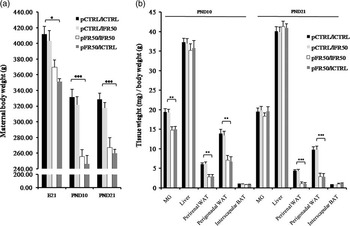
Perinatal undernutrition caused a significant reduction in pFR50 (pFR50/lFR50 and pFR50/lCTRL) mothers’ body weight when compared with pCTRL (pCTRL/lCTRL and pCTRL/lFR50) (Fig. 1a) as soon as E21. Moreover, maternal undernutrition induced a significant reduction in the relative weight (mg/g of body weight) of MGs at PND10 and white fat pads at each postnatal stage (PND10 and PND21) without affecting the liver, BAT weight (Fig. 1b), litter size or gestation length.
Maternal undernutrition during gestation and lactation reduces maternal body weight (a) and morphometric parameters (b). pCTRL/lCTRL (black bars), pFR50/lCTRL (dark gray bars), pFR50/lFR50 (white bars) and pCTRL/lFR50 (light gray bars). The first and second letters correspond to the nutritional status of the mothers and pups during the prenatal (p, last third of gestation) and lactation (l) periods, respectively. Data are means±s.e.m. (n=8 animals/group/stage). *P<0.05; **P<0.01; ***P<0.001: pFR50 (pFR50/lFR50 and pFR50/lCTRL) v. pCTRL (pCTRL/lCTRL and pCTRL/lFR50) at the same stage.

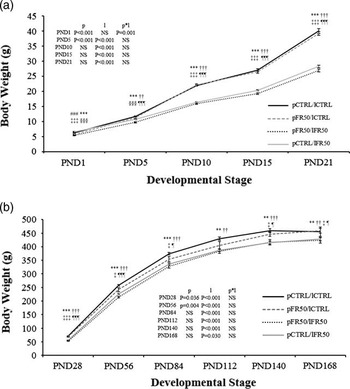
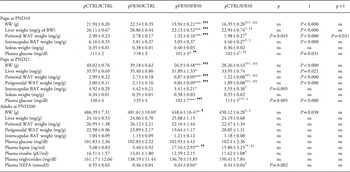
With regard to offspring’s body composition, pups from undernourished mothers (pFR50/lFR50 group) exhibited lower body weight than pCTRL/lCTRL animals throughout the lactation period (Fig. 2a) as already published.Reference Delahaye, Lukaszewski and Wattez 30 Relative weight of both brown, white fat pads and the liver were decreased in PND21 pFR50/lFR50 pups, whereas at PND10 a significant reduction was only observed in the liver and perirenal WAT of pups from undernourished mothers, indicating that fat depots exhibited a distinct sensitivity to maternal undernutrition (Table 1). During the lactation period, the growth velocity of pups, irrespective of the prenatal regimen of the mother (pCTRL or pFR50), was dictated by maternal nutrition during lactation (Fig. 2a). In each group, maternal undernutrition during lactation (lFR50) strongly decreased the growth velocity of pups when compared with mothers receiving a control diet postnatally (lCTRL).
Maternal nutrition during lactation controls the growth of offspring at both short (a) and long term (b). pCTRL/lCTRL (solid black lines), pFR50/lCTRL (dotted gray lines), pFR50/lFR50 (dotted black lines) and pCTRL/lFR50 (solid grey lines). The first and second letters correspond to the nutritional status of the mothers and pups during the prenatal (p) and lactation (l) periods, respectively. Data are means±s.e.m. (n=8 animals/group/stage). **P<0.01; ***P<0.001: pFR50/lFR50 v. pCTRL/lCTRL at same stage; †† P<0.01; ††† P<0.001: pCTRL/lFR50 v. pCTRL/lCTRL at same stage; ‡ P<0.05; ‡‡‡ P<0.001: pCTRL/lFR50 v. pFR50/lCTRL at same stage; §§§ P<0.001: pCTRL/lFR50 v. pFR50/lFR50 at same stage; ¶ P<0.05; ¶¶¶ P<0.001: pFR50/lFR50 v. pFR50/lCTRL at the same stage.

Effects of cross-fostering on morphometric parameters and on hormone concentrations in male rat pups and in adults

BW, body weight; WAT, white adipose tissue; BAT, brown adipose tissue; NEFA=non-essential fatty acids.
The first and second letters correspond to the status of the mothers and pups during the prenatal (p) and lactation (l) periods, respectively.
*P<0.05; **P<0.01; ***P<0.001: pFR50/lFR50 v. pCTRL/lCTRL at the same stage.
† P<0.05; †† P<0.01; ††† P<0.001: pCTRL/lFR50 v. pCTRL/lCTRL at the same stage.
‡ P<0.05; ‡‡ P<0.01; ‡‡‡ P<0.001: pCTRL/lFR50 v. pFR50/lCTRL at the same stage.
¶¶ P<0.01; ¶¶¶ P<0.001: pFR50/lFR50 v. pFR50/lCTRL at the same stage.
Indeed, from birth to weaning, lFR50 animals exhibited a weight gain of 397% (21.49 g) and 327% (21.64 g) for pFR50/lFR50 and pCTRL/lFR50, respectively. A growth rate of 540% (33.77 g) and 581% (33.44 g) was observed for pCTRL/lCTRL and pFR50/lCTRL, respectively. After weaning and transition to solid food (from PND21 to PND200), pFR50/lFR50 and pCTRL/lFR50 rats showed a growth rate of 1568% (422 g) and 1493% (422 g), respectively, whereas pCTRL/lCTRL and pFR50/lCTRL exhibited a respective growth rate of 1115% (446 g) and 1129% (442 g).
Although some subtle differences were observed, the same tendency was noted concerning the mass of white fat pads, indicating that prenatal (p) nutrition does not significantly contribute to modify these parameters, except for interscapular BAT (P=0.045, 0.005 at PND10 and PND21, respectively; Table 1). In contrast, control diet during lactation induced a rapid catch-up growth of pFR50/lCTRL pups that exhibit similar body weight and fat pad masses than pCTRL/lCTRL pups as soon as PND10 (Table 1). In adulthood, the body weight of pFR50/lFR50 (Fig. 2b) was still lower than pCTRL/lCTRL. pFR50/lCTRL and pCTRL/lFR50 groups exhibited similar kinetic growth than pCTRL/lCTRL and pFR50/lFR50 animals, respectively (Fig. 2b). This catch-up/catch-down growth depends on the lactation period from PND5 to PND168 (P<0.001 at each stage except P=0.030 at PND168).
Effects of maternal undernutrition and cross-fostering on food intake
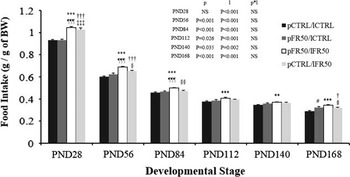
Adult male rats from undernourished mothers (pFR50/lFR50) exhibited a pronounced overeating from the weaning period, which persisted throughout adulthood when compared with pCTRL/lCTRL (Fig. 3), whereas pCTRL/lFR50 cross-fostered animals only showed increased food intake compared with pCTRL/lCTRL and pFR50/lCTRL (lCTRL) at PND 28 (Fig. 3). Data indicate that cross-fostering seems to decrease hyperphagia with an attenuation of food intake at PND56, PND84 and PND168 in pFR50/lCTRL when compared with pFR50/lFR50 (Fig. 3).
Effects of maternal undernutrition and cross-fostering on food intake at PND28, PND56, PND84, PND112, PND140 and PND168. Transient or chronic hyperphagia is not correlated with weight gain. pCTRL/lCTRL (black bars), pFR50/lCTRL (dark gray bars), pFR50/lFR50 (white bars) and pCTRL/lFR50 (light gray bars). The first and second letters correspond to the nutritional status of the mothers and pups during the prenatal (p) and lactation (l) periods, respectively. Data are means±s.e.m. (n=8 animals/group/stage). **P<0.01; ***P<0.001: pFR50/lFR50 v. pCTRL/lCTRL at the same stage; † P<0.05; ††† P<0.001: pCTRL/lFR50 v. pCTRL/lCTRL at the same stage; § P<0.05; §§ P<0.01: pCTRL/lFR50 v. pFR50/lFR50 at the same stage; ¶¶¶ P<0.001: pFR50/lFR50 v. pFR50/lCTRL at same stage; # P<0.05: pFR50/lCTRL v. pCTRL/lCTRL at same stage.

Effects of maternal undernutrition and cross-fostering on locomotor activity
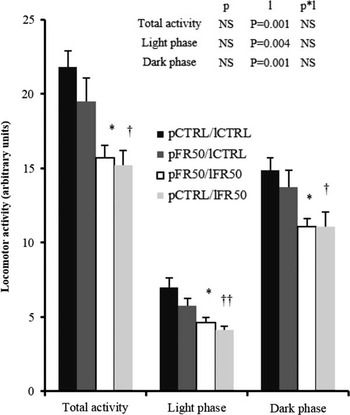
Maternal undernutrition induced a decrease in total locomotor activity at PND188, both during light and dark phases in lFR50 pups (pCTRL/lFR50 and pFR50/lFR50) when compared with pCTRL/lCTRL (Fig. 4). Even if the values of locomotor activity in pFR50/lCTRL are not significantly different, we observed that this locomotor activity has a tendency to be higher than that of lFR50 (Fig. 4).
Effects of maternal undernutrition and cross-fostering on locomotor activity at PND188. Undernutrition during lactation decreased long-term locomotor activity. pCTRL/lCTRL (black bars), pFR50/lCTRL (dark gray bars), pFR50/lFR50 (white bars) and pCTRL/lFR50 (light gray bars). The first and second letters correspond to the nutritional status of the mothers and pups, during the prenatal (p) and lactation (l) periods, respectively. Data are means±s.e.m. (n=8 animals/group). *P<0.05: pFR50/lFR50 v. pCTRL/lCTRL at same stage; † P<0.05; †† P<0.01: pCTRL/lFR50 v. pCTRL/lCTRL at the same stage.

Effects of maternal undernutrition and cross-fostering on glucose tolerance
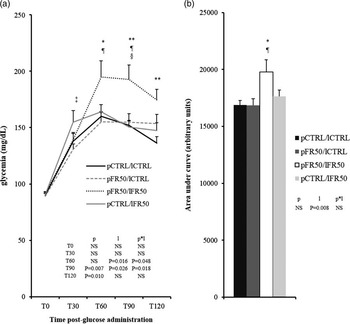
During OGTT, pFR50/lFR50 adult male rats had a higher glucose level from T60 to T120 when compared with pCTRL/lCTRL (194±14 v. 159±4, P<0.05 at T60; 193±13 v. 151±5, P<0.01 at T90 and 174±10 v. 136±6, P<0.01 at T120, for pFR50/lFR50 and pCTRL/lCTRL, respectively; Fig. 5a). We noticed that pCTRL/lFR50 presented a transient hyperglycemia at T30 when compared with pFR50/lCTRL (155±10 v. 138±7, P<0.01 at T30, for pFR50/lCTRL and pCTRL/lFR50, respectively; Fig. 5a). Except this last point, cross-fostering restored a glycemia similar to pCTRL/lCTRL animals as seen in the curves and areas under the curve data. pFR50/lFR50 animals exhibited an increased glucose level (19,970±1066 v. 16,871±419, P<0.01 for pFR50/lFR50 and pCTRL/lCTRL, respectively; Fig. 5b).
Effects of maternal undernutrition and cross-fostering on time course of plasma glucose (a) with corresponding areas under curve (b) at PND193. Maternal undernutrition during both gestational and lactational stages induced glucose intolerance from T60. pCTRL/lCTRL (solid black lines (a), solid black bars (b)), pFR50/lCTRL (dotted gray lines (a), dark gray bars (b)), pFR50/lFR50 (dotted black lines (a), white bars (b)) and pCTRL/lFR50 (solid gray lines (a), light gray bars(b)). The first and second letters correspond to the nutritional status of the mothers and the pups during the prenatal (p) and lactation (l) periods, respectively. Data are means±s.e.m. (n=8 animals/group). *P<0.05; **P<0.01: pFR50/lFR50 v. pCTRL/lCTRL; ‡ P<0.05: pCTRL/lFR50 v. pFR50/lFR50; § P<0.05: pCTRL/lFR50 v. pFR50/lFR50; ¶ P<0.05: pFR50/lFR50 v. pFR50/lCTRL.

Effects of maternal undernutrition and cross-fostering on the mean arterial blood pressure and heart rate
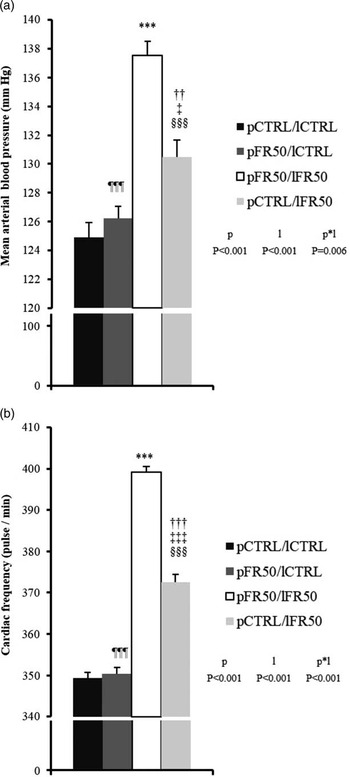
Maternal undernutrition induced an increase in mean arterial blood pressure (Fig. 6a) and heart rate (Fig. 6b) in adult male rats from undernourished mothers at 6 months of age. Cross-fostering resulted in mean arterial blood pressure (Fig. 6a) and heart rate (Fig. 6b) in FR50 animals cross-fostered by control mothers (pFR50/lCTRL), similar to those of pCTRL/lCTRL, whereas control rats cross-fostered with food-restricted mothers (pCTRL/lFR50) exhibited higher cardiac parameters.
Effects of maternal undernutrition and cross-fostering on mean arterial blood pressure (a) and on cardiac frequency (b) at PND180. Malnutrition during lactactional period increased both mean arterial blood pressure (a) and cardiac frequency (b). pCTRL/lCTRL (black bars), pFR50/lCTRL (dark gray bars), pFR50/lFR50 (white bars) and pCTRL/lFR50 (light gray bars). The first and second letters correspond to the nutritional status of the mothers and the pups, respectively. Data are means±s.e.m. (n=8 animals/group). ***P<0.001: pFR50/lFR50 v. pCTRL/lCTRL; †† P<0.01; ††† P<0.001: pCTRL/lFR50 v. pCTRL/lCTRL; ‡ P<0.05; ‡‡‡ P<0.001: pCTRL/lFR50 v. pFR50/lCTRL; §§§ P<0.001: pCTRL/lFR50 v. pFR50/lFR50; ¶¶¶ P<0.001: pFR50/lFR50 v. pFR50/lCTRL.

Effects of maternal undernutrition on leptin concentrations in plasma and milk of mothers and in plasma of pups
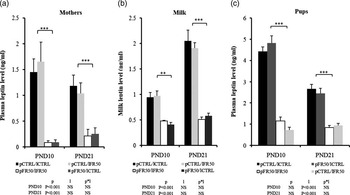
The reduced weight of white fat pads observed in FR50 mothers (Fig. 1b) was correlated to a drastic reduction in their plasma leptin concentration both at PND10 and PND21, when compared with CTRL mothers (Fig. 7a). Interestingly, we showed for the first time that maternal perinatal undernutrition decreases milk leptin concentration by about 50% (P<0.01) and 72% (P<0.001) at PND10 and PND21, respectively (Fig. 7b). It is also interesting to note that between PND10 and PND21, milk leptin levels increased in pCTRL conditions, whereas these variations did not occur in samples from pFR50 mothers.
Leptin concentration in the plasma of mothers (a), milk (b) and plasma of pups (c) at PND10 and PND21. Maternal undernutrition decreased the leptin level in milk and in plasma of both mothers and pups. pCTRL/lCTRL (black bars), pFR50/lCTRL (dark gray bars), pFR50/lFR50 (white bars) and pCTRL/lFR50 (light gray bars). The first and second letters correspond to the status of the mothers and pups during the prenatal (p) and lactation (l) periods, respectively. Data are means±s.e.m. (n=8 animals/group). **P<0.01; ***P<0.001: pFR50 (pFR50/lFR50 and pFR50/lCTRL) v. pCTRL (pCTRL/lCTRL and pCTRL/lFR50) at the same stage.

As already reported,Reference Delahaye, Breton and Risold 12 we showed that plasma leptin concentration is reduced in pFR50/lFR50 pups both at PND10 and PND21 (Fig. 7c). We also observed a 40% reduction in the leptin plasma levels from PND10 to PND21 in pCTRL/lCTRL offspring (Fig. 7c). No such variation was observed in pFR50/lFR50 pups who did not exhibit significant difference in their leptin plasma levels at PND10 and PND21 (Fig. 7c). Interestingly, our experiments also demonstrated that cross-fostering dictated the plasma levels of leptin in newborns as pFR50/lCTRL had leptin levels closely similar to those of pCTRL/lCTRL pups at PND10 and PND21, whereas in CTRL animals nursed by FR50 mothers (pCTRL/lFR50) leptin plasma levels were drastically reduced reaching concentrations similar to those observed in pFR50/lFR50 pups (Fig. 7c). Indeed, plasma leptin levels in pups are dictated by postnatal nutrition at both stages (P<0.001; Fig. 7c).
Plasma hormone levels
As noted in Table 1, maternal undernutrition and cross-fostering did not affect significant circulating parameters in adult male rats. Indeed, we observed no significant statistical difference between groups, especially for plasma glucose and plasma triglycerides. On the one hand, a slight but significant decrease in the plasma insulin level was observed in pCTRL/lFR50 when compared with pCTRL/lCTRL (P<0.05) together with a lower NEFA plasma levels in animals nursed by FR50 mothers during lactation (pCTRL/lFR50 and pFR50/lFR50) when compared with pCTRL/lCTRL adult male rats (P<0.05). On the other hand, hyperleptinemia was detected in pCTRL/lFR50 and pFR50/lFR50 when compared with pCTRL/lCTRL and pFR50/lCTRL, indicating that maternal perinatal undernutrition or during lactation alone caused an increase in the plasma leptin levels, whereas cross-fostering with a CTRL mother (pFR50/lCTRL) restored the plasma leptin levels similar to those of pCTRL/lCTRL.
Discussion
We previously reported that maternal perinatal undernutrition programs both HPA axis and sympatho-adrenal system in the adult male rats.Reference Vieau, Sebaai and Léonhardt 14 , Reference Laborie, Molendi-Coste and Breton 15 , Reference Sebaai, Lesage and Breton 31 These modifications were associated with long-lasting effects on regulation of the fluid and electrolyte balance such as a rise in the circulating levels of vasopressin and aldosterone. We show here that these endocrine changes are accompanied by mild hypertension and impaired glucose tolerance as already described in adult male rats from prenatally undernourished mothers.Reference Rivière, Michaud and Breton 32 – Reference Breton, Lukaszewski and Risold 34 However, offspring from perinatally undernourished mothers also exhibit hyperleptinemia, hyperphagia and decreased locomotor activity in the absence of obesity. As previously described,Reference Breton, Lukaszewski and Risold 34 hyperleptinemia does not necessarily reflect fat mass but may result from increased leptin gene expression in the adipose tissue. This may protect from obesity or alternatively indicates that these animals are indeed predisposed to adiposity.Reference Lukaszewski, Mayeur and Fajardy 35 Although we did not directly address this question, the occurrence of both hyperphagia and decreased locomotor activity, which reflects a diminution of energy expenditure, indicates that FR50 adult male rats display a central leptin resistance, suggesting that they will become obese later on, or that they exhibit higher energy expenditure, protecting them from weight gain. In line, we have reported that maternal perinatal undernutrition programs a brown-like phenotype of gonadal white fat associated with increased UCP1 gene expression,Reference Delahaye, Lukaszewski and Wattez 30 the uncoupling protein involved in heat production,Reference Nicholls and Locke 36 and activity of the sympatho-adrenal system in the male rat at weaning.Reference Molendi-Coste, Grumolato and Laborie 37 It is also interesting to note that the intolerance to glucose observed after OGTT is unlikely to be due to a resistance to the action of insulin, as FR50 adult male rats do not exhibit hyperglycemia nor hyperinsulinemia after an overnight fasting. It seems plausible that insulin production might not be sufficient to regulate glycemia in response to glucose challenge, as it has been reported that adult male rats from perinatally undernourished mothers present decreased β-cell mass associated with insulinopenia and marked glucose intolerance.Reference Garofano, Czernichow and Bréant 38 Recently, elegant studies reported that transplantation of pancreatic islets, from offspring whose mothers were protein restricted during lactation, was able to regulate fasting blood glucose concentrations in diabetic rats.Reference Branco, de Oliveira and Grassiolli 39 These results reinforce the idea that pancreatic islets from perinatally undernourished animals are not altered per se but presumably show a reduced number that may explain why β-cells are less sensitive to glucose stimulation. This decreased β-cell mass would explain the intolerance to glucose frequently observed in offspring from malnourished mothers.Reference Lesage, Del-Favero and Leonhardt 40 , Reference Venu, Harishankar, Krishna and Raghunath 41
As already reported by other groups,Reference Coupé, Grit and Hulin 42 , Reference Desai, Gayle, Babu and Ross 43 nursing IUGR pups by ad libitum fed dams induces a rapid catch-up growth. In human, although it is still a matter of debate and controversy, rapid catch-up growth of low birth weight babies may increase their risk to develop obesity in adulthood.Reference Ong 19 , Reference Ravelli, van der Meulen and Osmond 20 , Reference Mcmillen and Robinson 44 We report here that maternal nutrition during lactation has both short- and long-term consequences on the body weight of offspring. Irrespective of birthweight, maternal nutrition during lactation dictates glycemia, the weight of white and brown adipose tissues and the liver but does not affect the soleus muscle mass in pups. However, in adulthood, these modifications were not observed anymore, with the exception of body weight, which is still reduced in animals nursed by undernourished mothers and restored in IUGR rats cross-fostered to control mothers, respectively. According to previously published papers, we confirm that undernutrition during lactation prevents the development of catch-up growth and expansion of fat deposits.Reference Fagundes, Moura and Passos 45 , Reference Lim, Lee and Hwang 46 This is associated with decreased fasting insulin concentration suggesting a higher insulin sensitivity, which may promote lower lipogenesis and higher lipolytic activity, already reported in pups from protein-restricted mothers during lactation.Reference Fagundes, Moura and Passos 45 , Reference Lim, Lee and Hwang 46 However, undernutrition in rat neonates seems to have long-term deleterious consequences as it is able to induce mild hypertension, intolerance to glucose and modest hyperphagia in rats, confirming that lactation period is a very sensitive ‘programming’ window in rodents. Nevertheless, according to Barker hypothesis, we demonstrate that all these alterations are exacerbated in IUGR pups still undernourished throughout weaning, confirming that a low birth weight sensitizes to the development of metabolic diseases such as hypertension and diabetes.Reference Barker 1 – Reference Langley-Evans 4 The most important finding of our study is that cross-fostering of IUGR by mothers fed normally during lactation prevents the occurrence of several metabolic dysfunctions observed in FR50 adult male rats. It impedes the development of hypertension and intolerance to glucose, suggesting that early nutrition and modification of the kinetic growth may have beneficial effects. This is indeed surprising as most of the studies reported so far suggest that an early catch-up growth is an indicator of later metabolic dysfunctions.Reference Coupé, Grit and Hulin 42 , Reference Howie, Sloboda and Vickers 47 – Reference Lima Nda, de Moura and Passos 50 In addition, it has been recently reported that cross-fostering per se may lead to a deleterious outcome.Reference Matthews, Samuelsson and Seed 51 However, owing to the heterogeneity of the experimental models used, it is difficult to interpret data as results may vary depending on the regimen, species, strain, sex, age, intensity and duration of malnutrition, and the parameters examined.Reference Ellis-Hutchings, Zucker and Grey 52 – Reference Gosby, Maloney and Caterson 54 Moreover, some reports also suggested that non-catch-up growth in IUGR rats sensitizes to abnormal glucose tolerance.Reference Lim, Lee and Hwang 46
Since the pioneer studies by Bouret et al.,Reference Bouret, Draper and Simerly 27 it is clearly established that neonatal leptin plays a major neurodevelopmental role in rodents. Several reports have shown that manipulation of perinatal leptin concentration has long-term metabolic consequences in rats. The oral intake of physiological doses of leptin during the first 20 days of lactation has been shown to prevent obesity in later life.Reference Picó, Oliver and Sánchez 55 Accordingly, it has been reported that perinatal (from day 14 of pregnancy throughout lactation) administration of leptin into mothers prevents obesity and impaired glucose tolerance in rat offspring.Reference Stocker, Wargent and O’Dowd 56 However, it has also been published that leptin injected into rat pups for the first 10 days of lactation programs hyperleptinemia, hyperinsulinemia and hypertriacylglycerolemia in adulthood.Reference Toste, de Moura and Lisboa 57 Recently, large litter rearing, which leads to the reduction in milk intake, has been shown to protect selectively bred diet-induced obese rats from becoming obese via enhancement of their leptin sensitivity.Reference Patterson, Bouret and Park 58 It has also been reported that early postnatal leptin blockage leads to a long-term leptin resistance and susceptibility to diet-induced obesity.Reference Attig, Solomon and Ferezou 59 Although these results seem contradictory and difficult to conciliate, they clearly indicate that changing leptin plasma levels in rat offspring has long-term consequences. We have previously shown that the postnatal peak of plasma leptin observed between PND3 and PND14 in control rats was markedly reduced in FR50 pups.Reference Delahaye, Breton and Risold 12 Using cross-fostering, we report here that maternal nutrition during lactation dictates leptin plasma levels in pups. Control feeding restores the leptin plasma levels in weaning IUGR rats, whereas maternal undernutrition during lactation markedly reduces this adipokine concentration in control pups. Interestingly, maternal undernutrition also decreases milk leptin concentration suggesting that mother’s nutrition during lactation, via the modification of milk composition, is able to exert long-term metabolic consequences in the offspring. Our data reinforce the idea that the peak of leptin observed in rodent pups could be derived from the mother as it has been shown that leptin is transferred from the maternal circulation to breast milk and then passes to pups’ blood, suggesting that maternal leptin may exert biological effects on the infant.Reference Casabiell, Piñeiro and Tomé 60 However, we could not rule out that undernutrition during lactation may also modify maternal behavior, which has been shown to exert long-term and important effects in the offspring.Reference Peleg-Raibstein, Luca and Wolfrum 61
According to our data, it has been recently published that short neonatal leptin supply in IUGR piglets is also able to induce an increase in body weight and the relative weights of peripheral organs, such as the pancreas and the liver.Reference Attig, Brisard and Larcher 62 It is thus necessary to more precisely define the role of leptin during general development and to unravel milk compounds modified by maternal nutrition, which may constitute a promising target to identify putative factors involved in the programming of metabolic disorders.
Acknowledgements
The authors thank Drs Christine Laborie and Isabelle Dutriez-Casteloot, and Mrs Estelle Denhez, Jessica Montaigne and Ouma Cissé for killing animals and blood and tissue sampling.
Financial Support
This study was supported by grants from the French Ministry of Education and grants of the Conseil Régional du Nord-Pas-de Calais.
Conflicts of Interest
None.
Ethical Standards
The authors assert that all procedures contributing to this work comply with the ethical standards of the European Communities Council Directive (86/609/EEC) on the care and use of laboratory animals, has been approved by the French Departmental Direction of Veterinary Services Committee (DDSV/59-009228)) and accredited by the French Ministry of Agriculture (No. 04860).