Introduction
Osteomyelitis can be defined as an inflammatory condition of the bone, which begins as an infection of the medullary cavity, rapidly involves the Haversian systems and extends to involve the periosteum of the affected area. Infection occurs as a result of a bacteraemia, an inoculation during aseptic or bone surgery, or a contiguous infectious focus. Conditions altering the vascularity of the bone (such as radiation, malignancy, osteoporosis, osteopetrosis and Pagets disease) predispose to osteomyelitis. Systemic diseases which cause concomitant alteration in host defences, such as diabetes, anaemia and malnutrition, profoundly influence the course of osteomyelitis. The temporal bone is rarely involved by osteomyelitis; such cases are secondary to malignant otitis externa, aggressive otitis media or trauma.
Here, we present a rare case of a 60-year-old diabetic who presented with ear discharge and pain, and who was diagnosed with osteomyelitis of the temporal bone and temporoparietal abscess secondary to malignant otitis externa.
Case report
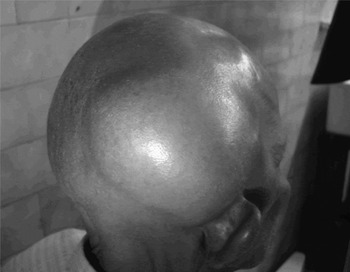
A 60-year-old man presented to us with the chief complaints of right ear pain and discharge of one and a half month's duration, a painful swelling behind the right ear for five days, and discharge from the post-aural swelling for two days (Figure 1). The ear discharge was profuse, purulent, not blood stained and not foul smelling. The patient gave a history of occasional right-sided headache. The patient was a known diabetic taking oral hypoglycaemic drugs.
Post-aural swelling due to temporoparietal abscess.

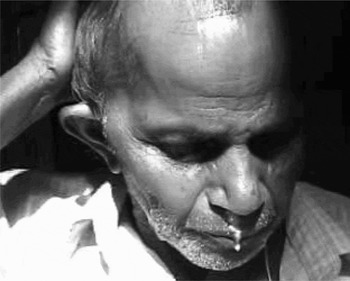
On examination, there was a 7 × 7 cm, fluctuant swelling over the right post-auricular area extending over the temporoparietal region, with a fistula in the post-aural sulcus. Pus was observed discharging from the fistula. There was marked mastoid tenderness. The right external auditory canal was oedematous and filled with granulation tissue and purulent discharge. The tympanic membrane could not be visualised. The facial nerve on the right side was intact and the fistula test was negative. The left ear was normal. Nasal examination showed mild deviation of the nasal septum to the left. On post-nasal examination, pus was seen discharging from the eustachian tube orifice. The patient himself demonstrated pus discharging from the right nasal cavity when he applied pressure over the right mastoid swelling while bending forwards (Figure 2).
Pus from the mastoid abscess discharging from the nose via the eustachian tube, upon application of pressure to the mastoid abscess.

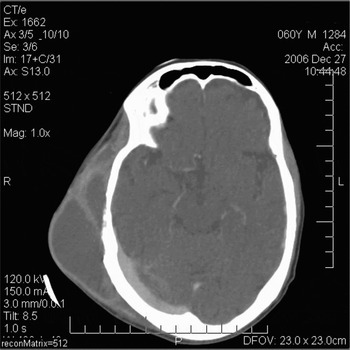
A pus sample was sent for histopathological examination. A biopsy was taken from the granulation tissue around the mastoid fistula. A microbiological culture report for the pus detailed growth of Pseudomonas aeruginosa sensitive to amikacin, ciprofloxacin, carbenicillin, gentamycin, tobramycin, piperacillin and ceftazidim. The patient's postprandial blood sugar level was 300 mg/dl. A computed tomography (CT) scan of the temporal bone demonstrated a temporal abscess destroying the mastoid bone (Figure 3). Pus was observed filling the middle ear, and the ossicles were absent. An audiogram revealed severe to profound, conductive hearing loss in the right ear, with mild to moderate, high frequency, sensorineural hearing loss in the left ear.
Axial computed tomography scan showing the parietal abscess, with bony sequestrum suggestive of osteomyelitis.

A diagnosis of malignant otitis externa leading to osteomyelitis of the temporal bone and mastoid abscess was made.
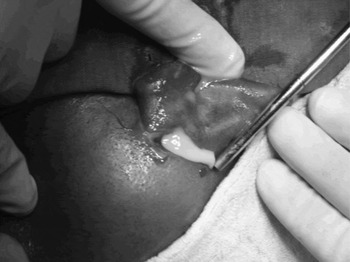
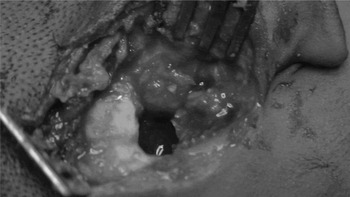
Using a post-aural incision, the abscess was drained and the fistula excised (Figure 4). When the mastoid cortex was uncapped, pus was seen to have filled the mastoid cavity and destroyed the mastoid including the tip cells. The dural and sigmoid plates were intact. A bony sequestrum was identified at the posterior canal wall (Figure 5). Between the sequestrum and the external auditory canal skin, there was profuse granulation tissue. This was curetted and removed. A modified radical mastoidectomy with a canal wall down procedure was performed, with sequestrectomy and debridement of the surrounding area. The malleus and incus were destroyed, although the stapes was intact. Peri-operatively, the patient was treated with intravenous cefotaxime, metronidazole and intravenous human Actrapid.
Intra-operative view showing pus in the mastoid cavity.

Intra-operative view showing bony sequestrum in the mastoid bone.

The patient showed a dramatic improvement in the first post-operative week. His diabetes was controlled. Oral antibiotics were continued for three months.
In the sixth month of follow up, the patient was asymptomatic with complete arrest of the disease process. He was advised to undergo ossiculotympanoplasty.
Discussion
The term ‘osteomyelitis’, introduced by NelatonReference Prasad, Prasad, Mouli and Agarwal1 in 1844, implies an infection of the bone and marrow. Osteomyelitis most commonly occurs in the long bones and vertebra. The bones reported to be involved by osteomyelitis in the head and neck are the mandible, frontal bone, cervical spine, maxilla, nasal bone, temporal bone and skull base.Reference Prasad, Prasad, Mouli and Agarwal1 Osteomyelitis of the temporal bone is a rare disease which commonly occurs secondary to malignant otitis externa or suppurative otitis media. ChandlerReference Chandler2 is credited with first using the term ‘malignant otitis externa’, in 1968. The term ‘malignant’ is used to emphasise the serious nature of this infection; in the original historical report, six of 13 patients died.
Malignant (or necrotising) otitis externa occurs predominantly in elderly diabetics, and the causative agent is almost uniformly P aeruginosa. However, cases have been reported in a small number of non-diabetic patients, particularly in children who are immunocompromised due to malignancy, malnutrition or severe anaemia. In 1984, a case of malignant otitis externa was reported in a child with an acquired immunodeficiency syndrome (AIDS) like illness, prior to identification of the human immunodeficiency virus (HIV). Since that time, further sporadic cases of this invasive infection have been reported in HIV and AIDS sufferers.Reference Chandler3 Malignant otitis externa is the end stage of a severe infection which originates from the external auditory canal and progresses through cellulitis and congruities to periostitis and osteitis and, finally, to osteomyelitis. Malignant otitis externa has also been reported following surgery to the temporal bone. Infection is thought to spread out of the cartilaginous external auditory canal through the fissures of Santorini, congenital defects in the floor of the external auditory canal. Once periostitis develops, infection progresses rapidly across the skull base. As a result, facial nerve and other cranial nerve palsies develop. Once periostitis is well developed, osteomyelitis ensues as a secondary phenomenon. Malignant otitis externa mainly affects the Haversian system of compact bone, and involvement of the pneumatised portion of the temporal bone is a late finding. The otic capsule is usually spared. Multiple microabscesses are found at surgery or postmortem.
Predisposing factors
The most common predisposing factor in the development of temporal bone osteomyelitis is diabetes mellitus;Reference Chandler3–Reference Walshe, Cleary, McConn and Walsh5 this was also the case with our patient. Driscoll et al. Reference Driscoll, Ramachandrula, Drezner, Hicks and Schaffer6 found that cerumen from diabetic ears had a higher average pH, compared with that from non-diabetic ears, and they postulated that such alkaline pH could provide a beneficial environment for bacterial overgrowth. Diabetic patients' increased predisposition to temporal bone osteomyelitis is due also to increased susceptibility to microangiopathic changes (facilitating tissue necrosis and reducing antibiotic uptake) and an altered immune response (compromised by poor migration, reduced chemotaxis and defective phagocytosis of polymorphonuclear leukocytes). Magliulo et al. Reference Magliulo, Varacalli and Ciofalo7 observed that skull base osteomyelitis arises as a complication of malignant external otitis, but it can also be due to middle ear and/or mastoid infection.
Clinical features
Schweitzer and VanessaReference Schweitzer and Vanessa8 listed the warning signs of temporal bone osteomyelitis as: deep pain (temporal, parietal, post-auricular or retro-orbital); intermittent, foul otorrhoea and spiking fever; preauricular cellulites; woody induration of the pinna; chronic mastoid cutaneous fistula; fibrotic mastoid granulation tissue; intermittent facial twitching suggestive of facial canal dehiscence; and persistent leukocytosis and an elevated sedimentation rate. From the literature, the most common presenting features include deep pain, discharge and granulations in the inferior aspect of the ear canal.
Investigation
Plain radiography of temporal bone osteomyelitis cases will show sequestra. Computed tomography scanning is helpful in accurate diagnosis and may show sclerosis of the temporal bone. Other imaging modalities include technetium 99 medronate methylene diphosphonate bone scanning and gallium 67 citrate scintigraphy. Computed tomography defines the location and extent of the disease at initial evaluation. It is definitive in determining osteitis when positive for bony destruction, but scans will only show abnormalities when demineralisation of 30 per cent or more occurs. Once demineralisation occurs, a CT scan rarely returns to normal and thus is not a reliable modality in assessing response to therapy.Reference Gherini, Brackmann and Bradley9 Imaging of the skull base in the setting of cranial neuropathy and probable infection is best accomplished with MRI. This modality has the advantage of better soft tissue discrimination than CT, and it is particularly useful for assessing soft tissue planes around the skull base and abnormalities of the medullary cavity of bone. Magnetic resonance findings which are highly sensitive of but nonspecific for osteomyelitis include marrow T1 hypointensity and T2 hyperintensity.Reference Chang, Fischbein and Holliday10
Gallium scans are also very effective. Gallium is absorbed by macrophages and reticular endothelial cells over 48–72 hours. It is thus a sensitive indicator of infection, which quickly returns to normal after an infection has cleared. In 1989, BeneckeReference Benecke11 proposed the following staging system for osteomyelitis of the temporal bone originating from the external auditory canal. Stage I disease has a positive gallium scan and a negative technetium scan, and the disease extends only to the soft tissue. Stage II is true osteomyelitis, with positive gallium and technetium scans, but the disease is limited to the mastoid. Stage III disease is also true osteomyelitis and is defined as extensive skull-based osteomyelitis, with positive gallium and technetium scans. Benecke went on to state that stage III disease could spread in three distinct patterns: posteriorly to involve the occipital bone, anteriorly to involve the facial bones, or medially across the clivus to involve the contralateral temporal bone.
Surgery
Treatment for osteomyelitis of the temporal bone consists of broad-spectrum antibiotics for not less than three months, along with surgical debridement and a wide meatoplasty. Local treatment of the auditory canal includes meticulous cleaning and debridement plus topical application of antimicrobial agents. In adults, strict diabetic control is necessary. Despite the reported efficacy of prolonged systemic antibiotic therapy, treatment failures do occur due to tissue hypoperfusion and hypoxia. Hyperbaric oxygen is gradually gaining acceptance as a beneficial adjunctive therapy and has been recommended whenever a therapeutic pressure chamber is available.Reference Phillips and Jones12 Hyperbaric oxygen increases wound pO2 levels, enhances phagocytic oxidative killing of aerobic micro-organisms, and promotes angioneogenesis and osteoneogenesis. Treatment consists of 100 per cent O2 given for 90 minutes at 2.5 atm absolute pressure, five days a week, 20 times, as an adjuvant therapy.Reference Mader and Love13 Since osteomyelitis is characterised by a failure to respond both locally and systemically to accepted medical and surgical therapy, Mader JT et al. advocates antibiotics and at least a cortical mastoidectomy, which enables a good prognosis.
Complications of osteomyelitis
Osteomyelitis of the temporal bone may further progress to skull base osteomyelitis, a more dangerous entity. In this condition, the infection may spread anteriorly to involve the parotid gland, temporomandibular joint or VIIth cranial nerve at the exit of the stylomastoid foramen. It may also spread posteriorly to the mastoid and vertical portion of the VIIth cranial nerve, or inferomedially to the skull base to involve the carotid artery, the jugular bulb and sigmoid sinus. Medial spread of disease can involve the clivus and hypoglossal nerve. Palsies of the IXth, Xth and XIth cranial nerves can occur when the jugular foramen becomes involved. Other complications include mastoiditis, chondritis of the auricle and central nervous system infection.
• This paper describes an advanced presentation of osteomyelitis of the temporal bone secondary to malignant otitis externa
• Treatment of osteomyelitis of the temporal bone consists of broad-spectrum antibiotics for not less than three months, along with surgical debridement and a wide meatoplasty
• In adults, strict diabetic control is necessary
• Hyperbaric oxygen is gradually gaining acceptance as a beneficial adjunctive therapy, and has been recommended whenever a therapeutic pressure chamber is available
The current case is interesting because of the fulminant course of the disease. The patient developed malignant otitis externa followed by osteomyelitis of the temporal bone with temporoparietal abscess. The patient also had uncontrolled diabetes. The disease was arrested only by aggressive surgery, debridement, long-term antibiotics and antidiabetic medication.
Conclusion
Our patient who had a predisposing factor of Diabetes Mellitus developed osteomyelitis of the temporal bone leading to painful absess behind right ear, with profuse purulent ear discharge. The pus was also demonstrated coming from the right nasal cavity on pressure application over the mastoid swelling. The CT scan of the temporal bone demonstrated a temporal abscess destroying the mastoid bone. A modified radical mastoidectomy with canal wall down procedure with sequestrectomy and debridement of surrounding area, broad spectrum antibiotics for three months, with diabetic control done.