Introduction
Evidence from the USA, Britain, and other Western European countries shows that women are often more economically left-wing than men, including expressing greater support for government spending, redistribution, and welfare (Shapiro and Mahajan, Reference Shapiro and Mahajan1986; Norris, Reference Norris and Mueller1988; Howell and Day, Reference Howell and Day2000; Campbell, Reference Campbell2012). Such gender differences are generally attributed to material inequalities: since women tend to be in weaker economic positions than men, it is in their interest to support policies that favour higher spending on social services and greater levels of redistribution. In turn, this has been argued to have important consequences for electoral outcomes and political campaigns; in particular, the emergence of the gender vote gap in the USA from the mid-1970s onwards, with women found to be more likely to vote for the Democrats than men, has been linked to women's economic preferences (Erie and Rein, Reference Erie, Rein and Mueller1988; Andersen, Reference Andersen1999; Box-Steffensmeier et al., Reference Box-Steffensmeier, De Boef and Lin2004).
In this paper, we focus on comparing how attitudes to redistribution and social spending vary across generations in the British and US contexts, which differ in their levels of welfare provision. Although we do not find consistent evidence that gender gaps are larger or smaller in either the USA or Britain, we do find differences in how gender gaps change across generations in the two countries. In the lower welfare context of the USA, the gender gap is either stable in size or widens for all generations born after 1925, depending on the indicator. In the relatively higher welfare context of Britain, the gender gap is largest for the post-war generation and becomes smaller for the generation born 1958–75 (the ‘neoliberal’ generation). There is contradictory evidence with respect to the youngest generation born post-1976 in Britain: for some indicators, they have a smaller gender gap than the post-war generation, but for one indicator – on health spending – they have a larger gender gap. Taken together, the results largely indicate a narrowing of the gender gap after the post-war generation in Britain vs. stability or widening in the USA. We argue that this could be related to women's greater economic vulnerability in the USA relative to Britain, where social spending is higher and there are more generous maternity and childcare policies. This suggests that public policy at the national level can be influential for attitudinal gender gaps, but that, importantly, this varies by generation. However, because our hypotheses are not fully supported by the analysis and we find somewhat different results across indicators, we argue that more research is required to fully understand the relationships between public policy provision and attitudinal gender gaps.
These findings do contrast with the expectations of the modernization perspective (Inglehart and Norris, Reference Inglehart and Norris2003) which expect women of younger generations to become progressively more economically left-wing than men in their preferences. Instead, we argue that diverse national policy contexts can produce different generational trends across countries. This contributes to the growing literature on the importance of generations for gender vote gaps in both the USA and Britain, which also generally shows that the predictions of the modernization perspective do not always hold (Shorrocks, Reference Shorrocks2016; Harsgor, Reference Harsgor2017). This paper also brings together two areas of scholarship which rarely speak to one another: that on gender gaps in attitudes and that on the effect of public policy on public opinion, which generally does not consider differential effects by gender (e.g. Wlezien, Reference Wlezien1995; Erikson et al., Reference Erikson, MacKuen and Stimson2002). In doing so, we aim to show the importance of public policy in the production of attitudinal gender gaps, which are usually discussed more in relation to differences between individuals in terms of social and economic status.
The remainder of the paper proceeds as follows: first, we review the relevant literature, then we turn to discussing our data and methods, including our methodological approach for disentangling age, period, and cohort in the analysis and our choice of over-time repeated cross-sectional datasets from the USA and Britain: the American National Election Study (ANES) (1982–2008),Footnote 1 the British Election Studies (1987–2015),Footnote 2 and the International Social Survey Programme (1985–2016),Footnote 3 which contain comparable and relevant indicators for our research questions as well as the appropriate controls. We then turn to the analysis of results and, finally, we discuss the wider implications of our analysis in the conclusion, with suggestions for future research.
Existing literature and theoretical expectations
Gender and attitudes towards redistribution
Women are usually found to be more supportive of redistribution and social spending on welfare and services than men are (Shapiro and Mahajan, Reference Shapiro and Mahajan1986; Norris, Reference Norris and Mueller1988; Kaufmann and Petrocik, Reference Kaufmann and Petrocik1999; Howell and Day, Reference Howell and Day2000; Alvarez and McCaffery, Reference Alvarez and McCaffery2003; Campbell, Reference Campbell2006; Barnes and Cassese, Reference Barnes and Cassese2017). Two main sets of explanations have been developed to account for this. The first is that women are more compassionate than men. This line of reasoning draws on the work of Gilligan (Reference Gilligan1982), who argued that women are more likely than men to think of themselves within interconnected relationships rather than in isolation and thus to develop an ethics of ‘care’, and is supported by experimental evidence that finds that women are more likely to share resources than men (Andreoni and Vesterlund, Reference Andreoni and Vesterlund2001; Kamas and Preston, Reference Kamas and Preston2012). This gender gap has also been found to influence the gender gap in attitudes towards inequality and social welfare provision (Kamas and Preston, Reference Kamas and Preston2018), although others have argued that there remains a lack of evidence for this perspective since few studies examine gender differences in compassion and its association with political orientations at the individual level (Blinder and Rolfe, Reference Blinder and Rolfe2017).
The second perspective on the other hand focuses on women's self-interest. Here, it is the fact that women are on average more economically vulnerable given their lower average income and higher likelihood to be in unpaid caring roles that is seen to make them more likely to support redistribution and state spending than men. This argument has been linked to women's higher support for the Democrats in the USA (Erie and Rein, Reference Erie, Rein and Mueller1988, Manza and Brooks, Reference Manza and Brooks1998; Andersen, Reference Andersen1999; Box-Steffensmeier et al., Reference Box-Steffensmeier, De Boef and Lin2004). Andersen (Reference Andersen1999), in particular, has argued that women are much nearer to seeing the effects of spending than men because they are more likely to be caring for children and the elderly, and as such use education, health, and social care services either for themselves or for their children and parents to a greater extent. This means women have a real interest in continued redistribution in the form of using taxes to spend on services due to their daily lived experience as carers. On the other hand, for men, the opposite may apply: since they do not come into contact with state services nearly as much, they may have a greater interest in maximizing their income through low taxation (Iversen and Rosenbluth, Reference Iversen and Rosenbluth2006).
However, both the compassionate and self-interested perspectives largely implicitly assume gender differences in preferences are independent of the wider political and social context and the pace of public policy initiatives. Research on variation in attitudinal gender gaps cross-nationally tends to focus on sociostructural variation between countries, such as divorce risk and women's labour force participation and labour market opportunities, rather than variation in public policy explicitly (e.g. Iversen and Rosenbluth, Reference Iversen and Rosenbluth2006; Finseraas et al., Reference Finseraas, Jakobsson and Kotsadam2012). This paper sees this as a major lacuna in extant literature and argues that shifts in public policy and social spending might affect the degree to which women prefer more social spending and redistribution in comparison to men across time and space.
In the literature on public opinion formation in relation to government policy, the thermostatic model has importantly suggested that as policy moves to the left, voters adjust their relative preferences accordingly in favour of less spending and vice versa (Wlezien, Reference Wlezien1995, Reference Wlezien2004; Bartle et al., Reference Bartle, Dellepiane-Avellaneda and Stimson2010). As such, the expectation here is that as public spending increases, the public's support for ‘more’ spending should decrease. At the same time, research in the USA has found that women's preferences are less ‘thermostatic’ when it comes to public spending. Women's preferences adjusted in a rightward direction towards lower public spending to a lesser extent than men's when public policy moved in a ‘liberal’ direction towards more government action (Kellstedt et al., Reference Kellstedt, Peterson and Ramirez2010). As a result, gender differences get wider when government policy moved in a more liberal direction. Kellstedt et al. (Reference Kellstedt, Peterson and Ramirez2010) shy away from offering an explanation for this observed trend. However, in line with our wider argument, we argue that the welfare and social spending environment in the USA could be the key.
In the US context of low levels of welfare provision, women are likely to change their preferences less than men in response to greater government spending because they have preferences for higher spending that are still not being met even when spending rises. This points to the importance of the national policy environment with respect to social spending when it comes to examining gender gaps in attitudes. The literature on gender and welfare regimes highlights how the welfare system within a country can affect women's material economic position (Orloff, Reference Orloff1993; Lewis, Reference Lewis1997). State support for working mothers, for example, influences women's entry into the labour force and thus their financial position (Gornick et al., Reference Gornick, Meyers and Ross1997; Stier et al., Reference Stier, Epstein and Braun2001). If women are more likely to be taking advantage of state services such as health care or education, and state rights such as benefits or parental leave, then the extent to which these are provided will particularly affect women's economic well-being. Since the more ‘economically vulnerable’ position of women on average is thought to be behind their general tendency to be more left-wing in their economic policy preferences, the extent to which public policy influences this economic vulnerability should be important for their attitudes.
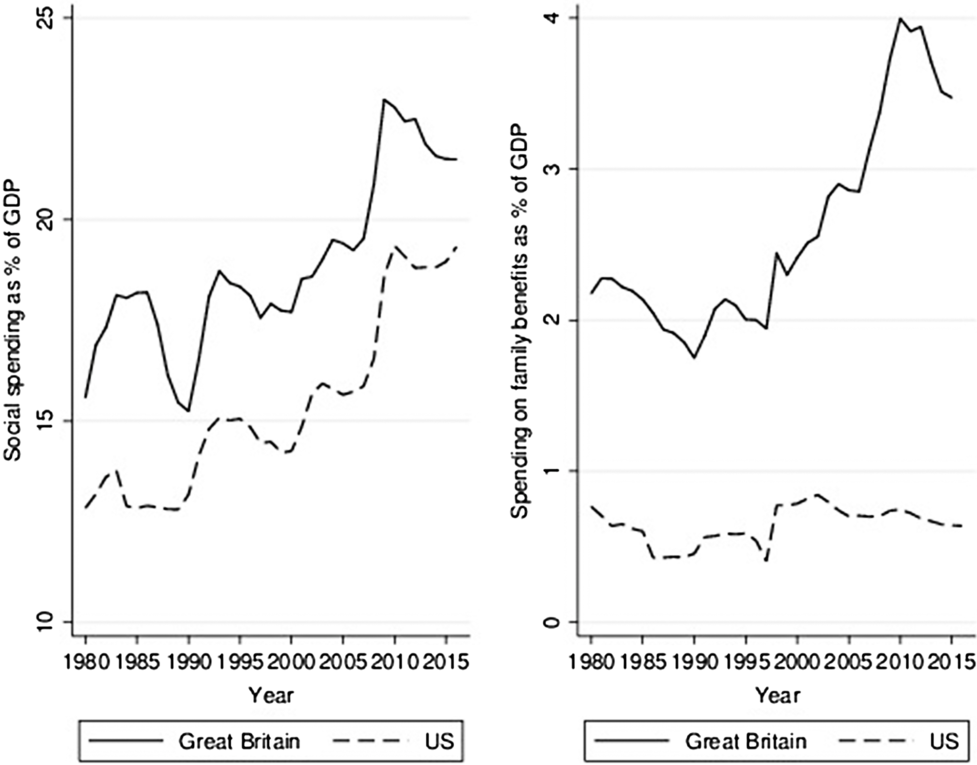
This discussion suggests that there should be important differences in gender gaps in preferences for redistribution between contexts with higher and lower welfare provision, with gender gaps in the latter expected to be larger and more consistent. This is because in contexts of lower welfare provision, women can be expected to be more economically vulnerable relative to men than in contexts of higher welfare provision. This can be seen in the comparison of the USA and Britain. While the USA and Britain are both ‘liberal’ welfare regimes, Britain has much higher levels of spending than the USA, having also been described as ‘proto social democratic’ in its social policy (Clarke, et al., Reference Clarke, Langan, Williams, Cochrane, Clarke and Gewirtz2001; Edlund and Svallfors, Reference Edlund and Svallfors2012). To illustrate this, Figure 1 shows social spending and family policy spending in both the USA and UK since 1980, as a percentage of GDP. Social spending includes benefits and provision for low-income families, the elderly, disabled, unemployed, or children. Family policy spending includes child-related benefits, parental leave income support, and childcare support. The figure shows that UK spending is consistently ahead of the USA on these two indicators, and when it comes to family spending, the USA has seen no change since 1980. This is particularly noteworthy given that family spending encompasses those developments which might particularly support women – especially mothers.
Social spending and spending on family benefits as a % of GDP 1980-2016 in the US and Britain.

The difference between the two countries can also be assessed in terms of services provided by the state, again especially in terms of those which might particularly impact women rather than men. In Britain, the National Health Service is based on universalist principles, the British state provides for a minimum level of childcare and a lengthy period of statutory maternity leave, as well as guaranteeing that a portion of this be paid – but all of these provisions are either weak or non-existent in the USA. On maternity benefits, for example, women in Britain have had access to some entitlement since 1975, which has steadily increased in both length and generosity, but there is still no country-wide provision for paid maternity leave in the USA.Footnote 4 The law in Britain mandates equal pay between men and women, again since the 1970s, but there is no equivalent national-level law in the USA.Footnote 5 Perhaps unsurprisingly given these differences, the USA has consistently had a higher score on the Gender Inequality Index, compiled by the UN, than Britain.Footnote 6
Since women are expected to be on lower incomes, have greater caring responsibilities, and come into greater contact with state services, we should expect that the social spending, services, and social rights described above are of particular relevance to them. This suggests that the gender gap in support for spending and redistribution should be greater in the USA than in Britain, because for women in the USA there is a large and consistently unmet demand from women for more services and redistribution. Where Kellstedt et al. (Reference Kellstedt, Peterson and Ramirez2010) compare the gender gap in response to changing policies over time, we argue that we should also expect to see differences in the gender gap in response to different policies across place. Thus, we expect a much larger gender cleavage on these issues in the USA where social spending has been consistently low compared to Britain which has relatively higher welfare provision. This leads us to our first hypothesis:
Hypothesis 1 (H1): The gender gap in support for spending and redistribution will be greater in the US (lower welfare provision) than in Britain (higher welfare provision).
Generational change in the attitudinal gender gap
Recent work in the field of gender gaps has highlighted that focusing on the aggregate-level gender gap as in the discussion above – that is, comparing all men and all women – is problematic since gender gaps vary by generation, and ignoring this variation risks underestimating the role of gender in shaping political attitudes and behaviour (Shorrocks, Reference Shorrocks2018). There are substantial differences between generations of women (and men, although to a lesser extent) in terms of both the social and economic roles that they occupy, and their formative experiences, which should lead us to expect differences in gender gaps by generation. Theories of generational socialization argue that key political behaviours and attitudes are developed during childhood and young adulthood, when young people are becoming aware of the political world, but then become more stable after this point (Mannheim, Reference Mannheim and Kecskemeti1968; Alwin and Krosnick, Reference Alwin and Krosnick1991; Bartels and Jackman, Reference Bartels and Jackman2014). Generations thus differ from each other attitudinally based on their differing experiences during these formative years. Gender gaps should thus form generationally, and gender gaps in vote choice in particular have been shown to vary by generation in Britain, the USA, and Western Europe (Shorrocks, Reference Shorrocks2016, Reference Shorrocks2018; Harsgor, Reference Harsgor2017). As a result of this expectation, we take a generational perspective when examining attitudinal gender gaps in this paper.
The modernization perspective on generational change in the attitudinal gender gap, put forward by Inglehart and Norris (Reference Inglehart and Norris2000, Reference Inglehart and Norris2003), argues that structural changes have altered men's and women's roles and thus led to growing differences between men and women in socioeconomic position. These changes have particularly occurred for younger generations and are understood to make women less economically secure relative to men. This is because, for example, women receive lower pay than men in the labour force but are also less likely to be married and are therefore more dependent on their own, rather than their husband's, income. Other research supports this perspective. Manza and Brooks (Reference Manza and Brooks1998) have argued that women's greater entry into the workforce has increased their preference for social spending because working women are often employed in the public sector, require childcare services, and if they are in low-paid jobs, they further require income maintenance. Togeby (Reference Togeby1994) emphasizes how while women have entered new economic roles in the workforce at higher rates, this has not been coupled with a comparable decrease in home and family responsibilities as women still take on a disproportionate amount of caring and domestic tasks, leading them to be more supportive of social spending and the provision of state services. Others have argued that the decline in marriage has made men richer and women poorer (Edlund and Pande, Reference Edlund and Pande2002). Such changes in women's roles within and outside the home have occurred generationally, with each new generation of women becoming more likely to participate in the labour force and less likely to be married. As a result, the modernization approach would suggest that each new generation of women should become more supportive of redistribution and social spending than the last, widening the gender gap between men and women in younger generations.
However, the changes associated with modernization can also be seen as making women economically better off in absolute terms since they no longer need to depend on men for an income and can choose of their own free volition if they desire to enter emotional partnerships or not. Moreover, younger generations of women have fewer care responsibilities on average compared to older generations of women, partially due to declining marriage and fertility rates but also especially in contexts where there is greater availability of welfare provision and social care. The modernization perspective does not take into account changes in public policy which may ameliorate some of the negative effects of social change on women's economic position, but the development of social and family policy to support working women and extend family care services is likely to be an important factor in whether women in younger generations are, in fact, economically worse off in relation to their older counterparts. Theories of generational socialization would expect the situation with respect to social and family policy during the formative years to be particularly relevant, since this is a crucial time of attitudinal formation.
Welfare and family policies have developed in Britain over time. As noted above, key provisions with respect to maternity leave and equal pay were introduced in the 1970s, and these were extended during subsequent time periods. Although the Conservative governments of the 1980s and 1990s in Britain in some ways rejected the ‘post-war consensus’ based around high spending, Keynesianism, and nationalization, they did not significantly reduce social spending during this period, and key services such as health and welfare were not privatized along with other industries (Bean and Papadakis, Reference Bean and Papadakis1998; Gamble, Reference Gamble2015). Importantly, key provisions began to be made during this period that would reduce the economic insecurity among women produced by the combination of greater labour market demands and childcare responsibilities described above. For example, the Conservative government of the 1990s introduced policies to help lone mothers with childcare (Clarke, Reference Clarke, Annesley, Gains and Rummery2007). Furthermore, the New Labour governments 1997–2010 introduced policies that were explicitly designed to help working women, with maternity leave policies which grew in comprehensiveness and the expansion of the provision of free or subsidized childcare (Annesley et al., Reference Annesley, Gains and Rummery2007; Clarke, Reference Clarke, Annesley, Gains and Rummery2007). This is seen in the growth in family spending after 2000 shown in Figure 1. This suggests that through to the end of the century in Britain, women gradually became economically better off compared to the past as a result of both increased entry into education and the labour force and continued welfare provision and the gradual accrual of social rights, which enabled women to take advantage of their greater economic opportunities by relieving them of (some of) their social care responsibilities. It is difficult to say the same for younger women in the USA, who face many of the same social changes that are associated with making women more economically vulnerable relative to men over time, but without the supportive policies from the state adopted in Britain.
As a result, younger generations of women in the USA have seen gradually changing gender roles, but without action from the state that would support such changes. This mismatch between demand and reality becomes steadily worse in younger generations in the USA, as women in each new generation increasingly adopt new, less traditional gender roles with little support from the state. This is particularly striking when we look at family spending in the USA in Figure 1, which has remained fairly stable since 1980. This is during a time when demand, for example, for childcare provision should have increased with women's growing labour force participation. Conversely, younger generations in Britain have seen similar changes to gender roles, but the state has broadly enacted policies that support such changes, that is, allow women to combine paid employment, caring responsibilities, and which provide economic support for women. This suggests that a modification to the modernization perspective is required: in some cases (i.e. Britain), women of younger generations are experiencing less economic vulnerability in their formative years, and as a result we should expect here a narrowing of the attitudinal gender gap. This reasoning thus results in another differential hypothesis for the two countries with respect to cross-generation change in the attitudinal gender gap in support for redistribution and social spending.
Hypothesis 2 (H2): In Britain (higher welfare provision) the gender gap in support for spending and redistribution narrows for younger generations. In the US (lower welfare provision), the gender gap should increase for these generations.
Data and methods
In this paper, we wanted to analyse the gender gap across generations in contexts of both low and high welfare provision. The USA and Britain are excellent cases as they allow us to employ a broadly ‘most similar systems’ design where the major distinction involves the level of welfare provision, measured both in spending and the provision of services and social rights. Both countries are liberal democracies, broadly considered to be liberal welfare regimes, and both experienced neoliberal turns after the late 1970s, when governments in both countries embarked on a programme of privatization and aimed to reduce the role of government. Thus, these are two similar countries in many respects but crucially differ on the level of welfare provided for their citizens.
In order to analyse cross-national and generational changes in attitudes, this paper employs data from three large over-time studies: the British Election Study (BES) (1987–2015),Footnote 7 the ANES (1982–2008),Footnote 8 and the International Social Survey Programme (1985–2016).Footnote 9 The BES and ANES provide large samples (13,865 in the BES; 9137 in the ANES) – which are particularly useful when sub-setting the data by generation and gender – with a comprehensive set of control variables, but have slightly different dependent variables in the two countries. The ISSP has smaller sample sizes (4250/4281 in Britain; 3682/3670 in the USA, depending on the dependent variable used) and fewer control variables but fielded the same dependent variables in both countries. We thus use all three datasets in order to comprehensively test our hypotheses.
For the ANES analysis, we use the following question and 1–7 scale: some people think the government should provide fewer services, even in areas such as health and education, in order to reduce spending. Other people feel that it is important for the government to provide many more services even if it means an increase in spending. Where would you place yourself on this scale, or have not you thought much about it? (1) Government should provide many fewer services: reduce spending a lot – (7) Government should provide many more services: increase spending a lot.
For the BES data, we use the following question and 1–11 scale: some people feel that government should put up taxes a lot and spend much more on health and social services (1). Other people feel that government should cut taxes a lot and spend much less on health and social services (11). And other people have views somewhere in-between. Which comes closest to your own views about taxes and government spending?
In the ISSP, we use two questions which ask about health and education spending, respectively, with the same question stem: listed below are various areas of government spending. Please show whether you would like to see more or less government spending in each area. Remember that if you say ‘much more’, it might require a tax increase to pay for it. (1) Spend much more; (2) spend more; (3) spend the same as now; (4) spend less; and (5) spend much less. We treat this as a 1–5 scale in the analysis below in order to be consistent across datasets, but we get very similar results if we treat this variable as categorical (i.e. through ordered logit regression).
The BES and ISSP variables are reverse-coded in our analysis so that higher values indicate greater support for taxation and spending. These questions were selected because they explicitly ask about the trade-off between taxation and spending on key social provisions, capturing opinions on redistribution and social spending. They also avoid using the words ‘welfare’ or ‘poor’ which have been found to produce very different responses in the USA (Page and Shapiro, Reference Page and Shapiro1992).
The choice of these three datasets was informed by the need to have repeated cross-sections providing data on the same generations in multiple years, in order to isolate generational differences. Age and period effects are potential confounders for the effect of generation. It is often found that people become more conservative as they age (e.g. Tilley and Evans, Reference Tilley and Evans2014), and certain historical moments – or periods – are understood to change everyone's attitudes. As such, in order to identify generational effects, we need to control for both age and period, or year of survey, in our models. This raises an identification problem since the three effects of age, period, and cohort are in a linear relationship with each other; as soon as we know two values, we know the third:
 $${Year \;of \;birth = Year - Age}$$
In order to address this problem, we follow the method presented in Grasso (Reference Grasso2014) and specify age–period–cohort models with a categorized generation variable which reflects theoretical distinctions between generations based on the historical periods. We then apply generalized additive models (GAMs) to plot an identified, smoothed cohort effect to check the robustness of the generational groupings. This combined method allows us to deal with the identification problem in this context.
Year of birth is the key independent variable to test H2. We group respondents into political generations based on when they spend the majority of their formative years.Footnote 10 We use similar generational groupings to Grasso et al.'s (Reference Grasso, Farrall, Gray, Hay and Jennings2017) study, in order to ensure that we group birth years together which have previously been found, due to socialization experience, to be similar in their redistributive and spending preferences. We thus define four key periods in both countries: pre-war, post-war, neoliberal, and third way. Furthermore, and particularly relevant for our hypotheses, this groups respondents into generations who entered adulthood and the labour force under similar policy contexts: during the ‘post-war consensus’, the neoliberal period (Thatcher/Reagan), and the ‘third way’ (Blair/Clinton). Table 1 shows the key historical periods and years of birth for these generations. We include this variable generation in OLS regression models and then use the GAMs to cross-check the results from the age–period–cohort models. The GAMs impose no functional form on the cohort variable and so enable us to visually inspect the cohort patterns and assess whether this matches the generational grouping used in the OLS models.
Generations in the USA and Britain

The differences in the coding between the USA and British generations take into account that Thatcher was elected 2 years earlier than Reagan, and Blair was elected 4 years after Clinton.
* This period includes Bush Jr.
Previous research has identified that the post-war generation in Britain is the most supportive of social spending, and that the neoliberal and third way generations are less supportive (Grasso et al., Reference Grasso, Farrall, Gray, Hay and Jennings2017). Our hypotheses are not concerned with these general generational trends but about the gender gap changes between generations. In order to test our hypotheses, we thus include an interaction between generation and gender, a dichotomous variable for whether the respondent is a woman. We expect the gender gap to get smaller for the youngest (neoliberal and especially third way generations) in Britain, but not in the USA, in line with H2.
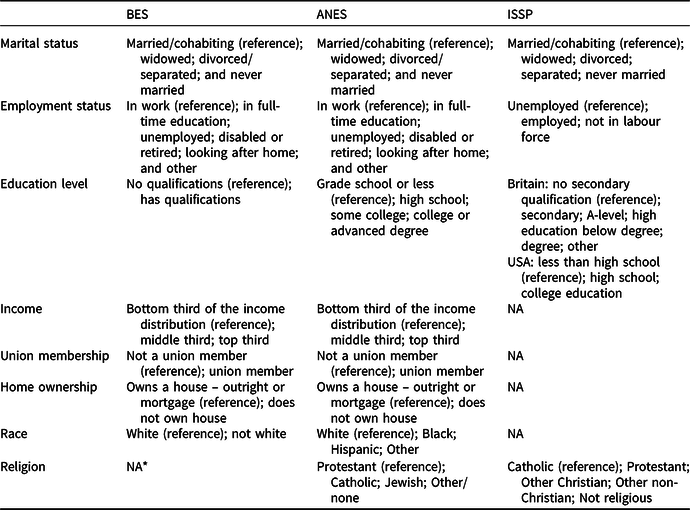
Model 1 for each dependent variable thus includes generation and its interaction with gender, age (under 34 years; 35–59 years; and over 60 years),Footnote 11 and year of survey. Model 2 includes measures of socioeconomic characteristics. This allows us to test whether it is the socioeconomic characteristics of generations that matters for the attitudinal gender gap or whether gender differences remain once we control for these characteristics – which would suggest an important role for formative years socialization. The socioeconomic measures we use are home ownership, marital status, union membership, income band, social class, education level, employment status, race, and religious denomination. We have made every effort to harmonize the coding of controls across datasets, but not all are available in every dataset – especially the ISSP. Table 2 below shows the controls used in each dataset.
Coding of control variables

NA = not available.
* We do not include religion in the modules using the BES because, although religious identification is available in all the waves included in our analysis, including it in our models results in a high number of missing values. As a robustness check, we conducted the analysis on the reduced sample required by the BES of religious identification is included. Religion is not statistically significant in predicting our dependent variable, and its inclusion does not affect our results.
Results
First, we discuss some basic descriptive results. Gender gaps throughout this paper are calculated as women's mean placement minus men's mean placement, so positive numbers indicate women are more supportive of redistribution and spending. The gender gap across all years for the ANES tax-spend indicator is 0.42 (p < 0.001), while for the BES tax-spend, it is half that size at 0.22 (p < 0.001). These continuous scales are different but the scale in Britain (11 points) is larger than that in the USA (7 points), making the fact that the gender gap is smaller in Britain more significant. Another way of looking at this is to look at the gap as a percentage of the overall scale. In the USA, the size of the gender gap is 6.3% of the 1–7 scale, while in Britain, it is only 2% of the 1–11 scale. Thus, to the extent that the numbers can be compared, the gender gap is larger in the USA than in Britain using the continuous dependent variables.
However, looking at the ISSP, it is not clear that the gender gap is larger in the USA than in Britain. In the USA, the gender gap in attitudes to health spending is 0.08 (p < 0.01) on the 5-point scale, and 0.09 (p < 0.01) for attitudes towards education spending. In Britain, the gender gap for health spending is 0.09 (p < 0.001) and for education spending is 0.07 (p < 0.01). This indicates very small differences in the gender gaps between the countries. We therefore have very limited evidence for H1: it seems to be the case when comparing the indicators from the ANES and BES, but not in the ISSP where the indicators are comparable.
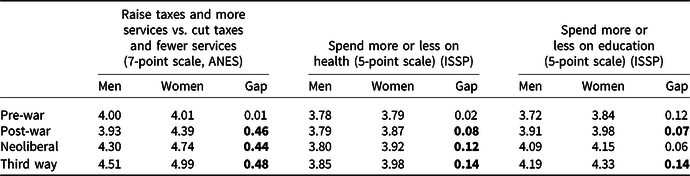
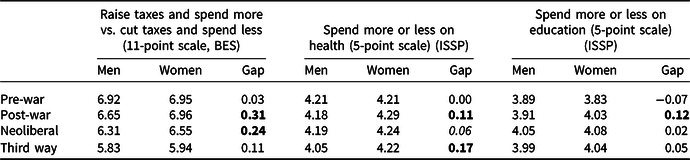
Gender gaps by generation are presented in Tables 3 and 4. The results show the raw means in support for redistribution and spending for men and women across generations, as well as the gender gap, in the USA and Britain. In both countries, for all questions, there is no statistically significant gender gap for the pre-war generation. The exception is for education spending in the USA, where there is a large, albeit statistically insignificant (p > 0.1), gender gap for the pre-war generation, where women are 0.12 higher on the 1–5 scale than men. However, the expected gender gap where women are more supportive of redistribution and social spending is found in the post-war generation (born 1920s–50s) in both countries, for all question types. For this generation, the post-war gender gap is larger using the ANES continuous scale than the BES continuous scale but smaller in the USA than Britain if we compare the questions from the ISSP.
Support for spending in the USA by gender and generation

Gender gaps in bold are statistically significant at p < 0.05. Gender gaps in italics are statistically significant at p < 0.1. The gap is calculated as women's mean placement – men's mean placement.
Support for spending Britain by gender and generation

Gender gaps in bold are statistically significant at p < 0.05. Gender gaps in italics are statistically significant at p < 0.1. The gap is calculated as women's mean placement – men's mean placement.
Here, the similarity between the countries ends. The gender gap in the USA for the neoliberal and third way generations remains positive and statistically significant with the third way gender gap similar to or larger than that for the post-war generation. The exception is again for the ISSP question on spending more on education, where the gap for the neoliberal generation is statistically insignificant, although similar in size to that of the post-war generation. In Britain, for the BES scale and the ISSP question on education, the gender gap narrows for the neoliberal and third way generations compared to the post-war generation. The exception in Britain is the ISSP question on spending on health, where the third way generation has a very large gender gap – and in fact this appears to be the largest gender gap in any country on the ISSP indicators. These results are partially consistent with H2, which expected smaller gender gaps for the younger generations of women in the higher welfare context – Britain. The results of two of the three indicators in Britain are consistent with this hypothesis.
It is worth also noting that, although we are not concerned with the general generational trends here, they are broadly consistent with prior research into generations and attitudes in both countries (Russell et al., Reference Russell, Johnston and Pattie1992; Fullerton and Dixon, Reference Fullerton and Dixon2010; Edlund and Svallfors, Reference Edlund and Svallfors2012; Grasso et al., Reference Grasso, Farrall, Gray, Hay and Jennings2017; Neundorf and Soroka, Reference Neundorf and Soroka2018). Younger generations in the USA become more supportive of redistribution and social spending, while this is less consistent in Britain, where older generations already had higher levels of support for redistribution and social spending.
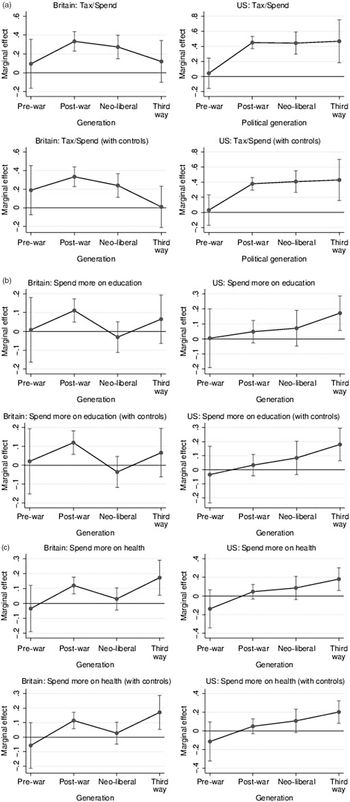
We now turn to the regression models. Figure 2a–2c illustrates the marginal effect of gender from models 1 (without controls) and 2 (with controls) for each generation to aid interpretation, for each of the indicators, respectively. The marginal effects are given 95% confidence intervals, and when this interval crosses the zero line, the gender difference within that generation is statistically insignificant at p < 0.05. The full tables are available in the Supplementary Material.
Marginal effect of gender on support for tax-spend scale, education spending, and health spending in Britain (first column) and the US (second column).

The results are largely consistent with those shown descriptively in Tables 3 and 4, although adding age and period controls appears to offer more support for our generational hypothesis, H2. In Britain, in Figure 2a and 2b, the effect of gender is largest for the post-war generation and then narrows for the younger generations. This is particularly the case for the tax-spend scale (BES) and education spending (ISSP) indicators, where the neoliberal and third way generations have smaller gender gaps than the post-war generation in Britain. This difference is statistically significant (p < 0.01) for education spending when comparing the post-war and neoliberal generations and marginally significant when comparing the post-war and third way generations (p < 0.1). Moreover, there is no statistically significant difference between the gender gaps in the neoliberal and third way generations on this indicator. The gender gap between the post-war and third way generations is also statistically significant (p < 0.01) for the BES tax-spend scale.Footnote 12 In Britain, the indicator for health spending (ISSP) is more inconsistent with our expectations: the neoliberal generation has an insignificant gender gap, and the difference between this and the post-war generation is marginally significant (at p < 0.1). However, the marginal effect of gender is substantively large and statistically significant for the third way generation on this indicator.
In the USA, the size of the effect of gender is either consistent or getting larger for all generations born after 1925, and there is a statistically significant gender gap by the third way generation for all indicators. The third way gender gap is statistically significantly larger than the gender gap for the post-war generation (p < 0.05) for the ISSP indicators, although the gender gaps in the ANES for all post-war generations are very similar in size. These findings are broadly consistent with H2, as in the lower welfare context of the USA, women are consistently more supportive of redistribution and social spending than men in all post-war generations, and for the spending on education and health indicators, this grows for each subsequent generation. In the higher welfare context of Britain, we do not see this consistent pattern and the neoliberal generation always has a smaller gender gap than the post-war generation. Moreover, including the sociodemographic variables in model 2 had very little effect on the gender-by-generation patterns. This indicates that something other than the relative social and economic positions between men and women is responsible for the gender gap in both countries. We argue that experiencing differences in welfare provision and public policy in the formative years are likely important for generating these cross-country differences.
We can also directly compare the magnitude of the predicted gender gaps in percentage point terms in the two countries. In the ISSP indicators on health and education spending, the gender gaps for the post-war generation are larger in Britain than in the USA. Conversely, the gender gaps for the neoliberal and third way generation are larger in the USA than in Britain, with the exception of the third way generation on the health spending indicator, where they are of a similar size in the two countries. Direct comparison between the BES and ANES is hard, but the magnitude of the effect of gender in each generation can be compared to the magnitude of the effect of other variables. In the USA, the size of the gender gap for all generations except the pre-war generation, in the model with the controls, is about 0.4 on the 1–7 scale. This is larger than the effect of employment status, union membership, education, marital status, income, social class, or being a Catholic. The only variables which have a larger effect are race and being Jewish. This shows that the gender gap in support for redistribution and social spending is of a substantial magnitude in the USA, for all generations born after 1925. In Britain, the gender gap for the generation with the largest gender gap – the post-war generation – is just over 0.3 on the 1–11 scale. Again, this is larger than the effects of employment status, union membership, education, marital status, income, or social class, and only dwarfed by the effect of ethnicity. However, for the neoliberal generation, where the gender gap is about 0.2, the effect of employment status is larger, and for the third way generation, where the gender gap is effectively zero, the effect of all other socioeconomic variables is larger than that of gender. Taken together, the results show that gender can have a substantial effect in Britain, but this is only consistently demonstrated across all indicators for those born from the 1920s to 1950s. For the younger generations, gender appears to be a less important influence on attitudes towards spending and redistribution than other socioeconomic variables.
Robustness checks
The GAMs act as a robustness check on the results presented here. The full results can be found in the Supplementary Material. The smoothed terms suggest that the generational categorization applied from the theory is broadly valid. Moreover, they show that our conclusions with respect to the trends in the gender gap also hold when the models are specified in this way. The gender gap grows (ISSP) or remains consistent (ANES) across generations, while there is a larger gender gap for the post-war generation in Britain than for the other generations. The results are also robust to including interactions between gender and period, gender and age, and age and period in the model. These interactions are almost always statistically insignificant and, most importantly, do not affect the generational results and do not change the substantive conclusions presented above.
Discussion and conclusions
This paper examined how the gender gap in attitudes to redistribution and social spending changes across generations in contexts of lower and higher social spending – specifically, the USA and Britain. We do not find evidence for H1, that gender gaps are larger in the USA than Britain. We find more evidence, although still mixed, for H2: that the generational trends in attitudinal gender gaps differ between the USA and Britain. In the USA, the attitudinal gender gap is either consistently large (tax-spend scale, ANES) or growing (education and health spending, ISSP) across generations. Conversely, in Britain, the gender gap narrows for younger generations born after 1960, and for two indicators (tax-spend scale, BES and education spending, ISSP) is also smaller in the youngest generations (especially neoliberal but also third way) than it is for the post-war generation. When it comes to the health spending indicator in the ISSP, however, the gender gap does indeed narrow from the post-war to the neoliberal generation in Britain, but then is much larger again for the youngest, third way generation.
This finding for the youngest generation for health spending in Britain is contrary to our hypotheses and thus presents a puzzle. It could be that there is something specific about health spending that means that the youngest generation of women in Britain is particularly supportive of more health spending compared to the youngest generation of men. This would suggest that policy domain is relevant when discussing attitudinal gender gaps. However, health is also mentioned explicitly in the BES tax-spend indicator which shows quite a different pattern for this generation – one of a closing gender gap. Alternatively, the GAMS could shed some light here. When examining the continuous trend in the gender gap rather than how it appears in each generation, it appears that the gender gap actually grows in size during the neoliberal generation, before decreasing again for the third way generation. As a result, the generation coming of age at the end of the neoliberal generation and beginning of the third way generation shows a similar gender gap in terms of health spending as the post-war generation – but this then decreases again for the very youngest. This could potentially be related to the more anti-state position of the Conservative governments in the 1980s and 1990s, which is then reversed somewhat by New Labour in the late 1990s and 2000s. However, this is a post hoc explanation and does not seem to occur for the BES tax-spend indicator, which also mentions health. Finally, it could be that we should not draw strong conclusions about this youngest generation using these data: there are only around 500 respondents in the third way generation for Britain in the ISSP, compared to over 700 for the third way generation in the USA in the ISSP, and over 1100 in the BES, and they only enter our sample in the 2006 wave. Since we do not observe this generation as much as the other generations, and there are fewer of them, perhaps it is not possible to make strong inferences regarding them from the data we have. To some extent, we will have to wait for future trends in order to ascertain the gender difference that is present in this generation.
Generally, while there are the idiosyncrasies across our datasets and indicators as discussed above, we find that the generations born after 1960 have smaller gender differences on attitudes towards redistribution and social spending than the immediate post-war generation in Britain, but a similarly sized or larger gender difference compared to the post-war generation in the USA. We suggest that different levels of welfare provision in the USA and Britain lead to these important differences in the gender gaps across generations. Both countries have experienced rising female employment and education, in line with other advanced post-industrial nations. However, in Britain, that has been combined with higher levels of welfare provision and policy changes that make it easier for women to combine work and family life, which increased women's economic security and material living standards. As a result, we argue women of younger generations in Britain became more similar to men in their economic preferences as their socioeconomic position improved. This is consistent with arguments that emphasize women's economic vulnerability but merely recognizes that women's economic vulnerability has reduced over time, and that there may be less difference between men and women in terms of economic vulnerability in certain contexts.
In contrast, in the USA, there is a much weaker social safety net than in Britain – for example, guaranteed paid maternity leave still does not exist in the USA. Although welfare spending has increased over time in the USA, as suggested by Figure 1, family spending has not, and key reforms which might particularly support women have not been enacted. This suggests that the modernization perspective and associated arguments which emphasize women's increased economic vulnerability over time – as a result of declining marriage rates and greater entry into employment coupled with a lack of social protection from the demands of caring – apply much more in the USA case than in Britain. We argue that this is why we see a consistent or growing gender gap for all younger generations in the USA where there are unmet demands from women for more social spending. In Britain, by contrast, younger generations of women may not see fundamental provisions as under threat and may feel more economically secure than in the USA and are therefore no more demanding of redistribution and social spending than men – at least for two out of our three indicators. Thus, we suggest that gender differences remain more marked in country contexts characterized by less generous welfare, especially in younger generations.
Our analysis shows the importance of going beyond examining the aggregate-level gender gap where we compare all men and women and consider how gender gaps vary – in this case, by generation. While the differences between the countries are less obvious when we examine the gender gap for all generations pooled together, once we examine it by generation, we can see important differences between Britain and the USA in how gender is related to attitudes on redistribution and social spending. Moreover, we also show that explanations for change in gender gaps, generational or otherwise, which emphasize common causes across post-industrial nations, such as modernization theory, have important limitations: country-specific contexts can produce different gender gaps within different generations.
This analysis has focused on comparing generational trends in Britain and the USA, as a first, exploratory, test of our theory, but the suggestion that gender gaps in support for redistribution and social spending are related to welfare and other types of government policy is a worthwhile area of investigation and would benefit from further comparative research, especially encompassing other welfare regime types. For example, Social Democratic welfare regimes in Scandinavian countries have even more comprehensive welfare state provision than Britain but are also characterized by large gender vote gaps in younger generations (Shorrocks, Reference Kamas and Preston2018). Analyses including more countries and direct measures of welfare provision in a comparative context would provide a more wide-ranging test of the theory developed in this paper and tease out the complex relationships between public policy provision and attitudinal gender gaps. Technical issues concerning co-varying trends and a lack of variation in family policy spending over time in the USA meant we were unable to include direct measures of public spending in our analysis here, but we suggest that testing the relationship between this and the attitudinal gender gap cross-nationally would be particularly fruitful.
These findings also have important implications for the practice of politics more widely, including political campaigns and outcomes. Politicians in the USA and Britain often try to target the ‘women's vote’, but this may be easier in the USA since women's preferences are more stable, both across generations and relative to men. However, in Britain, it is less clear what would appeal specifically to women voters as a bloc when gender differences in preferences alter across generations quite so distinctly. The gender gap in attitudes across generations in the USA is likely to contribute to the existence in modern elections of the gender gap where women are more supportive of the Democrats than men. The changing attitudinal gender gap in Britain is possibly one of the reasons why such a gender vote gap has not emerged there (Campbell, Reference Campbell2012; Shorrocks, Reference Shorrocks2016), given the less consistent attitudinal gender gap across generations. Future research should develop these analyses of the gender gap in attitudes across generations for other national contexts as well as for other types of policy-related attitudes where suitable over-time data are available. These analyses would further inform our understanding of the link between public policy and public opinion, and how this can be mediated by gender.
Acknowledgements
We would like to thank Stephen Fisher, Rosie Campbell, Charles Pattie, Liran Harsgor, and the participants at the 2016 Elections, Public Opinion, and Parties Annual Conference for their helpful comments on earlier versions of this paper. We would also like to thank the three anonymous reviewers.
Supplementary material
To view supplementary material for this article, please visit https://doi.org/10.1017/S1755773920000120.