INTRODUCTION
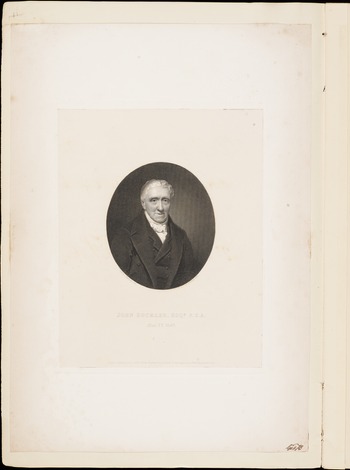
In her bicentennial history of the Society of Antiquaries of London, Dame Joan Evans headed a chapter ‘Years of War, 1793–1815’.Footnote 1 The title alluded as much to the internal conflicts of the Society as to the ongoing war with France. In particular, she referred to the antagonism felt by some members of the Fellowship against the building restoration projects of the architect James Wyatt (1746–1813). As is well-known, Wyatt – Surveyor of the King’s Works (1796–1813), which included responsibility for Somerset House, where the Society held its meetings – was the subject of a blackballing scandal at the Society. Wyatt faced opposition from its preservation-minded faction led by the former director Richard Gough (1735–1809) and the architect John Carter (1748–1817), following Wyatt’s controversial restoration of Salisbury Cathedral, which had begun in 1789. When his candidacy for membership to the Society arose in 1797, Wyatt was blackballed. Although he was elected after a further election, one enduring manifestation of the ‘War on Wyatt’ was a general increase in the blackballing of candidates. One ill-fated victim was the antiquarian artist and architect John Buckler (1770–1851) (fig 1), who, as Evans observed, ‘doubtless owed [his double blackballing in 1808 and 1809] to his friendship with Gough and Carter’, before finally gaining membership in 1810.Footnote 2
An engraved portrait of Buckler by John Outrim, after Sir William John Newton (1850) included in the title page of Buckler’s collected letters. Photograph: Bodleian, ms Buckler, fol ii.

The blackballing of Buckler, the subject of this paper, was of great significance to him and to the eccentric, somewhat off beam antiquarian dynasty that bears his name, comprising his sons John Chessell Buckler (1793–1894) and George Buckler (1811–86), and his grandson Charles Alban Buckler (1824–1905) – they were united by their indefatigable reverence for the Gothic past. As Sir George Gilbert Scott said of them, his Gothic kinsmen, in 1866: ‘The bent of their minds for three generations has been in the mediaeval line.’Footnote 3 John Buckler’s ultimate bestowal of the post-nominal FAS institutionalised the Buckler dynasty, sowing the seeds for a disposition about architecture, conservation and recording that would endure, over three generations, until the turn of the twentieth century.
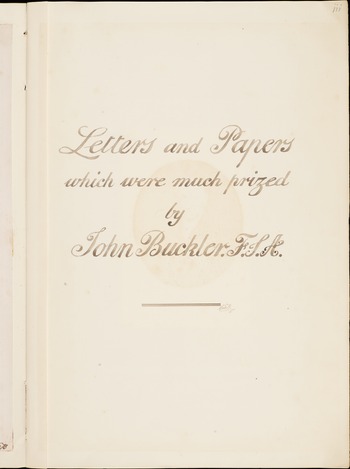
The blackballing scandal is recorded in a remarkable cache of letters (fig 2) held at the Bodleian Library, Oxford, the key source for this article. Titled ‘Letters and Papers which were much prized by John Buckler FSA’, the portfolio includes 220 items.Footnote 4 Following an introduction to Buckler and the Buckler dynasty, and a general introduction to his correspondence network, his letters will be scrutinised in two further sections. The first section will examine the correspondence specific to Buckler’s electoral efforts at the Society, the subject of no fewer than eighty-five letters dating from January 1807 to April 1810. The testimonies of different correspondents allude to several reasons why Buckler was blackballed: it had to do with professionalism, factionalism and his views on the conservation of medieval buildings. These ideas will be fleshed out in the second section, which considers the role played by Buckler’s antiquarian network in the formation of his approach to the representation and recording of medieval buildings, later inherited by John Chessell Buckler, and the subject of the remaining letters in the portfolio spanning the years in which Buckler was active: 1796–1851. They shed light on his (and his patrons’) self-conscious adherence to a form of representational accuracy propagated by Gough and Carter that Noah Heringman has described as Gough’s ‘Science of Preservation’, namely ‘a scientific domain for antiquarianism [that placed] an unfashionable emphasis on material culture’.Footnote 5 Heringman identified two key strands of this ‘science’ to which Buckler subscribed: the creation of a visual record of medieval buildings, and the critique of historically unfaithful alterations. The ‘Carter school’, a term used explicitly by John Chessell Buckler in autobiographical passages written in 1858, has been described by Rosemary Hill as ‘a minority, all but a coterie, within the Society of Antiquaries’.Footnote 6
Title page of ‘Letters and papers which were much prized by John Buckler FSA’. Photograph: Bodleian, ms Buckler, fol iii.

The paper will also foreground the antagonisms Buckler faced in negotiating his role as a ‘gentleman’ amateur versus that of a professional artist. As a whole, the paper will further enrich our understanding of the role of the Society in the development of neo-medievalism, architectural history and buildings archaeology, and, in particular, approaches to the conservation of medieval buildings. Moreover, it will tell Buckler’s story for the first time. Rescuing him from the relative obscurity into which posterity has cast him, it will explain his own role in the developing discourses of antiquarianism and the Gothic Revival, and, finally, the pervasive and enduring fascination with the Middle Ages taken up by his sons and grandson.
JOHN BUCKLER AND THE BUCKLER DYNASTY
Buckler was born in Calbourne, Isle of Wight, into a family of cordwainers. In 1785, aged fifteen, he moved to Magdalen College, Oxford, to assist Richard Barnard Fisher, the college steward, whom he had known from his birthplace.Footnote 7 Fisher’s family included Col George Bulteel Fisher, an amateur draughtsman and sometime honorary exhibitor at the Royal Academy, who first encouraged Buckler’s serious pursuits as an artist.Footnote 8 Before long, Buckler was articled to the London surveyor Charles Thomas Cracklow (1763–1826), who leased land on Magdalen’s Southwark estate, and likely knew Fisher.Footnote 9 By at least 1801, Buckler had been appointed a bailiff to Magdalen College, overseeing the college’s estates in Southwark and East Newhall in Essex.
Alongside his post as bailiff, which he held for nearly half a century, Buckler established a considerable reputation as a topographical artist, preferring watercolours and aquatint. He was supported by his employer, Revd Dr Martin Routh (1755–1854), the president of Magdalen College, for whom Buckler also acted as agent for the purchase of antiquarian books.Footnote 10 He owed much of his early success to Oxford. For instance, he was one of the contributing artists to the Oxford Almanacks, benefiting from their late eighteenth-century shift in representational focus from allegorical to architectural subjects.Footnote 11 Buckler and John Chessell were also central figures in debates about architecture, especially in Oxford, and played their part in the struggle against the destruction of medieval buildings and the matter of their conservation.Footnote 12
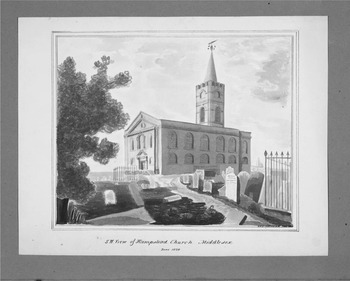
The Bucklers are most remarkable, and best understood, when considered as a dynasty. Dynasties – ie aggrandised families – are acutely self-constructed phenomena, and the Bucklers’ own self-construction always had something of the heroic about it, akin to a fable.Footnote 13 Buckler’s grandson, Charles Alban Buckler, for example, inherited the idea of the Buckler dynasty as standing for protection. In the family history, Bucleriana, he often employed the double-entendre (a fabulist trope, according to Jayne Elizabeth Lewis) of the ‘buckler’ (ie a small round shield), whose verb form means ‘to shield, defend, protect’.Footnote 14 Charles Alban was insisting on the Buckler dynasty as having safeguarded the architecture of their (medieval) forebears against wanton demolition or so-called ‘Improvement’. This idea was solidified by the paterfamilias John Buckler’s association with the Carter school – while Carter was cast as the dynasty’s enduring hero (fig 3), Wyatt was cast as its villain.
‘S.W. View of Hampstead Church, Middlesex’, showing the grave of John Carter with the epitaph ‘sacred to the memory John Carter/antiquarian […]’. George Buckler (1828). Indian ink drawing. Image: Bodleian, ms Top. Gen. c 103 6r.

Buckler was one of the most industrious topographical artists of his time, as encapsulated by the Buckler family’s collection of prints and drawings at the British Library.Footnote 15 He is now generally best remembered for his engravings of the cathedrals and abbey churches of England and Wales, which had brought him fame in his own time.Footnote 16
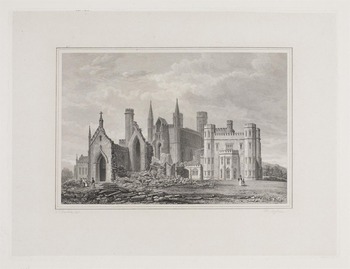
Other markers of his esteem as an artist include: illustrations for Thomas Lister Parker’s ‘Castellated and domestic architecture of England and Wales’ (nd) with John Chessell Buckler; and, with J M W Turner, prints in Thomas Dunham Whitaker’s ‘History of Richmondshire’ begun in 1817, which, according to an advertisement in the Edinburgh Review, was ‘handsomely printed in folio, on fine demy paper, and the large paper copies on superfine royal drawing paper’.Footnote 17 In particular, Buckler enjoyed the generous patronage of Sir Richard Colt Hoare (1758–1838). In line with Colt Hoare’s fondness for Wales, he produced a volume of drawings entitled ‘Ecclesiastical, Monumental and Castellated Antiquities of North Wales’ (1810). Also notable are Buckler’s 690 watercolour drawings for Colt Hoare of ecclesiastical antiquities in Wiltshire (1808–10). It bears mentioning, furthermore – as the ghost of Wyatt was so important to the Bucklers – that he was one of the delineators who depicted Fonthill Abbey (1796–1813), Wiltshire, which Wyatt designed for William Beckford. The third of Buckler’s self-published prints of Fonthill shows the dramatic collapse of the tower in 1825 (fig 4). A pencil inscription below the platemark on one copy echoed Shakespeare’s The Tempest: ‘The Tower fell 21st. December 1825./And thus this unsubstantial Fabrik falling left a sad wreck behind!’Footnote 18 While Fonthill was a saleable subject in a market clamorous for tasteful engravings, its fall, depicted here, might also have symbolised to Buckler, as an architect, his and his colleagues’ recent triumph in perpetuating what they likely perceived as a more erudite school of Gothic than that practised under Wyatt’s leadership.
John Buckler (del.) and Thomas Higham (sculpt.) (c 1825). Fonthill, collapse of the tower. Steel engraving on chine collé. Image: Lewis Walpole Library, Farmington, CT, Babb-Beckford no. 85+.

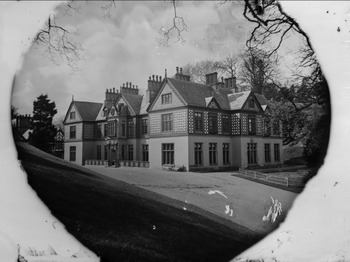
As an architect, Buckler attracted the patronage of conservative aristocratic patrons looking back on the past nostalgically, cherishing remains. Perhaps owing to Colt Hoare’s influence, he had particular fortune gaining commissions in North Wales. Notably, he built: Hawarden Castle, Flintshire (1819), for the Tory politician and antiquary Sir Stephen Glynne; Halkyn Castle, Flintshire (1824–7), for the 2nd Earl Grosvenor (later Marquess of Westminster), a Tory (and then Whig) MP; and Pool Park, Denbighshire (1826–9), for the 2nd Baron Bagot (fig 5).Footnote 19 Buckler displayed a drawing of the latter, a half-timbered neo-Elizabethan pile, at the Royal Academy in 1830 alongside other contemporary works of domestic Gothic architecture by Joseph Gwilt, Anthony Salvin, Thomas Hopper and John Chessell Buckler. The Gentleman’s Magazine argued that, as a whole, these designs, which were hanging in the Library, ‘finely supply the place of the contemptible gewgaws of the Wyatt school […] which formerly occupied this room’.Footnote 20 With this in mind, M H Bloxam in his Principles of Gothic Architecture (1836) identified Buckler – along with Carter – as among the most erudite of the early nineteenth-century professors of Gothic architecture.Footnote 21 Correspondingly, over a century later Sir Howard Colvin observed that Buckler ‘had for his time an almost unrivalled knowledge of medieval antiquities’.Footnote 22
Photograph (1875) of Pool Park, Ruthin, Clwyd (J Buckler, 1826–9). Negative, glass and wet collodion. Photograph: The National Library of Wales.

Buckler also designed churches, including the tower at Holy Trinity at Theale, Berkshire (1827–8), as a new living for Magdalen College, Oxford, and the early ecclesiologically-correct St John the Baptist at Pentrobin in Flintshire (1843) for Glynne, who would later become the vice president of the Ecclesiological (late Cambridge Camden) Society.Footnote 23 But Buckler preferred to draw, and therefore, as he recalled late in his life, ‘I never made any effort to increase the number of my employments as an architect’.Footnote 24 John Chessell, however, built a substantial practice. Most famously, he won the second premium in the Palace of Westminster competition in 1835, and realised Costessey Hall, Norfolk, for the old Catholic family the Stafford-Jerninghams (c 1825–70), later assisted by Charles Alban. The latter converted to Roman Catholicism in 1844 before establishing a practice of his own, designing many Catholic churches and rebuilding Arundel Castle, Sussex (1874–1901), for the 15th Duke of Norfolk. Charles Alban became Surrey Herald of Arms Extraordinary in 1880 and, in 1885 a Donat of the First Class of the Sovereign Military Order of Malta, an illustrious Catholic order of chivalry. He had ascended to a high position in the social hierarchy, miles away from the humble roots of his grandfather.
BUCKLER’S CORRESPONDENCE NETWORK
Like Sir Walter’s Scott’s titular protagonist in The Antiquary (1816) ‘being in correspondence with most of the virtuosi of his time’, Buckler’s letters are a testament to an enduring antiquarian network of correspondence.Footnote 25 Leading cultural, religious and antiquarian figures corresponded with Buckler, including: Sir Joseph Banks (1743–1820), the naturalist and president of the Royal Society who wielded considerable influence at the Society of Antiquaries; Turner, the iconic representative of British Romantic art; the antiquary and topographer John Britton (1771–1857); and senior clergy, such as John Buckner (1734–1824), Lord Bishop of Chichester.Footnote 26 The portfolio of letters contains portraits of the Scottish educationist Revd William Mavor (1758–1837) and the architect Thomas Harrison (1744–1829).Footnote 27 A significant claim appears in a letter from Benjamin West (1738–1820), president of the Royal Academy, claiming, ‘I first directed his [Buckler’s] attention to the drawing of the English Cathedrals’.Footnote 28 West’s friendship may account for Buckler’s fortune in having had pictures accepted at the Academy for fifty-four consecutive years (1796–1849), often two or three per year, at a time when artists squabbled for position and space was hotly contested.Footnote 29 Many of the correspondents were both Buckler’s supporters at the Society’s struggle and patrons of his topographical work; the cleric Edward Balme, for example, remembered in a letter to the librarian Thomas Kerrich in 1820 that ‘Seven Bishops, whose Cathedrals he had published, recommended Buckler’ at the Society.Footnote 30 It is clear from the letters that, as opposed to a largely market-led means of production, Buckler enjoyed private patronage, rather than commercial relationships with his supporters, reminiscent of Wenceslaus Hollar and the Duke of Norfolk.
The Bodleian’s portfolio is the only epistolary collection of its kind within the Buckler family archive. The subject matter of the letters is often seemingly routine, suggesting that Buckler’s retention of the letters enabled him to use them as testimonials for new clients. Thus, for instance, can be found quite unexceptional letters from the architects Sir John Soane (1753–1837) and Sir Robert Smirke (1780–1857), respectively. The former was grateful for an unspecified print from Buckler supplying Soane’s ‘want for the illustration of Bridges’;Footnote 31 Smirke requested outline copies of several of John Chessell’s drawings of cathedrals.Footnote 32 Elsewhere, as we will see, correspondents also keenly engaged in antiquarian discussion with Buckler, evidently valuing his intellect. A case in point is the antiquary John Gage, later John Rokewode (1786–1842), Director of the Society (1829–42). For Rokewode (who had changed his name on inheriting a baronetcy in 1838), Buckler would later publish remarks on the remains of St Mary Overy, Southwark, in Archaeologia.Footnote 33 Part of a distinguished recusant family, he is part of the Catholic-Gothic axis associated with the Carter school (discussed below). As the Buckler letters show, he was also part of the conversation about the development of Gothic and its nomenclature. A case in point is that Rokewode accurately, if hesitantly, debated the meaning of ‘clerestory’ with Buckler, at a time when many architects and antiquaries still had a rudimentary sense of what ‘Gothic’ actually amounted to.Footnote 34
The acquisition history of the letters suggests dynastic motivations. On Buckler’s death in 1851, they became the property of John Chessell, but – via the short possession of the Revd William Buckler, Rector of Illchester – they were handed down to Buckler’s fifth son, George, who arranged them under their present title in 1882. George Buckler was himself a distinguished architect and antiquary. He was in a (mostly nominal) partnership with John Chessell until 1842, worked under Sir James Pennethorne at the Office of Works, and authored Twenty-Two of the Churches of Essex.Footnote 35 His archiving and cataloguing of his family letters can be seen as a means of constructing a dynastic identity, perpetuating the fable of the Bucklers as protectors, in which the blackballing scandal at the Society was centrally formative.
The letters also show that John Chessell inherited representational skills and patronage, together with knowledge and ideals about medieval architecture, from his father. The Revd Joseph R Henderson of Bermondsey, to take one characteristic example, wrote in an undated letter of his satisfaction with a representation of the Abbey of St Saviour, Bermondsey, by John Chessell: ‘I beg to offer Mr B. Jnr. – my best thanks, & congratulations on this early proof of inheriting the clearness & truth of his Father’s architectural pencil.’Footnote 36 Henderson made reference to the younger Buckler’s inheritance of those epithets that underpin the topographical tradition: clearness and ‘truth’ in illustration. In 1894, following John Chessell’s death, The Architect and Contract Reporter reiterated in its obituary how ‘From his father [he] inherited his taste for the study of architecture, and consummate skill in its delineation, composition and practice. His own drawings […] have a touch of native genius rarely if ever surpassed’.Footnote 37
BLACKBALLING BUCKLER
Before detailing Buckler’s own oppositions at the Society, we should first briefly recollect the circumstances of Wyatt’s watershed rebuttal mounted by the Society’s preservationist faction from the 1780s, which included Gough and Carter, as we have seen, and also the Society’s sometime vice president, Sir Henry Englefield (1752–1822), and the Revd John Milner (1752–1826).
Wyatt’s destructive campaigns of ‘Improvement’ at several cathedrals from the 1780s onwards catalysed the conflict. They prompted Gough to advance more forcefully his existing exhortation to not only protect but also increase the study of medieval buildings, a revisionist move to be realised by topographical endeavours with an emphasis on accuracy of representation. Carter, the first draughtsman appointed by the Society, met Gough’s challenge.Footnote 38 Owing to the threat of loss of the Galilee porch of Durham Cathedral during Wyatt’s restoration from 1795, Carter exhibited his commissioned drawings of Durham Cathedral to the Society on 20 November that year, indicating the damages intended or already made to it by Wyatt.
Furthermore, Wyatt’s destructive restoration campaign at Salisbury Cathedral had led to Gough publishing an acerbic letter in the Gentleman’s Magazine in August 1788, that John Frew described as ‘the first coherent preservationist manifesto. For the first time, we find the Antiquary conceived of as a protector […] of objects of antiquity’.Footnote 39 The cause seemed to have been won a decade later when Wyatt’s candidature for Fellowship was put forward in May 1797. The Society’s 1777 statute had made it clear that ‘the election shall, in all cases, be determined by a majority of two thirds of the votes of the Members present, and balloting on the occasion’.Footnote 40 Eleven black balls out of twenty-seven were cast, and he was successfully blackballed.
Wyatt’s allies strengthened, however, ahead of a second ballot in December, and this time Wyatt was successful.Footnote 41 This weakened the preservationist faction, and led both to Gough’s resignation as the Society’s director, and to the temporary confiscation of Milner’s provocative, anti-Wyatt treatise.Footnote 42 A still more acerbic letter by Milner to the Gentleman’s Magazine appeared in April 1798, which summarised his faction’s sentiments. Addressing the editor in reference to Wyatt, he argued:
if a person, however great his learning or his merit may be in one line of antiquity, has dishonoured, disfigured, and is in the constant practice of dishonouring, disfiguring, and destroying […] the most instructive monuments of Antiquity, in another line […] I, for my part, should conclude that he could not become a member of the Society, consistently with the end of its institution.Footnote 43
The blackballing of Wyatt was still memorable a decade later, when Buckler put himself forward for election to the Fellowship. Let us now examine his two failed elections, in June 1808 and January 1809, and his electoral success in April 1810.
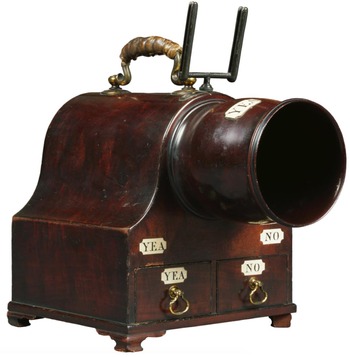
Perhaps anticipating his nomination for membership, Buckler had written to the Society in December 1807 presenting the remainder of the prints of his cathedrals series to them, concluding with the hope ‘that the labours of the Society […] may continue successfully employed, in the investigation of our national antiquities’.Footnote 44 On 12 May 1808, a recommendatory testimonial was read to the Society on Buckler’s behalf in which he was described as ‘An Artist well known for his many excellent Views of the Cathedrals & other antient Ecclesiastical Edifices of this Country, and extremely zealous in the Study of Antiquity’.Footnote 45 In the event, his certificate having been hung in the Meeting Room for the requisite time and the election having being balloted on 23 June, Buckler received twenty-seven white balls to twenty-eight black balls and was not elected (fig 6). This met with outrage from several antiquaries, including Darley Waddilove, Dean of Ripon (1736–1828), who was ‘shock’d at the illiberal Conduct of some of the Antiq Members’.Footnote 46
The oldest surviving blackball ballot machine at the Society of Antiquaries. Photograph: Society of Antiquaries of London.

Moreover, the result of the ballot came as a complete surprise to many, and, yet again, the Wyatt fiasco was mentioned as a case of parallelism, such as by the Romsey antiquary, surgeon and ornithologist John Latham (1740–1837) in his letter to Buckler the following July:
So it is & serves to show, that ill designing Men forming a knot and coming in numbers with a design of blackballing, will often succeed […] The like happened to Mr Wyatt, architect from the machinations of Mr Carter, who enjoying his good name & high reputation, slyly got together all his Party & effectually black-balled Him.Footnote 47
The Bishop of Chichester suggested that Buckler’s failure was due to the date of the election, which was generally ‘a black ball day’.Footnote 48 He later suggested that Buckler was unsuccessful owing to ‘a desire of the Society to exclude an obnoxious Candidate, which could not be well done, without, at that time, excluding you’.Footnote 49 While Buckler had been forwarded for election in the company of four other candidates – Barrington Pope Blachford, Anthony Cardon, Thomas Espin and William Mavor, with only Blachford succeeding – it is unclear who the ‘obnoxious candidate’ was.Footnote 50
William Brand (d. 1813), the customs officer at the Boston port, suggested that Buckler was rejected owing to a widespread disdain towards professional artists.Footnote 51 Latham drew the same conclusion:
I well know that the Society as a Body, has great objection to what are called artists, or rather simply Professional Men, be they however imminent [sic: eminent] – also to Teachers of Seminaries and are not always liberally minded toward inferior Clergy, in short, to any Man who may be likely to turn F.A.S. to his advantage.Footnote 52
Colt Hoare, meanwhile, suggested that Buckler’s rejection might have had to do with Fellows’ concerns that, due to the increased value of the Society’s publications in recent years, which Fellows received at no cost, numerous ‘improper’ people had sought to gain admittance.Footnote 53
The Norwich printer-publisher William Stevenson (1741–1821) added his own speculations, which were far more serious in their implication. He suggested that Buckler’s rebuttal was owing to the actions of the ever-influential Sir Joseph Banks and the director of the Society, the engraver Samuel Lysons (1763–1819). Stevenson declared, referencing Pope, that: ‘The Behaviour of Lysons is Tyrannical in the extreme: “bear no rival next [sic] the throne” […] But what shall I say to the Great Sr Joseph’s treachery? Such conduct lowers a man, in my esteem, beneath the Brutes.’Footnote 54 Latham had tried to change Lysons’ mind, but he had replied that, as Latham related, however respectable Buckler might be, ‘he sh:d [sic] certainly be against you […] because you were an artist’, fearing that the Society would in due course be overrun with them.Footnote 55
The letter penned by Stevenson in the same month to John Britton (and copied to Buckler), hoping to solicit his vote in Buckler’s favour in the second ballot, echoed the sentiments of many correspondents:
considering that his life has been spent in perpetuating the finest Remains of ancient Archi:re in this Kingdom, I am at a loss to conceive […] why [Buckler] should be twice rejected. […] What should be one of the first Institutions in Europe, is become a Cabal of jealous, self-interested Men […] one more actuated by Envy & party motives than a Desire to promote the Designs of the Institution & reward merit.Footnote 56
A second certificate was put forward on Buckler’s behalf on 1 December 1808, which was balloted on 19 January 1809. His ballot produced twenty-four affirmations to eighteen negatives. In spite of increasing his signatories to eleven, he was again not elected.
The following year, in March 1810, Buckler canvassed the antiquarian network ahead of his third ballot, which was to take place on 12 April that year. Although the election certificate was not a formal document and did not oblige its signatories to vote for Buckler at the subsequent ballot, it was, as the botanist John Symmons (d. c 1832) put it, ‘supposed the most numerously and respectably attested ever offered to the Society’.Footnote 57 He had thirty-one signatories, demonstrative of the high regard in which many of the antiquarian elite held him. Several correspondents warned Buckler, however, that he should once again expect a strong opposition to his candidacy.Footnote 58 There was also some disapproval of Buckler’s behaviour at having pushed his candidature forward in spite of being rejected on two former occasions.Footnote 59 For, as Rosemary Hill has observed, an ‘aspirant gentleman artist, angling for opportunities’ should do so ‘without seeming to presume’.Footnote 60
Buckler canvassed Routh, and his letter, held at Magdalen College, is one of the few known surviving letters penned by Buckler himself concerning his election. It offers a good sense of the nature of Buckler’s campaign and how it was conducted:
Reverend Sir
[…]
I have before informed you of what had happened with respect to myself at the Antiquary Society by the very ungenerous conduct of Mr Lysons. My Friends have thought proper to bring my name forward again, […] and in spite of such strong recommendations, a rumour has reached me that I am again to experience this person’s violent opposition. I am therefore advised to write to all my Friends who is likely to render me service to solicit their aid with those who are members and should be in Town on the evening of the ballot to give me their vote and interest which takes place on the 12th of April next. I have just seen Mr Michell [the College Steward] who in the course of conversation mentioned the name of John Wilmot Esq. of Bruce Castle Tottenham and who I am certain you are acquainted with. Your kind recommendation of me to him would do me great service.Footnote 61
The support of the politician John Eardley Wilmot (bap. 1749–1815) for Buckler suggests that he had voted on principle, having recognised Buckler’s talent, while supporting the work of the Carter school. Buckler’s seeking work from Wilmot also suggests a motive to secure his vote for a second time. The letter continued:
I believe Mr Gutch [Registrar] of Oxford is a member, & I rather think Dr Rawbone [the College Chaplain] is. If you would condescend to oblige me by any recommendation I shall ever by thankful – this Mr Lysons from some cause unknown to me wishes to aim a blow at my professional reputation, and most ungraciously so, after the very respectable way my name has been brought forward.Footnote 62
The landscape painter and prolific diarist Joseph Farington chronicled Buckler’s third election. He recorded at first-hand the result of the ballot held on 12 April 1810:
Antiquary Society I went to. Sir Henry Englefield in the Chair; a very full meeting. A Ballot was had for – Buckler. His certificate was signed by a prodigious number, – among whom, – the Speaker [of the House of Commons] – the Chief Baron, – many Bishops, &c. – On opening the Boxes there were for – Mr. Buckler 90, against 43.Footnote 63
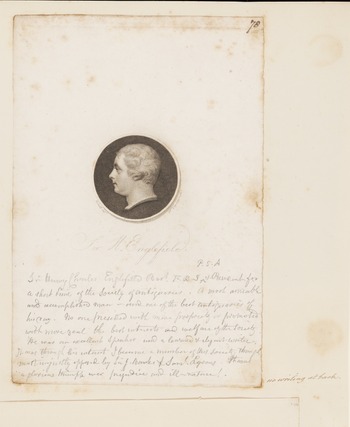
This gave Buckler a majority of two beyond the numbers required by the Society’s statutes, and he was finally admitted as a Fellow of the Society of Antiquaries on 16 April 1810. To many, the result of the election offered the satisfaction of doing justice to Buckler’s antiquarian merits. To others, it signalled an end to an emerging crisis of respectability in the Society. Soon afterwards, Colt Hoare begged Buckler to ‘grant me the first account of our triumph […] It must be highly gratifying to you to have been so warmly, publickly and honourably patronized’.Footnote 64 Yet Englefield had been still more influential. As Evans observed, he had ‘circularized the Society’ on Buckler’s behalf.Footnote 65 Indeed, in an undated annotation written on a print of Englefield in Buckler’s portfolio (fig 7), Buckler recorded for posterity his indebtedness to his patron in helping quash the cabal of Lysons and Banks:
No one presided with more propriety or promoted with more zeal the best interests and welfare of the Society […] It was through his interest I became a member of this Society, though most injustly opposed by Sir Banks & Lysons.
J Buckler’s annotated print of Sir Henry Englefield PSA (n.d.). Photograph: Bodleian, ms Buckler, fol 78.

Such success, he conceded, ‘was a glorious triumph over prejudice and ill-nature!’.Footnote 66
Instances of exclusion
The preceding section has examined Buckler’s ultimate inclusion at the Society through the lens of his exclusion.Footnote 67 He was at the mercy not only of the factionalism inherent in the nature and structure of British clubs per se – eg blackballing procedures at the Architects’ Club and the Surtees Society were common – but, beyond that, of a determined coup.Footnote 68 Banks in particular became the subject of wide ridicule owing to the liberties exercised during his long-standing presidency of the Royal Society that became known as the ‘Dissensions’ in response to his interference in the election of Fellows.Footnote 69 Regarding the Society of Antiquaries, it will suffice for present circumstances to mention only Banks’s influence in securing the election of a Banksian successor to the Society’s President, the Earl of Leicester, which Rosemary Sweet reads as a ‘projected coup d’état’, a means ‘to defeat those such as Sir Henry Englefield who had supported Carter in the Wyatt débâcle’.Footnote 70 The behaviour of Banks prompted various polemical pamphlets, many of which – tellingly – were listed in Gough’s catalogue of topographical literature.Footnote 71 Eighteen rhyming couplets or ‘Poetical Squibs’ are also found in the Buckler portfolio, which adopt the same satirical rhetoric alluding to Banks’ role in Buckler’s struggle.Footnote 72 As Toby Musgrave has recently pointed out, however, Banks himself was elected a member of the Society at the age of twenty-three in February 1766 through the influence of friends, in spite of not having contributed anything to antiquarian studies.Footnote 73
Lysons was one among many that were indebted to Banks’ command of patronage, and owed his post as Keeper of the Tower Records to Banks’ royal connections; indeed, Banks had introduced Lysons to George iii in July 1796.Footnote 74 We can, therefore, read the actions of the anti-Wyatt school – Wyatt being architect to the king – as contrary to Lysons’ and Banks’ interests with the Crown, a reading curiously not alluded to in the correspondence. Indeed, that the resistance to Buckler was associated solely with his topographical draughtsmanship, discussed below, seems unlikely. As Farington once observed, ‘accuracy of drawing seems to be a principal recommendation to Sir Joseph [Banks]’, himself an early patron of Paul Sandby.Footnote 75 As for Lysons, several scholars have singled him out, alongside Carter and Buckler no less, as among the key figures central to the late eighteenth- and early nineteenth-century ‘material turn’.Footnote 76 Furthermore, we might have expected Lysons, as an engraver, to sympathise, given the Royal Academy’s denial of recognition to engravers. Unsurprisingly, many antiquaries failed to conjecture the rebuttal of artists at their society, ‘on whose minds antiquities are most deeply impressed’, as Samuel Partridge, Vicar of Boston, put it.Footnote 77 Furthermore, it is worthwhile remembering that Lysons, too, was part of a self-conscious antiquarian dynasty, as the younger brother of Daniel Lysons (1762–1834), with whom he collaborated on the Environs of London and the Magna Britannia,Footnote 78 and the uncle of Samuel Lysons (1806–77). This may have added to the rivalry between two embryonic antiquarian dynasties.
Yet Buckler’s exclusion can still, in part, be accounted for by his professional status as an artist, in line with contemporary negative attitudes towards artisan draughtsmen.Footnote 79 Indeed, Banks’ prejudice on these grounds, too, was far from untypical. As Peter Clark put it, ‘Banks at the Royal Society was accused of encouraging “every titled man, foreigner or English” to apply, whilst excluding professional men’.Footnote 80 A curious concomitant was that, as Evans observed, in the face of professional ambiguities and snobberies, ‘professional artists, such as Carter and Buckler, who were not Academicians, were the only Fellows to be called Mr., not Esquire, in the Society’s lists’.Footnote 81 After all, Carter had once boasted, in reference to the successful attempt to blackball Wyatt, that ‘he who was but plain Mister/should dare to stand up ’gainst a squire’.Footnote 82
The anti-Wyatt cabal had been dubbed the ‘Gothic party’, and also the ‘Catholic party’, owing to their bias in publishing engravings of the medieval cathedrals, which many FSAs opposed, considering them ‘relics of popery’. That Buckler was best known for his cathedral prints may not, therefore, have helped his electoral chances.Footnote 83 The religious aspect is not alluded to in the letters, however, except when Colt Hoare referred to a topographical expedition being made to Flintshire, Wales, by Carter and Buckler in 1810: ‘You must let me know in time when you and Carter mean to set out on your pilgrimage to S[aint] Winefred’s Well [sic] that I may bring some things to you on the road’.Footnote 84 Buckler and Carter were presumably keen to see the medieval chapel over the well, but since the well was, by this date, symbolic of the survival of Catholic recusancy in Wales, Colt Hoare presumably called their visit a ‘pilgrimage’ to tease them. While Carter is not believed to have followed the Catholic faith, he had been sympathetic to the Catholic cause, and was dubbed ‘a Popish dog’ in a quarrel at the Society in 1800.Footnote 85 His closeness to Milner, a Catholic bishop for whom he built St Peter’s, Winchester (1792), and to Englefield, also a Catholic, put him in that camp.Footnote 86 Buckler was Protestant, but while Magdalen College, Oxford, was to become a hotbed of Tractarianism and Anglo-Catholicism, it is likely that Buckler’s Anglicanism leaned towards the ‘High’ side. Buckler’s son, John Chessell, worked for many old Catholic families (not only the aforementioned Jerninghams, but also the Bedingfelds at Oxburgh Hall, Norfolk). The medievalist C M Antony suggested that John Chessell had ‘long before accepted as inevitable the reconciliation’ of his three eldest sons, the architect Charles (who took the name Alban) in 1844, William in 1847 and Edward Chessell in 1851; his fourth son, Henry Chessell, also joined the Catholic church in 1855.Footnote 87 The three younger sons, who became Dominican friars, were later dubbed the ‘Buckler Trinity’.Footnote 88
Lastly, there is also evidence of professional jealousy on the part of certain antiquaries. A letter from Symmons to Buckler suggested that Richard Fenton (1747–1821) was likely among Buckler’s blackballers at his 1810 effort as he was believed to be ‘extremely jealous [… and seeking to] do everything in his power to prevent the objects of a gentleman so eminently protected by his own best friend & patron R’d. Hoare’.Footnote 89 The reasons for Buckler’s historic rebuttal at the Society, then, were various. They reveal still more about the nature of factionalism in the learned early nineteenth-century Society and, in particular, its onslaught against professionalism.
THE BUCKLERS AND THE ‘CARTER SCHOOL’
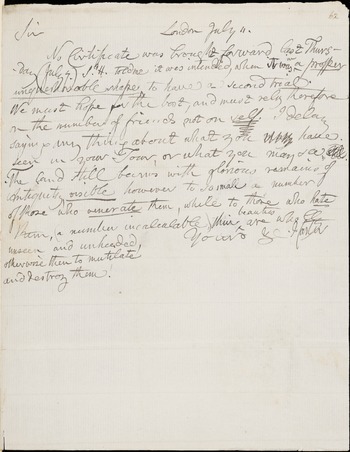
Buckler was a young scion of the Carter school. A testament to their friendship is his custodianship of Carter’s aforementioned rhetorical sketches depicting Wyatt’s restorations at Durham Cathedral, which Buckler gifted to the Society of Antiquaries in May 1829. Carter also appears frequently in Buckler’s portfolio of letters. Most notable is an exchange from the churchman and topographer Hugh Owen (1761–1827), who wished to be remembered to Carter, admiring his ‘genius, science & intrepidity in defense [sic] of our glorious & precious fabrics of antiquity’.Footnote 90 Exhibiting the parallelism of Buckler and Carter’s motivations to safeguard medieval antiquities, one letter from Carter to Buckler (fig 8) lamented how: ‘The land still [?]beckons with glorious remains of Antiquity, visible however to so small a number of those who venerate them, while to those who hate them, (a number incalculable,) their beauties are wholly unseen and unheeded, otherwise than to mutilate and destroy them!’Footnote 91
John Carter’s letter to J Buckler (11 July 1809).Photograph: Bodleian, ms Buckler, fol 62.

With the draughtsman Charles Stothard (1786–1821), Carter and Buckler, respectively, also produced sketches of the Painted Chamber murals in St Stephen’s Chapel in the Palace of Westminster, albeit without the support of the Society.Footnote 92 Furthermore, they both recorded Welsh antiquities for Colt Hoare, who praised in equal terms their qualifications to carry out his wishes:
I commissioned in 1801, Mr. John Carter, a most able artist in the line of architecture and monumental antiquities, to undertake a journey through South Wales, and to draw every subject that might appear interesting to him […] Actuated by the same feeling towards North Wales, I engaged Mr. John Buckler to pursue the same plan […] Thus I have been enabled to rescue many valuable records of British Antiquities, some of which have already suffered since our visitation, and others threaten a speedy decay.Footnote 93
It is clear across the correspondence that Buckler’s work adhered closely to the ideals of the Carter school, namely in his and his patrons’ interest in the measured illustration of medieval buildings – including the careful delineation of archaeological stratigraphy, especially in the face of imminent decay or destruction – together with a self-conscious desire for ‘accuracy’ of representation. ‘Truth and accuracy’, for example, were requested by Hugh Owen and John Brickdale Blakeway (1765–1826) when they commissioned Buckler to illustrate parts of their History of Shrewsbury.Footnote 94 The exchanges record mutual, welcome criticism between publisher and artist: ‘as however, you ask for criticism I will honestly give it’, declared Blakeway.Footnote 95 Criticism, in reference to Shrewsbury Abbey, for example, concerned the undesirable volume of thickets in the foreground of Buckler’s drawing, and questioned the size of the openings on the belfry that he had depicted.
A further notable example is an exchange from the Revd Henry Thomas Payne, of Llanbedr, Wales, in October 1816, demonstrating the strength of the endeavour to make Buckler’s drawing as representative of the structure, and its historic layers, as possible. Referring to an observation made on his last visit to St David’s Cathedral, Payne noticed a round-headed blind arch above the pointed arched window on the western side of the tower. Speculating that it functioned as a relieving arch to the window below, he added:
It cannot, I think have had any other object […] In point of beauty it certainly is not to be regarded as an improvement of the edifice, – but if I am correct in my conjecture – it may in some degree be illustrative of its history – therefore worthy of our notice.Footnote 96
Most of the letters in the Bodleian portfolio regard Buckler’s series of cathedral aquatints, self-published from his Bermondsey home from 1796. The letters between Buckler and George Markham, Dean of York, on the subject of an engraving of York Minster are representative. An overriding concern for verisimilitude on the part of both artist and patron justified the Dean’s criticisms of Buckler’s outline of the minster before subscriptions were collected for his final print; it was common practice for Buckler to send his outline on to the patron to compare it with the original structure. Markham requested the local engraver Joseph Halfpenny (1748–1811) to make corrections, insisting that ‘Nothing but your expression of a work to have it accurate should have induced me to take the liberty of altering your drawing’.Footnote 97
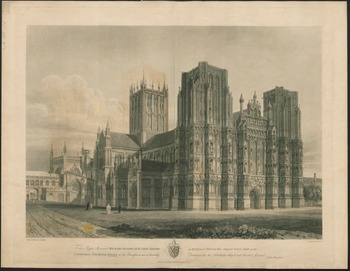
The high value placed on accuracy can also be charted in contemporary media. With reference to a north-west view of Wells Cathedral (fig 9) dedicated to the Revd Richard Beadon, Bishop of Bath and Wells (another of Buckler’s signatories in the Society struggle), the Monthly Magazine in 1806 noted how
A complete set of the views of the cathedrals of this country has long been a desideratum in the arts. […] We are happy to see that Mr. Buckler has embarked in this undertaking […] It is but justice to say, the perspective is accurate, the general effect broad and simple, and the tout-ensemble highly interesting.Footnote 98
North-west view of Wells Cathedral, drawn and etched by J Buckler, engraved by F C Lewis and inscribed to the Revd Richard Beadon, Bishop of Bath and Wells, 1806. Photograph: British Library, K.Top.38.10.g.

The broader, mostly twentieth-century, historiography concerning the Bucklers generally accepts the Bucklers’ accuracy, emphasising the value of their topographical recordings for the archaeological record.Footnote 99
The letters also complicate Gough’s complaint (albeit made two decades earlier) regarding ‘the caprice, or the avarice, or the indifference, or false taste of Deans and Chapters’ whose seemingly wanton ruination of the antiquities in their custody was compared to that of the Reformation.Footnote 100 Buckler’s letters show that many deans and their chapters, by the turn of the nineteenth century, were in fact supporting Gough’s representational demands. Assessing Buckler’s print of the church of St Cross, Winchester, in January 1809, Latham himself participated in carefully measuring and recording the uprights of the entrance of the north porch with a plumb line, and questioned Buckler’s depiction of the upper part of the shafts and the incline of the side jambs.Footnote 101 A final case in point is the Revd Charles Walters of Bishop’s Waltham, Hampshire, who allied topographical drawing with the preservationist project. While acknowledging receipt of Buckler’s plates of Romsey Church in August 1812, Walters declared his
regret that it is not in my power to gratify my extreme attachment to antient architecture by the purchase of all those beautiful delineations with which you have favoured the world – & which, in spite of the wide wasting rage of innovation, falsely styled improvement, will convey to posterity the beauty of those noble monuments of human genius & industry – the Cathedrals of England.Footnote 102
Buckler’s collaborative efforts concretise Heringman and Lake’s assertion that antiquarianism was an inter-disciplinary field, ‘a shifting economy of scholarly and artistic labor and consumption’, a fluid and complex network of participating players. Heringman has emphasised, furthermore, the symbolic displacement of ‘rich and polite Fellows’ at the Society with what he called ‘knowledge workers’, the former having failed to take up the preservationist credo that Gough deemed should be an antiquary’s inherent responsibility. Buckler, in this capacity, can be considered a second-generation knowledge worker.
John Chessell Buckler and the Carter school
Before reaching a conclusion, it is significant to note how Buckler looked to his son, John Chessell, to take up the preservationist project of the Carter school. A case in point is that, from 1816, he began engraving his father’s series of prints of cathedrals for wider circulation, which found praise in the Gentleman’s Magazine, who described John Chessell as ‘a genuine son of Science, [who] bids fair to tread in the steps of the venerable Champion [Carter]’.Footnote 103 On Carter’s death, John Chessell made contact with Samuel Bentley, of the Nichols’ printing firm, expressing his inclination to be Carter’s obituarist in the Gentleman’s Magazine, where he would come to apostrophise Carter ‘Antiquity’s Most Resolute Friend’.Footnote 104 Unlike his father, John Chessell also inherited Carter’s rhetorical style as a writer. The well-known episode, in the summer of 1822, of the part demolition of the Old Quadrangle of Magdalen College, Oxford, is alluded to in John Snr’s correspondence: ‘So the murder is done at Oxford’, Hugh Owen lamented that year.Footnote 105 John Chessell evinced a fierce protest lamenting the demolition in the form of a polemic called Observations (1823) that précised the College’s longer-standing approbation of ‘innovations’ in an acid language that mirrored Carter’s.Footnote 106 John Chessell’s pamphlet alluded to Wyatt in relation both to his quadrangle proposals at Magdalen – involving the demolition of the north range of the fifteenth-century cloister – and to his executed restorations of the college chapel (1790).Footnote 107 John Chessell lamented:
the correctness of his judgment [in which] he was opposed by a Gough, an Englefield, a Carter; and though his influence was at first irresistible, yet the combined and steady efforts of these eminent Antiquaries, slowly but at last effectually checked the tide of Innovation.Footnote 108
Other members of the Buckler family followed in the tradition of their paterfamilias. To offer only a selection of the many examples, George Buckler recorded the crypt of St Saviour’s, Southwark, illustrated in the Gentleman’s Magazine (1835); Carter had recorded visits made in 1797 and 1808.Footnote 109 Charles Alban, likewise, recorded the wall paintings, which depicted various biblical scenes, discovered on the southern wall of Headington Church, Oxfordshire, during restoration work under his and his father’s superintendence in the summer of 1863.Footnote 110 Due to the state of decay of the structure, John Chessell claimed that the frescoes (of distemper with red and yellow ochre) could be preserved only with the pencil. The Bucklers, then – the epitome of the antiquarian mindset – are one notable example of the continued pertinence of the project of the Carter school.Footnote 111
CONCLUSION
Buckler, hitherto almost entirely overlooked by scholarship, has been revealed here as a well-known and significant figure in the landscape of late Georgian antiquarian and architectural culture. His story further strengthens our understanding of the role of the Society of Antiquaries as the key arena in which discussions about the Gothic Revival and the conservation of medieval buildings took place, before other organisations, such as the Ecclesiological Society and the Oxford Society for the Promotion of Gothic Architecture, took up the mantle. The Carter school, and its offspring in Buckler and John Chessell Buckler, also helped establish the body of knowledge that later enthusiasts, such as A W N Pugin, would turn to their advantage.Footnote 112
The blackballing of Buckler is also of significance in understanding the motivations and make-up of the Buckler antiquarian dynasty as a whole. Buckler courageously bore the flag of ‘romanticism’ proper to his era, trying to recover the past to regain a sense of authenticity for Britain. John Chessell took up his father’s hard work and topographical knowledge as an opportunity to develop a successful practice in the halcyon years of the new Gothic project. But in a long career clinging onto an increasingly outmoded antiquarianism, he would be effectively ‘blackballed’ by the architectural profession, as the younger generation claimed to hold a superior knowledge of Gothic architecture.Footnote 113 Charles Alban, who relied on his association with his antiquarian forebears to sustain his reputation, was also ‘blackballed’, less by his contemporaries – for he found reliable patronage from the Catholic hierarchy – but by a twentieth-century historiography that favoured a narrative of ‘progress’ which could not include him.Footnote 114
In reference to Buckler’s campaign, Stevenson had written in 1809 that:
the conduct of those who opposed Mr B’s admission – has certainly increased the number of his Friends & benefited him far more than the F.A.S. affixed to his name would ever have Done.Footnote 115
He implied that Buckler’s victory was only as important as the ritual of the process of nomination. The fellowship bridged the tensions between his professional status and the dilettantish acceptability demanded by the Society. Through his canvassing and correspondence, as much as his fellowship, Buckler came closer to finding belonging in the realm of the Gentleman, bringing him closer to aristocratic sources of patronage. Buckler’s victory was also symbolic. Having been a scapegoat for the cause of the party, he finally found programmatic endorsement for his school and project. That said, however, he seemingly went on to have very little direct involvement with the Society. Hence, when an obituary of Buckler was given at the Society’s April anniversary address in 1852, it noted that ‘his only communication to the Society of Antiquaries consisted in “Remarks upon some Remains of Ancient Architecture [… at] St Mary Overy in Southwark” […] extending, I think, to no more than two pages’.Footnote 116
If, as Sweet has argued, Carter’s ‘outspoken claims for his own professional superiority over the gentlemen amateurs of the Society met with a chilly response’, Buckler’s experience shows us that social displacement within the Society on the grounds of expertise was still possible.Footnote 117 Buckler, jostling for position in late Georgian society, displayed those marketable claims for ‘accuracy’ of representation, on the one hand, and an advanced grasp of Gothic architecture on the other.Footnote 118 Oldbuck’s ancestor’s motto in Scott’s The Antiquary comes to mind when thinking of Buckler’s success on these grounds. To the hero, Lovel, it is communicated that ‘Kunst macht Gunst’, which was explained as ‘Skill, or prudence, in availing ourselves of our natural talents and advantages, will compel favour and patronage, even where it is withheld, from prejudice, or ignorance […] Skill wins favour’.Footnote 119
ABBREVIATIONS AND BIBLIOGRAPHY
Abbreviations
- BL
-
British Library, London
- Bodleian
-
Bodleian Library, Oxford
- SAL
-
Society of Antiquaries of London