THE PLURAL UNDER ANALYSIS
The basic rule to pluralize nouns and adjectives in Brazilian Portuguese (BP) is adding a morpheme [–s] to the end of the word, as in apartamento ‘apartment’, apartamentos ‘apartments’, janela ‘window’, janelas ‘windows’. This plural pattern is the most regular and productive in BP. According to the Dicionário Eletrônico Houaiss da Língua Portuguesa, roughly 85% of all Portuguese words that can be pluralized (nouns, adjectives, pronouns, and articles) adopt the [–s] morpheme.
Brazilian Portuguese has a small group of words (approximately 7,400) that end with the nasal diphthong [–ão] in the singular form, such as irmão ‘brother’, leão ‘lion’, pão ‘bread’. Despite the same singular morphemes, when pluralized, each of these words has a different plural form: irmão ‘brother’, irm ãos ‘brothers’, leão ‘lion’, le ões ‘lions’, pão ‘bread’, p ães ‘loaves of bread’. These plural forms are determined by their different etymological source. As all three singular forms are the same and the plural is determined by etymological origin, the choice for the standard plural is not always an easy task. Because all singular words from this group have the same last two segments, there is a “competition” between three plural morphemes for each singular form. For this reason, speakers sometimes are not sure which plural form should be used in a particular word. Brazilian Portuguese corpora, such as Corpus do Português (which contains more than 2 million spoken words), show examples of words that should have a certain etymological plural, but are pluralized as if they belonged to a different class. This is the case with the word cidadão (‘citizen’). Its etymological plural should be cidad ãos, but the word cidad ões is registered in this corpus. To analyze the plural forms of this group in Portuguese, the type frequency of each plural morpheme was counted. The search was based on the largest Portuguese dictionary, the Dicionário Eletrônico Houaiss da Língua Portuguesa (2001), which lists 228,500 words. The results are shown in Table 1.
Type frequency of [–ões], [–ãos], and [–ães] plural forms for [–ão] singular words

Table 1 shows that, within the [–ão] singular group, the morpheme [–ões] is much more frequent than the other two. The morpheme [–ões] accounts for 97.8% of the pluralization of this group, with 7,260 different lexical types, whereas [–ãos] accounts for 1.5% (108) of the words. The least frequent type, [–ães], pluralizes only 0.7% (48) of these words. Given that [–ões] has the highest type frequency for [–ão] singular words, it is expected that some [–ãos] or [–ães] etymological words might adopt the [–ões] plural. Before drawing on more hypotheses about what might be happening to this class of words, let us turn to the theoretical background adopted to analyze this plural group.
THEORETICAL BACKGROUND
The plural variations analyzed in this paper might be a result of frequency effects. Although there are some different linguistic theories that deal with frequency, for the purpose of this study, exemplar models (Bybee, Reference Bybee1985, Reference Bybee2001, Reference Bybee2010; Pierrehumbert, Reference Pierrehumbert2000, Reference Pierrehumbert, Bybee and Hooper2001, Reference Pierrehumbert, Bod, Hay and Jannedy2003) will be adopted. These models were chosen because the source of the variation in the [–ão] may lay in frequency effects, which are best handled in models of mental lexicon that consider the usage of linguistic structures and their impact on cognition.
In exemplar models, whole words or frequently used expressions are the basis of lexical storage (Bybee, Reference Bybee1995). Words are organized in terms of semantic and phonological similarities, and morphological relations emerge from connections among them. Every token of a word is lexically stored, as well as information on the social, pragmatic, and morphological context of each word we experience (Johnson, Reference Johnson, Johnson and Mullenix1997).
Pierrehumbert (Reference Pierrehumbert2000, 2001, 2003) showed that the same phonemes have different phonetic realizations in different languages. Also, the same phonemes will behave differently in the same language depending on the surrounding context (cf. Johnson & Mullenix, Reference Johnson and Mullenix1997). Therefore, there is an ample body of research that supports the assumption of rich memory storage for lexical items.
In exemplar models, each linguistic category has a prototypical member. There is still no agreement as to what determines the prototypical member. Rosch (Reference Rosch1973, Reference Rosch, Rosch and Lloyd1978) claimed that the prototypical member has the most attributes of the category. Bybee and Eddington (Reference Bybee and Eddington2006) argued that the prototype is the most frequent member of a given category. Whether the prototype is defined by attributes or frequency, other instances that share some similarities with this central member surround it. Exemplar models do not require that all members of a specific category have the same properties. If a subject can find similarities between a recently learned token and an old one, the new token will fall into the same category as the old one. Linguistic categorization is thus a matter of degree or gradience.
Exemplar models also state that “experience affects representation” (Bybee, Reference Bybee2001:6). Thus, the way we deal with words in our daily life will influence how we store and access them. The frequency with which certain words are used has a particularly strong effect on our mental representations. Words that are very often used tend to undergo phonetic reduction (cf. Bybee & Scheibman, Reference Bybee and Scheibman1999; Pagliuca & Mowrey, Reference Pagliuca, Mowrey, Ramat, Carruba and Bernini1987). This can be understood as the destructive effect of repetition. As with any other neuromotor activity, repetition of words produces automatization and then overlapping and reduction of the articulatory gestures. On the other hand, high frequency can have a conserving effect on irregular words. In English, for example, the most irregular verbs are also the most frequent ones: to be (is, was, were), to go (went, go, goes), and so on. These verbs preserve their irregularity because they are very frequent and become independent of their base forms (Bybee, Reference Bybee1985).
According to Bybee (Reference Bybee, Janda and Joseph2002:604), “Token or text frequency is the frequency of occurrence of a unit, usually a word or morpheme, in running text. … Type frequency refers to the dictionary frequency of a particular pattern, such as a stress pattern, an affix, etc.” These two concepts of frequency interact and have several consequences (Bybee, Reference Bybee1985, Reference Bybee2001, Reference Bybee2010). First, type frequency contributes to productivity. The more a pattern (a morpheme, in the context of this paper) is used, the stronger its representation is in the mental lexicon. Low and medium frequency items define the productivity of a given category. When low and medium frequency items are accessed, their token frequency is not strong enough to make them be activated through the word itself. They are accessed via its class first. Thus, anytime a low or medium frequency word is accessed, its access spreads through the whole exemplar cluster, strengthening it. In terms of production, more frequent items are more likely to be chosen for production. If every individual token counts, very frequent words will be mapped onto already existing exemplars. This will probably make a particular token stronger and more likely to be picked for production (Pierrehumbert, Reference Pierrehumbert2000, Reference Pierrehumbert, Bybee and Hooper2001, Reference Pierrehumbert, Bod, Hay and Jannedy2003).
In exemplar models, lexical storage is based on tokens that speakers experience, so that words are not necessarily decomposed, and can be stored and accessed as whole units in memory. For the same reason, it is not necessary to use abstract rules to make up new words. Generalizations emerge from comparisons made between the patterns available in the lexicon. Based on these generalizations, new words can be formed and old ones can be forgotten. Because the mental lexicon is a plastic and mutable “dictionary” that is never complete, the task of learning and categorizing words is part of human cognition throughout life.
Relating the theoretical background with the [–ão] plurals, the predicted frequency effects are as follows. Because the [–ões] plural morpheme has the highest type frequency, it can be considered the prototype plural member for the [–ão] singular category. As the prototype member, [–ões] can attract items from the [–ãos] and [–ães] classes because of their tiny type frequency. Token frequency might also play an important role here, because high token frequency words will probably keep their etymological plurals, even if they belong to the etymological [–ãos] and [–ães] classes. These hypotheses will be tested by experiments designed for this purpose.
THE METHOD
To investigate processes of language variation that happen to [–ão] words in BP, a set of psycholinguistic experiments was elaborated. Before describing these experiments, however, some methodological decisions have to be mentioned.
It can be stated that psycholinguistic experiments do not represent how subjects speak in a natural setting. I acknowledge that this argument holds some truth. For a research project like this one, it would be more reliable to draw on sociolinguistic interviews with native speakers. However, items from [–ãos] and [–ães] groups have very low token frequency individually. For this reason, it would be very challenging to make subjects speak the words that are being analyzed here. In addition to that, as this paper investigates frequency effects in the [–ão] items, it would be necessary to elicit words from the three plural groups in at least three different frequency ranges, which would make it even more difficult to gather exactly the words that were being analyzed. An alternative to sociolinguistic interviews would be to use BP spoken language corpora and find cases of a plural form being used instead of the etymological one. However, none of the plural variants investigated in this paper were found in searches of Lael Fala (a corpus of 197,901 spoken words). In addition to that, data collected in a research project conducted by Scherre (Reference Scherre1988), investigating pluralization marks in BP, was analyzed. Scherre (Reference Scherre1988) interviewed 64 native speakers and collected 13,229 tokens. In all her data, there were only 200 [–ão] plural words, none of which had any of the variations analyzed here. Clearly, using spoken language sources would not provide enough data to make solid conclusions about the [–ão] plurals. For these reasons, psycholinguistic experiments were applied to gather the data that were needed for the analysis.
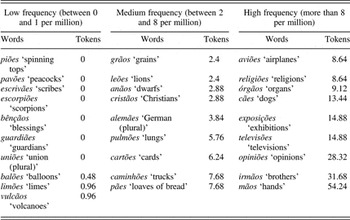
Because the main goal of the experiments was to investigate how frequency influences the plural of [–ão] words, 28 [–ão] items from low, medium, and high frequency ranges were chosen. In addition to the plural forms, the words were also chosen based on morphological criteria explained in this subsection. The frequency counts were based on the Corpus do Português, which has 2,083,296 words from spoken language. As it is the frequency of the plural words that makes them more accessible and more likely to be used to form a new plural, the frequency of the plural for each word was considered.
Deciding the boundaries between each frequency range was not an easy task. As shown in Table 1, the groups [–ãos] and [–ães] have low type frequency. The first step to divide the frequency ranges was to check the Corpus do Português to find the token frequency of [–ãos] and [–ães] words. Within the [–ãos] group, the items with highest token frequency were mãos ‘hands’ (54.24 tokens per million) and irmãos ‘brothers’ (31.68 tokens per million). Within the [–ães] group, the items with highest token frequency were cães ‘dogs’ (13.44 tokens per million) and pães ‘loaves of bread’ (7.68 tokens per million). As these examples show, [–ãos] and [–ães] items have low token frequency individually. Because of that, a high token frequency range consisting of items with more than 8 tokens per million would end up with three words in the [–ãos] group and one word in the [–ães] group, as the examples show. For this reason, the boundaries for token frequency ranges were: low frequency (0–1 token per million words), medium frequency (2–8 tokens per million), high frequency (more than 8 tokens per million). Another important point to state here is that token frequency might not be equivalent to familiarity. Some words, such as bênção ‘blessing’ or limão ‘lime’ might seem frequent, but in a spoken language corpus (Corpus do Português), their token frequency is less than one token per million words. On the other hand, a word such as alemão ‘German’ has 3.84 tokens per million in the same corpus. Words from the three plural groups ([–ões], [–ãos], and [–ães]) were chosen for the experiments. Table 2 shows the items organized from lowest to highest token frequency.
Words selected for the psycholinguistic experiments “token frequency of the plural form per million words”

These words were organized in three different sets of experiments:
Comments on pictures: Some cards with pictures or drawings depicting the [–ão] words selected for the experiments were printed out. The pictures or drawings would always show items in their plural forms. The researcher handed these cards one by one to each subject and asked him or her to make a comment on what they saw on each card.
Reading of sentences: This part consisted of sentences in which there were slots filled with drawings or pictures representing [–ão] words. The subjects' task was to read each sentence, pronouncing the plural form for each picture or drawing. An example of these sentences was “Os [picture of two lions] vivem na África.” (‘Lions live in Africa.’)
Plural production: In this part of the experiment, the subjects were told that the researcher was going to say some words and they should provide their plural form. So, the researcher would say avião ‘airplane’, and each speaker would make up the plural for each word.
In each part of the experiments, 12 distractor items that would not be analyzed were included. Examples of these items are árvore (‘tree’), batata (‘potato’), girafa (‘giraffe’).
The experiments were conducted in between January and March of 2006, in Rio de Janeiro, Brazil, with 36 BP native speakers. After the data were collected, there were 1,277 tokens. These tokens were statistically analyzed by the logistic regression of SPSS (version 19 for Mac, SPSS, Inc., Chicago, Illinois). Different factors were used for each feature that could influence the plural variation. The same factors were also considered when choosing words from each plural group. Here are the factors considered:
• Number of syllables: words with one syllable (mão, ‘hand’, pão, ‘bread’) or more than one syllable (ór-gão ‘organ’, ca-mi-nhão, ‘truck’);
• Morphological structure: words without suffix (pião ‘spinning top’, vulcão, ‘volcano’), and words with suffix (guardião, ‘guardian’, exposição, ‘exhibition’);
• Etymological plural: etymology in [–ões], [–ãos], or [–ães];
• Preceding segment: vowel (av ião, ‘airplane’, l eão, ‘lion’) or consonant (cris tão, ‘Christian’, g rão, ‘grain’);
• Frequency: low frequency (0–1 token per million words), medium frequency (2–8 per million), high frequency (more than 8 per million);
RESULTS
In analyzing the data, the first step was to find out the direction taken by the variation in these plural forms. Table 3 shows general results concerning which etymological plurals changed to a different plural form.
General results

The cases in which non-etymological [–ões] plural variants occurred are bold. As we can see, words belonging to the [–ões] group preserved their plural forms in 93.5% of the cases. On the other hand, words belonging to the [–ãos] class changed to [–ões] in 38.7% of the tokens, and words from the [–ães] class adopted [–ões] in 14.5% of the cases. Thus, this table clearly shows the path of change. Words from [–ãos] and [–ães] groups are taking the [–ões] plural, but the opposite (words from the [–ões] class being pluralized with [–ãos] or [–ães]) happened in only 6.3% of the tokens (considering [–ãos] and [–ães] together). The results suggest that, in fact, the high type frequency of the form [–ões] is serving as analogical basis for the smaller classes, that is, [–ãos] and [–ães].
Analyzing Table 3, another explanation can be proposed. Changes in plural forms might have to do with saliency, in the following terms. Pluralization from [–ão] to [–ões] implies a change in stressed vowel, so it would be the most salient one. Pluralization from [–ão] to [–ães] has a change in unstressed vowel, so it would be less salient than the first one. Finally, pluralization from [–ão] to [–ãos] has no change, so it would be the least salient pluralization form. In fact, Table 3 shows that [–ões] plurals are preserved in 93.5% of the cases, [–ães] in 80.1%, and [–ãos] in 57%. Changes in plurals correspond to the degrees of saliency. To verify if this factor would be considered relevant, it was included in the SPSS logistic regression, but SPSS did not select saliency as a significant variable.
As Table 3 showed, the plurals that really change are the ones from [–ãos] and [–ães] etymological origins. Once the direction of plural migration was defined, the [–ões] class was excluded from the analysis. This decision was made because [–ões] words hardly ever change their plurals, as Table 3 shows. It would not make sense, then, to include [–ões] words in a case of variation in which words are actually changing to the [–ões] class.
Excluding the [–ões] etymological words, there were 608 tokens of [–ãos] or [–ães] etymological words. Analyzing these tokens in the SPSS logistic regression, it was possible to determine the relevant factors for the plural variation. Type of experiment was not considered significant by the SPSS, so all data were analyzed together. Table 4 shows each factor selected as significant, along with its values.
Significant variables for change of etymological [–ãos] or [–ães] plurals in Brazilian Portuguese

Table 4 shows that only three factors were relevant for the plural migration: etymological plural, token frequency, and number of syllables, whereas morphological structure and preceding segment were not. In the following paragraphs, each of these significant results will be analyzed separately, beginning with number of syllables.
Before commenting on Table 5, it should be mentioned that prescriptively in BP, all one-syllable words from the [–ão] group are pluralized with [–ãos] or [–ães] (grão—gr ãos, ‘grains’, pão—p ães, ‘loaves of bread’). There is no one-syllable word pluralized with [–ões]. Thus, the results displayed in Table 5 are consistent with this pattern. Speakers preserved the infrequent types ([–ãos] or [–ães]) in all monosyllabic words, without exceptions. This fact demonstrates that, in the task of pluralizing words, speakers unconsciously proceed to a probabilistic analysis of the patterns available on the lexicon. Overall, [–ões] is much more frequent than [–ãos] or [–ães]. However, this high type frequency does not mean that speakers will randomly apply the [–ões] plural. Because speakers store whole words in their mental lexicon, the information that monosyllabic words are never pluralized with [–ões] emerges from the comparison among the stored items. Items with more than one syllable, on the other hand, are freer to adopt the [–ões] plural. It should be mentioned here that, out of the one-syllable words, only one of them (mão, ‘hand’) belongs to the high-frequency range. Therefore, it cannot be stated that the monosyllabic items are also highly frequent, and so they would preserve their plurals anyway, even if they had more than one syllable. In fact, one-syllable words did not change their plurals, even if they had low frequency. The results support the hypothesis that, when pluralizing words, speakers use their rich memory storage and compare the words to be pluralized to items already stored. Given that there is no monosyllabic word pluralized with [–ões], this information was entirely preserved in all cases analyzed. The information on number of syllables is closely related to [–ãos] and [–ães] plurals, therefore speakers preserve these low type frequency plurals in this specific locus.
Number of syllables

Table 6 shows that [–ãos] etymological words are more likely to adopt [–ões] plural than [–ães] etymological words. As we saw in Table 1, [–ãos] is more frequent than [–ães] by a slight margin (0.8 percentage points). However, the responses do not display this range of variation. These results can be explained in connection with number of syllables. There were four monosyllabic words, two from the [–ães] group and two from the [–ãos] group. As it was showed in Table 5, regardless of their etymological source, monosyllabic words do not change their plural forms. To further analyze the effects of the etymological source, monosyllabic items were eliminated from the data. Running the words again in SPSS, etymological source was no longer considered a relevant factor. Thus, it seems that the etymological source does not really matter. Because [–ãos] and [–ães] have low type frequency, both plural forms are likely to take the [–ões] analogical plural. It seems that it is type frequency that makes the difference, rather than etymological source.
Etymological source

Finally, Table 7 clearly shows that low-frequency words are more likely to adopt [–ões] plural, whereas high-frequency words were pluralized with [–ões] in very few cases (only 1.9% of the tokens). These results are consistent with the claims of exemplar models. High token frequency makes a word stronger in the mental lexicon. The more frequent a word is, the more likely it will become independent of its class and be analyzed as an autonomous unit. Across languages, high-frequency words also tend to be the most irregular ones. In this case, high frequency-words from the [–ãos] and [–ães] classes preserved their plurals, despite their low type frequency. On the other hand, low-frequency words from the same classes are the leaders of the morphological variation. Because of their low frequency, [–ãos] and [–ães] words rely on their classes to be accessed. Because their classes have very low type frequency, it does not guarantee that their etymological plural will be preserved. Whenever speakers want to pluralize low-frequency items ending with [–ãos] or [–ães], they will use the morpheme that is more frequent for the whole [–ão] singular class, that is, [–ões].
Token frequency effects

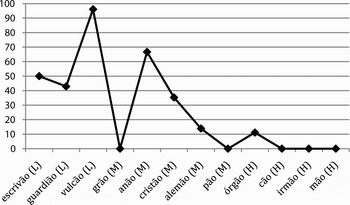
To help us visualize the frequency effects for each word, a figure showing the percentage that each word individually changed from [–ãos] and [–ães] to [–ões] was organized. It should be mentioned that the experiments originally had 28 words. However, recall that after analyzing Table 3, the [–ões] group was excluded from the analysis. Without these words, there were 12 words ending with [–ãos] or [–ães] plurals in Figure 1. In the figure, the words are displayed from lower to higher token frequency, with a letter within parentheses representing the word's frequency range.
Variation according to each word.Footnote 1

Figure 1 graphically shows that the less frequent the words are, the more likely their plural is to be nonetymological; in contrast, the more frequent the words are, the less likely they are to have a variant plural. Low-frequency words change more than medium- and high-frequency ones do. It is also important to mention that, among the medium- and high-frequency items, there are cases such as pão (‘bread’), cão (‘dog’), grão (‘grain’), and mão (‘hand’). These four items are monosyllabic, which is probably why they never changed their etymological plural, regardless of their frequency range. It can be stated that these monosyllabic items are biasing the token frequency effects. In order to verify if there would be token frequency effects even without the monosyllabic items, these words were temporarily excluded from the analysis. Even without these items, token frequency is still considered relevant by the SPSS software, as shown in Table 8.
Token frequency effects “no monosyllabic words”

Table 8 shows that after one-syllable words were excluded from the data, token frequency remains a significant factor. It can thus be stated that token frequency is important for speakers to retrieve a given plural form. Assuming that words are stored and accessed whole, the more speakers experience a word in its plural form, the more easily it will be remembered. The opposite is also true. Words that are not frequently used are more likely to be forgotten by language users.
In general, the results show an interaction between type and token frequency. The [–ões] class is stronger and more productive than the other two. This has caused some variation in the low token frequency items from the [–ãos] and [–ães] classes. Because all words have the same singular form, they share phonological similarities that allow them to take either plural form. On the other hand, the analysis also showed that [–ãos] and [–ães] are still preserved in certain specific environments, such as in monosyllabic words. This demonstrates that instead of applying the [–ões] morpheme to all [–ão] singular words, the speakers showed probabilistic and detailed knowledge of this word class.
Exemplar models are thus capable of accommodating the range of variation that occurs within these BP plurals. If each occurrence of a word is categorized and influences mental representations, the exemplar cluster for [–ão] singular words has [–ões] as the central member and [–ãos] and [–ães] as peripheral items. Items in [–ãos] or [–ães] have very low type frequency and, therefore, will be stored farther from the prototype member. Due to their low type frequency, they will be preserved only in very frequent items that are stored as independent units and do not count on their class to be retrieved.
CONCLUSIONS
Based on the exemplar model theoretical framework adopted for this paper and on the experiments that were carried out, some basic conclusions can be stated. First, the experiments demonstrated that words from the [–ãos] and [–ães] etymological classes are invading the territory of [–ões]. The morpheme [–ões] can be considered the prototype member to pluralize [–ão] singular forms because it has the highest type frequency in this category. Because all words from the three etymological groups share the same ending, either one of the three plural morphemes can be adopted for each word. As [–ões] has the highest type frequency, words from the [–ãos] and [–ães] groups are migrating to the [–ões] class. However, this variation is not random. It demonstrates an interaction between type and token frequency, as follows. High token frequency words do not change their plurals because they can be stored as whole units; low token frequency words from the [–ãos] and [–ães] groups are adopting [–ões] plurals because neither their class nor their token frequency guarantees their preservation.
Even though [–ões] has the highest type frequency, it is not applied to all singular [–ão] words. Plurals in [–ãos] and [–ães] are preserved in one-syllable words and words that have high token frequency. It can thus be stated that speakers have a detailed and probabilistic knowledge of patterns available in the lexicon.