They arrive, we are amazed and holding our breath as the large travel cases open to reveal smaller cases and yet smaller cases until the whole space is filled with cases. We see FIVE different colors of cases with various markings, numbers, names, stickers from other concert sites, airline cargo markings, train stickers, and other non-descript sign-symbols. Some of the cases are colored red, some blue, green, black, and many are painted a sunbright yellow. Soon the cases are pushed, pulled, and hauled into five different shapes of color; we begin to feel a sense of order growing out of the mass of metal, wood, skin, and fiber. Area by area the machine unfolds.
A special made gong stand holds gongs of various sizes from ten to forty inches in diameter, bells are hung from inverted racks that look like sculptured icons in motion, unusual stands hold drums, wood blocks, cymbals, and sound makers we never dreamed of. The space is TRANSFORMED into a semi-circle of gold, bronze, brass, silver, and copper, a beautiful shining sound object waiting to tone the infinite sound of the ART ENSEMBLE OF CHICAGO. Finally a huge bass drum is placed in the center of the semi-circle, the machine is ready. We wait.
They arrive, without name nor form but as the personators of GREAT BLACK MUSIC—ANCIENT TO THE FUTURE; as it flows from the then to now, the beginningless beginning to the endless end, from the center of the center to the unlimited bounds of the universe.Footnote 1
In the above excerpt from the prose poem accompanying the 1982 Art Ensemble of Chicago double LP Urban Bushmen, Joseph Jarman captures the sense of anticipation before an Art Ensemble performance at Amerika Haus in Munich, and also provides to the record-store browser, radio DJ, or home-stereo auditor a visually detailed narrative that explains how to listen to the Art Ensemble of Chicago. Jarman portrays the Art Ensemble as five globe-trotting concert artists, as creators of a “beautiful shining” instrument sculpture made up of complementary timbral “areas,” “metal, wood, skin, and fiber,” and as ritualists who summon from this colorful machine the “infinite,” five-dimensional, improvised sound of “Great Black Music.”
The Art Ensemble of Chicago emerged from a series of small groups in the 1960s led by Roscoe Mitchell, a young saxophonist who was interested in experimental music and felt dissatisfied with the performance opportunities available on the jazz and nightclub scene, like many of his contemporaries on the South Side of Chicago. In the summer of 1965, Mitchell and the bassist he had recruited to his quartet, Malachi Favors, were among the founding members of a new artists' collective, the Association for the Advancement of Creative Musicians (AACM), led by pianist and composer Richard Abrams. The AACM of the mid-1960s comprised several dozen African American musicians of varying degrees of professional experience who had a shared commitment to producing original music in concert settings and establishing an artistic environment that would promote creative development and economic independence among the membership, individually and collectively.Footnote 2 Mitchell's band became one of the leading ensembles in the AACM when St. Louis trumpeter Lester Bowie joined in 1966. Their performances were distinguished by stylistically eclectic group improvisations and a “tremendous tone palette” featuring folk instruments, handmade and found sound-makers, and exotic percussion.Footnote 3 In keeping with AACM practice, Mitchell frequently added guest artists to his band for concerts and recordings.Footnote 4 Fellow AACM saxophonist Joseph Jarman collaborated with Mitchell on several occasions, enhancing the theatrical qualities of Mitchell's performances. Jarman's own 1960s projects reflected his involvement with a variety of expressive forms, from poetry and drama to dance, visual art, installations, and multimedia.Footnote 5
Jarman was devastated when, in a period spanning fourteen months, two members of his band tragically died: pianist Christopher Gaddy (in March 1968) and bassist Charles Clark (in April 1969). The Roscoe Mitchell group helped Jarman through this difficult period by involving him more regularly in their performances and recordings.Footnote 6 In May 1969, Jarman accepted an invitation to join the Mitchell band permanently for a venture to Paris, where Claude Delcloo (a French drummer, magazine editor, and the artistic director for the BYG record label) had arranged a few performance opportunities for any AACM group willing to self-finance the transatlantic voyage.Footnote 7 The Bowie-Favors-Jarman-Mitchell quartet, which shortly after their arrival in Paris adopted the name Art Ensemble of Chicago, recorded ten albums during their first year abroad and became something of a phenomenon in Paris and elsewhere in northern Europe for their riotous music and inventive performances, as well as their creative costumes and face paint.Footnote 8 In the summer of 1970, the Art Ensemble added a fifth member, percussionist Don Moye, who knew Mitchell, Jarman, and other AACM members from their mid-1960s appearances in Detroit, where Moye had attended college. Moye was rapidly assimilated into the Art Ensemble's multi-disciplinary improvisational aesthetic; the Bowie-Favors-Jarman-Mitchell-Moye quintet—the “classic” Art Ensemble of Chicago—returned to the United States in 1971 and stayed together for more than twenty years until Jarman's retirement in 1993.Footnote 9
This essay centers on a pivotal period in the development of the Art Ensemble's performance practice. Group improvisation is at the core of Art Ensemble performances, which I analyze as networks of spontaneous, collective interactions. In this article I draw insights from improvisation studies, ethnomusicology, music theory, my interviews with the members of the Art Ensemble, and my personal experience as an improviser, in order to reveal the in-the-moment individual and collective decisions made by the Art Ensemble in performance. Through my analytical work, I intend to offer accounts of Art Ensemble performances that can also shed light on jazz, improvised music, and other “Great Black Music” traditions reflected in the Art Ensemble's multi-disciplinary performance practice.Footnote 10
In the introduction to his volume Creativity in Performance, psychologist Keith Sawyer describes group improvisation as a “collective” process characterized by how the performers “listen to the co-performers,” “create. . .in response to the other performers,” and construct “participatory,” “contingent” performances that “emerg[e] from the actions of all the participants.”Footnote 11 What the features listed by Sawyer all have in common is a fundamental principle of performance: interaction. All ensemble performance—whether musical or nonmusical, improvised or composed—requires the performers to interact and communicate through sonic, gestural, and verbal means.Footnote 12 Improvising performers, in particular, interact by listening and observing, by responding (and not responding) to one another, by imagining past/present/future stages in the performance, by reshaping musical textures individually and together, and by collectively assuming responsibility for the improvisatory process.Footnote 13 For these reasons, the interactive act of musical improvisation has been compared to other interactive, improvisatory art forms and behaviors, from improvisational theater to ordinary conversation.
The metaphor of conversation has been especially fruitful for musicologists studying jazz and improvised music. Ingrid Monson, for example, has combined poststructuralist linguistics with jazz musicians' ethnotheories of improvisation in order to represent jazz performance as a discursive, interactive process. In her book Saying Something, Monson regards the small jazz band as a “framework for musical interaction among players who take as their goal the achievement of a groove or feeling—something that unites the improvisational roles of the piano, bass, drums, and soloist into a satisfying musical whole.” Together, the members of the ensemble keep time, comp, solo, and articulate formal features of the piece being performed, in accordance with the “musical options” available on their respective instruments and in conjunction with “what everyone else is doing.”Footnote 14
The basic outline of Monson's interactionist theory of jazz improvisation underlies the work of many other ethnomusicologists and music theorists, notably Paul Berliner, Robert Hodson, Travis Jackson, and Peter Reinholdsson.Footnote 15 This article incorporates certain aspects of interactionist theory, adjusted for the analysis of the Art Ensemble of Chicago's approach to collective improvisation. As multi-instrumentalists and improvisers engaged in multiple expressive domains, the members of the Art Ensemble adopt interactive roles that are highly contingent in the context of any particular performance; interactive roles in Art Ensemble performance practice are also determined by the musicians' experiences with different “Great Black Music” styles and artistic idioms, their years of rehearsing and performing together (including their conditioning in the AACM), as well as their interdependent creative personalities.Footnote 16 Additionally, in order to better engage with the multi-disciplinary range of Art Ensemble performance practice as well as the “hybrid compositional-improvisative” nature of the group's performances,Footnote 17 I develop in this article a theoretical device that I call an “interactive framework.”Footnote 18
My “interactive framework” concept derives in part from theories of style, grammar, and expectation in classical music. Interactive frameworks are roughly analogous to Leonard B. Meyer's “style systems,” which Meyer defines in Emotion and Meaning in Music as “complex systems of sound relationships understood and used in common by a group of individuals”—in other words, musical structures that are experienced interpersonally among a community of composers, performers, and auditors.Footnote 19 In Art Ensemble performance practice, interactive frameworks can be improvisationally generated, compositionally determined, or both improvisational and compositional. Most Art Ensemble compositions, for example, function in performance as platforms for group-oriented or soloistic improvisation; as interactive frameworks, these pieces are compositional in conception but largely improvisational when realized in performance. Notable exceptions include Mitchell's through-composed television/radio/cinema-theme-style pieces, such as “The Waltz” from A Jackson in Your House and the title track from the Nice Guys album.Footnote 20 Frequently, Art Ensemble interactive frameworks also encompass ritualistic, theatrical, and visual elements alongside sonic referents drawn from the expansive “Great Black Music” continuum. As Jarman explained, “[I]n African music and Great Black Music all the arts were together. That means that anyone who was a musician was also a dancer, actor. . . . We are trying with the Art Ensemble to revive this tradition, to make people understand that they are free, that there's no separation between these forms.”Footnote 21
At certain moments in Art Ensemble performances, all of the musicians seem to be moving the improvisation in the same direction, and their contributions to the present interactive framework are easily heard as affirming a processual consensus. At other times the members of the Art Ensemble create interactive frameworks that are multi-directional or “multi-centered,” in which the individual musicians temporarily inhabit interactive roles that “function completely independently,” as Roscoe Mitchell has stated, or generate musical structures that are oppositional, even unstable.Footnote 22 To better describe these moments, new analytical models for group interaction are required—such as “negotiation,” a process in which multiple parties try to reconcile opposing interests while exposing themselves to the risk of unanticipated resolutions. Sawyer relates multi-directional or multi-centered improvisational situations to the first of “two stages of creativity”:
In the first, divergent stage, many ideas and concepts are proposed without concern for how they will work; this is what happens in a brainstorming session. In the second, convergent stage, the set of ideas is filtered, selected, and connected, to result in the final creative product. The two stages are also paralleled by the distinction between problem-finding and problem-solving.Footnote 23
Art Ensemble performances characteristically pass through multiple divergent and convergent stages before concluding. Additionally, all members of the Art Ensemble are free to proceed at their own pace through the overall texture, an aspect of the band's aesthetic that distinguishes Art Ensemble performance practice from certain other improvisational idioms. “[J]azz groups,” for example, “simply treat performance errors as compositional problems that require instant, collective solutions, in some cases the skillful mending of another's performances,” according to Paul Berliner.Footnote 24 This is not to say there is no such thing as an error or a “wrong note” in Art Ensemble performance practice. However, as the musicians assemble and disassemble interactive frameworks, transforming one texture into another, the rules change: what was a divergent or multi-centered idea in the context of one interactive framework can become a convergent gesture in another interactive framework, and vice versa.
Along with conceptualizing the Art Ensemble's improvisational performance practice as an interactive process, the other principal component of my analytical approach is phenomenology, especially as practiced by Marion A. Guck.Footnote 25 Phenomenological analysts, according to Guck, “put listener response at the center of their analytical work” in order to “model the relationship between a work and an involved listener.”Footnote 26 Guck has framed music analysis as “interpretation”—not of musical notation, sound recordings, or “works,” but of the analyst's subjective “hearings” of musical sounds. For Guck, “music is created between some musical sounds and a person,” and analytically interpreting hearings is therefore a creative, interactive, and intersubjective musical-verbal act.Footnote 27 In this essay, I re-center phenomenological theory away from interpretations of listener response and towards the improviser's perspective, drawing on my personal experience as an improviser—including performances as a bassist with Jarman and a number of other AACM musicians—in order to respond to Art Ensemble group improvisations through the act of analysis.
To analyze Art Ensemble performances phenomenologically from an improvisational perspective is to position myself inside the music as an improviser-analyst and full participant in “the event, the collective activity, and the group,” as Sawyer phrases it.Footnote 28 This methodological stance emphasizes the affinities between the intricate acts of improvisation and phenomenological music analysis. For instance, improvisers and phenomenologists hear multiple implications in musical sounds and often choose to respond performatively (or analytically) with musical statements that play with this sense of ambiguity.Footnote 29 Improvisers and music analysts also access a large body of “implicit, practice-based knowledge” in order to rapidly process musical sounds as meaningful and spontaneously respond in appropriate ways.Footnote 30
In mainstream music-theoretical discourse, musical meaning is often understood as a “product of expectation” based on the listener's expertise with a particular musical style, genre, or schema.Footnote 31 My analytical work seeks improvisation-centered expectation theories particular to Art Ensemble performance practice. By positioning myself as an improviser-analyst inside an Art Ensemble performance, I can hypothesize what the members of the Art Ensemble are hearing—individually and collectively—in the context of a particular interactive framework, what the musicians “expect” will happen next, what responses they expect to construct, what responses they expect of one another, and alternative improvisatory pathways they may have expected to investigate. In addition, my performance background helps me communicate analytically how corporeal and social aspects of music making are reflected in the improvisatory process: certain interactive frameworks and instrumental techniques are difficult to sustain for long stretches, and eventually require the members of the Art Ensemble to rest or switch instruments, while other highly participatory interactive frameworks audibly energize the musicians.
I account for the musicians' expectations of one another, the physical and social dimensions of performance, and other inside-the-music topics through information gathered in my dialogues with members of the Art Ensemble, including an interview with Don Moye conducted while listening to a recording of the performance analyzed in this article.Footnote 32 As a result, my analytical interpretations are contingent upon the hearings, recollections, and explanations offered by the members of the Art Ensemble.Footnote 33 This represents a broadening of traditional phenomenological operating procedure, which generally involves multiple stages of analytical introspection followed by the production of a text that describes the resulting layers of musical experience.Footnote 34 In contrast, the preliminary stages of my analytical work were decisively shaped by a series of conversations between members of the Art Ensemble (especially Moye) and myself—an interactive, multi-centered discourse that resonates with the Art Ensemble's improvisational performance practice.
Analysis
In January 1972, the Art Ensemble played two concerts at the University of Chicago's Mandel Hall, a Victorian-style one-thousand-seat theater in the student union.Footnote 35 The seventy-six-minute performance on Friday, 15 January 1972, was recorded and eventually released by the independent Chicago label Delmark as a double-LP set titled Live at Mandel Hall.Footnote 36 The following analysis of the middle stretch of the performance—roughly corresponding to album sides 2 and 3—explores the networks of improvised interactions on Live at Mandel Hall, focusing on the integration of composed material into the improvisational process, the functions of stylistic diversity and multi-instrumentalism in Art Ensemble performance practice, and the various interactive roles played by Bowie, Favors, Jarman, Mitchell, and Moye.
The set lists for Art Ensemble performances, including the event documented on Live at Mandel Hall, were chosen just before the concert, typically in the band's dressing room.Footnote 37 George E. Lewis has compared the Art Ensemble's improvised realizations of these set lists to similar “suite” strategies adopted by other contemporaneous AACM groups: “These suites would be made from several pieces, with connective tissue in the form of transitional music. These transitions were considered crucial and were always carefully considered, whether planned in advance or improvised. . . . Once the music started, the suites were articulated improvisatively; most often, continuous performance for over an hour was the rule, providing a relaxed and flexible framework for the articulation of narrative.”Footnote 38 The Art Ensemble prepared for this challenge of creating lengthy performances from minimal sketches by subjecting themselves to demanding periods of rehearsal. In the weeks leading up to a concert or tour, the Art Ensemble rehearsed every day for several hours beginning at nine or ten o'clock in the morning.Footnote 39 During rehearsals, the Art Ensemble practiced both new and old pieces to expand and refresh the group's repertoire of original compositions. However, “actual improvisation” did not generally take place in rehearsals and was reserved for live performance.Footnote 40 The Art Ensemble also dedicated significant rehearsal time to studying an array of musical systems, performance styles, and interactive frameworks that would ultimately resurface during the improvisational process.Footnote 41 According to Joseph Jarman, the “different kinds of formats” regularly rehearsed by the Art Ensemble included “drum rhythm”:
[N]ot only the wonderful African drum rhythms and forms that we play but some of the more standardized forms. We will just listen to what a backbeat is, and Moye will play a backbeat and we will just internalize a backbeat. When we are playing a backbeat and the backbeat vanishes we can still play the backbeat, because it's internalized, the rhythm becomes like our own blood.Footnote 42
My analysis begins about nineteen minutes into the concert, when Favors starts playing a two-note iterative cell on balafon, <B4, C-sharp5>, one of the principal elements of Mitchell's composition “Checkmate.”Footnote 43 “Checkmate” is not a “head arrangement” in the jazz sense or a through-composed work; rather, it is a modular composition structured similarly to some of the early minimalist pieces written by Mitchell's contemporaries on the West Coast and “downtown” New York scenes.Footnote 44 In live performances of “Checkmate,” the compositionally determined interactive framework consists of three blocks of loosely related material—a repeating <B4, C-sharp5> balafon oscillation, long tones/drones, and a dense, non-metric drum pattern—which serve as a flexible, shifting background for a diatonic flute improvisation by Mitchell, the composer.Footnote 45
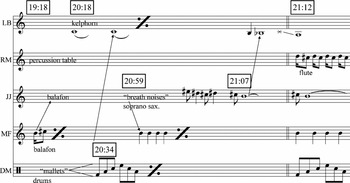
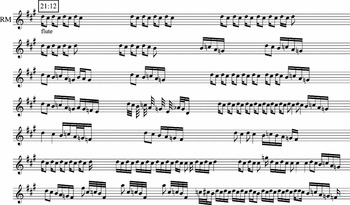
Favors starts playing the <B4, C-sharp4> balafon riff at 19:18, as shown in Example 1. Whether “Checkmate” was cued verbally or visually by Mitchell, or initiated by Favors on balafon, Favors's distinctive, persistent two-note loop is sufficient to get the rest of the musicians thinking about “Checkmate”: when to enter, how to interpret the compositional modules assigned to them in rehearsal, and how to make the piece fit into the context of the preceding music and the rest of the performance. One minute after Favors's entrance, Bowie introduces the second modular component, a sustained C4 on kelphorn.Footnote 46 At 20:34 Moye reshapes his rhythmically diffuse, melodic mallet playing into a steady 6/8 beat, the third element of “Checkmate”; Bowie acknowledges Moye's decision to join the modular structure by playing another long tone on kelphorn an instant later.Footnote 47 At 21:07 Jarman settles into his modular role on soprano saxophone, stepping down from B4 to a long-tone A4. When at 21:12 Bowie and Jarman land on A3/A4 simultaneously and Mitchell enters on flute—playing a diatonic inversion of Favors's balafon ostinato that also centers on C-sharp5—all five musicians are finally participating in the “Checkmate” modular structure. In a sense, “Checkmate” begins again here, with all the modular blocks in place to support the composer's flute improvisation. Like his composition, Mitchell's flute solo is also modular in character, and is initially based on a <D5, C-sharp5> motive (eventually <D5, C-sharp5, B4>) that coordinates with the A-major diatonic/pentatonic modular elements performed by the rest of the ensemble, as Example 2 shows.
Assembling the “Checkmate” modular structure. All examples in this article are my transcriptions of the Art Ensemble's compositions, reproduced by permission of Art Ensemble of Chicago Publishing Co. (ASCAP). An audio track corresponding to this example is available at www.journals.cambridge.org/sam2008006. All audio examples for this article are excerpted from Art Ensemble of Chicago, Live at Mandel Hall, Delmark DS-432/433, 1974, used by permission of Delmark Records.

The opening phrases of Mitchell's “Checkmate” flute improvisation. An audio track corresponding to this example is available at www.journals.cambridge.org/sam2008007.

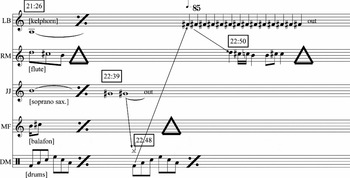
While Mitchell picks up speed in his improvisation, the other musicians reinterpret the modular components they are playing, as shown in Example 3: Bowie and Jarman transform their layered long tones into chains of rhythmically fragmented accents, and Favors alternates between his initial <B4, C-sharp5> balafon riff and pulse patterns made of repeated B4s. At 22:39 Jarman selects a different long tone, F-sharp4, recoloring what Mitchell, Bowie, and Favors are playing by emphasizing the F-sharp-minor diatonic/pentatonic tonal area over the A-major diatonic pentatonic tonal area that inhabits the same pitch space.
Reshaping the “Checkmate” modular structure. Triangles, following AACM convention, mean “improvise(d).” An audio track corresponding to this example is available at www.journals.cambridge.org/sam2008008.

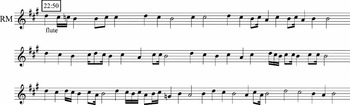
Moye answers Jarman with a series of cymbal crashes, construing Jarman's tonal shift as a turning point in the “Checkmate” interactive framework after a period of subtle, collective reinterpretation of the modular elements provided compositionally by Mitchell. The rest of the ensemble agrees: Jarman drops out, Favors breaks up his <B4, C-sharp4> ostinato and plays freely across the balafon, and Bowie sounds a concluding string of fourteen short F-sharp4s on kelphorn (echoing Jarman's F-sharp4 long tones), then lays out. As Example 4 illustrates, Mitchell reacts in a contrary fashion, by playing longer, slower-paced rhythms and restricting the pitch content of his improvisation to the four-note diatonic-scale segment (<D5, C-sharp5, B5, A5>), reverting to the motivic core of his modular role at a moment when the rest of the musicians are moving the group improvisation in a different direction, beyond the stable-state version of “Checkmate” heard at 21:12.
The next stage of Mitchell's “Checkmate” flute improvisation. An audio track corresponding to this example is available at www.journals.cambridge.org/sam2008009.

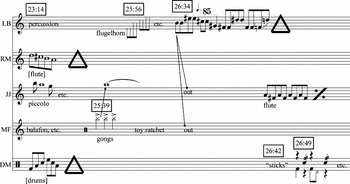
By 23:14 the members of the Art Ensemble are exiting the “Checkmate” modular structure one at a time (as Example 5 shows), mirroring the system of staggered modular entries in the two-minute span from 19:18 to 21:21 during which the piece was assembled. Jarman—now on piccolo—is harmonizing Mitchell's lines, rather than drawing on any of the “Checkmate” modular components. Moye responds to Jarman by abandoning his dense 6/8 beat and adopting a supportive rhythmic role beneath the new Mitchell-Jarman flute-duet texture. Favors is the next musician to break decisively with the “Checkmate” modular structure, striking three gongs at 25:39 and then grinding away on a toy ratchet, one of the Art Ensemble's signature sounds. Jarman distills his counterpoint with Mitchell into a string of long-tone A5s, homing in on the central pitch of “Checkmate” as a concluding gesture. Hearing Mitchell's composition recede in the flow of the ensemble improvisation, Bowie switches from small percussion to flugelhorn to perform phrases built from non-directional dotted-rhythm arpeggios—abstract gestures that could potentially be assembled into some kind of “march.”
Disassembling the “Checkmate” modular structure. An audio track corresponding to this example is available at www.journals.cambridge.org/sam2008010.

At the time of Bowie's flugelhorn entrance, 25:56, the ensemble improvisation is balanced between multiple opposing possibilities. Favors and Bowie had already begun to transition away from “Checkmate,” and they are certainly not playing “Checkmate” now. Essentially, Favors is playing indeterminate transitional percussion, all-purpose sounds that could fit into a number of characteristic Art Ensemble interactive frameworks, particularly the gong crashes, which are often heard in “improvisational transitions” and in cymbal-and-gong-orchestra interactive frameworks.Footnote 48 Bowie's proto-march arpeggios constitute a specific stylistic reference that contrasts strongly with the poly-melodic, rhythmically independent modular material of “Checkmate.” Bowie's musical idea offers not just a way out of “Checkmate,” but also a new interactive-framework destination. Jarman is not quite so far along as Favors and Bowie. His long tones are not especially suitable for an improvisational transition; rather, it seems that Jarman is trying to end “Checkmate” by returning to the long tones he played at the beginning of the piece. Mitchell and Moye, however, are still playing “Checkmate.” Of course, all five musicians understand that “Checkmate” has to end, and that the pre-performance set list does not indicate what is supposed to immediately succeed it.Footnote 49 Accordingly, Bowie, Favors, Jarman, Mitchell, and Moye will have to “negotiate” where to go next, when to leave, and how to get there.
At 26:34, as Jarman's final A5 on piccolo evaporates, Bowie takes charge of the group texture with a crisply articulated, tonally suggestive march-style flugelhorn melody.Footnote 50 Mitchell instantly “quantizes” his melodic line to coordinate rhythmically with Bowie, while remaining in the A-major diatonic/pentatonic pitch space of his “Checkmate” improvisation. Moye switches on the snares of his snare drum and starts playing (with sticks) a slow march pattern at about eighty-five beats per minute, matching the tempo and style suggested by the new Bowie-Mitchell flugelhorn-flute duet. Jarman rejoins the texture on flute: his A4–F-sharp4 tremolo combines the two long-tone pitches he employed during “Checkmate” without sounding like an overt reference to the composition. By carefully maintaining a tonal connection with “Checkmate,” Jarman and Mitchell are preserving an aspect of narrative continuity and waiting for Bowie and Moye to construct the next interactive framework. What results is a dovetailed, layered transitional passage in which elements of the “old” and “new” textures are heard simultaneously, a distinctive feature of Art Ensemble concert “suites.” Performative moments like this one, that “[straddle] two or more existing schemas,” in the words of cognitive theorist David Huron, are often perceived as particularly “distinctive” by listeners.Footnote 51 By creating a perceptually distinctive moment of textural overlap, the members of the Art Ensemble are in effect telling the audience in Mandel Hall that “Checkmate” has essentially ended, and to expect something different soon.Footnote 52 The phenomenon of interactive-framework overlap in Art Ensemble practice—enabled by an “AACM-style” performative balance between individual agency and a commitment to group improvisationFootnote 53—exemplifies what literary scholar Bruce Tucker has called the “first-person, plural” narrative perspective projected by the Art Ensemble in performance.Footnote 54 “[F]rom this perspective,” according to Tucker, “the Ensemble arranges the disparate musical styles, time periods, places, and events of its complicated, instrumental musical narrative. . .an epic myth of identity in a diasporic context of profound discontinuities of time, place, nationality, language, historical experience, and much else.”Footnote 55
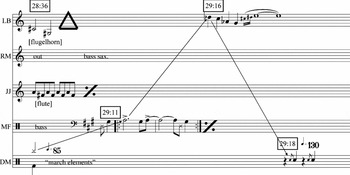
As the “Checkmate” modular structure dissolves into a loosely organized march-style interactive framework, the formerly brisk pace of the improvisatory narrative seems to slow, except for Jarman's A4–F-sharp4 tremolo, as shown in Example 6. Then Favors has a new idea—at 29:11, a two-measure bass vamp in the key of A that outlines a tempo considerably faster than that of the preceding march-style passage. In the relatively empty, unstable texture Favors inhabits, the timing and structure of this bass pattern have an immediate, galvanizing effect.
Dovetailing “Checkmate” into a new transitional passage. An audio track corresponding to this example is available at www.journals.cambridge.org/sam2008011.

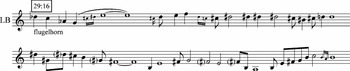
Favors's mesmeric bass line is too good for Bowie to pass up. At 29:16, Bowie launches into a soaring flugelhorn melody (shown in Example 7), and as he guides his opening phrase upward to D5, Moye introduces a backbeat flam pattern at about 130 beats per minute,Footnote 56 creating with Favors a rhythmic and tonal foundation for Bowie's Iberian-inspired solo line: “an angular approach to the Sketches of Spain thing,” according to Moye.Footnote 57 The speed and fluidity with which this textural/thematic/tempo transformation is achieved amazed Moye, listening to Live at Mandel Hall thirty-five years later: “We don't practice stuff like that. That's a one-in-a-thousand shot there.”Footnote 58 Although the musicians may not have rehearsed this particular “improvisational transition,” “Spanish” brass solos are an important element of Art Ensemble performance practice, and given the rhythmic and tonal context provided by the rhythm section, it is easy to understand how the Spanish-brass-solo interactive framework was activated in Bowie's mind. What is truly remarkable about this moment in Live at Mandel Hall—if not “one-in-a-thousand,” considering the musicians' extensive experience rehearsing and performing together—is how complete and convincing the rapid, improvised transition sounds.
The opening phrases of Bowie's flugelhorn improvisation. An audio track corresponding to this example is available at www.journals.cambridge.org/sam2008012.

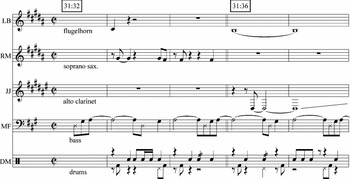
At 31:15 Bowie moves away from the Sketches of Spain melodic idiom and improvises a string of three four-measure R&B-style riffs in dialogue with Mitchell, who is now playing soprano saxophone.Footnote 59 At the conclusion of their third exchange, Bowie finishes Mitchell's phrase, resolving Mitchell's fourth-beat E4 to A3 on the metric downbeat at 31:36, as Example 8 shows. This improvised metric and melodic synchronization between Bowie and Mitchell, along with the hypermetric structure articulated by the rhythm section of Favors and Moye, creates the impression of a clear sectional demarcation, as well as a tonal transition: the A-major-related pitch content in the four measures surrounding the 31:36 arrival coordinates tonally with Favors's bass line and recalls the diatonic/pentatonic pitch space of “Checkmate,” but contrasts markedly with the intervening Spanish sounds of Bowie's post-“Checkmate” flugelhorn solo, which fused D minor and A major.Footnote 60 After the sectional transition at 31:36 Mitchell takes over from Bowie and initiates a soprano saxophone improvisation over the solid rhythm section groove.
A moment of convergence: “Dautalty.” An audio track corresponding to this example is available at www.journals.cambridge.org/sam2008013.

The beginning of Mitchell's soprano saxophone solo, which is shown in Example 9, corresponds to the starting point of the collective improvisation “Dautalty,” judging by the track listing on the double-LP release. This moment in the concert resembles a particular point in “Checkmate,” the beginning of Mitchell's flute solo at 21:12, in several ways; perhaps the musicians are still thinking in a similar, modular fashion. Both textures emerge from long, accumulative transitions during which the musicians enter independently, gradually adding convergent elements as Mitchell waits patiently for the interactive framework to crystallize, so he can start his solo. In the present improvisational context, Favors plays a three-note cut-time vamp on bass, replacing his two-note short-long balafon cell from “Checkmate.” Moye hooks up with Favors, playing a drum-and-bugle-corps-inspired cadence beat rather than a metrically independent 6/8 mallets pattern.Footnote 61 Bowie and Jarman support Mitchell with overlapping long tones, just as in “Checkmate,” but on different instruments (flugelhorn and alto clarinet).
The opening phrases of Mitchell's “Dautalty” soprano saxophone improvisation. An audio track corresponding to this example is available at www.journals.cambridge.org/sam2008014.

Mitchell's “Dautalty” improvisation, while not motivic in construction like his “Checkmate” flute solo, is similarly spacious and microtonal in execution. The microtonal aspects of the present solo are even more pronounced than the microtonality of the “Checkmate” improvisation: Mitchell begins his “Dautalty” soprano saxophone solo with simple melodies drawn from the A-major triad and pentatonic scale, to which he applies his distinctive system of intonation, pulling and tensing against the transparent, tempered tuning of Favors's repetitive bass line and the anchoring long tones played by Bowie and Jarman. Also, the subtly off-center rhythms chosen by Mitchell create an analogous feeling of asymmetrical, micro-rhythmic friction in the metric domain against the steady groove articulated by Favors and Moye.
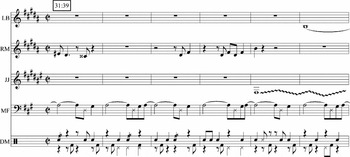
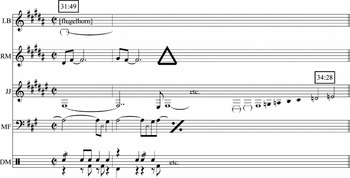
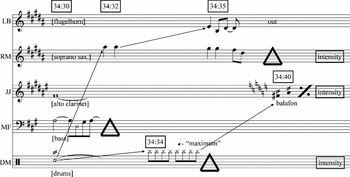
Beneath Mitchell's soprano saxophone solo and Bowie's supportive mid-range riffing, Jarman adopts an additive approach for his alto clarinet accompaniment. Jarman builds everything on A2, his opening long tone, at first surrounding A2 with its chromatic neighbor tones, G-sharp2 and B-flat2, and then introducing higher pitches in each phrase—C3, D3, E3—before returning to A2, as illustrated in Example 10. Ultimately at 34:28 Jarman reaches for F3, then continues up the scale through G3, arriving on A3 at 34:30.
Jarman on alto clarinet, connecting A2 to A3. An audio track corresponding to this example is available at www.journals.cambridge.org/sam2008015.

Moye reacts instantly to Jarman's arrival on A3 by arresting his comfortable drum-and-bugle-corps cadence beat to play a roll on his snare drum, as shown in Example 11. After letting the energy created by his snare roll build for a few seconds, Moye breaks into a rapid cymbal pattern, articulating a bebop/free-jazz style “maximum tempo,” the fastest tempo playable on the drum set. Mitchell is undisturbed by the sudden change from Moye and continues his slow-paced improvisation. Jarman, however, chooses the path cleared by Moye, switching from alto clarinet to balafon to perform a reorganized version of his post-“Checkmate” flute tremolo: a stream of rapidly articulated F-sharp4s (approximately four notes per second) followed by another stream of A4s.
Jarman and Moye summon an intensity structure. An audio track corresponding to this example is available at www.journals.cambridge.org/sam2008016.

Together, Jarman and Moye have summoned an intensity structure, a characteristic Art Ensemble interactive framework. In AACM circles and among the members of the Art Ensemble, the term “intensity” refers to a post-bebop performance style often associated with the mid-1960s “New Thing” movement that developed in New York contemporaneously with the founding of the AACM. Saxophonist Archie Shepp, one of the principal “New Thing” figures, suggests the term “energy-sound” playing to denote methods of music production typified by high levels of physical energy and timbral complexity.Footnote 62 In his account of performing with the Art Ensemble in 1977, George E. Lewis defines an “[i]ntensity structure” as a “furious texture vamp” that is “extremely dense, fast-moving, yet ultimately static.”Footnote 63 Against the burgeoning increases in intensity and “horizontal density” articulated by the rest of the ensemble, Mitchell continues to pace himself, and resists yielding immediately to the intensity style.Footnote 64 The oppositional, multi-dimensional approach to improvisation adopted by Mitchell at this point (and elsewhere) in Live at Mandel Hall is reminiscent of a “new music. . .for thinkers” that Mitchell has imagined:
The instruments function completely independently. You don't have to back me up and I don't have to back you up either. And I really would prefer [you] not following me. That cuts down on the full dimension of the music. It makes the music one-dimensional. . . . A lot of the music we experience today is built around a particular center, or drone, but in this situation we could have multi-centers. When we look at the function of the rhythm section in so-called “jazz,” a lot of the music will have a particular beat and the bass can be walking a particular line and the piano will be playing chords of some sort. Now to diffuse that whole thinking, and create a pure music, would be more along the lines of what I would be thinking about.Footnote 65
In the present improvisatory context, of course, only Mitchell is operating “completely independently” from the rest of the band, whose unified gestures are sustaining the intensity-dominated interactive framework. Still, Mitchell's lonely struggle against the human and instrumental resources of the Art Ensemble sonic “machine” is thrilling to hear, and one can easily imagine the vivid visual dynamic witnessed by the Mandel Hall audience as Mitchell, stage right, intently maintains his textural independence from the musicians to his left.Footnote 66
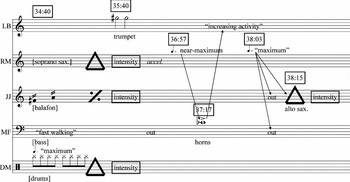
At 35:40 Bowie rejoins the intensity structure in his recurring interactive role as the signifying trumpeter, playing smears and shouts in the register above Mitchell, as shown in Example 12. Bowie's trademark “contrasting ironic, ejaculatory brass witnessing” adds to the prevailing intensity texture, and the musicians respond with increased density and dynamics—except for Favors, who at this moment is doing all he can on bass, and elects to lay out.Footnote 67 Mitchell gradually increases the horizontal density or apparent tempo of his improvisation following Bowie's entrance. At 36:57 Mitchell reaches a near-maximum tempo, playing almost as fast as possible on the soprano saxophone but still restraining himself dynamically, further delaying his complete surrender to the new intensity structure and encouraging the other musicians to adopt a temporally expansive, long-range improvisational perspective as they collectively develop this multi-centered intensity structure. Favors cheers on Mitchell with horn blasts, which Bowie parodies on trumpet.
Mitchell's soprano saxophone improvisation converges with the intensity structure; Jarman joins on alto saxophone. An audio track corresponding to this example is available at www.journals.cambridge.org/sam2008017.

Mitchell finally moves into maximum-horizontal-density/maximum-tempo intensity-style playing at 38:03, over three minutes after Moye and Jarman started the intensity-structure process, an extraordinary demonstration of patience and an illustration of the performative-personality contrast between Mitchell's often deadpan style and the extroverted showmanship of Moye and Jarman. Mitchell has described this careful approach to improvisation as essentially compositional:
[I]f you study improvisation you've got to look at it as paralleling composition—it's basically the same process you're going after except you're trying to do it spontaneously. In order to really do it spontaneously, you have to control many things. When you're writing something, you have options, many ways you can go, and you have the time to do that if you want. You have to still have that situation if you're improvising.Footnote 68
Favors (who may be fatigued at this point in the performance) and Jarman give Mitchell a little space to establish his place in the intensity framework by laying out at 38:06. However, Jarman cannot stay away for long, and at 38:15 he picks up his alto saxophone and launches a blistering intensity-style solo, competing dynamically with Bowie and Mitchell.
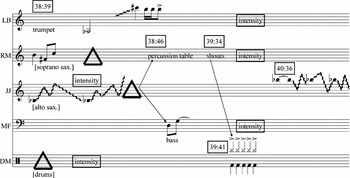
As Example 13 illustrates, Jarman begins to dominate the ensemble texture at 38:39 with a set of rapid runs rooted on D-flat3, the lowest pitch on his alto saxophone. Sensing the opportunity for a change in texture and a temporal extension of the intensity structure, Mitchell moves to percussion table, transferring the energy he accumulated in his long soprano saxophone improvisation into the rickety sounds of his percussion table. The exchange of interactive roles between Mitchell and Jarman—lead intensity saxophonist to percussionist, and vice versa—keeps the overall energy level high while allowing one player or the other to physically recover from a demanding saxophone improvisation, and more importantly renews the ensemble sound while maintaining a broad textural and timbral balance between winds and percussion.
Mitchell moves to percussion, creating a textural shift within the intensity structure. An audio track corresponding to this example is available at www.journals.cambridge.org/sam2008018.

This improvisational methodology requiring constant textural change within any sustained interactive framework (even an intensity structure) is emblematic of Art Ensemble performance practice.Footnote 69 According to the members of the Art Ensemble, this methodology distinguished their approach to improvised musical performance from the monochromatic, one-dimensionally intense, “energy-sound” playing of contemporaneous bands, particularly New York–based, non-AACM groups. Mitchell—who visited New York with Jarman at the height of the “New Thing” in 1966—recalled: “We were unlike the music that was coming out of New York at that time because a lot of it was very intense, and that was it.”Footnote 70 “They never really played anything that was soft or anything like that. We were going around with these kelp horns and whistles. The Chicago people got intense, but they also got soft, and they also were incorporating other sounds into their music.”Footnote 71
The sonic diversity and depth achieved by the Art Ensemble in performance is a manifestation of their multi-stylistic “Great Black Music” compositional/improvisational repertoire, and of their commitment to “multi-instrumentalism.” Anthony Braxton recalled that “as early as 1966 the AACM had developed alternative concepts that dictated new roles for every family of instruments—including percussion . . .‘Little Instruments' or ‘Sound Tools.’”Footnote 72 Multi-stylism and multi-instrumentalism in Art Ensemble performance practice were inextricably linked, not just because playing different interactive frameworks required different instruments, but because the group sought an “infinite” expressive and “spiritual” palette, according to Jarman:
[O]ne of the elements that made the Art Ensemble search so diligently, was for the manifestation of the true sound. So that's why we had so many instruments. They were looking for specific sounds to express the music that was flowing through their consciousness. And that sound could be a bowl, a table, a piece of wood; whatever it took. Also there was another challenge. . .to investigate an infinite number of forms. We were not masters of every form, but we certainly had to be aware of every form. For example, African forms of music, Moye would teach us African rhythms with specific forms. . . . When we worked on it and did it right, you could feel the spirit click in, you could feel the spiritual uplift of the universality of the music. Even if it was a Southeast Asian form, when we got to the right level of that, you could feel the spirit click in.Footnote 73
For Moye, the logistical inconvenience of transporting and setting up hundreds of instruments was outweighed by the interactive improvisational possibilities afforded by multi-instrumentalism: “All these years we've been carrying this stuff around at our own expense, plus setting it up. I was in the group for nine years before we had a roadie. The reason why we went to all of this trouble is that now we've got all of these sounds there all of the time. We can move in and out of different situations and color them the way we want to.”Footnote 74 During an Art Ensemble performance, Roscoe Mitchell can hear a timbre created by Don Moye and replicate it, or respond with an entirely different tone color; he can hear a sound in his mind and find it in his instrument collection.
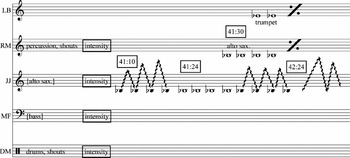
At 39:34 Mitchell significantly increases the density of his percussion table improvisation, using small cymbals and wood blocks to match the horizontal density and timbral profile of Moye's drum-set playing. Moye elevates his performance in turn, triggering a general increase in intensity throughout the ensemble; Mitchell shouts in response. As Example 14 illustrates, Jarman returns to the lowest register of his alto saxophone at 41:10 to play a series of dense runs based on D-flat3, drawing a clear connection between the present improvisational context and the D-flat3–based lines he played two minutes earlier. At 41:24 Jarman simplifies his low-register idea to three long-tone D-flat3s, calling Bowie and Mitchell with a simple, compelling musical idea that begs to be doubled.Footnote 75 Mitchell answers on alto saxophone, followed by Bowie on trumpet an octave higher, and as they intone D-flat3/D-flat4 together Jarman floats above them, moving rapidly up and down the harmonic series using the overblowing technique associated with “intense,” “energy-sound” styles of saxophone playing.
Jarman starts playing long tones, echoed by Mitchell and Bowie. An audio track corresponding to this example is available at www.journals.cambridge.org/sam2008019.

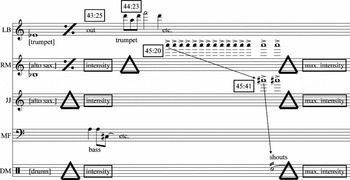
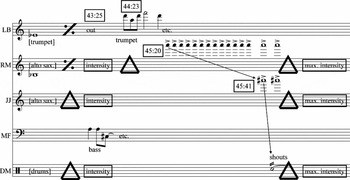
Bowie and Mitchell decide to stop playing long tones at 43:25, changing the coloration of the intensity structure. After resting for a few seconds, Mitchell joins Jarman, doubling the number of dense, rough-timbre intensity alto saxophone improvisations in the ensemble texture, as shown in Example 15. Mitchell slowly works his way up to the extreme high register of his alto saxophone, where at 45:20 he starts playing piercing long-tone C6s above the improvised lines of Bowie and Jarman. At 45:41 Jarman echoes Mitchell's upper-register long-tone idea, but selects a different pitch: C-sharp6, which he repeatedly bends towards D6 to accentuate the shattering dissonance he is forming with Mitchell. An instant later, Moye adds to the furor by redirecting the flow of his intensity drum playing into a thunderous snare drum roll, the gesture that originally triggered the intensity structure at 34:30, and which certainly could be interpreted by the musicians and the audience as a signal to end the intensity structure. Over Moye's drum roll, Mitchell and Jarman prolong their dissonant high-register long-tone interaction, pushing the ensemble sound complex into a moment of exhilarating “maximum” intensity.
Mitchell and Jarman converge toward a moment of “maximum” intensity. An audio track corresponding to this example is available at www.journals.cambridge.org/sam2008020.

Moye finally breaks up his drum roll at 46:38, cymbal-crashing five times and returning to multi-directional, intensity-style drumming, as Example 16 shows. The extended one-minute buildup created by Moye's snare drum roll and the release of energy when it ends helps the group improvisation continue at an even greater level of intensity than before. It seems that the musicians are testing each other's physical capacities—and the audience's willingness to endure a prolonged “period of tension”Footnote 76—by sustaining this intensity episode past the point when it would have been logically expected to end (at Moye's drum roll), a collective impulse inspired by the deliberate, “compositional” unfolding of Mitchell's solo during the opening moments of the intensity structure and fueled by Jarman's indomitable saxophone playing.Footnote 77
While the other performers prolong the intensity structure, Mitchell moves to percussion again. An audio track corresponding to this example is available at www.journals.cambridge.org/sam2008021.

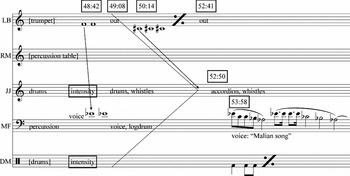
Shortly after Moye ends his drum roll, Mitchell finishes his saxophone improvisation and switches to percussion table for the second time in this intensity structure. Mitchell's dense cymbals-and-wood-blocks sonic output occupies the same frequency and timbral spaces as the cymbals of Moye's drum set; eventually Moye yields that acoustic territory to Mitchell, focusing at 48:03 on his drum set's low-register instruments: tom-toms and double bass drums.Footnote 78 Hearing the significant textural change created by Mitchell and Moye, Jarman puts down his alto saxophone at 48:12.
The musicians have presented themselves with a second opportunity to end the intensity structure, an interactive framework normatively centered on the saxophonists and often controlled by Jarman, whose redoubtable “energy sound”–style saxophone playing is one of his improvisational specialties and an interactive role in which he is often cast.Footnote 79 Rather than letting the intensity feeling subside, however, Jarman pivots away from the audience, addresses the African drums at the interior of the stage assemblage, and at 48:18 nearly drowns out the rest of the band with a barrage of drum strokes, as Example 17 illustrates.Footnote 80
Jarman transforms the intensity structure into a percussion-orchestra interactive framework. An audio track corresponding to this example is available at www.journals.cambridge.org/sam2008022.

By switching to drums, Jarman tilts the performative balance away from the wind instrument family and towards the group's battery of percussion instruments, a decisive point in the group improvisation that exemplifies Jarman's ability to coordinate Art Ensemble intensity structures through his presence or absence on saxophone. Just as significantly, Jarman joins Favors and Mitchell in facing the percussion instruments at the center of the semicircular instrument sculpture on the Mandel Hall stage; for the first time in the concert, only Bowie and Moye are facing the audience. Bowie reacts by funneling his intense trumpet improvisation into long tones; Favors sings along.
When Bowie lays out at 49:08, the rest of the musicians are playing percussion instruments, a transitional moment representing a continuation of the heightened intensity-structure energy level but a complete transformation of the ensemble texture from a saxophone-centric “free jazz” setup to a multi-centered percussion-orchestra instrumental configuration. The epic intensity structure has lasted about one-third of the length of the concert at this point, a remarkable time span compared to the briefer improvisational and compositional interactive frameworks that preceded it. Bowie returns on trumpet at 50:14, playing long tones, quieter and quieter, as the percussion orchestra clatters around him. Eventually Bowie's persistent decrescendo wears the rest of the ensemble down, and the dynamic, density, and intensity levels drop substantially. Bowie exits at 52:41, further thinning the texture, and Jarman switches to accordion. Finally the Art Ensemble has allowed the intensity structure to disintegrate, after having “stated everything” in the intensity interactive framework: “[T]he color has . . .been worked,” as Moye would say.Footnote 81
In this analysis I traced networks of group interactions in an Art Ensemble of Chicago performance using an improviser's phenomenological perspective, and demonstrated cycles of convergence towards and divergence from one compositionally generated (“Checkmate”) and one improvisationally generated (“Dautalty”) interactive framework. These interactive frameworks were primarily portrayed as musical structures, and other aspects of Art Ensemble performance practice—such as multi-instrumentalism and the members' shifting interactive roles—were usually conceptualized in musical terms; however, I want to reemphasize that Art Ensemble performance practice is fundamentally multi-disciplinary. The ritualistic, theatrical, and visual dimensions of Art Ensemble performance practice also operate in convergent and divergent ways in the larger context of interartistic group improvisation. In future analytical studies of the Art Ensemble of Chicago, I plan to employ multimedia frames of reference to capture the ritualistic, theatrical, and visual narratives of the band's improvisatory performances. Analytical work of this kind would be an important contribution to the current literature on the Art Ensemble and the larger jazz studies/improvised-music studies field, which is defined by an absolute divide between music-analytical approaches and everything else.Footnote 82 The performance practice of the Art Ensemble of Chicago presents scholars with an opportunity to bridge this divide by developing analytical, interpretive, and critical methodologies that, like the Art Ensemble's performances, are multi-disciplinary and improvisation-centered.
Appendix
A Partial List of the Instruments Played by the Art Ensemble of Chicago on Live at Mandel Hall (Delmark DS-432/433, 1974)
Lester Bowie: bass drum, flugelhorn, kelphorn, percussion, trumpet
Malachi Favors: balafon, bass, Fender bass, bells, gongs, horns, logdrum, percussion, toy ratchet, vocals, zither
Joseph Jarman: accordion, balafon, bells, alto clarinet, claves, drums, flute, gongs, marimba, percussion, piccolo, ratchet, alto saxophone, soprano saxophone, tenor saxophone, vibraphone, vocals, whistles
Roscoe Mitchell: bell lyre, bells, bike horns, clarinet, flute, gongs, percussion table, alto saxophone, bass saxophone, soprano saxophone, steel drums, tambourine, vocals, whistles
Don Moye: bells, congas, drums, drumset, gongs, horns, logdrum, percussion, triangle, vocals