1. Introduction
The Pyrenees are a WNW–ESE-trending Alpine fold and thrust belt that contains pre-Variscan basement rocks, late Neoproterozoic to Carboniferous in age. Pre-Variscan basement rocks form a large belt in the core of the cordillera and provide evidence of several pre-Variscan and Variscan magmatic episodes. Recently, the extensive use of U–Pb zircon geochronology, together with new geochemical and isotopic data, have produced significant advances in the understanding of these magmatic episodes, including the importance of subduction-related Ediacaran magmatism (Castiñeiras et al. Reference Castinñeiras, Navidad, Liesa, Carreras and Casas2008; Casas et al. Reference Casas, Navidad, Castiñeiras, Liesa, Aguilar, Carreras, Hofman, Gärtner and Linnemann2015; Padel et al. Reference Padel, Alvaro, Casas, Clausen, Poujol and Sánchez-García2018a), Ordovician magmatic events linked to the formation of the northern Gondwana passive margin (Cocherie et al. Reference Cocherie, Baudin, Autran, Guerrot, Fanning and Laumonier2005; Castiñeiras et al. Reference Castinñeiras, Navidad, Liesa, Carreras and Casas2008; Casas et al. Reference Casas, Castinñeiras, Navidad, Liesa and Carreras2010; Navidad et al. Reference Navidad, Casas, Castiñeiras, Barnolas, Fernández-Suárez, Liesa, Carreras and Gil-Peña2010) and Carboniferous magmatic rocks formed during the Variscan collision (Pereira et al. Reference Pereira, Castro, Chichorro, Fernández, Díaz-Alvarado, Martí and Rodríguez2013; Denèle et al. Reference Denèle, Laumonier, Paquette, Olivier, Gleizes, Barbey, Schulmann, Martínez Catalán, Lardeaux, Janousek and Oggiano2014; Martínez et al. Reference Martínez, Dietsch, Aleiniikoff, Cirés, Arboleya, Reche and Gómez-Gras2016; Van Lichtervelde et al. Reference Van Lichtervelde, Grand’Homme, de Saint-Blanquat, Olivier, Gerdes, Paquette, Melgarejo, Druguet and Alfonso2017). In some cases, where there is a lack of fossils and of reference stratigraphic horizons, geochronological data can also enable us to assess the age of the pre-middle Palaeozoic metasedimentary sequences and correlate them along the whole margin (Padel et al. Reference Padel, Alvaro, Casas, Clausen, Poujol and Sánchez-García2018a). This is the case for the pre-Upper Ordovician sequences of the Eastern Pyrenees where Ediacaran, Ordovician and Carboniferous magmatic rocks are interbedded with or mainly intrude into an almost unfossiliferous, thick (up to 5000? m) pre-Upper Ordovician series.
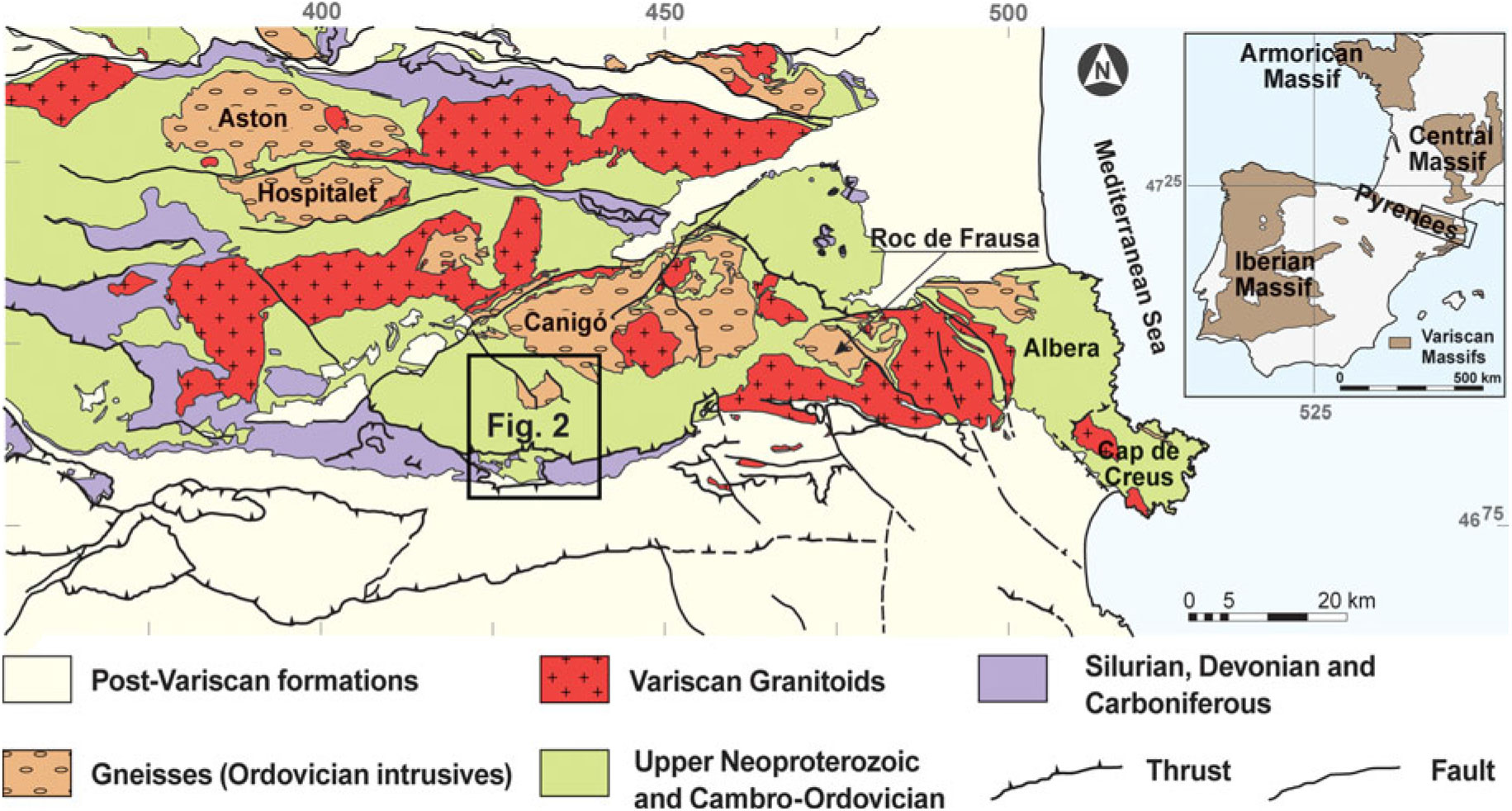
In this study, we focus on a thick sequence of strongly welded, rheomorphic (i.e. showing secondary flow structures) rhyolitic ignimbrites that crop out extensively in the Campelles–Bruguera area, along the southern slope of the Canigó massif (Fig. 1). These volcanic rocks were initially attributed to Late Carboniferous – Early Permian magmatism (F. Robert, unpub. Ph.D. thesis., Univ. Besançon, 1980), lying unconformably on an undated pre-Variscan slate-dominated succession (Cambrian–Ordovician?; J. A. Muñoz, unpub. Ph.D. thesis, Univ. Barcelona, 1985). We present new geochronological results that demonstrate these rocks correspond to a late Middle to early Late Ordovician magmatic event rather than a late Palaeozoic one. Unlike other Ordovician igneous rocks in the Pyrenees, the impressive volume of the rhyolitic ignimbrites represents an important volcanic event. We compare our new radiometric ages with existing ones from plutonic and subvolcanic rocks from the same late Middle to early Late Ordovician magmatic episode found near the study area and suggest a possible genetic relationship among all of them.
Simplified geological map of the Eastern Pyrenees and the location of the study area.

2. Geological setting
Ordovician magmatic events have been well studied in most of the Ordovician terranes of the North Gondwana margin and other margins of the Rheic Ocean (Holland & Patzkowsky, Reference Holland, Patzkowsky, Witzke, Ludvigson and Day1996; Herrmann et al. Reference Herrmann, Haupt, Patzkowsky, Seidov and Slingerland2004; Finney & Berry, Reference Finney and Berry2010 and references therein; Huff et al. Reference Huff, Bergstrom, Kolata, Finney and Berry2010), where they are mainly represented by calc-alkaline granites and granodiorites, and silicic volcanic rocks. A number of large eruptions that may even have had implications for climate change have also been identified from the period (Huff et al. Reference Huff, Bergstrom and Kolata1992; Young et al. Reference Young, Saltzmann, Foland, Linder and Kump2009; Buggisch et al. Reference Buggisch, Joachimski, Lehnert, Bergstrom, Repetski and Webers2010; Herrmann et al. Reference Herrmann, Macleod and Leslie2010; Lefebvre et al. Reference Lefebvre, Servais, François and Averbuch2010; Sell et al. Reference Sell, Ainsaar and Leslie2013; Jones et al. Reference Jones, Martini, Fike and Kaiho2017). In Alpine peri-Mediterranean domains, Ordovician magmatic rocks are well represented in several areas, including the French Massif Central (Roger et al. Reference Roger, Respaut, Brunel, Matte and Paquette2004; Pitra et al. Reference Pitra, Poujol, Den Driessche, Poilvet and Paquette2012; Lotout et al. Reference Lotout, Pitra, Poujol and Van Den Driessche2017), Sardinia (Helbing & Tiepolo, Reference Helbing and Tiepolo2005; Gaggero et al. Reference Gaggero, Oggiano, Funedda and Buzzi2012), Sicily (Trombetta et al. Reference Trombetta, Cirrincione, Corfu, Mazzoleni and Pezzino2004) and the central, southern and eastern Alps (Heinisch, Reference Heinisch, Karamata and Sassi1981; Zurbriggen et al. Reference Zurbriggen, Franz and Handy1997; von Raumer, Reference von Raumer1998; Guillot et al. Reference Guillot, Schaltegger, Bertrand, Deloule and Baudin2002; Schaltegger et al. Reference Schaltegger, Abrecht and Corfu2003).
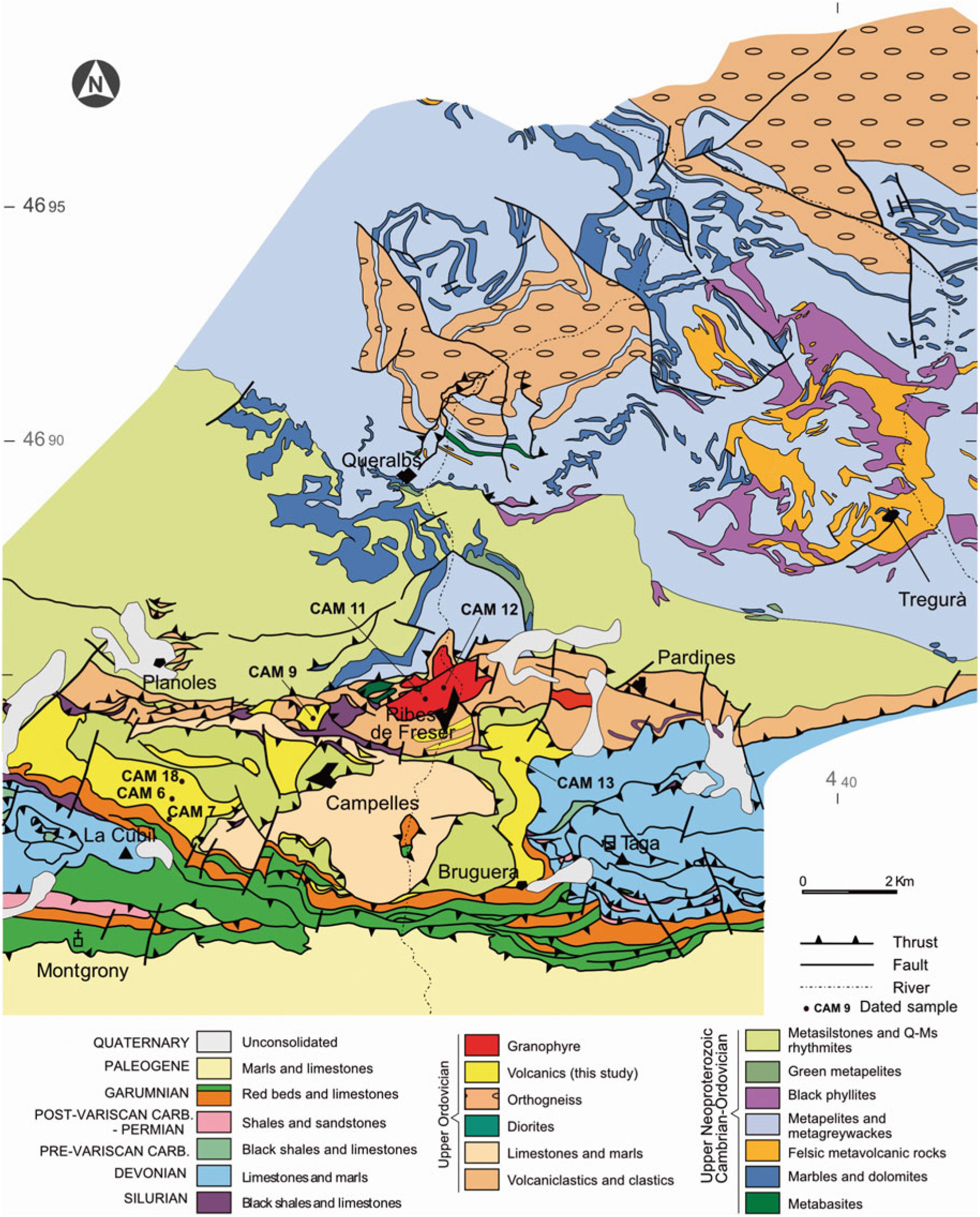
In the Pyrenees, Ordovician magmatic events form part of successive magmatic pulses that are well documented in the pre-Variscan basement rocks (Figs 1, 2). According to radiometric data, this Ordovician magmatism lasted for c. 30 Myr (c. 477–446 Ma) (Deloule et al. Reference Deloule, Alexandrov, Cheilletz, Laumonier and Barbey2002; Castiñeiras et al. Reference Castinñeiras, Navidad, Liesa, Carreras and Casas2008; Denèle et al. Reference Denèle, Barbey, Deloule, Pelleter, Olivier and Gleizes2009; Casas et al. Reference Casas, Castinñeiras, Navidad, Liesa and Carreras2010; Martínez et al. Reference Martínez, Iriondo, Dietsch, Aleinikoff, Peucat, Cirès, Reche and Capdevila2011; Mezger & Gerdes, Reference Mezger and Gerdes2016), and although the magmatic activity seems to be continuous, geochronological and geochemical data reveal the existence of two separate magmatic events, one of Early to Middle Ordovician age and the other of late Middle to Late Ordovician age. The Early–Middle Ordovician magmatic events (c. 477–467 Ma) gave rise to voluminous granites that constitute the protoliths of the gneisses of the Aston, Hospitalet, Canigó, Roc de Frausa and Albera massifs (Cocherie et al. Reference Cocherie, Baudin, Autran, Guerrot, Fanning and Laumonier2005; Castiñeiras et al. Reference Castinñeiras, Navidad, Liesa, Carreras and Casas2008; Denèle et al. Reference Denèle, Barbey, Deloule, Pelleter, Olivier and Gleizes2009; Liesa et al. Reference Liesa, Carreras, Castineiras, Casas, Navidad and Vila2011; Mezger & Gerdes, Reference Mezger and Gerdes2016). Early–Middle Ordovician granites are of calc-alkaline and metaluminous composition, and some authors relate them to arc magmatism, generated by subduction beneath the northern Gondwanan margin (e.g. von Raumer et al. Reference von Raumer, Stampfli and Bussy2003; von Raumer & Stampfli, Reference von Raumer and Stampfli2008). It should be noted that coeval mafic plutonic and silicic volcanic rocks are scarce. By contrast, the late Middle to Late Ordovician magmatic pulse (c. 467–446 Ma) yielded a varied suite of magmatic rocks especially well represented in the Canigó massif: calc-alkaline ignimbrites, andesites, volcaniclastic rocks, diorites and various types of small granitic bodies (Martí et al. Reference Martí, Muñoz and Vaquer1986; Casas et al. Reference Casas, Castinñeiras, Navidad, Liesa and Carreras2010; Martínez et al. Reference Martínez, Iriondo, Dietsch, Aleinikoff, Peucat, Cirès, Reche and Capdevila2011).
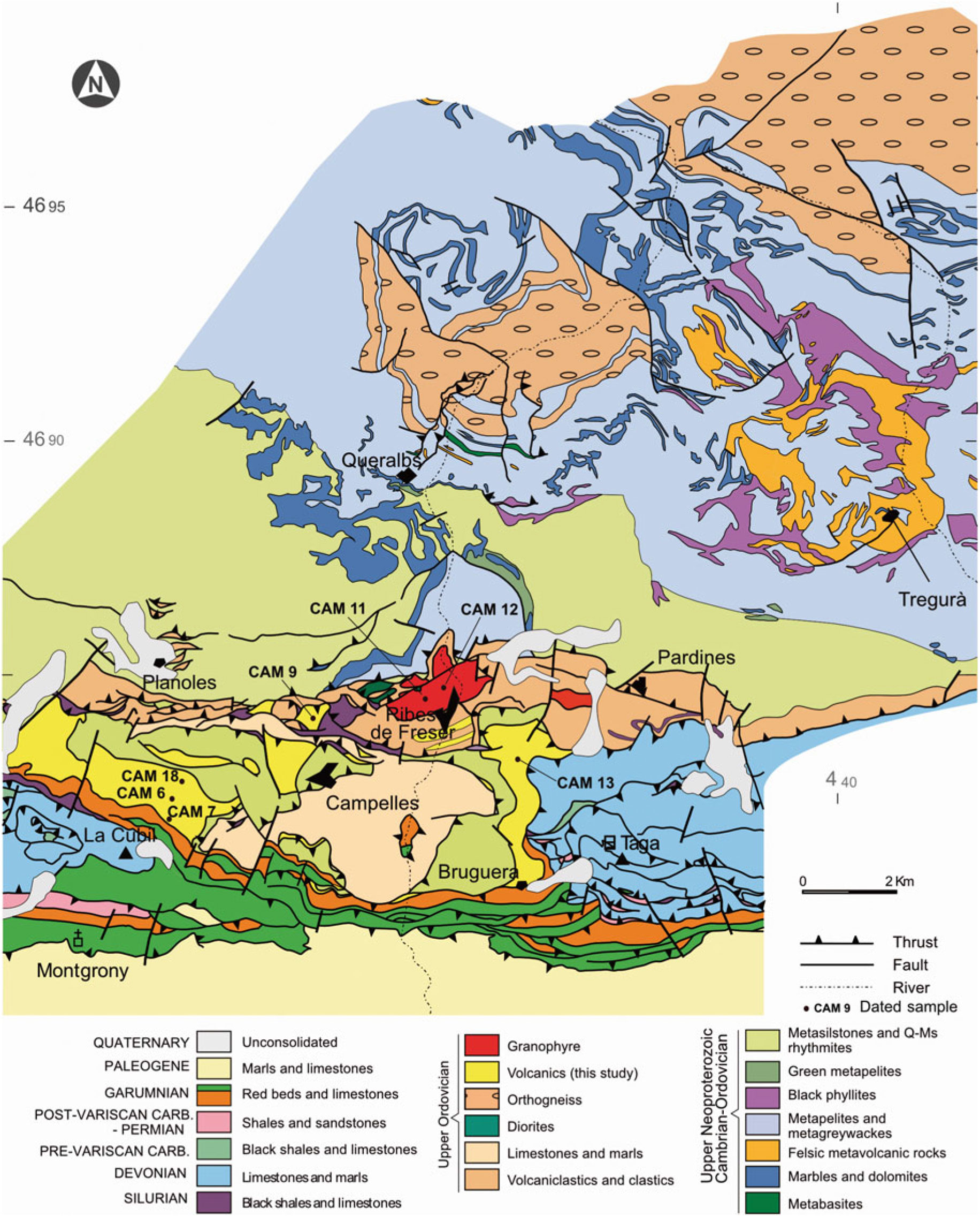
Geological map of the study area.
The Ediacaran–Lower Ordovician sedimentary sequence that crops out extensively in the Central and Eastern Pyrenees is covered unconformably by a well-dated Upper Ordovician succession (Cavet, Reference Cavet1957; Hartevelt, Reference Hartevelt1970). This younger succession constitutes a broad, fining-upwards megasequence of clastic deposits bearing a key limestone–marlstone interbed, which lies unconformably upon older Cambrian–Ordovician beds (Santanach, Reference Santanach1972; García-Sansegundo et al. Reference García-Sansegundo, Gavaldà and Alonso2004; Casas & Fernández, Reference Casas and Fernández2007; Padel et al. Reference Padel, Clausen, Alvaro and Casas2018b) (Figs 2, 3, 4), and which has been interpreted as related to extensional tectonics (e.g. García-Sansegundo et al. Reference García-Sansegundo, Gavaldà and Alonso2004; Alvaro et al. Reference Alvaro, Casas, Clausen and Quesada2018; Puddu et al. Reference Puddu, Alvaro and Casas2018). The presence of volcanic rocks interbedded with the Upper Ordovician sediments has been noted from Pierrefite (Calvet et al. Reference Calvet, Lapierre and Charvet1988) and mainly from the Ribes de Freser area (Robert & Thiebaut, Reference Robert and Thiebaut1976; F. Robert, unpub. Ph.D. thesis., Univ. Besançon, 1980; C. Ayora, unpub. Ph.D. thesis, Univ. Barcelona, 1980). These volcanic rocks compose a predominantly pyroclastic succession, which indicates the predominantly explosive character of this volcanic episode; associated lavas and subvolcanic intrusive rocks are scarce (Martí et al. Reference Martí, Muñoz and Vaquer1986). The composition of these pyroclastic rocks includes andesite, rhyodacite and rhyolite, and in volume they provide only a relatively minor contribution to the sedimentation of their corresponding Ordovician basins.
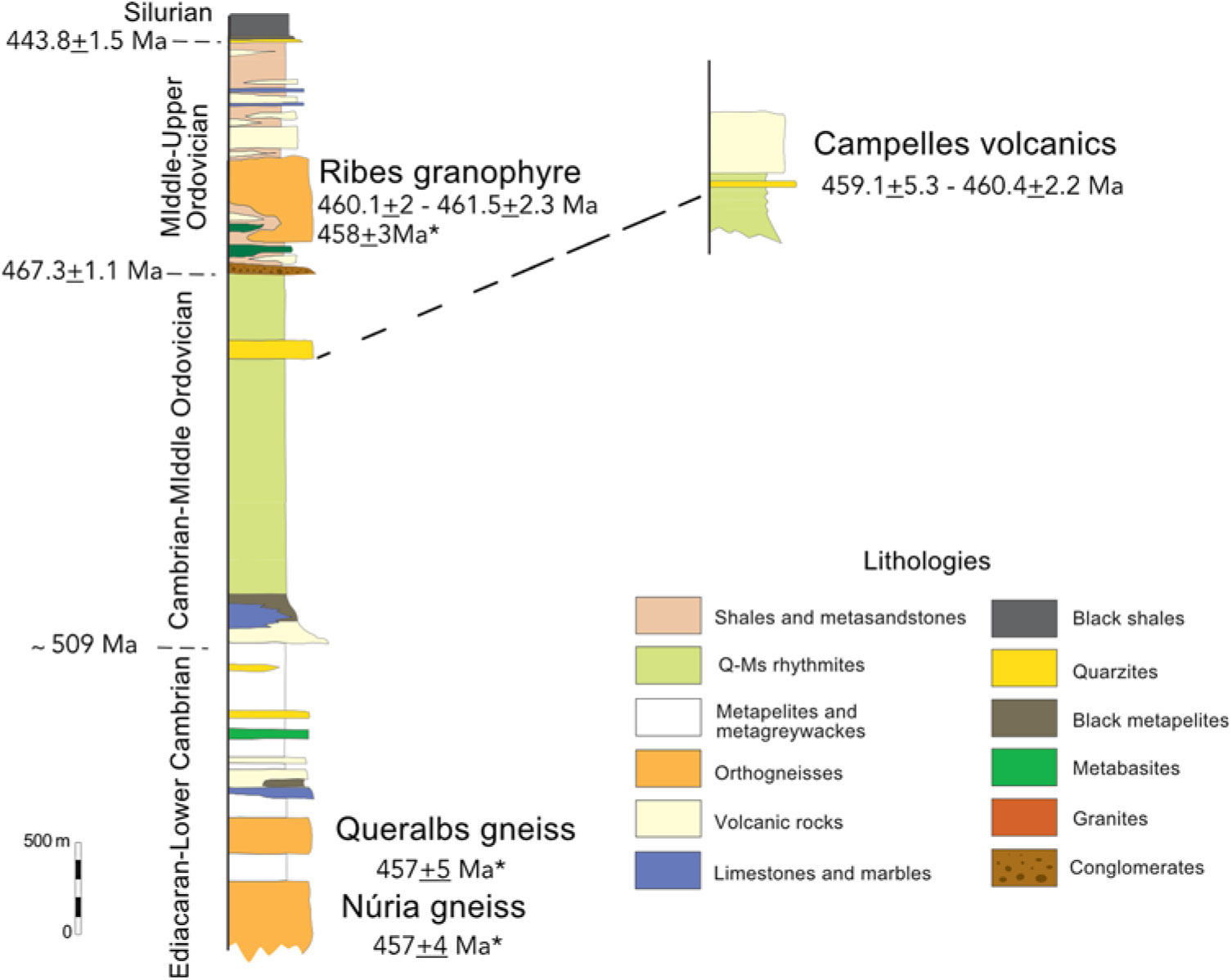
Synthetic stratigraphy of lower to middle Palaeozoic terranes in the study area and ages of the Middle–Late Ordovician magmatic rocks obtained in this study. * ages taken from Martínez et al. (Reference Martínez, Iriondo, Dietsch, Aleinikoff, Peucat, Cirès, Reche and Capdevila2011). The time scale follows Cohen et al. (Reference Cohen, Finney, Gibbard and Fan2013). The dashed line shows the correlation between the main stratigraphic section at Ribes de Freser (left) and that at Campelles (right).

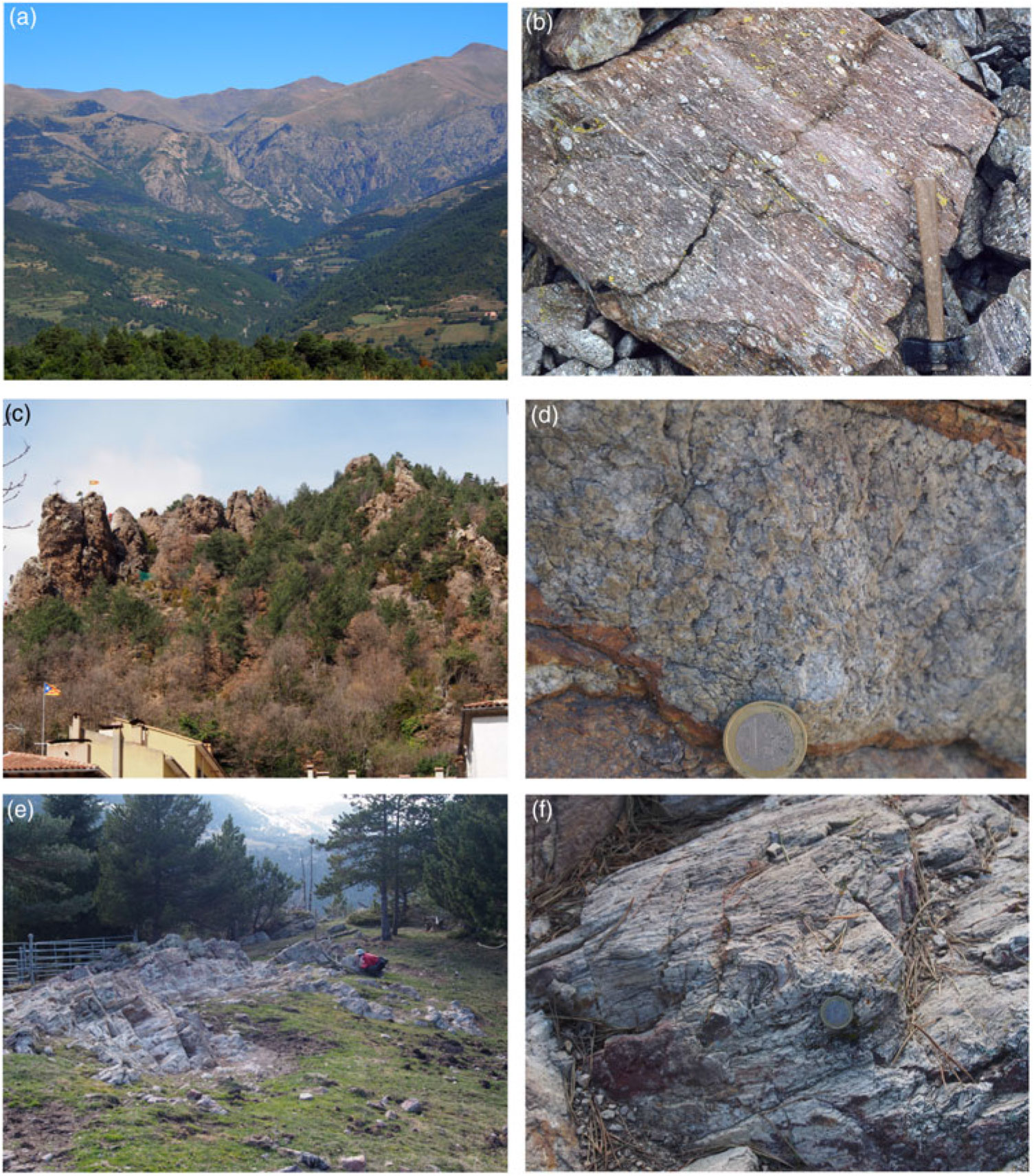
Field photographs of the Late Ordovician magmatic rocks in the study area. (a) General view of the Núria gneiss. (b) Close-up of the Núria gneiss. (c) General view of the Ribes granophyre. (d) Close-up of the Ribes granophyre. (e) Outcrop of rheomorphic ignimbrites. (f) Close-up of the rheomorphic ignimbrites. Hammer length for scale is 30 cm. Coin width is 2.32 cm.

Additionally, our study area (Campelles–Bruguera, along the southern slope of the Canigó) includes a subvolcanic granitic body, the Ribes granophyre, an undeformed, fine-grained, leucocratic granofels with a microscopic granophyric texture, emplaced in the lower part of the Sandbian–lower Katian succession and dated at 458 ± 3 Ma by Martínez et al. (Reference Martínez, Iriondo, Dietsch, Aleinikoff, Peucat, Cirès, Reche and Capdevila2011) (Figs 2, 3, 4a–d). Several other granitic orthogneissic bodies are emplaced in the lower part of the pre-Variscan succession; for example, the Núria gneiss is a homogeneous, medium-to-coarse-grained, two-mica granite gneiss (protolith age of 457 ± 4 Ma; Martínez et al. Reference Martínez, Iriondo, Dietsch, Aleinikoff, Peucat, Cirès, Reche and Capdevila2011), and the contemporaneous Queralbs gneiss is an augen gneiss that forms a ring around and on top of this two-mica gneiss (with an igneous crystallization age of 457 ± 5 Ma; Martínez et al. Reference Martínez, Iriondo, Dietsch, Aleinikoff, Peucat, Cirès, Reche and Capdevila2011, who used the name Núria augen gneiss for the Queralbs gneiss).
In addition to volcanic rocks clearly interbedded with Upper Ordovician sediments, the study area contains a thick (>1000 m) succession of rheomorphic rhyolitic ignimbrites (the Campelles–Bruguera ignimbrites), occasionally associated at their bases with basaltic andesites (Figs 2, 3, 4e, f). This succession lies unconformably over undated rocks, attributed to the Cambrian or Lower Ordovician (J. A. Muñoz, unpub. Ph.D. thesis, Univ. Barcelona, 1985), that include an occasional thin, poorly exposed succession of continental sedimentary fan deposits. The presence of some pollen remains in these fan deposits motivated F. Robert (unpub. Ph.D. thesis., Univ. Besançon, 1980) to attribute them and the overlying volcanic rocks to a late Palaeozoic volcanic episode, the effects of which are noted throughout the Pyrenees. This assumption was never questioned by subsequent studies (J. A. Muñoz, unpub. Ph.D. thesis, Univ. Barcelona, 1985; J. Martí, unpub. Ph.D. thesis, Univ. Barcelona, 1986; Martí, Reference Martí1991) despite the fact that these pollen remains were described as “badly preserved and a poor representative association that is insufficient to precisely indicate the age of the sediment” by F. Robert (unpub. Ph.D. thesis., Univ. Besançon, 1980). The ignimbrites are rhyolitic in composition and show clear secondary silicification due to post-emplacement alteration processes (J. Martí, unpub. Ph.D. thesis, Univ. Barcelona, 1986). They are very crystal-poor, possessing only phenocrysts of sodium-rich plagioclase, quartz and minor biotite. The main characteristic of these rocks is their flow banding, with some flow folds caused by the extreme stretching and welding of the original pumice fragments due to rheomorphism (J. Martí, unpub. Ph.D. thesis, Univ. Barcelona, 1986) (Fig. 4e, f). Stretched pumices (fiammes) are still visible in some outcrops, evidence of their primary pyroclastic character (Fig. 4f).
In the Pyrenees, Early–Middle Ordovician magmatic events developed during an episode of folding, uplift and erosion that led to the formation of the Upper Ordovician (‘Sardic’) unconformity, whereas a subsequent extensional pulse developed normal faults that controlled the post-Sardic sediments and filled in palaeorelief depressions (García-Sansegundo et al. Reference García-Sansegundo, Gavaldà and Alonso2004; Casas & Fernández, Reference Casas and Fernández2007; Casas, Reference Casas2010). In order to complete our understanding of the Middle–Late Ordovician magmatism, we present here the first zircon U–Pb age data from the thick sequence of rheomorphic rhyolitic ignimbrites cropping out in the vicinity of the towns of Campelles and Bruguera. This succession of volcanic rocks was deformed during the Variscan orogeny but is not affected by metamorphism. It is only partially affected by post-emplacement hydrothermal alteration that produced the silicification of the original glass components and transformed the juvenile phenocrysts into clay aggregates, microcrystalline quartz and carbonates, but their original forms and textures are preserved.
3. Analytical methodology
To determine the age of the Campelles–Bruguera welded ignimbrites, we selected five samples (CAM-6, CAM-7, CAM-9, CAM-13 and CAM-18) that were prepared for laser-ablation inductively coupled plasma mass spectrometry (LA-ICP-MS) isotopic dating of single zircon crystals. Samples CAM-18, CAM-6 and CAM-7 are located, from base to top, respectively, along the same rheomorphic ignimbrite unit, cropping out c. 4 km west of the town of Campelles (Fig. 2). Sample CAM-9 corresponds to the same unit that occurs in an isolated outcrop c. 2 km north of Campelles. Sample CAM-13 comes from a thick unit of rheomorphic ignimbrites located north of the town of Brugera (Fig. 2). We also collected two samples (CAM-11 and CAM-12) from the Ribes granophyre that was previously dated by Martínez et al. (Reference Martínez, Iriondo, Dietsch, Aleinikoff, Peucat, Cirès, Reche and Capdevila2011). Zircon grains were separated from fresh rock samples in the Faculdade de Ciências e Tecnologia da Universidade Nova de Lisboa (FCT-UNL) laboratories using standard heavy mineral separation techniques, including the application of heavy liquids and a Frantz isodynamic separator. The final selection of the zircon grains for U–Pb dating was performed by hand-picking under a binocular microscope. The most euhedral zircons, with well-preserved facets and no sign of resorption were selected for analysis. Prior to analysis, the mounted and polished grains were imaged under cathodoluminescence (CL), using an ELM-3R luminoscope. CL images were used to avoid inclusions of minerals that can contain radiogenic Pb (e.g. apatite), and to avoid analysing inherited cores and overgrowths.
The laser-ablation system at Laboratorio de Estudios Isotópicos, Centro de Geociencias, UNAM, has been described by Solari et al. (Reference Solari, Gómez-Tuena, Bernal, Pérez-Arvizu and Tanner2010). It consists of a Thermo ICap Qc quadrupole ICP-MS equipped with an LPX 200 Excimer laser, and a new M151 two-volume cell, with even greater stability than the cell described by Müller et al. (Reference Müller, Shelley, Miller and Broude2009). The instrument is run through a Resonetics M050 workstation. A ‘squid’ signal homogenizer is used immediately after the cell, approximately 2 m before the ablated material enters the plasma. A total of 350 ml of He is used as carrier gas and mixed downstream with 4.5 ml of N2. A frequency of 5 Hz was used during the work, with a constant on-target fluence of 6 J cm−2, measured with an external energy meter. An analytical spot of 23 μm was systematically used throughout the whole study, while the pit depth is estimated to be less than 8 μm. The zircon standard 91500 (Wiedenbeck et al. Reference Wiedenbeck, Allé, Corfu, Griffin, Meier, Oberli, Von Quadt, Roddick and Spiegel1995) was used as the primary standard, and the Plešovice standard (Slama et al. Reference Slama, Kosler, Condon, Crowley, Gerdes, Hanchar, Horstwood, Morris, Nasdala, Norberg, Schaltegger, Schoene, Tubrett and Whitehouse2008) was employed as a secondary (quality control) standard. Both were interspersed in the sequence with unknown zircon crystals: two 910500 and one Plešovice followed by ten unknown zircon grains. Additionally, NIST SRM 610 was also analysed to calculate the elemental concentrations in zircon, monitored to check for inclusions or subtle changes in composition that could be indicative of different domains. We used 29Si as an internal standard, assuming a stoichiometry of 32.77 % SiO2 in zircon.
The data reduction was performed using Iolite 3.0 (Paton et al. Reference Paton, Woodhead, Hellstrom, Hergt, Greig and Maas2010, Reference Paton, Hellstrom, Paul, Woodhead and Hergt2011) employing the VizualAge data reduction scheme developed by Petrus & Kamber (Reference Petrus and Kamber2012). Uncertainties of the primary standard during the analytical session were propagated using Iolite protocols. The calculated age uncertainties correspond to two standard errors. Data were exported from Iolite and the Concordia diagrams and weighed mean dates were calculated and plotted using Isoplot v.3.7 (Ludwig, Reference Ludwig2008). No common Pb correction was applied as the small 204Pb count rates were insignificant when compared to the 204Hg signal typically seen in our system. Analyses that fell outside +30 % and −5 % discordancy, or which had more than 10 % 2-sigma errors, were discarded. The external reproducibility of the Plešovice secondary standard measured during the analytical session in which the current analyses were performed yielded a mean 206Pb–238U age of 340.7 ± 1 Ma (2SE, n = 39, MSWD = 1.1). The range of this variation is −0.86 to +0.71 % of the (recalculated) accepted 206Pb–238U date of Horstwood et al (Reference Horstwood, Košler, Gehrels, Jackson, McLean, Paton, Pearson, Sircombe, Sylvester, Vermeesch, Bowring, Condon and Shoene2016) that corresponds to 337.16 ± 0.11 Ma. The long-term variation of the secondary standard is thus within the accepted uncertainty for the LA-ICP-MS dating, currently stated as c. 1–2 % (e.g. Klötzli et al. Reference Klötzli, Klötzli, Günes and Kosler2009; Horstwood et al. Reference Horstwood, Košler, Gehrels, Jackson, McLean, Paton, Pearson, Sircombe, Sylvester, Vermeesch, Bowring, Condon and Shoene2016).
4. Results
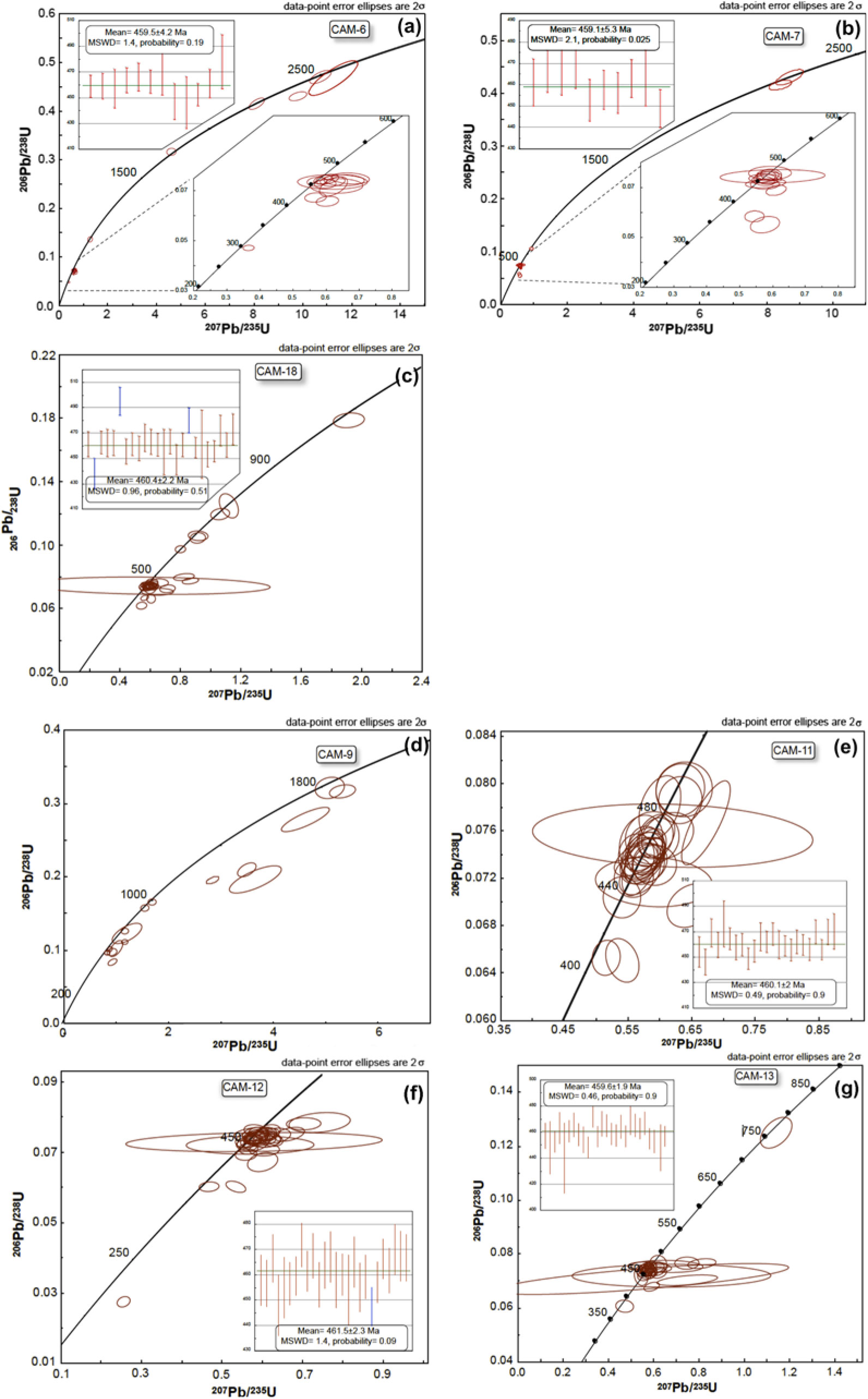
The seven selected samples described above yielded 218 U–Pb analyses that, after filtering, were used to determine crystallization ages. Oscillatory zoning, observed under CL, was interpreted as magmatic. The analyses performed on those domains were thus interpreted as indicative of zircon crystallization in the magma chamber. Results are presented in Figure 5 (and Table S1 in the online Supplementary Material).
U–Pb Wetherill Concordia diagrams of the dated samples. Insets are the 206Pb–238U weighted mean dates, normally interpreted as indicative of the crystallization age of the dated samples. In each inset diagram the red lines correspond to the analyses used for mean age calculation; the blue lines in diagrams CAM-12 and CAM-18 are the analyses rejected by the age calculation algorithm in Isoplot 3.7 (Ludwig, Reference Ludwig2008). Error bars correspond to 2 sigma errors.

Thirty zircon crystals were analysed from the ignimbrite sample CAM-6, collected from the middle zone of the thick ignimbritic succession of Campelles (Fig. 2). In all, 24 satisfied the filtering criteria. Some of the zircon crystals are prismatic and stubby in shape, barely zoned under CL, and cluster around a mean 206Pb–238U date of 459.5 ± 4.2 Ma (n = 12, MSWD = 1.4), which is interpreted as the crystallization age of the ignimbrite. Some other crystals with anhedral to corroded shapes yielded older ages, ranging from the Neoproterozoic (the youngest, 824 Ma) to the Palaeoproterozoic and even Neoarchaean (Fig. 5a). One slightly discordant younger crystal is indicative of Pb loss.
Sample CAM-7 corresponds to the top of the same ignimbrite unit as sample CAM-6. Only 20 zircon crystals were recovered, 17 of which met the filtering criteria. They are up to 280 µm in length, generally prismatic and elongated. Under CL they show oscillatory zoning developed parallel to the crystallographic c-axis. A group of ten analyses straddle the Concordia curve, with a mean 206Pb–238U age of 459.1 ± 5.3 Ma (n = 10, MSWD = 2.1), interpreted as the ignimbrite crystallization age (Fig. 5b). A few zircon grains were younger and variably discordant, indicative of Pb loss, whereas three others were older inherited crystals ranging from 652 to c. 2300 Ma in age.
CAM-18 belongs to the base of the same welded ignimbrite unit as samples CAM-7 and CAM-6. Out of the 35 analysed zircon crystals, 33 met the filtering criteria. They range from elongated prisms with pyramidal terminations, to short and stubby. Under CL they show moderate luminescence, with faint oscillatory zoning. Most analyses are concordant, including six grains that give older ages (Neoproterozoic, Ediacaran to Cryogenian in age; Table S1 in the online Supplementary Material), which we interpret as xenocrysts (Fig. 5c). The most abundant group clusters on the Concordia curve and gives a mean 206Pb–238U date of 460.4 ± 2.2 Ma (n = 21, MSWD = 0.96; Fig. 5c), which we interpret as the age of ignimbrite crystallization.
Sample CAM-9 also consists of a welded ignimbrite cropping out several kilometres towards the NW from the site of samples CAM-6, CAM-7 and CAM-18. Only 20 zircon grains were recovered from CAM-9, 16 of which satisfied the filtering criteria. They are small compared with zircons from the previously described samples, not exceeding 140 µm, with mostly oval to rounded morphologies. Although being poorly luminescent under CL, igneous zoning is observable in some of the crystals. Few of these crystals are concordant; instead most are variably discordant (Fig. 5d). Three of the least discordant are Ediacaran, ranging in age from 592 to 625 Ma (Table S1 in the online Supplementary Material); the others range in age from early Neoproterozoic to Palaeoproterozoic. While stratigraphic correlations suggest for this unit a similar Ordovician age as the other dated samples, we were unable to recover any magmatic zircons.
Sample CAM-13 corresponds to a different outcrop of welded ignimbrite, belonging to the Bruguera succession (Fig. 2). In all, 33 out of 35 analysed zircon crystals met the filtering criteria. They are stubby grains with bipyramidal terminations, faintly zoned under CL and up to 220 μm in length. Most of the analysed crystals are concordant. Apart from one clearly inherited zircon, with an apparent age of 759 ± 28 Ma, and another, slightly discordant one with an apparent age of 379 ± 12 Ma, almost all the other crystals define a cluster whose mean 206Pb–238U age of 459.6 ± 1.9 Ma (n = 26, MSWD = 0.46) is interpreted as the age of crystallization (Fig. 5g).
Finally, samples CAM-11 and CAM-12 both belong to a granophyre, previously dated at 458 ± 3 Ma by Martínez et al. (Reference Martínez, Iriondo, Dietsch, Aleinikoff, Peucat, Cirès, Reche and Capdevila2011). In all, 35 zircon grains were analysed from sample CAM-11, all of which except one met the filtering criteria. They range in shape from elongated to bipyramidal short prisms, up to 260 µm in length. Under CL they show homogeneous luminescence, with faint oscillatory zoning only developed in a few crystals. A few of the analysed zircon grains were slightly discordant. A group of 23 coherent analysis yielded a mean 206Pb–238U date of 460.1 ± 2 Ma (n = 23, MSWD = 0.49), interpreted as the age of granophyre crystallization (Fig. 5e, inset). A small number of zircon crystals, although concordant, yielded a slightly older mean age of c. 488 Ma, and probably correspond to either inherited grains or antecrysts formed in the magma chamber during an earlier episode of magma crystallization. Three discordant grains ranging from c. 438 Ma to c. 410 Ma are interpreted as recording Pb loss. Sample CAM-12 also yielded a good number of zircon crystals, 35 of which were analysed and met the filtering criteria. They are generally stubby and bipyramidal, up to 240 μm in length, although some are fragmented prisms belonging to larger crystals. Under CL they often show oscillatory zoning, with some high-luminescent inclusions, possibly apatite crystals. Apart from a few discordant data, which probably experienced Pb loss, the overall behaviour of the remaining crystals have a consistent age. The mean 206Pb–238U date of 461.5 ± 2.3 Ma (n = 25, MSWD = 1.4; Fig. 5f, inset) obtained from a coherent group of 25 analyses is interpreted as the crystallization age of the granophyre. Only two grains were slightly older but discordant; three other younger and discordant analyses probably experienced variable amounts of Pb loss.
5. Discussion and conclusions
The new isotopic ages obtained in this study demonstrate that the Campelles–Bruguera rheomorphic rhyolite ignimbrites, previously attributed to a late Palaeozoic volcanic event, are in fact Sandbian–Katian in age and are part of a Middle–Late Ordovician magmatic event in the Eastern Pyrenees. In addition to the stratigraphic implications that these results have for understanding the pre-Variscan evolution of the Pyrenees, there are also significant implications for the origin, characteristics and importance of volcanism associated with Middle to Late Ordovician magmatism in the Eastern Pyrenees. All the ages obtained indicate that a single magmatic event produced the emplacement of the silicic intrusive Ribes granophyre and Campelles–Bruguera ignimbrites. Despite the fact that volcanic rocks interbedded with Middle–Upper Ordovician metasediments are abundant and present in nearly the whole Middle–Upper Ordovician stratigraphic succession in the Eastern and Central Pyrenees, they were previously recognized as neither volumetrically significant nor indicative of the provenance or location of source vents. The predominance of pyroclastic rocks (e.g. ignimbrites and ashfall beds) was already noted by Martí et al. (Reference Navidad, Casas, Castiñeiras, Barnolas, Fernández-Suárez, Liesa, Carreras and Gil-Peña1986) as indicative of the explosive character of this volcanism. The recognition of the Campelles–Bruguera rheomorphic ignimbrites as products of the Middle–Late Ordovician magmatism in this area increases their extent by several thousands of cubic kilometres, thereby suggesting that this volcanic episode was much more significant than once thought. This, together with the thickness of the Campelles ignimbritic succession, which is in the order of 1000 m, suggests the occurrence of Sandbian–Katian mega-eruptions possibly linked to the formation of collapse calderas.
First, this implies that much greater magma production was needed to sustain the volcanism and, secondly, that the mechanisms for storing and expelling such large amounts of rhyolitic magmas were favoured by the regional and local tectonics operating at that time. Such a large volume of volcanic rocks and their particular characteristics (i.e. rheomorphic ignimbrites) suggest that one or more large caldera structures were the source of the volcanism in this area, as was suggested when these rocks were still considered to be late Palaeozoic in age (F. Robert, unpub. Ph.D. thesis, Univ. Besançon, 1980; J. Martí, unpub. Ph.D. thesis, Univ. Barcelona, 1986; Martí, Reference Martí1991). Moreover, it has been proposed (Navidad et al Reference Navidad, Casas, Castiñeiras, Barnolas, Fernández-Suárez, Liesa, Carreras and Gil-Peña2010) that the most probable tectonic setting for the emplacement of the Middle–Late Ordovician volcanic and plutonic rocks is an extensional regime. An extensional geodynamic setting would favour the large-scale eruption of silicic magma, as it occurs in other similar settings in more modern analogues (Basin and Range, USA, Lipman, Reference Lipman, Burchfiel, Lipman and Zoback1992; Sierra Madre Occidental, México, Aguirre-Díaz & McDowell, 1993). Thus, by 460 Ma, the extensional break-up of the Gondwanan margin and the rifting away of terranes, including the Eastern Pyrenees, was in progress.
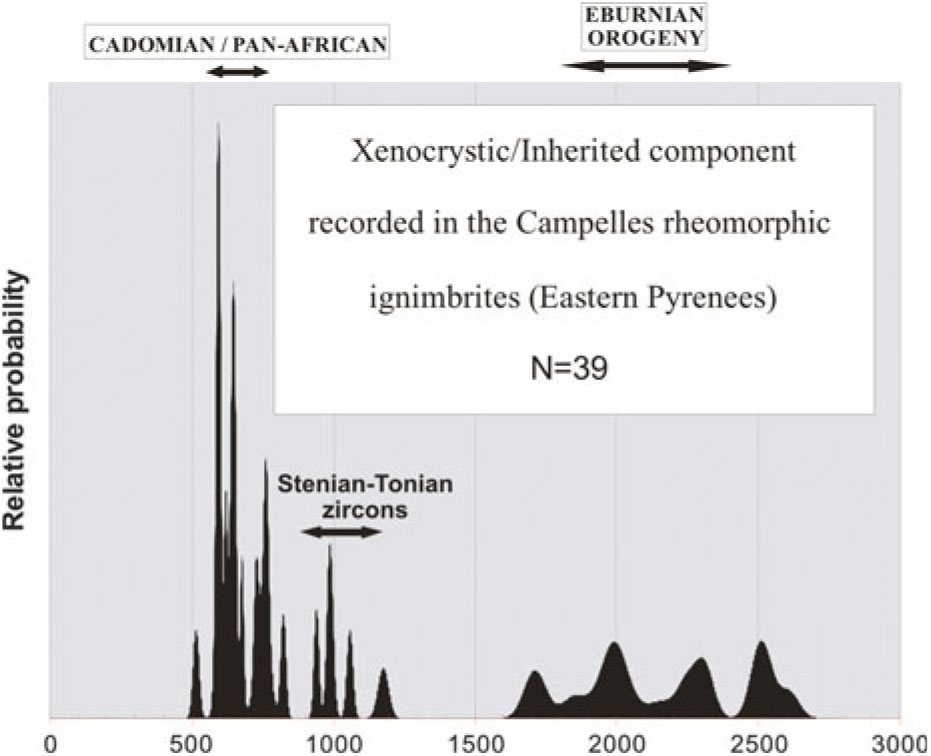
Existing petrological and geochemical data of the volcanic rocks dated here (J. Martí, unpub. Ph.D. thesis, Univ. Barcelona, 1986; Martí et al. Reference Martí, Muñoz and Vaquer1986) reveal a calc-alkaline character coincident with that of the coeval intrusive rocks cropping out in the same area (Martínez et al. Reference Martínez, Iriondo, Dietsch, Aleinikoff, Peucat, Cirès, Reche and Capdevila2011). Martínez et al. (Reference Martínez, Iriondo, Dietsch, Aleinikoff, Peucat, Cirès, Reche and Capdevila2011) proposed that these intrusive rocks were derived from the melting of Ediacaran sediments formed from the erosion of previous Neoproterozoic arc rocks, which were contaminated by older components, possibly owing to the partial melting of a pre-Neoproterozoic basement. Inherited Neoproterozoic (and even a few Palaeoproterozoic to Archaean) zircon grains found in nearly all the samples we dated (Fig. 6) support the existence of pre-Neoproterozoic components in the source region of these magmatic rocks. However, pre-Palaeozoic crystalline basement does not crop out in the eastern Pyrenean part of the Variscan Chain, and so the exact source of the late Middle – early Late Ordovician magmas remains uncertain.
Diagram of the relative probability with all the inherited zircon grains analysed in this study. The probability plot was produced using Isoplot/Ex 3.7 (Ludwig, Reference Ludwig2008). The 207Pb–206Pb age was used for interpretation of all zircons >1.0 Ga, and the 206Pb–238U age for younger grains.

The Middle–Late Ordovician magmatic episode in the Eastern Pyrenees would have been triggered by extensional tectonics affecting a crust previously thickened by a compressional episode of Middle Ordovician age (Casas, Reference Casas2010; Navidad et al. Reference Navidad, Casas, Castiñeiras, Barnolas, Fernández-Suárez, Liesa, Carreras and Gil-Peña2010), which followed the Neoproterozoic–early Cambrian subduction-related magmatism (Casas et al. Reference Casas, Navidad, Castiñeiras, Liesa, Aguilar, Carreras, Hofman, Gärtner and Linnemann2015). This tectonic scenario involving compression followed by extension resembles the events that occurred at the end of the Variscan orogeny in relation to the Late Carboniferous – Early Permian volcanism, which is widely found throughout the Pyrenees in pull-apart basins. These basins were generated during a late-orogenic extensional phase that also generated large-volume eruptions of calc-alkaline magmas (J. Gisbert, unpub. Ph.D. thesis, Univ. de Zaragoza, 1981; J. Martí, unpub. Ph.D. thesis, Univ. Barcelona, 1986; J. Gilbert, unpub. Ph.D. thesis, Univ. Cambridge, 1989; Lago et al. Reference Lago, Arranz, Pocovi, Gale, Gil-Imaz, Wilson, Neumann, Davies, Timmerman, Heeremans and Larsen2004). This late Palaeozoic volcanism was coeval with the emplacement of granodioritic plutons at very shallow crustal levels (García-Sansegundo et al. Reference García-Sansegundo, Gavaldà and Alonso2004; Pereira et al. Reference Pereira, Castro, Chichorro, Fernández, Díaz-Alvarado, Martí and Rodríguez2013). Likewise, our new age data show that all studied magmatic products from the area attributed to a Middle–Late Ordovician magmatic episode, i.e. the Núria gneisses, the Ribes granophyre and the Campelles–Bruguera volcanic rocks, lie within a very narrow age range. Consequently, we must assume that all these magmatic products have a genetic connection. However, the lack of xenocrysts in the Ribes granophyre, in contrast with their presence in most of the ignimbritic samples, poses an interesting question on whether or not both magmas shared the same source, which deserves to be investigated in further studies in order to understand this potential plutonic–volcanic connection.
Author ORCIDs
Joan Martí 0000-0003-3930-8603
Acknowledgements
Financial support for this work was provided by the projects CGL2015-66335-C2-1-R, CGL2017-87631-P and CGL2017-84901-C2-1-P from Spanish MINECO. JM is grateful for the MECD (PRX16/00056) grant. We would like to thanks Carlos Ortega-Obregón (CGEO, UNAM) for the instrument maintenance and U–Pb determinations. We thank the Editor, C. Dietsch, and an anonymous referee for their constructive reviews. English text was reviewed and corrected by Michael Lockwood.
Supplementary material
To view supplementary material for this article, please visit https://doi.org/10.1017/S0016756819000116.