



Why doctors chose a career in psychiatry and how they stay committed is a multi-layered and long-term process. The earliest steps start with parental influence shaping their children’s career choices through access to resources, their own aspirations for their children, role modelling, and support. Reference Plasman, Gottfried, Williams, Ippolito and Owens1–Reference Lekfuangfu and Odermatt3 This is most relevant in medicine, where occupational transmission is higher than in other professions, and one in five medical students has at least one parent who is a practising medical doctor. Reference Polyakova, Persson, Hofmann and Jena4 For junior doctors considering a career in psychiatry, inclinations before medical school have a greater influence than for those attracted toward other specialties. Reference Goldacre, Fazel, Smith and Lambert5 Initially, psychiatry may be surrounded by a sense of mystery, and open communication about mental health at home can stimulate an interest in a career in psychiatry. Reference Varma6 The dynamics of parental profession on children’s career choice are relevant to medical students and clinician educators who try to make well-informed decisions about a career in psychiatry or otherwise. In the long term, doctors working in psychiatry who have developed a coherent view of what contributed to their career choice can be expected to have a stronger professional identity, closely related to retention in psychiatry. Reference Roberts, Chung, Forbes, Hew, Aung and Kang7,8 Psychiatrists who would not choose psychiatry again were more likely to have a negative professional identity – a factor more important than job burnout, dissatisfaction, excessive regulation, heavy workload and lower income. Reference Gu, Zheng, Gu, Wang, Shi and Jiang9
Previous research has attempted to characterise the role of parental influence in: (a) the formation and development of career-relevant interests, (b) selection of academic and career choice options, and (c) performance and persistence in educational and occupational pursuits. Reference Lent, Brown and Hackett10 Across the lifespan, both family structure variables (e.g. parents’ occupations) and family process variables (e.g. warmth, support, attachment, autonomy) influence a career choice. Reference Whiston and Keller11 Cultural and socioeconomic contextual and other individual factors, including gender differences, may further shape the dynamics of parental influence. Reference Riska12 Future professionals often go through several stages of exploration before they finalise their career choice. Too little exploration and too much commitment early on leads to premature foreclosing decisions that hinder the development of a robust professional identity. Reference Crowe and McGarr13 High-quality career decision-making is associated with higher job satisfaction, well-being and performance, but medical students often experience stress in choosing a future career – an improved understanding of the factors involved in making these decisions would be helpful. Reference Fris, Vianen, Hooft, Hoog and Pagter14
The aim of the present study was to explore beliefs and experiences of parental professional influence toward or away from a career choice in psychiatry at two levels: (a) the influence that parents had on currently practising doctors in psychiatry and (b) the influence of current practising psychiatrists on their children.
Method
Methodological approach
Thematic analysis was chosen as the qualitative approach to explore and identify patterns of meaning within narrative data, emphasising the most salient clusters of content. Reference Braun and Clarke15 This method is often used to investigate a group’s conceptualisation of a specific phenomenon. As thematic analysis offers flexibility regarding the framework of thinking, we adopted an approach best suited to explore experiences and meaning in a straightforward way, assuming a more unidirectional relationship between meaning, experience and language. This is also known as an essentialist approach.
Participants
An international convenience sample of medical doctors practising in psychiatry were recruited through a poster presentation at the European Society for Child and Adolescent Psychiatry conference in the summer of 2023 (see Fig. 1). Through the poster presentation, they learned about the background, objectives and methods of the study. They were invited to participate in an online reflective questionnaire about their own perceptions of parental influence on career choice. Participants originated from nine countries (Belgium, Cyprus, Denmark, Germany, Greece, The Netherlands, Slovenia, Switzerland and the UK). Participants worked as medical doctors in child and adolescent psychiatry (n = 45): 16 resident -trainees and 29 registered medical specialists. To enrich the study data with external perceptions of parents as well as children of doctors working in psychiatry, participants were asked to forward the invitation within their families. This yielded an additional response of 24 (16 parents and eight children aged older than 16 years). Thematic analysis has no sample size constraints because the wealth of data is considered to be situated in the richness of participants’ narrative and not in the number of participants. Reference Braun and Clarke15 Data collection cut off is determined by ‘sufficiency’; that is, when the research team estimates they have reached enough in-depth understating of the phenomena studied, yet is also influenced by information power. Reference Malterud, Siersma and Guassora16 Information power indicates that the more information the sample holds, relevant to the actual study, the lower the number of participants that is needed. For the current study, we estimated that sufficient information power was reached, taking into account the specific aim of the study; sample specificity (i.e. international sample of doctors working in psychiatry across generations and their parents/children); richness and quality of their written contributions; and an analysis strategy on a case-by-case basis. Reference Malterud, Siersma and Guassora16
Recruitment of participants and study design. CAP, child and adolescent psychiatry.

Measures
Two open-ended questions triggered reflection in participants at two levels: on the influence of their parents on their own career (‘How do you think the professional occupation of your parents influenced your own career choice and professional involvement?’) and on their perceptions of their own influence on the current/future career choice of their children (‘How do you think your own profession influences the career choice and professional involvement of your children? If you don’t have any children yet, how do you think it will in the (near) future?’).
Data analysis
Qualitative data from written reports were analysed inductively by one of the authors (M.-A.P.), based on Braun and Clarke’s six-stage thematic analysis method. Reference Braun and Clarke15 Iterative analysis was conducted throughout data collection. Using thematic analysis, the authors sought systematic identification, interpretation and development of themes derived from the content of the data. The two perspectives – prior parental influence on their career choice and (expected) present/future influence of their profession on their own children – were considered separately and then compared.
The first stage was devoted to reading and re-reading the written reports by two of the authors (M.-A.P. and M.H.). At this stage, they independently conducted line-by-line coding. They searched for common themes of meaning between respondents, an inductive and recursive process, while using constant comparisons within and between accounts. During stage 3, the themes were combined to reflect major features and patterns in the data and these were supplemented by an independent view of another author (P.K.H.D.). The next two stages were devoted to reviewing all the themes with the whole research team and to ensure consistency while refining the relevance of the themes. This enabled the discussion of alternative interpretations until a consensus on the pattern was reached. The derived themes and subthemes were not submitted to participants for their comments to verify that this reflected their experience because their participation was anonymous.
Reflexivity
Qualitative research aims at reporting subjective reality with the greatest rigour and validity. This process is improved by a ‘triangulation’ process; that is, confrontation and enrichment by several views on data collected. This helps to limit influence of a researcher’s personal view on the research while triggering reflexivity. Thus, our research team intentionally included researchers from various regions, different gender, age group and professional experience (trainers, trainees and health education researchers).
One researcher (M.-A.P. from France) is an associate professor who completed her PhD in psychiatric education. She has been strongly involved in undergraduate and postgraduate teaching in psychiatry at her university while being involved in child and adolescent psychiatry training daily through clinical teaching. M.-A.P. focused on coordinating the process of data analysis. They used written notes and a visual board journal to keep track of her own assumptions regarding the research phenomenon and to help approach objectivity during the data analysis. Two of the authors, M.H. and P.K.H.D., from The Netherlands, had experience in clinical work, teaching and supervision and in the organisation of local, national and international training activities, as training programme directors.
Ethics
The authors assert that all procedures contributing to this work comply with the ethical standards of the relevant national and institutional committees on human experimentation and with the Helsinki Declaration of 1975, as revised in 2013. All procedures involving human patients were approved by the French Institutional Review Board of ‘CERAPHP’ (Comité d’éthique de la recherche AP-HP Centre) provided permission (reference number 2023-11-17). Electronic anonymisation of data collection ensured that no previous relationship between researchers and participants could have influenced the process of researchers’ analysis or their educational pathway. All participants provided informed written consent to the inclusion of material pertaining to themselves.
Results
Professional occupation of parents
The distribution of parental professions of participants in the group of currently practising doctors (n = 45) showed that 22% (n = 10) had at least one parent working as a medical doctor (n = 3 were psychiatrists and n = 3 had both parents working as medical doctors). Other professional occupations included administration (20%), education (17%), social/healthcare-related work (16%), engineering (10%), management/leadership (9%) and a group of less frequent professions (e.g. agriculture, defence, home work).
Perceived influence of parental occupation on career choice
Two dimensions were determined from the results about the relationship between parental influence and career choice: the strength of influence and the nature of the relation by which career choice was influenced. Regarding the strength of influence, answers included words that expressed no influence at all, a little or indirect influence or a strong and direct influence. Some example quotes are ‘I don’t think my parents’ professional occupations influenced my career choice – but there were many aspects of my family life that did’; and ‘It did not influence me in any way. But my father, who suffered from serious psychiatric disease, pushed me to attend medical school’.
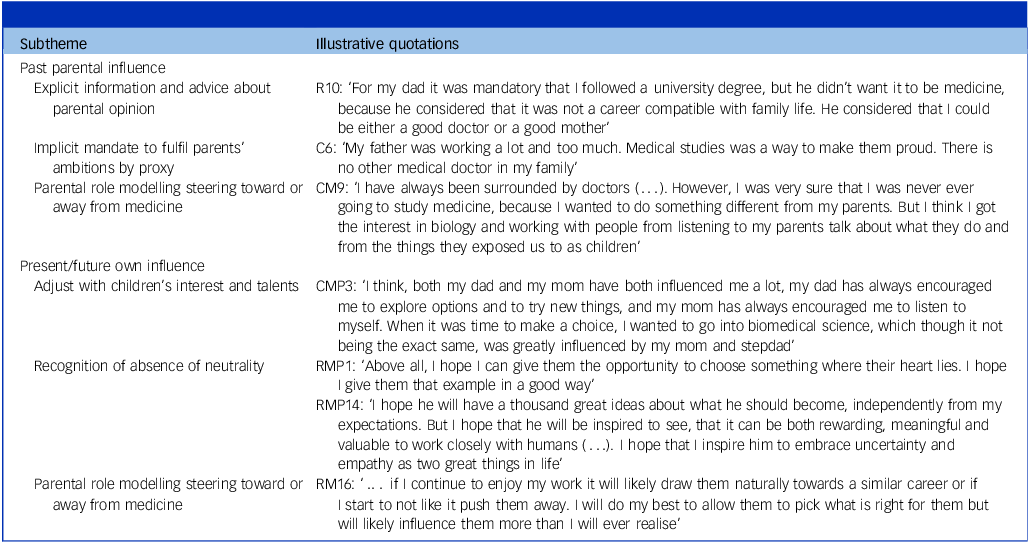
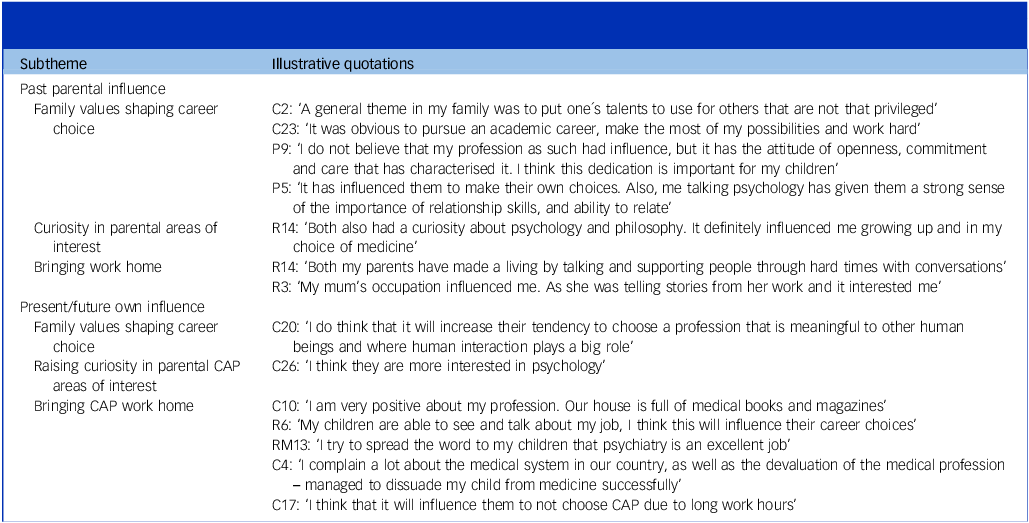
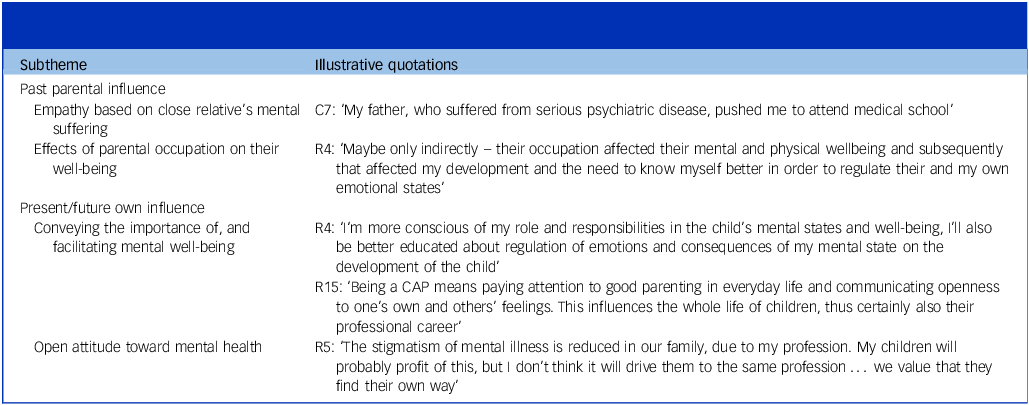
Concerning the nature of the relation, some participants mentioned direct (explicit) and linear influence of just one motive, whereas most participants perceived more indirect (intermediate, more subtle) influence, with a higher degree of complexity and intertwinement of several motives. Three main themes were found about perceived prior parental influence on career choice of doctors currently practising in psychiatry, and three similar main themes were identified about perceived current or presumed future influence on career choice of their children, but with some different subthemes (summarised in Tables 1–3 and Fig. 2).
Autonomy and guidance: quotations of perceived parental influence on career choice

R, resident with parents without a medical background; C, child and adolescent psychiatrist with parents without a medical background; CM, child and adolescent psychiatrist with parents with a medical background; CMP, child and adolescent psychiatrist with parents with a medical psychiatrist background; RMP, resident with parents with a background working in psychiatry; RM, resident with parents with a medical background.
Sociocultural background of families: quotations in perceived past parental influence on current child and adolescent psychiatry career choice and current influence on their children’s career choice

C, child and adolescent psychiatrist with parents without a medical background; P, parent; R, resident with parents without a medical background; CAP, child and adolescent psychiatry; RM, resident with parents with a medical background.
Lived experience of mental health: quotations in perceived past parental influence on current child and adolescent psychiatry career choice and current influence on their children’s career choice

C, child and adolescent psychiatrist with parents without a medical background; R, resident with parents without a medical background; CAP, child and adolescent psychiatry.
Summary of themes and sub-themes that were identified in the thematic analysis.

Autonomy and guidance
Participants detailed several ways their parents balanced autonomy and guidance regarding their career choice. Explicit information and advice included clear opinions from parents that were perceived as reliable guidance for career choice, although some perceived them as restricting expectancies. An example quote is ‘…that it was not a career compatible with family life. He considered that I could be either a good doctor or a good mother’. Implicit mandate to carry out parents’ ambitions by proxy was also reported. Some suggested that they took a role in compensating for previous disappointment, frustration or failures of their parents, often in the light of a lack of enabling conditions. Others expressed relief and joy in making their parents proud. An example quote is ‘Medical studies was a way to make them proud. There is no other medical doctor in my family’. Parental role modelling was reported as steering toward or away from a career in medicine. Direct role modelling included their parents’ work in psychiatry, medicine or related health or childcare professions. More indirectly, participants mentioned separation-individuation processes – where they would hold an active wish to take a path in line with or opposite to their parental role model. An example quote is ‘(…) very sure that I was never ever going to study medicine, because I wanted to do something different from my parents’.
About finding a balance between providing autonomy and guidance for their own children, participants highlighted the importance of adjusting to children’s interest and talents, in line with their views when practising as a psychiatrist. An example quote is ‘Above all, I hope I can give them the opportunity to choose something where their heart lies. I hope I give them that example in a good way’. Yet, some participants recognised absence of neutrality and having their own wishes for their children’s career choice. They experienced ambivalence: they hoped their children would follow a similar career path, and also hoped they would make their own choices according to their own wishes and expectations. An example quote is ‘I hope that he will be inspired to see that it can be both rewarding, meaningful and valuable to work closely with humans (…) that I inspire him to embrace uncertainty and empathy as two great things in life’. Most participants reported that they assumed they were role models for their children, and accepted the responsibilities and also the pride and enjoyment that comes with such a role.
Sociocultural background of family
A second theme mentioned by participants as relevant for their career choice toward psychiatry stressed the role played by their family sociocultural background. Participants emphasised family values such as altruism and cultural open-mindedness, and, more specifically, values helpful for the de-stigmatisation of people with mental disorders. An example quote is ‘I do not believe that my profession as such had influence, but it has the attitude of openness, commitment and care that has characterised it’. Also, the value of putting to best use one’s abilities when privileged with good socioeconomic circumstances or, on the other hand, of making the best of adverse circumstances. Some mentioned that their parents worked hard to reach a good socioeconomic status, and felt a responsibility to maintain the position or to improve socioeconomic status for their own children as a motive for medical studies. Participants highlighted curiosity in parental areas of interest. This seemed to have triggered initial interest in matters relevant for psychiatry, whether it be about matters of science, health, human science, social work, children or family functioning. Finally, several participants underlined the influence of work experiences brought home during their childhood. They explained how permeability of the work–life barrier made work part of family life, both in a negative and a positive way. Most participants pointed out positive memories of stories about their work that fostered their desire to pursue a career that was not necessarily equal, but showed resemblance. An example quote is ‘Both my parents have made a living by talking and supporting people through hard times with conversations’.
Regarding their influence on career choice of their own children, participants assumed an influence of their personal and professional values, including their social involvement toward others and a caring attitude. They thought their daily commitment to people with mental disorders would help with reducing stigma toward mental disorders and toward psychiatry as a profession. Moreover, participants believed that their in-depth interest in areas close to psychiatry could influence their children’s curiosity in human sciences, psychology or child development. Again, the role of narratives was reported as a supportive way to convey the children’s wish to open their minds. Most also expressed that bringing work home was unavoidable, which made psychiatry an inevitable part of their family life. Indeed, almost all of them reported an active reflection of the influence of their profession toward their children. An example quote is ‘I try to spread the word to my children that psychiatry is an excellent job’. Subsequently, they emphasised similarities between the nature of psychiatric practice – caring for families, children and young people – and their role as a parent with their own children. Participants tended to view this in a positive light, as something that could support their children’s social development as well as helping them to find their own way. On the other hand, some of them perceived some aspects of their practice as off-putting, mainly referring to aspects of the care system that hindered their ability to practice in a well-balanced way. An example quote is ‘I complain a lot about the medical system in our country, … the devaluation of the medical profession – managed to dissuade my child from medicine successfully’.
Lived experience of mental health
A third theme emerging from participants’ narratives was about a personal history of a close relative with lived experience of mental suffering. For several participants, this was reported as an early training of empathy development based on a loved one’s mental suffering. Some described effects of parental professional occupation on family well-being. The parent’s work as a psychiatrist was perceived as creating a stressful home environment (due to work pressures) and this called for self-regulation. An example quote is ‘… their occupation affected their mental and physical wellbeing and subsequently that affected my … need to know myself better in order to regulate their and my own emotional states’.
Considering their own children, participants mentioned the broader importance of facilitating the mental well-being of their own children, applying knowledge and skills acquired in their practice. They experienced similar responsibilities at work and at home to make an effort to provide guidance for children and young people to develop good mental health. An example quote is ‘… paying attention to good parenting in everyday life and communicating openness to one’s own and others’ feelings. This influences the whole life of children, …’. They also hoped that their profession would foster an open-minded attitude in their children toward mental health problems.
Discussion
Psychiatry needs bright new doctors that are intellectually challenged by the complexity of human brain development within its context, and a workforce with a sound professional identity. The attitude toward psychiatry in relation to other areas and how it is observed by medical students is relevant for their career choice toward or away from psychiatry, further professional development and ultimately, retention. Previous studies on career choice in psychiatry have focused on the image of the field regarding work conditions (e.g. financial reward, prestige and work–life balance), the nature of the work (e.g. being able to help, intellectually challenging, stigma toward mental health conditions) and career opportunities (e.g. access to training and lifelong learning). Reference Malhi, Parker, Parker, Carr, Kirkby and Yellowlees17–Reference Lee, Jang, Jang, Bong, Won and Yoon19
This study explored beliefs and experiences of parental professional influence toward or away from a career choice in psychiatry. The main themes showed similarities in how doctors working in psychiatry regard the influence of their parents on their own career choice and how they regard their own influence on their children’s career paths: balancing autonomy with guidance when helping children with their choice of profession; recognising a broader sociocultural background of their families and the transgenerational influence of lived experience with mental health. Parental occupation can be expected to play a role on their children’s career choices in all domains of professional education: qualification (what qualifications are needed for the profession), socialisation (participating in the culture of the profession) and subjectification (development of the person behind the professional). Reference Riska12 From these three domains of education formulated by Biesta, Reference Biesta20 the (sub) themes found in this study covered mainly socialisation and subjectification. Participants perceived explicit parental information regarding these two domains as well as a more implicit parental role modelling, and even a mandate to fulfil parental ambitions by proxy. The domain of qualification (what qualifications are needed to qualify for a profession) arose only indirectly in the analysis through interest in behaviour and psychology. This suggests a general pattern of transmission that is not specific for parents working as medical doctors or psychiatrists, but rather reflects a broader influence of values related to a number of other professions, and even underlying family values and how they guide children’s careers.
Practising doctors in psychiatry recognised the importance of the role of parents in providing autonomy and freedom of choice – but also that this process was only partially conscious and explicit, and that other factors were at play. These other factors related to the broader sociocultural background, values of their families and sometimes their own unmet needs or wish to have their children continue and take over what they had started. In addition to autonomy, participants also stressed the need for a relationship between children and parents that allows for well-intended advice to help navigate and make career choices that align with interests and talents. Autonomy, relatedness and experiencing competency have been described as crucial aspects in self-determination theory, one of the leading motivational theories. Reference Ryan and Deci21 Self-determination theory predicts that autonomous motivation – something to aim for when making career choices, rather than extrinsic motivation Reference Sheldon, Holliday, Titova and Benson22 – is a function of these three basic psychological needs. Of note, this theory also predicts development of mental health when these three basic psychological needs are met and self-determination theory-informed interventions positively affect indices of health. Reference Ntoumanis, Ng, Prestwich, Quested, Hancox and Thøgersen-Ntoumani23
Regarding the question as to how parents manage to help their children navigate professional career choice, parental role modelling and the narratives told at home were highlighted. Participants reported that they hoped their own stories could play a similar role in the personal and professional development of their children. Such stories contain both actual facts about what happened in their work life as well as aspects of perception of the narrator about their feelings and experiences. They are also seen as a powerful tool for medical education. Reference Charon24 Through their structure and power, such stories about medicine may help listeners or readers form a holistic picture and support them to ‘walk a mile’ in the characters’ shoes, picture oneself in this story and live it by proxy. Reference Charon25
Our results are in line with the sparse literature that covers the relationship between parental professional occupation and children’s career choice in medicine as, in our sample, approximately one in five had a parent who was a medical doctor. Reference Polyakova, Persson, Hofmann and Jena4 Other professional occupations frequently included work in education and social/healthcare, which resonates with the finding that career choice was perceived to be embedded within the much broader picture of the socio-economical-cultural background of the families. Family values seem to exert an influence on both the subjectification and socialisation of doctors as professionals as well as on their personal development. Although transcultural differences were not recognised explicitly from the results, it would be worthwhile to explore this in future studies as some factors associated with career choice have been found to be specific to, for example, low- and middle-income countries, such as attitudes toward social problems, voluntary work and influence of family life. Reference Puertas, Arósquipa and Gutiérrez26
Lived experience together with a set of values in the families of the participants resulted in a caring attitude toward others and a deep desire to help those in need. Such values may be related to parental professional occupation, but were described in a much broader sense by our participants. For some, lived experience of mental illness in the families of practising doctors in psychiatry seems to be aligned with the reported association of cumulative harm and childhood trauma and career decisions in people in the helping professions. Reference Bryce, Pye, Beccaria, McIlveen and Preez27 Traits developed through adversity, a strong motivation through one’s own experience and an attempt to make sense of previous experiences in their own or family members’ lives may all contribute to career choice. In relation to the effects of (parental) professional occupation itself on the mental well-being of the parent and child, there was some sense of danger that psychiatry – or medicine in general – is an area where hard work and long hours are required under potentially stressful conditions. This is in line with the reported high risk of depression and burnout in medical students and doctors. Reference Rotenstein, Ramos, Torre, Segal, Peluso and Guille28,Reference Podlesek, Volpe, Barrett, Ferrari and Kuzman29 Positive aspects included conveying openness towards their own children about mental well-being – and thus potentially facilitating resilience. The present study was not designed to look at effects over time, but it would be interesting to further explore differences between past and current generations of doctors and the effect of somewhat different circumstances including a generally increased awareness of mental health in younger adults. Reference Arango, Díaz-Caneja, McGorry, Rapoport, Sommer and Vorstman30 Such de-stigmatisation of psychiatric care may encourage more individuals to consider careers in psychiatry.
Strengths
Strengths of the study are that it is, to our best knowledge, the first to explore how and why parental career affects their children’s career choices in psychiatry, and lays a foundation for a framework that may ultimately be helpful in understanding why young doctors start showing an interest in psychiatry and why they begin to explore whether it may fit them well. By including registered psychiatrists and trainees, the study combined the perspectives of those for whom career choice was more recent or longer ago. The sample was further enriched by including the opinions of children and parents from doctors working in psychiatry, which allowed an external perspective of those directly involved either by having influenced the past choice of a doctor or by experiencing their present influence. The international sample provided some safeguarding against cultural bias.
Limitations
Limitations include the online anonymous self-questionnaire reflexive format. Although this was chosen to allow independent and free reflection on the studied phenomena; it did not allow for the wealth of interpersonal researcher/participant’s reflexivity during data collection, and inhibited triangulation (i.e. presenting the results of the thematic analysis to the participants for a check of accuracy and completeness). The convenience sampling method did not allow an opportunity to explore motivations for those who declined to participate. Those who participated may have been drawn to the study by virtue of having strong feelings, either positive or negative, about the effect of their parents’ professions on their own career paths, and those who are more indifferent may have been missed. The themes that were mentioned included mainly factors steering children toward a career in psychiatry, which can be expected, as they were practising doctors in psychiatry. Some themes may be specific for the convenience sample of doctors practising child and adolescent psychiatry, and as the study shows feasibility of such an approach, a future exploration in other or more diverse samples is relevant. Such future research may consider purposive sampling and other face-to-face or collective data collection, which would trigger participants reflexivity, including barriers, transcultural differences, potential gender differences, socioeconomic status and other aspects. Complementary insights may also be provided by including a larger group of children from psychiatrists and their siblings about their career choices and parental influences.
Implications
The implications of this study may be found at two levels. First, doctors working in psychiatry could use it as a framework for reflection on what aspects of the careers of their parents contributed to them becoming psychiatrists and could strengthen their professional identity, potentially leading to more job satisfaction and retention. It may also help them become more aware of the importance of the narratives they share and their own role modelling within their families and beyond – during teaching, education or training. After all, the current and expected shortage of the workforce of psychiatry is a concern for all, and the narratives psychiatrists share matter. The international scope of the study implies that the themes that were identified across and despite cultural differences are likely to be transferable and applicable to a diverse group of psychiatrists. Particularly, the awareness of the role of lived experience with mental health and illness can help increase equity and inclusivity in the workforce of colleagues with a personal or family history of mental health problems and with the reduction of stigma. Second, for medical students and teachers, this study adds a new perspective that may help attract the required bright future talents toward psychiatry. Thus far, efforts to guide medical students toward a suitable specialty have focused mainly on curriculum development and enhanced experiences during training. The present results imply that reflecting on how and why students pursue a career in psychiatry, and awareness about transgenerational influence can help guide their future entry to a field that fits them best.
Data availability
The data that support the findings of this study are available from the corresponding author, P.K.H.D., upon reasonable request.
Acknowledgements
The authors would like to thank Dr G. Berg and Dr A.S.K. Hansen for the inspiring discussion that helped to conceptualise the study; Dr Y. van Praag for her assistance drawing the figures; and the delegates of the section Child and Adolescent Psychiatry of the Union Medical Specialists Europe for their help with data collection.
Author contributions
P.K.H.D., M.H. and M.-A.P. were responsible for the formulation of research questions and study design. P.K.H.D. and T.S. conducted data collection. M.-A.P. and M.H. conducted data analyses. P.K.H.D., M.H., E.F., I.K., K.S.-J. and M.-A.P. wrote and reviewed the manuscript.
Funding
This research received no specific grant from any funding agency, commercial or not-for-profit sectors.
Declaration of interest
I.K. was supported by the Academy of Medical Sciences (grant number APR8\1005) and the UK Department for Business, Energy and Industrial Strategy.





eLetters
No eLetters have been published for this article.