Implications
Pyrroloquinoline quinone (PQQ), a vitamin-like compound with super antioxidant efficacy, had been recognized as a growth promoter in rodents. This study investigated the possiblilty of PQQ disodium (PQQ.Na2), the commericially available form of PQQ, as growth promoter in broiler chicks with antibiotic as positive control. Low level of PQQ.Na2 (0.2 mg/kg diet) can improve growth and yield comparable to 15 mg virginiamycin/kg diet, and also reduce lipid peroxidation. Current study opened a new avenue for alternative of antibiotic growth promoter in broiler chicks. Low responsive dosage implied that PQQ.Na2 may have potential to improve economic benefits for broiler industry.
Introduction
Pyrroloquinoline quinone (PQQ), a water soluble, heat stable, tricyclic ortho-quinone, is found to be widely distributed in nature (Rucker et al., Reference Rucker, Chowanadisai and Nakano2009). PQQ is characterized as vitamin-like redox cofactor for mammals (Kasahara and Kato, Reference Kasahara and Kato2003). Its reductive properties make it a good candidate for redox controlled signaling in living cells (Misra et al., Reference Misra, Rajpurohit and Khairnar2012) and also more effective than other bioactive quinones and ascorbic acid (Paz et al., Reference Paz, Flückiger and Gallop1990). A growth hormone-like activity of PQQ was observed in microorganisms (Shimao et al., Reference Shimao, Yamamoto, Ninomiya, Kato, Adachi, Ameyama and Sakazawa1984) and has been found to act as a growth promoting factor in rodents (Steinberg et al., Reference Steinberg, Gershwin and Rucker1994 and Reference Steinberg, Stites, Anderson, Storms, Chan, Eghbali and Rucker2003). A considerable amount of evidence have shown that PQQ may act as an antioxidant protecting living cells from oxidative damage in vivo and biomolecules from artificially produced reactive oxygen species (ROS) in vitro (Hamagishi et al., Reference Hamagishi, Murata, Kamei, Oki, Adachi and Ameyama1990). On a molar basis, PQQ was 15 times more effective than ascorbic acid in decreasing chemiluminescence generated by the xanthine–xanthine oxidase reaction and seven times more effective than α-tocopherol at preventing lipid peroxidation in rat brain preparations (Hamagishi et al., Reference Hamagishi, Murata, Kamei, Oki, Adachi and Ameyama1990). PQQ deprivation also results in defects in immune function and reduction in interleukin-2 levels. Maximizing sensitivity of B- and T-cells to mitogens was achieved in mice when as little as 1 nmol PQQ was added per gram of diet, about 100 to 400 μg PQQ per day in human diets (Steinberg et al., Reference Steinberg, Gershwin and Rucker1994 and Reference Steinberg, Stites, Anderson, Storms, Chan, Eghbali and Rucker2003). Because of its versatile functions, PQQ disodium (PQQ.Na2) salt has been authorized in Canada as a Natural Health Product, providing 20 mg PQQ.Na2 salt per day as antioxidant for maintenance of good health (Health Canada, 2012). PQQ has also been categorized as a Non-Drug in the Food and Drug Classification by the Ministry of Health, Labor and Welfare of Japan in 2013 (Mitsubishi Gas Chemical Company Notice, 2013).
Although PQQ has gained interests in medicine and health-related research in last decades, the cognizance on the usefulness of PQQ is not yet fully demonstrated in animal agriculture. Two papers regarding the protective effects of PQQ on chick embryo exposed to glucocorticoid treatment have been documented so far (Nishigori et al., Reference Nishigori, Yasunaga, Mizumura, Lee and Iwatsuru1989 and Reference Nishigori, Ishida and Ogihara-Umeda1993). However, information on efficacy of PQQ on traits of economic importance in broiler industry such as growth performance and carcass yield is scarce. Modern nutritional and farming strategies designed to produce broilers with high potential for growth, meat yield and feed efficiency have resulted in compromised health status (Siegel et al., Reference Siegel, Larsen, Emmerson, Gereart and Picard2000). Consequently, to promote the growth and development without compromising health would be a challenging task. In view of the versatile functions of PQQ as a nutrient and vitamin-like compound for supporting the growth and protection of living cells from oxidative damage, dietary PQQ supplementation may modulate the growth performance and antioxidant defense system of broiler chicks and these beneficial effects may provide a new avenue to poultry industry. Thus, it would be useful to identify the effects of dietary PQQ on growth performance and antioxidant defense system of broiler chicks. As a supplement, PQQ is usually commercially available in its disodium salt (PQQ.Na2). The objective of this study was therefore, to test the efficacy of dietary PQQ.Na2 supplementation on growth performance, using virginiamycin (VIR) as a positive control and antioxidant status of modern fast-growing broiler chicks. In addition, the dose responsive trial may also contribute to the estimation of the optimal supplementation level of PQQ.Na2 in the diet of broiler chicks, which may serve as a base for further studies.
Material and methods
Dietary treatments and animal management
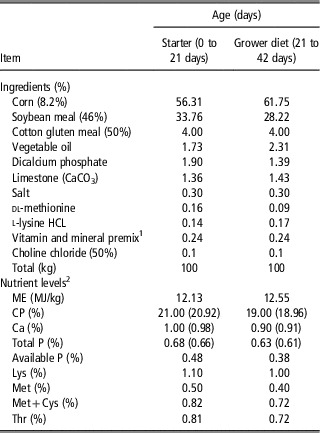
A total of 784 day-old male broiler chicks of the Arbor Acres (AA) strain were obtained from Beijing Huadu Broiler Company and were weighed and randomly assigned into seven experimental dietary groups consisting of eight replicates. Each replicate contained 14 birds. The dietary groups were: negative control group (NC) fed a basal diet without VIR or PQQ.Na2; a positive control group (PC) fed a diet with 15 mg of VIR/kg diet; and PQQ.Na2 groups fed with 0.05, 0.10, 0.20, 0.40 or 0.80 mg PQQ.Na2/kg diet. PQQ.Na2 was provided by Shanghai Medical Life Sciences Research Center Co. Ltd (Shanghai, China). For uniform distribution, PQQ.Na2 was prepared to 0.1% premix with corn starch, PQQ.Na2 content in corn starch carrier and complete feed was assayed by multiple reactions monitoring with liquid chromatography–tandem mass spectrometry using Agilent1100 (Agilent technologies, Waldbronn, Germany)and Thermo Finnigan TSQ Quantum (Thermo Finnigan, San Jose, CA, USA). PQQ content in the basal diet was 0.0185 and 0.0181 mg/kg for the starter and grower diet. The basal diet was a typical corn–soybean diet formulated to meet nutrient requirements of broiler chicks (National Research Council, 1994), for starter from 0 to 21 days and grower from 21 to 42 days of age. Compositions of basal diets and nutrients level are presented in Table 1. Feed and water were provided ad libitum at all times during the experimental period. Birds were subjected to feed withdrawal for overnight to permit gut clearance before sampling. The lightning regimen and ventilation were continuously checked from 0 to 42 days. Birds were raised in wire floor cages (cage size, 110×100×55 cm3) in a four-level battery under environmentally controlled room with continuous white light, under incandescent light. During the experimental period, the room temperature was maintained at 33°C for the 1st week and then gradually decreased by 3°C each consecutive week and kept at room temperature after 4 weeks. All management of birds was in accordance with the guidelines of raising AA broilers. All the experimental procedures have been approved by the Animal Care and Use Committee of the Feed Research Institute of the Chinese Academy of Agricultural Sciences.
Dietary composition and nutrient levels of experimental diets

1 Premix supplied per kg of diet: VA 12500 IU, VD3 2500 IU, VE 15 IU, VK3 2.65 mg, VB1 2 mg, VB2 6 mg, VB12 0.025 mg, biotin 0.0325 mg, folic acid 1.25 mg, Ca-pantothenate 12 mg, niacin 50 mg, Cu 8 mg, Zn 75 mg, Fe 80 mg, Mn 100 mg, Se 0.15 mg, I 0.35 mg.
2 The nutrient levels listed in parentheses are determined values, others are calculated ones.
Sample collection
At 21 and 42 days of age, two birds from each replicate, close to the average BW, were selected to sampling and data collection and were killed by cutting jugular vein. Blood samples were collected into heparinized test tubes, and then centrifuged at 1800×g for 10 min at 4°C to separate plasma, and stored at −20°C until analysis.
Growth performance and carcass yield
The BW and feed intake were recorded at 21 and 42 days of age for each replicate to determine the average daily gain (ADG), average daily feed intake (ADFI) and ratio of feed to gain (FCR). Mortality was recorded as it occurred. The ADG, ADFI and FCR were corrected with dead birds.
At 42 days of age, dressing percentage was calculated by dividing eviscerated weight to BW. Breast muscle, leg muscle and abdominal fat were removed and weighed. Breast muscle yield and leg muscle yield were calculated as percentage of eviscerated weight, whereas abdominal fat was calculated as percentage of BW. The average value of the two birds was regarded as the replicate value.
Immune organ index and plasma lysozyme activity
At 21 and 42 days of age, the lymphoid organs (thymus, bursa of fabricius and spleen) were collected, weighed and their relative weights were calculated as the ratio of lymphoid organ weight (g) to BW (kg). Plasma lysozyme activity was determined according to the method of Kreukeniet et al. (Reference Kreukniet, Nieuwland and Van der Zijpp1994) with micrococcus lysodeikticus as a substrate. The plasma within the replicate was pooled and analyzed in duplicate.
Assay of plasma antioxidative indices
The plasma antioxidative indices were analyzed in duplicate with pooled sample within replicate cage. The total antioxidant capacity (T-AOC) was measured by the method of ferric reducing/antioxidant power assay (Benzie and Strain, Reference Benzie and Strain1996). Total superoxide dismutase (T-SOD) activities in plasma were assayed using the xanthine/xanthine oxidase system for superoxide anion generation according to the method of Sun et al. (Reference Sun, Oberley and Li1988). A unit of T-SOD activity was defined by the amount of the enzyme required to inhibit the rate of formazen dye formation by 50% under defined condition. Malondialdehyde (MDA), the marker of lipid peroxidation was assayed by measuring the thiobarbituric acid (TBA)-reactive substances with spectrophotometer at 535 nm (Wills, Reference Wills1966). TBA material was described as nM of MDA per ml of plasma.
Statistical analysis
All data were subjected to one-way ANOVA using SPSS software package program (SPSS 16.0 for Windows, SPSS Inc., Chicago, IL, USA) and the means were compared for significance by post hoc Duncan’s multiple range tests. Linear and quadratic contrasts of PQQ.Na2 effects in the absence of PC group were also computed. A P-value of <0.05 was considered significant unless otherwise stated.
Results
Growth performance
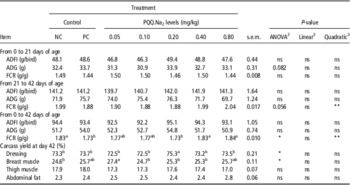
The effect of different levels of dietary PQQ.Na2 supplementation on growth performance is presented in Table 2. In the starter phase, dietary supplementation of PQQ.Na2 did not affect ADFI and FCR, whereas ADG partially differed (P<0.10) among dietary treatments. PQQ.Na2 treatment group of 0.20 mg/kg recorded the highest ADG, which was comparable to PC treatment group. Dietary treatment differences in mortality did not occur (data not presented).
Effect of different levels of dietary PQQ.Na2 supplementation on growth performance and carcass yield as relative to live BW of broiler chicksFootnote 1

ADFI=average daily feed intake; ADG=average daily gain; FCR=feed conversion ratio; NC=negative control; PC=positive control; PQQ.Na2=pyrroloquinoline quinone disodium; ns=not significant.
1 n=8 per treatment group.
2 One-way ANOVA of all the treatment groups.
3 Linear and quadratic=P-values of trend analysis of treatment groups without PC group.
a,bValues within a row with different superscripts differ significantly at P<0.05.
*P<0.05; **P<0.01.
In the grower phase, dietary supplementation of PQQ.Na2 did not affect ADG and ADFI, whereas partially (P=0.056) improved feed efficiency, quadratic effect (P<0.05). PC group, 0.10 and 0.20 mg/kg PQQ.Na2 groups showed higher ADG and superior feed efficiency than the NC group. Treatment group with inclusion level of 0.20 mg/kg PQQ.Na2 showed maximum ADG, and compared with NC group it has increased by 4.41 g. Dietary treatment differences in mortality did not occur (data not shown).
For the overall period, the inclusion of different levels of PQQ.Na2 in the diet of the broiler chicks did not affect ADG and ADFI, whereas FCR was markedly influenced (P<0.05; Table 2). Furthermore, FCR decreased quadratically (P<0.01) with increasing dietary PQQ.Na2 supplementation. FCR of broilers fed diet containing 0.20 mg/kg PQQ.Na2 was lower (P<0.05) than that of NC, but no significant difference was observed in FCR between NC and other PQQ.Na2-supplemented groups. PC group and 0.20 mg/kg PQQ.Na2 group had comparable ADG and FCR during the overall period. Notably, dietary inclusion of PQQ.Na2 at 0.20 mg/kg resulted in the best growth performance as evidenced by highest ADG and best feed efficiency, which was comparable to the PC group and better than the NC group.
Carcass yield
Effects of dietary PQQ.Na2 and VIR on carcass yield mainly eviscerated yield, breast muscle yield, leg muscle yield and abdominal fat are presented in Table 2. Dietary PQQ.Na2 or VIR supplementation did not affect relative leg muscle and abdominal fat deposition. Dietary inclusion of PQQ.Na2 at 0.20 mg/kg level had highest (P<0.05) dressing percentage, which was comparable to the PC group and better than the NC group. With regard to the relative proportion of breast muscle, dietary addition of PQQ.Na2 at 0.05 mg/kg had 11.45% greater (P<0.05) breast muscle percentage than that of NC group. PC and the highest level (0.80 mg/kg) of dietary PQQ.Na2 supplementation showed mediocre breast muscle percentage.
Immune organ index and plasma lysozyme levels
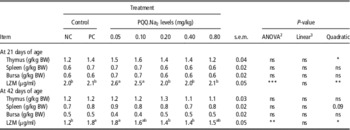
The results for the immune organ (spleen, thymus and bursa of fabricius) weight and plasma lysozyme levels at 21 and 42 days of age are displayed in Table 3. At 21 days of age, dietary PQQ.Na2 did not affect spleen or bursa index. Dietary PQQ.Na2 quadratically increased thymus index (P=0.036), and 0.10 mg/kg dosage group had the highest value. Low dosages (0.05 and 0.10 mg/kg) of PQQ.Na2 had greater (P<0.05) plasma lysozyme concentration compared with the NC group. At 42 days of age, thymus and bursa indices were not affected by dietary PQQ.Na2 addition. Low dosage (0.05 mg/kg) PQQ.Na2 group and PC group had higher (P<0.05) plasma lysozyme concentration than the NC group. There were no difference for plasma lysozyme concentration between the other groups and NC group.
Effect of different levels of dietary PQQ.Na2 supplementation on the relative immune organ weights and plasma lysozyme levels of broiler chicksFootnote 1

LZM=lysozyme; NC=negative control; PC=positive control; PQQ.Na2=pyrroloquinoline quinone disodium; ns=not significant.
1 n=8 per treatment group.
2 One-way ANOVA of all the treatment groups.
3 Linear and quadratic=P-values of trend analysis of treatment groups without PC group.
a,bValues within a row with different superscripts differ significantly at P<0.05.
*P<0.05; **P<0.01; ***P<0.001.
At both 21 and 42 days of age, there was a difference (P<0.01) in blood lysozyme levels between dietary treatments. All PQQ.Na2-supplemented groups numerically improved lysozme concentration as compared with the NC group at 42 days of age. Lysozme concentration increased quadratically (P<0.05) with dietary PQQ.Na2 supplementation. Dietary supplementation of PQQ.Na2 at 0.05 mg/kg showed the highest plasma lysozyme concentration among the PQQ.Na2-added groups and was significantly different from that of the NC group.
Blood antioxidant indices
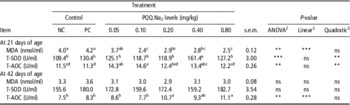
The effect of PQQ.Na2 on antioxidant indices of broiler chicks at 21 and 42 days of age are shown in Table 4. At 21 days of age, dietary PQQ.Na2 quadratically increased T-SOD activity and T-AOC, and linearly decreased MDA content in plasma (P<0.05). PC group had similar plasma MDA content, T-SOD activity and T-AOC as NC group. No less than 0.10 mg/kg PQQ.Na2 decreased (P<0.05) plasma MDA content compared with NC group. Plasma T-SOD activity was higher in 0.40 mg/kg PQQ.Na2 than any other group. Compared with NC, dietary PQQ.Na2 at 0.05 or 0.10 mg/kg dosage had greater (P<0.05) T-AOC.
Effect of different levels of dietary PQQ.Na2 supplementation on antioxidant indices in plasma of broiler chicksFootnote 1

MDA=malondialdehyde; T-SOD=total superoxide dismutase; T-AOC=total antioxidant capacity; NC=negative control; PC=positive control; PQQ.Na2=pyrroloquinoline quinone disodium; ns=not significant.
1 n=8 per treatment group.
2 One-way ANOVA of all the treatment groups.
3 Linear and quadratic=P-values of trend analysis of treatment groups without PC group.
a,bValues within a row with different superscripts differ significantly at P<0.05.
**P<0.01; ***P<0.001.
At 42 days of age, dietary PQQ.Na2 effect on plasma antioxidative indices was not as distinct as 21 days of age. Plasma MDA content and T-SOD activity were not affected by dietary PQQ.Na2 supplementation, whereas dietary PQQ.Na2 supplementation significantly increased (P<0.01) plasma T-AOC. In the present study, favorable plasma antioxidant status was achieved when birds were treated with PQQ.Na2 ranging from 0.05 to 0.80 mg/kg diet, with 0.4 mg/kg group had highest T-SOD at day 21, and both 0.20 and 0.80 mg/kg groups had higher T-AOC at day 42.
Discussion
Up to date several studies have reported the role of PQQ as a growth promoter. In rodents, growth was improved when PQQ was added to a basal diet, although its biological functions are not fully understood (Steinberg et al., Reference Steinberg, Gershwin and Rucker1994 and Reference Steinberg, Stites, Anderson, Storms, Chan, Eghbali and Rucker2003), and a vitamin-like activity has also been proposed (Kasahara and Kato, Reference Kasahara and Kato2003; Rucker et al., Reference Rucker, Storms, Sheets, Tchaparian and Fascetti2005). The numerically increased ADG and markedly improved feed efficiency in the overall period, in response to dietary PQQ.Na2 supplementation observed in the present study suggested the beneficial role of PQQ in broiler growth. The ADG and feed efficiency in 0.20 mg/kg PQQ.Na2 group was comparable to PC (antibiotic growth promoter) group, which indicated that PQQ.Na2 had potential as a growth promoter in broiler chicks. The improved feed efficiency by dietary PQQ.Na2 was probably associated with improved metabolism of essential amino acid lysine (Bauerly et al., Reference Bauerly, Storms, Harris, Hajizadeh, Sun, Cheung, Satre, Fascetti, Tchaparian and Rucker2006) or the modulation of mitochondrial function (Chowanadisai et al., Reference Chowanadisai, Bauerly, Tchaparian, Wong, Cortopassi and Rucker2010). It is said that mitochondrial function is highly correlated with feed efficiency in broilers (Bottje et al., Reference Bottje, Pumford, Ojano-Dirain, Iqbal and Lassiter2006). PQQ was observed to stimulate mitochondrial biogenesis through cAMP response element-binding protein phosphorylation and increased peroxisome proliferator-activated receptor-gamma coactivator-1 alpha (PGC-1α) expression (Chowanadisai et al., Reference Chowanadisai, Bauerly, Tchaparian, Wong, Cortopassi and Rucker2010). Our study in laying hens also supported the concept that PQQ.Na2 enhanced mitochondrial function (Zhao et al., Reference Zhao, Zhang, Wu, Yue, Wang, Qi and Sun2014). Feed efficiency was not affected in the starter period and greatly improved in grower period by dietary PQQ.Na2, which indicated that a durative time is needed for PQQ.Na2 to exert the growth promotion effects in broilers.
To the best of our knowledge, there is no report on the effect of PQQ on carcass yield of broilers so far. The results obtained in the present study indicated that dietary PQQ.Na2 supplementation partially increased breast muscle yield, whereas leg muscle was not affected at 42 days of age. Scheele (Reference Scheele1997) noted that growth occurs primarily in the pectorals and feather during the late stages of development in fast-growing broilers. The relatively rapid growth in PQQ.Na2-fed chicks in the grower phase may partly contribute the comparable increase of breast muscle yield. Another explanation for the different response of breast muscle and leg muscle may lie in the muscle fiber composition. Muscle fibers are categorized into slow-twitch fibers (type I muscle fibers) and fast-twitch fibers (type II muscle fibers). Breast muscle is primarily composed of white/glycolytic (type II) fiber, which contains few mitochondria and more glycogen and produce energy through the anaerobic pathway (von Lenerken et al., Reference von Lengerken, Maak and Wicke2002). Leg muscle consists of few type II muscle fiber and more red/oxidative (type I) fiber, which contains more mitochondrial and myoglobin, and utilize aerobic oxidation for their energy requirement. Muscle fiber transformation may occur in response to exogenous stimulation or feed ingredient in broilers (Zhao et al., Reference Zhao, Zhao, Jiang, Zheng, Chen, Liu and Wen2012). PQQ had been observed to stimulate PGC-1α expression (Chowanadisai et al., Reference Chowanadisai, Bauerly, Tchaparian, Wong, Cortopassi and Rucker2010), which was an effective inducer for type IIB fiber to type IIA (fast oxidative-glycolytic) fiber transformation in the pectoral muscle of broilers (Ueda et al., Reference Ueda, Watanabe, Sato, Akiba and Toyomizu2005). Thus, it is possible PQQ modulate muscle fiber transformation. In this study, no effect on leg muscle yield indicated that dietary PQQ.Na2 did not affect the growth and hypertrophy of leg muscle fiber having more mitochondria. With regard to the breast muscle, whether dietary PQQ.Na2 influences the muscle fiber size, density and transformation remains unknown. More glycolytic fiber in the breast muscle is prone to the occurrence of poor meat quality such as PSE (pale, soft, exudative) meat. Transformation from type IIB fiber to type IIA fiber may help to improve meat quality. PGC-1α expression and muscle fiber type analysis in PQQ.Na2-fed broilers is worthy of follow-up investigation.
Lysozyme is an important defense molecule of the innate immune system, which is important in mediating protection against microbial invasion. Lysozyme is found in both vertebrates and invertebrates (Jollès and Jollès, Reference Jollès and Jollès1984), and is also found in a large variety of animal secretions such as mucus, saliva and blood. As an important component of innate immunity, lysozyme is effective not only against gram-positive bacteria but also against some parasites such as coccidia (Sotirov and Koinarski, Reference Sotirov and Koinarski2003). Our current study found that plasma lysozyme activity was significantly increased by low dosage (<0.10 mg/kg) of dietary PQQ.Na2 supplementation and numerically increased by all other PQQ.Na2 diets during the grower phase. Higher levels of lysozyme activity indicated that dietary PQQ.Na2 may be beneficial for broiler chicks to cope with viral, bacterial or parasitic infections in pathogen surrounded environment.
In the present study, the antioxidant effect of dietary PQQ.Na2 supplementation was studied in broiler chicks. Previous studies have mainly focused on cell culture models or oxidative stress challenged conditions, and information on systemic antioxidative status of animals under normal conditions is scarce. Within normal animal body, ROS and free radicals are generated and scavenged continuously, and the concentrations of ROS and free radicals maintain homeostatis. Even a relatively small elevation in ROS or free radical levels may contribute to cell and tissue damage in living body. Animals have evolved highly complex antioxidant systems (enzymatic and non-enzymatic), which work synergistically, and in combination with each other to protect the cells and organ systems of the body against free radical damage (Rahman, Reference Rahman2007).
T-AOC is a measure of the antioxidant power, based on the reduction of ferrous ions by the effect of the reducing power of plasma constituents including enzymatic and non-enzymatic antixodiants. T-AOC may reflect the dynamic equilibrium between pro-oxidants and antioxidants in the plasma and give more biologically relevant information than that provided by individual antioxidant measurements (Ghiselli et al., Reference Ghiselli, Serafini, Natella and Scaccini2000). Increased plasma T-AOC at 21 and 42 days of age suggested that dietary PQQ.Na2 may improve the capacity of scavenging free radicals and decrease the damage of tissues or cells in broiler chicks. The reduction of endogenous lipid peroxide (MDA) observed in the current study further supported this phenomena. Decreased MDA level in myocardial tissue (Zhu et al., Reference Zhu, Zhou, Teerlink and Karliner2004), sciatic nerve (Gong et al., Reference Gong, Geng, Jiang, Aoki, Nakano and Zhong2012) and brain cortex (Zhang et al., Reference Zhang, Ding, Cao, Zhang, Ding and Ke2013) in rat model, and in plasma of human subjects (Harris et al., Reference Harris, Chowanadisai, Mishchuk, Satre, Slupsky and Rucker2013) had been observed, and are in agreement with our results. The trend analysis in both starter and grower phase also shows that plasma T-AOC, T-SOD activities and MDA content changed linearly or quadratically with the increasing dietary PQQ.Na2, these results confirmed previous report that PQQ as an antioxidant functioned in a concentration-dependent manner (Misra et al., Reference Misra, Khairnar, Barik, Indira Priyadarsini, Mohan and Apte2004).
It has been reported that PQQ exhibited oxidative stress protective ability not only by direct neutralization of ROS but also by induction of antioxidant enzymes (Misra et al., Reference Misra, Khairnar, Barik, Indira Priyadarsini, Mohan and Apte2004). Different from other studies with stress or challenge model, chicks were raised under normal environment without challenge in the current study, and enzymatic activity of T-SOD changed unsteadily. The results suggest that PQQ did not necessarily trigger induction of antioxidant enzymes in animals under normal raising environment. In the present study, dietary PQQ.Na2 induced elevation of T-AOC and activity of T-SOD and reduction of MDA concentration in the starter phase, whereas only elevation of T-AOC in the grower phase was observed. It appeared that young broilers were sensitive to antioxidant effect of dietary PQQ.Na2 supplementation. Dietary PQQ.Na2 addition resulted in higher T-AOC and lower MDA content in plasma, which indicated that PQQ.Na2 has the potential to act as an antioxidant in broilers. In light of the above, it can be suggested that PQQ.Na2 supplementation in broiler diets may be beneficial against free radicals and lipid peroxidation.
In the present study, the inclusion level of PQQ.Na2 was <1 mg/kg diet, which was far less than several hundred mg per kg diet, the possible toxicity dosage for animal (Rucker et al., Reference Rucker, Chowanadisai and Nakano2009). The results of the present study demonstrated that the inclusion of 0.20 mg/kg PQQ.Na2 in the diet was in favor of the growth performance, immune parameters and plasma antioxidant status under normal feeding environment without stress challenge. The response to a dosage of <1 mg/kg diet suggested that broiler chicks were more sensitive to dietary PQQ.Na2 addition.
Conclusion
In summary, dietary PQQ.Na2 supplementation improved growth performance, carcass yield, immunity and plasma antioxidant status of broiler chicks. There existed time cumulative effect for PQQ.Na2 to affect growth performance, and the favorable effects mainly occurred in grower phase in the broilers. The broiler chicks offer a useful animal model to study the growth promoting and antioxidant effects of PQQNa2. More work on PQQ application may benefit the broiler industry.
Acknowledgments
The financial support provided by Shanghai Medicial Life Science Research Center Co. Ltd, China Agriculture Research System-Beijing Team for Poultry Industry, the National Science & Technology Pillar Program (2011BAD26B04, Beijing, China) and Agricultural Science and Technology Innovation Program (ASTIP) is gratefully appreciated.