Ebstein anomaly is a rare congenital heart defect resulting from failure of adequate delamination of the tricuspid valve and accounts for 1% of congenital heart disease.Reference Boston, Dearani and O’Leary 1 Developed by Jose de Silva in 1989, the cone reconstruction involving surgical delamination of the valve leaflets and creation of a “leaflet cone” has become the standard of care for Ebstein anomaly.Reference da Silva, Baumgratz and da Fonseca 2 – Reference Dearani, Said and Burkhart 4 Multiple studies have shown good early and late outcomes for cone reconstruction.Reference Anderson, Dearani and Said 5 – Reference Silva, Silva and Moreira 10
Children with congenital heart disease are at higher risk of developmental disorders, behavioral and emotional problems, and an overall reduced quality of life.Reference Marino, Lipkin and Newburger 11 – Reference Varni, Limbers and Burwinkle 13 Surgical interventions including cardiac surgery in infancy have been shown to lead to reduced quality of life.Reference Guerra, Robertson and Alton 14 – Reference Bowman, Dearani and Burkhart 16 While physical improvements in heart function and exercise tolerance following repair of Ebstein anomaly have been reported, no study has looked at the overall quality of life and neurodevelopmental outcomes of children following cone reconstruction.Reference Driscoll, Mottram and Danielson 17 – Reference Li, Wang and Schreiber 21 In this study, we sought to evaluate the current health status, physical, emotional, social, and school functioning, and overall quality of life of young patients who had undergone cone reconstruction.
Materials and methods
In this Institutional Review Board approved study, we performed a retrospective chart review of all patients less than 21 years of age at time of cone reconstruction surgery from 1 June, 2007 to 31 August, 2016 at Mayo Clinic, Rochester, Minnesota. Patients who did not speak English were excluded from this study. Due to lack of validation of the quality of life survey, patients with current age less than 2 or greater than 25 years of age were also excluded. Data collected from each patient’s record included demographics, anatomic details of the cardiac defect and associated anomalies, and operative data. Active follow-up was obtained with a detailed health status questionnaire sent to known survivors. Data collected from the mailed questionnaire included current health status and symptoms, medications, arrhythmia history, subsequent hospitalizations, and functional status. If the questionnaire was not returned, two reminder telephone calls were attempted.
Each patient received a Pediatric Quality of Life Inventory. This inventory consisted of the 23-item PedsQL 4.0 Generic Core Scales that encompassed four domains: physical functioning, emotional functioning, social functioning, and school functioning.Reference Varni, Burwinkle and Seid 22 Patients with a current age of 19–25 years received the PedsQL 4.0 Young Adult Version.Reference Varni and Limbers 23 The PedsQL scales are composed of parallel child self-report and parent proxy-report formats. Items are linearly transformed to a 0–100 scale so that higher scores indicate a better quality of life. In addition, there are three summary scores: physical health summary score, psychosocial health summary score, and total scale score. Items were classified as a significant problem if it was reported as “often” or “almost always”. Patients were classified as “at risk for impaired quality of life” if their score was <1 SD below the population mean.Reference Varni, Burwinkle and Seid 22 The reliability and validity of the PedsQL Generic Core Scales have been demonstrated in healthy patient populations.Reference Varni, Burwinkle and Seid 22 – Reference Varni, Seid and Kurtin 24 Quality of life scores for patients who had undergone cone reconstruction was compared with previously reported scores for healthy children and children with chronic illness including asthma, diabetes, attention deficit hyperactivity disorder, and depression.Reference Varni, Burwinkle and Seid 22
Results are summarised using standard descriptive statistics. Duration of follow-up was calculated from date of surgery to date of survey return. The gender, age at time of surgery, and age at survey completion were compared between the questionnaire responders and non-responders using the chi-square test and Wilcoxon rank-sum test, respectively. All calculated p-values were two-sided, and p-values <0.05 were considered statistically significant.
Results
Demographics
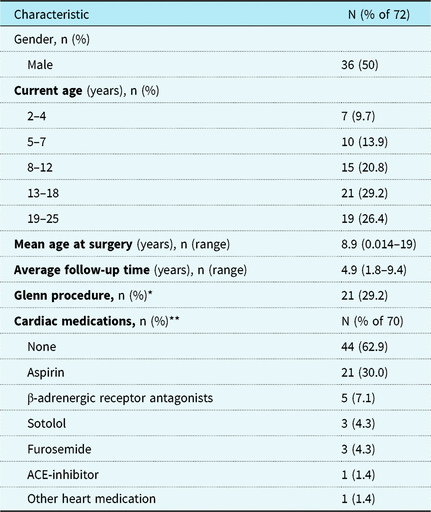
Between 2007 and 2016, 135 young patients ≤21 years of age underwent cone reconstruction at Mayo Clinic. There were four patients excluded based on age criteria at time of survey (<24 months or >25 years of age) and 15 additional patients were excluded based on lack of English proficiency (Figure 1). Of the 116 eligible patients, 72 (62.1%) returned the survey at a mean of 4.6 years (range 1.8–9.4 years) after initial operation (Table 1). Of survey responders, the average age at time of operation was 8.9 years (range 5 days–19 years) and average age at survey completion was 13.6 years (range 3–24 years). There was no statistically significant difference between gender, age at time of surgery, or rate of Glenn procedure completion between survey responders and non-responders (Supplementary Table 1).
Inclusion and exclusion criteria for patient responses.

Demographics of survey responders.

* Glenn procedures were either completed prior to or at the time of CR.
** No patients reported taking spironolactone, verapamil, diltiazam, amiodarone, warfarin, losartan, digoxin, chlorothiazide, or clopidogrel.
Health status
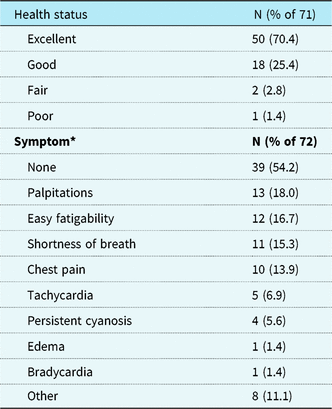
Most patients (96%, 68/71) reported their health as excellent or good (Table 2). Also, 39 (54.2%) patients were symptom-free. The most common symptoms reported were palpitations (18.1%), easy fatigability (16.7%), shortness of breath (15.3%), and chest pain (13.9%). Other symptoms reported included tachycardia (6.9%), persistent cyanosis (5.6%), bradycardia (1.4%), and edema (1.4%).
Self-reported health status and symptoms present in the last month.

* No patients reported fainting spells or ascites.
A majority of the patients (62.9%) reported taking no cardiac medications (Table 3). The most commonly used medication was aspirin (30.0%). Other medications included β-adrenergic receptor antagonists (7.1%), sotolol (4.3%), furosemide (4.3%), and ACE-inhibitors (1.4%).
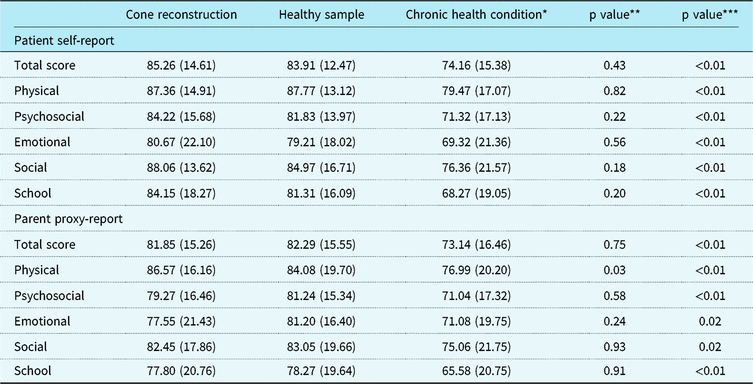
PedsQL 4.0 Generic Core Scales for children after cone reconstruction, healthy children, and children with a chronic health condition.Reference Li, Wang and Schreiber 21

* Children with asthma, diabetes, attention deficit hyperactivity disorder, depression, or “other”.
** p-value comparing cone reconstruction cohort to healthy control cohort.
*** p-value comparing cone reconstruction and children with chronic health conditions.
There were 14 (19.4%) survey responders who reported at least one cardiac-related hospitalization since their operation, and 7 of 14 were related to arrhythmia, wherein 2 resulted in pacemaker placement and 1 required ablation. Other reasons for hospitalization included tricuspid valve re-repair, thrombus formation, and pericardial effusions. Only one patient reported two hospitalizations, one for pericardiocentesis and a second for removal of a drain.
Pediatric quality of life inventory
Self-reported responses to the PedsQL Inventory were available for 60 patients ≥5 years of age at time of questionnaire. The average self-reported quality of life score among all patients was 85.3 (Table 3). The averages for the four domains, physical, emotional, social, and school, functioning were 87.4, 80.7, 88.1, and 84.1, respectively. There was no significant difference between patients who had undergone cone reconstruction and a previously reported healthy population results.Reference Varni, Burwinkle and Seid 22 By self-report, patients who had undergone cone reconstruction were significantly healthier than children with chronic health conditions in all areas of function.Reference Varni, Burwinkle and Seid 22
Parent proxy-report responses to the PedsQL Inventory were available for 53 patients aged <19 years of age at time of questionnaire. The average quality of life score by parent proxy-report was 81.8 (Table 3). The averages for physical, emotional, social, and school functioning were 86.6, 77.5, 82.5, and 77.8, respectively. Patients who had undergone cone reconstruction scored significantly higher than healthy peers in physical functioning (86.6 and 84.08, respectively) by parent proxy report. There were no statistically significant differences between our patients and healthy population means in any other category. However, by parent-proxy report, patients who had undergone cone reconstruction were significantly healthier than children with chronic health conditions in all areas of functioning (Table 3).
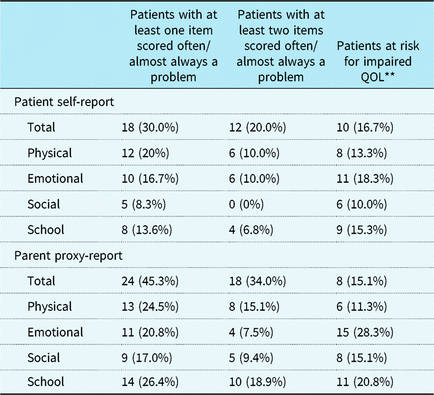
As shown in Table 4, 18 (30%) patients ≥5 years of age self-reported at least one item as significantly difficult (“often or almost always” a problem) with 20% reporting a significant problem with two or more items. Twenty percent reported a significant problem with physical functioning, 17% with emotional functioning, 8% with social functioning, and 14% with school functioning. Among 60 patients, 10 (17%) were considered “at risk for impaired quality of life” due to being >1 SD below the population mean.
Pediatric Quality of Life Inventory Scale* responses by parent proxy report for 53 patients <19 years of age and by self-report for 59 patients >5 years of age.

The number of items per scale varies depending on age version of the survey.
** Patients were classified as “at risk for impaired QOL” if their scores were >1 SD below the population mean. The population mean and SD were determined PedsQL 4.0 responses from a cohort of >10,000 patients.Reference Li, Wang and Schreiber 21
Twenty-four (45%) of the parent proxy-reports for children <19 years of age scored at least one item as significantly difficult and 18 (34%) reported two or more as significantly difficult. As listed in Table 4, 25% listed a significant problem with physical functioning, 21% related to emotional functioning, 17% in relation to social functioning, and 26% with relation to school functioning. Among 53 patients, 8 (15%) were classified as at risk for impaired quality of life by parent proxy report.
Of the 72 respondents, 98% are either full-time students or working full time. One patient is working part time for a reason other than heart problems. Ninety-two percent report no missed school or work days in the last month due to heart problems.
Discussion
Cone reconstruction has become standard of care for Ebstein anomaly with excellent short and long-term surgical outcomes.Reference Brown, Dearani and Danielson 7 However, little is known about long-term functional outcomes, overall health status, or quality of life after surgery. Our study demonstrates that patients who undergo cone reconstruction for Ebstein anomaly have excellent health status and quality of life outcomes in all areas of function for years after surgery.
A previous study of patients who underwent cone reconstruction at our institution found 98% survival at time of hospital discharge and no additional deaths related to cone reconstruction in short-term follow-up.Reference Anderson, Dearani and Said 5 Among young patients included in our study, 96% reported their health as “excellent” or “good”, and the majority of patients were living symptom- and medication-free. This supports that children and young adults with Ebstein anomaly have both low morbidity as well as low mortality after cone reconstruction.Reference Brown, Dearani and Danielson 7
It is known that children with congenital heart disease are at increased risk of developmental delay and disabilities as well as increased physical symptoms related to impaired cardiac function.Reference Marino, Lipkin and Newburger 11 , Reference Guerra, Robertson and Alton 14 Children born with congenital heart disease, like other chronic conditions, can have impaired quality of life in multiple areas of functioning. Varni reported that among children with a cardiac defect requiring surgery, overall quality of life was 76.3/100 and found that children with cardiac illness had a lower quality of life than healthy peers.Reference Varni, Limbers and Burwinkle 13 Patients undergoing cone reconstruction at our institution reports an overall QOL of 85.3/100 which is comparable to healthy peers. Thus, parents and caregivers can be reassured that in addition to return of cardiac function, patients can expect high functioning in all areas of well-being.
Despite excellent overall scores, a significant minority reported difficulty with one or more items on a regular basis. These tasks were distributed among all areas of quality of life including physical, emotional, social, and school functioning. This illustrates the need for continued general medical care and attention to potential difficulties in physical and psychosocial functioning.
This study demonstrates that children undergoing cone reconstruction for Ebstein anomaly can expect to attend school and work full time after cone reconstruction. All but one patient, who worked part time for reasons other than cardiac function, were full time students or employees, and the majority did not report needing to miss work or school for cardiac-related issues.
This study has several limitations. Health status was self-reported and not all patients responded to the survey and non-English speaking patients were excluded from this study. However, there were no significant differences between responders and non-responders in terms of gender, age at surgery, or age at time of survey. Also, the mean time from surgery was only 5 years (range 1.8–9.4 years) with some responders having limited post-operative time prior to survey completion. Future research will be needed to see if quality of life is maintained over longer time periods following surgery. Most neonates requiring surgery were not included in this study due to young age at time of survey distribution. Children requiring surgery for Ebstein anomaly during the neonatal period have more severe disease presentation and so the results of this study may not be representative of children requiring early interventions. Additionally, as the cohort of patients who undergo cone reconstruction increases, further research analyzing factors that can help predict patients who may have a lower quality of life will become possible.
Conclusions
Children with Ebstein anomaly who had cone reconstruction have excellent quality of life comparable with healthy peers and significantly better than other children with chronic health conditions. Families of children with Ebstein anomaly can expect excellent quality of life, long-term health status, and social functioning following cone reconstruction.
Author ORCIDs
Kristen Sessions https://orcid.org/0000-0003-2062-8746; Charlotte Van Dorn https://orcid.org/0000-0001-7931-4982; Johnathan Johnson https://orcid.org/0000-0001-7850-0636
Acknowledgement
None
Financial Support
This project was supported by the Mayo Clinic CCaTS grant (grant number UL1TR000135).
Conflicts of Interest
None
Ethical Standards
This study was approved by the Mayo Clinic Institutional Review Board (15-009245). All patients provided written informed consent. Parents or legal guardians provided written informed consent for children <18 years of age.
Supplementary material
To view supplementary material for this article, please visit https://doi.org/10.1017/10.1017/S1751731112000146.