1. Credo
The number of books and papers dealing with Squire Mèng (孟子)Footnote 1 and the book Mèngzǐ (孟子) in recent times is impressive, and they contain contributions by many major sinologists.Footnote 2 The main point of interest is easily identifiable: the question of human nature. The list of contributors to the volume of papers edited by Alan K. L. Chan constitutes a veritable roll call of the major voices in the most recent developments of this debate.Footnote 3 As I am no longer convinced of the validity of one of the main dogmas of these discussions, i.e. the uncritical assumption that Squire Mèng was a philosopher and that the views he handed down in the Mèngzǐ are thus to be interpreted in a philosophical context, I shall attempt neither to summarize nor criticize their individual findings in this context.Footnote 4 Nevertheless, it will certainly be helpful to point out the following two fundamental methodological issues which have given, and will continue to give, rise to serious differences as regards scientific intentions, approaches and opinions. By this, I do not intend to question the legitimacy of methods and approaches I happen not to adopt or sometimes even have reasons to dismiss.Footnote 5 I do, however, for the benefit of readers of this paper, intend to clarify my position and to chart the way through my reconstruction of a specific range of Mencian thoughts, thus preventing them from expecting insights I am neither willing nor able to deliver.
The first issue concerns the social context and the social role. As mentioned above, I doubt whether Squire Mèng should be classified as a philosopher. The main role that emerges from a close reading of the Mèngzǐ is that of a homo politicus, of an important and influential policy-making statesman and counsellor. It is true that our perception of historical figures and of their views is influenced by the social roles we attribute to them, and this becomes all the more critical when the associations we connect with these roles are based on our own cultural experiences.Footnote 6 Mistakes or preconceptions in this respect inevitably lead to wrong expectations as to the kind of ideas an author or his text offers. Based on the attitude of a close reader with philological interests (cf. the second issue below), this makes it imperative, on the one hand, to focus on the historical contextualization of the author and the text, and on the other, to pay great attention to the language and words he and his contemporaries were using.Footnote 7
The second issue concerns the attitude of the reader or researcher. In Lector in fabula, Umberto Eco draws an interesting and fundamental typological distinction between the reader of a text and the user of a text.Footnote 8 The reader, he states, is interested in finding out the intention of the author or compiler of a text. In this case the approach is hermeneutical and the result is generally a respectful interpretation of the ideas and intentions of the author and their manifestation in the text. The stance of the user is quite the opposite: here the text is used to set forth one's own ideas – the text is a mine for relevant data to support a theory that is currently debated and that usually has nothing at all to do with the text.Footnote 9 This is, of course, an absolutely honourable and legitimate way of dealing with a text, and in the Chinese context it comes close to the way traditional commentaries were conceived. The results of such approaches to a text (and classics lend themselves very readily to such endeavours) are examples of how texts could and still can be received (Rezeptionsgeschichte) and how they, divorced from their historical context, inseminate current debates. Such approaches are not intended to furnish the reader with an approximation of the historical reality of the author and his text(s) or the ideas current at that time, and they tend to translate texts and terminology in ways adapted to their own needs or to the needs of their prospective readers. Classifying Squire Mèng as a philosopher, therefore, naturally calls for philosophical renderings of the ancient Chinese terms, for selective reading, and presupposes or implies philosophers as the preferred readership.Footnote 10
2. The issues
Several transcripts of discussions between the Xuān-King of Qí (齊宣王) and Squire Mèng have been handed down in the book Mèngzǐ. In 1A.07, in many respects one of the most interesting dialogues,Footnote 11 Squire Mèng claims that the King has the ability to become a true king.Footnote 12 As evidence for this claim, he refers to an episode reported to him:
1 曰:「臣聞之胡齕. 曰『王坐於堂上. 有牽牛而過堂下者. 王見之, 曰,『牛何之?』對, 曰,『將以釁鐘.』王曰,『舍之! 吾不忍其觳觫. 若無罪而就死地. 』對, 曰,『然, 則廢釁鐘與?』曰,『何可廢也? 以羊易之!』不識有諸?」曰:「有之.」曰:「是心足, 以王矣. 百姓皆以王為愛也. 臣固知王之不忍也.」
Squire Mèng said, “Your minister is informed of the following incident by Hé of the lineage of the Hú. ‘Your Majesty’, he said, ‘was sitting in the upper part of the hall. There was someone tugging an ox past the lower part of it. Your Majesty saw him, and said, 〈Where is the ox going?〉 He replied, 〈We are going to consecrate a bell with its blood〉. Your Majesty said, 〈Let it go! I cannot bear its frightened straining and trembling. It is like being without guilt and still being made to approach the place of death〉. He objected and said, 〈If I do so, is that then the calling off of the consecration of the bell?〉 [Your Majesty] said, 〈Why should that be something permitting to call it off? Change [the ox] for a sheep!〉 – I am not sure whether this took place.” [The King] replied, “It did.” [Squire Mèng] said, “This ‘heart’ fulfils [a premise for] becoming a true king. The mínFootnote 13 all thought your Majesty had become partial.Footnote 14 But your minister knows for certain that your Majesty was not able to bear [its suffering].” (Mèng 1A.07)Footnote 15
When asked why he felt pity for the ox and not for the sheep, the King:
2 王笑曰:「是誠何心哉? 我非愛其財, 而易之以羊也. 宜乎百姓之謂我愛也.」
[…] gave an embarrassed laugh and said, “What kind of ‘heart’ has this [behaviour] corroborated?! I deny being partial to its expense, but I still changed it for a sheep! How right for the mín to call me partial!” (Mèng 1A.07)
Squire Mèng reassures the king and points out that he had, in fact, exercised a variety of the sense of humaneness necessary to become a true king – even though he harmed the sheep. The king:
3 說曰:「詩云,『他人有心, 予忖度之,』夫子之謂也. 夫: 我乃行之, 反而求之, 不得吾心. 夫子言之, 於我心有戚戚焉. 此心之所以合於王者何也?」
[…] was pleased, and said, “When a Song says, ‘When “hearts” emerge in the other person, I am able intuitively to perceive and to measure them’ – it is a reference to you, honoured Squire. I indeed did exercise this ‘heart’, but turning around and searching for it, I do not grasp my ‘heart’ [responsible for this behaviour]. You, honoured Squire, spoke about it, and within me the [corresponding] ‘heart’ caused a growing affinity to emerge there. What is the reason why this ‘heart’ meets with [the requirements for] becoming a true king?” (Mèng 1A.07)
This question calls for an explanation of the difference between being able to do something (néng 能) and actually doing it (wéi 為). That the King's kindness reaches animals but not the Hundred Clans means that he is simply not doing what he should as a king, not that he is unable to do it. According to Squire Mèng, the same explanation applies to his not becoming a true king:
4 言舉斯心加諸彼而已. 故: 推恩, 足以保四海; 不推恩, 無以保妻子. 古之人所以大過人者無他焉: 善推其所為而已矣. 今恩足以及禽獸, 而功不至於百姓者獨何與? 權: 然, 後知輕重. 度: 然, 後知長短. 物皆然, 心為甚. 王請度之. 抑王興甲兵, 危士臣, 構怨於諸侯: 然, 後快於心與?」王曰:「否. 吾何快於是? 將以求吾所大欲也.」
It says that a ruler only reaches the end when he has installed such “hearts” and applied them to others. If, then, a ruler extends his kindness, it will suffice to protect [the whole area between] the Four Seas, and if he does not extend it, he will lack the wherewithal to protect wife and children. A man may be lacking in everything else in which the ancients greatly surpass other men except in this: – he reaches the end only when he becomes an expert at extending what he ought to do to others. Now what could be the reason why [your] kindness is sufficient to reach to animals, but benefits do not reach the Hundred Clans? Weighing – only when you do so, do you know the weight [of a thing]. Measuring – only when you do so, do you know the size [of a thing]. All things are dealt with in this way, but for “hearts” it is most important. I beg your Majesty to measure them. All the more as you are mustering armoured soldiers and infantry men, endangering ranked servicemen and ministers, and suffering resentment from the feudal lords; – is it only when you do these things that you cause a quickening in your ‘hearts’?” The King said, “I do not. Why should I cause a quickening [to my ‘hearts’] by these [activities]? With these activities I am about to pursue what I greatly desire. (Mèng 1A.07)
After rejecting the items on a list of possible desires (food, music, comfort, etc.), Squire Mèng explicitly names the King's great desire – and severely criticizes it because of the obvious lack of (self-)reflection:
5 曰:「然, 則王之所大欲可知已. 欲辟土地, 朝秦楚, 莅中國而撫四夷也. 以若所為求若所欲, 猶緣木而求魚也.」王曰:「若是其甚與?」曰:「殆有甚焉. 緣木求魚, 雖不得魚, 無後災. 以若所為求若所欲, 盡心力而為之, 後必有災.」
Squire Mèng said, “If this be the case, then what your Majesty greatly desires may finally be known. You desire to enlarge your property and territory, to make Qín and Chǔ wait at your court, to direct the principalities of the Middle, and to bring peace to the Yí of the Four Regions. But to do what you do to pursue what you desire is like climbing a tree to seek for fish”. The King said, “Is it like this in its extreme consequences?” Squire Mèng said, “There is danger that it is even worse than that. If someone climbs a tree to seek fish, although he does not get the fish, he will not suffer any subsequent calamity. But doing what you do to pursue what you desire, and exhausting [your] ‘hearts’ and strengths in doing it, you will assuredly afterwards cause calamities to emerge.” (Mèng 1A.07)
These passages from Mèngzǐ 1A.07 vividly set the scene for reflecting on the role of hearts, desires, and behavioural patterns within the debate on so-called “human nature” (xìng 性) in ancient China. To which degree menFootnote 16 could be assigned the properties “(by natural endowment) good” (shàn 善) or “(by natural endowment) bad” (bù shàn 不善 or è 惡) was intensely debated by several thinkers in the course of the Zhànguó period. This can be plainly seen from the lead given by Squire Gōng-dū in a passage where Squire Mèng explains his position in an ongoing debate:
6 公都子曰:「告子曰:『性無善, 無不善也』. 或曰:『性可以為善, 可以為不善. […]』. 或曰:『有性善, 有性不善. […]』. 今曰:『性善』. 然, 則彼皆非歟?」
Squire Gōng-dū said, “Squire Gào says, ‘[Men] are [beings] who by natural endowmentFootnote 17 lack goodness, but who [also] lack not-goodness.Footnote 18’ Some thinkers say, ‘[Men] by natural endowment allow [themselves] to be formed into somebody good, or to be formed into somebody who is not good. […]’ Other thinkers say, ‘There are [men] who are by natural endowment good, and there are [men] who are by natural endowment not good. […].’ Now you say, ‘[Men] are by natural endowment good’. If this be the case, are all others then thinkers with mistaken views?” (Mèng 6A.06)
Reading this list of positions the following question arises: what kind of basic concept or elementary image of the natural endowment xìng, what shared view could possibly give rise to these divergent positions and interpretations? How did thinkers of the Zhànguó-period conceive of man's natural endowment? The focus of my paper shall therefore not be the differences which have been so clearly enunciated in the excerpt above, but the common ground underlying the various positions, especially the two extreme ones put forth by Squire Mèng and Squire Xún, respectively.Footnote 19 As the sequel to the dialogue between Squire Gōng-dū and Squire Mèng shows, the question of the natural endowment xìng is intimately and importantly related to concepts of what is usually (not in an enlightening way) termed “heart” or “heart-mind” (xīn 心). In a rightly famous passage Squire Mèng asserts the following:
7 惻隱之心, 人皆有之; 羞惡之心, 人皆有之; 恭敬之心, 人皆有之; 是非之心, 人皆有之.
“Hearts” for empathy and compassion – all men have them. “Hearts” for shame and repulsion – all men have them. “Hearts” for politeness and respect – all men have them. A “heart” for the right and the wrong – all men have it. (Mèng 6A.06)
Given the prominence and role of the word xīn “heart(s)” in this and similar cardinal passages devoted to discussing “human nature”, the undeniable relevance of the phenomena designated with this word, and the complex psycho-physical functions of this organ (or these organs), the prevailing attempts to define xīn and offer translations for it appear surprisingly superficial and uninformed.Footnote 20 The meaning and the functions of xīn, however, are essential for a deeper understanding of the concept – or concepts – of man during the Zhànguó period. In this paper, I shall try to shed light on these repeated references to the “heart”, i.e. to various or specific “hearts” (cf. the individualizing expressions shì xīn 是心, hé xīn 何心, and cǐ xīn 此心 implying the presence of other “hearts” in citations 1, 2, and 3 above), and on the relationship of these to desires and to certain patterns of behaviour. A first lead is contained in the following passage:
8 飲食男女, 人之大欲存焉. 死亡貧苦, 人之大惡存焉. 故: 欲惡者心之大端也. 人藏其心, 不可測度也. 美惡皆在其心不見其色也. 欲一以窮之, 舍禮何以哉?
Drinking, eating, acting as husband or wife – in these [activities] major desires of human beings are perpetuated. Suffering death, banishment, poverty or bitterness – in these [experiences] major dislikes of human beings are perpetuated. Hence, things that are desired or hated are important indicators of “hearts”. For human beings hide their “hearts” and do not allow them to be fathomed or measured. [True] beauty and ugliness are [properties that] both depend on their “hearts”, but do not appear in their expressions. If, with one single thing, one desires to limit [desires and dislikes], why should one abandon ritual behaviour? (Lǐ Jì 9.23)
This passage from the Lǐ Jì 禮記, the Records of Rites, contains a great many of the major keywords to be discussed in the following: the list begins with yù 欲 “desire” and wù 惡 “dislike”; it adds to these the related category of size (dà 大 “major” – which implies that there are also xiǎo 小 “minor” or “small” desires and dislikes; cf. the big ox and the small sheep in citation 1); it introduces the notion of measuring (cè 測 “to fathom”, i.e. “to determine the depth”, and duó 度 “to measure”, i.e. “to determine the size”;Footnote 21 cf. citations 3 and 4); it mentions overt (xiàn 見 “visible”) and covert (cáng 藏 “hidden”) phenomena, the latter being interpretable with the help of minor symptoms or major indicators (duān 端); it comprises several instances of the word xīn 心, which quite obviously does not refer to the physical organ “heart” but rather seems to oscillate between several psychological and physiological meanings or references; it refers to “beauty” and “ugliness” (měi è 美惡), synonyms for “good” and “bad”; and the list closes the inventory with the word for “rites” or “ritual behaviour” (lǐ 禮).
In what follows I shall discuss such keywords as shed light on the role of the heart in the debate on human nature, especially in its relationship to desires and when it focuses on the question of “good” or “bad”. I shall raise the question of how to react adequately, when translating, to the polysemy of two of the words written with the character 心. As an interpretative backdrop and thought-provoking methodical instrument, a cognitive metaphor or image as an attempt to visualize and understand the relationship between various terms will then be offered.
3. The workings of desires or dislikes
Let me first focus on things termed desirable or distasteful. Squire Mèng repeatedly lists objects or happenings that can be taken as exemplifications of citation 8 (above) from the Lǐ Jì. A well-known selection is given here in an abbreviated paraphrase:
9 魚我所欲也. 熊掌亦我所欲也. 二者不可得兼, 舍魚而取熊掌者也. 生亦我所欲也. 義亦我所欲也. 二者不可得兼, 舍生而取義者也. […] 是故所欲有甚於生者, 所惡有甚於死者. […] 人皆有[是心].
I like fish, and I also like bear's palm. When I cannot have both, I choose bear's palm. I want to live, but I also want to behave dutifully. Had I to choose, I would abandon remaining alive and opt for having behaved dutifully. […] In other words, there are things that human beings want more than life and also things that they hate more than death. […] Everyone has such “hearts”. (Mèng 6A.10)
Squire Mèng still had the innocent choice between two apparently desirable dishes – for us, however, bear's palms are definitely out, and if we further maltreat the oceans, fish might also disappear from the menu. But besides this, let us carefully register what Squire Mèng is saying and consider the implications. First of all, he lists a good number of desires and dislikes:
(a) yù yú 欲魚 “desire for fish”;
(b) yù xióng zhǎng 欲熊掌 “desire for bear's palm”;
(c) yù shēng 欲生 “desire to remain alive”;
(d) yù yì 欲義 “desire to behave dutifully”;
(e) suǒ yù yǒu shèn yú shēng zhě 所欲有甚於生者 “among things one desires there are such that are more [desirable] than remaining alive”;
(f) wù sǐ 惡死 “dislike dying”;
(g) suǒ wù yǒu shèn yú sǐ zhě 所惡有甚於死者 “among things one hates there are such that are less [to be hated] than dying”.
Squire Mèng then grades these different desires. The desire for fish and for remaining alive, according to him, are lesser desires (xiǎo yù 小欲) compared with the cravings or greater desires (dà yù 大欲) for bear's palm or for dutiful behaviour.Footnote 22 In other words, for Squire Mèng, desires conform to a ranking. Some desires are worth pursuing and more fulfilling than others. Under certain circumstances, lesser and greater desires are simultaneously attainable, under other circumstances, only one or the other is attainable. In the latter case, it is normal – and proper – to choose a higher-valued desire.
Continuing our close reading and pondering of some of the broader implications, we gain further insights into Mencian psychology and anthropology: if, as stated in the passage from the Lǐ Jì, a specific desire – or dislike – is a telltale, outward sign of a corresponding “heart”, then simultaneous and non-excluding desires cannot but be discrete indicators (duān 端) of just such a number of specific “hearts”.Footnote 23 Squire Mèng, whose desires have been listed above, must therefore have had at least seven “hearts”, e.g. one desiring fish (a) and one desiring bear's palm (b), one desiring to live (c) and one detesting dying (f), etc.
Having established that a desire or dislike is an indication of a corresponding “heart”, then, conversely, asserting that a certain “heart” exists must be related to a desire or dislike. This can be inferred from the famous situation construed by Squire Mèng where a person would certainly manifest a “heart” that is not unfeeling towards others should he suddenly see a young child about to fall into a well (Mèng 2A.06; cf. citation 33). Following this assertion, Squire Mèng himself offers a few desires and dislikes that do not count as triggers for this spontaneous demonstration of feeling: the wish to be held in good esteem by one's parents, the wish to win the praise of fellow villagers or friends, or dislike of the crying of a child. In a positive sense, we may add as possible triggers a dislike for seeing somebody innocently coming to harm or dying young. As we can see, the relation between “hearts” and desires or dislikes is neither unique nor uniform, i.e. a certain desire can be the trigger for different “hearts”, whereas one and the same “heart” can be moved by different desires or dislikes. The Lǚ Shì Chūn Qiū 呂氏春秋 therefore puts this relation between “hearts” and desires or dislikes in very general words and simply says: xīn suí yù 心隨欲 “a ‘heart’ defers to a desire” (LSCQ 20/8.1).
4. Different kinds of “hearts”
Having provided Squire Mèng with several different “hearts”, we can now turn to the manifold implications of this unexpected, but far from unusual lexicographical state of affairs:
Implication one: In the passage from the Lǐ Jì we are told that eating is among the major desires of human beings – they want to eat, they desire food (yù shí 欲食). From a logical point of view, we must imagine that this general desire for food comprises several more specific sub-desires, such as the desires for fish, bear's palm and other tasty dishes. We may therefore reasonably assume that Squire Mèng also had a ‘“heart” that desires food (yù shí zhī xīn 欲食之心). This implies that certain “hearts” are obviously grouped together in sets bearing the name of a superordinate “categorial heart”. This structure with two levels is also displayed in the case of the ‘“heart” that is not unfeeling towards others (bù rěn rén zhī xīn 人皆有不忍人之心; citation 33), itself a “variety of humane behaviour” (rén shù 仁術). Squire Mèng decomposes this “heart” into the following four constituent “hearts”: ‘agitated “heart”’ (chù xīn 怵心), ‘shocked “heart”’ (tì xīn 愓心), ‘empathizing “heart”’ (cè xīn 惻心), and ‘compassionate “heart”’ (yǐn xīn 隱心).
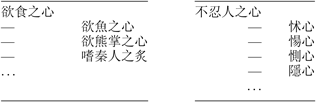
This type of tiered structure could be the key to interpreting the following cryptic statement from the Guǎnzǐ:
10 心以藏心. 心之中又有心焉. 彼心之心 […].
A/the “heart” thus stores [further] “hearts”. In the middle of a “heart”, the existence of additional “hearts” is to be assumed. Those “hearts” of a/the “heart” […]. (Guǎnzǐ 49)
Implication two: Having argued his preference for bear's palm or dutiful behaviour, Squire Mèng asserts that “everyone has such ‘hearts’” (cf. citation 9). As the written form of the expression shì xīn 是心 does not differentiate between singular and plural, he could be referring to a specific “heart” or to various kinds of “hearts”, i.e. the hearts that desire food, fish, bear's palm, or life. Based on universal human experience, we would, however, hesitate to assert that all human beings like fish or prefer bear's palm, so it seems rather doubtful that Squire Mèng is referring to such “hearts”. And the sentence immediately preceding his conclusion gives us the right clue: “there are things that human beings want more than life and also things that they hate more than death”. This clearly refers to a capacity to compare, and choose between, alternatives, and to grade them according to their social value or check them against a rule or norm. One thing is better or worse than another, one course of action is more or less appropriate than another (shèn yú 甚於). Elsewhere, Squire Mèng gives this “heart” a name: it is “the ‘heart’ that [judges whether something is] right or wrong” (shì fēi zhī xīn 是非之心) – and of this “heart” Squire Mèng also asserts that all human beings have it (Mèng 6A.06). Now, this “heart” stands for a specific critical power of mind, for a reflective or self-reflective awareness. In a way reminiscent of a statement we met with in citation 8 (i.e. “things that are desired or hated are important indicators of ‘hearts’” – yù wù zhě xīn zhī dà duān yě 欲惡者心之大端也), Squire Mèng asserts: “the ‘heart’ that [judges whether something is] right or wrong is the starting point of intelligent behaviour” (shì fēi zhī xīn zhì zhī duān yě 是非之心智之端也; Mèng 2A.06).
Implication three: The repeated claim that all human beings have certain “hearts” implies that, at birth, certain basic patterns of behaviour and the corresponding “hearts” are assumed to be present. Some are clearly already in working condition, others are there to be developed. For example, among the innate “hearts” we find the fundamental moods or emotional dispositions (qíng 情; cf. note 31). Squire Xún lists the behavioural patterns as follows:
10 性之好惡、喜怒、哀樂謂之情.
[Faculties by natural] endowment [such as] loving or hating, being pleased or angry, sorrowing or enjoying – these [the future king] should term “moods”. (Xún 22.1b; cf. also 17.3a)
And the Lǐ Jì pairs these moods with the corresponding “heart”:
11 其哀心感者, 其聲噍以殺. 其樂心感者, 其聲嘽以緩. 其喜心感者, 其聲發以散. 其怒心感者, 其聲粗以厲. 其敬心感者, 其聲直以廉. 其愛心感者, 其聲和以柔.
When [somebody's] “heart” for sorrow is touched, his voice turns sharp in order thereby to diminish [his sorrow]; when his “heart” for happiness is touched, his voice becomes intense in order thereby to prolong [his happiness]; when his “heart” for pleasure is touched, his voice becomes outgoing in order thereby to broadcast [his pleasure]; when his “heart” for anger is touched, his voice turns coarse in order thereby to whet [his anger]; when his “heart” for respect is touched, his voice becomes direct in order to thereby render honest [his respect]; when his “heart” for (undue) favouring is touched, his voice turns harmonious in order thereby to show softness. (Lǐ Jì 19.1)
Some tentative conclusions regarding the word xīn 心 can now be drawn. The textual evidence and the implications of the passages discussed show that this word refers to several lexically related, but separate entities: (a) to the physical organ named xīn, which we shall not deal with here; (b) to a global psycho-physiological organ – also named xīn – which acts as a storage place for comprehensive cardiac faculties; (c) to individual cardiac faculties or sets of related faculties stored in (b) and also named xīn, i.e. to the innate or acquired abilities constituting mental, perceptual, sensory, and psychic processes.
5. Translating xīn 心 – some thoughts on two cases
The short survey of the polysemy of the word xīn 心 given above inevitably raises the question of translations for the different words written with the same character, especially for the individual cardiac faculties. Gifted translators have, of course, always gone beyond the simplistic solution which uniformly offers one word for one character (e.g. “heart” or the current fad for “heart-mind”) and thus refuses to face textual complexities and the ubiquitous problem of homonyms and homographs. They offer pragmatic, contextually plausible solutions resulting in an impressive range of equivalents: propensity, mind, wish, sense, desire, reservation, opinion, longing, attitude – to name only some of the nouns offered as equivalents in translations. But this type of “lexicography by translation” does not systematically further our insight into the relationship between different “hearts” or cardiac faculties.
I shall briefly touch upon two cases which can be approached with methodical and systematic assumptions. Let me begin with expressions of the type āi xīn 哀心, which, in the context given above, is a genitive, and which I translated with ‘“heart’ for sorrow” – not: ‘“heart’ of sorrow”. Normally, we take genitives to be possessive in meaning, e.g. “the citizens of London”. Normally, too, we tend to disregard the appositive variant, e.g. “the city of London”. And this example shows how appositives occur and how they are to be analysed: “London” is a name and a city. These two categories make for two appositive constructions: “the city of London” or “the name London”.
Now “sorrow” (āi 哀) is in terms of category a sense (e.g. of loss upon the death of somebody), an emotional state or reaction, a feeling, a capacity, a faculty, etc. All these nouns qualify as heads of appositive constructions: “sense of sorrow”, “state of sorrow”, “feeling of sorrow”, etc. Thus, in citation 12, dealing with the stimulation of certain feelings, we can now exchange the rather graceless translation “‘heart’ for sorrow” by “sense of sorrow”. In the same way, the “hearts” for happiness, pleasure, anger, respect and resentment become more intelligible as “senses” of happiness, etc. The word xīn 心, when in appositive constructions with nouns of the type āi, can thus be translated by “sense of”, “state of”, “reaction of”, “feeling of”, “capacity for”, or “faculty to”.
Let us briefly return to the Mencian fishes. We could, for argument's sake, assume that the name of the heart corresponding to the desire for fish (yù yú 欲魚) should actually be named yú xīn 魚, instead of “‘heart’ that desires fish” (yù yú zhī xīn 欲魚之心) as suggested at first. In the possessive sense, the expression yú xīn would have to be translated by “the heart of a fish” – which, of course, is possible, but would certainly not do Squire Mèng justice. As an appositive, however, and remembering that Squire Mèng is talking about fish in the sense of a dish, of an appreciation of its savour, we can propose “a taste for fish”. This clearly means that in such cases we should browse intelligently through the “sensual” parts of the English (or German) lexicon.
Let me now turn to examples of the second type of expression I intend to discuss:
• “his xīn of a baby” (qí chì zǐ zhī xīn 其赤子之心; Mèng 4B.12);
• “the xīn of a dutiful son” (xiào zǐ zhī xīn 孝子之心; Mèng 5A.01);
• “the xīn of a father or mother” (fù mǔ zhī xīn 父母之心; Mèng 3A.03);
• “the xīn of a mín” (mín xīn 民心; ZGC 145/75/20);
• “the xīn of a lord” (jūn xīn 君心; Mèng 4A.20), etc.
It is obvious that the modifying expressions refer to social roles, e.g. father, son, etc. Now, the fulfilment of a social role is dependent on complex faculties, appropriate behavioural patterns – let us say, a specific mindset. And, in the context of ancient China, this leads us into the ramified discussion known by the well-known expression “rectification of names” (zhèng míng 正名). The designation of a social role, e.g. a nomen agentis like “father” (fù 父), is such a name (míng 名). This, inevitably, calls to mind the famous dictum of Squire Kǒng:
12 君君, 臣臣, 父父, 子子.
A ruler should behave like a [true] ruler, a minister like a minister, a father like a father, a son like a son. (Lùn Yǔ 12.11)
The predicate phrase in these commandments is composed of verbs referring to the realization (shí 實) of the related social role. The degree of realization can be assessed by comparing actual with prescribed behaviour. The statement from the Lǚ Shì Chūn Qiū 呂氏春秋 mentioned above (cf. p. 247) has an extension covering this very situation. It says:
13 人事皆然: 事隨心, 心隨欲. 欲無度者, 其心無度. 心無度者, 則其所為不可知矣.
All men do service as follows: the way of serving defers to cardiac faculties, and the cardiac faculties defer to desires. If a desire does not have something that gauges it, its corresponding cardiac faculty will lack measure. If a cardiac faculty does not have something that gauges it, then what it is doing denies insight. (LSCQ 20/8.1)
“Serving” means acting out a social role. In such cases, the word xīn clearly refers to sets of faculties. This specific mindset, this mentality, is the basis for actions or responses within a prescribed social framework. Hence, when a father (fù 父) behaves like a true father (fù 父), he is able to do so because he is equipped with the specific mentality of a father (fù xīn 父心). Or to put it in a general formula:
14 A person in a certain social role (míng 名) realizes (shí 實) specific cardiac faculties (xīn 心) which constitute a set, i.e. a mentality, defining and enabling behaviour (xìng 行) compatible with his current role.
Besides groups of faculties arranged by categorial term (e.g. different tastes), we have sets of abilities, i.e. mentalities, characterizing different, at times co-existing and even competing, social roles. The expressions listed above thus comprise the following mentalities: of a baby, of a dutiful son, of a father or mother, of a mín, or of a lord. The mentality of a father versus his son does not exclude the mentality of a dutiful son versus his son's grandfather. Neither are such sets necessarily fixed for all time: it is possible to change one's mind or heart, to assume a new outlook or mentality. The corresponding expression is biàn xīn 變心, i.e. to replace one mentality with another, as in the following paraphrased episode:
15 齊大夫諸子有犬. 犬猛不可叱, 叱之必噬人. 客有請叱之者. 疾視而徐叱之, 犬不動. 復叱之, 犬遂無噬人之心.
Squire Zhū, a dài-fū of Qí, had a fierce dog that bit whoever wanted to call him off. A guest-client asked for permission to deal with it. He gave the dog a revolting stare and called him off. The dog did not move. He did it once more, but the dog had lost its inclination to bite people, i.e. its “bite-people”-mentality. (ZGC 374/182/28)
Apart from offering proof of the early existence of “dog whisperers” in China and a good example of a dog learning to conform to his social role, i.e. to behave like a true dog, this anecdote demonstrates what I would term a performative triangle (see Figure 1):
A performative triangle

The three interacting corners represent: desire or dislike; cast of mind or specific mental faculty; and pattern of behaviour or action. A ruler feeling the urge (yù 欲) to swallow the empire will develop a framework or mindset upon doing so (yǒu tūn tiān-xià zhī xīn 有吞天下之心, ZGC 167/86/1), and this will translate into a spate of actions designed to fulfil this desire (cf. the mustering of soldiers in citation 4, or bringing Qín and Chǔ to wait at his court in citation 5). These actions, and the reactions they provoke, may modify the frame of mind or certain desires, thus triggering new or different actions, and so on and so forth.
6. The sense organs and their commanders
Of the cardiac faculties, we have already met one which functions as a critical faculty, as a power of reflective or self-reflective awareness. Squire Mèng called it “the sense of right or wrong” (shì fēi zhī xīn 是非之心), and asserted that not only do all human beings have it, but that it is also the starting point for intelligent or insightful behaviour (Mèng 2A.06 and 6A.06, cf. citation 7). The following passage shows that several such faculties are to be assumed, being paired with a corresponding organ. Its designation, xīn, is best discussed in conjunction with the sense organs (tiān guān 天官).Footnote 24 In what follows, I shall term this the cardio-mental faculty or faculties, thus differentiating them from other cardiac faculties. Human beings by nature, and according to most listings, have five sense organs (wǔ guān 五官), which, says Squire Mèng, are linked to their faculties in a special way:
16 耳目之官不思, 而蔽於物. 物交物, 則引之而已矣. 心之官, 則思. 思, 則得之; 不思, 則不得也.
As the sensory organs ear and eyeFootnote 25 do not cogitate, they are misled by things. When [these] things (i.e. ear or eye) adhere to others (i.e. to a phenomenon), the former simply attracts the latter. The sensory organs in the [corresponding] cardiac faculties, however, cogitate. By cogitating they comprehend things; if not, things are incomprehensible. (Mèng 6A.15)
In the Xúnzǐ, we discover what amounts to the same concept and point of view:
17 耳目鼻口形能各有接而不相能也. 夫: 是之謂天官. 心居中虛. 以治五官. 夫: 是之謂天君.
The eye, ear, nose, mouth, and body are [faculties] each being able to interact [with objects], but not to observe their own capacities. Now: such [capacities] are termed “providential sense organs (tiān guān 天官)”. The [corresponding] cardio-mental faculties (xīn 心) dwell within the central cavity. With these [a person] governs the Five Sense Organs. Now: such [cardio-mental faculties] are termed “providential lords (tiān jūn 天君)”. (Xún 17.3a)
The Lǚ Shì Chūn Qiū 呂氏春秋 confirms these remarks and expands on them:
18 耳之情欲聲. 心不樂, 五音在前弗聽. 目之情欲色. 心弗樂, 五色在前弗視. […] 欲之者耳目鼻口也. 樂之弗樂者心也. 心必和平. 然, 後樂。心必樂. 然, 後耳目鼻口有以欲之.
By natural disposition,Footnote 26 auditory [organs]Footnote 27 have a desire (yù 欲) for sounds. If, however, [the corresponding cardio-mental] faculty (xīn 心) does not enjoy them, they refuse to listen even when the Five Key Tones are set before them. By natural disposition, visual [organs] have an appetite for colours. If, however, [the corresponding cardio-mental] faculty does not enjoy them, they refuse to look even when the Five Colours are set before them. […] The ones with an appetite for certain things are ear, eye, nose, and mouth. The ones enjoying or refusing to enjoy such things are the [respective cardio-mental] faculties. It is necessary that the faculties be harmonious and balanced. Only then do they enjoy. It is necessary that the faculties experience joy. Only when they do so, do ear, eye, nose and mouth have the wherewithal to desire something. (LSCQ 5/4.1)
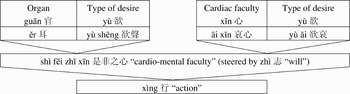
In these three passages, presumably spread over the entire third century bc, we can observe that yù 欲 in the sense of “appetite” or “desire” is held to be the inherent trigger of constitutional power (lì 力) or behavioural pattern of a sense organ. Similarly, we have desires embedded in certain cardiac faculties, e.g. the sense of sorrow. These organs and cardiac faculties do not think, nor do they appraise what they are inclined to do. Doing the thinking for these sense organs and sensory faculties, judging the appropriateness of their actions, is a cardio-mental faculty, i.e. “the cardiac faculty that [judges whether something is] right or wrong” (shì fēi zhī xīn 是非之心). Whether action is taken or a behaviour practised, regardless of whether it be right or wrong, depends on the implementation of one's will or determination (zhì 志) (See Figure 2).
The relationship between “desire” and “action” when steered by the embedded cardiac faculties, the commanding cardio-mental faculty, and will power

The psycho-physiological processes in the following excerpt take place within this structure:
19 孟子曰:「[…] 弈之為數小數也. 不專心致志, 則不得也. 弈秋通國之善弈者也. 使弈秋誨二人弈. 其一人專心致志, 惟弈秋之為聽. 一人雖聽之, 一心以為有鴻鵠將至. 思援弓繳而射之. 雖與之俱學, 弗若之矣. 為是其智弗若與? 曰,『非然也.』」
Squire Mèng said, “[…] Essentially, the board game yì is an easy game. But if one does not apply one's senses to it and does not focus one's will on it, it is something one does not comprehend. Throughout the country, the yì-player Qiū is regarded as the expert at the game. Let him teach two people to play yì. One applies his senses and focuses his will on the game, and only yì-player Qiū's [instructions] are followed. Even though the other person is listening to him, a single sense assumes that wild geese and swans are about to arrive. He imagines taking up his bow and corded arrow and shooting them. Although yì-player Qiū is giving them lessons at the same time, this will prevent them from being equal. Is this because the ability to understand prevents them from becoming equal? I would say, ‘It is not because of their being so.’” (Mèng 6A.09)
The commanding position of the cardio-mental faculty or faculties approving or disapproving of certain actions (in our terms: of the mind), is explicitly discussed in the following passage from the Xúnzǐ:
20 心者形之君也, 而神明之主也. 出令而無所受令. 自禁也, 自使也, 自奪也, 自取也, 自行也, 自止也. 故: 口可劫而使墨云,形可劫而使詘申. 心不可劫而使易意. 是之, 則受; 非之, 則辭. 故曰: 心容. 其擇也, 無禁必自見.
The one acting as cardio-mental faculty is the lord with regard to the physical body, but [at the same time only] a head with regard to [a person's] spiritual acumen. It issues commands, but amongst [those commanded] there is not one from whom it accepts commands. It is [the authority] from which prohibiting and causing, from which depriving and choosing, from which putting into action or stopping action, issue. Hence, the mouth allows itself to be forced (shǐ 使) to be silent or to speak, and the body allows itself to be forced to bend or to stretch. The [responsible] cardio-mental faculty, in contrast, does not allow [its subordinated agent(s)] to force it to change its opinion. When it judges something to be correct, it accepts this; when it judges something to be mistaken, it rejects this. Hence it is said: the cardio-mental faculty determines [man's] conduct. When it decides upon a choice, then there is no restraining it, and [the chosen sense or behavioural pattern or agent] must let itself become manifest. (Xún 21.6a)
Let us take note of the peculiar usage of the designations jūn 君 “lord (of a principality)” and zhǔ 主 “head (of a lineage)”. The former is in a higher position (normally the lord of a state, guó 國), the latter is subordinated to the first (normally ranking as the head of a dàifū-lineage, i.e. as a zǐ 子 “viscount”). This has interesting implications:
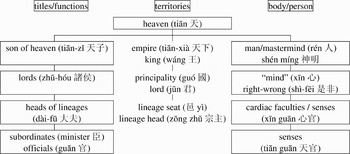
Implication one: The expression “the cardio-mental faculty” at the beginning of citation 20 roughly translates the Chinese xīn zhě 心者. Its conspicuous use instead of the simple xīn shows, to my mind, that the modifying xīn stands for a derived homographic verb. The resulting relative construction, “one acting like a cardio-mental faculty”, is clearly more appropriate in this context – and shows that it is not only a ruler who can “behave like a [true] ruler” (jūn jūn 君君), but also a cardio-mental faculty turned agent (xīn xīn 心心). This cardio-mental faculty is capable of being the lord over the physical body (cf. the use of the word shǐ 使), i.e. under certain circumstances, it governs the body, the sense organs, or the perceptional faculties, just like a lord governs his state, independently initiating and directing vital processes. The graph in 22 (Figure 3) illustrates, tentatively, the general idea and correspondences:
21
Stratification of correspondences in terms referring to titles/functions, territories, and body/person

Implication two: When it comes to interaction with “spiritual acumen” (shén míng 神明) – an expression which is, and here may remain, rather opaque – the same cardio-mental faculty is “only” a head (zhǔ 主), i.e. it is subordinated to this higher authority (jūn 君), just as a head of a lineage is subordinated to the head of the state. As such it can be subjected to commands and orders, thus assuming a position between the overlord (i.e. the human being, or “ego”) and the agents executing its commands, as shown in the following excerpt from 21 (Figure 3):
22

Implication three: It cannot be coincidental that Squire Xún talks about the “lord over the physical body” (xíng zhī jūn 形之君) and “head [steered by a person's] spiritual acumen” (shén míng zhī zhǔ 神明之主), but does not talk about “lord over the person” (shēn zhī jūn 身之君) or “head [steered by] the person” (shēn zhī zhǔ 身之主). This shows that he had a conception of the chain of command with a further position above those two mentioned, a line-up clearly visible in the following passage:
23 王監於殷紂. 故: 主其心而慎治之. 是以能長用呂望,而身不失道.
The Wén-King observed [the causes of misfortune] in [the case of] Zhòu of the dynasty of the Yīn. Hence he reduced his cardio-mental faculties to heads (of lineages) and was careful to put them in order. By [doing] this, he was able to employ Wàng from the lineage of the Lǚ for a long time and personally not to err in leadership. (Xún 21.2)
This confirms that the individual is lord over the cardio-mental faculty as well as the related perceptual faculties. The way he displays his leadership is by exercising his will and setting his priorities right. The cardio-mental faculty can, in the absence of determined or wilful interference or guidance, act as (uncontrolled) sub-commander; as soon as a person takes charge of the cardio-mental faculty and exercises his will or his determination to act (zhuān xīn zhì zhì 專心致志; Mèng 6A.09), the cardio-mental faculty as well as the sense organs or other cardiac faculties become lower-echelon commanders or instruments subjected to him, i.e. to the “mastermind”.
7. A cognitive image of the psycho-physiological heart
This mastermind must be operating when Squire Mèng states that desires and dislikes can be graded as lesser (xiǎo 小) or greater (dà 大), and that reaching a decision necessitates “weighing” (quán 權) and “measuring” (duó 度) operations, also in the case of cardiac faculties or senses (cf. citation 4). Squire Xún basically resorts to the same notion:
24 見其可欲也, 則必前後慮其可惡也者. 見其可利也, 則必前後慮其可害也者. 而兼權之, 孰計之. 然, 後定其欲惡取舍.
If someone sees that something may be desired, then he must be one who considers front and back whether it may be detested. If he sees that something may be profitable, then he must be one who considers front and back whether it may be harmful. But weighing it both ways, he fully calculates it. As soon as he has done so, he settles the accepting or abandoning of his desires and dislikes. (Xún 3.13)
For such operations, there is a need for a tertium comparationis, i.e. we need predetermined values with which we can compare. In the following citation, the Lǚ Shì Chūn Qiū puts the relationship between cardiac faculties and norms in the following words:
13 欲無度者, 其心無度. 心無度者, 則其所為不可知矣.
If a desire does not have something that gauges it, its corresponding cardiac faculty will lack measure. If a cardiac faculty does not have something that gauges it, then what it is doing denies insight. (LSCQ 20/8.1)
We can measure different dimensions, but in contexts related to cardiac faculties or senses, the concept of “weighing” is most prominent.Footnote 28 The metaphorical power of this process strongly suggests choosing a balance as an appropriate cognitive image (in ancient China, most probably not a balance but a steelyard). On one side, we shall imagine a vessel for a liquid (a basin-like pán 盤, or a cauldron, dǐng 鼎), on the other a counterweight serving to balance the “cardiac” vessel. The fact that the heart or cardiac faculties are said to be “balanced” or could be “brought into balance” (píng 平), furnishes the main visual element of the cognitive image as shown in Figure 4.
Weight and counterweight within a cardiac faculty

Put simply, a cognitive image serves to visualize a more or less complex phenomenon. It may generate related metaphors. For example: at an early stage of particle physics, our solar system served as a model for understanding the construction of atoms, composed of a nucleus (the sun) and of electrons surrounding it (the planets). This type of image is not merely descriptive or stative – if well chosen, it can also be highly productive in the sense that it tempts us into thinking further by following the leads and implications of the image. This I shall demonstrate further below with an early version of this model I had to discard (cf. the last two paragraphs of section 0).
Excessive sorrow would tip the left arm of the balance downwards, a deficient expression of sorrow would let it rise. In a strongly ritualized society, both of these expressions or movements are publicly undesirable, even when they would seem personally appropriate and perfectly understandable. In everyday operations (e.g. when weighing fruit in the market), the counterweight is manipulated in order to balance and indicate the actual weight of the goods. Social norms acting as counterweights, however, generally have a fixed weight and position.Footnote 29 They therefore remain in balance, i.e. in accord with the prescribed norm, or travel out of balance, i.e. the upward movement would signal that, for the bereaved, the rites fail to match the depth of his personal sorrow, the downward movement would signal a substandard degree of sorrow. A cardiac faculty or sense in such a state would be termed “biased” or “unbalanced” (xié 邪). This implies that the balance has no built-in checks on the range which the arms could possibly travel, i.e. the more intense a desire or hatred, the further up or down the arms can travel.
The cognitive image also suggests that the norms or rules that supply the basis for gauging a cardiac faculty, i.e. the counterweight, are a fixture of the corresponding cardiac faculty. Squire Mèng designates some of them as inherent to the faculty:
25 仁義禮智非由外鑠我也. 我固有之也.
[The patterns] of humane, dutiful, ritual and intelligent behaviour are not of the kind that are infused into us from without. They are of the kind that firmly exist in us. (Mèng 6A.06)
26 口之於味也, 目之於色也, 耳之於聲也, 鼻之於臭也, 四肢之於安佚也性也.
The response of the mouth to tastes, of the eyes to colours, of the ears to sounds, of the nose to smells, of the four extremities to peace and comfort – these responses are due to natural endowment. (Mèng 7B.24)
What if certain cardiac faculties or senses with the related norms are not part of the natural endowment? These can be acquired by learning (xué 學) and enquiring (wèn 問; Mèng 6A.11). This is also the case when a cardiac faculty is stunted or disappears completely – and this can even happen to innate faculties; Squire Mèng says: “Anyone letting the senses of empathy and compassion disappear is not a human being (wú cè yǐn zhī xīn, fēi rén yě 無惻隱之心, 非人也; Mèng 2A.06)”. Movement of a cardiac faculty can in certain cases be positive, i.e. when it moves to a balanced position, or negative, i.e. when it becomes unbalanced. The terms used for these are “to move the cardiac faculty or sense” (dòng xīn 動心; Mèng 2A.02) or “to fill/flood the cardiac faculty or sense” (chōng xīn 充心; Mèng 2A.06 or 7B.31). Squire Mèng states that the “fluid” or “liquor” or “stream of energy” that fills these vessels is the so-called qì 氣 (qì tǐ zhī chōng yě 氣體之充也; Mèng 2A.02) or “vital energy”, which is associated with will (zhì 志), i.e. with the mastermind. This can be deduced from the following passage, where Squire Mèng answers a question about “moving cardiac faculties or senses”, as follows:
27 既曰『志至焉, 氣次焉,』又曰『持其志, 無暴其氣』者, 何也?」曰:「志壹, 則動氣; 氣壹, 則動志也. 今: 天蹶者趨者是氣也, 而反動其心.」
“What is the reason why you (i.e. Squire Mèng) add that ‘if one sustains one's will, sudden outbreaks of one's vital energies disappear’, after having said that ‘when the will arrives at a place, the vital energies are forced by it to take second place’?” Squire Mèng said, “If the will enjoys priority, then it moves the vital energies; if the vital energies enjoy priority, then they move the will. Now in cases where somebody naturally stumbles or hastens this is due to a vital energy, but it adversely moves his cardiac faculty.” (Mèng 2A.02)
But to which stimuli does a cardiac faculty or sense respond with a movement, if not to the will of the mastermind? According to Lǚ Shì Chūn Qiū 20/8.1, they are (also) stimulated by desires (xīn suí yù 心隨欲) – either in a steered way or like independent commanders. If desires are not limited by norms, their corresponding faculties will lack measure (dù 度). As a consequence, the objects of the world are divided up into two fundamental categories: things that may be desired (kě yù 可欲), and things that ought to be disliked (bì wù 必惡). We thus come full circle and see the Mencian choice between fish and bear's palm, between life in shame or death through dutiful service resurfacing. We perceive, or are taught, and thus – with the corresponding cardiac faculties – know, which things are better or higher-valued, and which are not. As a last resort, we can also choose to reduce our desires and hopefully escape from certain dilemmata. As Squire Mèng says: “For nurturing the psycho-physiological heart (yǎng xīn 養心), nothing is regarded as more excellent than reducing desires (guǎ yù 寡欲; Mèng 7B.35)”.
8. Human nature? A matter of keeping or setting hearts right
Let me try and summarize the concept of the ancient Chinese psyche as it is observed primarily in the extant texts attributed to Squire Mèng and Squire Xún. The overall impression we gather seems to point to an anthropological set-up with a strong penchant for, and the distinct marks of, a multi-layered bureaucratic organization: first, a hierarchy of authority, i.e. chain of command; second, a specialization of functions, i.e. different “departments” of cardiac faculties (e.g. sensory faculties, mental functions, etc.) or specialized, cross-departmental groups for certain tasks (e.g. mentalities); and third, adherence to rules (cf. the illustration in 21 above). In the same way the empire is brought into, or sustained in, balance (tiān-xià píng 天下平), the heart or the constellation of cardiac faculties is meant to reach, or remain in, an equilibrium (xīn píng 心平). Similar to the harmony (hé 和) established between mín (民), rén (人) and the Hundred Clans (bǎi xìng 百姓), the psycho-physiological heart or the orchestra of cardiac faculties is meant to achieve, or act in, harmony. This harmony is not based on equality; every instrument has to play its appointed part and to submit to the instructions of the director, alias the lord of the state or mastermind.
This understanding of the role of the psycho-physiological heart and the cardiac faculties within the heart (心 xīn) as the seat of government in the human body, besides being a rich source for metaphors, allows us to approach one of our key questions: what kind of concept did ancient Chinese thinkers associate with the term xìng 性 (generally translated by “human nature”; in this paper tentatively as “natural endowment”) and why could they, at the time of birth, plausibly assign to human beings the properties shàn 善 (usually rendered as “good”), bù shàn 不善 or è 惡 (usually rendered as “bad”)? The character xìng is a compound of 生 shēng, which refers to something at birth or still in the raw, and radical 61 (心 / 忄), thus inviting us to suspect that it does have something to do with the state of the psycho-physiological heart or the cardiac faculties at birth. My initial steps therefore led me to form the following preliminary image and working conception for xìng.
By natural endowment, man has complementary, paired cardiac faculties or senses (e.g. love vs. hate, seeing vs. not-seeing, being respectful vs. non-respectful, etc.). These, at first, I envisioned as arranged in the form of equal-armed balances. The extreme points of the arms (duān 端)Footnote 30 of such pairs can, for emotions, be conceived of as weights in different counter-balanced positions or, for sensory faculties, as switches with two antithetical positions: “on” or “off”. The deeper one's sorrow, the more superficial one's happiness. Within this large array of functionally differentiated balances, the arm position of some of them has a fundamental influence on the functioning, or malfunctioning, of state and society. The more egotistic the inclination, the worse for society it is; the more altruistic, the better. Judging from the textual evidence, especially in the Mèngzǐ and the Xúnzǐ, xìng is the designation of this initial configuration of cardiac faculties:
28 性者天之就也. 情者性之質也. 欲者情之應也.
The thing “initial configuration of cardiac faculties/senses” is an accomplishment of Heaven. The thing “settings of cardiac faculties/senses” is a [current or habitual] material arrangement of the initial configuration of the cardiac faculties/senses. The thing “desire” is a reaction of settings of cardiac faculties/senses. (Xún 22.5b)
10 性之好惡、喜怒、哀樂謂之情.
[Faculties] of the senses’ initial configuration [such as] loving or hating, being pleased or angry, sorrowing or enjoying – these [the future king] should term “settings [of the emotional cardiac faculties]”.Footnote 31 (Xún 22.1b)
This conceptual reconstruction of a complex cardiac configuration xìng offers a good and generalized explanatory basis for the various opinions set forth by ancient Chinese thinkers. It allows for the position that men can be formed into good or bad people, it allows for some people to be born good, some bad, and it does not even contradict the assertion that the categories “good” or “bad” do not apply to it – as Squire Gōng-dū states in the following re-wording of citation 6:
6 公都子曰:「告子曰:『性無善, 無不善也』. 或曰:『性可以為善, 可以為不善. […]』. 或曰:『有性善, 有性不善. […]』. 今曰:『性善』. 然, 則彼皆非歟?」
Squire Gōng-dū said, “Squire Gào says, ‘[Men] are [beings] who lack goodness as far as the initial configuration of cardiac faculties/senses is concerned, but who [also] lack not-goodness.’ Some thinkers say, ‘As far as the initial configuration of cardiac faculties/senses is concerned, [men] allow [themselves] to be formed into somebody good, or to be formed into somebody who is not good […].’ Other thinkers say, ‘As far as the initial configuration of cardiac faculties / senses is concerned, there are [men] who are good, and there are [men] who are not good. […]’. Now you say, ‘[Men] are good as far as the initial configuration of cardiac faculties / senses is concerned’. If this be the case, are all others then thinkers with mistaken views?” (Mèng 6A.06)
This reconstruction of the meaning of xìng accounts for all sorts of stabilized, original or acquired settings and typical combinations: a person may retain a pristine configuration (大人者不失其赤子之心者也 “people of the type ‘great man’ are such who do not lose their cardiac faculties/mentality of a new-born babe”; Mèng 4B.12), or it may acquire the configuration of a filial son (孝子之心 “cardiac faculties/mentality of a fililal son”; Mèng 5A.01) or of a lord (jūn xīn 君心 “cardiac faculties/mentality of a lord”; Mèng 4A.20),Footnote 32 or may even be subjected to configurational ups and downs (有/無恒/恆心 “have/not have constant cardiac faculties/mentality”; Mèng 1A.07).
Finally, this reconstruction of xìng, in an easily adaptable understanding, also makes sense in passages where the original nature of phenomena other than human beings are discussed:
29 夫: 水之性清. 土者抇之. [固], 不得清. 人之性壽. 物者抇之. [固], 不得壽.
Now: Watery [things] in their original configuration are clear.Footnote 33 [Things] of dirt muddy them. If this persists,Footnote 34 watery [things] do not succeed in being clear. Human beings in their original configuration live to an old age. [Certain] things soil them. If this persists, human beings do not succeed in living to an old age. (LSCQ 1/2.2)
The crucial question that now arises is: how is the xìng of human beings originally structured and equipped, i.e. which faculties or balances are present at birth, and which are their default positions. Are they fit for, or inclined towards, socially compatible or incompatible behaviour? The two extreme positions, “good” according to Squire Mèng, “bad” according to Squire Xún, can be explained by the position of the balance-arms: for the former, all dip to the compatible side, for the latter, all to the incompatible side. Other basic positions, such as that set forth in citation 6, can be explained within this conceptual reconstruction, which also lends itself to two other views put forward in the sinological debate, namely the static and the dynamic view of “human nature”. A person may be fixed or remain in a compatible or incompatible position, or it may develop into one or the other as he or she is subjected to configurational ups and downs due to the vicissitudes or contingencies of life.
Further investigation of the topic, however, showed that this preliminary reconstruction and the accompanying image not only contradicted textual evidence in decisive points, but also did not seem to furnish a convincing or plausible image of the observable psycho-physiological evidence in ancient Chinese times. For the first, the fundamental concept of complementarity – so reasonable and seemingly natural to assume in the ancient Chinese context – was wrecked when a text surfaced mentioning not the expected bipolar cardiac faculty for sorrowing and being happy (āi lè zhī xīn 哀樂之心), but two separate faculties, i.e. either a cardiac faculty for sorrowing (āi xīn 哀心), or one for being happy (lè xīn 樂心; cf. citation 11). As the necessity for this became clearer, it was easy to think of corresponding examples: one can feel sorry that a dear old uncle has passed away, but be quite happy he is leaving some money. Sorrow and happiness directed at the same time towards different objects could not be represented in the first design. And even more fittingly, the abstract entities, e.g. sorrow or happiness, were displaced by a situation, by the realization of a feeling directed towards a specified object, by a behavioural pattern – or in grammatical terms: by verb-object-structures.
In the ensuing phase of rectification, I was also forced to introduce a new concept of the counterweight. Instead of my naive initial assumption that sorrow and happiness could be correlated manifestations of one and the same underlying feeling, i.e. of a single cardiac faculty, the texts offer the notion of norms, rules, standards, model persons, etc. for the counterweight. This, consequently, provided an authority for the approval or disapproval of behaviour, for judgement regarding its appropriateness. And this, I believe, offered a new and exciting look at the relationship between name (míng 名) and realization (shí 實) (cf. observation 16 above) – or to put it in grammatical terms: between agent subjects and their homonymous derived verbs of the type “father acts as true father” (fù fù 父父).Footnote 35
9. “Good” or “bad”
Finally, a revision of the understanding of the keyword “good” (shàn 善) emerged. From the contexts of the debate about the qualities of men based on their initial configuration of cardiac faculties it is abundantly clear that this word has something to do with the functioning of society or the principalities. As is well known (and has been repeatedly mentioned in this paper), Squire Mèng and Squire Xún are the major representatives of two opposing positions in this debate:
30 孟子曰:「人之性善.」曰:「是不然. […] 人之性惡. […].」
Squire Mèng said, “As for the initial configuration of cardiac faculties, human beings are socially compatible”. I say, “This is not the case. […] As for the initial configuration of cardiac faculties, human beings are socially incompatible”. (Xún 23.3a)
The way this question has hitherto generally been posed and dealt with in the field of sinology, i.e. as a dichotomy of “good” and “bad” as a fundamental property of so-called human nature, inevitably leads to many thorny problems (cf. note 16). Most of these have already been endlessly debated by generations of (Occidental) philosophers and theologians. To put it very simply: if man were basically good because his nature is originally good (which is assumed to be the position of Squire Mèng), then the existence or the source of evil must become a problem; however, if he is basically bad because his nature is originally bad (which is assumed to be the position of Squire Xún), then the existence or the source of the good must become a problem. As these two thinkers, so far as I can see, fail to give us the slightest clue that such metaphysical questions had to be solved, it just might be that they did not have to tackle such problems in the first place! Sinology would then have been dealing with a pseudo-problem due to the unreflected imposition of occidental positions.
Two important circumstances may be responsible for this state of affairs:
(a) Misunderstanding xìng 性. If the reconstruction of the psycho-anatomical model of the heart and the consequences for the understanding of the word xìng is accepted, then we clearly do not need to ask whether man is naturally “good” or “bad”, whether adopting the first excludes the second. The basic constellation of his cardiac faculties, their complementary, antithetical, but independent settings, clearly show that for major ancient Chinese thinkers man is conceived as constitutionally disposed to both possibilities, to the good as well as to the evil, to social fit or misfit. The fundamental difference in the positions of the Squires Mèng and Xún resides in the fact that their views and arguments concerning the default positions of the natural faculties, concerning the initial configuration of the emotional, sensory, and perceptual array allotted to man by Heaven, are at variance. Squire Mèng argues that the multiple scales of the initial configuration all incline towards the compatible positions, Squire Xún assumes that they incline towards the incompatible.
(b) Misinterpreting shàn 善. The second question we have to ask is whether our understanding of the two predicates, shàn and bù shàn 不善 or è 惡, ought to be revised. Reviewing sentences with shàn, it becomes clear that this word is associated with the notion of excellence and adequacy, but it also emerges that it always implies a certain field of excellence or compatibility, i.e. good at what, or good for what?Footnote 36 The field for which excellence is implicitly required in the debate between our two major thinkers is the field of social order. The initial configuration of human beings’ cardiac faculties is either a sound foundation (Squire Mèng's position) or a deficient foundation (Squire Xún's position) for building a well-ordered human society.
Both thinkers draw on one clear type of empirical evidence to render plausible their position concerning the initial configuration, namely on the type of unthinking and spontaneous behaviour people tend to in given situations. This is thought to reflect the behavioural default settings of the cardiac faculties. Squire Mèng takes up this line of argument as follows:
31 今曰:『性善』. 然, 則彼皆非歟?」孟子曰:「乃若其情, 則可以為善矣. 乃所謂善也. 若夫為不善, 非才之罪也. 惻隱之心, 人皆有之. […].」
[Squire Gōng-dū said,] “Now you say, ‘[Men] are by natural endowment good’. If this be the case, are all others then thinkers with mistaken views?” Squire Mèng said, “Because I approach [the question] from [spontaneous] settings of the cardiac faculties,Footnote 37 I can therefore posit that the initial configuration of the cardiac faculties is compatible. That is just what I mean by ‘compatible’. If a person becomes deficient, then it is not the fault of his original assets. The senses of empathy and compassion – all men have it. […]” (Mèng 6A.06; cf. citation 7 above.)
Squire Mèng observes how human beings spontaneously react in certain situations, and concludes from this that such unreflected behaviour clearly discloses the basically compatible default position of the heart's settings. The evidence he draws on is rightly famous:
32 孟子曰:「所以謂人皆有不忍人之心者, 今人乍見孺子將入於井, 皆有怵愓惻隱之心[也]. 非所以內交於孺子之父母也. 非所以要譽於鄉黨朋友也. 非惡其聲而然也. 由是觀之: 無惻隱之心, 非人也. […].」
Squire Mèng said, “The reason why I say all men have a sense that is not hard-hearted towards others is that any person, given he suddenly sees a young child about to fall into a well, will show a sense of agitation and shock, of empathy and compassion. This is not a means to get acquainted with the parents of the young child, neither is it a means to win praise from his fellow villagers or friends, nor is it that he does so because he dislikes its crying. If one looks at it from this point of view, then anyone lacking the senses of empathy and compassion is not a human being. […].” (Mèng 2A.06)
This spontaneous reaction is, in certain key situations, judged an excellent positive reaction contributing to social order. Such evidence, and the concept of multiple scales presented above (scales that incline towards one side or the other), also sheds light on the manifold images with water in the Mèngzǐ. Especially revealing in relation to the image of scales is the following passage, in which Squire Mèng compares certain default behaviours of water to the default settings of human beings:
33 告子曰:「性猶湍水也. 決諸東方, 則東流; 決諸西方, 則西流. 人性之無分於善不善也猶水之無分於東西也.」孟子曰:「水信無分於東西, 無分於上下乎? 人性之善也猶水之就下也. 人無有不善, 水無有不下. 今夫水:搏而躍之, 可使過顙, 激而行之, 可使在山. 是豈水之性[也]哉? 其勢, 則然也. 人之可使為不善, 其性亦猶是也.」
Squire Gào said, “Letting people act according to the initial configuration of human beings’ cardiac faculties is something you can liken to channelling water. If you open a passage for it to the east, it will flow east; if you open a passage for it to the west, it will flow west. The initial configuration of human beings’ cardiac faculties lacks a preference for the socially compatible or the incompatible just as water lacks a preference for east or west”. Squire Mèng said, “Water truly lacks a preference for flowing east or flowing west, but does it lack a preference for flowing upward or downward? The initial configuration of human beings’ cardiac faculties is compatible just as water tends towards low ground. Amongst men there is not one that [naturally or spontaneously] exhibits incompatible behaviour, just as amongst bodies of water there is not one that [naturally or spontaneously] exhibits not flowing downwards. Now for this water: if you slap it and make it shoot up, it allows itself to be forced to go higher than the forehead, if you pump it and make it take a certain way, it allows itself to be forced to stay on a hill. How can this be the initial configuration of water? It is the circumstantial influence of these [actions] that makes it behave thus. That men allow themselves to be forced into becoming people with incompatible behaviour, is surely because their initial configuration has to be likened to this [latter property of water].” (Mèng 6A.02)
Given that human beings start from a compatible configuration, Squire Mèng's aversion to, and rejection of, the use of force in educational processes is self-evident. This is the topic of the following passage:
34 告子曰:「性猶杞, 柳也; 義猶桮, 棬也. 以人性為仁, 義猶以杞, 柳為桮, 棬.」孟子曰:「子能順杞, 柳之性而以為桮, 棬乎? 將戕賊杞, 柳而後以為桮, 棬也. 如將戕賊杞, 柳而以為桮, 棬, 則亦將戕賊人以為仁, 義與! 率天下之人而禍仁, 義者, 必子之言夫!」
Squire Gào said, “The initial configuration [of human beings’ cardiac faculties] is something that is similar to that of the qǐ- and liǔ-willows. People behaving in a dutiful way are beings that are similar to cups and bowls. To use the initial configuration of human beings to produce people behaving in humane and dutiful ways is similar to producing cups and bowls out of [the wood of] qǐ- and liǔ-willows”. Squire Mèng said, “Are you, Squire, by adhering to the initial configuration of qǐ- and liǔ-willows, able to fashion them into cups and bowls? You surely are somebody who will first apply force to the qǐ- and liǔ-willows and maltreat them to fashion them into cups and bowls. If it be the case that you are somebody who will first apply force to the qǐ- and liǔ-willows and maltreat them to fashion them into cups and bowls, then you are also somebody who will first apply force to men and maltreat them to produce people behaving in humane and dutiful ways. These remarks of yours will certainly be such that lead high-ranking persons of the empire to regard humane and dutiful behaviour as misfortunes!” (Mèng 6A.01)
Two facts are interesting here: first, Squire Mèng does not contradict the assumption that the initial configuration of human beings’ cardiac faculties can be formed into something else, e.g. into a new configuration (cf. Squire Xún's use of wèi 偽 in citations 36, 38, 41, and note 38). The initial configuration is thus by no means a static constellation, fixed at the beginning and never changing. Second, Squire Mèng seems to accept that humane and socially correct behaviour is not fully developed from the beginning.
Squire Xún posits that the initial configuration of human beings’ hearts is incompatible with good social order. How does he, then, argue his position? Let us look at the following passage:
35 今人之性: 生而有好利焉. 順是故爭奪生而辭讓亡焉. 生而有疾惡焉. 順是故殘賊生而忠信亡焉. 生而有耳目之欲有好聲色焉. 順是故淫亂生而禮義文理亡焉. 然, 則從人之性, 順人之情必出於爭奪, 合於犯分, 亂理而歸於暴. 故: 必將有師法之化禮義之道. 然, 後出於辭讓, 合於文理而歸於治. 用此觀之: 然, 則人之性惡明矣. 其善者偽也.
Let us now consider the initial configuration of human beings’ cardiac faculties. From the moment of birth it lets a fondness for profit exist in him. As man accedes to this [fondness, a craving for] quarrelling and robbing is engendered in him and [the desire] to be courteous and deferent perishes. From the moment of birth, the configuration lets the crippling by hatred exist in him. As man accedes to this [fondness, a craving for] injuring and murdering is engendered in him and [the desire] to be loyal and trustworthy perishes. From the moment of birth, the configuration lets the cravings of ears and eyes and a fondness for pitches and colours exist in him. As man accedes to this [fondness, a craving for] dissolute and wanton behaviour is engendered in him and [the desire] to behave according to patterns of ritual and socially correct conduct perishes. This being the case, following the initial configuration of human beings’ cardiac faculties and yielding to the [default] emotional settings will certainly result in quarrelling and robbing. Such [behaviour] fits with the violation of the social order, with the upsetting of the patterns [of dutiful conduct], and will lead to violence. Thus, it is necessary that man continuously experiences the transformation [of his configuration] by teachers and exemplary models and the guidance by ritually and socially correct persons. Only when this is the case, then [the behaviour of men] will result in courteousness and deference. It will be in harmony with the patterns of ritually correct and dutiful conduct and lead to order. If one looks at it from this point of view, then the deficiency of the initial configuration of human beings’ cardiac faculties is evident. The compatible ones [amongst] them are (acquired) anthropogenic configurations [of the cardiac faculties].Footnote 38 (Xún 23.1a)
These two extremely different judgements on the soundness of the initial configuration as a foundation for social order inevitably result in different educational formulae for dealing with the corresponding situation. If the initial configuration of human beings’ cardiac faculties is judged a sound foundation, as Squire Mèng proposes, education must be based on “conserving, tending and protecting”:Footnote 39
36 宋人有閔其苗之不長而揠之者. 芒芒然,歸.謂其人曰:『今日病矣. 予助苗長矣.』其子趨而往視之.苗則槁矣. 天下之不助苗長者寡矣. 以為無益而舍之者不耘苗者也. 助之長者揠苗者也. 非徒無益, 而又害之.
There was a man from Song who tugged at his seedlings because he was worried that they would not become full-grown. Tip by tip he did this and then returned home. He said to his people, “This day has exhausted me. I have been helping the seedlings to grow”. His sons hastily went to look at them. But the seedlings were already withering. Those in the kingdom who do not help seedlings to grow are becoming fewer. The reason why such people nevertheless turn the seedlings into something useless and abandon them, is that they do not weed them. (Mèng 2A.02)
Squire Xún, naturally, prescribes quite a different therapy. In order to get people to behave in a socially adequate way, he is prepared to apply pressure and even force:
37 故枸木必將待檃栝烝矯. 然, 後直. 鈍金必將待礱厲. 然, 後利. 今人之性惡. 必將待師法. 然, 後正. 得 禮義. 然, 後治. 今人無師法, 則偏險而不正; 無禮義, 則悖亂而不治. 古者聖王 – 以人之性惡 – 以為偏險而不正, 悖亂而不治. 是以為之起禮義制法度. 以矯飾人之情性而正之; 以擾化人之情性而導之也. [始]皆出於治, 合於道者也. 今: 人之化師法, 積文學, 道禮義者為君子. 縱[情性], 安恣睢而違禮義者為小人. 用此觀之: 然, 則人之性惡明矣. 其善者偽也.
Now: warped wood must be progressively treated by pressing in the frame and by bending under steam. Having done so, it becomes straight. Dull metal must be progressively treated by the grindstone and the whetstone. Having done so, it becomes sharp. Well: the initial configuration of human beings’ cardiac faculties is [in the same way] deficient. It must be progressively treated by teachers and exemplary models. Having done so, it becomes righted. [Men thus] obtain ritually and socially correct conduct. Having done that, they are orderly. Now: if men lack teachers and exemplary models, they are not righted, because they remain prejudiced and impetuous. If they lack ritually and socially correct conduct, they are disorderly, because they remain contrary and rebellious. Due to the deficiencies of the initial configuration of human beings’ cardiac faculties, the sage kings of antiquity took men to be not upright, because they were prejudiced and impetuous, and to be disorderly, because they were contrary and rebellious. Therefore and for their sake they initiated [patterns of] ritually correct and dutiful conduct and established laws and standards. By straightening out and adorning the initial configuration and settings of human beings’ cardiac faculties, the sage kings set men upright, and by taming and transforming the deficient initial configuration and settings of human beings’ cardiac faculties, they guided them. For the first time, all men ended up in orderliness and were in harmony with the guiding principles. Now: men who develop into teachers and exemplary models, who accumulate learning and expertise, and who are guided by ritually correct and dutiful [patterns of] conduct, turn into lordsquires. Those who give in to the initial configuration and settings of the hearts, who are content with subservience and rudeness, and who deviate from ritually and socially correct [patterns of] conduct turn into petty men. Let us look at it taking all this into account: this being the case, it is evident that the initial configuration of human beings’ cardiac faculties is deficient. The sound ones [amongst] them are (acquired) anthropogenic configurations. (Xún 23.1b)
These few excerpts from the two thinkers show why, in Squire Mèng's opinion, men can incline towards socially unfavourable conduct or be tempted and seduced to do so. It is equally clear why Squire Xún should begin his book with an “exhortation to learning” (chapter 1) in order to encourage men to acquire as a second nature a sound new configuration modelled on the instructions of the sage kings of antiquity.
10. Closing remarks
To be “moral” in the societies of the Zhànguó-period, i.e. to be “good” or “bad”, meant to learn to behave in orderly ways, meant to conform to the customs (< lat. mos), regulations, and usages of kinship groups and of society, meant to conserve the traditions and achievements of the sage kings. A person excelling in his role (shàn rén 善人) as a member of society or kinship group qualifies as a good person. But when does a person “excel”, when is he or she a “good person”? Squire Mèng, when asked why he calls someone a good (shàn 善) and trustworthy (xìn 信) person, says:
38 可欲之謂善. 有諸己之謂信. 充實之謂美.
A person who judges the permissibility of desiresFootnote 40 I call “good”; a person who develops this in himself I call “trustworthy”; a person who fulfills the realization [of these two in his social roles] I call “beautiful”. (Mèng 7B.25)
Thus, a “good person” has expertise in judging the permissibility of desires (shàn yú kě yù 善於可欲), and the right desires will stimulate the right cardiac faculties (xīn suí yù 心隨欲). The ethical backdrop for this is the ideal of a functioning society and state. Earlier in this paper, I concluded that the objects of the world are divided into desirable (kě yù 可欲) and undesirable things (cf. after citation 27). This categorization not only presupposes that a person – by nature or by learning – knows how to assign objects to the correct category, it also lets thinkers avoid the metaphysical trap so prominent and difficult to deal with in Western philosophy, namely the tendency to posit “the good” and “the bad” as mutually exclusive absolutes. Again, we return to the Mencian emphasis on our ability, our cardiac faculty, to make the correct choice between fish and bear's palm, between life in shame or death through dutiful service. Squire Mèng gives a vivid example for the failure to make a correct choice:
39 今: 有無名之指屈而不信. 非疾痛害事也. 如有能信之者, 則不遠秦楚之路. 為指之不若人也. 指不若人, 則知惡之. 心不若人, 則不知惡. 此之謂不知類也.
Now, a person has a middle finger that is bent and not stretched straight. This is neither an illness nor an injury, nor does it impair him when serving. If there were someone able to straighten it, then he would judge the distance between Qín and Chǔ as not far. This is because he regards his finger to be inferior to that of others. This being so, he knows that he [should] dislike it. If a cardiac faculty is inferior to that of others, he does not realize that he [should] dislike it. Such is behaviour termed “not knowing how to categorize”. (Mèng 6A.12)
This shift away from the heart as prime focus of interest reminds us of the capital importance already accorded by the Lǐ Jì to desires and dislikes: “Things that are desired or hated are important indicators of ‘cardiac faculties’”. And: “[True] beauty and ugliness both depend on [people's] cardiac faculties, but do not appear in their expressions” (cf. citation 8). But this still leaves us with a residual, but non-trivial problem. Which alternatives do we have when we cannot base the difference between Squire Mèng and Squire Xún on the simplistic image of balances tipping to one side or the other? Again, we have to shift our attention from the cardiac faculties to the desires and dislikes, to their outward signs. Desires or behavioural patterns that surface spontaneously, which are realized before the blessings of education transform and civilize us, would turn out to be most compelling evidence – and both thinkers build on evidence of this kind. Squire Mèng presents the unpremeditated reaction of a person seeing a child about to fall in a well, a reaction that cannot be related to an outward stimulus and that must therefore be due to an inborn desire (Mèng 2A.06; cf. citation 33). This reaction is also evidence for the person's innate ability to judge which action or behaviour is appropriate to the situation, i.e. it is an indicator of the mental faculty approving or disapproving of certain actions at work (shì fēi zhī xīn 是非之心). All this is evidently heartening news. Squire Xún, on the other hand, serves up the bad news:
40 人之性惡. 其善者偽也. 今: 人之性生而有好利焉. 順是, 故爭奪生而辭讓亡焉.
Human beings, by dint of the initial configuration of cardiac faculties, behave in despicable ways. When they behave in socially acceptable ways, it is because of (acquired) anthropogenic configurations. Now, as human beings are born with the former initial configuration of cardiac faculties, they develop in themselves a love of profit. As they succumb to this, quarrelling and stealing thus come alive in them, and renouncing and yielding disappear from them. (Xún 23.1a)
Squire Xún, unlike Squire Mèng, does not rely on at least some of the innate desires being socially acceptable and therefore guaranteeing basic values of a functioning society and state. On the contrary, he qualifies all of them as despicable and unbalanced. Only education and learning can achieve a change and build what he calls new (acquired) anthropogenic configurations (wèi 偽). To this end, he employs the services of the mind, which is most probably identical with the mental faculty approving or disapproving of certain actions (shì fēi zhī xīn 是非之心) and which is subordinated to a master-mind.
As for one fundamental aspect, both thinkers agree: the overall importance of desires (cf. citations 5 and 29 above). Originally good desires can directly lead to, or support, a functioning society; the efforts of a government are therefore to be invested in preventing things from deteriorating, in conserving existent good values handed down from the ancients. The corresponding educational system seeks to tend and cultivate these good tender sprouts. By creating the right desires, originally bad configurations can be transformed; the efforts of a government are to be invested in creating the right stimuli and making things better by adopting norms that fit the actual historical situation. The corresponding educational system is aimed at reworking human beings and bending the warped cardiac faculties into new and useful forms. It comes as no surprise that desire, and not heart, is ultimately the keyword of the debate. The theory of human nature is only in the second place dependent on a theory of the psycho-physiological heart; in the first place it calls for a phenomenology of desires. All we need is a developed sense of what is permissible and what is not – either, as Squire Mèng asserts, as a natural gift, or, as Squire Xún asserts, as abilities acquired through learning.
The question of “human nature” – or, in my words, of the initial configuration and settings of human beings’ cardiac faculties, senses, and sensory organs, ought to be put on a new foundation in sinological discourse. It appears that the debate has become mired in a self-centred linguistic and cultural marshland as regards the questions asked, the concepts proposed, and the terminology used. It has spawned a phantom problem. It has repeatedly failed to recognize and acknowledge the complexity of the texts concerned, and it has often heavily relied on imperfect, inadequate translations to confirm arguments and ostensibly build theories – surrogate theories that mostly originate in current academic scenes or fashions rather than spring from a vital and independent historical interest in the problems which concerned ancient Chinese thinkers. The reluctance, or the failure, to submit the sources to the necessary close and comprehensive readings is actually quite depressing – despite the formulaic remarks in notes at the beginning of papers stating that “translations are the authors’”. The neglect of systematic lexicological studies is a concomitant symptom.
The study of the ancient Chinese concept(s) of “human nature”, of the natural constitution of beings both human and non-human, must be fundamentally renewed. It is at the root of many other important questions, and therefore still deserves ample attention – all the more as it is addressed in many of the bamboo manuscripts recently found.Footnote 41 One of the prerequisites for this renewal, I hope to have shown with my paper, is a deeper understanding of the concept of desires and of the heart(s), and of their roles and functions. All that seems to be needed is a developed sense for what is correct and for what is not – and that, Squire Mèng declares, all men (including sinologists) naturally have.