Elections can make for great theater. Uncertain and performative affairs by design, electoral politics have been known for producing the type of twists and turns equal to the best dramas. In elections, otherwise obscure political figures, previously besieged by the bureaucratic inertia and political partisanship of everyday politics, can all of a sudden signal a desire to enter the limelight. Once there, they present themselves as chosen leads called on to act out a plot thick with ambition, power and vision. During these times, the entire nation and its people can quickly fall into what Tocqueville called a “feverish state” (Tocqueville Reference De Tocqueville2000, 128). Mesmerized, the public can lose sight of what it is actually important and realize, only later, that they have become a captive audience to the show.
The notion that elections and theater are related is not new (Higgins Reference Higgins2015; Badiou Reference Badiou2013). Theatrical metaphors have long been used by political analysts and the general public to capture the drama that surrounds electoral politicking. Yet now more than ever before, political candidates are judged as much by the performances they give as by the policies they propose (Gabler Reference Gabler1998; Davids Reference Davies1986, 114). The early stages of the 2016 US presidential election, for example, were largely dictated by the one-man Donald Trump show. Or consider the 2010 UK general election, where Nick Clegg’s debating performances played a decisive role in influencing the outcome of that election (Rai Reference Rai2014; Parry and Richardson Reference Parry and Richardson2011).
Theatrical tropes cannot be ignored in an age where political appearances are staged as performances “mediated by camera angles and on-line producers who create a set of narrative trajectories” (Dolan Reference Dolan2001, 6). Charles Guggenheim, who was Robert Kennedy’s former campaign advisor, already knew that the population sees presidential campaigns as entertainment: “people expect drama, pathos, intrigue, conflict, and they expect it to hang together as a dramatic package” (Guggenheim cited in Davies Reference Davies1986, 98).
Yet regardless of how entrenched the relationship between electoral politics and theater is, political scientists have seldom paused to analyze the performative dimensions of the election process. Policy analysts may borrow heavily from the language of theater to encapsulate the spectacle and uncertainty of electoral races. Yet even when doing so, they often fail to explore, in detail, how exactly politics is conveyed through gesture, production and narrative – in other words, those things which are revealed only through a performative or aesthetic lens. While some political scientists may see these insights as trivial, especially when it comes to studying and predicting electoral outcomes, research has shown that aesthetic sensibilities can reveal much about politics and democracy (Bleiker Reference Bleiker2009; Chou Reference Chou2012).
The purpose of this article is to highlight what can be gained by viewing and scrutinizing elections as theater. To do this, we argue that political scientists can benefit from a greater awareness of what is called “electoral theater”: a form of theater that deals explicitly with electoral politics (Bottoms Reference Bottoms2015). It stages electoral issues and rituals, but also reveals electoral politics itself as a form of theater. Understanding the dynamics at play can help political scientists understand that performance is a type of politics and that spectators can be more than passive observers.
These insights are of fundamental importance. As Stephen Coleman (Reference Coleman2015) argues, performance pervades election rituals, from the politicians who stage their campaigns to the voters who cast their verdict. The relationship between the various sites of performance is in constant flux and inevitably linked to changing power relationships. New forms of power may emerge once an audience is aware of the theatrical politics that surrounds the struggle over governance. Expressed in different words: being aware of the performative aspects involved in elections allows citizens to move from passive consumers to active agents (Rai Reference Rai2010). This is why we stress that both scholars and everyday observers of electoral politics can benefit from familiarizing themselves with the insights typically reserved only for the experts of the stage and screen.
We begin our discussion by identifying key similarities between electoral politics and the world of theater. These range from the role of actors to the stage setting and the plotline. We then discuss one particular example of electoral theater: James Graham’s The Vote, a play that was staged on the night of May 7, 2015, as Britain went to the polls for the general election. While the play was one which could be criticized on both theatrical and political grounds, we argue that staging and broadcasting The Vote on election night meant that the public was exposed to electoral theater as never before. They were also pushed to rethink the very role of drama in the election process and coverage.
ELECTIONS ARE THEATRICAL
Elections are theatrical spectacles. Increasingly, political parties and professional politicians have learned that mastering “theatrical techniques from the world of entertainment” is essential if they are to give a convincing performance on the campaign trail (Davies Reference Davies1986, 100). Those like Obama, who have learned the art of “stagecraft and spectacle,” can be assured of instant celebrity status (Kellner Reference Kellner2009, 719).
But election campaigns actually share a number of very specific and crucial similarities with the dramatic arts. Both are forms of ritual drama. In an important but largely neglected article, Dan Nimmo (Reference Nimmo1985) draws attention to four interesting parallels between election and theater in particular. We briefly summarize them here before exploring the political implications in more detail.
But election campaigns actually share a number of very specific and crucial similarities with the dramatic arts. Both are forms of ritual drama.
First: Nimmo writes that both elections and theater require a cast of actors. There is no drama without a diversity of actors to play their designated roles. The same is true in an electoral contest. Different candidates are needed to represent the different political parties and positions. But what makes elections and theater entertaining is the range of actors they bring to their respective stages. In elections as in theater, there should be “heroes, villains, fools, victims, and assorted supporting parts be they good guys or bad, winners or losers” (Nimmo Reference Nimmo1985, 32). While no two elections are the same, Nimmo writes that few electoral campaigns have been without at least a hero, a villain and a fool. For him, the 1976 US presidential election was a good example of a campaign that boasted all three. In that contest, Richard Nixon was cast as the unstated villain while Jimmy Carter was seen as the hero who wanted to give his country “a government as good as its people.” Earl Butz, who was Secretary of Agriculture and known more for his verbal fumbles than anything else, in turn, was said to have played the role of the fool. Of course, who is a hero and fool depends on one’s perspective. In some instances the very same actor can be seen as the hero, villain and fool all at the same time – depending on who the audience happens to be. This was arguably the case with Sarah Palin, the Republican Vice-President candidate in the 2008 US presidential election.
A second important similarity shared between the stage and election trail is the setting of the scene. Theater is only believable if the acts on stage are set against an appropriately engaging backdrop. The scene provides context and helps give the drama scale. With presidential elections, Nimmo writes, there are multiple scenes that actors have to contend with. There is the local stage, the national stage and the international one. Kissing babies, visiting workers in factories and meeting world leaders in foreign countries can all help to set the scene for the type of acts which the electoral actor hopes to achieve if elected. This was something that Obama managed to master early in his presidential campaign in 2008. Not only was he a charismatic individual. His visionary message of “change” also promised a renewed national and global focus that appealed both to an American and global audience.
Third, electoral candidates are like stage actors in that the best will project a personal and instantly recognizable swagger. Citing Richard Jensen’s 1980 Public Opinion article on winning election strategies, Nimmo writes that the best electoral actors have tended to draw on one of five basic styles used by presidential candidates since the earliest days of the Republic to help distinguish themselves as actors: the army rally, the advertiser, the missionary, the crusade, or the counter-crusade (Nimmo Reference Nimmo1985, 33). These theatrical ploys are all designed to captivate the public audience in different ways; while some will unite, others are intended to divide. How and when the electoral actor uses these styles will determine whose following they win.
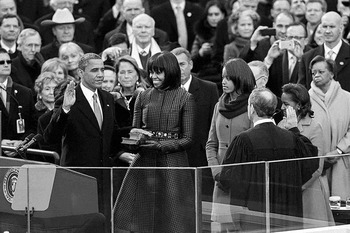
Finally, like any compelling theatrical production, good campaigns hinge on a compelling plotline. Without it, actors will just become another face in the crowd and any proposed policies, whatever their merits, will simply remain empty symbols without the power to capture the public’s imagination and support. For Nimmo, weaving an absorbing campaign plotline is fundamental. While stories can unfold in any number of ways, the typical electoral plotline will usually have certain essential elements, ranging from a compelling entry into the campaign, speeches and nominations at party conventions, announcements on election day and, finally, the highly symbolic and performative swearing in ceremony – something which Obama again perfected unlike no other recent president (Nimmo Reference Nimmo1985, 34) (see figure 1). While standard, these and many other elements in the plotline determine how popular and captivating the particular electoral storyline becomes.
President Barack Obama takes the oath of office from Supreme Court Chief Justice John G. Roberts Jr., right, in a public ceremony at the US Capitol before thousands of people in Washington, D.C., Jan. 21, 2013
Note: This work is in the public domain in the United States because it is a work prepared by an officer or employee of the United States Government as part of that person’s official duties under the terms of Title 17, Chapter 1, Section 105 of the US Code. Retrieved in July 2015 from Wikimedia Commons: https://commons.wikimedia.org/wiki/File:Barack_Obama_second_swearing_in_ceremony_1-21-13.jpg

POLITICS THROUGH AESTHETICS – ELECTIONS THROUGH THEATER
Performance and elections are therefore inseparable – which is why the theater metaphor is a powerful and recurring trope used by political analysts to capture election processes in all parts of the world. But even though analysts make good and frequent use of the theater metaphor to capture electoral campaigns, few – including Nimmo – take the next and, we argue, necessary step: to analyze electoral theater performances from an aesthetic perspective. This, of course, is not something that most political scientists are trained to do (Love and Mattern Reference Love, Mattern, Love and Mattern2013, 6). Instead, the general view is that aesthetic rationalities, and the insights they produce, are neither relevant for understanding elections nor predicting their outcomes. Using theater metaphors may be one thing. Yet taking the aesthetic insights entrenched in electoral theater performances seriously, and on their own terms, is quite another.
This, for us, needs to change. The relative marginalization of the arts from public life represents a missed opportunity because a “creative approach” is precisely what is needed to understand and solve the world’s challenges (Becker Reference Becker1995, 387; also see Bleiker Reference Bleiker2009, 1-3). And so it is with the theater of elections: while political scientists and election forecasters readily depict electoral politics in theatrical terms, they fail to take full advantage of theatrical insights to see through the drama of the election. This is precisely where theater and performance experts can come in. They can offer unique insights into the drama of electoral politics. Jill Dolan, a renowned American theater scholar, puts it this way:
Those of us actually trained to look critically at performance, to study its links to ideology and culture, can offer ourselves as experts who study the election and the debates through a performative lens – not one that stresses entertainment value, but one that looks at gesture, narrative manipulations, contexts, and ‘spin’ with an eye toward the politics they convey (Dolan Reference Dolan2001, 6).
While it is easy to see how elections are theatrical, most of us – including the political analysts who rely on theatrical metaphors – lack the “skills of performance criticism” that enable us to separate what is important from what is not. Even when election observations come close to resembling theater criticism, they often rely on problematic dualisms that separate politics from aesthetics and elections from entertainment (Dolan Reference Dolan2001, 7). Seeing through these dichotomies is necessary to reveal the show for the real issues at hand.
While it is easy to see how elections are theatrical, most of us – including the political analysts who rely on theatrical metaphors – lack the “skills of performance criticism” that enable us to separate what is important from what is not.
A starting point for appreciating the politics of theater is knowing what and how to watch – something which those of us trained in the social sciences know too little about. Yet this is what theater is in its simplest and most unadulterated form: the art of learning how to pay the right kind of attention to the sights, sounds and other sensations that surround us (Woodruff Reference Woodruff2008, 18). While the dichotomy between aesthetics and politics has meant that theater is now understood and practiced in a very particular and narrow way, it can also be understood more broadly as something central to social interaction: “we see theater all around us if we open our eyes to what lies beyond the boundaries of fine art”, writes Paul Woodruff (Reference Woodruff2008, 17), another well-respected theater academic.
Here, politics too should be considered a theatrical practice. “Politics needs all of us to be witnesses,” Woodruff claims: “Leaders who work in closed meetings are darkening the stage of public life….they are strangling democracy” (Woodruff Reference Woodruff2008, 23). Watching them – knowing how to watch them – is therefore key to keeping them accountable. The election spectacle is only one – though one important – stage for political theater. To this end, Woodruff encourages citizens to become “good watchers”: individuals who can “watch, think, find the attitude that they judge is right, and in so doing learn about the action they are watching” (Woodruff Reference Woodruff2008, 185).
LEARNING FROM ELECTORAL THEATER: JAMES GRAHAM’S THE VOTE
There are many ways for citizens to become “good watchers” in the theatrical sense. Yet in relation to electoral politics, there is arguably no better way to do this than with theater itself, specifically, we argue, with electoral theater. While theater that aims to depict political or electoral events have generally been understood in fairly narrow terms in the West, that is, as high-brow entertainment, there is a long tradition in other cultures of using theater to shape and understand elections. As Arjun Ghosh (Reference Ghosh2005, 171) notes of India, street theater is frequently used during elections as a “low-cost method of campaigning…to articulate local issues and forge a more intimate relationship with its audiences.” For people who are poor or unrepresented by the mainstream media, theater offers an accessible venue for information and participation. Likewise, Eugene van Ervan (Reference Van Ervan1987) has documented the widespread use of electoral theater during presidential elections in the Philippines. “Where the mass-dissemination of information was completely controlled by the government,” van Ervan (1987, 58) noted that “theatre became the best medium for spreading alternative points of view. Also, people’s theatre workshops, conducted throughout the archipelago, increased the political awareness of urban poor, farm workers, unemployed, or striking factory laborers and students.”
But electoral theater is also able to do something more profound. In explicitly dramatizing the electoral process, it can offer its audiences a critical glimpse into the theatrical nature of elections. Dramatizing elections, in other words, can reveal just how much election campaigns have become just another form of drama.
In what remains, we want to engage with one particular and particularly revealing example of electoral theater: James Graham’s The Vote. On the night of May 7, 2015, as British citizens went to the polls to cast their vote in the general election, Graham staged a theatrical performance simultaneously for stage and screen that offered the public a unique chance to view the 2015 British general election as theater. The Vote, performed before a live London audience on May 7 and simultaneously broadcast on More4 to over half a million viewers across Britain, was a real-time fictional representation of the final 90 minutes of voting at a London polling station. Labeled “a real-time play for theatre and television”, The Vote was premised on the notion that elections are theatrical, and theater political. For the play’s director, Josie Rourke, The Vote was a unique production that is, at its heart, “about the act of voting and democracy in the 21st century.”
Presented as a situation comedy, the play revolved around an elderly citizen who is accidentally given two voting papers. In an effort to rectify the error, the two poll clerks in attendance go on to commit a series of other electoral frauds by accident, ultimately embroiling the polling station’s presiding officer. The play was created to be entertaining and fun. Yet there is also a more sobering message, which came right at the end of the play (minutes before the polls closed both on stage and in reality). Admitting to the fraud perpetrated under his watch, the presiding officer makes a desperate plea to those present that one’s vote matters. “It has to mean something, right?,” he pleads: “It has to matter!” However important elections are, and they are, too many of us now go to the polls failing to realize why the vote is crucial to the democracies in which we live. Worse still, many more today are failing to turn up to vote at all. Audiences were left with this poignant political message minutes before the polls shut on May 7. Elections are dramatic, but even more than that, they are important to the continued vitality of democracy – a point now often obscured or forgotten by citizens who merely see election campaigns for their entertainment value. Yet this is a point that clearly came to the fore in Graham’s electoral drama.
Familiarizing ourselves with theater – and learning to see events through a performative lens – is more important now than ever because, as citizens and election observers, we are more entwined in the drama of politics and political personalities than ever before.
Why not therefore make theater part of the election drama to help us to better understand what the drama of the election is actually about? Familiarizing ourselves with theater – and learning to see events through a performative lens – is more important now than ever because, as citizens and election observers, we are more entwined in the drama of politics and political personalities than ever before. Becoming aware of the theatrical devices and ploys used by political and media experts to inspire, persuade and distract us may therefore make us into more astute political observers.
This is the premise of The Vote: that broadcasting the performance live on television on the night of the general election can make audiences rethink the role of drama in the election process and coverage. The Vote is, of course, a fictional theatrical production. However, the implicit question the play asks of audiences is to what extent does this theatrical production differ from the usual electoral dramas we have become accustomed to seeing staged by the news and broadcast media? This then leads to a second question. How can watching the former help us watch the latter for what is actually is: as just another form of theater? While we do not present empirical evidence surrounding the so-called efficacy question in this article, we do believe that in posing these and other questions, plays such as The Vote offer everyday citizens the chance to both observe electoral politics and pose critical questions about the substantive political issues that lie beneath – or are intertwined with – the performative exterior.
Elections as theater? Nothing could be less trivial for democracy in the twenty-first century.