With phrases such as ‘collaboration’, ‘co-production’ and ‘history making a difference’ being promoted by funding councils and universities alike, there is an increasing need for historians to work in partnership with academic and non-academic partners and encourage a diverse range of people to engage with historical research. As historians are often more used to working alone in archives than working collaboratively, especially with non-academic partners, there is also a need to understand the pitfalls and pleasures associated with working in such a way. Within an academic environment, the research undertaken by the historian is considered to be the ‘expert’ view; however, working collaboratively on the co-production of research levels out the boundaries between contributors and is theoretically assumed to recognize the value of all contributions equally.Footnote 1
Using Leicester's de-industrialized St George's area as a case-study, this article discusses three projects, all of which involved an academic team, including urban historians, working with a range of non-academic partners, in order to uncover the history and heritage of this area of the city.Footnote 2 The first two of these projects leveraged digital media to engage audiences beyond the academy, while the third used a more traditional set of interpretation panels. I worked as a researcher as part of a larger collaborative team on two Arts and Humanities Research Council (AHRC) funded projects – AHRC Creative Economy Knowledge Exchange project, Archives, Assets and Audiences: New Modes to Engage Audiences with Archival Content and Heritage Sites in 2013 and Affective Digital Histories: Recreating De-Industrialised Places, 1970s – Present in 2013/14. I was also one of a team of researchers commissioned by Leicester City Council to research sites for the Story of Leicester Heritage Interpretation Panels. The use of technology in the first two projects enabled a greater level of participation by audiences who were able to access location-specific historical information, including images and sounds, as well as using technology to make their own contributions to the project archive. In the third project, the limited number of words and images that can be used on an interpretation panel restricted the level of detail which could be provided, yet this information still remains in place for passers-by to read whilst changes in technology have reduced the operational life of the locative media based resources.
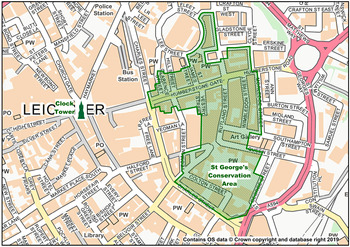
The St George's area of central Leicester is located half a kilometre east of the Clock Tower, a local landmark, which is considered to be the centre of the city (see Figure 1). From the late nineteenth century, it was a bustling industrial and commercial area, home to hosiery, knitwear and footwear manufacturers exporting products throughout the world. Although Leicester's economy was based on a more diverse industrial base than industrial towns reliant upon a single industry, it was not immune to the national decline in manufacturing. With the decline in British industry accelerating during the 1960s and 1970s, the period from 1960 to 1978 saw over 175 million square feet of empty industrial properties. Nicholas Falk considered the problem of the large proportion of redundant industrial buildings to be of a magnitude not faced since the ‘dissolution of the monasteries or the Great Wars’.Footnote 3 As Neil Cossons, deputy director of the Liverpool Museum, pointed out at the East Midlands Industrial Archaeology conference held in Leicester in 1970, ‘Britain's industrial past needs to be preserved just as much as other historical monuments.’Footnote 4
Map of the St George's area. Image courtesy of Leicester City Council.

In the decades between the 1970s and the 1990s, Leicester saw significant changes as its ‘identity as “a great industrial town” rapidly dissolved with the collapse of one manufacturing firm after another’.Footnote 5 With this, came the loss of workplace communities, especially as the works social programmes of sporting and cultural activities came to an end. Between 1981 and 1996, there was a 35 per cent decline in manufacturing employment in the city.Footnote 6 This picture of industrial decline in the city was reflected at a local level within the St George's area with a number of factories and warehouses closing. Although some industry remained into the 1990s, the area was designated as a conservation area in 1989, reflecting a more general move to the preservation of industrial heritage in the face of de-industrialization. In the case of Leicester St George's, the move towards conservation was both in recognition of the high-quality architecture and local concerns about the impact of the decline of the city's footwear, hosiery and knitwear industries on the warehouses and factories which were integral to the urban fabric of the area.Footnote 7 By the late 1990s, the St George's area was largely abandoned and as more buildings were vacated it was clear that a new purpose needed to be found for the area. The National Lottery was launched in 1994, with the arts designated as one of the beneficiary good causes eligible for lottery funding. This resulted in unprecedented levels of capital funding available for arts and cultural facilities in England from the mid-1990s.Footnote 8 In 2000, the St George's area was identified as the city's new ‘cultural quarter’, a designation which paired culture-led regeneration with the preservation of industrial heritage.Footnote 9
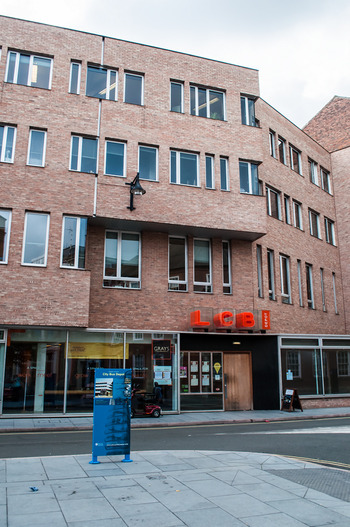
Regeneration funding from the European Union, national, regional and local government sources and lottery capital funding has since transformed the area.Footnote 10 The old Leicester City Bus (LCB) depot was repurposed for use by creative businesses as Leicester Creative Business (LCB) depot in 2004 (see Figure 2). The international award-winning architect Raphael Vinoly designed the new Curve theatre, which opened on one of the partially vacant sites in 2008, and Phoenix Square, the new digital media centre, opened in 2009. By this time, a number of the fine historic factories and warehouses had reopened as bars and restaurants or were undergoing conversion to residential and office use. However, the new occupants of the buildings knew little of the area's history or of the historic buildings they were occupying. This was an issue which the projects sought to address. Although each of the three projects outlined below were stand-alone research initiatives, supported from different funding programmes, they each drew upon previous work in order to uncover the multiple histories and heritage of the area. Together, they brought the urban history of the area – the past uses of the urban fabric – to new audiences beyond the academy, including the new occupants of the area's regenerated historic buildings.
Leicester Creative Business (LCB) Depot © Leicester City Council

The Rise, Fall and Reinvention of Industry project
The Rise, Fall and Reinvention of Industry project was part of a wider AHRC Creative Economy Knowledge Exchange project, Archives, Assets and Audiences: New Modes to Engage Audiences with Archival Content and Heritage Sites.Footnote 11 The wider project focused on the industrial heritage of the East Midlands as a case-study for the collaborations, specifically on the three themes of (i) enlightenment and innovation; (ii) cultures of work, welfare and play; and (iii) the rise, fall and reinvention of industry. The universities worked with regional partners from the cultural and creative sectors. While both arts and humanities scholars and creative industries practitioners use archives in their work, the latter consider them to be databases of assets from which they generate experiences for audiences. In addition to generating creative work, many cultural and creative organizations are experienced in working collaboratively across their sector and with diverse communities to co-create cultural products like exhibitions and performances. Technological advancements have meant that social media now enables members of the audience to contribute back to archives by tagging, annotating and uploading their own media.Footnote 12 The project brought together academics and creative industry partners and engaged both with diverse audiences. Consequently, Leicester's cultural quarter was an ideal area in which to explore the linking of academic research with the creative industries.
The work undertaken by the University of Leicester team was under the theme of the rise, fall and reinvention of industry. Under this theme, there were several aspects to the work carried out in Leicester and I will focus on the two projects working around the St George's area. One strand of the work looked at the history of three grade II listed buildings in Rutland Street, a main street in the area.Footnote 13 On one side of the street stands the four-storey Alexandra House which was described by the architectural historian Nikolaus Pevsner as ‘the finest warehouse in Leicester and one of the finest in the country’.Footnote 14 It was built for Faire Brothers & Co. shoe mercers in the late 1890s and was the largest bootlace warehouse in the world. Opposite is the Pfister and Vogel building, built by the Milwaukee-based leather company in the 1920s. Adjacent to this lies the Makers’ Yard buildings; a group of restored Victorian industrial buildings dating back to 1854 and recognized as the oldest framework-knitting frame shop in the East Midlands. The architecture of Alexandra House and the investment by an American company in building in Rutland Street demonstrate the level of the confidence once associated with the industry of this area.
The aim of the research was to identify what had taken place in the buildings, including the people working in them, the goods they produced and the changes in the use of the buildings over time. Sources including planning records, photographs, local newspapers, trade directories and trade publications were used in order uncover this detail. Once the archival research had been undertaken, an event was held in the area at the Leicester Creative Business Depot to present results of the archival research on these three buildings. The choice of venue was significant as it was located within the cultural quarter and was also a space familiar to creative practitioners. Using a familiar space in which the creative practitioners felt comfortable helped to reduce potential barriers to engagement with the project.Footnote 15 We produced a catalogue of the available archival sources along with some reproductions of documents such as copies of entries from trade directories; adverts for firms like Faire Brothers of Alexandra House; and archival images of the street itself. The information was grouped into themes covering the international links from the buildings in Rutland Street, the contributions to war efforts and the social and welfare aspects of the companies. Images of items manufactured within these buildings were also displayed, both to inspire the creative practitioners to use the material in their work and generally to encourage wider use of archives in their creative projects.Footnote 16 Following this event, seven creative groups or individuals arranged individual meetings to look at the catalogue of archival assets in more detail and discuss their ideas for projects, and a further three were in contact by email. Ideas for creative projects ranged from theatrical pieces to animated trails.
Imaginative use of the archival material by creative business Munro + Whitten reinterpreted the history of Makers’ Yard and the place of this former factory in Leicester's hosiery industry.Footnote 17 As part of Leicester City Council's European Regional Development funded regeneration of the building, Munro + Whitten's project brought the building back into the public attention by staging an event focusing on the sights and sounds of the former hosiery area.Footnote 18 The project therefore sought to engage people not just with the physical building but also with the atmosphere of the area during the rise of industry. Interpretation panels outlining the history of the buildings from 1854 were produced for the project and remain in place inside the building. The artists and designer-makers now occupying the space can understand the history of it and appreciate why the building is designed as it is, the role it has played in the history of the hosiery industry and the development of Leicester's industry.
A second creative project was based on the archival research on these three buildings. Two other creative businesses (Large Scale film production and eKit web design and development) responded to the research on Makers’ Yard. Together, they produced ‘Meeting the Presser’, an interactive video app which contained a short film of a framework knitting machine in use with subtle prompts to view additional associated content for specific points in the film. The film drew on the archival research but also included some oral history recordings and the performance of a poem. Like the Munroe + Whitten project which went beyond the text and highlighted the sights and sounds of the former hosiery building, this video app was able physically to show the working framework knitting machine and the associated noises of the machine in action.Footnote 19
Another strand of the work focused on the cultural quarter more widely and built working partnerships with Phoenix, the digital media centre based in the cultural quarter, and Cuttlefish Multimedia Company, a small creative business based in the area. At the time, the University of Leicester had recently received the archive of the local paper, Leicester Mercury, which contained newspaper cuttings and images of the previous 50 years and proved to be a valuable resource for the project. This project drew upon traditional archival sources, like local authority planning records and trade directories but also upon oral history interviews conducted as part of the project. These diverse materials were all included in a Cultural Quarter App containing over 100 photographs, interviews and information on 25 locations in the area.Footnote 20 The oral history interviews were able to uncover the history of the area during the period of deindustrialization and before the area's regeneration.Footnote 21 These showed that the departure of large firms from St George's did not immediately result in a complete loss of industry in the area. Although the large vacant spaces were unsuitable for modern industrial needs, some were adapted for use by smaller hosiery and textile manufacturers, who occupied parts of them for short periods of time. These included small firms producing items such as socks, underwear and jeans. Unlike the larger employers who had occupied the area for decades, many of these small firms were not captured by traditional records, such as trade directories. They also lacked the promotional budgets of firms like Faire Brothers & Co. so did not run advertising campaigns in the trade press. Generally, firms of this nature were operating at ‘subsistence level’.Footnote 22 This transitional period in the history of the area was further revealed in oral histories which also uncovered details of the night-life of the area, especially that which developed in the derelict warehouses. This was a history not well documented in traditional archival sources, which evidenced the industrial success of the area more than its decline or its use by marginalized groups, but it captured an important chapter in story of the area and the place it held in local memory.Footnote 23
Affective Digital Histories: Recreating De-Industrialised Places, 1970s – Present project
The Affective Digital Histories project was again funded by the AHRC and looked at two former industrial locations within the East Midlands: Glossop, a market town in Derbyshire, and the St George's area of Leicester. Led by the University of Leicester, this was also a project in which academics worked in partnership with the creative sector in the respective areas to engage with the local community.
The earlier research had demonstrated that once deindustrialization had begun in the St George's area, the utilization of space became more varied and temporary. The St George's area strand of the work built firmly upon the foundations of the previous project to explore the hidden and untold stories of the people who lived, worked and played in the former industrial buildings. To do this, it fostered the effective partnerships developed with Phoenix and Cuttlefish Multimedia. As these two AHRC projects took place in succession, it was possible to build upon the organizational links as well as the individual personal relationships of team members who worked on both projects. New partnerships were also developed with De Montfort University and other University of Leicester departments.Footnote 24
The oral history work undertaken for the Cultural Quarter App produced in the earlier project highlighted that there was a later twentieth-century history of the area to go alongside the earlier industrial past. The dominant narrative of the area was of deindustrialization and regeneration; however, this was not a seamless transition. While the cultural quarter's industrial past was clear, far less was known about the period from the late 1970s to the late 1990s, when groups such as the Leicester United Caribbean Association, punks, goths, bikers, cross-dressers and gay-friendly organizations used the growing number of vacant spaces. Advances in technology meant that it was not only possible for people to access archival content about the area from their phone (as in the case of the Cultural Quarter App) but it was also possible for them to contribute to and comment on the content. Appeals for stories, reminiscences, pictures etc. were made through social media and local groups and networks. Drop-in sessions were advertised in the Phoenix listings brochure and were held at the venue. These sessions used historic maps of the area and archival photographs and press cuttings to generate discussion and help recall memories. The stories of people who went about their daily lives in the area were a vital element of Affective Digital Histories and to help collect these stories a video booth was built for people to record short audio and video clips and share their recollections and memories of Leicester's cultural quarter. The booth was housed in the Phoenix so it was geographically located in the area, in a venue that is publicly accessible and open late into the evening, thus making it as easy as possible for people to contribute to the project. Four of these stories were then uploaded to the Affective Digital Histories archive for accessing online. Having identified the existence of gaps in the history of the area that were within living memory, crowdsourcing for contributions provided a way of both collecting more stories and providing the opportunity for individuals to engage with the existing content.Footnote 25
In addition to collecting these recollections, the Centre for New Writing at the University of Leicester ran a national competition and awarded creative writing commissions for the Affective Digital Histories project to reimagine the life of industrial buildings. In the earlier project, the sessions where the archival research was presented to the creative practitioners were an effective way of engaging the target group with the material and showing the potential use of such sources. Consequently, we again held events where archival information about the St George's area was made available for creative writers to explore to inspire their work. As the focus of this project was the 1970s onwards, the images and press cuttings from the Leicester Mercury archive were a particularly useful resource for engaging creative writers with the project. Architectural historian, Joan Skinner, had photographed a number of the industrial buildings when they were first vacated and had bequeathed the archive to the University of Leicester so this was another valuable source from the point at which the industry left the area.Footnote 26
To complement the Cultural Quarter App, two further apps were developed as part of this project.Footnote 27 The Hidden Stories App took the five commissions inspired by the archival information on Leicester's cultural quarter and wove them together with animations and what, in 2014, was the latest smartphone technology to create a literary exploration of the area. Specially commissioned poetry, plays and narrative fiction explored urban locations and their history. Using the app, readers were able to read parts of the stories in situ before moving to the next location for the next part of the story. The works were also available on the project website and were published in an anthology. A launch event for the anthology was held at the Phoenix where each of the commissioned writers read or performed their work to a wider audience which included other local creative practitioners and members of the general public. This provided an opportunity for engagement with the project which did not require the use of technology.
The sounds of the area had also changed through time, from the whirring of machinery to the sounds of the cinema and nightclub customers. Working with De Montfort University, a location-based sound trail for the area was developed. The Sounds of the Cultural Quarter App provides an immersive experience of sounds from the past and present. Once again, the wider public contributed by recording sounds on their mobile phones and submitting them to the project. This provided content for the sounds of the present but some of the sounds of the past required help from local organizations and businesses. For example, one of the last factories to close in the St George's area had made socks so the sound of the sock-making machinery was required. This was recorded at a manufacturer in another part of the city and the visit to record it was covered by the local television news.Footnote 28 For the duration of the projects, the apps were all promoted in the foyer of the Phoenix, which provided a very good mechanism for raising awareness of the work with the wider public. As the Phoenix is Leicester's digital media centre not only does it attract people who live and work in the St George's area but also members of the public from the city and county who use the café or watch a film in the cinema space. A large map of the area was painted on one of the walls in the foyer with some of the locations featured on the apps highlighted. An iPad was also available in the foyer for people to access the digital archive material. They could then download the app onto their own device and engage with the location specific content as they wandered around the area.
The original research undertaken by academic ‘experts’ using traditional archival sources resulted in largely text-based sources which were scant on detail of the de-industrialized area. Through engagement with non-academic partners and the wider public, it was possible to locate participants and conduct oral history interviews. With the guidance of academic ‘experts’ who conducted the interviews, ‘lay person’ interviewees helped to uncover more of the social history of the area and details of the de-industrialized period before regeneration. By including the contributions from non-academic ‘lay-persons’, a range of histories were uncovered and presented using a much wider variety of sources. Technology used in the development of the apps made it possible to put the history of the area into people's hands to discover as they walked around; however, when Apple upgraded the technology at the end of 2017, it affected the Cultural Quarter Apps and they are currently not operational on Apple devices. Whilst the apps continued to operate on Android devices, the Apple upgrade meant that the effective lifespan of the app on Apple devices was around four years. This impacted on the ability of Apple device users to access the location-specific material; however, all the archival information, the creative writing, the oral histories, the sounds of the area and the videos remain publicly accessible via the project website and through the University of Leicester's Special Collections online.Footnote 29
Heritage Interpretation Panels
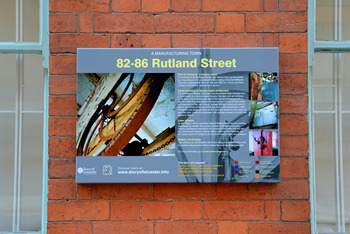
It is still possible to access some of the history of area whilst walking the streets of the cultural quarter through a series of Heritage Interpretation Panels. Heritage Interpretation Panels funded by Leicester City Council are part of a city-wide initiative of over 100 panels telling the story of Leicester, featuring information on key heritage buildings and well-known individuals associated with Leicester (see Figure 3).
Heritage Interpretation Panel Makers’ Yard in Rutland Street © Leicester City Council.

In the St George's area, this built on content from both of the earlier projects to locate physical interpretation panels throughout the area. Generally using three images and around 300 words, these panels are intended to help those who live, work or just visit the area to understand more about history of the cultural quarter. These panels drew upon the work produced by projects that relied on the latest technology of the time to present location-specific history; however, it is the panels located in the streets which now continue to provide the most reliable source of information on specific locations. Interacting with the panels also does not require any additional effort from the reader, such as knowledge of and downloading of apps, or even ownership of a device. The panels are unable to offer the immersive experience provided by the sounds of the locations and the associated creative writing. Nor can they provide anywhere near the level of information available on an app. Unlike the app, they do not encourage the reader to engage in any depth or to contribute their own story to the archive of the area, but they do provide an opportunity for the casual passer-by to engage with the history and heritage of the area through the historical images and written text. However, the history and heritage that the panels depict is in line with the city council's desired narrative for the regeneration of the area.Footnote 30 This predominantly promotes the industrial and architectural heritage of St George's rather than the de-industrialized area or its social history, which can be found on the app. There are always choices to be made about which history forms the dominant narrative, and this is especially so within the confines of a panel of 300 words which is unable to provide the depth or range of detail that is accessible via the apps. Generally, users of the apps were likely to spend longer in the area and invest time and energy in exploring the area and the associated information. Readers of the panels may just have a passing interest, although it is possible to explore more detail on certain sites via the Story of Leicester website.Footnote 31
Ways of working
Co-production was an extremely beneficial way of working for the two AHRC-funded projects. Without the collaboration of the creative industries partners, and subsequent engagement of the wider public, it would not have been possible to discover as much of the varied history of the area, such as the level of detail on the rave venue established in one of the former industrial buildings. This is particularly evident in the case of the communities associated with the period of de-industrialized space, once the larger manufacturers left and before the regeneration process began. The online archive developed from these projects contains a searchable timeline which enables users to access sources ranging from photographs of the area from the 1870s to the present day alongside newspaper cuttings, oral history interviews, historic and present day sounds of the area and video and audio clips of memories recorded by local people in the video booth.Footnote 32 This marrying together of official histories, much of which is text based, with human stories uncovered by the project along with images and sounds through time, enables a much richer understanding of the history of the area.
Establishing good working relationships with both academic and non-academic partners takes time, and investing time in those relationships is important for building good foundations for projects. The University of Leicester gaining two successive AHRC awards enabled the good working relationships developed with Phoenix and Cuttlefish Multimedia during The Rise, Fall and Reinvention of Industry to be built upon for the Affective Digital Histories project. When working with non-academic partners, it is important that all parties understand the culture, hierarchy, decision-making processes, time scales and funding pressures of organizations operating in the different sectors.Footnote 33 Scheduling meetings to include a little time for the opportunity to learn more about partners, for example starting meetings with a working lunch giving people time to mingle before launching into agenda items, can help. Refreshments can often help people to settle in unfamiliar situations; this is especially true in work with community groups where this can go a long way to help break down barriers and encourage participation. Where possible, rotating the hosting of meetings between partners can assist in understanding the different organizations and engaging and immersing oneself with the area can quickly help to build a level of familiarity with the place of study. Whilst all partners are working to meet the overall aims and objectives of the project, they may also have objectives of their own they wish to achieve as part of the process. In the case of Cuttlefish Multimedia, the geography of the projects enabled them to develop their locative technology by linking archival content to specific locations within the area. In 2013, when the first project began, the Phoenix was keen to explore the move away from desk-based to hand-held technology as people increasingly used tablets and phones to access content.
The short-term nature of project funding places temporal limits on its impact and meaningful lifespan. The University of Leicester has in place technical systems and resources to manage digitization and content management so open access to the archival content remains available, but it is important to recognize that smaller, less well resourced, partners are unlikely to have the capacity to support the project beyond their own funded contribution. This is highlighted particularly well in the case of the Apple upgrade which rendered the cultural quarter apps inoperable on Apple devices. As this occurred outside the project timeframe, Cuttlefish Multimedia had no resources to change the apps to ensure they continued to work. In considering the physical lasting impact and legacy of any project, it is important to consider that the use of technology has the capacity to dictate the useful life expectancy of the work. When undertaking short-term funded projects which rely heavily upon technologically driven outputs, it is worth considering the inclusion of some non-technologically reliant outputs in order to avoid the project lifespan being limited by changes in technology.
Legacy beyond the academy
Some of the work of writers commissioned as part of Affective Digital Histories went on to receive wider recognition. Divya Ghelani and Mark Goodwin were invited to read their respective commissions, An Imperial Typewriter and Mist's Rave, at the Literary Leicester Fringe. Carol Leeming's choreopoem, Love the Life You Live…, won the Leicester Writers' Club Siobhan Logan Award for the spoken word in 2014 and was staged at Curve theatre in January 2018. Divya Ghelani's short story is being made into a short film, having been chosen as one of 10 finalists by B3 Media's TalentLab scheme for Black, Asian and minority ethnic artists. Divya has continued to build on her experience from the Affective Digital Histories project. In October 2018, she launched a project for which she secured Arts Council funding for an oral history project based round another building from Leicester's industrial past. This project links to a wider Heritage Lottery funded exhibition held at Leicester's Newarke Houses Museum from May to October 2019.Footnote 34
The cultural quarter projects outlined here have uncovered the varied histories of a culturally significant space in Leicester. Above the historiographical importance of this research, the real value has been in engaging communities in the practice of urban history well beyond the academy. Whilst the location-based technology is no longer able to place the history of cultural quarter spaces onto all hand-held devices, the more traditional combination of image and text on interpretation boards still ensures that those who now live, work and play in the area have a greater understanding of the history of St George's and its place in the lives of those who lived, worked and played there in earlier decades. In terms of the original objectives of the projects, not only have diverse audiences engaged with archival sources, but a commissioned writer has continued to use historical archives in her own work and has successfully raised creative and cultural funding to encourage new partners and participants to engage with archival sources from Leicester's industrial past.