Implications
During lactation sows are most commonly kept in farrowing crates with a limit to move freely. Though piglet crushing can be minimized in this system, sows cannot express their full natural behaviour. Our study showed that loose-housing after a short postnatal period affected neither the number of piglet crushings nor the activity level of the gilts and integument alterations nor pre-weaning mortality. Therefore, it is recommended to allow sows to move around to some extent during the later lactation period.
Introduction
The major reason for keeping lactating sows in farrowing crates in intensive production is to avoid crushing of the piglets. Compared to loose-housing, these systems require also less space and are easier to manage, that is handling of animals and manure removal (Blackshaw et al., Reference Blackshaw, Blackshaw, Thomas and Newman1994; Barnett et al., Reference Barnett, Hemsworth, Cronin, Jongman and Hutson2001; Baxter et al., Reference Baxter, Lawrence and Edwards2012; Hales et al., Reference Hales, Moustsen, Nielsen and Hansen2013). Nevertheless, crates are currently under discussion because the movement of the sows, and thus the natural animal behaviour and welfare are highly impaired (Lawrence et al., Reference Lawrence, Petherick, Mc Lean, Deans, Chirnside, Vaughan, Clutton and Terlouw1994; Jarvis et al., Reference Jarvis, Lawrence, Mc lean, Deans, Chirnside and Calvert1997). As a consequence, in countries like Norway, Sweden or Switzerland farrowing crates are already forbidden by law. A general ban of farrowing crates by European Union legislation in the near future seems to be feasible. Therefore, alternative housing systems to farrowing crates with continuous confinement that improve the animal welfare are urgently needed. An important instrument for estimating the welfare of an animal is the analysis of its behaviour (Lidfors et al., Reference Lidfors, Berg and Algers2005). Another problem of farrowing crates is that they can cause serious skin lesions (Boyle et al., Reference Boyle, Leonard, Lynch and Brophy2002).
Various studies proved the feasibility of loose-housing sows during the lactation period as piglet mortality and piglet weight gain did not differ from crating systems (Cronin et al., Reference Cronin, Lefebure and Mc Clintock2000; Marchant et al., Reference Marchant, Rudd, Mendl, Broom, Meredith, Corning and Simmins2000; Moustsen and Poulsen, Reference Moustsen and Poulsen2004; Pedersen et al., Reference Pedersen, Moustsen, Nielsen and Kristensen2011; Moustsen et al. Reference Moustsen, Hales, Lahrmann, Weber and Hansen2013). Nevertheless, crating for at least the first 4 days postpartum (pp) seems to be necessary (Moustsen et al., Reference Moustsen, Hales, Lahrmann, Weber and Hansen2013); otherwise piglet crushing might be detrimental (Hales et al., Reference Hales, Moustsen, Nielsen and Hansen2014). In the study of Baumgartner et al. (Reference Baumgartner, Ofner, Quendler and Winckler2007), loose-housed sows tended to be more active than crated ones, whereas weaning weights were not affected. Kamphues (Reference Kamphues2004) observed a higher proportion of sitting in the group of crated sows compared to the loose-housed group. Allowing the sow to move freely in the farrowing pen, could also motivate piglets to suckle and consequently benefit the weight gain of the litter (Pedersen et al., Reference Pedersen, Moustsen, Nielsen and Kristensen2011). Melisova et al. (Reference Melisova, Illmann, Chaloupkova and Bozdechova2014) demonstrated a higher activity level of sows in pens when compared to crates, while crushing rates did not increase and weight gain of piglets benefitted from free farrowing pens. Therefore, a system that can be altered between confinement and loose-housing of the sows might be most feasible to increase the sow’s ability to move without leading to higher piglet mortality rates (Marchant et al., Reference Marchant, Rudd, Mendl, Broom, Meredith, Corning and Simmins2000; Pedersen et al., Reference Pedersen, Jørgensen, Heiskanen and Damm2006) and still offering a sufficient safety for the farmer while handling animals during lactation (Moustsen et al., Reference Moustsen, Hales, Lahrmann, Weber and Hansen2013). Thus, the aim of this study was to investigate the effect of crating sows during lactation for different periods on their behaviour and integument alterations and on piglets’ performance.
Material and methods
Animals and housing
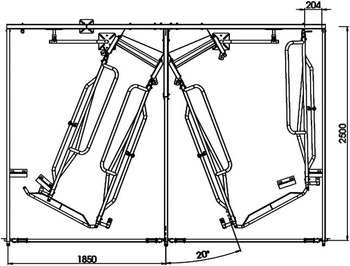
The study was conducted in a commercial herd with 1280 sows of Hypor Libra origin (Hypor, Boxmeer, The Netherlands), which was located in Thuringia, Germany. Artificial inseminations were conducted using Duroc semen. Only gilts (n=168) were included in the study to avoid correlations with earlier experiences of the sows. In the mating units, the animals were kept in individual crates. Pregnant sows were housed in groups with an electronic feeding station and moved to the farrowing unit 5 days before the calculated farrowing date. The pens measured 1.85×2.50 m and were fully slatted with plastic coated metal wire. They were equipped with crates that could be used to fix the sow (Figure 1). When crated, the sows had 1.4 m2 of space allowance and when loose-housed 2.8 m2. The crate measured 110 cm in height and 200 cm in length. The width could be altered from 55 to 70 cm. Litters were equalized by cross-fostering piglets born within the same day.
Layout of the farrowing pen (left: farrowing crate closed; right: farrowing crate open).

A diffuse ventilation was installed with the barn temperature adjusted to 21°C. The creep area had floor heating and a heat lamp (125 W) that was installed until 7 days pp. Twice a day the sows were fed by an automatic liquid feeding system. The diet was based on barley, wheat and soya bean meal and contained 13.2 MJ ME/kg and 17.5% protein. Until day 2 pp, gilts received 1.5 kg per day. Thereafter, the amount was increased by 0.5 kg every second day until it reached 4.5 kg per day on day 12 pp, and by 0.5 kg daily until day 15 pp.
The gilts were randomly allocated to one of the following three treatment groups: A: animals were housed in continuous confinement from 0 to 26 days pp (n=55); B: animals were confined until 14 days pp and then loose-housed until day 26 pp (n=54); and C: animals were confined until day 7 pp and then loose-housed until day 26 pp (n=59).
Behavioural observations
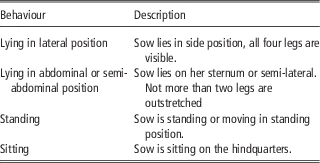
The behaviour of 18 randomly selected gilts (6 from each group) was observed from day 5 to 26 pp. Video recording took place in a farrowing unit accommodating 59 lactating gilts. Three digital cameras (Mobotix M24M Allround L22, Langmeil, Germany) were connected to a notebook and three CCTV cameras (Panasonic WV-BP330, Osaka, Japan) in connection with a time lapse recorder (Panasonic recorder model AG TL 750 S-VHS/S, Osaka, Japan) were installed at the ceiling above the pens. The Multi-Video-Processor (model MVP-104GX, Anaheim, USA) allowed the simultaneous use of three cameras in connection with only one recorder. One camera recorded the behaviour of three sows simultaneously. At night an emergency lighting was available. Videos were analysed using instantaneous sampling using 10 min intervals. The behavioural variables that were recorded are described in Table 1. The proportion the different behaviours were performed per day was calculated for each gilt.
Definition of the behavioural variables

Integument scoring
Integuments of all gilts were evaluated on days 7, 14 and 25 pp. Therefore, lesion scores were recorded for the body regions legs and lumbar vertebra with the following binomial score: 0=no lesions; 1=lesions visible. Lesions at the shoulder were scored 0=no lesions; 1=slight lesions (<2 cm); 2=moderate lesions (>2 to <5 cm). The score of the left and right shoulder was summed as well as the score of the four legs.
Performance parameters
Gilts were weighted when they were placed in the farrowing unit and at weaning on day 26 pp. The individual body weights of piglets were recorded on day 1, 7, 14 and 25 pp. Losses of piglets were daily documented with a date and the cause of death as judged by the staff. Causes were differentiated between crushed (open-mouthed, swollen tongues, patterns of the slatted floor on the body and blue discoloration of the skin), culled, streptococcal infection (inflammations of the central nervous system disorders), starved (extreme emaciation), bitten (significant bite marks), anomaly (abnormalities and congenital malformations), and other. All dead piglets were weighted.
Statistical analysis
The program package SAS version 9.3 (SAS Institute Inc., Cary, NC, USA) was used for the statistical analysis. The gilt as the experimental unit was applied. Statistical significance was accepted at P<0.05.
Data on mortality, which were recorded as a binomial trait, were analysed with the GLIMMIX procedure including the fixed effect of the treatment group. Performance variables were analysed with the MIXED procedure including the treatment (A, B, C) and week (1, 2, 3) as fixed effect and the gilt as random effect. The behavioural variables were arcsin square root-transformed before analysis to adjust data for normality. The model statement included the treatment (A, B, C) and week (1, 2, 3) as fixed effect and the gilt as random effect. Least squares means were separated by the probability of differences option (PDIFF) with Bonferroni adjustment. Treatment effects for the integument scoring were tested by applying the Exact-Fisher-test within the FREQ procedure. Because treatments did not differ significantly, frequencies summed over all treatments are presented.
Results
Behavioural parameters
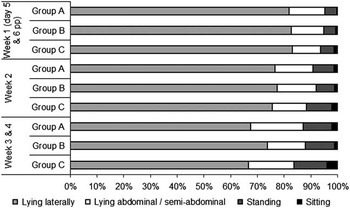
The time budgets of the different postural behaviour patterns separated for the different weeks of lactation are presented in Figure 2. From week 1 to week 3 and 4 of lactation, the proportion of lying laterally decreased. Concurrently, the time spent lying in abdominal/semi-abdominal position increased. During the second half of the lactation period B-gilts more frequently laid laterally (73.8%) than A-gilts (67.4%) and C-gilts (66.7%) (P<0.05). For the other behaviours no differences between weeks were noted.
Time budgets during different periods of gilts that were crated continuously from day 0 to 26 pp (A), until day 14 pp (B) and until day 7 day pp (C). pp=postpartum.

Integument scoring
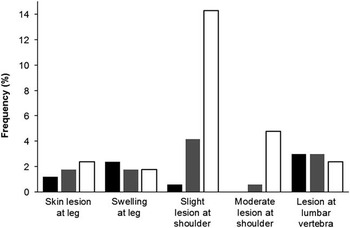
One week after farrowing 7% of the gilts were found with at least one lesion at the legs, shoulder or lumbar vertebra; this proportion increased to 11% on day 14 and 26% on day 26. Differences between the treatment groups were not found (P>0.05). The rising incidence was mainly caused by shoulder lesions, which accounted for 75% of all lesions on day 26. As shown in more detail in Figure 3, particularly the incidence of slight shoulder lesions rose from <1% on day 7 to 4% on day 14 and 14% on day 25 pp. At the latest scoring date 5% of all studied gilts even showed moderate lesions at the shoulder. For the other body regions the integument score remained below 4% over the lactation period.
Frequency of abnormal integument scores of gilts (n=168) on day 7 (black bars), 14 (grey bars) and 25 postpartum (white bars) at the legs, shoulder and lumbar vertebra.

Performance parameters
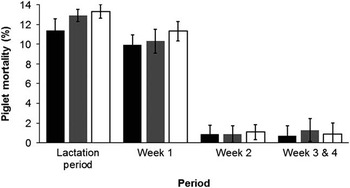
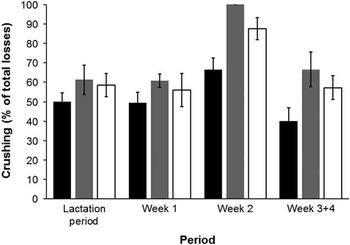
On average, the 168 gilts had a litter size of 12.8±3.6 live-born and 0.8±1.2 stillborn piglets. After the lactation period of 26 days 11.2±1.1 piglets were weaned per litter. The piglet mortality rates for the whole lactation period were 11.4, 12.9 and 13.3% for groups A, B and C, respectively (P>0.05; Figure 4). In all treatment groups losses occurred in about 90% of the cases in the first week pp. In total, 272 piglet losses were recorded. Crushing was the most frequent cause of death. The percentage of crushings averaged over the whole lactation period varied between 50% in A-gilts and 59 and 61% in B- and C-gilts (P>0.05; Figure 5). The highest proportion of crushings of at least 67% was recorded in the second week pp in all groups, but during this week the piglet mortality was lower than 1% in all groups (P>0.05; Figure 5).
Piglet mortality rates in gilts crated continuously from day 0 to 26 pp (A, black bars), until day 14 pp (B, grey bars) and until day 7 pp (C, white bars). pp=postpartum.

Proportion of piglet crushing on the total losses in gilts crated continuously from day 0 to 26 pp (A, black bars), until day 14 day pp (B, grey bars) and until day 7 pp (C, white bars). pp=postpartum.

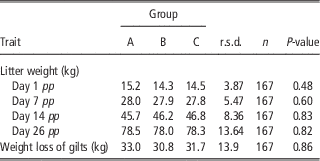
The daily weight gain of the piglets during the lactation period did not differ significantly between the experimental groups (P>0.05), neither for the whole lactation nor within the individual weeks (Table 2). Averaged over the entire lactation period, piglets gained 220 to 225 g/day. The litter weights at the four weighting times did not differ between the housing variations. Focusing on the values of day 14 and 26, groups ranged between 45.7 to 46.8 and 78 to 78.5 kg, respectively (Table 2). During lactation, gilts of group A, B and C lost 16.9, 15.8 and 15.7% of the pre-farrowing weight, respectively (P>0.05).
Litter weights on day 1, 7, 14 and 26 pp and gilts’ weight losses during lactation when crated continuously from day 0 to 26 pp (A), until day 14 pp (B) and until day 7 day pp (C)

pp=postpartum.
Discussion
Pen design
Animal welfare of sows during the lactational period is an increasing concern and the widely used farrowing crates are under discussion. Nevertheless, most lactating sows in the developed world are still crated (Barnett et al., Reference Barnett, Hemsworth, Cronin, Jongman and Hutson2001). Marchant et al. (Reference Marchant, Rudd, Mendl, Broom, Meredith, Corning and Simmins2000) and Moustsen et al. (Reference Moustsen, Hales, Lahrmann, Weber and Hansen2013) investigated farrowing systems which represent a compromise between free farrowing and continuous confinement of the sow. In these systems the sows are only crated for the first days pp when the danger of piglet crushing is most serious. For the remaining lactation period the crates are opened and the sow is loose-housed. As pointed out by Moustsen et al. (Reference Moustsen, Hales, Lahrmann, Weber and Hansen2013), crating can be limited to the first 4 days pp in order to avoid unnecessary crushings. In the present study a newly developed pen which also allows temporary crating was under investigation. In fact, this farrowing system was developed for intensive production systems, in which the abrupt change from continuous confinement as practiced at the moment to free farrowing is not an option; mainly due to increased management requirements. Even under optimized management regimen excessive piglet mortality might arise (Hales et al., Reference Hales, Moustsen, Nielsen and Hansen2014) and this limits the implementation of free farrowing pens in the field. Given the compromise between the ability of the sow to express its natural behaviour and the consequences this might have on the piglets in terms of crushings, the pen under study is able to provide the sow with a certain additional area to move and turn around, but not to the same extent as several of the recently developed free farrowing pens exceeding sizes of 5 m2 (Weber et al., Reference Weber, Keil, Fehr and Horat2007; Hales et al., Reference Hales, Moustsen, Nielsen and Hansen2014). Nevertheless, the sow had twice the space allowance (2.8 m2) when the crate was opened compared to the closed crate in our study. However, the optimal space allowance for sows in loose housing pens is still unknown and effects on piglet mortality in relation to the pen size and dimensions are warranted to be evaluated. In order to avoid excessive piglet crushings the crates were opened in the present study at 7 or 14 days pp as other previous studies identified the first week pp as the most important period in terms of piglet crushings (Moustsen et al., Reference Moustsen, Hales, Lahrmann, Weber and Hansen2013; Hales et al., Reference Hales, Moustsen, Nielsen and Hansen2014).
Behaviour
Regarding the activity level of the sows, lying in lateral and abdominal/semi-abdominal position was, at almost 90% of the time, the predominant postural position. In the literature similar time budgets with lying accounting for >85% are commonly found (Johnson et al., Reference Johnson, Morrow-Tesch and McGlone2001; Kamphues, Reference Kamphues2004). The percentage of the lateral position on the total lying time was in the range (70%) reported by Kamphues (Reference Kamphues2004). During the suckling period the proportion of lying decreased from 95% in the first week to 86% in the third and fourth week. The decline in the total lying time was accompanied by a reduced proportion of lying in the lateral position and increased proportion of lying in the abdominal/semi-abdominal position. This development has been described by Johnson et al. (Reference Johnson, Morrow-Tesch and McGlone2001) as a kind of ‘piglet avoidance strategy’. The experimental groups did not differ in the proportion of lying in the abdominal position, but gilts that were confined until 14 days pp were lying more often in the lateral position and less in the abdominal/semi-abdominal position in the second half of the suckling period. Comparing farrowing crates with loose-housing pens, Boyle et al. (Reference Boyle, Leonard, Lynch and Brophy2002) found the loose-housed animals lying longer on the first day in the farrowing pen when compared to the crated ones. During the later lactation period, differences in the time spent lying were not noted.
On average, the observed gilts spent approximately a tenth of their time standing, which widely agrees with the time budgets of previous studies (Kamphues, Reference Kamphues2004; Baumgartner et al., Reference Baumgartner, Ofner, Quendler and Winckler2007). In general, standing can be associated with activity or the motivation for activity. It is also a sign of attention and vitality (Baumgartner et al., Reference Baumgartner, Ofner, Quendler and Winckler2007). However, opening the crate, thus doubling the space allowance, did not motivate the animal to be more active. Even though not possible when using the time sampling method, recording the number of postural changes would have been a valuable indicator to assess whether loose-housed sows are standing up more frequently, too. Although not increasing the activity level, the possibility of turning around enabled the sows to interact with their environment and should be considered as highly beneficial for the animal. This is of major importance when optimizing farrowing pens because pigs are bored during most of the day in their barren environments (Puppe et al., Reference Puppe, Ernst, Schön and Manteuffel2007). During the lactation period the time of standing doubled from ~5 to >10%. This increase can be explained mainly by a recovery of the sows from birth and the ‘piglet avoidance strategy’ as already mentioned above (Blackshaw et al., Reference Blackshaw, Blackshaw, Thomas and Newman1994; Johnson et al., Reference Johnson, Morrow-Tesch and McGlone2001; Valros et al., Reference Valros, Rundgren, Spinka, Saloniemi and Algers2003). Recent results of Melisova et al. (Reference Melisova, Illmann, Chaloupkova and Bozdechova2014) support an increasing activity level of sows kept in pens compared with crates, which is not associated with increased piglet crushing rates, partly due to better body conditions of piglets.
Similarly to standing, the time of sitting, which analogous to standing, rose throughout the suckling period and was not significantly different between the treatments. Similarly, Blackshaw et al. (Reference Blackshaw, Blackshaw, Thomas and Newman1994) also did not find any difference in sitting or standing up between sows in a farrowing crate and a farrowing pen.
To further improve the welfare of the sows in the farrowing unit, the studied pen also allows to loose-house the sows from the time they enter the farrowing unit until farrowing starts. Particularly, when nest building material such as straw is provided in addition, nest building could be performed at least to a limited extent. This in combination with the loose-housing during the period that was studied here, might lead to more pronounced effects on the sow behaviour, integument alterations and also piglet weight gain than found with the present study design, where the sow was also confined during the nest building period.
Integument lesions
The incidence of lesions at the legs, shoulder or lumbar vertebra increased steadily with a quarter of the gilts showing at least one lesion at the end of the lactation period independent of the treatment group. This emphasizes that farrowing crates are not only problematic in terms of behavioural restrictions but also in terms of health. Currently, there are no studies available that compare skin lesions in loose-housing and crating systems. The fact, that shoulder lesions are a major problem in farrowing crates becomes clear from the present study as well as the study of Bonde et al. (Reference Bonde, Rousing, Badsberg and Sørensen2004), who even found a prevalence of 20% in farrowing crates. There is evidence that lesions that occur at different points of the production cycle have negative impacts on the reproductive performance, and thus longevity, of the sows (Pluym et al., Reference Pluym, Van Nuffel, Van Weyenberg and Maes2013). If lesions that are caused by crate fixtures could be minimized by loose-lactating, benefits might outweigh the additional management efforts during periods of loose-housing.
Performance
Given the fact that gilts in all treatments were crated at least until 7 days pp, the piglet mortality did not differ between the groups due to the fact that >90% of the losses occurred within this period. Expectedly, piglet crushing was the main reason causing losses. Using similar farrowing pens with integrated crates as used in this study, Moustsen et al. (Reference Moustsen, Hales, Lahrmann, Weber and Hansen2013) observed a higher piglet mortality rate in pens where sows were loose-housed throughout the whole lactation period than in those that were crated during the first 4 or 7 days pp; suggesting that crating for just 4 days pp is sufficient to avoid unnecessary crushings. Comparing farrowing crates with free farrowing pens, Hales et al. (Reference Hales, Moustsen, Nielsen and Hansen2014) found greater mortality rates in pens than in crates, even though pen sizes were, at 5.3 to 6.3 m2, considerably larger than in this as well as the aforementioned study. Contrarily, Weber et al. (Reference Weber, Keil, Fehr and Horat2007) found similar mortality rates in crates and loose-farrowing systems; but the proportion of crushed piglets was higher in loose-housed than in crated sows. Under practical farming conditions, KilBride et al. (Reference KilBride, Mendl, Statham, Held, Harris, Cooper and Green2012) found a similar overall pre-weaning mortality of 12% in farrowing crates, loose-housed systems and the system that was studied here, with crating during the first days pp, whereas crushings more frequently occurred when sows were continuously loosed-housed. In summary, piglets are at higher risk of death when sows are loose-housed. Nevertheless, the design of the pens has been modified in such a way that this risk can be minimized. Furthermore, pre-weaning mortality depends on a number of other factors that have to be taken into account, too, whenever loose-housing systems are evaluated. While litter size was not associated with mortality (Hales et al., Reference Hales, Moustsen, Nielsen and Hansen2014), parity, birth weight and piglet sex are determining factors (Hales et al., Reference Hales, Moustsen, Nielsen and Hansen2013).
Although indications exist that prove superior weight gains of piglets in free farrowing pens related to the motivation of piglets to suckle (Melisova et al., Reference Melisova, Illmann, Chaloupkova and Bozdechova2014), the limited space allowance in the pen under study might not have been sufficient to induce significant differences in piglet performance. Furthermore, the fact that feed intake was restricted to the same amount for all treatments, limits overall conclusions on the weight development of the sows as well as the piglets.
Conclusion
This study showed that loose-housing of gilts during the lactation period after they were crated until 7 or 14 days pp affected neither the activity level of the gilts and integument alterations nor pre-weaning mortality. Therefore, it is recommended to allow sows moving around to some extent during the later lactation period.
Acknowledgements
The authors thank the owner and staff of the participating farm for their collaboration.