Introduction
Lungworm is one of the most important causes of pneumonia in sheep. Symptoms of sheep infected with lungworm are mucous discharge, coughing and tachypnoea; deaths occur in cases of heavy infection (Soulsby, Reference Soulsby1982). Lungworms cause the development of bacterial pneumonia due to secondary complications in the lungs (Malone, Reference Malone and Aitken2007), as well as live-weight loss and a decrease in milk production, especially in young animals (Soulsby, Reference Soulsby1982). Dictyocaulus filaria is the most pathogenic lungworm in sheep. The adult worms live in the trachea, bronchi and bronchioles of small ruminants. Infection of the host occurs by mouth. Larvae penetrate into the intestinal wall and pass via the lymph vessels to the mesenteric lymph glands, where they develop and undergo the third ecdysis. The worms pass via the lymph and blood vessels to the lungs, where they are arrested in the capillaries and break through into the air passages (Soulsby, Reference Soulsby1982; Malone, Reference Malone and Aitken2007). The prepatent period is about 4–5 weeks (Kassai, Reference Kassai1999).
The land snail acts as the intermediate in the life cycle of Cystocaulus ocreatus, and swallowing the intermediate host with its food infects sheep. The infective larvae usually reach the lung via the hepatic portal system or lymph vessels. The parasite moults twice in the interstitial tissue of the lung and migrates to the alveolar ducts. The parasite lives in the lung parenchyma and subpleural nodules of small ruminants (Schnieder, Reference Schnieder, Rommel, Eckert, Kutzer, Körting and Schnieder2000). The prepatent period is 5–6 weeks (Kassai, Reference Kassai1999).
Eprinomectin (4′-(epiacetylamino)-4′-deoxy-avermectin B1) is among the macrocyclic lactones in the avermectin family. It is available on the market at a pour-on dose of 0.5 mg/kg for cattle (Shoop et al., Reference Shoop, Egerton, Eary, Haines, Michael, Mrozik, Eskola, Fisher, Slayton, Ostlind, Skelly, Fulton, Barth, Costa, Gregory, Campbell, Seward and Turner1996). Eprinomectin has been reported to be highly effective against ectoparasite infestations in farm animals (Aguirre et al., Reference Aguirre, Gaido, Cafrune, Castelli, Mangold and Guglielmone2005; Rehbein et al., Reference Rehbein, Winter, Visser, Maciel and Marley2005; Habela et al., Reference Habela, Moreno, Gragera-Slikker, Gomez, Montes, Rodriguez and Alvinerie2006), immature and adult gastrointestinal nematodes in cattle (Shoop et al., Reference Shoop, Egerton, Eary, Haines, Michael, Mrozik, Eskola, Fisher, Slayton, Ostlind, Skelly, Fulton, Barth, Costa, Gregory, Campbell, Seward and Turner1996; Pitt et al., Reference Pitt, Langholff, Eagleson and Rehbein1997; Williams et al., Reference Williams, Stuedemann, Bairden, Kerbouf, Ciordia, Hubert, Broussard, Plue, Alva-Valdez, Baggott, Pinkall and Eagleson1997; Cramer et al., Reference Cramer, Pitt, Rehbein, Gogolewski, Kunkle, Langholff, Bond and Maciel2000) and Dictyocaulus viviparus (Shoop et al., Reference Shoop, Egerton, Eary, Haines, Michael, Mrozik, Eskola, Fisher, Slayton, Ostlind, Skelly, Fulton, Barth, Costa, Gregory, Campbell, Seward and Turner1996; Pitt et al., Reference Pitt, Langholff, Eagleson and Rehbein1997; Williams et al., Reference Williams, Stuedemann, Bairden, Kerbouf, Ciordia, Hubert, Broussard, Plue, Alva-Valdez, Baggott, Pinkall and Eagleson1997; Cramer et al., Reference Cramer, Pitt, Rehbein, Gogolewski, Kunkle, Langholff, Bond and Maciel2000; Höglund et al., Reference Höglund, Ganheim and Alenius2003). Evaluation of the effect of eprinomectin against lungworm infections in small ruminants has been performed in goats only and has been reported to be 100% effective against Muellerius capillaris (Geurden & Vercruysse, Reference Geurden and Vercruysse2007).
Eprinomectin has not been licensed on the market for use in small ruminants, although it has been reported to be reliable and effective against gastrointestinal nematodes in sheep and goats (Chartier et al., Reference Chartier, Etter, Pors and Alvinerie1999; Panitz et al., Reference Panitz, Godfrey and Dodson2002; Cringoli et al., Reference Cringoli, Rinaldi, Veneziano and Capelli2003, Reference Cringoli, Rinaldi, Veneziano, Capelli and Rubino2004). However, we are not aware of any other studies that report on the use of eprinomectin against lungworm infection in sheep. Therefore, in the present study, the efficacy of eprinomectin pour-on against natural infection by D. filaria and C. ocreatus in sheep was evaluated for the first time.
Materials and methods
Sampling of sheep and study design
Lungworm infections were detected using the Baerman technique in a Pirlak breed (Daglic × Kivircik) (Akçapınar, Reference Akçapınar and Akçapınar1994) sheep flock. In total, 30 female sheep, aged 2–6 years, weighing 40–55 kg and naturally mix-infected with D. filaria and C. ocreatus, were selected from this flock. The animals were not pregnant, were not lactating and had not received any anthelmintic treatment within the year prior to the start of the present study.
The infected sheep were divided randomly into two groups, treated (n = 15) and untreated (n = 15), and the ear-tag numbers were recorded. Sheep in the treated group were administered a single pour-on dose of eprinomectin (0.5 mg/kg) (Eprinex®, Topkim, Istanbul, Turkey) by syringe after splitting the wool extending from the neck region to the tail and covering the back (between the two scapulas) of the sheep. No medication treatment was applied to the untreated group. All animals were allowed to graze together.
Parasitological procedures
Individual faecal samples (5 g) were taken directly from the rectum of both groups of animals on the pre-treatment day and at days 7, 14, 21 and 42 post-treatment. Lungworm larvae were identified (Van Wyk et al., Reference Van Wyk, Cabaret and Michael2004) using the Baerman technique (Hendrix, Reference Hendrix1998) and the number of larvae per gram of faeces (LPG) was determined.
Data analysis
The efficacy of eprinomectin was calculated at 7, 14, 21 and 42 days, in terms of faecal larval count reduction (FLCR), using the formula FLCR (%) = 100 × [(C − T)/C], where C is the arithmetic mean value for the untreated group and T is the arithmetic mean value recorded for the eprinomectin-treated group. The acceptable effectiveness was 90% or higher (Wood et al., Reference Wood, Amaral, Bairde, Duncan, Kassai, Malone, Pankavich, Reinecke, Slocombe, Taylor and Vercruysse1995). The Mann–Whitney U test was used to compare the mean LPG obtained from the control and treated groups at days 0, 7, 14, 21 and 42. Results were considered as statistically significant at the 5% probability level. Statistical analysis was performed using SPSS 13.0 software for Windows (SPSS Inc., Chicago, Illinois, USA).
Results
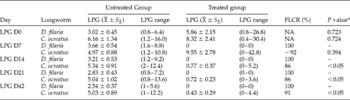
The number of LPG belonging to sheep included in the untreated and treated groups during the study are displayed in table 1. Dictyocaulus filaria was determined as 3.02 ± 0.45 and 5.86 ± 2.15, C. ocreatus was detected as 6.16 ± 1.34 and 8.32 ± 2.41 LPG at day 0, respectively, in the untreated and treated groups.
The number of larvae per gram of faeces (LPG) and reduction percentage of faecal larval counts (FLCR) for the treated group compared with the untreated group of sheep.

*, Mann–Whitney U-test.
NA, data not analysed.
 , standard error of the mean.
Following the standards for rating anthelmintic efficacy as put forward in the World Association for the Advancement of Veterinary Parasitology guidelines (Wood et al., Reference Wood, Amaral, Bairde, Duncan, Kassai, Malone, Pankavich, Reinecke, Slocombe, Taylor and Vercruysse1995), eprinomectin was found to be 100% effective against D. filaria at day 7 post-treatment and this effect lasted through days 14, 21 and 42 post-treatment. However, the reduction in number of total faecal larval counts for C. ocreatus started at day 14 post-treatment and the reduction rate of faecal larval count was detected to be 86, 86 and 91%, respectively, at days 14, 21 and 42 post-treatment (table 1).
No statistically significant difference was observed (at the 5% level of significance) in the efficacy of eprinomectin against C. ocreatus between the untreated and treated groups before the treatment on day 0 and at day 7 after the initiation of treatment; however, the difference observed on days 14, 21 and 42 was found to be significant (5% level of significance) (see table 1).
No side-effects were observed in the animals during the treatment.
Discussion
The benzimidazole (Cremers, Reference Cremers1983; Bliss & Greiner, Reference Bliss and Greiner1985; Hele, Reference Hele1986; Jones & Worley, Reference Jones and Worley1997), pro-benzimidazole (Cabaret, Reference Cabaret1991; Kulo et al., Reference Kulo, Chartier and Cabaret1994) and avermectin (Gıcık et al., Reference Gıcık, Arslan, Sarı and Umur2002; Hidalgo-Argüello et al., Reference Hidalgo-Argüello, Díez-Baños and Rojo-Vázquez2002; Rehbein & Visser, Reference Rehbein and Visser2002; Papadopoulos et al., Reference Papadopoulos, Sotiraki, Himonas and Fthenakis2004) class of drugs is used for the treatment of lungworm infections in small ruminants. Currently available anthelmintics are poorly effective against protostrongylid lungworms, in particular against the lung parenchyma-dwelling species. At least a double application or an application of elevated doses of anthelmintics is required for a significant reduction of lungworm larval output (Bürger, Reference Bürger, Eckert, Kutzer, Rommel, Bürger and Körting1992). In addition, some anthelmintics have low activity while others show variable degrees of efficacy according to the dose rate used, sometimes requiring two or three times the normal dose and repeat treatments, and this does not always give a complete control of dictyocaulosis in sheep (Hidalgo-Argüello et al., Reference Hidalgo-Argüello, Díez-Baños and Rojo-Vázquez2002). In the present study eprinomectin was found to be 100% effective against D. filaria in sheep. The result obtained is the first finding exhibiting that eprinomectin is effective against D. filaria in sheep in a short time period.
Eprinomectin was found to be 91% effective against C. ocreatus. The location of C. ocreatus may be the reason for this lesser efficacy, as mentioned by Papadopoulos et al. (Reference Papadopoulos, Sotiraki, Himonas and Fthenakis2004). Additionally, in the previously performed studies the plasma concentrations of topical administration of eprinomectin to goats and sheep were reported to be low and variable (Alvinerie et al., Reference Alvinerie, Lacoste, Sutra and Chartier1999a; Dupuy et al., Reference Dupuy, Chartier, Sutra and Alvinerie2001). In this study the differences in larval count when C. ocreatus was compared with the untreated group on days 14, 21 and 42 were found to be important (5% level of significance).
In the present study the differences obtained in efficacy of eprinomectin between D. filaria and C. ocreatus may be based on the different susceptibility of the parasites to the drug.
Eprinomectin is an antiparasitic drug which is preferable both for gastrointestinal and lungworm infections since it leaves neglectible residue levels in cattle (Shoop et al., Reference Shoop, Egerton, Eary, Haines, Michael, Mrozik, Eskola, Fisher, Slayton, Ostlind, Skelly, Fulton, Barth, Costa, Gregory, Campbell, Seward and Turner1996; Alvinerie et al., Reference Alvinerie, Sutra, Galtier and Mage1999b), sheep (Hodošček et al., Reference Hodošček, Grabnar, Milčinski, Süssinger, Eržen, Zadnik, Pogačnik and Cerkvenik-Flajs2008) and goat milk (Alvinerie et al., Reference Alvinerie, Lacoste, Sutra and Chartier1999a; Dupuy et al., Reference Dupuy, Chartier, Sutra and Alvinerie2001). In previous studies performed (Shoop et al., Reference Shoop, Egerton, Eary, Haines, Michael, Mrozik, Eskola, Fisher, Slayton, Ostlind, Skelly, Fulton, Barth, Costa, Gregory, Campbell, Seward and Turner1996; Pitt et al., Reference Pitt, Langholff, Eagleson and Rehbein1997; Williams et al., Reference Williams, Stuedemann, Bairden, Kerbouf, Ciordia, Hubert, Broussard, Plue, Alva-Valdez, Baggott, Pinkall and Eagleson1997; Cramer et al., Reference Cramer, Pitt, Rehbein, Gogolewski, Kunkle, Langholff, Bond and Maciel2000; Höglund et al., Reference Höglund, Ganheim and Alenius2003), eprinomectin has been reported to be very effective against D. viviparus, which is a cattle lungworm.
Eprinomectin is licensed as a pour-on formulation for use in lactating cows but has not been registered by its manufacturer for use in small ruminants. However, there is considerable evidence that eprinomectin, like ivermectin and moxidectin, is used ‘off licence’ in these animals (Dupuy et al., Reference Dupuy, Chartier, Sutra and Alvinerie2001). Panitz et al. (Reference Panitz, Godfrey and Dodson2002) reported that topical eprinomectin is a useful endectocide in sheep wool. Another advantage of eprinomectin is the ease of drug administration (pour-on), with wool length, timing of rain relative to time of drug application and environmental conditions, such as ultraviolet exposure, heat and freezing, having no effect on the efficacy of treatment (Gogolewski et al., Reference Gogolewski, Allerton, Pitt, Thompson, Langholff, Hair, Folton and Eagleson1997).
In conclusion, the results of the present study show that eprinomectin is useful for treatment of D. filaria and C. ocreatus in sheep. However, eprinomectin is not currently registered for use in sheep.