Clostridium difficile infection (CDI) has increased in incidence and severity and remains a disease frequently associated with healthcareReference Gould and McDonald 1 ; it is associated with increased length of stay, hospital readmission, increased healthcare costs, and increased mortality.Reference Gould and McDonald 1 – Reference Nanwa, Kendzerska and Krahn 6 In 2013, CDI was identified as an urgent public health threat by the Centers for Disease Control and Prevention. 2 Efforts to decrease the incidence of CDI were identified as a priority in the White House’s 2016 healthcare budget proposal. 7 The epidemiology of CDI has changed to include populations previously considered to be at low risk, including healthy outpatients, peripartum women, individuals with no recent antibiotic exposure, and children.Reference Gould and McDonald 1 , Reference Dubberke, Carling and Carrico 8 – Reference Zilberberg, Tillotson and McDonald 11
Given the increasing incidence of CDI, determining the economic burden of this disease is critical for making informed policy decisions. Moreover, as the affected populations shift to include those patients thought to previously be at lower risk of CDI, identifying the costs of CDI for different populations becomes increasingly important.Reference Nanwa, Kendzerska and Krahn 6 Studies of hospitalized adults with CDI have found attributable costs ranging from $3,000 to $15,000 per hospitalization and attributable length of stay (LOS) of 3–7 days.Reference Kyne, Hamel, Polavaram and Kelly 12 – Reference Tabak, Zilberberg, Johannes, Sun and McDonald 15 While some studies have examined hospital charges for children with CDI, the true attributable cost of pediatric CDI remains poorly defined.Reference Sammons, Localio, Xiao, Coffin and Zaoutis 16 To address this gap, we conducted a study to determine the attributable cost and LOS of CDI in hospitalized children. We hypothesized that costs for pediatric CDI would be lower than those associated with CDI in adults because severe disease and poor outcomes are less common in children.
METHODS
Study Design, Setting, and Population
We analyzed the Kids’ Inpatient Database (KID) from the Agency for Healthcare Research and Quality (AHRQ) Healthcare Cost and Utilization Project (HCUP); KID is the largest publicly available all-payer pediatric inpatient care database in the United States. 17 It contains approximately 3 million nationally representative samples of US pediatric hospital discharges, yielding national estimates of 7 million discharges. This database allows for calculation of national estimates through the use of weight, cluster, and strata variables in analyses. A KID update is released every 3 years, and we used the most recent data from the 2012 dataset, which was made available in 2014. 17
We analyzed the discharge records of patients between 2 and 18 years of age who were alive at discharge. We excluded patients younger than 2 years because children in this age group have high rates of asymptomatic colonization with C. difficile. We defined CDI using the International Classification of Diseases, Ninth Revision, Clinical Modification (ICD-9-CM) diagnostic code 008.45. If a discharge record had a primary or secondary diagnosis of 008.45, then we considered the hospitalization to be associated with CDI. This approach has been validated in both pediatric and adult studies of CDI.Reference Dubberke, Reske, McDonald and Fraser 18 , Reference Shaklee, Zerr and Elward 19
Outcomes
Our primary outcome was the attributable cost of CDI that occurred during hospitalization. To measure inpatient cost, total inpatient charges were converted to costs using the hospital-specific KID cost-to-charge ratio. 20 The estimated costs are hospital-specific all-payer inpatient costs. 20 Our secondary outcome was attributable length of stay due to CDI. We could not use LOS after the CDI event for this outcome because KID does not provide timing of CDI diagnosis during the admission. Instead, total LOS was used.
Primary Statistical Analysis
To generate propensity scores for CDI, we created a multivariate logistic regression model with the following predictors of CDI: age, sex, race/ethnicity, primary payer status, and clinical characteristics. The clinical predictors included in the bivariate and multivariate models were bacterial and fungal infections (as a proxy for antimicrobial administration), malignancy, solid organ transplant, primary and secondary immunodeficiencies, cystic fibrosis, inflammatory bowel disease, and the presence of gastrostomy tube.Reference Sandora, Fung and Flaherty 21 – Reference Owens, Donskey, Gaynes, Loo and Muto 23 Other potential confounders of the relationship between CDI and cost were also included: extracorporeal membrane oxygenation (ECMO), dialysis, central catheter placement, and mechanical ventilation.
The predicted probabilities from the logistic regression model were used as propensity scores to match a CDI hospitalization with hospitalizations without a diagnosis of CDI at a 1:2 ratio. Propensity scores were then used to assess similarities between cases and controls.Reference Dugoff, Schuler and Stuart 24 , Reference Zanutto 25
We compared cost and LOS between CDI cases and propensity-score matched controls using multivariate generalized linear models accounting for matching identifier (random intercepts) (Table 3). For attributable cost of CDI, we utilized a γ distribution, and for attributable LOS of CDI, we used a Poisson distribution adjusted for overdispersion. Although we matched a CDI case with controls based on propensity scores that included demographic and clinical characteristics, we included these characteristics as adjusters in the multivariate generalized linear models to reduce potential variation within matched pairs.Reference Goudie, Dynan, Brady and Rettiganti 28 We did not account for complex survey design (weight, cluster, and stratification) to estimate attributable cost and LOS of CDI. However, the survey weight, cluster, and strata were included as additional confounders in the multivariate logistic regression models that produced propensity score because these factors may capture other confounders for CDI that were not observed in the samples.Reference Korn and Graubard 26 , Reference Pfeffermann 27
To determine whether the attributable cost and LOS varied by risk for CDI, we performed the same models described above with the additional variable of a quartile variable of CDI propensity scores and interaction terms between the quartile variable and all other variables in the model. Consequently, we stratified the attributable cost and LOS by quartiles of propensity scores for CDI to examine the magnitude of attributable cost per quartile of propensity score for CDI.
Attributable cost and LOS were calculated by subtracting the mean cost or LOS for hospitalizations without a diagnosis of CDI from the corresponding mean values for hospitalizations with a diagnosis of CDI. Costs are presented in 2017 US dollars. We used the medical care component of the consumer price index to account for inflation to convert 2012 costs to 2017 US dollars. P<.05 was considered statistically significant.
Sensitivity Analysis
Because longer LOS is associated with having CDI, we conducted a sensitivity analysis for the attributable cost that incorporated LOS in the propensity score itself, as well as in the generalized linear model. We ran the same generalized linear model but added LOS as an additional predictor to better understand the association between LOS and CDI. This approach allowed us to identify the cost of CDI that was attributable to LOS.
SAS software version 9.4 (SAS Institute, Cary NC) was used to perform all analyses. The study was granted exempt status by the Boston Children’s Hospital Institutional Review Board.
RESULTS
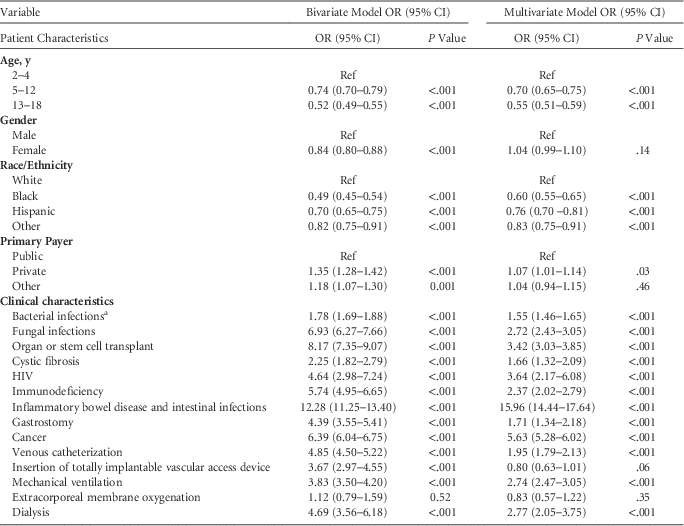
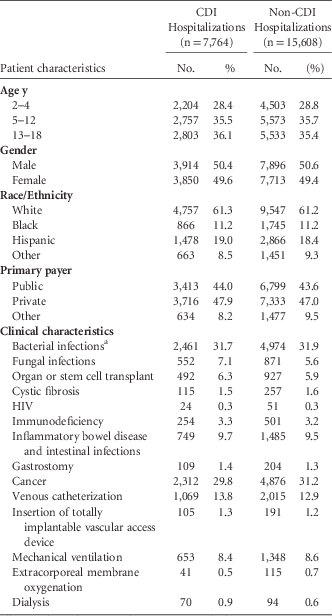
We identified 8,527 (0.53%) pediatric hospitalizations with a secondary diagnosis of CDI and 1,597,513 discharges without CDI. CDI diagnosis was more prevalent in younger, male, white, and privately insured patients (Table 1). Demographic and clinical characteristics that comprise the propensity score are also outlined in Table 1. Our propensity score matching resulted in a similar distribution of all variables between cases and controls (Table 2).
Predictors of CDI From Propensity Score Model

NOTE. OR, odds ratio; CI, confidence interval.
a Septicemia, bacterial infection unspecified site, meningitis, pneumonia, and arthritis.
Distribution of Matching Variables for Cases and Controls After Matching Using a 1:2 Ratio

NOTE. CDI, Clostridium difficile infection; HIV, human immunodeficiency virus.
a Septicemia, bacterial infection (unspecified site), meningitis, pneumonia, and arthritis.
Using the primary cohort of cases and controls matched based on propensity score, the average cost of hospitalizations for patients with CDI was $8,317 higher than the average cost of hospitalizations for patients without CDI (P<.0001). Using this same cohort, we found that the hospitalizations for patients with CDI were approximately 4 days longer than hospitalizations for patients without CDI (P<.0001) (Table 3).
Attributable Cost and Length of Stay

NOTE. CDI, Clostridium difficile infection; LOS, length of stay.
a P<.001.
b P<.05.
c Cost for CDI group/Cost for non-CDI group; LOS for CDI group/LOS for non-CDI group.
d Matched on LOS and adjusted for LOS in sensitivity analysis.
In a sensitivity analysis that used the cohort of cases and controls matched on the propensity score that included LOS in addition to the demographic and clinical characteristics in Table 1, the cost of hospitalization remained higher for patients with CDI (P<.0001), but the adjusted mean cost difference between the groups decreased to $1,917 (Table 3).
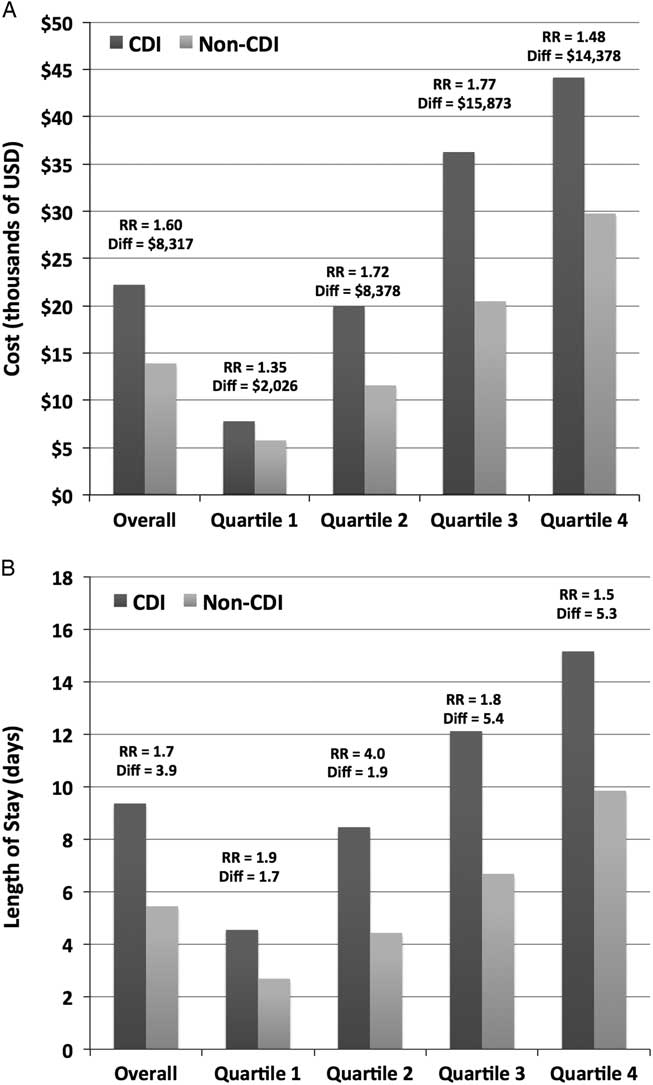
Figure 1 displays cost and LOS in our matched cohort stratified into quartiles by propensity score. Quartile 1 represents the group at the least propensity (ie, risk) for developing CDI and quartile 4 represents those at most risk. Both cost and LOS increased across the quartiles with those most at risk having higher cost and a longer LOS.
Attributable cost (A) and length of stay (B) of CDI by risk quartiles. CDI, Clostridium difficile infection; Diff, absolute difference; RR, relative difference ratio; USD, US dollars.

DISCUSSION
In a large, nationally representative dataset of pediatric discharges, CDI was uncommon but was associated with significant cost. The attributable cost of a hospitalization associated with a diagnosis of CDI was either $1,917 or $8,317, depending on whether LOS was adjusted for. When not adjusting for LOS, CDI-associated hospitalizations cost 1.6 times more than non-CDI associated hospitalizations. This estimated range for attributable cost of CDI in children is similar to published adult CDI cost estimates.
We had hypothesized that the attributable cost of CDI would be lower in pediatric patients as severe disease and complications are not as common in children as in adults. However, it is possible that hospitalized pediatric patients with CDI are more medically complex than the average child and therefore accrue higher costs. Additionally, failing to account for the impact of LOS on cost has been recognized as an important limitation of previous CDI cost analyses.Reference Dubberke, Butler and Reske 5 , Reference O’Brien, Lahue, Caro and Davidson 13 LOS that occurs prior to the CDI event is a confounder of cost; both the risk of CDI and the overall cost of hospitalization increase with LOS. In addition, LOS after the CDI event may be a driver of cost because the CDI episode extended the hospital stay, which likely accounts for the greatest portion of the cost. Few previous studies, even in the adult literature, have accounted for LOS as a confounder of cost of CDI.Reference Dubberke, Reske, Olsen, McDonald and Fraser 3 , Reference Kyne, Hamel, Polavaram and Kelly 12 , Reference Dubberke and Olsen 14 We were unable to adjust specifically for the duration of hospitalization prior to the diagnosis of CDI given that KID does not provide timing of diagnosis. However, to provide a conservative lower bound of an estimate for the cost of CDI, we included LOS as a predictor in our model predicting cost. The contrast of the findings from our 2 models—1 adjusting for LOS and 1 not adjusting—confirm and extend the findings of previous studies demonstrating that LOS is indeed an important consideration when calculating the attributable cost of CDI.Reference Asensio, Di Bella and Lo Vecchio 29
We also found that children with a diagnosis of CDI had a total LOS that was 4 days longer than children without CDI, even using a cohort of cases and controls that were matched by propensity to develop CDI. Given that we did not have access to the timing of diagnosis, we cannot conclude definitively that this increase in LOS is specifically a consequence of CDI, nor can we distinguish between community-associated (CA-CDI) versus hospital onset (HO-CDI) infection. However, it is certainly plausible that HO-CDI could result in an extension of the duration of hospitalization because of ongoing diarrhea, fever, metabolic complications, or other complications associated with the CDI diagnosis or treatment. In a recent study from Europe, the increase in LOS attributable to CDI among a cohort of 19 children was 5 days; this value is similar to our estimate for children in the United States.Reference Asensio, Di Bella and Lo Vecchio 29
Our study adds to the very limited literature regarding the economic burden of pediatric CDI. Nylund et alReference Nylund, Goudie, Garza, Fairbrother and Cohen 30 examined KID data from 1997 through 2006, and they reported descriptive median hospitalization charges in 2006 to be $10,893 in patients without CDI versus $31,957 in CDI patients. However, these results were reported as charges rather than cost, and no specific attempt to determine attributable cost was made.Reference Nylund, Goudie, Garza, Fairbrother and Cohen 30 In a propensity-matched retrospective cohort study using the Pediatric Health Information System (PHIS) database from 2006 through 2011,Reference Sammons, Localio, Xiao, Coffin and Zaoutis 16 patients with hospital onset CDI (HO-CDI) had a longer LOS and a higher total cost compared with patients with community-onset CDI (CO-CDI) ($93,600 for HO-CDI vs $18,900 for CO-CDI). The cost associated with CDI in this study was higher than the upper limit of cost estimates for adult CDI.Reference Sammons, Localio, Xiao, Coffin and Zaoutis 16 One potential explanation is that the PHIS database includes data only from freestanding children’s hospitals, and thus, costs may not be as nationally representative. In addition, no adjustment for LOS was included in those models, so the LOS-adjusted attributable cost of CDI might have been lower.
Our study does have limitations, several of which are inherent to the use of an administrative dataset in which no clinical or laboratory data are provided. First, we identified cases solely on the basis of ICD-9-CM codes. While this approach has been previously validated in both the adult and pediatric population, we were unable to improve specificity by the inclusion of laboratory testing or CDI-specific treatment.Reference Dubberke, Reske, McDonald and Fraser 18 , Reference Shaklee, Zerr and Elward 19 We were also unable to include additional clinical information such as the use of gastric acid-suppressing agents or individual antibiotics, both well-established predictors of CDI development.Reference Owens, Donskey, Gaynes, Loo and Muto 23 , Reference Jimenez, Drees, Loveridge-Lenza, Eppes and delRosario 31 Furthermore, the timing of diagnosis of CDI is not available in KID, so assessment of CDI-associated hospitalizations is likely representative of both CA-CDI and HO-CDI disease; in fact, the limitation of using administrative data to accurately assess HO-CDI specifically has been studied previously.Reference Dubberke, Butler and Yokoe 32 Finally, we only captured direct medical costs. Indirect costs such as school absenteeism or parental leave from work could not be measured, but arguably, they have a substantial impact on the national economic burden of this disease.Reference Dubberke and Olsen 14
We have shown that the attributable cost of CDI in hospitalized children is in a similar range to that of adults with CDI. Given both the clinical implications and economic burden of this infection, pediatric CDI must remain an active and targeted infection prevention priority. As the incidence of CA-CDI increases, further cost of illness studies should focus on differentiating community-associated versus hospital-onset infection.Reference Gupta and Khanna 33 Defining the cost of CDI in children allows both clinical and policy stakeholders to better shape policies around prevention strategies in both the inpatient and outpatient settings. Potential strategies may include the development or expansion of inpatient pediatric antimicrobial stewardship resources, investment in infection preventionists, and even the development of novel outpatient community antimicrobial stewardship programs. The case for such strategies is already thoughtfully being made for interventions to prevent CDI in adults,Reference Slayton, Scott, Baggs, Lessa, McDonald and Jernigan 34 and these ideas should be extended to children as well. Our innovative assessment of costs and LOS in children should provide valuable support to these efforts.
ACKNOWLEDGMENTS
Financial support: P.M. received partial support from an NIH/NICHD Pediatric Infectious Diseases Research Training grant (for trainees at Boston Children’s Hospital, grant no. 5-T32HD055148-07). No other financial support was provided relevant to this article.
Potential conflicts of interest: All authors report no conflicts of interest relevant to this article.