Introduction
Perchlorate (ClO4−) has been directly detected at two landing sites on Mars at concentrations between 0.5 and 1% (Hecht et al., Reference Hecht, Kounaves, Quinn, West, Young, Ming, Catling, Clark, Boynton, Hoffman, DeFlores, Gospodinova, Kapit and Smith2009; Navarro-Gonzalez et al., Reference Navarro-Gonzalez, Sutter, Archer, Ming, Eigenbrode, Franz, Glavin, McAdam, Stern, McKay, Coll, Cabane, Conrad, Mahaffy, Martín-Torres, Zorzano-Mier and Grotzinger2013) suggesting that ClO4− could be globally distributed on the planet, in surface 10 cm layer of the regolith (Davila et al., Reference Davila, Willson, Coates and McKay2013). Hypotheses of the origin of perchlorates in the Mars regolith during photochemical reactions with the participation of halite and other chlorine-containing minerals were proposed (Carrier and Kounaves, Reference Carrier and Kounaves2015). The presence of perchlorates in the regolith of Mars is considered among the main factors limiting the survival of terrestrial microorganisms (Quinn et al., Reference Quinn, Martucci, Miller, Bryson, Grunthaner and Grunthaner2013; Wadsworth and Cockell, Reference Wadsworth and Cockell2017). At the same time, it has been suggested that perchlorate ions could be involved in the oxidation of organic substances as an electron acceptor (Oren, Reference Oren2014). It is known that the presence of perchlorates reduces the crystallization temperature of water. In particular, the eutectic temperatures for sodium and magnesium perchlorates detected in the Mars regolith are −37 and −61°C, respectively (eutectic concentrations of sodium and magnesium perchlorates are 52% (~4.3 М) and 44% (~2 М) respectively) (Möhlmann and Thomsen, Reference Möhlmann and Thomsen2011). Reducing the crystallization temperature of water can contribute to the functioning of living organisms in modern Mars (Beblo-Vranesevic et al., Reference Beblo-Vranesevic, Bohmeier, Schleumer, Rabbow, Perras, Moissl-Eichinger, Schwendner, Cockell, Vannier, Marteinsson, Monaghan, Riedo, Ehrenfreund, Garcia-Descalzo, Gómez, Malki, Amils, Gaboyer, Hickman-Lewis, Westall, Cabezas, Walter and Rettberg2020). Experimentally, it has been shown that the formation of liquid salt brines capable to maintain fluid state for several days is possible under Martian regolith conditions (Chevrier et al., Reference Chevrier, Hanley and Altheide2009; Hennings et al., Reference Hennings, Heinz, Schmidt and Voigt2013). It was established that the presence of other salts in brines, in particular MgSO4, MgCl2, NaCl, contributes to a further decrease in crystallization temperature, while brines containing magnesium and calcium perchlorates remain in a supercooled liquid state up to a temperature near to −120°C (Toner et al., Reference Toner, Catling and Light2014). It is assumed that such solutions can persist in the thickness of regolith for a long time and support the preservation of cellular structures (Primm et al., Reference Primm, Gough, Chevrier and Tolbert2017).
The geomorphological structures resembling recurring slope lineae (RSL) found in various regions also testify in favour of the periodic existence in modern Mars of liquid water. Performed spectral analyses and model experiments indicate that these structures may be formed during modern water processes of moving brines containing sodium and magnesium perchlorates. Thus, the periodic liquid water is assumed to exist in some areas of the planet (Chevrier and Rivera-Valentin, Reference Chevrier and Rivera-Valentin2012; Ojha et al., Reference Ojha, Wilhelm, Murchie, McEwen, Wray, Hanley, Masse and Chojnacki2015). At the same time, there are mechanisms explaining RSL formation without liquid water involvement (Dundas et al., Reference Dundas, McEwen, Chojnacki, Milazzo, Byrne, McElwaine and Urso2017; Schmidt et al., Reference Schmidt, Andrieu, Costard, Kocifaj and Meresescu2017).
The habitability of suggested RSL brines and brine-saturated regolith layers remains questionable. Perchlorates are also found in some arid earth soils, in particular in the soils of the Atacama (Chile) and Mojave (USA) Deserts, the formation mechanism of which is similar to the proposed mechanism of perchlorate formation in Martian regolith (Catling et al., Reference Catling, Claire, Zahnle, Quinn, Clark, Hecht and Kounaves2010; Lybrand et al., Reference Lybrand, Michalski, Graham and Parker2013). The content of perchlorates varies in the range 2.9 × 10⁻⁵ to 2.565 × 10⁻⁴% in the soils of the Atacama Desert and reaches values of 0.744 × 10⁻⁴ to 1.48 × 10⁻³% in surface waters (Calderon et al., Reference Calderon, Palma, Parker, Molina, Godoy and Escudey2014). At the same time, a unique diversity of prokaryotes was revealed in the soils of this desert, among others including representatives of the phylums Actinobacteria and Chloroflexi not described previously. The analysis of total DNA extracted from the soils of this desert demonstrates the presence of chemolithoautotrophic prokaryotes capable of generating energy by oxidation of nitrates, carbon monoxide, iron and sulphur, which act as non-phototrophic producers of primary organic matter in bacterial communities (Drees et al., Reference Drees, Neilson, Betancourt, Quade, Henderson, Pryor and Maier2006; Connon et al., Reference Connon, Lester, Shafaat, Obenhuber and Ponce2007; Neilson et al., Reference Neilson, Quade, Ortiz, Nelson, Legatzki, Tian, LaComb, Betancourt, Wing, Soderlund and Maier2012). These results indicate that the presence of perchlorates in the soil at the specified concentrations, which are significantly lower than are in the Mars regolith, is not a limiting factor for the development of microorganisms, but rather contributes to the formation of unique adapted communities.
It has been discovered in model experiments that methanogenic prokaryotes retain the metabolic activity in the presence of perchlorates in concentrations up to 1% (Shcherbakova et al., Reference Shcherbakova, Oshurkova and Yoshimura2015; Kral et al., Reference Kral, Goodhart, Harpool, Hearnsberger, McCracken and McSpadden2016). Possibility of the methanogens adaptation to high perchlorate concentration and the methane production at 5% perchlorates by adapted cells was shown (Kral et al., Reference Kral, Goodhart, Harpool, Hearnsberger, McCracken and McSpadden2016). The ability of Bacteria and Archaea to reduce perchlorates using various biochemical pathways has been shown (Bardiya and Bae, Reference Bardiya and Bae2011; Liebensteiner et al., Reference Liebensteiner, Pinkse, Schaap, Stams and Lomans2013; Shcherbakova et al., Reference Shcherbakova, Oshurkova and Yoshimura2015). Microbial consortia and bacterial strains are known to be able to maintain metabolic activity and carry out perchlorate reduction in solutions containing perchlorates in rather high concentrations – up to 0.05% (Logan et al., Reference Logan, Zhang, Mulvaney, Milner, Head and Unz2001; Okeke et al., Reference Okeke, Giblin and Frankenberger2002; Anupama et al., Reference Anupama, Prajeesh, Anju, Priya and Krishnakumar2015). It has been revealed that halophilic bacteria, isolated from various saline natural environments, have the ability to reproduce on culture media containing 1% perchlorate mixture simulating the composition of Mars regolith (Al Soudi et al., Reference Al Soudi, Farhat, Chen, Clark and Schneegurt2017). The growth of halotolerant bacteria Halomonas venusta and Planococcus halocryophilus has been shown on liquid media containing 12.2 and 13.6% sodium perchlorate, respectively (Al Soudi et al., Reference Al Soudi, Farhat, Chen, Clark and Schneegurt2017; Heinz et al., Reference Heinz, Waajen, Airo, Alibrandi, Schirmack and Schulze-Makuch2019, Reference Heinz, Krahn and Schulze-Makuch2020). It has been demonstrated that bacteria could develop on media simulating the salt composition of Martian soil containing perchlorates at a concentration of 0.5% (Nicholson et al., Reference Nicholson, McCoy, Kerney, Ming, Golden and Schuerger2012), in brines containing a mixture of sulphates and perchlorates with a concentration of the latter up to 3.7% (Beblo-Vranesevic et al., Reference Beblo-Vranesevic, Huber and Rettberg2017b), as well as maintain viability after short-term (15 min) exposure to sodium perchlorate with concentration up to 43% (Beblo-Vranesevic et al., Reference Beblo-Vranesevic, Bohmeier, Perras, Schwendner, Rabbow, Moissl-Eichinger, Cockell, Pukall, Vannier, Marteinsson, Monaghan, Ehrenfreund, Garcia-Descalzo, Gómez, Malki, Amils, Gaboyer, Westall, Cabezas, Walter and Rettberg2017a, Reference Beblo-Vranesevic, Bohmeier, Schleumer, Rabbow, Perras, Moissl-Eichinger, Schwendner, Cockell, Vannier, Marteinsson, Monaghan, Riedo, Ehrenfreund, Garcia-Descalzo, Gómez, Malki, Amils, Gaboyer, Hickman-Lewis, Westall, Cabezas, Walter and Rettberg2020).
To date, the maximum concentration of sodium perchlorate which allows microbial cells proliferation in vitro is considered to be 9.8% for Archaea (Halorubrum lacusprofundi), 13.6% for Bacteria (P. halocryophilus) and 29.9% for micromycetes (Debaryomyces hansenii) (Heinz et al., Reference Heinz, Krahn and Schulze-Makuch2020).
Recently performed studies of aerobic heterotrophic bacteria, isolated from various arid habitats, have shown the ability of a wide variety of bacteria to reproduce on growth media containing perchlorates. Seventy-one per cent out of the 324 strains studied was able to reproduce in the presence of 0.5% Mg(ClO4)2, 24% of the strains retained metabolic activity in vitro in the presence of 10% of this salt. Fifty-two per cent of aerobic heterotrophic bacteria isolated from these samples reproduced on a medium containing 5% Mg(ClO4)2. The most tolerant strains belonged to genera Agrococcus, Arthrobacter, Bacillus, Brachybacterium, Cellulomonas, Georgenia, Kocuria, Leucobacter, Massilia, Microbacterium, Planomicrobium, Plantibacter, Pontibacter, Pseudarthrobacter, Pseudochrobactrum, Pseudomonas, Rhodococcus, Rufibacter, Salinibacterium, Sphingomonas, Streptomyces (Belov et al., Reference Belov, Cheptsov and Vorobyova2018, Reference Belov, Cheptsov, Vorobyova, Manucharova and Ezhelev2019, Reference Belov, Cheptsov, Manucharova and Ezhelev2020a, Reference Belov, Cheptsov, Vorobyova, Manucharova and Ezhelev2020b).
Thus, at present, it has been shown that soils containing up to 2.6 × 10⁻⁴% perchlorates could be inhabited by a highly diverse and numerous microbial communities; mechanisms for utilization of perchlorates by prokaryotes have been described and a number of prokaryotic strains capable of in vitro reproduction on nutrient media containing high concentrations of perchlorates (up to 13.6%) have been isolated. Nevertheless, it remains unclear whether the microbial communities of soils of extreme habitats, considered as terrestrial analogues of the hypothetical microbial communities of Mars (Smith and McKay, Reference Smith and McKay2005; Parro et al., Reference Parro, de Diego-Castilla, Moreno-Paz, Blanco, Cruz-Gil, Rodríguez-Manfredi, Fernández-Remolar, Gómez, Gómez, Rivas, Demergasso, Echeverría, Urtuvia, Ruiz-Bermejo, García-Villadangos, Postigo, Sánchez-Román, Chong-Díaz and Gómez-Elvira2011; Wierzchos et al., Reference Wierzchos, Ríos and Ascaso2012; DiRuggiero et al., Reference DiRuggiero, Wierzchos, Robinson, Souterre, Ravel, Artieda, Souza-Egipsy and Ascaso2013; Preston and Dartnell, Reference Preston and Dartnell2014), can withstand the effects of such high concentrations of perchlorates in situ. It is clear that microbial communities contain microorganisms with different tolerance levels that could lead to a significant reduction in diversity and biomass when exposed to high concentrations of oxidizing agents. At the same time, there are several factors (such as interactions of microorganisms with each other and/or with a mineral matrix and a pool of metabolites) that contribute to increasing the tolerance of microorganisms in microbial communities in situ (Cheptsov et al., Reference Cheptsov, Vorobyova, Belov, Pavlov, Tsurkov, Lomasov and Bulat2018a). In addition, soil is a complex heterophasic organomineral system, in which the influence of a series of factors can be possible, including local heterogeneities in the distribution of perchlorates, the influence of salts and minerals contained in the soil sample, the occurrence of any chemical reactions that may have unpredictable effects on the microbial community. Currently, no studies of the reaction of microbial communities on the effects of high concentrations of perchlorate in situ have been conducted. The aim of this research was to study the effect of 5% sodium perchlorate on prokaryotic communities of extreme soils in situ in the model experiment.
Materials and methods
Samples
Soil samples of extreme habitats previously subjected to a series of astrobiology model experiments were used as objects in the study: the arid soil sample collected at the foot of the Atlas Mountain and the Antarctic permafrost sample, collected in the Antarctic desert (Grigoriev et al., Reference Grigoriev, Vorobyova and Cheptsov2017; Cheptsov et al., Reference Cheptsov, Vorobyova, Osipov, Manucharova, Polyanskaya, Gorlenko, Pavlov, Rosanova and Lomasov2018b, Reference Cheptsov, Vorobyova, Polyanskaya, Gorlenko, Pavlov and Lomasov2018c, Reference Cheptsov, Vorobyova, Gorlenko, Manucharova, Pavlov and Lomasov2018d).
The sample of the surface horizon of mountain soil with an incompletely developed profile soil (sample S1) was collected in the mountain desert at the foot of Atlas mountain system, Morocco. Annual mean temperatures in the region are about 19°C with mean temperatures about 30 and 9°C for July and January, respectively. Annual precipitation is about 150 mm. This area is considered as a terrestrial natural analogue of Mars (Groemer et al., Reference Groemer, Soucek, Frischauf, Stumptner, Ragonig, Sams, Bartenstein, Häuplik-Meusburger, Petrova, Evetts, Sivenesan, Bothe, Boyd, Dinkelaker, Dissertori, Fasching, Fischer, Föger, Foresta, Fritsch, Fuchs, Gautsch, Gerard, Goetzloff, Gołębiowska, Gorur, Groemer, Groll, Haider, Haider, Hauth, Hauth, Hettrich, Jais, Jones, Taj-Eddine, Karl, Kauerhoff, Khan, Kjeldsen, Klauck, Losiak, Luger, Luger, Luger, McArthur, Moser, Neuner, Orgel, Ori, Paternesi, Peschier, Pfeil, Prock, Radinger, Ramirez, Ramo, Rampey, Sams, Sams, Sandu, Sans, Sansone, Scheer, Schildhammer, Scornet, Sejkora, Stadler, Stummer, Taraba, Tlustos, Toferer, Turetschek, Winter and Zanella-Kux2014; Impey and Henry, Reference Impey and Henry2016). Earlier in this place, the European Space Agency and NASA tested the landing module and scientific equipment for the ExoMars mission. This soil was classified as Xerosol. The sample was taken from a depth of 5–10 cm. The particle size distribution of the sample is of the sandy-loam type. The moisture of air-dry sample was 1.5%.
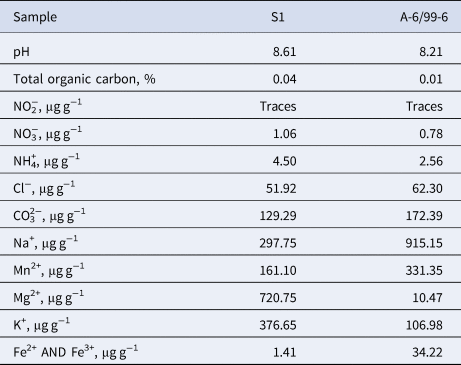
The sample A-6/99-6 was taken from 1.3–1.5 m depth in 6/99 well drilled in the flat area of the Beacon Valley (Antarctic, Dry Valleys, 77°50′S, 160°36′E, 1270 m above sea level) (Gilichinsky et al., Reference Gilichinsky, Wilson, Friedmann, Mckay, Sletten, Rivkina, Vishnivetskaya, Erokhina, Ivanushkina, Kochkina, Shcherbakova, Soina, Spirina, Vorobyova, Fyodorov-Davydov, Hallet, Ozerskaya, Sorokovikov, Laurinavichyus, Shatilovich, Chanton, Ostroumov and Tiedje2007). Sedimentary rock is coarse-grained sand with inclusions of pebbles cemented by ice into a massive cryogenic structure with a depth of at least 20 m (Sugden et al., Reference Sugden, Marchant, Potter, Souchez, Denton, Swisher and Tison1995). A-6-99/6 sample is coarse-grained sand with a small amount of ice – the moisture content of the thawed sample was about 6%. The lowest temperature recorded in the permafrost samples studied is −18.5°C. After sampling and transportation till experiment, the sample was stored at −18°C. The chemical characterization of the samples was carried out as described previously (Cheptsov et al., Reference Cheptsov, Belov, Vorobyova, Osipov and Bulat2019) and is shown in Table 1.
Chemical characteristic of the samples

Samples incubation
To conduct the model experiment, two weights of 20 g were taken from each soil and placed in sterile 50 ml polypropylene containers. One series of 20 g samples was moistened with 5 ml of sterile distilled water (designated as S1-H2O and A-6/99-6-H2O samples), the other with 5 ml of sterile 20% NaClO4 solution (S1-ClO4− and A-6/99-6-ClO4− samples), thus obtaining a final concentration of perchlorate of 5% relative to the weight of the soil in the container. In this way, the total water content in the samples (the sum of the moisture initially contained in the samples and the added water) was 21.5 and 26% (w/w) for S1 and A-6/99-6 samples, respectively. No organic substrates were added to the samples. Moistened samples were incubated in closed containers at a temperature of 28°C for 10 days. The incubation temperature was chosen based on data about the prevalence of mesophiles in permafrost and arid soils (Cheptsov et al., Reference Cheptsov, Vorobyova, Manucharova, Gorlenko, Pavlov, Vdovina, Lomasov and Bulat2017, Reference Cheptsov, Vorobyova, Belov, Pavlov, Tsurkov, Lomasov and Bulat2018a; Belov et al., Reference Belov, Cheptsov and Vorobyova2018, Reference Belov, Cheptsov, Vorobyova, Manucharova and Ezhelev2019) as well as on the results of previous studies of the S1 and A-6/99-6 samples (Cheptsov et al., Reference Cheptsov, Vorobyova, Osipov, Manucharova, Polyanskaya, Gorlenko, Pavlov, Rosanova and Lomasov2018b, Reference Cheptsov, Vorobyova, Polyanskaya, Gorlenko, Pavlov and Lomasov2018c, Reference Cheptsov, Vorobyova, Gorlenko, Manucharova, Pavlov and Lomasov2018d).
After incubation of all the samples, plating on solid nutrient media with further counting of the culturable bacteria numbers was carried out, the total numbers of prokaryotes and the numbers of metabolically active prokaryotes were estimated, the functional activity of the communities was evaluated by multisubstrate testing (MST). The same set of analyses was performed for the microbial communities of the control native samples that were not subjected to moistening and incubation (S1-Control and A-6/99-6-Control samples).
Epifluorescence microscopy
The total number of prokaryotes in the samples was determined with epifluorescence microscopy (EFM) with acridine orange dye. Cell desorption was carried out by vortexing using Heidolph Multi Reax vortex (Schwabach, Germany) for 30 min at 2000 rpm. The preparations were produced in six replicates per sample, fixed by heating, then stained with a water solution of acridine orange (1:10 000) for 3 min, then washed and viewed under the Primo Star (Zeiss, Germany) microscope with fluorescence epi-illumination system (AmScope, Irvine, CA, USA) at 700× magnification for 20 fields of vision for each replication. Cells with green fluorescence were counted. The water used for the dilution preparation was simultaneously examined as control.
The prokaryotic cells number was calculated using equation (1)

where N is the number of cells per gram of soil; S 1 is the area of the preparation (μm2); a is the number of cells in the field of view; n is the dilution index; V is the volume of the soil suspension drop placed on the glass (ml); S 2 is the field of view of the microscope (μm2); and c is the sample weight (g) (Belov et al., Reference Belov, Cheptsov and Vorobyova2018).
Culturing
Determination of culturable heterotrophic aerobic bacteria number was carried out by plating on solid nutrient peptone-yeast-glucose (PYG) media and Reasoner's 2A media (R2A) (van der Linde et al., Reference van der Linde, Lim, Rondeel, Antonissen and de Jong1999; Belov et al., Reference Belov, Cheptsov, Vorobyova, Manucharova and Ezhelev2019). Each sample was diluted using sterile distilled water at 1:10 ratio. For cell desorption, the suspensions were vortexed using Heidolph Multi Reax vortex (Schwabach, Germany) for 30 min at 2000 rpm. After preparation of a series of tenfold dilutions in sterile distilled water, aliquots of each dilution were plated on the surface of a solid nutrient medium in three replicates. The culturing was carried out at 28°C temperature; the number of colony-forming units (CFU) was counted after 2 weeks of the Petri dishes incubation and after 2 weeks more the dishes were checked for the case of growth of extra colonies.
Fluorescence in situ hybridization
The analysis of metabolically active prokaryotes was performed using the fluorescence in situ hybridization immediately after the incubation of the samples. Each sample was placed in sterile phosphate-buffered saline (PBS) (10 mM, рН 7.4) in dilution 1:10. Prokaryotic cells were desorbed from mineral particles using sonification with a Soniprep 150 ultrasonic disintegrator (MSE, Heathfield, UK) for 2 min at 50% power and a frequency of 22 kHz. Separation of prokaryotic cells and mineral particles was then performed by centrifugation at 2000 rpm for 10 min. The supernatant was taken and centrifuged at 14 500 rpm for 15 min for the cell precipitation. Cell fixation was carried out with formaldehyde, for which cells were resuspended in PBS, containing 3% formaldehyde and then vortexed at 2000 rpm for 90 min. After that, the cells were precipitated by centrifugation at 14 500 rpm for 15 min, washed twice by sterile PBS and then resuspended in sterile PBS. Finally, the cells were fixed on slides with Teflon coats and consistently washed in the ethanol concentrations of 50, 80 and 96% for 3 min for each concentration.
Hybridization was performed according to the method described by Amann and Ludwiq with RNA-specific probes with Cy3 fluorescent dye for detection of Bacteria and Archea representatives (Amann and Ludwiq, Reference Amann and Ludwig2000). Hybridization and flushing buffer solutions compositions, as well as a detailed protocol, are described in Manucharova et al. (Reference Manucharova, Vlasenko, Men'ko and Zvyagintsev2011).
The preparations were produced in four replicates, viewed under the ZEISS Mikroskop Axioskop 2 plus (Zeiss) fluorescent microscope with Filter set 15 filters at 700× magnification for 50 fields of vision for each replication. Cells with red fluorescence were counted.
The prokaryotic cell numbers were calculated using equation (1).
Community-level physiological profiling
To assess the potential functional activity of the microbial communities, the MST was performed (Cheptsov et al., Reference Cheptsov, Vorobyova, Osipov, Manucharova, Polyanskaya, Gorlenko, Pavlov, Rosanova and Lomasov2018b and references therein). The testing was carried out with 47 substrates including sugars, alcohols, amino acids, salts of organic acids and polymers (all substrates are listed in Cheptsov et al. (Reference Cheptsov, Vorobyova, Osipov, Manucharova, Polyanskaya, Gorlenko, Pavlov, Rosanova and Lomasov2018b), all tests were performed in two replicates). Each sample was diluted (1:30) in sterile distilled water and vortexed for 30 min at 2000 rpm using Heidolph Multi Reax vortex. The mineral particles were precipitated by centrifugation (2000 rpm, 2 min). The hydrogenase activity indicator (triphenyltetrazolium bromide) was added to the supernatant, and after mixing, a 200 μl aliquot was added to each well of a 96-well plate containing mineral salts and the set of 47 test substrates in two replicates. The plates were incubated at 28°C for 72 h. After the incubation, the optical density of the solutions was measured photometrically at a wavelength of λ = 510 nm using a Uniplan (Pikon Ltd., Russia) plate photometer.
Gas chromatography-mass spectrometry of lipids
The taxonomic structure of microbial communities in situ was studied by gas chromatography-mass spectrometry (GC-MS) of lipids for the Xerosol samples due to its more pronounced reaction according to the results of culturing, EFM, FISH and MST compared to the permafrost samples. The analysis was carried out on the GC-MS system HP-5973 Agilent Technologies (USA) using the technique of multi-ion mass fragmentography of specific ions of mass spectra of genera- and species-specific higher fatty acids and cell wall aldehydes (Turova and Osipov, Reference Turova and Osipov1996; Shekhovtsova et al., Reference Shekhovtsova, Osipov, Verkhovtseva and Pevzner2003). Detailed description of sample preparation and analysis are presented in Cheptsov et al. (Reference Cheptsov, Vorobyova, Osipov, Manucharova, Polyanskaya, Gorlenko, Pavlov, Rosanova and Lomasov2018b).
Data analysis
Statistical data processing was performed using the Microsoft Office Excel 2018 software package (Redmond, Washington, USA). The numbers of cells were recalculated to the mass of the dry sample. For data on cell numbers, the confidence limits of the mean were calculated by standard error of the mean multiplied by Student's t-criteria for 95% probability. Cluster analysis was performed in Statistica 7.0 (StatSoft, Tulsa, Oklahoma, USA). Indices of diversity and similarity of microbial communities were calculated according to Chernov and Lysak (Reference Chernov and Lysak2008).
Results
The total number of prokaryotes and the number of cultured bacteria (EFM and culturing)
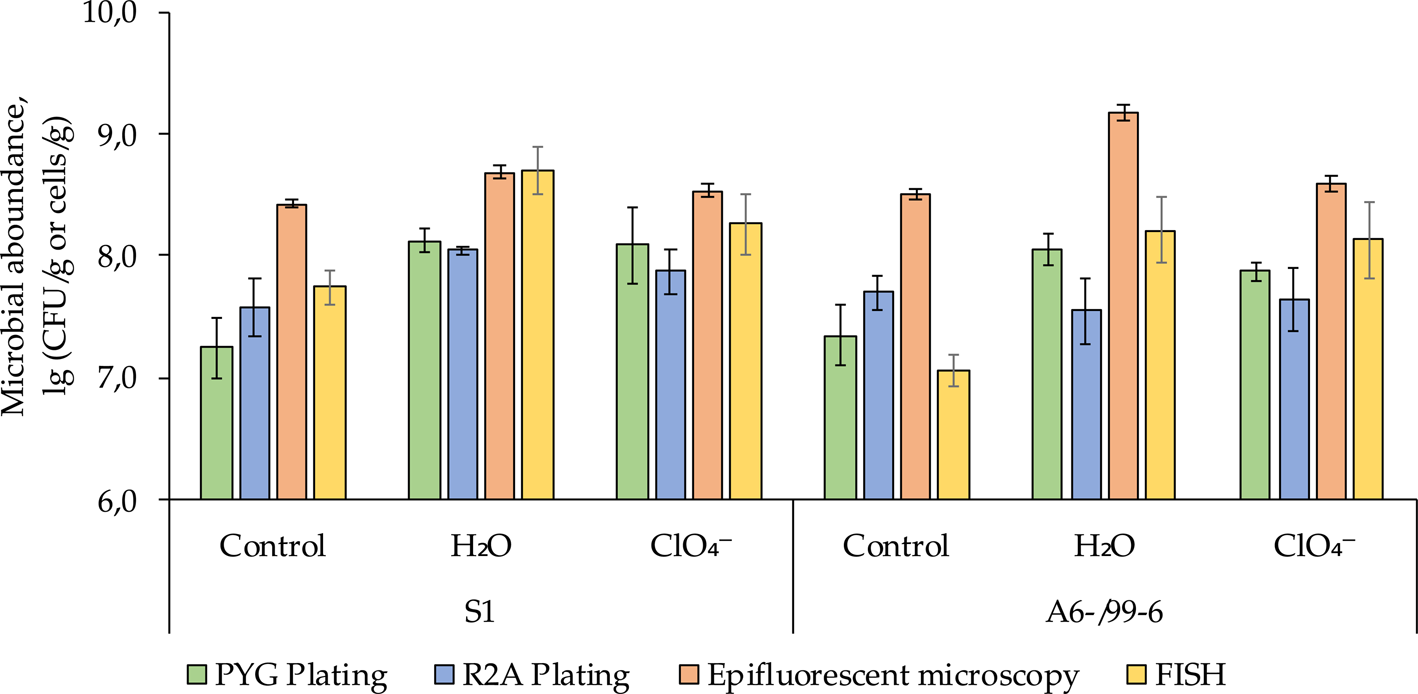
The total numbers of prokaryotes in control samples of the Xerosol and in the Antarctic permafrost were (2.7 ± 0.2) × 108 and (3.2 ± 0.6) × 108 cells g−1, respectively. After incubation with distilled water, the number of prokaryotes in the soil and permafrost increased by 1.8 and 4.7 times, respectively. In the samples supplemented with sodium perchlorate, the total number of prokaryotes also exceeded the control values, however only by 20–30% (Fig. 1).
The number of prokaryotes in the samples studied: PYG Plating – the number of CFU g−1 cultured on PYG medium, R2A Plating – the number of CFU g−1 cultured on R2A medium, EFM – the total number of prokaryotes in situ determined by the EFM method, cells g−1, FISH – the number of metabolically active prokaryotes in situ determined by the FISH method (the sum of metabolically active Bacteria and Archaea), cells g−1. Error bars are corresponding with the 95% confidence limits.

The CFU numbers of heterotrophic aerobic bacteria in the S1-H2O and S1-ClO4− samples were nearly the same and almost an order higher than the control values on the PYG medium and 2–4 times higher on the R2A medium. A significant increase in the number of cells cultured on the PYG medium was also observed in permafrost – by 5 and 3 times at the incubation with water and a perchlorate solution, respectively, while the number of bacteria cultured on R2A practically did not change (Fig. 1).
Thus, incubation of the samples with both water and a perchlorate solution led to an increase in the number of prokaryotes; however, an increase in the number of prokaryotes was less significant in the presence of perchlorate.
The number of metabolically active bacteria and archaea (FISH)
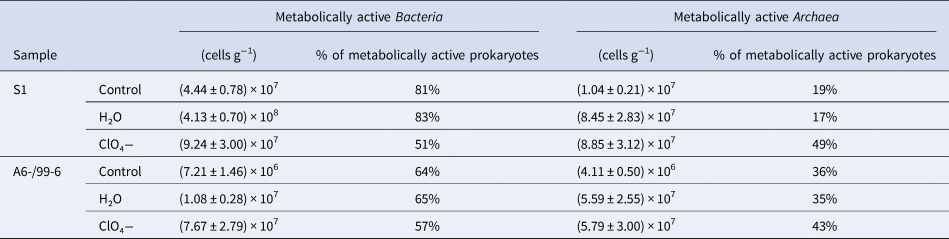
An increase in the number of metabolically active prokaryotes was observed in all incubated samples in comparison with the native control samples. The cell number of Archaea increased 8.1–8.4 times in the soil and 1.4 times in the permafrost not depending on the presence of perchlorate. The number of bacteria increased by 9.3 and 2.1 times in samples S1-H2O and S1-ClO4−, respectively. The number of Bacteria increased 10.6 times in the permafrost incubated with perchlorate and 14.7 times in the permafrost incubated with distilled water (Fig. 1). Thus, unlike Archaea, Bacteria demonstrated sensitivity to the presence of perchlorate. Thereby, an increase in the proportion of metabolically active representatives of the Archaea domain was noted in the perchlorate-containing samples, especially in the Xerosol sample (Table 2).
The numbers of metabolically active prokaryotes in the samples studied

Incubation with both water and salt solution led to an increase in the proportion of metabolically active prokaryotic cells of the total number of prokaryotes determined by the EFM method. The number of metabolically active cells in sample S1-H2O was revealed at the level of the total number of prokaryotes in this sample; in the Xerosol sample with the addition of perchlorate, the number of metabolically active prokaryotes was two times lower than the total number of cells. The proportion of metabolically active prokaryotes in samples A-6/99-6-H2O and A-6/99-6-ClO4− was 11 and 35%, respectively (Table 2).
Based on these results, the conclusion could be made that the presence of perchlorate in situ did not inhibit the growth and/or activation of archaeal metabolism, but had an inhibitory effect on bacteria.
Metabolic fingerprints of microbial communities
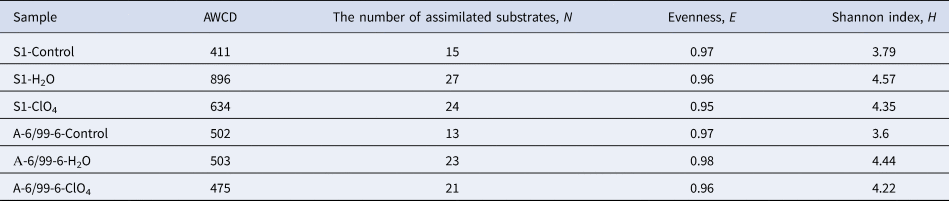
The average consumption of substrates (average well colour development, AWCD index) by the microbial community of Xerosol, revealed by MST, in samples incubated with perchlorate solution and water was higher than the control level 1.5 and 2.2 times, respectively. A less distinct reaction was observed in the samples of the permafrost, for which the metabolic activity of both incubated samples showed practically no difference from the control (Table 3).
Indices of functional diversity and potential metabolic activity of the microbial communities studied

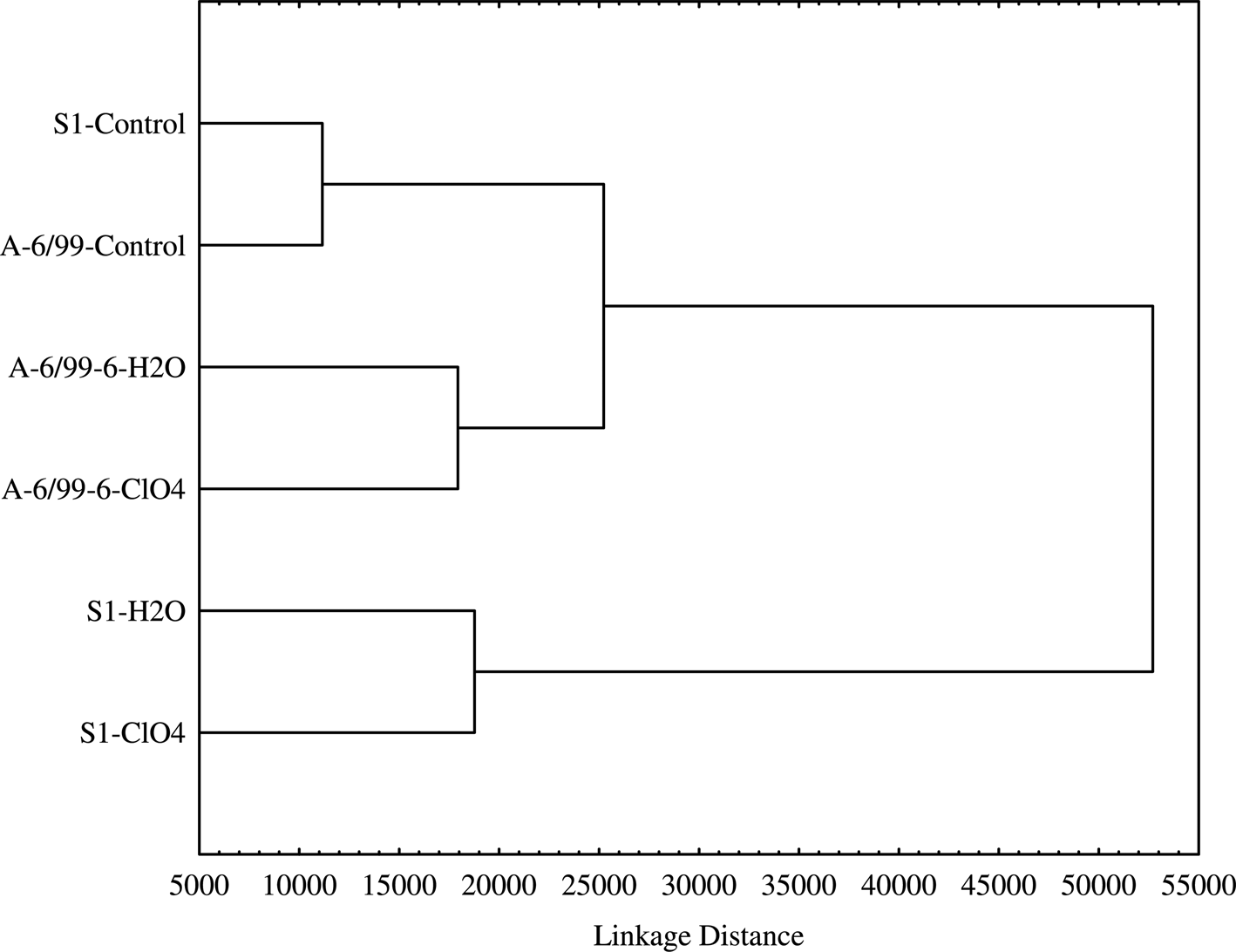
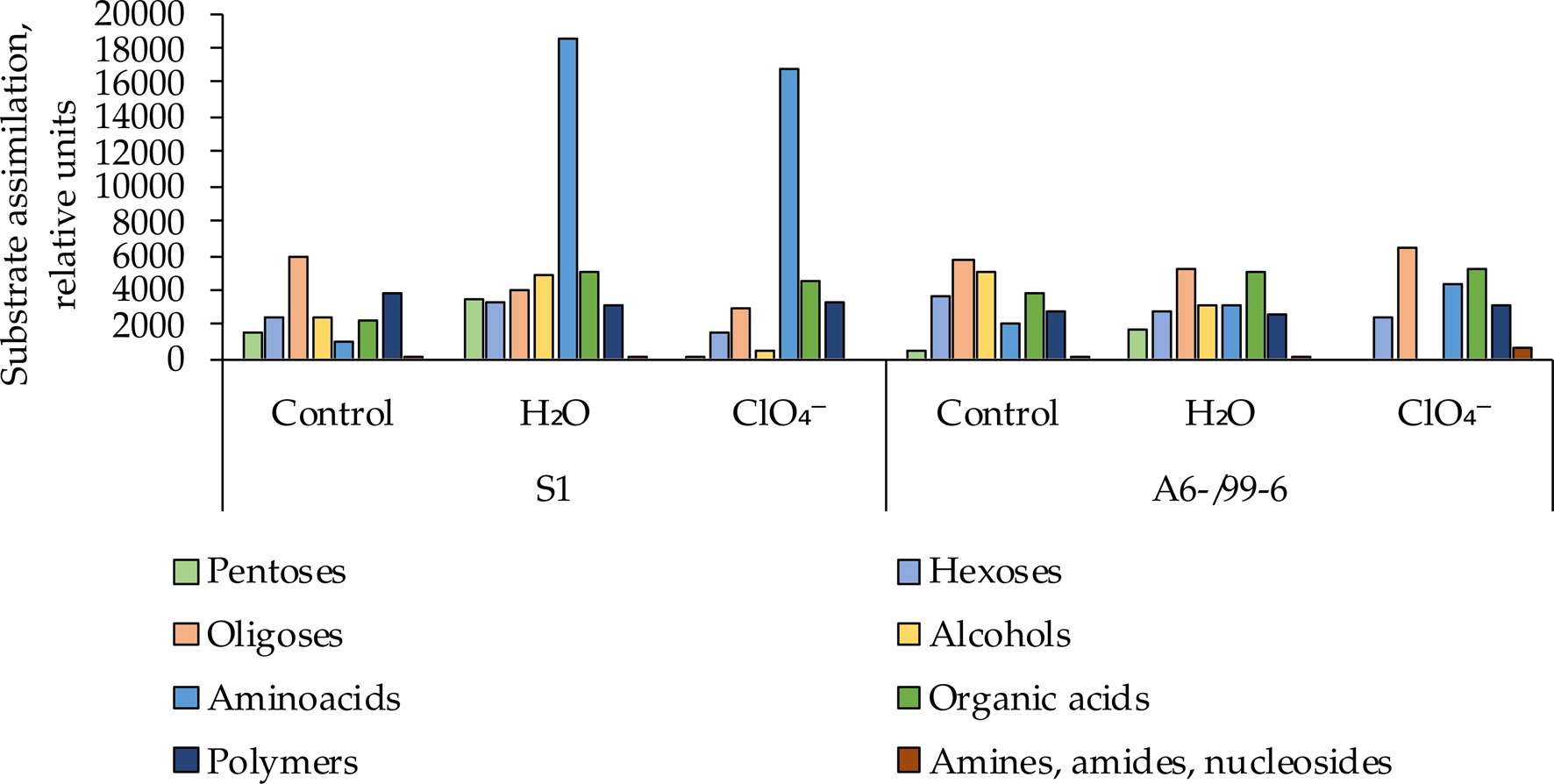
At the same time, all incubated samples demonstrated an increase in the diversity of consumed substrates and a rise of the Shannon index (Table 3). Along with that, the greatest variety of consumed substrates was noted for samples incubated with water. Cluster analysis of metabolic fingerprints of microbial communities showed that despite the expectations, the substrates consumption spectra of communities of samples incubated with perchlorates do not combine into one cluster (Fig. 2). The substrates consumption spectra of Xerosol underwent the greatest restructuring: in the S1-H2O sample, an increase in the assimilation of amino acids, alcohols, pentoses, hexoses and organic acids and a decrease in the assimilation of oligosaccharides and polymers were observed; in the S1-ClO4− sample, the most actively assimilated substances were amino acids and organic acids (Fig. 3). While the consumption spectra of substrates for samples incubated with water and with a perchlorate solution were quite similar, reduced consumption of pentoses and alcohols by the microbial community in the presence of perchlorates in sample S1-ClO4− was observed; the microbial community of the permafrost incubated with perchlorate did not consume pentoses and alcohols at all, while began to consume amines, amides and nucleosides.
Cluster analysis of microbial communities' metabolic fingerprints. Clusterization was performed using Ward's method; distance metric is City-block (Manhattan) distances. Number of variables – 6, number of cases – 47.

Consumption of different classes of substrates by microbial communities.

In general, the presence of sodium perchlorate at 5% concentration did not have a significant inhibitory effect on the potential metabolic activity and functional diversity of the microbial communities of the studied samples.
Microbial diversity in Xerosol according to GC-MS of lipids
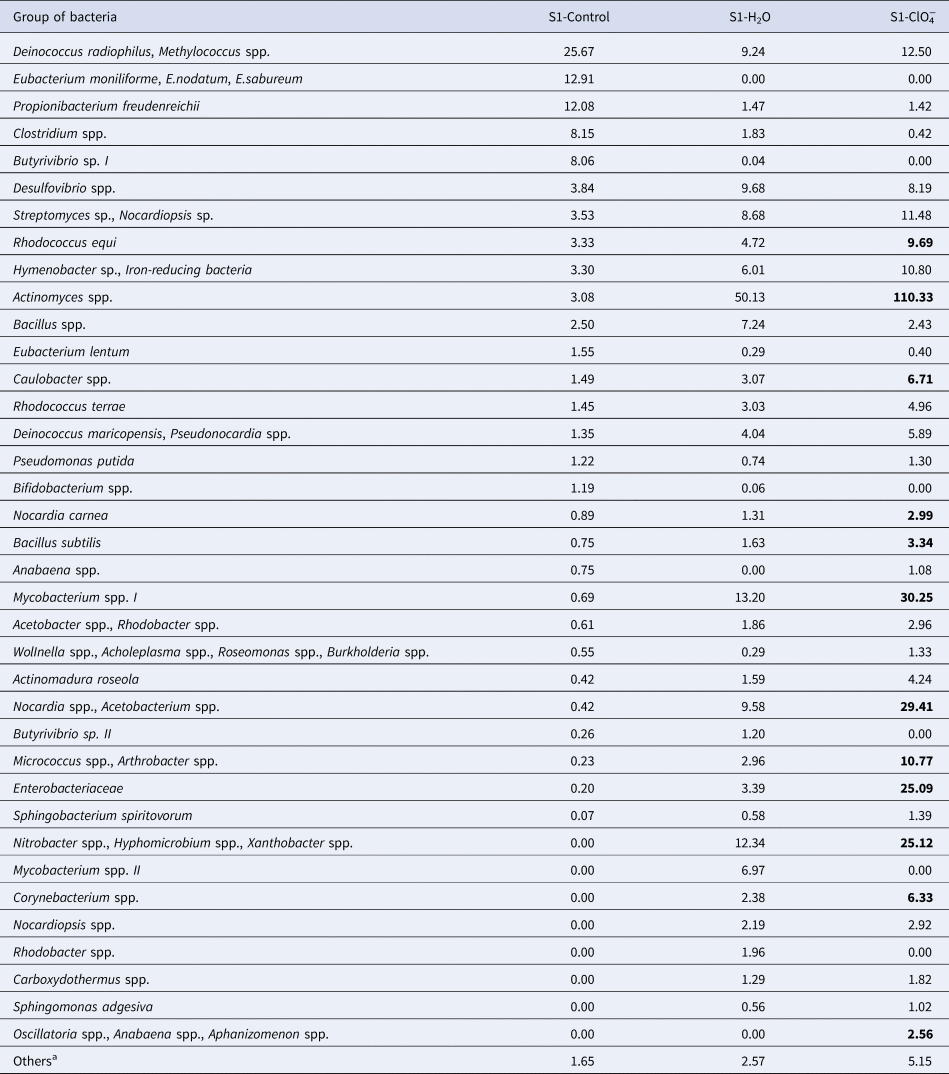
Lipid markers specific for 40, 46 and 44 groups of bacteria were detected using GC-MS in a native control, incubated with water and incubated with a solution of perchlorate samples, respectively (Table 4). A wide diversity of prokaryotes belonging to the phyla Actinobacteria, Proteobacteria, Firmicutes, Bacteroidetes was revealed, the dominance of which is typical for desert ecosystems (Belov et al., Reference Belov, Cheptsov and Vorobyova2018, Reference Belov, Cheptsov, Vorobyova, Manucharova and Ezhelev2019).
Number of cells ( × 105 cells g−1) of different bacterial groups in samples of Xerosol soil according to GC-MS of lipids

Bold indicates the values of cells number in S1-ClO4− sample, most significantly exceeds corresponding values registered in control sample and sample, incubated with water.
a The Others group includes groups of bacteria, the number of which in none of the samples did not exceed 106 cells g−1: Aeromonas hydrophila, Anabaena spp., Aphanizomenon spp., Butyrivibrio sp. III, Clostridium perfringens, Cytophaga spp., Eubacterium spp., Hymenobacter spp., Malassesia spp., Microcystis spp., Pontibacter spp., Pseudomonas fluorescens, Pseudomonas vesicularis, Riemirella spp., Sphingomonas capsulata, Streptococcus mutans, Xanthomonas spp.
Incubation with both water and perchlorate solution led to a significant reorganization of the microbial community structure. In particular, in both cases, the concentration of markers typical for bacteria of the genera Eubacterium, Clostridium, Propionibacterium decreased, while the concentration of lipids typical for Actinomyces, Nocardia, Acetobacterium, Micrococcus, Arthrobacter, Enterobacteriaceae, Nitrobacter, Hyphomicroberium, Xphomicroberium and some other taxa increased (Table 4). The largest rise was observed for Actinobacteria. It was revealed that the sample with 5% sodium perchlorate compared with the sample incubated with water was approximately two times higher in the number of Actinobacteria and Bacteroidetes phylum representatives, was 1.6 times lower in the number of Firmicutes phylum representatives. An increase of Cyanobacteria phylum representatives was detected, the number of which was below the detection limit in sample S1-H2O.
Community similarity indices calculated on the basis of their structure according to GC-MS lipids indicate that there was high similarity of microbial communities of both incubated samples. This similarity was greater than that obtained by comparing the microbial community of the native control samples for both incubated samples (Table 5). These results are in good agreement with the cluster analysis data of the metabolic profiles of microbial communities. Despite some differences in structure, microbial communities in the presence of perchlorate and without it were developing in a similar way as almost an identical set of bacterial groups could be found with the same dominant groups.
Communities similarity indices based on lipid GC-MS community structure data

Discussion
The response of microbial communities to the presence of perchlorate and possible causes of high tolerance
During the experiment, a significant increase in the number of prokaryotes was revealed in samples incubated with distilled water and a perchlorate solution. The increase was higher in the samples, incubated with water, which is associated with the inhibitory effect of perchlorate, however this inhibition was not significant. According to the numbers of cultured cells and MST, the microbial community of Xerosol was more responsive to incubation than the permafrost sample. With comparable values of the total number of prokaryotes in the control samples, the proportion of metabolically active prokaryotes in Xerosol was higher than in permafrost, which may be associated with high abundance of bacteria in a resting and/or dormant state, the reactivation of which requires a longer time of sample incubation. A high abundance of resting and dormant forms of prokaryotes is typical for microbial communities of permafrosts (Soina et al., Reference Soina, Mulyukin, Demkina, Vorobyova and El-Registan2004; Soina and Vorobyova, Reference Soina and Vorobyova2004; Goordial et al., Reference Goordial, Davila, Greer, Cannam, DiRuggiero, McKay and Whyte2017).
Data on metabolic profiles and taxonomic diversity of microbial communities incubated with water and perchlorates indicate their high similarity. It could be suggested that the presence of perchlorates was not the main factor determining the functional diversity and metabolic activity of microbial communities. Probably, studied microbial communities responded primarily to the presence of water, while the final result of ecological succession was mostly determined by the initial content of the microbial community, as evidenced by the high similarity of metabolic fingerprints of the samples in pairs S1-H2O and S1-ClO4−, A-6/99-6-H2O and A-6/99-6-ClO4−, as well as confirmed by data for lipid content revealed by GC-MS analysis. An increase in the proportion of Actinobacteria phylum representatives was observed in a Xerosol sample incubated with perchlorate, which is consistent with data on their high metabolic mobility and resistance to desiccation, ionizing radiation, oxidative stress and also their detection as dominant in hypersaline perchlorate-containing ecological niches (Connon et al., Reference Connon, Lester, Shafaat, Obenhuber and Ponce2007; Neilson et al., Reference Neilson, Quade, Ortiz, Nelson, Legatzki, Tian, LaComb, Betancourt, Wing, Soderlund and Maier2012; Mohammadipanah and Wink, Reference Mohammadipanah and Wink2016).
A higher tolerance to perchlorate was detected for Archaea in comparison to Bacteria according to the FISH analysis results. Earlier, archaeal family Halobacteriaceae showed to have a resistance to high UV and γ radiation levels, the ability to persist for a long time within brine inclusions in salt crystals, as well as tolerance to perchlorates (at a concentration of 1.2%) which participate in anaerobic metabolism (Oren, Reference Oren2014; Serrano et al., Reference Serrano, Alawi, de Vera and Wagner2019). The maximum NaClO4 concentration suitable for the growth of Archaea is currently considered to be 9.8% (Heinz et al., Reference Heinz, Krahn and Schulze-Makuch2020). Non-halophilic archaea also demonstrated metabolic activity in the presence of more than 0.22% magnesium perchlorate (Shcherbakova et al., Reference Shcherbakova, Oshurkova and Yoshimura2015). However, high resistance to the factors mentioned above is also shown for a wide variety of bacteria (Harrison et al., Reference Harrison, Gheeraert, Tsigelnitskiy and Cockell2013; Musilova et al., Reference Musilova, Wright, Ward and Dartnell2015; Cheptsov et al., Reference Cheptsov, Vorobyova, Belov, Pavlov, Tsurkov, Lomasov and Bulat2018a; Belov et al., Reference Belov, Cheptsov, Vorobyova, Manucharova and Ezhelev2019; Takai, Reference Takai2019), and there are bacteria known to grow at higher concentrations of perchlorate (Heinz et al., Reference Heinz, Krahn and Schulze-Makuch2020). In this regard, it is unclear whether the higher tolerance of Archaea is a feature of the studied microbial communities or whether Archaea have a higher tolerance to perchlorates in general. Obviously, further research is required to answer this question.
It is unclear whether the differences between microbial communities with and without perchlorate addition are related to the oxidizing properties of perchlorate, or whether they are due to an increase in the concentration of sodium and magnesium ions and/or a change in the osmotic strength of the solution. To elucidate the mechanism of perchlorate action on microorganisms in soils, it is necessary to carry out parallel incubation and analysis of samples both in the presence of perchlorate and in the presence of other salts, for example, chlorides, which do not possess the properties of strong oxidizers. It is shown that about 30–70% of culturable heterotrophic aerobic bacteria isolated from arid soils and permafrosts are able to grow in media containing 5% NaCl (Belov et al., Reference Belov, Cheptsov and Vorobyova2018, Reference Belov, Cheptsov, Vorobyova, Manucharova and Ezhelev2019, Reference Belov, Cheptsov, Manucharova and Ezhelev2020a, Reference Belov, Cheptsov, Vorobyova, Manucharova and Ezhelev2020b). It is known that sodium chloride at concentrations ~5% inhibit microbial growth (in terms of [3H]-leucine incorporation into biomass) and respiration in soils at 2–3 times (Wichern et al., Reference Wichern, Wichern and Joergensen2006; Rousk et al., Reference Rousk, Elyaagubi, Jones and Godbold2011; Rath et al., Reference Rath, Maheshwari, Bengtson and Rousk2016). Such effects are comparable with some results of perchlorate addition in our experiment, in particular, with less increase of total prokaryotes count compared with incubation without perchlorates. At the same time, a number of microbial communities' characteristics were only slightly affected by perchlorates addition, e.g. number of culturable bacteria, potential metabolic activity, functional diversity, etc. It suggests that 5% perchlorate may cause even less effect on soil microbial communities in situ compared with sodium chloride in the same concentration.
The concentration of perchlorate used in the study exceeds the perchlorate content in the Martian regolith and in several orders greater than in the perchlorate-containing earth soils (Navarro-Gonzalez et al., Reference Navarro-Gonzalez, Sutter, Archer, Ming, Eigenbrode, Franz, Glavin, McAdam, Stern, McKay, Coll, Cabane, Conrad, Mahaffy, Martín-Torres, Zorzano-Mier and Grotzinger2013; Calderon et al., Reference Calderon, Palma, Parker, Molina, Godoy and Escudey2014). This concentration is not the limit at which the survival of certain microorganisms is indicated. However, this concentration can inhibit the growth and metabolic activity of microorganisms and lead to their death (Matsubara et al., Reference Matsubara, Fujishima, Saltikov, Nakamura and Rothschild2017; Beblo-Vranesevic et al., Reference Beblo-Vranesevic, Huber and Rettberg2017b; Belov et al., Reference Belov, Cheptsov and Vorobyova2018, Reference Belov, Cheptsov, Vorobyova, Manucharova and Ezhelev2019, Reference Belov, Cheptsov, Manucharova and Ezhelev2020a, Reference Belov, Cheptsov, Vorobyova, Manucharova and Ezhelev2020b). Thereby, the discovery of such a high tolerance of soil microbial communities is somewhat unexpected. However, it should be noted that in studies of the tolerance of microorganisms to high concentrations of perchlorates, the sensitivity of individual strains was studied, while in this study, the influence of perchlorates on the microbial community in situ was researched. In this case, there are factors that could contribute to a greater tolerance such as interactions between different species and populations of organisms, interaction with a pool of metabolites, the release of redox enzymes by individual organisms, the formation of complex cellular aggregates, including the mineral particles (Cheptsov et al., Reference Cheptsov, Vorobyova, Belov, Pavlov, Tsurkov, Lomasov and Bulat2018a and references therein). Due to the high heterogeneity of the soil as a habitat and the presence of hydrophilic and hydrophobic loci, as well as various sorption processes (Diehl, Reference Diehl2013), distribution of perchlorates may be uneven when they are added in the form of a solution, due to which some microorganisms may be affected by lower or higher concentrations. A decrease in the concentration of perchlorates in individual microlocus due to perchlorate reduction could also be suggested (Bardiya and Bae, Reference Bardiya and Bae2011).
The high tolerance demonstrated by the studied microbial complexes of extreme habitats may also be due to the presence of adaptations to oxidative stress. It is known that the mechanisms of resistance to various types of stress are closely related (Cabiscol et al., Reference Cabiscol Català, Tamarit Sumalla and Ros Salvador2000; Wassmann et al., Reference Wassmann, Moeller, Reitz and Rettberg2010; Chattopadhyay et al., Reference Chattopadhyay, Raghu, Sharma, Biju, Rajasekharan and Shivaji2011; Musilova et al., Reference Musilova, Wright, Ward and Dartnell2015). In communities existing under conditions of moisture deficiency and extreme temperatures, resistance mechanisms should be well developed (Fierer et al., Reference Fierer, Leff, Adams, Nielsen, Bates, Lauber, Owens, Gilbert, Wall and Caporaso2012; Goordial et al., Reference Goordial, Davila, Greer, Cannam, DiRuggiero, McKay and Whyte2017). The results are consistent with the previously shown high radioresistance of the microbial communities of the studied samples (Cheptsov et al., Reference Cheptsov, Vorobyova, Osipov, Manucharova, Polyanskaya, Gorlenko, Pavlov, Rosanova and Lomasov2018b, Reference Cheptsov, Vorobyova, Polyanskaya, Gorlenko, Pavlov and Lomasov2018c, Reference Cheptsov, Vorobyova, Gorlenko, Manucharova, Pavlov and Lomasov2018d), as well as with information regarding the high per cent of perchlorate-tolerant bacteria in microbial communities of desert soils and permafrost (Belov et al., Reference Belov, Cheptsov and Vorobyova2018, Reference Belov, Cheptsov, Vorobyova, Manucharova and Ezhelev2019, Reference Belov, Cheptsov, Manucharova and Ezhelev2020a, Reference Belov, Cheptsov, Vorobyova, Manucharova and Ezhelev2020b).
Implications and further studies
The obtained results demonstrate that the concentrations of perchlorates 0.5–1% found in the Mars regolith not only strictly limit the development of microorganisms (as was shown earlier), but also should not significantly inhibit per se the development of terrestrial microbial communities in Martian regolith. At the same time, it is obvious that the existence of econiches with both lower and higher concentrations of perchlorates is possible due to the heterogeneity of the regolith. In particular, the estimated crystallization temperature of solutions in RSL is −50°С (Chevrier and Rivera-Valentin, Reference Chevrier and Rivera-Valentin2012), which is achieved at a concentration of sodium perchlorate of 52% (Chevrier et al., Reference Chevrier, Hanley and Altheide2009), which is an order higher than used in this experiment. Studying the presence of sodium perchlorate at the 5% concentration reduces the crystallization temperature of the solution by a maximum of 1.5°С (Hennings et al., Reference Hennings, Heinz, Schmidt and Voigt2013).
We have considered the perchlorate effect in the model of hypothetical wet regolith layer, in situation where microbial activity is possible. However, the effect of perchlorate on the microorganisms' survival in dry regolith in the absence of available water (including hygroscopic water) remains unclear. Obviously, this effect should be different due to the absence of the possibility of damages reparated by microorganisms in the absence of liquid water, as well as due to a different distribution of the salt in the soil on microscales. The study of this issue would supplement the knowledge about the long-term preservation possibility of microorganisms between hypothetical periods, when their metabolic activity, growth and reproduction are possible.
The revealed high tolerance to perchlorates is an argument in favour of the possibility of the survival of contaminant microorganisms, which can be brought to the surface of Mars during space landing missions. This emphasizes the feasibility of strict adherence to the norms of planetary quarantine and the need to improve methods for reducing the microbial burden on spacecrafts.
The detected response of microbial communities to high concentrations of perchlorates allows to determine a number of areas for further research. The primary tasks are to define the maximum concentration of perchlorates at which the reproductive and metabolic activity and/or viability of soil microbial communities in situ is maintained, the identification of the most tolerant groups of microorganisms (with their possible use as model objects in astrobiological studies), comparison of microbial sensitivity in situ and in pure culture, the search for factors that ensure the high tolerance of microorganisms. The next step could be a more complete reproduction of the chemical composition of regolith and solutions, the existence of which is possible on Mars, with an evaluation of the effect of the chemical composition on the survival, taxonomic diversity and functional activity (including perchlorate reduction) of microbial communities. Further, it also seems necessary to simulate the salt composition in combination with low temperatures and anaerobic conditions in order to reproduce a set of key factors that could limit the growth of microorganisms in the regolith with a salt content at a level sufficient for the appearance of available water.
Conclusion
The presence of perchlorate in soil at concentrations ten times higher than that found in Martian regolith has a weak inhibitory effect on the microbial communities of soils and sediments of extreme ecosystems: in the samples incubated with a 5% perchlorate solution, there was a smaller increase in the total number of prokaryotes and metabolically active bacteria, as well as a smaller increase in potential metabolic activity and functional diversity than in the samples incubated with water. At the same time, in the presence of perchlorates, a comparable increase in the number of cultured bacteria and metabolically active Archaea and the formation of communities similar in taxonomic structure and metabolic fingerprints were noted. Probably, the toxic effect of perchlorates in a heterophase soil environment is reduced due to the heterogeneity of the distribution of perchlorate at the microscales due to the interaction of cells with each other, with a mineral matrix and/or with a pool of metabolites. A study of the reaction of microbial communities to the presence of higher concentrations of perchlorate in the soil, determination of the maximum concentration of perchlorates at which metabolic activity is observed in situ and an investigation of perchlorate in the soil are planned to be conducted during further researches.
Acknowledgements
The authors express their gratitude to D.A. Gilichinsky, now deceased, for the provision of permafrost samples. The study was partially funded by PRAS no. 17 (Evolution of organic world. Role and influence of planetary processes), subprogram 1. The authors thank anonymous reviewer for help in improving the manuscript.