Introduction
Host plant resistance is an essential tool for the management of the banana weevil Cosmopolites sordidus (Germar) (Coleoptera: Curculionidae), the most important pest of banana in eastern Africa (Gold et al., Reference Gold, Pena and Karamura2001; Kiggundu et al., Reference Kiggundu, Gold, Labuschagne, Vuylsteke and Laow2003). This weevil caused over 40% yield loss and reduced banana plantation life in research trials (Rukazambuga et al., Reference Rukazambuga, Gold and Gowen1998; Gold et al., Reference Gold, Kagezi, Night and Ragama2004). Damage and yield loss increase over time and tend to be higher in ratoon crops.
Adult banana weevils have limited mobility and live in close association with the banana plant (Gold et al., Reference Gold, Kagezi, Night and Ragama2004). Dispersal is mostly through the movement of infested planting material. Eggs are laid singly in the corm or at the base of the pseudostem (Koppenhofer, Reference Koppenhofer1993; Abera et al., Reference Abera, Gold and Kyamanywa1999). Larvae feed primarily on the corm and also on the pseudostem. Weevils prefer laying eggs on older plants in the field (Abera et al., Reference Abera, Gold and Kyamanywa1999), although larvae were shown to perform better on younger plants in the laboratory (Mesquita and Caldas, Reference Mesquita and Caldas1986). Duration of larval stage, most commonly reported to be between 3 and 8 weeks, is influenced by temperature and host material (Mesquita and Caldas, Reference Mesquita and Caldas1986; Traore et al., Reference Traore, Gold, Boivin and Pilon1996; Gold et al., Reference Gold, Nemeye and Coe1999, Reference Gold, Pena and Karamura2001).
East African highland bananas (‘genome’ group AAA-EA) are highly susceptible to banana weevil (Kiggundu et al., Reference Kiggundu, Gold, Labuschagne, Vuylsteke and Laow2003). The letter ‘A’ in the genome represents the number of sets of chromosomes from Musa acuminata Colla (Musaceae); in genome groups where the letter ‘B’ occurs, it represents the sets of chromosomes from Musa balbisiana L. A. Colla (Pillay et al., Reference Pillay, Nwakanma and Tenkouano2000). Screening of banana cultivars for weevil resistance is done through estimates of larval damage to the central cylinder, cortex and corm periphery (Gold et al., Reference Gold, Speijer, Karamura, Tushemereirwe and Kashaija1994). Assessment of damage involves destructive sampling and is normally carried out at harvest (Kiggundu et al., Reference Kiggundu, Gold, Labuschagne, Vuylsteke and Laow2003).
Attempts to study resistance factors in the laboratory have been limited because larvae perform equally well on excised material taken from resistant and susceptible plants (Night et al., Reference Night, Gold and Power2010). It has been hypothesized that there is a breakdown of resistance factors following excision. Similarly this has also been observed in the field where crop residues of highly resistant banana clones (Kisubi and Kayinja) are heavily attacked (Gold and Bagabe, Reference Gold and Bagabe1997). In other plant species, screening of young plants for resistance to insects has been used widely. For instance, potted plants in a screenhouse were used to test for sugar beet resistance to the aphids Myzus persicae Sulzer and Aphis fabae Scopoli (Lowe, Reference Lowe1974). Eenink and Dieleman (Reference Eenink and Dieleman1980) used lettuce plants of 14–45 days of age to screen for resistance to M. persicae.
In some plant species, resistance is induced after insect attack (Baldwin, Reference Baldwin1999). Induced resistance has been observed in various plant-herbivore systems (e.g. Darrow and Bowers, Reference Darrow and Bowers1999; Agrawal, Reference Agrawal2000). A disadvantage of employing induced resistance is that plants sustain damage before the induction response kicks in (Baldwin, Reference Baldwin1999). In the current study, it was hypothesized that cultivars with intermediate levels of weevil damage and resistance employ the induced response.
The objectives of the current study were to: (i) compare survivorship and development rates of larvae feeding on living plants of cultivars varying in resistance levels and (ii) compare effects of previous weevil damage on plant resistance to the development of larvae in subsequent attacks in cultivars of different resistance levels.
Materials and methods
Study site
The studies were conducted between August 2003 and March 2004 at Kawanda Agricultural Research Institute located 13 km north of Kampala, Uganda. Kawanda is at 1195 m above sea level. Day length is constant throughout the year with average daily temperatures of 16 °C minima and 29 °C maxima. Annual rainfall averages 1250 mm in two rainy seasons (March–May and September–November).
Experimental plants and insects, and infestation protocols
Two experiments were conducted. Experiment 1 was conducted to compare the survivorship and development of larvae on different cultivars, and experiment 2 to compare the influence of past plant damage on the survivorship and development of larvae. This section describes plants and insects as well as the infestation procedures used in the two experiments. Methods specific to each experiment are described thereafter.
Plants in the sword sucker or maiden sucker stage (1–6 months old) (Robinson, Reference Robinson and Gowen1995) for use in the two experiments were collected from farmers' fields. The pseudostem was cut back to c. 15 cm, and the suckers were pared to remove weevil eggs and larvae. Pared suckers were planted in 20-litre plastic buckets containing about 10 litres of soil. The buckets were perforated in the bottoms and sides for drainage; the perforations were of such size that weevils could not pass through. The soil was dug from a field formerly planted with coffee and was mixed with farmyard manure in a ratio of 1:1 by volume. The buckets were placed in an enclosure of bamboo sticks to keep out grazing animals. The enclosure was constructed 30 m from other banana stands and separated by weedy secondary growth to prevent infestation by non-experimental conditions unaccounted for weevils. Movement of adult weevils across barriers of >20 m is limited (Gold et al., Reference Gold, Pena and Karamura2001). The plants were watered and weeded as needed.
Larvae were reared from eggs laid in the laboratory by field-collected adults. Weevils were maintained in the laboratory for 3–4 months in plastic buckets (pails). To collect eggs, weevils were provided with fresh suckers in the sword or maiden sucker stage consisting of corm and about 30 cm of pseudostem. The following day, eggs laid in the suckers were exposed by peeling off thin layers of the leaf sheaths using a small knife. Eggs were incubated in Petri dishes lined with moistened tissue paper, and the Petri dishes were sealed using masking tape. The Petri dishes were set on laboratory benches and checked daily for hatching. Hatching occurred in 5–8 days. Larvae that were less than 24 h old were used to infest banana plants.
Infestations were carried out by incising cone-shaped entry holes (approximately 0.6 cm wide and 0.4 cm deep) to simulate tunnels in the plant near the collar (i.e. corm–pseudostem junction) using a small knife. A single larva was inserted in a hole, which was then lightly capped with the plant tissue that had been cut out. Infestation was carried out early in the morning. Previous personal observations suggest that nearly all larvae successfully establish following infestation through such incisions.
Experiment 1. Survivorship and development of larvae on different cultivars
An outdoor pot experiment using six treatments (cultivars) with plants sampled at five different ages was carried out. Treatments included one susceptible (Atwalira, AAA-EA), one intermediate (Kabula, AAA-EA) and three resistant cultivars (Kayinja (ABB), Kisubi (AB) and Yangambi Km5 (AAA)). Resistance categories were based on results obtained in a field screening trial (Kiggundu et al., Reference Kiggundu, Gold, Labuschagne, Vuylsteke and Laow2003). The cultivar FHIA 17 (AAAA), considered tolerant (Gonzalez et al., Reference Gonzalez, Gomez and Aristizabal2004), was also included and grouped with the resistant cultivars. The treatments were completely randomized. The number of plants per cultivar varied due to failure of suckers of some cultivars to establish. Pots were spaced at 0.5 m.
Two pest density trials were conducted: (a) low-density trial: pared (peeled) suckers were planted in May/June 2003 and were infested with five or ten larvae 2–3 months after planting (August 2003); (b) high-density trial: planting was performed in October 2003, and infestation was carried out between January and February 2004 (3–4 months). All plants received 20 larvae each.
Plants were dissected at 5, 15, 25 or 45 days after infestation for determination of number of surviving larvae. For both low- and high-density trials, 4–12 plants of Atwalira, Kabula, FHIA 17 and Yangambi Km5 were sampled at 5, 15, 25 and 45 days; Kayinja and Kisubi were sampled only at 25 and 45 days due to failure of some plantlets to establish. Plants were uprooted and dissected at each sampling date, and the tunnel made by each inserted larva was followed to extract the larva. Percentage larval survivorship was calculated from larval counts. Head capsule widths are an indicator of larval growth rates and were measured as described by Gold et al. (Reference Gold, Nemeye and Coe1999).
Experiment 2. Influence of plant damage on survivorship and development of larvae
Plants of cultivars Atwalira, Kabula and Kisubi from trial (b) in Experiment 1 were saved after sampling. Another set of plants, planted at the same time (October 2003) and left uninfested, served as a control. The number of plants per cultivar per treatment ranged from 13 to 20 depending on the availability.
After larvae were extracted from the infested plants, the plants were pared to make sure that no eggs or other weevil life stages were on the plants. Only plants with corms weighing at least 0.25 kg after paring were retained and comprised the ‘re-infested’ treatment. The control plants were also pared. Corm weights of experimental plants ranged from 0.25 to 0.5 kg, but they did not differ among treatments. Both groups of plants were re-planted in plastic buckets as described previously.
Plants were grown for approximately 2 months and infested with weevil larvae in April 2004. Ten larvae less than 24 h old were inserted in smaller plants (i.e. 0.25–0.4 kg), and 20 larvae of similar age were inserted in larger plants (i.e. >0.4 kg). All plants were uprooted 7 days after infestation, and survivorship and head capsule widths of larvae were determined.
Data analysis
Data for the survivorship and development of larvae from the two trials (a) and (b) in Experiment 1 were combined for analysis since infestation level (larval density) did not affect resistance ranking of cultivars after analysis. The data from the two trials were simply considered a different set of replications. Survivorship data (percentage) were arcsine-square-root transformed. Analyses of variance (ANOVA) were carried out using generalized linear models (SAS v. 9.1, SAS Institute Inc.). Means were compared by the Tukey–Kramer post-hoc test following ANOVA.
Results
Experiment 1. Survivorship and developmental duration of larvae on different cultivars
Survivorship
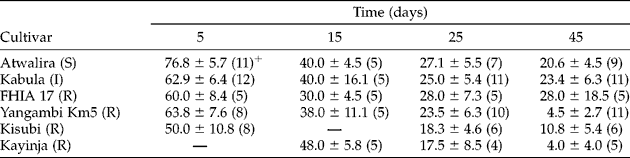
Differences in survivorship of banana weevil larvae feeding on different cultivars were (marginally) significant only at 45 days (F 5,41 = 2.46; P = 0.0489). The Tukey–Kramer procedure for mean comparison did not show significant differences between any two cultivars (Table 1).
Mean±SE survivorship (in %) of Cosmopolites sordidus larvae feeding on different cultivars in potted banana plants at various periods after infestation of plants
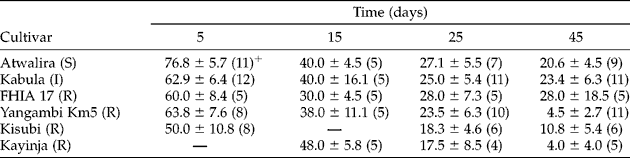
S, susceptible; I, intermediate; R, resistant.
Mean values were not significantly different at P = 0.05 (Tukey's test).
+ Figures in parentheses are sample sizes (number of plants).
Head capsule width
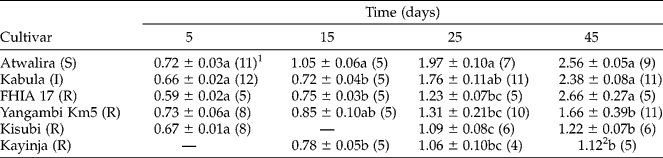
At 5 days, there were no significant differences in head capsule widths among cultivars (Table 2; F 4,28 = 1.68; P = 0.1835). At 15 days, mean head capsule widths of larvae were significantly different among cultivars (F 4,17 = 5.47; P = 0.0051). Larvae feeding on Atwalira and Yangambi Km5 had the highest mean head capsule widths (Table 2). At 25 days, differences in head capsule widths among cultivars were again significant (F 5,23 = 6.57; P = 0.0006). Larvae feeding on Kabula and Atwalira had the highest mean head capsule widths. At 45 days, cultivar differences in larval head capsule width were significant (F 5,15 = 17.03; P < 0.0001). Larvae feeding on Atwalira, Kabula and FHIA 17 had larger head capsule widths than those feeding on Kayinja, Kisubi and Yangambi Km5 (Table 2).
Mean±SE head capsule width (mm) of Cosmopolites sordidus larvae feeding on different cultivars in potted banana plants at various periods after infestation of plants
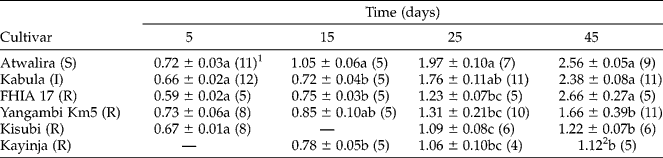
S, susceptible; I, intermediate; R, resistant.
Means followed by the same letter within a column are not significantly different at P = 0.05 (Tukey's test).
1 Figures in parentheses are sample sizes (number of plants).
2 n = 1, only one larva survived.
Experiment 2. Influence of past damage on survivorship and development of larvae
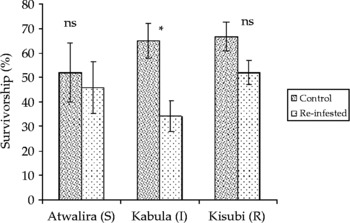
Larval survivorship was 49% on Atwalira, 49% on Kabula and 59% on Kisubi, and differences among cultivars were not significant (F 2,33 = 0.75; P = 0.4796). However, larvae in undamaged plants had significantly higher survivorship (61%) than those in the re-infested treatment (44%) (F 1,33 = 5.65; P = 0.0235).
Comparing the survivorship in the two treatments broken down by cultivar (Fig. 1) indicated that differences between controls and re-infested plants were significant only for Kabula (F 1,33 = 6.02; P = 0.0195) according to planned contrasts of controls versus re-infested. The two treatments were not significantly different for Atwalira (F 1,33 = 0.30; P = 0.5892) or Kisubi (F 1,33 = 1.20; P = 0.2812). Interaction of cultivar and treatment was not significant (F 2,33 = 1.00; P = 0.3785).
Mean survivorship (%) of larvae in banana plants previously infested with Cosmopolites sordidus larvae or uninfested (control) 7 days after infestation. S, susceptible; I, intermediate; R, resistant; ns, not significant. Asterisk (*) indicates significant difference in survivorship between control and re-infested plants at P < 0.05.

Head capsule differences were similar for larvae reared on Atwalira (0.74 mm), Kabula (0.71 mm) and Kisubi (0.68 mm) (F 2,34 = 2.39; P = 0.1065). They were also similar for plants that had previously been damaged by larvae (1.09 mm) and for the undamaged controls (1.13 mm) (F 1,34 = 1.10; P = 0.3011).
Discussion
Negative effects caused on herbivores feeding on resistant host plants include increased mortality and prolonged development. These parameters are therefore used in various screening studies. For banana weevil, field studies have shown clear differences in banana cultivar resistance (Gold et al., Reference Gold, Speijer, Karamura, Tushemereirwe and Kashaija1994; Kiggundu et al., Reference Kiggundu, Gold, Labuschagne, Vuylsteke and Laow2003). However, initial attempts to develop rapid resistance screening methods have been impeded by methodological issues and lack of correlation between laboratory results and field observations (Night et al., Reference Night, Gold and Power2010). A method using potted plants was employed in the current study to evaluate cultivar resistance.
In the current study, no statistically significant differences in larval survivorship among cultivars were observed. These results are consistent with those of previous laboratory studies using excised plant tissue that showed no differences between susceptible and resistant cultivars in survivorship (Kiggundu, Reference Kiggundu2000; Night et al., Reference Night, Gold and Power2010). Yet these results are not consistent with damage observed in the field (Kiggundu et al., Reference Kiggundu, Gold, Labuschagne, Vuylsteke and Laow2003). For instance, Yangambi Km5 was reported to suffer in the field damage of 0.4% compared with that of 10.3% on Atwalira, and Kisubi is resistant in the field (total damage of 1.5%) (Kiggundu et al., Reference Kiggundu, Gold, Labuschagne, Vuylsteke and Laow2003). Damage levels of at least 10%, combined with plant loss through plant snapping/toppling and death associated with weevil damage, can cause considerable yield losses (Rukazambuga et al., Reference Rukazambuga, Gold and Gowen1998; Gold et al., Reference Gold, Kagezi, Night and Ragama2004). These data suggest that full establishment of plants is requisite to expression of resistance. Banana suckers die back before sprouting after they are planted. Moreover, previous work has shown that plant remains (dead plants) of Kisubi suffer high weevil damage (Gold and Bagabe, Reference Gold and Bagabe1997).
Research should be conducted to determine the youngest age at which potted plants can be screened for resistance to banana weevils. Eenink and Dieleman (Reference Eenink and Dieleman1980) observed that differences between lettuce genotypes susceptible and resistant to M. persicae increased with plant age. In the current study, survivorship on susceptible varieties was at least twice than that on intermediate or susceptible varieties. While cultivar differences in larval survivorship were not statistically significant, they could be biologically significant. Studies should be conducted to determine the relationship between larvae number and feeding damage.
In the current study, banana weevil larvae feeding on different banana cultivars demonstrated differences in growth. Larvae feeding on the more resistant cultivars had smaller head capsules than those feeding on the susceptible cultivar, Atwalira. Delayed development of insects feeding on unsuitable host plants, such as resistant cultivars, has been widely reported (Smith, Reference Smith2005). The results of this study are consistent with those of Kiggundu (Reference Kiggundu2000), who observed prolonged duration of the larval stage of weevils feeding on various resistant banana cultivars in the laboratory. Therefore, plants can be screened for resistance to the banana weevil based on head capsule size in potted plants at 45 days. Differences between susceptible/intermediate and resistant varieties are clear at this stage.
Growth of larvae was not affected by previous weevil damage 7 days after infestation. However, the survivorship of larvae was influenced by previous attack in the intermediate cultivar Kabula but not in Atwalira and Kisubi. Thus the intermediate cultivar Kabula may primarily employ induced resistance. Inducible defences may be most advantageous when they occur against low background levels of other defences (Lewinsohn et al., Reference Lewinsohn, Gijzen and Croteau1991; Herms and Mattson, Reference Herms and Mattson1992; Stout et al., Reference Stout, Workman, Workman and Duffey1996).
It was demonstrated that survivorship is not affected and development is prolonged in larvae feeding on living potted plants of resistant cultivars. Results of this study show that experiments using potted plants can be used to screen for resistance to banana weevil using measurements of growth. Further studies are recommended to determine the plant age at which differences in survivorship of larvae appear in potted plants. Induced resistance may play a role in the defence of some cultivars against banana weevil.
Acknowledgements
Funding was provided by the Rockefeller Foundation as part of a PhD fellowship to G.N. We are grateful for the support of Dr Wilberforce Tushemereirwe, Head of the National Banana Research Programme, and the National Agricultural Research Organization of Uganda. The authors thank Valentine Nakato for assistance with data collection and acknowledge the comments of anonymous reviewers on the manuscript.