Management Implications
Hymenachne amplexicaulis (West Indian marsh grass) is classified as a Category I invasive plant species by the Florida Exotic Pest Plant Council because it alters native plant communities and ecological functions. Our study found that H. amplexicaulis spread relatively quickly among wetlands embedded in grazing land. We also highlighted that drainage ditches facilitate the spread of this species. Wetlands that are in proximity and/or directly connected to a large ditch are more likely to be invaded by H. amplexicaulis compared with wetlands that are isolated or disconnected from the ditch network. These findings have strong implications for wetland restorations such as those implemented on grazing lands by the wetland reserve easement program (USDA-NRCS). Indeed, H. amplexicaulis has the potential to prevent or slow down the recovery of plant communities following wetland restoration. Thus, preventing the introduction of H. amplexicaulis to recently restored wetlands is paramount for minimizing its spread. Our results suggest that backfilling larger ditches may prevent or slow down the introduction of this species following hydrologic restoration of wetlands embedded in grazing lands, a step not always included in restoration planning.
Introduction
Biological invasions by nonnative species are often considered a serious threat to ecosystems across the globe (Vitousek et al. Reference Vitousek, D’Antonio, Loope and Westbrooks1996). Wetlands are particularly vulnerable to species invasions, because they are landscape sinks that accumulate materials such as sediments and nutrients that promote opportunistic species (Zedler and Kercher Reference Zedler and Kercher2004, Reference Zedler and Kercher2005). Although they make up less than 9% of Earth’s land area, wetlands provide multiple valuable ecosystem services, and biological invasions may alter these functions (Charles and Dukes Reference Charles, Dukes and Nentwig2007; Zedler and Kercher Reference Zedler and Kercher2005). Wetland functions are especially crucial in agroecosystems, because they may help reduce the impact of agriculture on downstream water bodies (Dunne et al. Reference Dunne, Smith, Perkins, Clark, Jawitz and Reddy2007; Verhoeven and Setter Reference Verhoeven and Setter2010; Zedler Reference Zedler2003). Wetlands are sensitive to land use and management practices that may facilitate the spread of invasive species (Boughton et al. Reference Boughton, Quintana-Ascencio, Nickerson and Bohlen2011; Pierre et al. Reference Pierre, Quintana-Ascencio, Boughton and Jenkins2017). This scenario occurs in Florida, particularly in central Florida, because 1) grazing land (pasture and rangeland) is the largest land use, 2) wetlands comprise at least 21% of the landscape (Swain et al. Reference Swain, Boughton, Bohlen and Lollis2013), and 3) Florida is a hot spot of nonnative species invasions by multiple taxonomic groups (Dawson et al. Reference Dawson, Moser, Kleunen, Kreft, Pergl, Pyšek, Weigelt, Winter, Lenzner, Blackburn, Dyer, Cassey, Scrivens, Economo and Guénard2017). One of the many species invading sensitive wetlands in Florida is West Indian marsh grass [Hymenachne amplexicaulis (Rudge) Nees].
Hymenachne amplexicaulis is a wetland obligate species that is native to Central and South America and the West Indies. This stoloniferous perennial grass can form large monotypic stands of high biomass in seasonally flooded lowlands, as well as along riverbanks and man-made ditches (Csurhes et al. Reference Csurhes, Mackey and Fitzsimmons1999; Houston and Duivenvoorden Reference Houston and Duivenvoorden2002; Overholt et al. Reference Overholt, Diaz, Cuda and Benshoff2006). Hymenachne amplexicaulis has now spread to most countries in the neotropics (Diaz et al. Reference Diaz, Overholt, Sellers and Cuda2013) and subtropical and tropical Australia, where it was introduced as forage (Csurhes et al. Reference Csurhes, Mackey and Fitzsimmons1999; Wearne et al. Reference Wearne, Clarkson, Grice, van Klinken and Vitelli2010). In Florida, this species was first recorded in 1957 in a ponded pasture, and it is now present in at least 27 Florida counties (EDDMapS 2020). It is unclear whether the adventive H. amplexicaulis was intentionally introduced as forage or accidentally introduced by migratory birds from nearby Caribbean islands (Diaz et al. Reference Diaz, Overholt, Sellers and Cuda2013; Hill Reference Hill1996).
Hymenachne amplexicaulis is classified as a Category I invasive exotic by the Florida Exotic Pest Plant Council, that is, it is a “species altering native plant communities by displacing native species, changing community structures or ecological functions, or hybridizing with natives.” For example, researchers have found that sites dominated by H. amplexicaulis experienced a simplification of their macroinvertebrate assemblages compared with sites dominated by native vegetation (Overholt et al. Reference Overholt, Diaz, Cuda and Benshoff2006). By altering community structure, invasion by H. amplexicaulis may impede the success of wetland restoration projects. For example, in central Florida, the establishment of H. amplexicaulis in the Kissimmee River has prevented broadleaf marsh communities from recovering to historically dominant levels following the restoration of natural hydrologic regimes (Toth Reference Toth2017). This species also can pose an economic problem. In Australia, H. amplexicaulis impedes drainage systems and reduces sugarcane (Saccharum officinarum L.) productivity through direct competition, contributing to economic losses (Csurhes et al. Reference Csurhes, Mackey and Fitzsimmons1999; Wearne et al. Reference Wearne, Clarkson, Grice, van Klinken and Vitelli2010). Despite these consequences, few studies have investigated the factors affecting the spread of this hydrochorous species.
Dispersal of H. amplexicaulis may be facilitated by seasonal flooding, which establishes connections among water bodies and transports propagules (seeds and stolons) (Csurhes et al. Reference Csurhes, Mackey and Fitzsimmons1999; Diaz et al. Reference Diaz, Overholt, Sellers and Cuda2013; Middleton Reference Middleton1999). Florida grazing lands, which are characterized by a network of seasonal wetlands that may be connected by man-made ditches and/or sheet flow during the wet season, represent a suitable matrix for H. amplexicaulis dispersal (Middleton Reference Middleton1999). Although research has shown that drainage ditches facilitate seed and pollen dispersal for wetland plants, it is unknown how drainage ditches may facilitate dispersal of seeds and stolons compared with sheet flow (Favre-Bac et al. Reference Favre-Bac, Ernoult, Mony, Rantier, Nabucet and Burel2014, Reference Favre-Bac, Mony, Ernoult, Burel and Arnaud2016; Soomers et al. Reference Soomers, Winkel, Du and Wassen2010, Reference Soomers, Karssenberg, Soons, Verweij, Verhoeven and Wassen2013). A better understanding of the drivers of H. amplexicaulis dispersal would enable decision makers to prepare effective management plans for invaded regions, prioritize areas on which to focus their efforts, and decide the most effective methods to prevent further spread.
The aim of this study was to map the distribution of H. amplexicaulis among wetlands on a 4,170-ha Florida cattle ranch with more than 600 seasonal wetlands embedded in a ditch network. Hymenachne amplexicaulis is a recent invader at this site, with earliest records dating back to 2006 (Boughton et al. Reference Boughton, Quintana-Ascencio, Bohlen, Jenkins and Pickert2010, Reference Boughton, Quintana-Ascencio, Nickerson and Bohlen2011, Reference Boughton, Quintana-Ascencio, Bohlen, Fauth and Jenkins2016). Consequently, it is a good candidate species to study the factors influencing the spread of an obligate wetland species within Florida grazing lands. More specifically, we investigated the relative importance of wetland isolation, ditch connectivity, and several other landscape factors on H. amplexicaulis presence. We expected that H. amplexicaulis would most readily invade wetlands within highly managed pastures, which typically have higher nutrients, higher cattle-stocking rates, and more ditches. We also expected that the likelihood of observing H. amplexicaulis would be higher in larger wetlands due to longer hydroperiods and more appropriate habitat for H. amplexicaulis. Finally, we hypothesized that the likelihood of observing H. amplexicaulis would be lower in isolated wetlands but that connectivity would increase the chance of observing this species.
Materials and Methods
Site Description
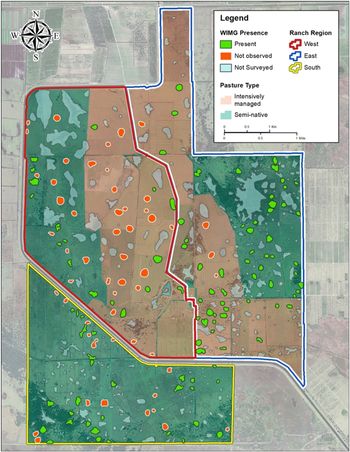
This study was conducted at Archbold Biological Station’s Buck Island Ranch (BIR), a 4,170-ha commercial cattle ranch in Lake Placid, FL (27.1534°N, 81.1974°W). The region is characterized by a subtropical climate. Average annual rainfall is approximately 1,300 mm, occurring primarily in the summer-wet season (May to October). An extensive ditch network, established by the 1960s, was used to reduce flooding in the wet season and irrigate pastures in the dry season (Supplementary Figure S1). There are more than 600 seasonal wetlands at BIR, about a third of which are isolated from the ditch network (Pierre et al. Reference Pierre, Quintana-Ascencio, Boughton and Jenkins2017). Wetlands range in size from 0.007 to 41.9 ha with duration of flooding (i.e., hydroperiod) ranging between 2 and 10 mo (Steinman et al. Reference Steinman, Conklin, Bohlen and Uzarski2003). These wetlands are located within two types of pastures (P): intensively managed pastures (IMPs) and semi-natural pastures (SNPs; Figure 1). IMPs (1,830 ha) are characterized by extensive ditching, high fertilizer use, and introduced nonnative forage grasses (primarily bahiagrass [Paspalum notatum Flueggé] and less common Bermudagrass [Cynodon dactylon (L.) Pers.] and limpograss [Hemarthria altissima (Poir.) Stapf & C.E. Hubbard]), and they sustain a higher stocking density of cattle (Boughton et al. Reference Boughton, Quintana-Ascencio, Bohlen, Jenkins and Pickert2010). Alternatively, SNP (2,250 ha) have fewer ditches, were never fertilized, experience lower grazing pressure, and have less exotic planting, retaining a large proportion of their native flora.
Distribution of Hymenachne amplexicaulis (West Indian marsh grass, WIMG) among seasonal wetlands at Archbold Biological Station’s Buck Island Ranch (BIR), Lake Placid, FL. The West and East regions were separated by Buck Island Ranch Road, and the South region was separated from the northern regions by the Harney Pond Canal.

Landscape Factors
We investigated six landscape factors that may influence the distribution of H. amplexicaulis at BIR (Table 1). The ranch was divided into three regions (R): West, East, and South (Figure 1). Each wetland was located in either IMP or SNP type (P). We estimated wetland area (Awetland, in ha) as a proxy for hydroperiod, assuming that larger wetlands have longer hydroperiods (Babbitt Reference Babbitt2005; Brooks and Hayashi Reference Brooks and Hayashi2002; Snodgrass et al. Reference Snodgrass, Komoroski, Bryan and Burger2000).
Definition of variables used to study Hymenachne amplexicaulis presence at Archbold Biological Station’s Buck Island Ranch (BIR), Lake Placid, FL.

ArcGIS v. 10.3.1 was used to estimate isolation and connectivity of wetlands at BIR (Environmental Systems Research Institute 2015). First, we calculated the Hanski isolation index (IHanski) that measures wetland proximity, considering the area of nearby habitat patches and their distance to a focal patch (Hanski and Thomas Reference Hanski and Thomas1994). Second, we calculated the minimum Euclidean distance (straight-line distance, EDmin, in m) between the edge of the focus wetland and the closest “source” ditch. A source ditch is a large, permanently flooded ditch (top width greater than 2 m) that is assumed to be a propagule source of H. amplexicaulis. We also recorded the presence of a ditch connection when the focal wetland was located less than 10 m away from a ditch or from a neighboring wetland that was connected to the ditch network (DC, yes/no). For a ditch to be considered “connected,” the ditch needed to intersect a source ditch.
Wetland Selection and Hymenachne amplexicaulis Survey
Sampling all 600 wetlands was not logistically feasible, so we restricted our investigation to wetlands that had an area between 0.2 and 2 ha. Additionally, we excluded wetlands on muck soils (Gator muck [loamy, siliceous, euic, hyperthermic Terric Haplosaprists], Samsula muck [sandy or sandy-skeletal, siliceous, dysic, hyperthermic Terric Haplosaprists], Tequesta muck [coarse-loamy, siliceous, active, hyperthermic Histic Glossaqualfs], and Hicoria mucky sand [loamy, siliceous, active, hyperthermic Arenic Endoaqualfs]) and focused on wetlands with sandy soil, the dominant wetland soil at the study site. Wetlands partially located outside of the BIR boundary and wetlands located in both pasture types were not included in the analysis.
Then we separated wetlands into four isolation categories based on the quartiles of the Hanski isolation scores in order to include wetlands across all levels of isolation in our analysis (i.e., low isolation [16.4 to 33.7], low to medium isolation [33.8 to 43.7], medium to high isolation [43.8 to 59.7], and high isolation [59.8 to 103.4]). At least five wetlands in each of the four isolation categories were selected per pasture type (intensively managed vs. semi-natural) in the East and West regions. As the South region only contains SNPs, at least 10 wetlands were selected from each isolation category in this ranch region. If there were less than five wetlands in an isolation category, a wetland was randomly selected from another category within the same pasture type and ranch region.
In total, 124 wetlands were selected. We surveyed each of these wetlands in May to June 2017 to record if H. amplexicaulis was present. This survey involved walking through each wetland while visually assessing it for the presence or absence of H. amplexicaulis. The entire wetland area was searched until either H. amplexicaulis was found or 30 min elapsed. If H. amplexicaulis was not detected after 30 min, we assumed it to be absent from the wetland. Loose propagules were not considered confirmation of H. amplexicaulis presence. The presence of ditch connections also was confirmed in the field. Presence–absence of H. amplexicaulis data were available for an additional 34 wetlands surveyed in October 2016 as part of another study (Boughton et al. Reference Boughton, Quintana-Ascencio, Bohlen, Fauth and Jenkins2016). The 34 additional wetlands fit the selection criteria partially. All isolation groups, pasture types, and ranch regions were represented. However, the number in each category was not completely balanced. Thus, 158 wetlands were included in the analysis.
Data Analysis
To determine which factors influenced the presence of H. amplexicaulis in the surveyed wetlands, we compared generalized linear models with binomial errors and a logit link, using the second-order Akaike information criterion (AICc; Burnham and Anderson Reference Burnham and Anderson2002). These models assessed the probability of H. amplexicaulis presence as a function of landscape connectivity (isolation and ditch connectedness) and wetland attributes. Models included both main effects and a relevant two-way interaction. The interaction between EDmin and DC was incorporated, because we anticipated that ditch connectivity would be more important for highly isolated wetlands (i.e., far from potential propagule sources), where overland dispersal is less likely.
Before model selection, we checked for collinearity among independent variables. Multicollinearity was assessed using a variance inflation factor with a cutoff value of 3, using the car package in R (Fox and Weisberg Reference Fox and Weisberg2018). This method was used for models that only contained main effects. The x and y coordinates of the wetland centroids were initially included in our model set, but we detected significant multicollinearity problems when these variables were in the same model as ranch region. As ranch region had the most explanatory power, x and y coordinates were excluded from our list of candidate models. The Hanski isolation index was log10 transformed to meet normality assumptions.
A set of 53 different models based on a priori hypotheses were tested, including null and global models (Supplementary Table S1). All models with a relative likelihood greater than 0.050 (equivalent to ΔAICc < 6.0) were included in a confidence set of plausible models (Burnham and Anderson Reference Burnham and Anderson2002). Based on likelihood-based inference, all 13 models in our confidence set are deemed plausible. Model averaging was not performed to address model uncertainty due to multicollinearity among predictor variables and the inclusion of interaction terms in our model set (Cade Reference Cade2015). All statistical analyses were performed using R software v. 3.4.3 (R Development Core Team 2017). Model selection based on AICc was performed using the AICcmodavg package (Mazerolle Reference Mazerolle2017).
Results and Discussion
Hymenachne amplexicaulis at Buck Island Ranch
Hymenachne amplexicaulis was first observed more than a decade ago (2006) at BIR (Boughton et al. Reference Boughton, Quintana-Ascencio, Bohlen, Jenkins and Pickert2010, Reference Boughton, Quintana-Ascencio, Nickerson and Bohlen2011, Reference Boughton, Quintana-Ascencio, Bohlen, Fauth and Jenkins2016). At that time, H. amplexicaulis was observed in 8 of 40 wetlands (20%), all located in the East section of the ranch and mainly in wetlands within IMPs. A subsequent survey in 2016 revealed that this species was present in at least 50% of these 40 wetlands. By 2017, H. amplexicaulis was observed in 104 of the 158 investigated wetlands (66%), with the highest level of invasion recorded in the East region (93%) (Figure 1). These findings suggest that H. amplexicaulis is rapidly spreading throughout our study site, as previously observed in Queensland, Australia (Low Reference Low1997; Wildin Reference Wildin1989). We only surveyed a quarter of the wetlands present at our site. We selected wetlands across a broad range of isolation. These wetlands matched the distribution of wetland isolation observed at Buck Island Ranch. We avoided very large wetlands that are uncommon, because they usually have longer hydroperiods and tend to be permanent wetlands rather than seasonal. On the other hand, we avoided small wetlands, because they often have low hydroperiods, which may prevent survival following a dispersal event. We think this selection was appropriate to study the factors influencing dispersal, but a study focusing on survival and abundance should include a broader range of wetland sizes.
Introduction Pathway and Influence of Grazing Land Management
Our model confidence set included 13 models (Table 2; ΔAICc < 6.0), and no specific model had an AICc weight >0.9. Although multiple models were supported by our data, most of them were congruent. Four models were strongly supported by our data (ΔAICc ≤ 2), and they all included the main effects of region and pasture type (IMPs vs. SNPs) (Table 2). The likelihood of observing H. amplexicaulis was higher in the East region of the ranch, with 93% of the surveyed wetlands invaded by H. amplexicaulis, followed by the South region (64%) and the West region (37%) (Figure 1). These results confirm that H. amplexicaulis was first introduced in the East region, quickly dispersing throughout this section and later to the West region. A large conveyance canal separates the South region from the rest of the property and operates as a strong local dispersal barrier, due to its large width and depth. Although it may carry propagules downstream (i.e., out of the study area), the likelihood of H. amplexicaulis dispersing across the canal from the East and West regions to the South region is low. For this reason, we think a second introduction event occurred in the South region. Hymenachne amplexicaulis was not introduced intentionally as forage for cattle at BIR, but multiple other dispersal vectors are suspected, including storm and floodwaters, cattle, and birds (Csurhes et al. Reference Csurhes, Mackey and Fitzsimmons1999; Low Reference Low1997; Wearne et al. Reference Wearne, Clarkson, Grice, van Klinken and Vitelli2010). Wearne et al. (Reference Wearne, Clarkson, Grice, van Klinken and Vitelli2010) also suggested that H. amplexicaulis could be dispersed by machinery and heavy equipment. Our data set does not allow us to test which of these events actually occurred at our study sites. In the last few decades, however, large construction projects took place, and multiple storms passed through the ranch.
Results of Akaike information criterion model selection for Hymenachne amplexicaulis presence at Archbold Biological Station’s Buck Island Ranch, Lake Placid, FL. a

a Abbreviations: AICc, second-order Akaike information criterion; R, region; P, pasture type; AWetland, wetland area; IHanski, log10(Hanski isolation); EDmin, Euclidean distance; DC, ditch connection presence.
b Only models with relative likelihood > 0.050 (equivalent to ΔAICc < 6.0) and the null model are shown. An asterisk (*) indicates the main effects and an interaction.
c K value indicates the number of parameters in the model.
Our study highlighted the influence of pasture type. The likelihood of observing H. amplexicaulis was higher in wetlands embedded within SNPs (71%) compared with IMPs (57%) (Figure 1). This finding suggests that nutrient additions in IMPs did not promote the spread of this species, in contrast with earlier studies on the same species (Csurhes et al. Reference Csurhes, Mackey and Fitzsimmons1999; Wearne et al. Reference Wearne, Clarkson, Grice, van Klinken and Vitelli2010) and on other nonnative species. It is also possible that greater competition from other nonnative forage species or higher productivity may hinder H. amplexicaulis establishment in IMP wetlands, because these wetlands have a greater diversity and abundance of nonnative species (Boughton et al. Reference Boughton, Quintana-Ascencio, Bohlen, Jenkins and Pickert2010). Heavier cattle grazing, which can reduce flowering and seeding of H. amplexicaulis, also may limit the invasion in IMPs (Wearne et al. Reference Wearne, Grice and Nicholas2008). Pasture type is a factor integrating past and current management intensity in terms of fertilization (N, P, K fertilization in IMP, no fertilization in SNP), drainage (higher drainage in IMP), and stocking density (higher in IMP). For these reasons, it is not possible to disentangle fertilization from stocking-density effects on dispersal and survival of H. amplexicaulis.
There are several other reasons that may explain why we observed H. amplexicaulis more frequently in SNPs. This pasture type occurs at lower elevations than IMPs, and the resulting direction of gravity flow in ditches can enhance dispersal to wetlands in SNPs. Additionally, the construction projects that may have contributed to the spread of H. amplexicaulis only occurred in SNPs in the East and South regions of the ranch. Finally, the spread of H. amplexicaulis may have been constrained by wetland isolation in IMPs. In our study, IMP wetlands were on average more isolated than SNP wetlands, as measured by Hanski isolation index. If IMP wetlands are more isolated from their neighbors than SNP wetlands, then overland dispersal among wetlands may be less likely to occur in IMPs.
Importance of Wetland Isolation and Wetland Connectivity
Our top models also included Euclidean distance to the source ditch (EDmin) and ditch connection (DC, yes/no), suggesting that both wetland isolation and connectivity explained the presence of H. amplexicaulis in seasonal wetlands (Table 2). Highly isolated wetlands (high EDmin) were less likely to be invaded by H. amplexicaulis, in agreement with multiple studies on a diverse array of organisms (Cosentino et al. Reference Cosentino, Schooley and Phillips2010; Lehtinen et al. Reference Lehtinen, Galatowitsch and Tester1999; Shulman and Chase Reference Shulman and Chase2007; Snodgrass et al. Reference Snodgrass, Bryan, Lide and Smith1996). Wetlands connected to a source ditch were more likely to be invaded by H. amplexicaulis, indicating the important role of ditches in the dispersal of this species and other nonnative species (Pierre et al. Reference Pierre, Quintana-Ascencio, Boughton and Jenkins2017). At our study site, many of the larger ditches harbor a substantial population of H. amplexicaulis, highlighting that larger ditches act both as a dispersal corridor and habitat (Rasran and Vogt Reference Rasran and Vogt2018). In our data set, 113 of 158 wetlands (72%) were connected to the ditch network (Supplementary Figure S1). About 69% (78) of the connected wetlands contained H. amplexicaulis, whereas only 58% (26) of wetlands with no ditch connection contained this species.
Interestingly, one of our top models included a positive interaction between wetland isolation (EDmin) and wetland connectivity (Figure 2). As wetland isolation increased, the likelihood of observing H. amplexicaulis decreased. This decline was steeper, however, when a wetland was not connected to the ditch network. Consequently, ditch connection is more important for highly isolated (EDmin) wetlands. Pierre et al. (Reference Pierre, Quintana-Ascencio, Boughton and Jenkins2017) found that ditches facilitate the dispersal of an invasive apple snail (Pomacea maculata Perry) from a large regional canal and that, although less plausible, overland dispersal from ditches and nearby wetlands was a contributing factor. The importance of the ditch network is further corroborated by several studies of wetland plants in agricultural landscapes. For example, Soomers et al. (Reference Soomers, Karssenberg, Soons, Verweij, Verhoeven and Wassen2013) showed that the seeds of two wetland plant species (common reed [Phragmites australis (Cav.) Trin. ex Steud.] and cypress-like sedge [Carex pseudocyperus L.]) were able to disperse great distances (up to at least 1,000 m) through drainage ditches in an agricultural landscape. Another study investigating the spatial genetic structure of fineleaf waterdropwort [Oenanthe aquatica (L.) Poir.] and gypsywort [Lycopus europaeus (L.)] demonstrated that ditches serve as pathways for seed and pollen dispersal (Favre-Bac et al. Reference Favre-Bac, Mony, Ernoult, Burel and Arnaud2016).
Predicted probability of observing Hymenachne amplexicaulis in relation to Euclidean distance in wetlands connected to the ditch network (blue dashed line) and wetlands not connected to the ditch network (solid red line).

We limited the scope of our study to the factors driving the dispersal of H. amplexicaulis and thus only focused on presence–absence data. Because variables positively associated with dispersal might have a negative effect on H. amplexicaulis dominance, future research should investigate how pasture management, as well as the abiotic and biotic environment of wetlands, influence the abundance of H. amplexicaulis. Additionally, as many Florida wetlands have been invaded by H. amplexicaulis, developing ways to control this species is crucial.
Conclusions and Implications
In this study, we highlighted the factors influencing the dispersal of H. amplexicaulis in the Florida grazing land landscape. Our results indicate that H. amplexicaulis is a highly effective disperser. It has spread to most wetlands at BIR and has the potential to spread rapidly among Florida wetlands. We found that ditches contributed to the dispersal of this species and suggest water flow as a primary dispersal mechanism. Because H. amplexicaulis can quickly spread to large areas, it is vital to understand the effects of this species on native ecosystems. For example, when H. amplexicaulis disperses to a wetland with adequate abiotic conditions, it is able to establish and form large clonal stands, outcompeting native species such as maidencane [Panicum hemitomon Schult.]. The consequences of such changes on biodiversity, nutrient cycling, and water-use efficiency should be investigated (Houston and Duivenvoorden Reference Houston and Duivenvoorden2002; Overholt et al. Reference Overholt, Diaz, Cuda and Benshoff2006; Wearne et al. Reference Wearne, Clarkson, Grice, van Klinken and Vitelli2010). Further work is also needed to understand 1) how grazing and fire affect H. amplexicaulis invasion success, 2) whether seeds or stolons are the primary invasion propagule, and 3) whether the species forms a persistent seed bank. If H. amplexicaulis does not form a persistent seed bank, then herbicide application might be an effective control strategy. These studies will help managers prioritize areas to focus their efforts, enabling us to control current populations and anticipate potential spread.
Acknowledgments
We would like to thank Ruth Whittington, Matthias Gaffney, and Sarah Garvey for their help during 2016 wetland surveys. EH Bouchard was supported by an Archbold Research internship. Initial wetlands surveys were funded by the U.S. Department of Agriculture Natural Resources Conservation Service (USDA CSREES, # 2006-35101-17204). This research was a contribution from the Long-Term Agroecosystem Research (LTAR) network. LTAR is supported by the U.S. Department of Agriculture.
The authors do not have any conflict of interest regarding the work presented in this article.
Supplementary material
To view supplementary material for this article, please visit https://doi.org/10.1017/inp.2020.16