Introduction
The establishment of a secure attachment between a child and their primary caregiver enhances the likelihood of positive outcomes in social and emotional development including areas such as behaviour (Fearon, Bakermans-Kranenburg, van Ijzendoorn, Lapsley, & Roisman, Reference Fearon, Bakermans-Kranenburg, van Ijzendoorn, Lapsley and Roisman2010; Groh, Roisman, van Ijzendoorn, Bakermans-Kranenburg, & Fearon, Reference Groh, Roisman, van Ijzendoorn, Bakermans-Kranenburg and Fearon2012), communication (Belsky & Fearon, Reference Belsky and Fearon2002b; van Ijzendoorn, Dijkstra, & Bus, Reference van Ijzendoorn, Dijkstra and Bus1995), social skills (Groh et al., Reference Groh, Fearon, Bakermans-Kranenburg, Van Ijzendoorn, Steele and Roisman2014), and emotional wellbeing (Sroufe, Reference Sroufe2005). Children with disabilities are less likely to develop a secure attachment than children without a disability (Clements & Barnett, Reference Clements and Barnett2002; Howe, Reference Howe2006; Naber et al., Reference Naber, Swinkels, Buitelaar, Bakermans-Kranenburg, Ijzendoorn, Dietz and Engeland2007; Rutgers, Bakermans-Kranenburg, van IJzendoorn, & van Berckelaer-Onnes, Reference Rutgers, Bakermans-Kranenburg, van IJzendoorn and van Berckelaer-Onnes2004; van Ijzendoorn, Schuengel, & Bakermanskranenburg, Reference van Ijzendoorn, Schuengel and Bakermanskranenburg1999; van Ijzendoorn et al., Reference van Ijzendoorn, Rutgers, Bakermans-Kranenburg, Swinkels, van Daalen, Dietz and van Engeland2007). While the Australian national guidelines for best practice (Early Childhood Intervention Australia, 2016) recommend a focus on promoting responsive caregiving and strengthening parent–child relationships, early childhood intervention (ECI) professionals come from a range of professional backgrounds and may not have received any training regarding attachment theory or intervention. There appears to be little research regarding the skills, knowledge or attitudes of ECI professionals regarding attachment. This article addresses a gap in the research by reporting the findings of a study which was undertaken to identify the knowledge, views, and practices of ECI professionals regarding attachment at an ECI service in Australia.
Attachment
Attachment refers to the emotional connection between a child and the person they preferentially seek comfort from when they are ‘frightened, tired or ill’ (Bowlby, Reference Bowlby1982, p. 371) and use as a secure base when they play and explore (Bowlby, Reference Bowlby1988). Four categories of attachment quality have been identified – secure, insecure-avoidant, insecure-resistant (Salter Ainsworth, Blehar, Waters, & Wall, Reference Salter Ainsworth, Blehar, Waters and Wall1978), and insecure-disorganised (Main & Solomon, Reference Main, Solomon, Brazelton and Yogman1986). Attuned and responsive caregiving is associated with secure attachment (Salter Ainsworth, Reference Salter Ainsworth1985), low-level responsiveness, and reduced sensitivity with insecure-avoidant (Salter Ainsworth, Reference Salter Ainsworth1985), intrusive, unpredictable, and less affectionate caregiving with insecure-resistant (Beebe et al., Reference Beebe, Jaffe, Markese, Buck, Chen, Cohen and Feldstein2010), and insecure-disorganised attachment is linked with parental unresolved state of mind regarding grief, loss or abuse, and anomalous caregiver behaviour (Madigan et al., Reference Madigan, Bakermans-Kranenburg, Van Ijzendoorn, Moran, Pederson and Benoit2006). While the primary influence on a child's attachment security is their parent's own attachment security (Fonagy, Steele, & Steele, Reference Fonagy, Steele and Steele1991; van IJzendoorn, Dijkstra, & Bus, Reference van Ijzendoorn, Dijkstra and Bus1995), other parental factors can play a role in attachment security such as stress, social and marital support, and depression (Atkinson et al., Reference Atkinson, Paglia, Coolbear, Niccols, Parker and Guger2000). The effects of the quality of attachment are probabilistic rather than direct, with secure attachment increasing the likelihood of positive outcomes for wellbeing and development, and insecure attachment increasing the risk of adverse outcomes (Belsky & Fearon, Reference Belsky and Fearon2002b; Sroufe, Reference Sroufe2005).
A meta-analysis of 69 empirical studies (N = 5947) of the relationship between externalised behaviours – hostile, aggressive, or oppositional behaviours – and attachment found a small to medium effect size (d = 0.31) (Fearon, Bakermans-Kranenburg, van Ijzendoorn, Lapsley, & Roisman, Reference Fearon, Bakermans-Kranenburg, van Ijzendoorn, Lapsley and Roisman2010). Other studies have found a smaller but still a significant association between internalised behaviour – depression, withdrawal, and anxiety – and attachment (Groh, Roisman, van Ijzendoorn, Bakermans-Kranenburg, & Fearon, Reference Groh, Roisman, van Ijzendoorn, Bakermans-Kranenburg and Fearon2012; Madigan, Atkinson, Laurin, & Benoit, Reference Madigan, Atkinson, Laurin and Benoit2013). A meta-analytic review examining 80 independent studies (N = 4441) investigated the association between attachment security and social competence with peers and found that the association was moderately significant (d = 0.39), did not diminish with time, and was influenced by neither the socio-economic status of the sample studied, nor the type of insecurity (Groh et al., Reference Groh, Fearon, Bakermans-Kranenburg, Van Ijzendoorn, Steele and Roisman2014). Language development (Belsky & Fearon, Reference Belsky and Fearon2002a, Reference Belsky and Fearon2002b; van Ijzendoorn, Dijkstra, & Bus, Reference van Ijzendoorn, Dijkstra and Bus1995) and executive function (Bernier, Carlson, Deschenes, & Matte-Gagne, Reference Bernier, Carlson, Deschenes and Matte-Gagne2012) have also been found to have a significant association with attachment quality. Various longitudinal studies have found that attachment plays a significant role in the ongoing emotional wellbeing of children, with secure attachment promoting resilience (Belsky & Fearon, Reference Belsky and Fearon2002b; Dallaire & Weinraub, Reference Dallaire and Weinraub2007; Sroufe, Reference Sroufe2005), and insecurity being a risk factor for psychopathology (Crawford, Cohen, Chen, Anglin, & Ehrensaft, Reference Crawford, Cohen, Chen, Anglin and Ehrensaft2009; Sroufe, Reference Sroufe2005) with disorganised attachment being a particular risk for this (Sroufe, Reference Sroufe2005).
Children with Disability
Research from the U.S.A. and the Netherlands indicates that less than half of children with a disability develop a secure attachment (Clements & Barnett, Reference Clements and Barnett2002; Naber et al., Reference Naber, Swinkels, Buitelaar, Bakermans-Kranenburg, Ijzendoorn, Dietz and Engeland2007; van Ijzendoorn, Schuengel, & Bakermanskranenburg, Reference van Ijzendoorn, Schuengel and Bakermanskranenburg1999; van Ijzendoorn et al., Reference van Ijzendoorn, Rutgers, Bakermans-Kranenburg, Swinkels, van Daalen, Dietz and van Engeland2007) compared to 65% of the general population worldwide (van Ijzendoorn & Kroonenberg, Reference van Ijzendoorn and Kroonenberg1988). This may due, in part, to the increased likelihood of parents of children with disabilities experiencing increased stress, poverty, marital strain, and low maternal wellbeing (Australian Bureau of Statistics, 2008; Risdal & Singer, Reference Risdal and Singer2004; Sloper & Beresford, Reference Sloper and Beresford2006; Totsika, Hastings, & Smith, Reference Totsika, Hastings and Smith2013). Parental insightfulness and resolution to diagnosis have also been found to be significantly related to attachment security (Koren-Karie, Oppenheim, Dolev, Sher, & Etzion-Carasso, Reference Koren-Karie, Oppenheim, Dolev, Sher and Etzion-Carasso2002; Oppenheim, Koren-Karie, Dolev, & Yirmiya, Reference Oppenheim, Koren-Karie, Dolev and Yirmiya2012). Children with a disability may also have reduced emotional availability or responsivity, which can impact the attachment process (Gul et al., Reference Gul, Erol, Akin, Gullu, Akcakin, Alpas and Oner2016; John, Sheffield Morris, & Haliburton, Reference John, Sheffield Morris and Haliburton2012). Children with a disability may have more difficulty communicating their needs, which makes it more challenging for parents to be attuned in their responses (Howe, Reference Howe2006; van Ijzendoorn et al., Reference van Ijzendoorn, Rutgers, Bakermans-Kranenburg, Swinkels, van Daalen, Dietz and van Engeland2007).
Children with a disability are particularly over-represented in the insecure-disorganised category with as many as 35% in this category compared to 15% in middle-class samples, 25% in low socio-economic status samples, and 48% in maltreated samples (van Ijzendoorn, Schuengel, & Bakermanskranenburg, Reference van Ijzendoorn, Schuengel and Bakermanskranenburg1999). In some cases, parental behaviour associated with disorganised attachment may include maltreatment, whilst in other cases, it can be the result of the caregiver dealing with unresolved trauma or loss, or the child experiencing extended or repeated separations (Granqvist et al., Reference Granqvist, Sroufe, Dozier, Hesse, Steele, Van Ijzendoorn and Duschinsky2017). It has also been suggested that children with autism spectrum disorder (ASD) may at times perceive their parents’ behaviour as threatening due to ‘mirror neuron dysfunction’ (van Ijzendoorn et al., Reference van Ijzendoorn, Rutgers, Bakermans-Kranenburg, Swinkels, van Daalen, Dietz and van Engeland2007, p. 606).
The dynamic relationship between children's behaviour, parental stress, and negative parental behaviour is a mutually escalating one (Hastings, Reference Hastings2002; Mitchell, Hauser-Cram, & Crossman, Reference Mitchell, Hauser-Cram and Crossman2015; Newland & Crnic, Reference Newland and Crnic2017). Children with a disability are less likely to be securely attached and more likely to display challenging behaviours (Baker et al., Reference Baker, McIntyre, Blacher, Crnic, Edelbrock and Low2003; Charman, Ricketts, Dockrell, Lindsay, & Palikara, Reference Charman, Ricketts, Dockrell, Lindsay and Palikara2015). They are three to four times more likely to experience neglect or maltreatment than children without a disability (Sullivan & Knutson, Reference Sullivan and Knutson2000) and more likely to be placed in out-of-home care (CREATE Foundation, 2012). Furthermore, children with a disability experience emotional and psychiatric disorders at elevated rates (Einfeld & Tonge, Reference Einfeld and Tonge1996; Emerson, Reference Emerson2003; Totsika, Hastings, Emerson, Lancaster, & Berridge, Reference Totsika, Hastings, Emerson, Lancaster and Berridge2011).
Early Childhood Intervention
The aim of ECI in Australia is to enhance the development and wellbeing of young children with a disability or developmental delay. Strengthening a child's relationship with their primary caregivers is one way of influencing the trajectory of developmental outcomes for children with a disability (Guralnick, Reference Guralnick2015). Working closely with families in their homes in the crucial early years of attachment forming presents an opportunity to both identify and intervene regarding attachment insecurity. The earlier intervention occurs, the easier it is, and the more likely it will be to have a successful outcome (Carlson, Sampson, & Sroufe, Reference Carlson, Sampson and Sroufe2003; Moulin, Waldfogel, & Washbrook, Reference Moulin, Waldfogel and Washbrook2014; Rees, Reference Rees2005; Richter, Reference Richter2004). Successfully intervening could have lifelong benefits for the child's social and emotional wellbeing (Sroufe, Reference Sroufe2005).
ECI professionals in Australia come from a range of professional backgrounds including speech pathology, occupational therapy, early childhood or specialist education, physiotherapy, social work, and psychology. Anecdotally, the exposure to information on attachment theory through qualifying discipline programs varies considerably across these disciplines. The development of strategies and skills related to promoting positive attachment can be quite limited. There are no pre-requisites to entering the field of ECI other than holding one of the discipline qualifications identified above, nor are there any standards around what training is offered upon entry. Each organisation determines their own policies and priorities regarding orientation and training. Recent changes to government funding of ECI in Australia may further limit the training offered to staff from their employers.
Aims of the Study
While the parent–child relationship is recognised in ECI as ‘critical’ (Early Childhood Intervention Australia, 2016, p. 12) in child development, there appears to be no research regarding the knowledge, views, and practice of ECI professionals in relation to attachment. The purpose of the current study is to explore the knowledge, views, and practice of ECI professionals regarding attachment at an ECI service in Australia. Areas of exploration include where they have gained this knowledge and how important they think this knowledge is in their role as an ECI professional. How often they apply this knowledge and how they translate it into practice will also be explored.
Method
A survey of ECI professionals was conducted by administering a questionnaire to all ECI professionals employed in one not-for-profit organisation in Australia. As no previous research on this topic could be located, questions were drafted specifically for this questionnaire. The content of the questionnaire was informed by a review of the literature and was structured to enhance the likelihood of completion by keeping it clear and concise, and ordering the questions from quick closed questions to longer more open questions (Newby, Reference Newby2014). Where Likert scales were used, they were taken from existing examples (Brown, Reference Brown2010). As recommended by Newby (Reference Newby2014), drafting of the questions was done with all three authors to ensure the questions were relevant, clear, and unbiased, while piloting was conducted by experts in ECI to identify any technical or comprehension issues and gather other input from a user perspective.
The questionnaire was created on Survey Monkey® in three sections. The first section consisted of four closed questions asking about participant's professional discipline and years of experience in ECI, with families of children with a disability and with families in general. The second section consisted of seven questions which were a mix of closed and open questions. It was anticipated that the closed questions were quick and easy, and therefore respondents would be more likely to answer them, whilst the open questions were seeking ‘a richer picture’ of their experiences (Newby, Reference Newby2014, p. 301). Questions in this section sought information regarding their knowledge, views, and confidence, where they have learnt about attachment, and what has been helpful in developing their knowledge. The third section included two open questions – one asking for a practice example and the other for any additional thoughts or comments in case the structured questions missed something that the respondent thought was significant (Newby, Reference Newby2014).
Ethics approval was granted by the La Trobe University Human Ethics Committee (Reference HEC16-129). The participant information statement provided at the beginning of the questionnaire explained that participation was voluntary, the survey was anonymous, and that completing the survey signified consent. Responses could not be retracted because they were not identifiable.
Participant Recruitment
The organisation where the data was collected is a large not-for-profit ECI organisation. The children who receive services from this organisation have a range of diagnoses. Approximately a third of the children are considered to have a developmental delay, another third has ASD, and the rest are made up of very small percentages of children with specific diagnoses or are in the process of seeking diagnosis.
The selection of this organisation could be considered convenience sampling (Newby, Reference Newby2014, p. 257) as the lead author was employed there. The study is preliminary, and no attempt is made to make statistical generalisations from the data. The questionnaire was issued to all ECI staff in the organisation in April 2017 by an administrative officer from the organisation's head office via email. The email stipulated that participation was voluntary. A reminder email was sent about three weeks later and a final email was sent the following week, indicating that the survey would close in a few days. At the time, there were approximately 129 ECI professionals within the organisation, not including those on extended leave, such as parental leave. There were 50 responses to the questionnaire. Upon examination, it was evident that two of these responses came from the same person – an unfinished questionnaire that detailed discipline and years of experience was followed immediately with a completed questionnaire with identical data in the first section. The incomplete questionnaire was removed leaving 49 responses – an approximate 38% response rate. Of these 49 respondents, 36 completed all but one of the compulsory questions, skipping the practice example. All compulsory questions were completed by 31 participants. The final question asking for additional comments was not compulsory and drew 20 responses.
Participants
Representation was broad in this study with all professional disciplines employed by the organisation included. ECI staff in team leader and management positions were included in the study, while all non-ECI staff, such as corporate and administrative staff, were not included. Participants ranged from having less than 6 months experience in ECI to 30 years (see Table 1.). There was insufficient data available regarding the disciplines and levels of experience of all ECI staff in this organisation to be clear that this group was representative of the ECI workforce in the organisation. However, occupational therapy and speech pathology are the most common disciplines in the organisation, followed by teaching. The least common discipline is physiotherapy followed by social work and psychology. This is in line with the responses.
Average years of experience.

The average number of years of experience respondents had in working in ECI was 6.9 years (see Table 1.). The data was trimodal with 2, 4, and 6 years each occurring six times. The number of years of experience in working with families with a child with a disability, including their ECI work and any other roles they had undertaken, was 11.4 years. The average years of experience in working with families in general, with or without a disability, including time in ECI and other roles working with children with a disability was 14.2 years. Years of experience varied amongst the different disciplines of respondents with teachers having the most years of experience and speech pathologists the least.
Experience of respondents in working with families ranged from 18 months to 32 years, indicating that new graduates were not represented.
Analysis
Despite there being some numerical data in the questionnaire, such as years of experience, a qualitative analysis was undertaken. A sufficient number of respondents were required to provide the opportunity for a thematic analysis and narrative discussion and the resulting response rate was sufficient to provide rich material for analysis.
Data was managed using NVivo 11 for Windows. Thematic analysis was undertaken with a constructivist approach as the authors acknowledge the subjectivity of their interpretation of the data (Charmaz, Reference Charmaz2014). Responses to all open questions were coded line-by-line inductively, with codes being developed from the data, rather than deductively with predetermined codes (Saldana, Reference Saldana2016). Focussed coding led to further grouping of codes, recoding of some references, and consequent discarding of some codes. Review of this analysis was conducted by two other researchers to contribute to the rigour of the analysis (Saldana, Reference Saldana2016).
Findings
The findings in relation to each of the questions will be presented to illustrate the dominant themes arising through the analysis. Direct quotes from respondents are used to allow their voices to come through and to enable examination of the selection of themes.
1. What knowledge do ECI professionals in a particular ECI program in Australia, have of attachment?
Overall, participants understood that attachment plays an important role regarding the child's health and wellbeing, with a specific emphasis on the role attachment security can play in the socio-emotional wellbeing and development of children and their learning. Respondents also provided insights into the reasons why the development of a secure attachment might be harder for children with a disability. Their own professional skills to address this also emerged as a theme.
Socio-emotional Wellbeing and Development
A range of themes specifically related to socio-emotional wellbeing and development emerged, including self-regulation, confidence, relationships, and worldview. Self-regulation was discussed in terms of emotional regulation and the role this plays in behaviour. Participants saw that self-confidence was influenced by attachment security and that this had flow-on effects to development. The quality of the parent-child attachment was also identified as impacting the development of future relationships and even the way a child comes to perceive the world. Statements included that attachment is:
“Key to helping a child develop their foundation for successful social emotional wellbeing and ultimately a positive sense of self and social relations with those around them.”
“Affects the way a child relates and understands the world.”
Learning
Connections were made between a sense of confidence, security, and learning. Participants expressed the view that a secure attachment provides children with a sense of safety that enables them to explore their environments and learn calmly, knowing they will be supported if they make mistakes or encounter difficulties. Secure attachment was thus seen to facilitate healthy brain development, ordered thinking, and resilience. For example:
“Feel free to explore and be confident and creative and open to new experiences; supports resilience; security to try new things, make mistakes, talk through options, try again, not feel threatened by failure.”
“Secure attachment to a caregiver gives a child a safe space to explore their world and learn new skills in.”
Children with a Disability
There were a range of general responses regarding secure attachment being harder to achieve when a child has a disability. Most of the reasons given for this related to the child's skills, including their ability to reciprocate and communicate. An understanding of the dynamic nature of the process of attachment development was demonstrated by some participants. Children with ASD were singled out for mention regarding the impact their sensory issues, eye contact avoidance, and their atypical behaviours being potentially misinterpreted by parents prior to diagnosis. The emotional reactions of parents upon discovering that their child had a disability were seen to adversely impact the development of a secure attachment. The associated medical needs that a child with a disability may have were also seen as possible causes of attachment problems due to the periods of separation this may cause, and the additional level of stress for parents. Stress was identified as a risk to attachment, coming from several sources for parents of children with a disability, such as emotional, financial, and negative feedback from others. Statements from participants included:
“A child with a disability may find it more difficult to develop secure attachment with their parent/carer as they may not have the cognitive or language skills to be able to be understood by their parent/carer. This may cause frustration within the relationship if communication is not effective.”
“Parents could be experiencing grief and trauma around their sense of loss of the child they thought they were going to have and around the circumstances of how they were informed of their child's disability. They may feel depressed themselves and find it hard to respond to/notice atypical or subtle communication attempts their child is making and find it hard to respond when the child isn't behaving as expected.”
“Early medical complications may have impacted on their ability to attach e.g. extended time in hospital/connected to machines, multiple changes in the people around them.”
Professional Skills
Professional skills emerged strongly as a theme across several questions, largely related to comments made about the respondent feeling they had insufficient knowledge in this area. One comment referred to their studies in psychology as being helpful. Many participants expressed a desire to learn more on this topic, largely through further training.
“Additional information on attachment challenges for carers of children with disabilities would be extremely useful in our practice.”
2. Where do ECI professionals gain their knowledge of attachment?
General themes regarding sources of knowledge included ‘on the job’, workshops, team practices, reading, and resources.
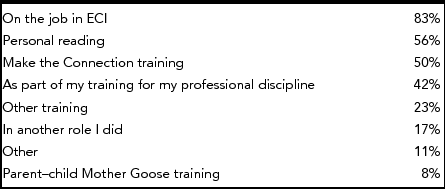
Numerical data gathered indicated that most respondents (83%) learnt about attachment ‘on the job’ (see Table 2 for percentage responses – participants selected all options that were relevant). Work experience was seen by some as helpful due to ‘hearing parent perspectives’ and ‘observation’.
Sources of learning.

There were general comments that workshops or training had been helpful. Make the Connection® (MTC) training, a mainstream intervention to promote attachment that had been offered broadly in the organisation in the past, was specified by many. There were single mentions of a range of other workshops.
Team support was identified as helpful, particularly discussions with colleagues – several specified discussions with a psychologist and one with a social worker. There was also a reference to supervision.
Reading related to attachment was mostly mentioned in general terms. There were specific single references to Circle of Security®, Bruce Perry, Dan Seigel, and Center on the Developing Child.
Resources considered helpful included the Australian Childhood Foundation website; the responsive caregiving and teaching practice principle materials created by the ECI organisation, participation in local Infant Mental Health network meetings, and having access to Circle of Security® resources.
3. How important do ECI professionals think the knowledge of attachment security is to their role?
Many respondents referred to the importance of the role attachment plays in child health, development, and wellbeing using words such as ‘vital’, ‘critical’, ‘central’, and ‘essential’.
“It is the thing that underpins everything to do with child development and wellbeing.”
“Essential for promoting the physical, social and emotional development and independence of the child.”
Data indicated that 67% (24/36) of respondents thought that an understanding of attachment in their role as an ECI professional was ‘absolutely essential’, 31% (11/36) chose ‘very important’, and one participant (3%) chose ‘of average importance’. No participants selected ‘of little importance’ or ‘not important at all’.
4. How frequently and confidently do ECI professionals apply this knowledge?
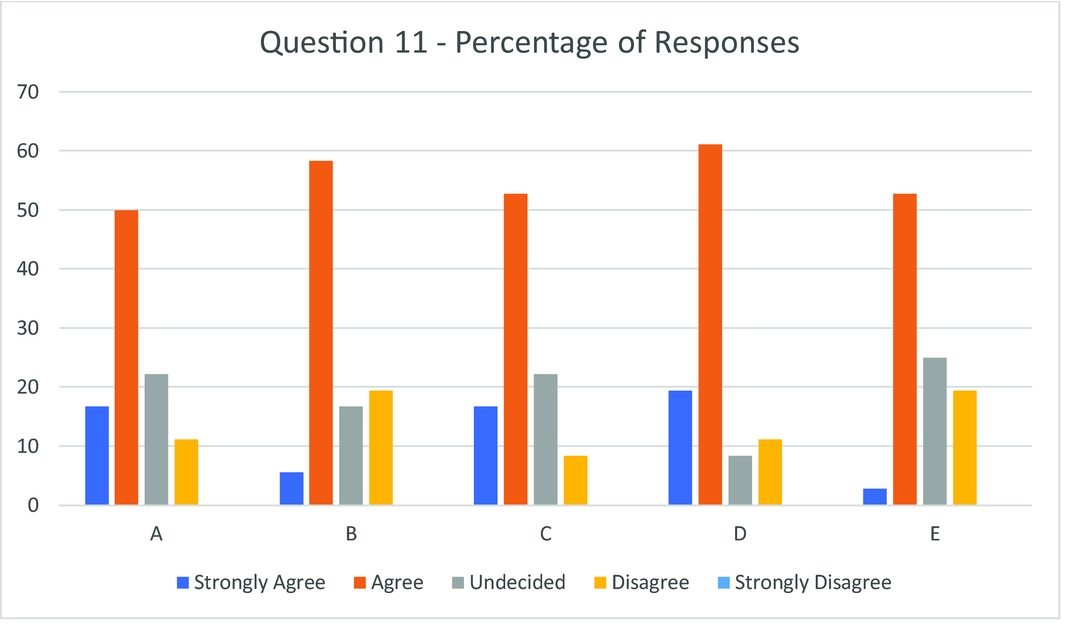
As depicted in Figure 1, most respondents agree that they are knowledgeable, confident, and comfortable in identifying and addressing attachment issues and that they know how or where to seek further information. Two respondents (6%) strongly agreed with the statement that they were knowledgeable about how to strengthen the attachment of children with a disability and one person (3%) strongly agreed that they felt comfortable in doing so. The statement that drew the most agreement, with 81% (29/36) of respondents agreeing or strongly agreeing was the statement regarding identifying when there was an attachment issue of concern. The statement that drew the least agreement with 56% (20/36) of respondents agreeing or strongly agreeing related to feeling comfortable about addressing attachment with families.
Knowledge and confidence of ECI professionals regarding attachment. Please rate your responses to the following statements: A – I am knowledgeable regarding attachment for children with disabilities, B – I am knowledgeable about how to strengthen the attachment of children with disabilities, C – I know where to go, or who to go to, to learn more about attachment, D – I am confident that I would notice if there was an issue with attachment in a family I was working with, and E – I am comfortable in addressing attachment with families in my work.

Five participants out of 36 (14%) drew on their knowledge of attachment in their work in ECI ‘always’, 58% (21/36) ‘very often’, 22% (8/36) ‘sometimes’, and 6% (2/36) selected ‘rarely’. No participants selected that they ‘never’ drew on their knowledge of attachment in their work in ECI.
5. How do they translate this knowledge into practice?
Responses to the practice example question provided information relating to indicators that there was a problem with attachment that needed to be addressed, strategies used, and outcomes experienced.
Indicators of Attachment Problems
Indicators identified by respondents that suggest a problem with attachment security included the child behaving differently in different environments, behaving violently (particularly towards their mother), or displaying non-compliant or attention-seeking behaviour. In other scenarios, the child not seeking comfort from their parent or seeking support from people indiscriminately was highlighted as indicators. Separation anxiety was also seen as an indication of insecure attachment. One example cited eating and sleeping issues in conjunction with separation anxiety.
Indicators of problematic attachment in relation to parental behaviour in the practice examples included the parent behaving inconsistently towards the child or displaying ambivalent or negative feelings regarding the child.
“The mother indicated she did not enjoy any time she spent with her son and she found the time she spent with him “draining” and this was significantly impacting her mental health. She could not identify any good/positive qualities of her child.”
Indicators arising from the interactions between children and their parents related to both verbal and non-verbal communication, when seen as being at atypically low level, particularly eye contact.
In the practice examples provided by participants, whenever specific diagnostic information was given regarding family members, the information related to either the child having ASD or the parent having a mental health issue.
Intervention Strategies
Strategies used to strengthen attachment included encouraging the parent to engage in enjoyable activities with the child such as play, and exploring parents’ feelings and talking about attachment directly, such as ‘why it was important and why it may not be developing easily’. Specific frameworks, resources, or programs drawn upon included Circle of Security® (Mercer, Reference Mercer2015), Hanen® (Carter et al., Reference Carter, Messinger, Stone, Celimli, Nahmias and Yoder2011), DIRFloortime® (Sealy & Glovinsky, Reference Sealy and Glovinsky2016), PICCOLO™ (Innocenti et al., Reference Innocenti, Roggman and Cook2013), Make the Connection®, and the responsive caregiving practice principle from the ECI organisation. Team practices were reported such as case consultation. Referrals made to other professionals/organisations, particularly for counselling, was also a valued option.
Outcomes of ECI Interventions Regarding Attachment
Outcomes from the examples provided included a reduction in attention-seeking behaviour from the child and the child being more discriminate in their affection. Interactive outcomes reported included parent and child being more engaged with each other and having some enjoyable time together. Outcomes for parents reported included an observed increase in calmness, positivity, and responsivity towards the child, and an increase in understanding their own feelings and behaviours. One respondent reported no change and another that the situation was improving but there was ‘still a long way to go’.
Discussion
The results provided some insight into the views and knowledge of experienced ECI professionals in an Australian community service organisation that has made attempts to build the skills and knowledge of staff in relation to attachment. Importantly, respondents saw an understanding of attachment as important in their work and something that almost all of them drew upon in their work. The impacts on child development of the strength of attachment described by respondents was in keeping with the literature available and demonstrated a sound understanding of the role of attachment in child development. Participants identified that attachment for children with a disability may be more challenging for a range of reasons, but primarily associated it with difficulties the child may have with reciprocal affection, eye contact, and/or communication. Overall, responses indicated an understanding that the development of a secure attachment can be more challenging for children with a disability.
The finding that most respondents learnt about attachment primarily through their work in ECI, with less than half of them learning about it in their undergraduate training, has implications regarding the orientation and training of new staff. The limited or single mentions of a range of workshops and tools indicate that there has not been a consistent practice framework adopted. There are, therefore, implications from this finding regarding the need for an overt and structured approach to ensuring staff are supported adequately to build their knowledge, skills, and confidence in this area once they enter the field of ECI.
The finding that almost half of the respondents did not feel comfortable in addressing attachment with families indicates a potential need for further resources, support, or training in the sector. Intervention strategies described in the practice examples commonly included referral to external agencies. This may reflect individual discomfort, the complexity of those situations, or a perception that the problem was beyond the scope of their role or expertise. Many participants reported that their skills or knowledge regarding attachment were not sufficient and an expressed desire for additional learning on this topic emerged strongly.
Team support, particularly consulting with other team members, emerged as helpful in learning about attachment and as a key strategy when addressing the issue in practice. This finding supports the need for an overt focus on team practices, such as consultation, joint visits, supervision, and team meetings to ensure effective knowledge sharing.
Implications for Practice, Policy, and Future Research
Further research is required to more deeply explore how ECI professionals address attachment in their practice and to evaluate the effectiveness of the approaches used by ECI professionals in their work regarding attachment.
The importance of attachment in child development has been well established in research and the risks for children with a disability are emerging. From a policy perspective, given the key findings of this study that fewer than half of ECI professionals learn about attachment in their undergraduate training and that nearly half do not feel comfortable to address this issue with families, consideration could be given in the sector as to how best to ensure ECI professionals have the knowledge, skills, and confidence to effectively work with families to strengthen attachment.
Limitations
The questionnaire was only administered to staff within one organisation with limited data available as to the exact number of staff who received the email and their discipline. Not all staff who received the questionnaire completed it, and of those who submitted a response not all of them responded to every question. It may have been that practitioners who elected to respond to the questionnaire were more interested, knowledgeable, or confident in the topic than those who did not, but diligence, workload, or curiosity could also be factors.
The study is exploratory and so there are no comparative studies to contrast the findings with. As this is an exploratory study of a subset of staff within a single ECI service in Australia, broader inferences cannot be made about ECI professionals in other organisations or countries.
Conclusion
While knowledge of attachment theory and skills in strengthening attachment relationships contributes to the goal of ECI to enhance the development and wellbeing of children with disabilities, ECI professionals may come to the field without any such grounding. With no industry benchmarks regarding training, there is a risk that families will not receive the support they require, and thus the opportunity to positively alter the trajectory of development will be missed.
This study is the first to explore the knowledge, views, and practice of a range of ECI professionals. It provides an insight into an ECI organisation in Australia, which has attempted over recent years to increase the knowledge and skills of its staff in this area. The study shows that this group of ECI professionals are generally knowledgeable about attachment. They learned about attachment largely ‘on the job’ and viewed it as being very important in child development. More needs to be done to ensure all ECI staff are supported sufficiently to effectively address attachment security in their work. Participants identified a range of strategies they use to address the attachment security of the children they work with; however, more research is required to evaluate the effectiveness of these strategies.
Declaration of conflicting interests
The first author is employed within the case study organisation as a manager although is currently on extended leave. This poses two potential conflicts of interest. One is that employees may have felt pressured to participate. To counteract this, the request to participate came from a central administrative officer rather than the author. The second potential conflict is that the author could be suspected of attempting to portray the organisation favourably or to promote training products. The organisation is not identified in the study and no such promotions are made. The organisation has not interfered in any way with the findings or their dissemination.