


1. INTRODUCTION
In Leeds, an elderly woman, grinning, peers out of the doorstep of a terraced house and repeatedly hits the back of a saucepan with a spoon. On Zoom, a Deep Listening group, based in London but with members spread across the world, pauses to tune into the trickling of claps and cheers emanating from outside one participant’s window. From a hillside in Hartlepool overlooking a dense housing development, a whistle is heard amid the clapping, its user modulating their airflow to vary the timbre. In Edinburgh, residents of a shared housing block gather in their communal back garden to clap, talk and listen to the flurry of whooping, bagpipes and guitar-strumming floating across the city. Inside a Cardiff living room, the sound of a car horn blaring to an improvised rhythm cuts through the applause. In Newport, fireworks are let off, with one of them nearly hitting a resident’s five-year-old daughter. On a residential street in Kirkcaldy, residents ‘boo for Boris’ and show their thumbs down with varying degrees of enthusiasm. In a small West Yorkshire market town, toy horns and pot-banging ricochet off the opposite side of a valley.
These moments, some reconstituted from research interviews and others based on published videos and articles, reflect some of the many ways in which the Clap for Carers initiative, which drew a reported 37 million participants across the United Kingdom, manifested itself between March and May 2020.Footnote 1 Standing on their doorsteps or balconies, or at their windows on Thursday evenings, participants clapped and made other sounds, officially in praise of the work being done by nurses, doctors and other care workers during the Covid-19 pandemic. Similar practices, some formalised and others more spontaneous, gained popularity in many countries throughout the world at around the same time. By 15 March, coordinated clapping was happening in Spain, Italy and Portugal (BBC 2020). In some cities, such as Paris and New York, the event took place nightly, while in Italy, footage was widely circulated showing tenement residents singing to each other from their windows.
In the case of the United Kingdom, the initiative was arguably unique in the country’s history. Other occasions, such as certain instances of the ‘minute’s silence’ and a few major sports events, might have drawn a similar breadth and depth of public engagement. But where the minute’s silence is marked, even constituted, by the performance of sonic absence, Clap for Carers appeared to offer the polar opposite, an opening of sonic expression. And while appreciation for sports events is often effusive and widespread, it is less coordinated and sustained than was public participation in Clap for Carers, which took place ten times at weekly intervals. Unique, then, in its apparent intertwining of mass scale, expressive licence and relatively long-term duration, it was also an ambivalent phenomenon. Charged with the emotional weight of the pandemic and its spiralling impact, it was variously experienced and interpreted as a moving and inclusive act of solidarity, communality or remembrance, a means for politicians, via these positivist understandings, to cynically feign empathy, and a smokescreen for government incompetence and underfunding. My own conversations have suggested that, in part due to the strength of this ambivalence, people often maintained these contrasting understandings internally, shifting between them both during the initiative and when recollecting it.
Clap for Carers was subject to considerable discussion in the British media, much of which was clustered into trenchant defences of the positions outlined earlier. By contrast, at the time of writing few published articles or broadcasts have sought to examine Clap for Carers in more detail, whether from the perspectives of anthropology, behavioural psychology, political science, or other disciplinary locations. This is unsurprising given the recency of the event and the context in which it occurred, but it remains the case that Clap for Carers poses abundant questions for researchers. What made it meaningful to people? What, if anything, did it achieve? How did its manifestations vary, by participants’ location and background? What accounts for the forms it took and the ways in which its boundaries were negotiated?
This article addresses Clap for Carers from the perspectives of sounding and listening, asking how sound was mobilised creatively, to what ends, and what this suggests about participatory sonic practice more broadly.Footnote 2 Establishing that sound was activated in ways which exceeded the functionalist framing of ‘clapping for carers’, I identify this excess specifically in terms of a generative and musical attention to sonic materiality. I then argue that the politics of this sonic proliferation can be approached by considering the initiative as a socially engaged artistic practice. Following Bishop (Reference Bishop2012), Clap for Carers is argued to have been generative insofar as it accommodated forms of aesthetic autonomy through which participants could question the boundaries and possibilities of public sounding. As with some examples of socially engaged artistic practice, the prioritising of an assumed consensus, while helpful in other ways, narrowed the prospects of a deeper socio-sonic questioning. Nevertheless, where sound was more freely explored and attended to, these autonomous experiences gestured towards what Voegelin (Reference Voegelin2019) describes as an ‘echography of the inaudible’, through which a plurality of voices, actualities and political possibilities are heard. In this sense, such experiences point to sound’s capacity for stretching participatory practices beyond affirmation and negation, towards more agonistic forms of engagement.
The research draws on ethnographic methods as far as this was possible in the context of Covid-19, supplementing these with analysis of published video and audio documentation, media reports and quotations drawn from these reports. Based in London, I was a regular participant in the activity I was investigating, and the core of the research material comprises the notes I made on this experience and on conversations with others taking part, as well as a set of four in-depth interviews I conducted by phone and video with participants living in different UK locations and in towns and cities of varying sizes. A key aim was to document participants’ recollections while as fresh as possible. As a result, the majority of the interviews were with people already known to me, who I could reach and speak with in depth, unrestricted by the need to first build new relationships in a particularly challenging context.Footnote 3 In ways that are made clear in the article, these interviews represent a diversity of experiences and circumstances, though no claim is made as to their being ‘representative’ of UK residents. The interviews focused on participants’ sonic recollections of Clap for Carers and also reflected on the social and environmental features of their neighbourhoods, their perspectives on the pandemic, and other relevant topics. The article draws on this interview material in a range of ways, from brief references that support or challenge the points being made to substantial direct quotations where the interviewee’s own narrative is considered important. The research was carried out between May and August 2020, prior to, for example, the rollout of Covid-19 vaccines, and with the Clap for Carers initiative only recently concluded. My approach to the interviews, the responses of the interviewees, and my own further research and analysis were all undoubtedly inflected by the tensions of this period. This is likely to have been true of all qualitative research related to the pandemic and conducted during this period, and will likely remain true for some time as the pandemic continues to interact with social bodies and institutions in new ways.
2. BEYOND CLAPPING, BEYOND CARERS
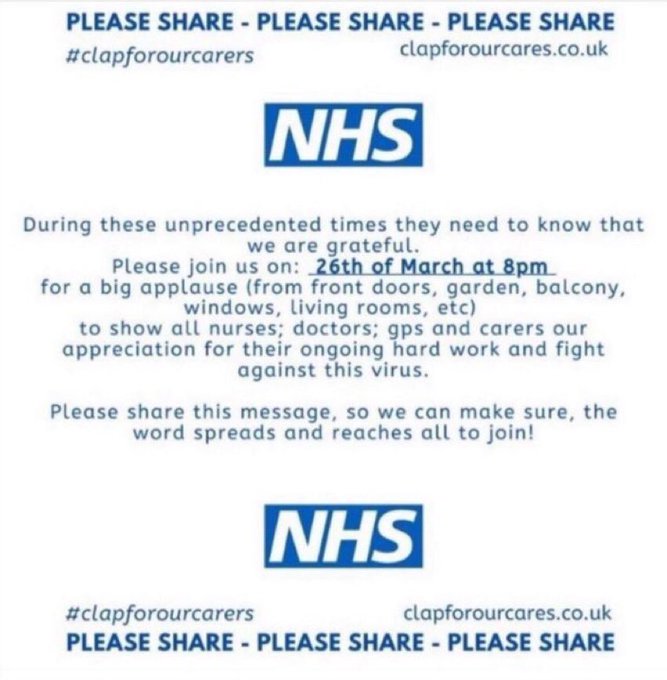
From the digital flyer circulated in the days preceding the first event to its very last iteration on 28 May, Clap for Carers had a well-publicised official purpose: to thank those conventionally defined as care workers for their efforts during the ongoing pandemic.Footnote 4 This purpose was distilled in the initiative’s name, which concisely signalled both the object of applause and the form the applause was to take. In turn, this clarity of form and purpose was widely reproduced in media reports, including by participants quoted in them. For instance, following the first iteration, a participant in Upper Wraxall, Wiltshire, was quoted by The Guardian:
During this time of isolation it is one of the ways we can collectively show our gratitude and respect to all members of our NHS. Whilst we quarantine in the comfort of our homes they risk their lives to save others. It’s really important to us that they know we want to say thank you. (Morris and Brooks Reference Morris and Brooks2020)
Further reports, and my own interviews and conversations, suggest that this form and purpose remained prominent for participants throughout the initiative. However, the same materials also make clear that further forms and purposes, with sounding and listening at their heart, multiplied over time. To make sense of this, it is useful to begin by noting how vividly participants could recall what they heard. Anna, who works for an educational institution in Edinburgh, took part in the shared back garden of the block of flats where she lives with her husband and their son. After outlining to me the view from her back garden, she emphasised a specific auditory experience:
But then, as you go down the hill, you get to where St Mark’s Park is, and you’ve got the Water of Leith. And then there’s this huge big block of flats down there, across the water. And they all have balconies on them, and so everyone would go on the balconies, and lots of people from this side would go out, and it was the most amazing sound, because it was almost like it was bouncing around. It’s like a C-shape around a car park. So it would just be kind of echoing.Footnote 5
Anna also recalled a sense that sounds were drifting and floating in from relatively far away, as if the whole city could be heard. Nwando, an artist living in Todmorden, West Yorkshire, had similarly distinct auditory recollections. When I interviewed her in August 2020, she recalled that, like many others, she had been sceptical about Clap for Carers: ‘I was very cynical about it … this performance of support, given the way people voted in this country to bring in a government that absolutely does not support the NHS.’Footnote 6 After a conversation with a friend who she was surprised to learn had been participating, she decided to join in:
I think the next week it was coming up to that time and I thought ‘Oh – I’ll open the windows and see what’s going on.’ And there was the sound. I live on the hillside of quite a steep valley, so sound has quite an interesting way of behaving – sound, light, water, they all have quite a beautiful way of behaving in this valley. I’m on the top of my building and I face trees, and then the valley drops down onto a road, then there are some very small houses on the canal, and then up again, and the other bank is just trees. So when I opened my windows I didn’t see anybody. But I could hear the sound coming from the left and from the right. And I can hear that it’s coming from beneath, but it feels like it’s doing this thing of spreading out and then slightly coming back up, and so the sound’s being met from the other side of the valley as well.
Not only was listening clearly prominent in Nwando’s memory of Clap for Carers but, the preceding quotation suggests, it was also through listening that she could begin to identify the co-presence of others. This reflected my own recollection of standing on my doorstep, my view of most nearby homes obscured by cars and porches, and of listening emerging as an important epistemological resource, a means of ascertaining the scale of what I was participating in. Clearly, for all three of us sound was being appreciated in part for the effects of its distinctly diffusive capacity in a context where closer physical proximity had been discouraged. The importance of listening within recollections of Clap for Carers helps contextualise important ways in which sound was made use of to extend the initiative’s form and purpose. Most obviously, the range of sounds produced and heard extended well beyond clapping. As Nwando recalled:
It was cheering, and as it went along there were people playing trumpet sometimes, and banging pots and pans. Which was very joyous. And again, because we can’t see anybody else apart from us in our block, just the three households and the trees, but we could hear it, echoing down the valley. And it did get louder as the weeks went on, I mean yeah, I’d be using my voice, and clapping.
Likewise, Anna remembered hearing a range of different sounds, including ‘foghorn-type’ instruments, brass, bagpipes and guitars. The sonic palette of Clap for Carers, from the evidence of the interviews I conducted and the audio and video documentation I found, seems to have incorporated cheering, booing, whistling, banging pots and pans, ringing bells, playing musical instruments, singing, fireworks and car horns. While it might be argued people were simply seeking maximum volume, this would not account for the relative scarcity of amplified sound, or for the fact that only rarely did single sound sources seem to dominate for extended periods of time. In a single 30-second clip from Cropton Road in Hull, for example, it is possible to hear rhythmically organised clapping and pot-banging alongside a firework explosion (see Kitching and Kershaw Reference Kitching and Kershaw2020).
As well as recalling this sense of variety, those I spoke with also touched frequently on the idea of a magical, even organic sound, swelling, receding and transforming in texture as new elements were introduced. In one of my own recollections while standing on my doorstep, a soft and even applause seemed set in place for at least 30 seconds, before being suddenly interrupted by one family of raucous pot-bangers. At this point, the texture rapidly diversified across my auditory field, with cheering and whistling bouncing off the closely packed brick surfaces of the residential street. On other occasions, the briefly tapped horn of a passing car would be met, in an impulsive call-and-response, by a second or two of high-intensity sounding by those on their doorsteps. These patterns of commingling, responsiveness and contagion manifested a playful logic of improvisation, unfolding over the relatively brief duration of each session – usually no more than three minutes. Moreover, participants also remembered the range of sounds seeming to expand over the weeks. Anna, for example, commented that ‘you definitely started to hear more instruments’ as the weeks went by, including bagpipes and guitars, while Nwando remarked that ‘it definitely got louder as the weeks went on’. As such, these recollections of Clap for Carers can be understood in terms of a clear and creative attention to sonic materiality: to the particular pleasures of organising sound, testing its thresholds and experiencing its spatial–temporal transformations.
3. SPEAKING TWICE: THE AESTHETIC REGIME OF ART
One way to address these more exploratory uses of sound is to approach the initiative itself as a kind of artistic practice. While it was not generally framed in these terms, the preceding descriptions do point to a concern with the substance of what was being sonically created, which is to say an aesthetic concern. Moreover, socially engaged artistic practices, while their conceptual boundaries are highly contested, have common features that are also shared by Clap for Carers: the attempt, however partial, to dissociate authorship from a single individual; the emphasis on situations, processes or improvisation over or alongside fixed ‘works’; the foregrounding of active roles for those who are not professional artists; and the prominence of socially oriented goals (e.g., Kester Reference Kester2011, Reference Kester2013; Bishop Reference Bishop2012: 2).Footnote 7 It is particularly useful to consider Claire Bishop’s (Reference Bishop2012) well-known critique of participatory art and of the discourse surrounding it. As Bishop argues, the turn to such practices, particularly since the 1990s, manifests ‘a shared set of desires to overturn the traditional relationship between the art object, the artist and the audience’ (ibid.: 2). Against the purportedly passive consumption of object-based artworks, an ‘art of action’ is offered, ‘taking steps – however small – to repair the social bond’ (ibid.: 11). And against the purportedly neoliberal implications of the individual artist, participation and collaboration are promoted as ‘an automatic counter-model of social unity’. It should be recognised that the practices Bishop describes are now often shaped by increasingly reflexive approaches that render her characterisations somewhat outdated (e.g., Miller Reference Miller2016). Nevertheless, her account of the value systems that shape these practices and of the problems they pose remains powerful. Specifically, while participatory work is regularly discussed by critics and institutions with reference to contemporary art, the criteria for evaluation are often rooted in ethics. Citing the example of Istanbul-based collective Oda Projesi, Bishop notes that both the artists and those who wrote about their work focused on the substance of the artists’ relationships with their collaborators and the degree to which authorship was perceived to be fairly distributed (Bishop Reference Bishop2012: 22). Meanwhile, formal, conceptual or experiential concerns were de-emphasised or even denigrated, a pattern Bishop identifies across many projects.
It is this ‘disavowal’ of the aesthetic, its depiction as ‘an elitist realm of unbridled seduction complicit with spectacle’ (ibid.: 27), that Bishop seeks to counter. In contrast, Bishop advances a notion of aesthetics borrowed from the political philosophy of Jacques Rancière, in which autonomy and liberatory potential are instead foregrounded (Rancière Reference Rancière2006). Key to this is Rancière’s notion of the aesthetic regime of art, which marks a break with two earlier systems of identification (ibid.: 20). The first of these, the ‘ethical regime of images’, is linked with Plato’s core concern with art’s purpose and truth content, and is ‘ethical’ insofar as it centres art’s effect on human behaviour. By contrast, the ‘mimetic regime’ – also called ‘poetic’ and ‘representative’ – is concerned not with art’s purpose or truth content but, following Aristotle, with its conformity to rules regarding its form and content. Finally, the aesthetic regime liberates art from such rules, centring our experience of art – aesthesis – and its autonomy from reason or power. Importantly, this autonomy means such experiences are undecidable and thus political. This notion of aesthetics, then, obviates its bifurcation with ethics in the art-critical discourse Bishop describes. In her words, ‘the aesthetic doesn’t need to be sacrificed at the altar of social change, because it always already contains this ameliorative promise’ (Bishop Reference Bishop2012: 29).
This tension between a narrowly ethical framing and the autonomous imperative of the aesthetic regime provides a helpful means of approaching experiences of Clap for Carers. As we have already seen, the initiative was marked on the one hand by an explicitly worldly purpose and sound’s functional role in achieving it, as distilled in its name. As we have also seen, a more exploratory – autonomous – use of sounding and listening was likewise evident. Alongside this was a proliferation of understandings among participants as to why they, and others, were taking part and what it meant to them. One reason for this was the physical absence, for many people, of the care workers they were to be applauding. While some occasionally directed their sonic activities towards neighbours they knew were care workers, this was not always practical. Instead, people often recalled having care workers ‘in mind’, or reached for broader interpretations of their own applause. Anna’s husband, Niall, for example, described it as a ‘rallying cry’ of positivity:
It came at a time when it just didn’t feel like there was a lot of positivity being projected by the media or whatever. So this felt like it was something kind of cheerful.Footnote 8
For Nwando, the act of clapping in particular allowed the initiative to access something other than praise for care workers:
It was very clear that what it was about, for me, and I think for most people, was this chance to have some communing time. If you’re very isolated, and I was very isolated at first, seeing some friendly faces, smiling faces … Clapping together is a really powerful thing. It has some kind of psycho-physiological effect on people, that’s why we do it, other than tradition and convention. We feel compelled to clap at the end of performances for example. The reason why I can tell people really want to do it and need to do it is because I’ve done performances where I’ve asked people not to clap. It’s really uncomfortable. People feel it’s not finished, it’s not done, they’ve not been able to let something out. So it’s an expression, at a moment when there’s so little chance to express, we’re locked in our homes.
Nwando’s reading of clapping as a means of communing was echoed in an article by neuropsychologist Catherine Loveday, one of the relatively early contributions by academics to discussions around the initiative. For Loveday, ‘the effects we felt last Thursday go beyond learned association and feeling grateful … what many of us found for those few minutes was a much needed sense of human connection and belonging’ (Loveday Reference Loveday2020). This clear plurality of readings in itself gestures towards the kind of undecidability that characterises the aesthetic regime. A more emphatic example is offered by another participant, Laure, a professional singer, singing teacher and practitioner of Deep Listening, the technique developed by musician and theorist Pauline Oliveros.Footnote 9 It is useful to consider her experience in some detail. Laure had been training in Deep Listening for two years and was due to lead a series of group sessions for the first time in March 2020. In such sessions, the group uses Oliveros’s scores, as well as new ones, as a springboard for collectively practising Deep Listening. Not long before the first session, European countries began to go into lockdown, and the group, whose members come from a number of different countries, found itself unable to meet in person. They decided to go ahead with the sessions via Zoom, with Laure leading from Paris, where she was now living temporarily:
A couple of days before I led the first session, in Paris this clapping was already going on. [Another participant] informed me that it was going to start in London, and we realised the first day it would start right in the middle of the session. So I decided to listen to that, because that’s the practice, and that’s the beauty of it.
Before we went online I gave everyone in the group a score by Pauline that is called ‘Just Listening’. It’s quite simple, it’s just a practice of making a diary while listening. Whether it’s at a specific time of day, or the same each week, etc. Ten minutes before [the clapping], I re-introduced this piece, and I said, ‘okay, I think we should listen to what’s going to happen’, and I shared the score on the screen. We did it as a homage to London, because at that time you can imagine, it’s 9pm in France, it’s 8pm in the UK, somebody’s in Bogota! London is the place we usually gather, so that was really beautiful, to re-ground in London. That was quite like –- ‘agh, when are we going to meet again?’, and still that question is around. That was the first moment, and that was potentially really frustrating, somehow. It was also really bizarre to be online, because it’s a practice that was made of flesh, of touching, We usually experiment with the same sounds being around us, so we have this feedback with each other that is quite incredible because you also expand, you know, and how are we going to improvise a piece together in real time? And how are we going to do that with Zoom? And then our private spaces are going to have different sounds, that we’re going to share. And at that time I said, ‘You should open your windows, I think London is going to applaud for the first time tonight, so, you know, let’s just listen.’ Just listen to what it is. It also gives a beautiful perspective.Footnote 10
By focusing initially on listening, from their decentred locations around the world, the group could generate an entirely different experience of Clap for Carers. Far from providing access to a purportedly extra-social appreciation of ‘sound itself’, a position Kane (Reference Kane2015) might (critically) describe in terms of ‘onto-aesthetics’, their experience registers a meshing of auditory cultures and geographies. In a further experimental turn, Laure and her collaborators explored the idea of Clap for Carers as a kind of cacerolazo, in reference to the pot-banging practices used in protest movements, most famously in Latin America. She described to me a particular moment in the same session:
And something really beautiful happened. The participant from Bogota, David, said he wanted to share with us a sound. And he shared with us the sound of a cacerolazo, that he had field-recorded a few months before. You know what was happening in Bogota around October or November 2019,Footnote 11 and people were killed. You could sense it, whether you were aware about it or not. And he said that that day he was coming back from his parents’ place, he was a little bit outside, this was happening in Bolivar Square, and something really terrible happened, and so he explained it in his own words. And he field-recorded it, and he made us listen to that. Because that ‘Clapping for Carers’ somehow re-linked him with this ‘cacerolazo spontaneo’.
So we went into a short listening session, like three or four minutes, of this cacerolazo, all these casseroles [sic] and everything you can pick up, right? And so, of course afterwards I jumped into … you know, a spontaneous cacerolazo happened. Actually the first time, what happened is that, through David, the clapping extended into a cacerolazo. So everyone, in their own space, picked up a little cacerola, and started going ‘ding ding ding ding’. And this became our applause.
If the other participants quoted earlier articulated a range of interpretive positions beyond the initiative’s official purpose, the preceding quotation suggests Laure and her group channelled this possibility of autonomous experience into their own collective practice. Addressing the use of cacerolazo-type actions in Nepal in 2015, Kunreuther suggests that ‘the content of protest remains obscured in the din of banging that echoes across the city, signifying through noise a breakdown in communication between ruler and ruled’ (Kunreuther Reference Kunreuther2018: 23). While the group was not straightforwardly interpreting Clap for Carers as a cacerolazo, in the sense of an act of political refusal or the articulating of a political demand (e.g., Rodríguez 2011), in pointing to the socio-sonic proximity of the two actions they make such an interpretation possible. This also links Clap for Carers to a historical lineage of related practices. Davis and Sterne (Reference Davis and Sterne2012), for example, link cacerolazo protests in Quebec to the charivari tradition in early modern France, a pot-banging custom with close relatives across Europe. While charivaris were usually, and sometimes violently, targeted at local residents accused of offences, they could also be aimed at symbols and representatives of institutionalised power (Davis Reference Davis1971; Walsham Reference Walsham2017).
4. THE LIMITS OF SONIC CONSENSUS
Taken together, this proliferation of sounding, listening and interpretive freedom begins to move Clap for Carers beyond the ‘ethical regime’ described by Rancière towards the undecidable, autonomous experiences his analysis privileges. The importance of such undecidability, Bishop argues, is that it creates the conditions for dissensus, understood as ‘a questioning of how the world is organised, and therefore the possibility of changing or redistributing that same world’ (2012: 27). In one sense, the very occurrence of Clap for Carers, in its sonic refiguring of everyday environments, represented such a questioning. Yet in general, those I spoke to did not interpret the initiative in terms of dissensus. Most obviously, the widely circulated footage of senior politicians clapping marked an alignment with power and limited its scope for oppositionality. Moreover, the persistence of the official framing, strengthened by the immediate crisis of the pandemic, worked to offset any expectation that applause might give way to more dissensual actions.
Instead, Clap for Carers was frequently discussed in terms of bringing neighbours, communities or the country together, suggesting it went some way to accomplishing the ameliorative aims associated with socially engaged art. However, participants I spoke to often described this prioritising of unity and consensus in ways that trouble assumptions about what these can accomplish. One example is provided in a comparison that Anna articulated, between Clap for Carers and the ‘Boo for Boris’ campaign, a short-lived attempt to transmute the initiative into a more dissensual action.Footnote 12 For Anna, the latter had ‘so many different levels’ and was ‘more complex as an idea’, whereas Clap for Carers had uncontroversial appeal:
I suppose with clapping for the NHS, there’s no negative side to that, unless you’ve had a really bad experience with the NHS or something. Probably you’re likely to agree that it is a good thing. That we need it and that they’re doing a good job. Footnote 13
While highlighting how consensus served as a key priority, Anna’s remark that ‘there’s no negative side’ to clapping for the NHS also signals how cautiously the scope of this consensus was defined. Indeed, this sonic caution was sometimes felt to be contradictory. As Nwando said:
That’s part of my problem here, it’s like, ‘we’re doing something nice, aren’t we, we’re doing something nice. For us, for ourselves’, as far as I can see. We’re not protesting. Like, why would I be banging on a pan? I really had a problem with the whole ‘We can all pat ourselves on the back and feel like we’ve done something.’ We haven’t done anything!
Elaborating further, she added that she felt the limited length of each iteration was part of this, making things feel ‘so managed, so under control’, to the extent that she stopped taking part well before the end of May. A particularly clear instance of this sonic ‘managing’ of the initiative was in response to the use of fireworks by some participants. Criticising this, the chief superintendent of the Scottish Society for the Prevention of Cruelty to Animals (SSPCA) issued the following statement:
There is absolutely no reason whatsoever that people should be setting off fireworks during the weekly ‘clap for carers’ event. It’s disappointing that some members of the public would try to turn a moment of genuine appreciation for key workers into a competition to see who can make the most noise.Footnote 14
The dualism of this formulation, in which actualisations of Clap for Carers constituted either ‘genuine appreciation’ or ‘a competition to see who can make the most noise’, deliberately marks a boundary of sonic legitimacy. To be clear, the argument is not that setting off fireworks was a silenced attempt at aesthetic provocation, or that there were no reasonable grounds to oppose it, but that this particular response reflects an aesthetic–moralist linkage of noise with ‘unwanted sound’ (Thompson Reference Thompson2017). In this sense, the sonic ‘niceness’ that Nwando identified in clapping is one that, in prioritising consensus, masks a defeat of the capacity to provoke or transform. Heard this way, and following Bishop, clapping for carers sounds the stalled possibility of a deeper socio-sonic questioning.
While this entrenchment of a narrow sonic consensus was undoubtedly limiting, the significance of the autonomous experiences described earlier should not be overlooked. These may have lacked the kind of antagonistic impulse favoured in Bishop’s analysis, but Bishop’s preference for such work has itself been widely challenged on the basis that, among other flaws, it risks leading not to the dialectical promise of a better world but to the nihilistic acceptance of an unchangeable one (e.g., Miller Reference Miller2016; Bell Reference Bell2017). Rather than rehearse this debate, it is helpful to approach autonomous experiences of Clap for Carers in terms of more recent conceptions of participation that move beyond the limitations of both consensus and antagonism. Taking up this task in relation to sonic practice, Voegelin (Reference Voegelin2019: 21) proposes an ‘echography of the inaudible’, a practice that ‘explores the unseen reverb of reflection where plural causes become visible and their consequences thinkable’. Drawing on anthropological writings on the notion of possibility by Petra Rethmann and Jane Guyer, and recalling the agonistic pluralism of Chantal Mouffe (Reference Mouffe1999), echography is posited as an ‘agonistic dispersion’, ‘[enabling] us to hear the dynamics of a political actuality and to imagine its sonic possibilities’ (Voegelin Reference Voegelin2019: 21).
At its most generative, Clap for Carers was amenable to such an echography, its excavations of, and within, a sonic present heard in terms of an irreducibly plural clamour. For Voegelin, sound’s ‘ephemeral mobility’ (ibid.: 37) is key to this enlargement of political possibility, and this was likewise true of Clap for Carers, even if this space–time of possibility was not always audible. Indeed, what Nancy (Reference Nancy and Mandell2007: 10) describes as sound’s ‘tendentially methexic’ character was constitutive of the initiative more generally, substantiating the sense of human co-presence it accomplished and activating relatively accessible sites of participation – the doorstep, the window, the garden, the street. In drawing such sites into play, Clap for Carers registered sound’s distinctive affordances for practices that seek to interanimate private and public, home and neighbourhood, everyday life and singularity.
5. CONCLUSIONS
For many, the most prominent recollection of Clap for Carers, especially amid the pandemic’s worsening impact, was one of an empty gesture. Sounding and listening, here, serve as little more than the tools of a trite kind of ‘folk politics’ (Srnicek and Williams Reference Srnicek and Williams2015) that closes its ears to structural crisis. Such an assessment mirrors Bishop’s complaints about the ‘ultimately modest gestures’ of much participatory art (2012: 23). I have sought to argue here that attending to the specificities and variations in how participants experienced sound presents a more complex picture. An attention to sonic materiality allowed those taking part to extend the initiative beyond its functionalist framing, generating ephemeral socio-sonic environments that can be understood by way of the autonomous experiences art entails. While the initiative as a whole remained sonically bound by the same kind of ameliorative consensus that limits some participatory projects, these autonomous experiences index sound, following Voegelin, as an ‘agonistic dispersion’ of political possibility. To pose this argument is not to cast judgement on the initiative or its participants, myself included. Rather, sounding and listening present a prism through which to interpret its ambivalent pleasures and politics, and in turn the affordances of participatory sonic practice more broadly. Equally, turning to theorisations of socially engaged practice is not to imply these represent the only or most appropriate framework for approaching Clap for Carers. After all, this was not an initiative marked by the kinds of formalised roles or deliberative processes that characterise much socially engaged practice. It was formed in, and resists extrication from, the exceptional and complex dynamic of Covid-19. As such, theorisations of socially engaged practice offer it not solutions to problems but, I have argued, generative ways of helping account for how sonic participation is and might be imagined and applied.