
Introduction
The Scottish legal system is the remarkable creation of almost 1,000 years of Scottish history, comprising a rare mixture of civil and common law concepts. While the Treaty of Union 1707 established England and Scotland as one kingdom, with the same monarchy and succession, a single Parliament and equal trade and economic rights, the independence of the Scottish legal system (including that of the Court of Session) was protected. It is distinct from its English counterpart in a number of ways, and all the more so since the passing of the Scotland Act 1998, which introduced a degree of devolution to Scotland.
Background to the Scottish legal system
The legal system of Scotland is quite separate from the rest of the United Kingdom, and it has developed as rather a hybrid system, comprising elements of civil and common law. Its separate existence was confirmed in the Treaty of Union of 1707, and extends to the courts, legal profession and to the law itself. The main influences on Scots law came from the Continent, particularly France and the Netherlands, and have their roots in Roman law. These influences helped to establish an “institutional” tradition, with the major early legal texts modelled on the Institutes of Justinian, e.g. Lord Bankton's An Institute of the Laws of Scotland, Erskine's Institutes and Bell's Principles, and Dictionary. These sources are still accorded special status.
There is a good summary of the development of Scots law from medieval times in A Short Commentary on the Laws of Scotland by T.B. Smith, W Green & Son, 1962.
The increase in legislation in the last 50 years or so has brought an increasing proportion of law that is common to both England and Scotland, as well as the growing impact of EU law. Devolution has slowed the influence of English law in some areas, but still there is a move towards rationalising major areas of legislation, e.g. the law relating to companies. The main areas where Scots law differs are private and criminal law.
The formal sources of Scots civil law which give authority to a legal rule fall under five headings: legislation, authoritative writings, judicial precedent, custom and equity. The authority attached to each of these sources has varied at different stages in the history of Scots law.
Legislation
Enacted law in Scotland comprises prerogative legislation by the Crown, statutes of Parliament and laws made by an authority to which Parliament has delegated powers of legislation. Delegated legislation includes statutory instruments, rules and bye-laws. It is still possible to find reference to statutes of the pre-Union Parliament which still remain in force. Their interpretation tends to be more liberal than literal; they were published in very different circumstances from those in which modern legislation is passed.
Historically the Scottish courts have exercised wider powers than those under statutory authority. The power to regulate its own procedure was conferred originally on the court's constitution by the Act 1532, c.36. Acts of Sederunt, which rest ultimately on statutory authority, form part of the written law of Scotland and were codified in 1913. These have since been superseded by further Rules (see below). The supreme criminal court of Scotland, the High Court of Justiciary, exercises comparable legislative control by means of Acts of Adjournal.
Judicial precedent
Until the nineteenth century, authoritative institutional works were more relied upon than judicial precedent. The influence of the appellate jurisdiction of the House of Lords, the improved methods of law reporting, and the reorganisation of the Court of Session, has moved towards viewing judicial precedent as more important, but the rules of precedent are still not as set as in the High Court of England and Wales.
Custom
Custom, or usage, is where certain courses of conduct which have gained general acceptance in a community, may be given the binding force of law through recognition by the State. Some of these may be judicially noticed by the courts and will be enforced without actual proof. These are, in effect, the common law. Others must be proved, for example proof of a custom of trade, on the grounds that the parties knew of it, and must have intended to act on it, according to a trade usage.
Equity
Generally, equity is not customarily acknowledged as a distinct source of Scots law. Its principles underlie the fundamental principles of common law, for example in the areas of contract and succession.
Scottish criminal law
Scottish criminal law matured much later than the civil law. There is no criminal code, and criminal procedure is largely regulated through statute. Since the House of Lords has no jurisdiction to hear Scottish appeals, there has not been the same pressure to assimilate Scottish and English criminal law. Practice of the courts was also mediated through the institutional writers. Hume's Commentaries of 1797 were the first, and possibly the most influential, treatise. The criminal law of Scotland was largely developed through the inherent jurisdiction of the High Court of Justiciary to declare new crimes.
Scottish Court System
The structure of the courts in Scotland is quite different to that of England and Wales, although it more closely resembles the latter now than ever before. The main Acts regulating court procedure in Scotland are the Sheriff Court Act 1907, the Court of Session Act 1988 and the Criminal Procedure (Scotland) Act 1995.
The Civil System
The basic structure of the Scottish civil court system is as follows:

House of Lords
In Scottish civil procedure, the ultimate court of appeal is not in Scotland, but is the House of Lords in London. Generally it has been the case that two of the Lords of Appeal should be appointed from persons qualified in the law of Scotland, and they would usually hear Scottish appeals.
On 1 October 2009, the Supreme Court of the United Kingdom will assume the appellate function of the Judicial Committee of the House of Lords, as well as the devolution jurisdiction of the Judicial Committee of the Privy Council, under the Constitutional Reform Act 2005. Appeals to the Law Lords come from the Court of Session in Edinburgh, Scotland's supreme civil court.
Court of Session
The Court of Session is itself both a court of first instance (known as the Outer House) and a court of appeal (known as the Inner House).
The jurisdiction of the Court of Session is extremely broad. The Court can deal with all civil proceedings in Scotland, except those specifically reserved to other courts or tribunals. For example, sequestration, or personal bankruptcy, applications are now only competent in the Sheriff Court, as are actions to recover possession of heritable property. The underlying rationale of these, and other exclusions, of what are generally regarded as high-volume, low-value, straightforward cases, is to ease the administrative burden on the court. Conversely, certain types of action which are regarded as too important to be left to inferior courts, fall within the exclusive jurisdiction of the Court of Session, such as judicial review petitions, actions of reduction (e.g. of a contract), and certain actions relating to status. Generally, the judges have a mixed bag in terms of the civil cases they will consider. However, certain judges are nominated to deal with specific discrete areas of law and practice, though sometimes not exclusively so, and special rules of procedure exist for certain areas, such as commercial actions, personal injury actions, judicial review, intellectual property and tax disputes.
Procedure, where not governed by statute, is made by Act of Sederunt. The Court of Session has power by act of sederunt to regulate its own procedure, and in doing so may even modify, amend or repeal Acts of Parliament relating to its procedure. The principal regulations, known as the Rules of the Court of Session, are contained in the Act of Sederunt (Rules of the Court of Session) 1994, made under the Court of Session Act 1988. It is important to note, however, that the rules are not to be looked upon in the same manner as the provisions of an Act of Parliament. Rather, they are there to assist both the court and the parties in reaching a just conclusion to the issue in the cause as expeditiously as possible and not to obstruct or frustrate that end.
Only advocates, known as barristers in England, and solicitors with extended rights of audience, known as “solicitor advocates,” may represent parties in the Court of Session. Solicitors have rights of audience in the Sheriff Courts.
• Inner House
There are two divisions of the Inner House, known as the First Division and the Second Division. Each has equal authority. The First Division consists of Scotland's most senior judge, the Lord President, and three of the six most senior judges of the Court of Session. The Second Division is headed by the second most senior judge, the Lord Justice-Clerk, and the remaining three of the six most senior judges. Business for disposal by the Inner House is allocated by the Keeper of the Rolls, after consultation with the Lord President. The jurisdiction of the Inner House is primarily appellate in character.
• Outer House
The Outer House of the Court of Session consists of around 24 judges, known as Lords Ordinary, who sit either alone or, in very limited categories of civil cases, such as certain personal injury or defamation claims, with a jury.
There are specialist judges to whom certain particular matters may be assigned, i.e. the Insolvency judge; the Patent judge; the Lord Ordinary in Exchequer Causes, and the Lord Ordinary in Teind Causes (ecclesiastical matters).
Sheriff Court
Sitting below the Court of Session in the court hierarchy are the 49 Sheriff Courts, each having jurisdiction over a specific geographical part of the country, which as far as possible coincides with local government districts, and is known as a Sheriffdom, of which there are currently six. Each Sheriffdom is presided over by a Sheriff Principal, to whom, in civil matters only, an appeal may be taken from certain decisions of a sheriff within that Sheriffdom.
Like the Court of Session, the jurisdiction of the Sheriff Court is extremely wide. Unlike, for example, the English county court, there is no maximum monetary limit on the jurisdiction of the sheriff. Therefore, in many cases, a litigant seeking to raise civil proceedings will generally have a choice as to whether to pursue the action in a local Sheriff Court or in the Court of Session in Edinburgh. The decision as to the forum in which to litigate will be influenced by many factors. The complexity, or significant value, or the nature of the claim, or perhaps the desire to locate the litigation in Edinburgh, with international transport connections, to facilitate travel arrangements for witnesses from abroad, may point to the Court of Session as the appropriate forum. Likewise, a desire to minimise cost, or to litigate in a local forum that is convenient to the litigant or witnesses, may point to the Sheriff Court. The Sheriff also has an extensive jurisdiction to hear a colourful array of statutory and administrative appeals, including appeals from decisions of Childrens' Panels, Licensing Boards, local statutory regulators (such as the Scottish Commission for the Regulation of Care) and the like.
In civil matters, unless otherwise excluded by statute, a right of appeal exists against certain decisions of a Sheriff to the Sheriff Principal. Appealable decisions include final interlocutors (orders), interlocutors against which leave to appeal has been granted, and specified other decisions. The appeal to the Sheriff Principal is a popular (optional) form of appeal, as it is comparatively cheap, speedy and local. It is possible to “cut out” this layer of appeal by simply appealing direct to the Inner House of the Court of Session from a relevant decision of a sheriff, thereby, in effect, circumventing the Sheriff Principal.
A decision of the Sheriff Principal can be appealed to the Inner House of the Court of Session. From there, the decision can be appealed, as of right, to the House of Lords. Interestingly, while an appeal to the Supreme Court from any civil order or judgment of the Court of Appeal in England and Wales currently requires the permission of the Court of Appeal, no such “filtering” procedure exists in relation to appeals from the Inner House of the Court of Session to the House of Lords (Court of Session Act 1988, Section 40(1)(a)). Nor is such a “filter” introduced by the Constitutional Reform Act. This automatic right of appeal to the House of Lords from the Inner House of the Court of Session has been criticised in some quarters, and is closely monitored by the Law Lords. (See the dicta of Lord Hope of Craighead in Wilson v Jaymarke Estates Ltd 2007 SC (HL) 135, who expressly noted that this privilege, peculiar to Scottish litigants, should not be abused).
Therefore, in theory, a litigant starting in the local Sheriff Court in Lerwick could face three rounds of appeal proceedings – to the Sheriff Principal, to the Inner House of the Court of Session, and to the House of Lords in London. The recent ground-breaking decision in Moncrieff v Jamieson 2008 SC (HL)1, in which the House of Lords acknowledged the existence of a servitude right to park, originated in the Sheriff Court in Lerwick and ended up, following a 14 day proof before the sheriff and an appeal direct to the Inner House of the Court of Session (skipping the Sheriff Principal) in the House of Lords in London, where the Pursuer prevailed.
The Criminal System
There are two separate forms of criminal procedure used in Scotland, namely solemn and summary. All serious crimes are prosecuted under solemn procedure. That means that the accused is tried before a High Court judge (or sheriff) and a jury. Summary procedure is used in the prosecution of less serious crimes, where the accused is tried before a sheriff sitting alone. Even in summary proceedings, hefty fines and periods of imprisonment can be imposed. Indeed, upon conviction under summary (or solemn) procedure, the sheriff has power to remit to the High Court for sentencing, if he considers that his (limited) powers are insufficient.
High Court of Justiciary
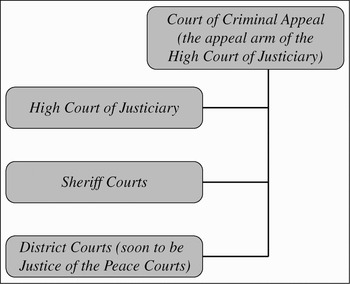
Scotland's supreme criminal court is the High Court of Justiciary. In contrast to civil cases, there is no further right of appeal available to the House of Lords. This situation was confirmed by the Criminal Appeal (Scotland) Act 1926. Instead, an appeal against conviction or sentence (or both) lies to the High Court sitting as the Court of Criminal Appeal.
It has a wide jurisdiction in respect of common law and statutory offences, except where jurisdiction is otherwise reserved. It is affected by the European Court of Justice, where relevant, and is required in certain circumstances to refer questions to the ECJ.
The court's procedure is regulated by Acts of Adjournal, insofar as it is not regulated by statute. The Act which constituted the court in its modern form provided ‘that it be left and recommended to the judges of that court to regulate the inferior officers thereof, and order every other thing concerning the said courts’.
This in effect continued powers which were inherent in it as the Court of the Justiciar, the jurisdiction and powers of which are the basis of those of the High Court of Justiciary today. Hence the powers of the court to regulate its procedure today, in so far as not prescribed by statute.
The current statute governing criminal procedure provides that the High Court may by Act of Adjournal regulate the practice and procedure in relation to solemn criminal procedure, including appeal to the High Court sitting as a Court of Criminal Appeal, and a similar provision is made in respect of summary criminal proceedings. An Act of Adjournal is passed by a quorum of judges and is signed by the presiding judge ‘I P D’, In Praesentia Dominorum. Acts of Adjournal are recorded in the High Court Minute Books, as well as in the Books of Adjournal and may be published in the Edinburgh Gazette, or as statutory instruments.
The High Court of Justiciary has jurisdiction over all of Scotland and over all crimes, including murder, culpable homicide, known in England as manslaughter, armed robbery, drug trafficking and sexual offences, unless specifically excluded by statute. Cases are tried under solemn procedure by a judge and a jury comprised of 15 men and women. Maximum powers of punishment extend to life in prison and/or a fine of any amount (for common law crimes), or to such maximum limit as may be prescribed by statute.
Below the High Court of Justiciary in the criminal court hierarchy are the Sheriff Courts. As explained above, the Sheriff Courts have an extensive civil and criminal jurisdiction. Criminal cases can be heard before a sheriff sitting alone (in summary procedure) or a sheriff and a jury (in solemn procedure). The choice of procedure determines the maximum punishment available. In solemn procedure before a sheriff and jury, the maximum sentence is three years in prison (though the sheriff may choose to remit sentencing to the High Court if he considers that his powers of imprisonment are inadequate in any particular case) and/or an unlimited fine. In summary procedure before a sheriff alone, the maximum sentence is six month's imprisonment or a fine not exceeding the prescribed sum (subject again to the sheriff's power to remit to the High Court, in appropriate cases, for a more severe sentence to be imposed. Examples of offences the Sheriff Court has jurisdiction over include theft, assault, possession of drugs and soliciting.
District courts form the lowest level of the criminal court hierarchy. Every local authority area in Scotland must have at least one District Court. A Justice of the Peace, who is a lay person, sits with a legally qualified clerk. The District Courts' jurisdiction extends only to summary criminal matters, and sentences are limited to imposing a fine of up to level four on the standard scale (£2,500), with the option to imprison for up to sixty days. District Courts are in the process of being phased out by legislation, to be replaced with “Justice of the Peace Courts” with comparable sentencing powers.
Other courts
Courts-Martial Appeal Court
The Courts-Martial Appeal Court hears appeals against conviction from any person convicted by any naval, army or air force court-martial, and against sentence up on civilians. The court applies the substantive and adjectival law of England. The court may sit at any place in or outside the UK, as directed by the Lord Chief Justice of England.
Lands Tribunal for Scotland
The Lands Tribunal for Scotland has a wide jurisdiction in many fields relating to land, both urban and rural. These include determining matters regarding compulsory purchase, valuation and compensation relating to land, and to vary or discharge land obligations. It also hears appeals on any question of fact or law arising from anything done (or omitted to be done) by the Keeper of the Land Register of Scotland.
Lands Valuation Appeal Court
Only questions of value can be submitted to the Lands Valuation Appeal Court. It hears appeals from decisions of the Lands Tribunal.
Scottish Land Court
This body took over the judicial function of the old Crofters Commission in 1912, and deals with landholders' tenure, crofting tenure, and agricultural holdings tenure.
District Court
The District Court is a hybrid, being partly determined by statute and partly providing historic continuity by maintaining the use of the justice of the peace and stipendiary magistrate. The competency of the court only extends to minor offences, although it can impose fines of up to £1,000, and may impose imprisonment of up to sixty days. Each local authority may nominate up to a quarter of its members to serve as ex officio justices.
Tribunals
There are also a number of tribunals covering a wide range of specialist areas including employment, immigration, child welfare and mental health. In many instances there is a statutory right of appeal from a tribunal to a particular court or specially constituted appellate tribunal.
Employment Appeal Tribunal
The EAT in Scotland operates in a similar way to that in England and Wales, although appeals would go to the Court of Session.
Court of the Lord Lyon
The Lord Lyon King of Arms presides over the Court of the Lord Lyon, from which appeal lies through the Court of Session to the House of Lords. The jurisdiction of the Lord Lyon is principally in the grant of armorial bearings by letters patent, and also to determine claims to particular armorial bearings or heraldic issues.
The impact of devolution: the Scotland Act 1998
Devolution came to Scotland in the form of the Scotland Act 1998. The Act has been described as a written constitution for Scotland and it created a devolved Executive with responsibility for certain devolved subject matters, and a devolved Parliament to legislate on the same devolved subject matters. (The devolved executive is referred to in the Act as the “Scottish Executive,” but it has been re-branded as the “Scottish Government” by the current Scottish National Party administration). As well as creating the Scottish Executive and the Scottish Parliament, the Scotland Act also sets out the limitations upon their powers.
The Scottish Parliament has three main roles:
(1) To make legislation, by means of primary legislation (Acts of the Scottish Parliament) and by approving subordinate legislation made by the Scottish Executive;
(2) To hold the Scottish Executive to account and
(3) To provide a forum for political debate. Notwithstanding the constraints on the Scottish Parliament's powers, it can debate any subject matter it chooses.
The Scottish Parliament can only legislate on matters within its legislative or devolved competence. The structure of the Act is to define by exclusion: it lists, in very broad terms, those subject areas that are outwith devolved competence, leaving the (undefined) “rump end” as devolved. Section 29 of the Scotland Act 1998 provides that “An Act of the Scottish Parliament is not law so far as any provision of the Act is outside the legislative competence of the Parliament.” This introduced an importance change to the nature of legislation in Scotland. Such legislation is now more susceptible to judicial scrutiny and challenge than ever before. Constitutional law has never been so vibrant!
Thus an Act of the Scottish Parliament will be outwith its legislative competence if, amongst other things, it contravenes EC law or the European Convention on Human Rights (ECHR), or strays, in a substantive way, into subject areas that are specifically and expressly “reserved” to the UK Parliament at Westminster. The UK Parliament retains exclusive competence to legislate in all these “reserved” matters. For example, the UK Parliament has reserved to itself the exclusive competence to legislate on subjects such as defence, the armed forces, economic and fiscal policy, international relations, atomic energy, social security, consumer protection, equal treatment or opportunities, and a vast range of other matters identified, in very broad terms, in Schedule 5 to the Act. By default, the Scottish Parliament can legislate on matters not otherwise expressly reserved, which would include areas such as health, education, justice and local government.
It should be borne in mind that the UK Parliament at Westminster keeps overall sovereignty. It retains power to legislate on areas that have been devolved to the Scottish Parliament, or to over-ride any act of the Scottish Parliament, if it so wishes. That said, a well-established convention, known as the Sewel Convention, seeks to ensure that both legislatures respect a certain constitutional etiquette, by prescribing that the UK Parliament will not encroaching upon areas of law intended for the Scottish Parliament, without the latter's prior consent. Inevitably there will be areas of overlap.
The Scotland Act also provides a mechanism for the judicial determination of disputes on the limits of Scottish Parliament, and the Scottish Executive, activity. A “devolution issue” is the term used in the Scotland Act to describe any question that may arise as to whether or not the Scottish Parliament or Scottish Executive has acted within its powers. A devolution issue may arise in the course of any court proceedings in Scotland (or anywhere else in the UK). If the court considers that an Act of the Scottish Parliament, or an act or omission of the Executive, is “outwith competence,” it will be treated as being invalid. So far no Act of the Scottish Parliament has been successfully challenged, although there have been a number of attempts. The very first Act of the Scottish Parliament, The Mental Health (Public Safety and Appeals) (Scotland) Act 1999, was challenged, unsuccessfully, on the basis that it allegedly breached the ECHR. In contrast, there have been multiple instances of acts or omissions of the Scottish Executive (and of individual Scottish Ministers) being successfully challenged on the basis that they fall outwith devolved competence.
The Judicial Committee of the Privy Council is the final court of appeal to determine devolution issues.
The Scottish Parliament has passed a raft of legislation since it was brought into existence almost ten years ago. Its current legislative portfolio is diverse. For example, it famously introduced a general prohibition on smoking in a variety of public places, including all restaurants and bars, and a ban on fox-hunting, well in advance of any other part of the United Kingdom; it has re-cast the Scottish liquor licensing laws; and provided a right for women to breast-feed freely in public places.
Examples of differences between the Scottish and English legal systems
The Scottish legal system's independence from its English counter-part is most visible in some key differences in substantive law, terminology and court procedure. Whilst there is, and will remain, considerable overlap between the Scottish and English legal systems in critical economic and commercial areas, such as company law and employment law, there are stark differences in areas such as property, delict (tort), contract, family and criminal law.
By way of illustration:
Terminology
North of the border, there are pursuers and defenders (not claimants and defendants or respondents); a restraining order is known as an interdict (not an injunction); one might be sued for damages in delict (rather than tort); a liability may arise for damages for solatium (which means injury to feelings).
Criminal trials
In Scotland majority verdicts are commonly accepted (at least eight out of fifteen members of a Scottish criminal jury must find the accused guilty). Scottish juries may also return a verdict of “not proven”, a verdict unique to the Scottish legal system. The existence of this form of verdict is not without controversy, because of the stigma which is thought to attach to such a finding. A verdict of “not proven” has the same effect as a verdict of “not guilty”, with the accused acquitted of the charge for all time.
Conveyancing
In Scotland, the seller and purchaser of land do not (normally) sign a single contract document. Instead, contracts for the sale and purchase of property are constituted by an exchange of formal letters (known as “missives”), signed by solicitors acting for the parties which contain all the terms of the contract. The first missive will be the formal offer to purchase the property and in theory, if all the terms of the offer are acceptable without qualification to the seller, the subsequent acceptance results in the formation of a legally binding contract. More usually, the seller's solicitor will issue an acceptance subject to certain conditions. Formal letters are exchanged until all the terms are agreed and missives are then held to be “concluded”. At this point the contract is binding on both parties, and the buyer can be sued if he or she fails to come up with the price on the agreed date of entry to the property – which is usually some considerable time away. The Scottish system does not permit “gazumping”, whereby a seller can accept a higher offer to purchase from a third party, despite having already accepted the original purchaser's offer. That said, in recent times, it is increasingly common to find that the conclusion of missives is delayed until close to the proposed date of entry, with the result that the parties are denied the protection (and responsibility) of a concluded contract until close to the date of settlement.
Contract law
In Scots law, a promise can be binding on a promisor, without the need for any reciprocal consideration. For example, an offer to purchase may contain, or be accompanied by, a promise by the offeror not to withdraw the offer until a specified period has elapsed. Likewise, a promise may be made to a person contemplating the submission of an offer to the effect that if his offer is made in certain terms, and within a certain period, it will be accepted. Similarly, a seller may promise to issue an acceptance within a certain time of an offer already made to him. Under English law such promises may not be legally binding unless the promise is made in a deed under seal, or unless the promisee has provided valuable consideration for the promisor's undertaking. In Scots law, there is no necessity for any element of reciprocity. The promisor need receive nothing in return for his binding unilateral promise.


