Introduction
When Labour took office in 1997, it promoted the idea that paid work is the best form of welfare, including among groups like lone mothers that are marginal to the labour market. It also developed policies in relation to care and carework. Over half of mothers were already earning by 1997, particularly in dual-earner couples, and a tripod of policies to support worker-caregivers was needed: providing time for unpaid carework, services like childcare to help caregivers to earn, and money to compensate and support caregivers on leave or when their capacity to earn was reduced. This paper is about the money leg of the tripod.Footnote 1
The policies that Labour developed to deliver money to parents are often perceived as promoting paid work mainly for instrumental reasons: to reduce child poverty and welfare spending and increase women's employment for economic reasons in the context of the European Union's employment-oriented Lisbon Strategy (O'Connor, Reference O'Connor2005; Lewis, Reference Lewis2006; Annesley et al., Reference Annesley, Gains and Rummery2007). The story is more complicated than this.
Government money for caregivers – whether through tax credits or benefits, directly or indirectly to the main caregiver in the household – raises distributive issues concerning support to households with and without care responsibilities (‘inter-household’) and, within the household, between men and women (‘intra-household’). The inter-household aspect is especially contentious in a country such as the UK, where care responsibilities have tended to be seen as private, especially for children. As for the ‘intra-household’ dimension, feminist commentators have long questioned whether such payments should be conceptualised as recognition of carework carried out mainly by women, because this may merely reinforce the idea that care is women's work (Lister, Reference Lister2002). Nevertheless, policies providing compensation for the costs and opportunity costs of shouldering care responsibilities are of crucial practical importance for women, because the long-documented financial penalty of motherhood lasts for the rest of most mothers' lives (Joshi et al., Reference Joshi, Paci and Waldfogel1999; Sigle-Rushton and Waldfogel, Reference Sigle-Rushton and Waldfogel2007). Moreover, men's options to spend time out of the labour market for care, even if they wish to, can be incentivised or constrained by money policies.
The two issues of inter- and intra-household distribution are in fact linked. There is strong evidence that women (and more men) want to care (Gilligan, Reference Gilligan1982; Knijn and Kremer, Reference Knijn and Kremer1997; Burgess, Reference Burgess2007). However, direct payments to caregivers tend to be set at a low level; this is certainly the case with the Carer's Allowance (paid to caregivers of the disabled),Footnote 2 and the new and extended leaves for childcare that have been introduced under Labour. Other EU Member States are more generous. But none completely replaces income foregone, let alone the costs of upkeep for children. Thus state policies do not enable a financially equal choice between the performance of paid and unpaid work. Although many want and choose to care, this is also problematic given the gendered sense of obligation on the part of women to do carework (Finch and Mason, Reference Finch and Mason1992) and the fact that carework is necessary work (Nussbaum, Reference Nussbaum1999). Folbre (Reference Folbre1994) has insisted that childcare should be seen as a public good. Money spent on children's upkeep will also benefit everyone. At the very least, therefore, caregiving has socially beneficial spillovers as well as being a private good, and policy needs to take account of the ‘free-riding’ that occurs when one entity (or individual) benefits from the actions of another without sharing the costs: both on the part of households without care responsibilities vis-à-vis those with such responsibilities, and, at the intra-household level, at the expense of a (usually) female by a (usually) male partner (Fraser, Reference Fraser1997). As Deacon (Reference Deacon2007) puts it: ‘[P]ublic support for carers should be viewed as a form of compensation, provided in recognition of the price the caregiver must pay if she is to meet her obligations to those dependent upon her . . . Only if she has her own needs met in this way, can the caregiver enjoy equal citizenship’ (p. 484). This formulation also relates to women's autonomy, identified by Orloff (Reference Orloff1993) as a major goal of social policies, which in turn depends on the degree and the level of compensation provided, on the extent to which it encourages or discourages caregivers from earning during the majority period of the lifecourse when caregiving demands are not intense, and on which individual in a couple receives the money.
This paper does not attempt to quantify how financial costs and opportunity costs of caregiving should be distributed. Rather, it explores the amount of money Labour has directed to caregiving households, and the extent to which such money has effected redistribution, distinguishing the implications for lone mothers and partnered mothers and fathers (space permits only glancing reference to life-course and class dimensions). It concludes that Labour has done more in respect of inter- than intra-household distribution.
Labour's policy approach
Labour's policy channelled far more money into both labour market activation and families with children (in and out of paid work), particularly after April 2003. Honouring its pre-election pledge to stick to Conservative spending plans, Labour at first slightly reduced real-terms spending on family cash benefits, according to the restrictive OECD (2007) definition. But from 1.7 per cent of GDP in 1998, spending rose to 1.9 per cent in 2000–02 and 2.2 per cent in 2003; from £15.3bn to £22.5bn (2000 prices), higher than in 12 of the EU-15 countries. However, with spending concentrated on benefits in kind in the Nordic countries and France, overall spending on ‘the family’ in UK was still below that of seven others (ibid.).
Labour increasingly provided extra money in the form of tax credits, officially worth £17.9bn to 5.5million families in 2006–07 (£18.7bn including under- and over-payments) (HMRC, 2007a). These were initially similar to social security benefits. But from April 2003, in a structure basically planned by 1999 (HC, 1999a: cols 183–4), tax credits partially integrated the social security and tax systems, especially for those with children. All support for children's upkeep is now in principle (not yet in practice) delivered through Child Benefit (CB) and the Child Tax Credit (CTC), and both are now the responsibility of the tax authorities (HMRC) and independent of work or partnership status. But the interactions between the various taxes and benefits remain byzantine.
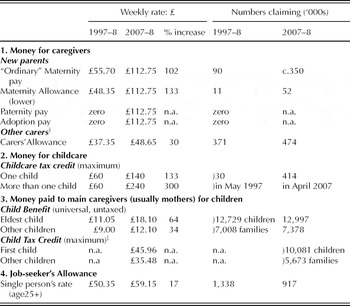
The Treasury played a key role in controlling policy. As an overarching principle, it developed what it calls ‘progressive universalism’ whereby all caregivers get some financial support, but the poorest get most (e.g., HMT et al., 2004). Universal child benefit was sharply raised and in 2005 a modicum of childcare funding was introduced for better-off families. Universality here recognises the social contribution even of millionaire parents. A small family element of CTC goes to most mothers but the larger per-child element is restricted to households on lower incomes, both in and out of work, and tapers to zero as family income rises. Married couples without dependent children ceased to get an income tax break, and the money was recycled to parents. At the interface between joblessness and low-paid work, those without children now get some in-work financial support (through Working Tax Credit –WTC), but parents get far more, since the unemployment and poverty traps are far deeper for those whose earnings need to support a family. New Deal programmes were developed to help parents, especially lone parents, to get jobs. Labour's policy penalises only those who contribute neither paid work nor carework: Jobseeker's Allowance has risen much less than care-related tax/benefits (Table 1) and the incomes of the childless unemployed have fallen sharply in real terms (WEU, 2006a: Table S7.3).
How much have tax/benefits changed?*

Notes: *Comparative figures are for the closest analogous benefit/tax credit/tax allowance
†The earnings limit for Carer's Allowance (net of tax, national insurance and some other costs) has been nearly doubled, from £50 to £95 a week. Since 1996–7, Exchequer costs have risen from £947m to £1.27bn at 2007/8 prices (DWP, 2007a). Exchequer costs of money claimed by disabled adults (Disability Living Allowance if under 65 and Attendance Allowance if over 65, for amounts of up to £64.50 per week) have risen as follows: Disability Living Allowance from £6.3bn to £9.7bn.; Attendance Allowance from £3.2bn to £4.4bn (2007–8 prices).
‡Per-family element of CTC, £10.48 per week (double with child under one), goes to all but the richest. It indirectly replaced the married couples' allowance worth £5.30 a week by 1997 (available to all taxpaying married couples, with or without children, including the richest, plus equivalent for taxpaying unmarried parents). Per-child element, maximum £35.48, compares with maximum child premia for the unemployed in 1997 of between £17and £25.
Sources: DWP and HMRC websites; Hansard, House of Commons, 20th January 1998, Written Answers (col.496); Child Poverty Action Group's Benefit Guides.
Defining money for parents as caregivers
Money for parental caregiving is difficult to define and measure. A study for the Fawcett Society (Bellamy et al., Reference Bellamy, Bennett and Millar2005) distinguishes between two types: money paid explicitly in recognition of time currently spent on carework (e.g. maternity pay, often conceptualised as earnings replacement) and money that caregivers receive as a ‘conduit’ for their dependants, e.g. child tax credit (see also Bennett, Reference Bennett2005, Reference Bennett and Lewis2006). There are two reasons why ‘conduit’ money needs to be included in any consideration of policies on money-for-care. The first relates to issues raised by Eleanor Rathbone in 1924 when she advocated state child payments to earners as well as the unemployed (Rathbone, Reference Rathbone1949). In order to pay for children's food and clothing, parents need to earn much more than childless adults to achieve an equal standard of living. Unlike wage rates set in a competitive labour market, tax/benefit systems can compensate for the earner's extra costs of children's upkeep: parents have legal responsibility for children and need help with children's living costs (as well as carework) if they are to enjoy equal citizenship. Insofar as children's upkeep is a public good, conduit payments, like maternity pay, are justified as earnings replacement – in this case compensating parents for the opportunity cost of earnings they could otherwise spend on themselves. The second reason for including conduit money arises because, unlike services and to a much greater extent than time, it can be transferred across functions and sometimes even across a life-time. Maternity leave cannot be postponed; childcare services cannot benefit parents providing their own childcare. But money is itself the means of exchange. If government increases the subsidy it pays ostensibly for children's upkeep, parents do not have to earn this money and can spend it on anything: they can work fewer hours and spend more time on care, use it to pay for childcare and work more hours – or spend more of what they earn on themselves. Tony Blair stated that Labour's early increases in child benefit were intended to help with childcare costs (DfEE, 1998:Foreword), a view at odds with the original purpose of the benefit, but justifiable in relation to the possible practical uses of the money. Recently, the Government repackaged the £120m it planned to spend (from 2009) on extending child benefit to pregnant women: it is now a one-off £190/woman ‘Health in Pregnancy Grant’. Although conditional on receiving health advice, this money is still ‘to help them invest in their individual needs . . . whilst giving them flexibility to choose . . . where they spend [it]’ (Kennedy, Reference Kennedy2007).
As distinct from ‘money and carework’ and ‘conduit money’, there is a third raft of money policies that are frequently cited by both government and academic analysts as helping to ease gender-related financial inequality (WEU, 2006b; Rodgers and Rubery, Reference Rodgers and Rubery2003; DWP, 2005). They include working tax credit (WTC), the national minimum wage (NMW) and pension credit. It is argued here that these too need to be factored into policy discussion of compensation that enables caregivers to enjoy equal citizenship. Again, they involve an element of earnings replacement, since, without carework, the individuals affected would be able to earn more. Care responsibilities reduce remuneration both at the time and over lifetimes but do not always attract specific care-related compensation. WTC, NMW and pension credit differ from policies that affect all women equally (e.g. equal pay). They are conceptually comparable to part-time work regulations, which protect all part-time workers, but mostly affect women and particularly mothers, and which therefore have a gender significance that does not apply to employment regulations in general (Kilpatrick and Freedland, Reference Kilpatrick, Freedland, Sciarra, Davies and Freedland2004).
The rest of this section estimates costs of money channelled to parents under the three heads identified above. Tax/benefit rates are detailed in Table 1. Much of the extra Exchequer cost arises because Labour has extended eligibility to more people and over time (e.g., maternity pay, 18 weeks in 1997, is to rise to 52 weeks by 2010).
‘Money for carework’
The Exchequer cost of maternity pay has tripled since 1997: an increase of about £1.2bn p.a. at 2007–08 prices (DWP, 2007a). Introducing paternity and adoption pay cost very little, although new fathers are taking more time off work (HC, 2007; Smeaton and Marsh, Reference Smeaton and Marsh2006). The provision in the 2006 Work and Families Act, which is scheduled from 2010 to permit mothers to transfer the second half of their maternity leave to their partners, will also cost very little (about £50m p.a.) if the low payment level compared to men's wages results in the expected low take-up (DTI, 2007).
The childcare element of working tax credit (henceforth CCTC) is a much expanded version of a similar provision that Labour inherited. In 1997, about 31,000 received this subvention for working parents' childcare costs, over 95 per cent of them were lone parents, the average weekly payment was under £20 a week and the annual Exchequer cost was under £35m. By April 2007, there were 414,000 recipients, over a third were in couples (couple eligibility requires both parents to be working 16+hours/week), the average weekly payment was £61 and the annual cost was £1.3bn (HMRC, 2007b).
CCTC is usually limited to those on low earnings and, in 2005, Labour introduced tax exemption on employers' childcare vouchers up to £50/week (now £55; HC, 2004: col.788), a measure it had earlier rejected (HC, 1999b: col.30). By the end of 2005, about a third of all employees were covered (concentrated in large organisations) and about a third of the parents among them were claiming. This was already about double the take-up the government had expected by 2009/10 so that the Exchequer cost, expected to reach £60m, is likely to be running into hundreds of millions. In 2005, almost all claims were for infant or pre-school care and most were for close to the maximum. Unlike CCTC, only one parent needs to be earning, and with both parents able to claim for the same child in the same childcare place (i.e. a total of £110 per child per week) nearly a third of claimants are fathers (HMRC, 2004; Kazimirski et al., Reference Kazimirski, Smith, Mogensen and Lemetti2006). As between all households with children, vouchers, like child benefit, are regressive, and nearly a third of claimants in 2005 were higher-rate taxpayers (ibid.).
In its first pension reform, Labour extended Home Responsibilities Protection (HRP) for caregivers' pension rights from the basic to the second state pension, in line with earlier Conservative plans (HC, 1995). Until age 12, HRP credits a ‘caring’ parent with pension contributions during periods spent out of the labour market. The 2006–07 pensions legislation introduced many small – but cumulatively important − changes that women's organisations had campaigned for. The future Exchequer cost of all these measures will depend on whether caregivers increase their paid work and will be offset by falls in means-tested pension credit for (female) pensioners, but could run to £billions per annum when fully operational 50 years hence.
However, Labour's policy significantly reduces pension commitments to caregivers in one respect. The rise in the state pension age to 68 will disproportionately affect them, because they are less able to build up the private sector pensions that enable others (male and female) to retire earlier. In addition, Labour has maintained tax breaks on pension contributions that overwhelmingly benefit (male) higher earners with unimpeded career opportunities. At over £16bn p.a. (net of tax paid on such pensions after retirement), these tax breaks currently cost the Exchequer about a third as much as National Insurance (NI) basic state pensions.
‘Conduit’ money
Labour has both increased child-related tax/benefits and transferred payments for couples to the person designated as the ‘main carer’ – usually the mother.
Since 1997–98, the Exchequer cost of Child Benefit (CB) has risen from £9bn to £10bn (2007–08 prices; DWP, 2007a). It will continue to rise above inflation with increases for the first child (to £20 a week from 2009). The Exchequer cost of CB's tax-free status has also risen, from about £700m in 1997–98 to £1.1bn today, which particularly benefits higher-income women (HMRC, 2007b: table 1.5).
In 2005–06, the Government paid out £11.7bn in Child Tax Credit (CTC) up from £10.6bn the previous year (HMRC, 2007a). CTC partially replaced other payments from April 2003, most of which usually went to the man. But CTC goes to the ‘main carer’, usually the mother. The Treasury estimated that initially £2bn was transferred annually from men to women (HMT, 2003); it is much more today. By 2004–05, tax credits had increased the incomes of mothers by about 10 per cent, particularly due to this switch (WEU, 2006a).
‘Low-earnings compensation’
Three such policies are discussed here: Working Tax Credit (WTC), the National Minimum Wage (NMW) and pension credit. Each of these has a gender dimension, even where their explicit rationale is work activation. Their identification as ‘money for caregivers’ is more contentious than the items listed in the previous two sections. However, ‘[e]fforts to reconcile work–life balance goals are at the heart of the design of tax-benefit programs’ (Nolan, Reference Nolan2006: 167). In the three instances we include here, if earning capacity had not been constrained by care responsibilities, there would be many fewer beneficiaries, particularly female caregivers (present or past), and the Exchequer cost would be much lower.
WTC is the successor to the Conservatives' Family Credit that mainly supported lone parents and is mainly intended to help parents to bridge the unemployment trap. Today, approaching 15 per cent of WTC claimants have neither a child nor a disability claim, but their claims are smaller and over 90 per cent of WTC money goes to caregivers. Well over half of WTC awards are paid to women or to the main caregiver (usually the woman). Of the two million WTC claimants, nearly 900,000 are lone parents (HMRC, 2007b). Including CCTC (see above) and payments to non-caregivers, WTC cost the Government £6.2bn in 2006–07, up from £5.4bn the previous year and nearly three times the cost of Family Credit in 1997 (HMRC, 2007a; DWP, 2007a).
Labour presents the NMW, £5.52/hour in 2007–08, as one of its proudest achievements for women (WEU, 2006b). When first introduced in 1999, it was expected to cost employers about £2.5bn p.a., a figure now revised down to about £1bn (DTI, 1998; HC, 2005). A further £1bn has been added since 1999 via NMW increases above average earnings. About two-thirds of beneficiaries are women, including most of the 30 per cent who are persistently low-paid (Bryan and Taylor, Reference Bryan and Taylor2006), though these figures overstate their share of the benefit since many more women than men work part-time. For our purposes here, the gender significance of the NMW is, first, that without it expenditure on the WTC would be much higher and, second, that because of household-based assessment for tax/benefits (discussed below), it raises the individual earnings of low-earning women who cannot claim WTC because of their partner's income – and makes it more worthwhile for them to earn.
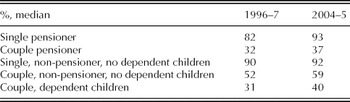
Labour's big increases in means-tested provision for pensioners are reflected in the sharp rise in single female pensioners' relative incomes (see Table 2). The current payment mechanism is pension tax credit which goes to over 2.6m claimants at a cost of £5.9bn (DWP, 2007b), about £2bn more (at 2007–08 prices) than in 1996–97. Labour has explicitly justified this pension credit on grounds of gender inequality and women's earlier caring roles:
Women account for 1.3million of the 1.9million people in retirement lifted out of absolute poverty since 1997. Of the 3.3million receiving Pension Credit, 2.18million are women . . . Only 30 per cent of women retiring today are entitled to a full basic State Pension – only 24 per cent on the basis of their own contributions and only 17 per cent are actually in receipt of a full basic State Pension based on these contributions . . . Childbirth, marriage, divorce and widowhood all have significant impacts on pension accrual. (DWP, 2005: v–vi)
Women's individual disposable incomes as a percentage of comparable men's

Note: There are too few single fathers for comparison with single mothers.
Source: Women and Equality Unit, Individual Income Statistics 2006, ONS.
However, as Table 2 also shows, the individual incomes of female pensioners in couples have benefited little because the credit is claimed by the male partner in 80 per cent of cases (DWP, 2007c: Table 5.4).
Implications for different groups
In 2003, the Treasury announced that ‘[b]y 2004–5, financial support for children through tax credits, Child Benefit and other benefits will have increased by £10.4bn in real terms from its 1997 level, a rise of 72 per cent’ (HMT, 2003: 98). The overall rise in care-related subventions since 1997 is now well above £20bn p.a., and well over 10 per cent of the cost of social protection in the UK. Tax/benefits for those without care responsibilities, such as job-seekers without children, have languished and a little of this money might be viewed as a transfer from the childless poor. Some would have reached caregiving households in other forms. But a large proportion is a transfer from taxpayers with few if any care responsibilities. It is not at the expense of services that particularly support caregivers such as health, education and supply-funded childcare, where spending has also risen.
By transferring money to caregiving households, including those on high incomes, Labour's tax/benefit and employment-related money policies reduced the inter-household ‘free-riding’ identified by Fraser (Reference Fraser1997): they have caused non-caregivers to do more to fulfil their obligations as a group to caregivers as a group, though not by providing time, unpaid, to care for strangers as Fraser's universal caregiver model suggests. The other element of Fraser's ideal is equal sharing of paid work and carework between partners – indeed, at the household level, her universal caregiver model family can be viewed as a dual earner/dual carer model (e.g., Daly and Lewis, Reference Daly and Lewis2000). Here, the implications of Labour's money policies are more ambivalent, not least because the household basis of means-testing means that many mothers with low individual incomes have missed out on redistribution. The analysis distinguishes between fathers, lone mothers and partnered mothers and reveals that care-related money policies have had differential effects.
Fathers
In 2004, Gordon Brown emphasised choice for fathers to care: ‘The first choice that parents want is more choice to stay at home . . . Building on . . . the introduction of two weeks' paid paternity leave already in this Parliament, we will for the first time respond to the case made to us for greater choice, and we will make paid maternity leave transferable from mothers to fathers’ (HC, 2004: col.787). However, although Labour's policy of providing fathers qua fathers with rights to time off work is a marked break with the past, its policies on money mean that the choice between paid work and carework is for fathers more symbolic than real. The Government's decisions not to pay parental leave at all, and to restrict paternity pay to a flat rate well below average male earnings, mean low take-up (Smeaton and Marsh, Reference Smeaton and Marsh2006; DTI, 2007). The only significant individualised money that Labour has offered fathers is help with childcare costs – but the tax break on vouchers is available only when they are earning. By failing to make carework a viable option for the higher earner in couples, Labour may have indirectly restricted the main caregiver's earning options (Lewis and Campbell, Reference Lewis and Campbell2007).
Lone mothers
Labour policy early set a target of raising lone parents' employment rates to 70 per cent by 2010, which would require an acceleration from the rate of increase so far, from 44.7 per cent in 1997 to 56.5 per cent in 2006 (Freud, Reference Freud2007). It supported this policy with the New Deal for Lone Parents (Millar and Rowlingson, Reference Millar and Rowlingson2001) and other financial incentives – for example £40 a week since 2004 for the first 12 months in a job after long-term unemployment (HMT, 2007). With good quality childcare more widely available, the choice for lone parents to earn has been made real and recent research suggests that, though not stress-free, the experience for both mothers and children has been favourable (Ridge, Reference Ridge2007).
Labour's increases in child benefit and child tax credit meant that lone parents' choice to care full-time was also less punitive than before 1997: the incomes of non-earning lone parents rose over 30% in real terms (WEU, 2006a: Table S7.3). Although they have long been required to attend interviews with a personal advisor to discuss the possibility of work, the Government stopped short of compelling lone parents to work until childcare was in place. However, from October 2008, lone parents with a child over 12 will qualify only for Jobseeker's Allowance (rather than Income Support), which carries paid work obligations. The age limit for unconditional support will be cut to under seven in 2010, bringing Britain into line with the EU norm (DWP, 2007d). Lone parents will still to be supported to care full-time until their youngest child's second year at primary school.
Where Labour's tax/benefit policies have most increased the constraint on lone mothers' choice is in the arena of intimate relations. Although the decision to pay CTC to the main caregiver eased financial insecurity for mothers living with low-income men (Campbell and Roberts, Reference Campbell and Roberts2002), many partnered mothers claim tax/benefits as if they were lone parents (Brewer and Shaw, Reference Brewer and Shaw2006). Lone parents claiming tax credits now have to declare new relationships to the authorities within one month, a draconian requirement compared to the tax regime for married couples who separate and have until the end of the tax year. So far, Labour has policed these rules with a light touch (as did the Conservatives too). But if it starts to enforce them, lone mothers may have to choose between sexual abstinence and financial dependence on a man in a possibly insecure new relationship.
Partnered mothers
When the family allowances (now child benefit) proposed by Eleanor Rathbone in the 1920s were enacted in 1945, the wartime Coalition Government originally intended that they be paid to the father. Rathbone's last-ditch campaign just before her death helped to secure payment to the mother (Macnicol, Reference Macnicol1980), but until 2003 means-tested payments for children were usually paid to the man of the house. Labour's switch of CTC payments to the main carer can be seen as at last extending Rathbone's principle to all subventions for children's upkeep and increased mother's individual incomes.
Outside the first few months of maternity leave, the principle behind Labour's money policies for main caregivers' (usually mothers') own upkeep appears to be different: get paid work or depend on the kindness of your (male) partner. True, Labour quickly abolished the last remnant of the Married Couple's Allowance (already cut by the Conservatives), a provision whereby the state helped higher-earning husbands to support a non-earning wife, even where childless. But the gender implications of its other policies are ambivalent.
An unintended outcome of Labour's household-based employment activation policy via tax credits was a disincentive to work for second adults (Rake, Reference Rake2001). Particularly after April 2003, it made technical adjustments to reduce this (Brewer et al., Reference Brewer, Clark and Myck2001). Labour recently raised the within-year disregard in WTC for a family's increase in earnings to the very large sum of £25,000: if a second adult gets a job, this will not usually reduce the couple's tax credits until the following tax year. These measures have not eliminated the paid work disincentive for second adults in couples in the WTC income bracket. The removal of the 10 per cent tax band (an individual entitlement) in 2008 is likely to strengthen it. This may increase the proportion of WTC claimant couples with male sole earners, which had been slowly falling but remains above half (over 500,000 couples). Conversely, Labour has not taken up Harker's proposal to amend the WTC to encourage second earners (Harker, Reference Harker2006; Brewer, Reference Brewer2007).
Labour's main contribution to helping mothers in couples to earn has been with childcare costs. The April 2003 changes to the CCTC extended financial support for childcare to many more families, particularly couples. In November 2002, 173,000 couples, only 10 per cent of claimants, were receiving CCTC; by July 2003, over a third of claimants were couples. Since 2003, the amounts of CCTC paid weekly to each family have risen by about a third and the couple proportion of recipients is also up. In dual-earner couples, the main caregiver receives WTC payments up to the level of CCTC, and, where both adults work 16+ hours, the couple nominates the payee (WTC is no longer paid via the wage packet). Because it is not means-tested, the childcare voucher scheme may also help. Both Child Tax Credit and CCTC are means-tested on household incomes, and not necessarily available to low-earning mothers. The assessment of the voucher scheme (Kazimirski et al, Reference Kazimirski, Smith, Mogensen and Lemetti2006) suggested that 10 per cent of claimants in 2005 were paying tax only at the 10 per cent rate, with 60 per cent on the standard rate. Insofar as childcare costs are perceived as something to be offset against the mother's earnings (rather than household income), the voucher scheme may be a counter to disincentives for partnered mothers to earn, and therefore reduce gender inequality at the intra-household level.
The Government has so far made no attempt to permit the main caregiver in couples, whether in or out of work, to receive means-tested support. This matters, particularly for pensioners and at the stages in the life-course when caregiving constrains earning opportunities most intensely. As Table 2 shows, the low relative individual incomes of female pensioners in couples have hardly risen.
In 2004, in connection with JSA claims, the Government said that it ‘believes that there is a strong case in principle for extending an individual's right to payment, as and when this is practical’ (HMT, 2004: 87). The Freud Report (Reference Freud2007) again raises the issue of individualisation, without making recommendations, but does recommend increased responsibility for non-earning adults in claimant couples to seek work. However, compared to (male) main earners and lone parents, the Government has not prioritized jobs for (female) partners, and it is only now starting to recognise its importance for reducing child poverty in couple households (HMT, 2008).
For many reasons, individualising tax/benefits is a contentious issue (e.g. Goode et al., Reference Goode, Callender and Lister1998). Recent research in other countries has indicated the potential of tax/benefit individualisation to affect paid work by mothers in couples (Crossley and Jeon, Reference Crossley and Jeon2007; Dearing et al., Reference Dearing, Hofer, Lietz, Winter-Ebmer and Wrohlich2007). Autonomy and the ability to achieve economic independence means ensuring individual access to (a) pensions and (b) income during periods of intense caregiving, but without undermining access at other times to more sustainable sources of income or autonomy, for example employment (Bennett, Reference Bennett2005). The first phrase in the title of the Freud Report is ‘Reducing Dependency’, but women's dependence on the men they live with is not part of its conceptualisation of ‘dependency’.
Conclusion
Labour's policies have greatly increased the amounts of money available to households with care responsibilities, and this has reduced the extent of ‘free-riding’ by those without. For lone parents, Labour has so far improved options for both paid work and full-time care, by redistributing money to parents whether they earn or not. However, policy is now being brought into line with the EU norm and a requirement to work at least part-time (or train for work) is now scheduled for lone parents with children over seven from 2010. The extensive means-testing at the household level distorts financial incentives and disincentives for those in medium and lower income brackets: lone mothers' partnering behaviour would be severely constrained by Labour's money policies if the cohabitation rules were fully applied, and there are disincentives for them to live in couples; in couples, mothers face a disincentive for a second adult to take a job, and are seldom paid their share of benefits. At the intra-household level, Labour's policies have done less to promote redistribution to caregivers (usually women) or to frame policies in such a way as to enable and encourage fathers to do carework. This in turn may constrain partnered mothers' employment choices. Labour's money policies on caregiving in couples are thus still partially framed within the Beveridgean assumption of a male breadwinner and dependent female.
Acknowledgements
The author is grateful for comments on an earlier draft to Professor Jane Lewis, Fran Bennett, Mike Brewer and the anonymous referees; and for support from the Economic and Social Research Council (ESRC) under grant number RES 225-25-2001.