Introduction
Tobacco is a major global health threat that is predicted to kill up to one billion people this century (WHO, 2008). The Framework Convention on Tobacco Control promotes methods for reducing the harms of tobacco through both prevention of tobacco initiation and assistance for current users to quit (WHO, 2003). Helping tobacco users to quit will reduce tobacco-related mortality faster than prevention alone (WHO, 2008) with the most effective method of quitting being a combination of behavioural support plus medication (Fiore et al., Reference Fiore, Jaen, Baker, Bailey, Benowitz and Curry2008).
To meet the challenge of assisting nearly one billion tobacco users to quit (Ng et al., Reference Ng, Freeman, Fleming, Robinson, Dwyer-Lindgren and Thomson2014), a workforce of individuals trained in tobacco cessation treatment is essential. Not all training methods are equally effective at promoting cessation (Carson et al., Reference Carson, Verbiest, Crone, Brinn, Esterman and Assendelft2012; Cornuz et al., Reference Cornuz, Humair, Seematter, Stoianov, van Melle and Stalder2002; McDermott, Beard, Brose, West, & McEwen, Reference McDermott, Beard, Brose, West and McEwen2013; Olano-Espinosa et al., Reference Olano-Espinosa, Matilla-Pardo, Minue, Antón, Gómez-Gascón and Ayesta2013; Wilson et al., Reference Wilson, Taylor, Gilbert, Best, Lindsay and Willms1988). Evidence-based training promotes better clinical practice and better cessation outcomes (Michie, Churchill, & West, Reference Michie, Churchill and West2011; West, Evans, & Michie, Reference West, Evans and Michie2011; West, Walia, Hyder, Shahab, & Michie, Reference West, Walia, Hyder, Shahab and Michie2010). There are limited existing data describing the training methods and content used to educate tobacco cessation treatment providers around the world. Our objectives for this study are to measure the prevalence of tobacco cessation treatment content, skills training and teaching methods reported by tobacco treatment training programmes around the world and to compare programmes across income levels.
Methods
Sample
We identified individuals involved in tobacco control and training around the world using a strategic non-probability sampling approach (Kruse et al., Reference Kruse, Rigotti, Raw, McNeill, Murray and Piné-Abata2015). Individuals included treatment specialists, government officials, and members of the Framework Convention Alliance and who either participated in prior tobacco treatment and tobacco control surveys administered by the research team (Pine-Abata et al., Reference Pine-Abata, McNeill, Murray, Bitton, Rigotti and Raw2013; Raw, Reference Raw, Regan, Rigotti and McNeill2009a; Raw, Reference Raw, Regan, Rigotti and McNeill2009b; Rigotti et al., Reference Rigotti, Bitton, Richards, Reyen, Wassum and Raw2009), were contacts of the research team, or were recommended by a range of tobacco control organisations. We reasoned that these individuals were likely to be knowledgeable about tobacco cessation treatment training in their countries. We identified 197 individuals involved in tobacco control from 122 countries spanning all six World Health Organization regions (WHO, 2015a) and four World Bank income levels (World Bank, 2014). Individuals were invited to participate by email. From this sample, we excluded invalid emails (N = 28) and ineligible contacts (i.e. those not involved in training programmes, N = 37).We also invited respondents to provide contact information for additional individuals involved with training programmes in their countries (N = 58). Our final response rate denominators were 190 individual programme contacts in 115 countries.
Survey Instrument
In the 28-item survey, we asked about training methods including whether programmes covered seven knowledge topics, seven treatment skills, harm reduction, work with diverse populations, and professional development (Appendix A). For respondents with more than one programme, we asked them to respond about their most comprehensive programme. The topics were adapted from the 11 core competencies outlined by the Association for the Treatment of Tobacco Use and Dependence (ATTUD, 2005). Some competencies covered multiple distinct topics and were assessed with multiple items. We did not ask about the law and ethics competency because we reasoned that some countries would not have regulations applicable to the tobacco treatment setting. The language was simplified with the help of an ATTUD member for an earlier training survey (Rigotti et al., Reference Rigotti, Bitton, Richards, Reyen, Wassum and Raw2009) and the items were revised again based on pre-testing and expert opinion by our research team.
Three research assistants in the Massachusetts General Hospital Tobacco Research and Treatment Center and 42 UK National Centre for Smoking Cessation and Training trainers pre-tested the survey. The survey was developed in English and professionally translated to Spanish and French. Two native speakers also fluent in English reviewed the translated versions, and any discrepancies in meaning between versions were edited.
Data Collection
Individual subjects were invited by email between May and September 2013 to complete a web-based survey. We offered no remuneration. The Lifeguide programme (http://lifeguide.ecs.soton.ac.uk/) was used to administer the survey. Non-responders were contacted biweekly on up to five occasions, with reminder emails containing both a link to the web-based survey and a word document version of the survey for subjects preferring to return the survey by email attachment. Completion of the survey implied consent.
Analysis
We calculated descriptive statistics of programme content and compared those characteristics across World Bank income levels (high, upper-middle, lower-middle, and low-income) using the Cochran–Armitage test for trends and the Kruskal–Wallis chi-square test for continuous variables. Analyses were performed using SAS version 9.3 (Cary, NC).
Results
Response Rate
We received individual responses from 122 individual contacts (64%) in 84 different countries (73%) with between one and 11 individual response(s) per country. Amongst the 84 countries, over half (N = 52, 62%) were low- or middle-income countries (LMICs) (Appendix B). Neither the individual nor country response rates differed significantly by income level or region. Most individuals (91%, N = 111) responded in English, 6% (N = 7) in French, and 3% (N = 4) in Spanish. In total, 104 individual contacts reported about 104 training programmes in 66 countries. Eighteen individual contacts from 18 countries reported having no training programme in their country (Kruse et al., Reference Kruse, Rigotti, Raw, McNeill, Murray and Piné-Abata2015).
Amongst the 104 individual contacts reporting about a training programme, many (48%, N = 50) individual respondents reported having multiple roles in their training programme including: trainer (52%, N = 54), programme manager (42%, N = 44), researcher (32%, N = 33), administrator (20%, N = 21), and funder (5%, N = 5).
Trainees
Amongst the 104 training programmes, healthcare workers (doctors, nurses, dentists, mid-level clinicians including clinical officers and physicians assistants, pharmacists, psychologists, respiratory therapists, or students of these professions) were the most commonly reported trainees (84%, N = 87 of 104). Programmes in lower income countries were less likely to report training healthcare workers (high-income 91% [N = 50], UM 80% [N = 24], LM 73% [N = 8], low 63% [N = 5], Cochran–Armitage trend test = 2.4, p = 0.01). Over half of individual programmes (54%, N = 56) reported training individuals outside the healthcare system including religious leaders, teachers, and community health workers. Many programmes reported training tobacco treatment specialists (33%, N = 34) and addictions specialists (23%, N = 24).
Treatment Modalities
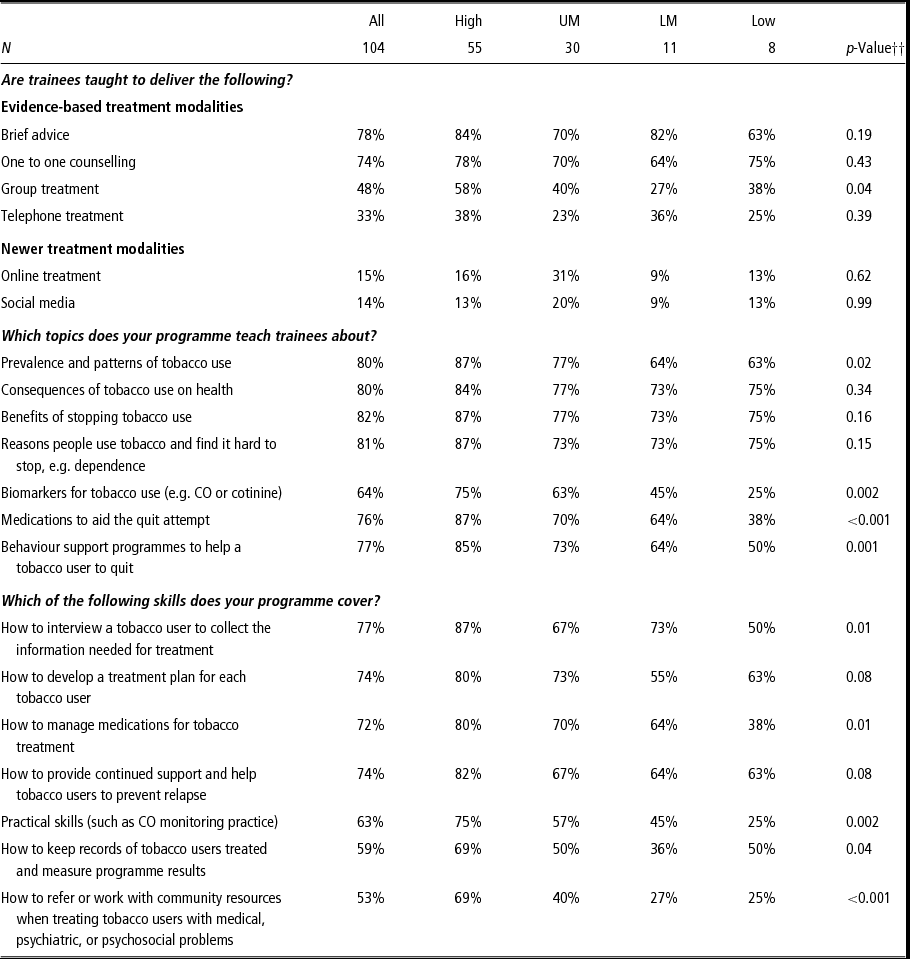
The majority of programmes reported teaching brief advice (78%) and one-to-one counselling (74%); teaching about telephone counselling was uncommon (33%) (Table 1). Few programmes reported teaching learners to deliver cessation assistance online (15%) or using social media (14%). Group counselling was more often reported by programmes in high-income countries (p = 0.04).
Tobacco cessation treatment training topics and skills covered by income level*†

Abbreviations: UM-upper middle, LM-lower middle, NRT-nicotine replacement therapy.
*2014 World Bank Country Income Level: http://data.worldbank.org/data-catalog/world-development-indicators?display=graph.
†104 of 122 individual contacts reported on 104 training programmes. Eighteen individual contacts reported no training programme in their country.
††Based on Cochrane–Armitage test for trend across high, UM, LM, and low country income level.
Training Content
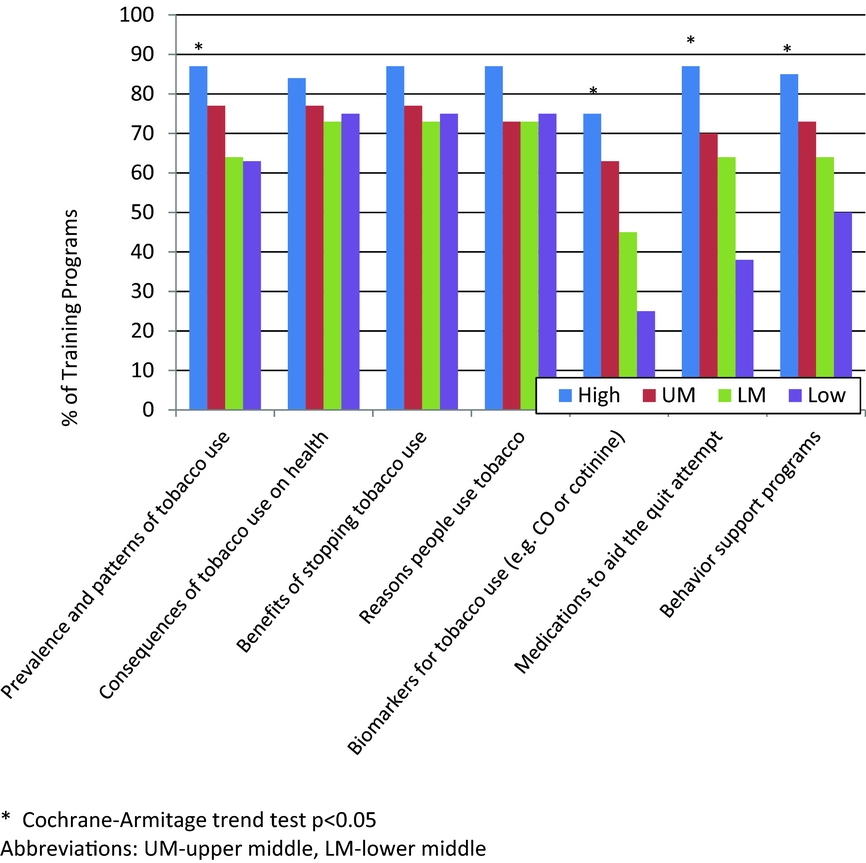
All seven topics and seven skills were taught by a majority of programmes (Table 1). Several educational topics were less often reported by programmes in lower income countries (Figure 1). The most commonly reported topics in low-income countries were consequences of tobacco use, benefits of stopping, and reasons people use tobacco (Table 1).
Educational topics covered in training programmes by income level.

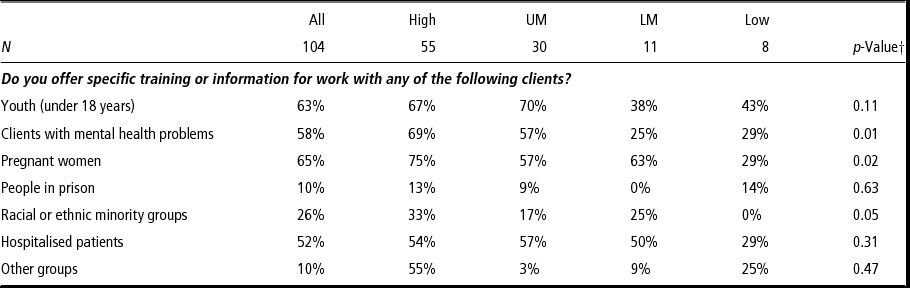
Overall, skills-based training was less common than teaching topics. Programmes in lower income countries were less likely to report training learners in how to interview tobacco users, how to manage medications, practical skills such as CO monitoring, how to keep records and measure programme results, and how to refer or work with community resources for tobacco users with co-morbidities (Table 1). Teaching of harm reduction methods was reported by 51% of programmes (N = 53) and there was no difference by income level. Most programmes reported including content for assisting one or more special populations (Table 2). Programmes in higher-income countries more often reported training learners to assist tobacco users with mental health problems and pregnant women.
Tobacco cessation treatment training programme work with special populations by income level*

Abbreviations: UM-upper middle, LM-lower middle.
*2014 World Bank Country Income Level: http://data.worldbank.org/data-catalog/world-development-indicators?display=graph.
†Based on Cochrane–Armitage test for trend across high, UM, LM, and low country income level.
Training Methods
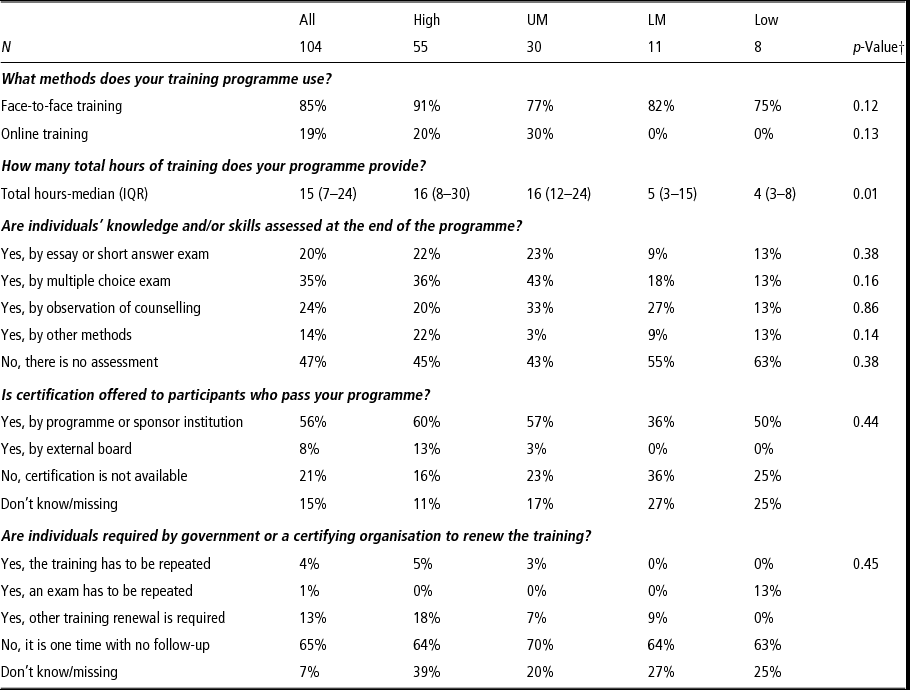
Most programmes (85%, N = 88) train providers using face-to-face methods for a median of 15 hours (interquartile range [IQR]: 7–24) (Table 3). Online training was rare (19%, N = 20). Programmes in lower income countries reported fewer training hours (p = 0.01). Half (53%, N = 55) of programmes reported an end-of-programme assessment for learners. This was most commonly a multiple choice exam (35%, N = 36), 20% (N = 21) used essay exam. One-quarter (N = 25, 24%) assessed learners by observing counselling skills. Most programmes (56%, N = 58) reported certification was available. We did not specify whether this was a certificate of participation or a more formal certification (e.g. Tobacco Treatment Specialist). Recertification or training renewal requirements were rare (17%, N = 18).
Tobacco cessation treatment training methods by income level*

Abbreviations: UM-upper middle, LM-lower middle, IQR-interquartile range.
*2014 World Bank Country Income Level: http://data.worldbank.org/data-catalog/world-development-indicators?display=graph.
†Based on Cochrane–Armitage test for trend, Fisher's exact test, or Kruskal–Wallis chi-square test across high, UM, LM, and low country income level.
Discussion and Conclusions
Discussion
This international survey of tobacco cessation treatment training programmes found that training programmes covered a comprehensive range of teaching topics and taught evidence-based treatment methods although topics and methods differed by country income level. The inclusion of practical skills training was less widely reported, particularly amongst LMICs, and there were potential training deficiencies in total hours of training, learner assessments, continuing education, and availability of online training.
Consistent with prior work (Rigotti et al., Reference Rigotti, Bitton, Richards, Reyen, Wassum and Raw2009), our study finds that most training programmes covered most recommended teaching topics (ATTUD, 2005). Our study adds to the literature by examining differences in cessation topics covered by income level. These income differences may reflect the stage of their tobacco epidemic (Thun, Peto, Boreham, & Lopez, Reference Thun, Peto, Boreham and Lopez2012). Lower income countries most often reported teaching about the consequences of tobacco use and benefits of cessation and this may reflect less prevalent knowledge of the harms of tobacco amongst the public in LMICs (Sansone et al., Reference Sansone, Raute, Fong, Pednekar, Quah and Bansal-Travers2012; Yang et al., Reference Yang, Hammond, Driezen, Fong and Jiang2010). Programmes in higher income countries more often reported more teaching about behavioural and pharmacologic treatments and biomarker assessment compared to lower income countries where these resources may not be widely available. It is worth highlighting that medications and biomarkers are not covered 100% of the time in high income countries where these resources are widely available (WHO, 2008). Furthermore, in LMICs where medications are not accessible, training providers to deliver behavioural cessation support may be the most efficacious treatment available to reduce the harms of tobacco use (Awaisu et al., Reference Awaisu, Nik Mohamed, Mohamad Noordin, Aziz, Sulaiman and Muttalif2011; Siddiqi et al., Reference Siddiqi, Khan, Ahmad, Dogar, Kanaan and Newell2013).
Skills-based training was not as commonly reported as tobacco cessation knowledge building, particularly amongst LMICs. This may reflect local resources, as described above, with less training in skills of medication management and CO monitoring where medications and biomarker measurement are not available. We also don't know whether face-to-face training methods were strictly lectures or whether they included more skills-oriented methods like case discussions or role playing. Prior work measuring medical student tobacco training has shown lectures are the most often used teaching method whilst role playing or practice with real clients is less common (Richmond, Zwar, Taylor, Hunnisett, & Hyslop, Reference Richmond, Zwar, Taylor, Hunnisett and Hyslop2009). Although knowledge building is necessary, it may be insufficient as a driver of behaviour change amongst treatment providers or smokers (NCSCT, Reference McEwen2013). Programmes which involve role playing or other skills-based training have been associated with greater provider behaviour change than lecture-based programmes (Spangler, George, Long Foley, & Crandall, Reference Spangler, George, Long Foley and Crandall2002) and skills-based tobacco dependence training improves cessation outcomes (Brose, West, Michie, & McEwen, Reference Brose, West, Michie and McEwen2014).
In addition to the need for more widespread skills-based training, our survey identified four other potential training shortfalls: hours of training offered, learner assessments, continuing education, and availability of online materials. Even in high-income countries, median hours of training are below the 30 hours training standards recommend (NCSCT, Reference McEwen2013) and more hours of training improves cessation outcomes (Lancaster, Silagy, & Fowler, Reference Lancaster, Silagy and Fowler2000). Only one-quarter of programmes assessed learners by observation of skills and less than half of programmes had any end of programme assessment. Requirements to retrain providers were also rare. One-off training programmes without continuing education may be only minimally effective at changing provider behaviour (Herie, Connolly, Voci, Dragonetti, & Selby, Reference Herie, Connolly, Voci, Dragonetti and Selby2012; Miller, Sorensen, Selzer, & Brigham, Reference Miller, Sorensen, Selzer and Brigham2006). Finally, in-person training was the norm. Meeting the growing needs of smokers in LMICs will require more rapidly scalable training methods. Online programmes could enable more hours of training content to be delivered inexpensively to a wide audience. Linking online programmes to skills-based training and continuing education, where possible, could further increase the effectiveness of trainees (Brose et al., Reference Brose, West, Michie and McEwen2014).
A key strength of this study is its large sample size, including training programmes from all income levels and all regions. To our knowledge, there are no other surveys measuring tobacco treatment training methods around the world. The study also has limitations. It is a non-probability sample that may not be representative of the entire population of training programmes. However, no comprehensive list of training programmes exists. Our sample may over-represent countries with more comprehensive tobacco control programmes and less sophisticated programmes may be excluded. We asked about topics covered but did not examine topical content in depth in this survey. Finally, data are self-reported and we cannot validate the accuracy of responses.
Conclusions
We identified potential shortfalls in training programmes as well as unmet needs for training programmes in LMICs. Tobacco cessation training programmes in LMIcs reported less training in practical skills for tobacco treatment providers. We also identified potential shortfalls in hours of training offered, learner assessment, continuing education, and reliance on face-to-face methods. Training modalities which offer more hours of training, learner assessments, retraining opportunities, and which can be more quickly disseminated than face-to-face programmes, such as online training are needed. Addressing these shortfalls in training programmes may speed progress towards reducing the harms of tobacco.
Acknowledgements
We acknowledge Dr Carol Clair and Dr Joseph Joyner for their assistance in reviewing the French and Spanish translations. We also thank our survey respondents for their contributions.
Financial Support
This study was funded in part by the National Centre for Smoking Cessation and Training (NCSCT) and Cancer Research UK. Dr Kruse's effort was supported by #T32HP12706-03-00 from the Health Resources and Services Administration for the Harvard General Medicine Fellowship, the National Cancer Institute Grant # 5 R25 CA 0571120 for Post-doctoral fellowship, Harvard School of Public Health, Department of Social and Behavioral Sciences, and the National Institute on Drug Abuse Grant # 5 K23 DA038717. The funders had no part in study design, collection, analysis, and interpretation of data, writing of the report, or the decision to submit the paper for publication.
Conflict of Interest
None.
Ethical Standards
The study was exempted from human subjects review by the Partners Healthcare Institutional Review Board (Boston, MA, USA).
Supplementary Material
To view supplementary material for this article, please visit http://dx.doi.org/10.1017/jsc.2016.22.