Introduction
The health of farmers has been previously explored, particularly in relation to occupational exposures and among professionally active individuals (Pérès et al. Reference Pérès, Matharan, Allard, Amieva, Baldi, Barberger-Gateau, Bergua, Bourdel-Marchasson, Delcourt, Foubert-Samier, Fourrier-Réglat, Gaimard, Laberon, Maubaret, Postal, Chantal, Rainfray, Rascle and Dartigues2012). However, few studies have focused on the health of retired farmers living in rural areas of France and no cohort study of such retirees has ever been conducted, even though the rural elderly population in the agricultural sector is large. Indeed, in 1955, the agricultural labour force reached 6.2 million people, or 31 per cent of the active population of France. Despite the fact that the population of farmers decreased (3.6% of the active population of France in 2010 according to the Farm Structure Survey), the farmers currently in retirement are numerous. Retirement is a major transition in life (Matthews and Brown Reference Matthews and Brown1987; Schlossberg, Waters and Goodman Reference Schlossberg, Waters and Goodman1995; Thériault Reference Thériault1994) and is accompanied by psychological factors that interact with the mental health and wellbeing of individuals (Gall, Evans and Howard Reference Gall, Evans and Howard1997; Wang Reference Wang2007).
According to the World Health Organization (WHO 2004), mental health is a state of wellbeing in which the individual can cope with the normal stresses of life. The notion of wellbeing is complex and multifactorial. It includes several conceptualisations in the medical and psycho-social fields. The medical model of mental health concerning disorders and diseases is complemented by the research of positive psychology on wellbeing (Seligman and Csikszentmihalyi Reference Seligman and Csikszentmihalyi2000). This approach focuses on personal development and considers that wellbeing is subjective. It is a self-assessment that differs from objective living conditions (material wellbeing, state of health, etc.). According to Netz et al. (Reference Netz, Wu, Becker and Tenenbaum2005), wellbeing combines different dimensions such as emotional wellbeing including depression, psychic wellbeing including perceived health and subjective wellbeing that refers to a positive overall assessment of one's wellbeing especially in terms of satisfaction with life (Diener Reference Diener1984, Reference Diener1994). Research examines the potential positive or negative impact of life events on wellbeing. The transition to retirement is one of the major events of adult life. But little is known about the psycho-social conditions experienced and perceived by retirees during this ultimate professional transition, their impact on the adjustment to retired life and, in fine, the wellbeing and mental health of retirees (Wang and Shultz Reference Wang and Shultz2010). In particular, this topic has not been investigated among the specific population of farmers. This research thus aims to extend the knowledge about the societal and public health issue regarding ageing in rural areas.
Retirement: a major psycho-social transition
The transition from working life to retirement not only implies the end of a worker's socio-economic status, it also disrupts the course of life with an increased amount of free time and multiple changes in various spheres of one's life (Curie Reference Curie2000; Parkes Reference Parkes1971). These major life changes can be experienced either in terms of project development opportunities and new activities corresponding to the aspirations of a person or be accompanied by severe stress and depression (Gall, Evans and Howard Reference Gall, Evans and Howard1997). Private life has to be rebuilt and reorganised, and involves many resources to avoid a deterioration and to maintain or improve health and perceived wellbeing during retired life (Iwatsubo et al. Reference Iwatsubo, Derriennic, Cassou and Poitrenaud1996; Pinquart and Schindler Reference Pinquart and Schindler2007; Poitrenaud et al. Reference Poitrenaud, Vallery-Masson, Costagliola, Darcet and Lion1983; Wang Reference Wang2007). Longitudinal studies on retirement transition in various populations (i.e. different socio-professional categories and countries) have found that retirement involves risks to the health and wellbeing of individuals depending on objective characteristics (i.e. early retirement, characteristics of the living environment, etc.) and also on psychological perceptions of this transition (i.e. perceived as a gain or loss, as a positive or negative event, etc.).
Several theoretical perspectives are useful to understand the psychological challenges in performing this ultimate professional transition.
The role theory (Ashforth Reference Ashforth2001) suggests that the extent of engagement and identification with the earlier professional role affects adjustment to the new life situation. The cessation of professional activity refers to the loss of a major role in life which can be experienced positively as a relief when this role had become oppressive and did not participate in a valorisation of self or as a drama in the opposite case. Another perspective concerns the continuity theory (Atchley Reference Atchley1989) during life changes experienced by an individual along normal ageing. People seek consistency in their patterns of life, behaviour and social relationships, and circumstances generating discontinuities, breaks in this consistency, would be avoided as stressful and initiating distress. The individual would consider this life transition from the standpoint of preserving and maintaining his or her lifestyle rather than the changes needed to adjust to the new retirement life. Psychological resources are widely sought because the retiree has to revise his or her entire life model to adjust for retirement successfully. In addition, the stress-coping theory suggests that the retirement life event can generate (a) an opportunity to leave professional stressors (such as perceptions of excessive work demands, unsatisfactory balance between work and personal life, negative impacts of professional activities on health) and/or (b) a confrontation with new stressors regarding entry into retired life (including the reduction in economic and social resources, the loss of activity and social role). Adjustment strategies may be more or less favourable to the development of the health and wellbeing of retirees depending on their singular perception of these types of life stressors associated with this event (Schlossberg Reference Schlossberg2004; Schlossberg, Waters and Goodman).
Hence, these theoretical perspectives indicate that it is necessary to take into account the individual perceptions of retirees regarding the changes caused by this transition in their life (Shultz and Wang Reference Shultz and Wang2011). These perceptions characterise in our study the psycho-social transition to retirement.
The impacts of psycho-social transition to retirement on the adjustment to retired life, wellbeing and mental health
Several components of the psycho-social transition to retirement are related to adjustments to retirement life and to the health and wellbeing of retirees. Previous studies have particularly shown that motivations as well as socio-cognitive and affective assessment associated with this life event contribute to retirement adjustment, mental health and wellbeing.
Retirement-related motivation: the Push–Pull model
The motivational Push–Pull model of retirement (Shultz, Morton and Weckerle Reference Shultz, Morton and Weckerle1998) enriched by a four-dimensional approach (Chevalier et al. Reference Chevalier, Fouquereau, Gillet and Demulier2013) examines the motivations (levers and brakes) involved in decisions and retirement transitions. This four-dimensional motivational model distinguishes, on the one hand, the factors encouraging people to retire from the professional world (Push) and those encouraging them to remain in it (Anti-push) and, on the other hand, the factors that attract them towards retirement (Pull) and those that might stop them from doing so (Anti-pull). It involves perceptions of dissatisfaction versus attachment, resulting in feeling either pushed out of the working world or being retained by it, and the fears or perspectives triggered by retirement. Regarding the decision to retire among entrepreneurs, Chevalier et al. (Reference Chevalier, Fouquereau, Gillet and Demulier2013) showed that Anti-push and Anti-pull motivation levels were positively correlated with the degree of commitment to work and anxiety regarding retirement. The meta-analysis by Topa, Moriano and Depolo (Reference Topa, Moriano and Depolo2009) also pointed to the influence on the decision to retire and planning of Anti-push factors (work involvement and job satisfaction) rather than Push factors. While the Push–Pull model is very relevant for analysing retirement motivations, it is essentially the Push–Anti-push model that demonstrates the most links with indicators of adjustment, wellbeing and the mental health of retirees. The longitudinal study of the French GAZEL cohort (14,714 employees followed up for seven years before and seven years after retirement) thus showed the importance of Push dimensions (perceptions of an unfavourable professional position, a poor working environment, high physical and psychological demands in professional activities, health problems) and Anti-push dimensions (strong job satisfaction, perception of a low level of demand at work and high quality of working life) in the evolution of self-assessed health. The prevalence of Push factors led to an improvement of perceived health during retirement while the prevalence of Anti-push factors does not result in any change either before or after retirement (Westerlund et al. Reference Westerlund, Kivimaki, Singh-Manoux, Melchior, Ferrie, Pentti, Jokela, Leineweber, Goldberg, Zins and Vahtera2009). Wang (Reference Wang2007) came to similar findings: three patterns of change in psychological wellbeing during the retirement transition were identified (no significant change, improvement or U-curve) depending not only on the socio-economic status of the individual but also on Push and Anti-push factors with regard to work.
Retirement-related appraisal: the ‘4S System’ transition theory
The perceived conditions in which a life change occurs have an impact on its more or less successful outcome. Schlossberg, Waters and Goodman (Reference Schlossberg, Waters and Goodman1995), Goodman, Schlossberg and Anderson (Reference Goodman, Schlossberg and Anderson2006) and Anderson, Goodman and Schlossberg (Reference Anderson, Goodman and Schlossberg2012) shed light on the processes at work during career transitions (Schlossberg Reference Schlossberg1981). The psycho-social transition is considered on the basis of the perceived event and the psychological and behavioural changes that the person who is facing it undergoes in order to adapt to his or her new situation. In this perspective, the issue of adaptation to the transition is primarily seen as a human development challenge in terms of improvement or deterioration. The ‘4S System’ (Situation, Self, Support and Strategies) transition theory proposed by Schlossberg and her colleagues (Anderson, Goodman and Schlossberg Reference Anderson, Goodman and Schlossberg2012; Goodman, Schlossberg and Anderson Reference Goodman, Schlossberg and Anderson2006; Schlossberg, Waters and Goodman Reference Schlossberg, Waters and Goodman1995) explains the psycho-social processes involved during such a transition and can be used for the purpose of personal development in this life-changing period (Anderson, Goodman and Schlossberg Reference Anderson, Goodman and Schlossberg2012; Schlossberg Reference Schlossberg2011; Schlossberg, Waters and Goodman Reference Schlossberg, Waters and Goodman1995). It describes the factors that impact how individuals cope with the transition and has been applied to the transition to retirement and the development of retirees (Schlossberg Reference Schlossberg2004, Reference Schlossberg2009). The socio-cognitive and affective appraisal of the transitional situation particularly refers to how individuals feel about the event, and what perception they have of the transition. The situation is defined according to eight factors (trigger, timing, control, role change, duration, previous experience, concurrent stress, assessment) that are considered to explain the adjustment to retired life. Following a longitudinal study among Dutch workers, Van Solinge (Reference Van Solinge2007) then Van Solinge and Henkens (Reference Van Solinge and Henkens2008) found that when retirement is endured rather than chosen (control), when the person is experiencing other stressful events in the same period (concurrent stress) and when the self-evaluation associated with this event is unfavourable (assessment), adaptation and satisfaction towards retirement are affected, perceived health deteriorates and retirees may consume more medication. Regarding the perception of the moment of retirement (timing), it has been found that when retirement occurs ‘on time’, that is to say in accordance with the moment culturally prescribed by the living and working environment, its repercussions on the physical and mental health of retirees are more favourable than when it occurs earlier than normal by socio-cultural standards (Calvo, Sarkisian and Tamborini Reference Calvo, Sarkisian and Tamborini2013; George Reference George2010).
The impacts of adjustment to retired life on wellbeing and mental health
Retirement satisfaction feelings and subjective adaptation to occupational inactivity have been studied as relevant psychological indicators of adjustment to retired life. They have been linked to the health and wellbeing of retirees.
Satisfaction with retirement
Retirement satisfaction is the degree of contentment that a retiree feels in his or her retired life (Fouquereau, Fernandez and Mullet Reference Fouquereau, Fernandez and Mullet1999). It is understood either in terms of a global feeling or in detail for various aspects of retired life. In the latter perspective, the Retirement Satisfaction Inventory (RSI; developed by Floyd et al. Reference Floyd, Haynes, Doll, Winemiller, Lemsky, Burgy, Werle and Heilman1992) is a reference tool that takes into account the appreciation of the reasons for retirement, the satisfaction of living conditions during retirement and satisfaction regarding the sources of enjoyment associated with retired life. This measure predicts adjustment and wellbeing in the last part of life (Floyd et al. Reference Floyd, Haynes, Doll, Winemiller, Lemsky, Burgy, Werle and Heilman1992). A comparative study of retirees in six European countries showed that the dimension of satisfaction regarding the sources of enjoyment during retirement strongly contributed to satisfaction with retirement (Fouquereau et al. Reference Fouquereau, Fernandez, Fonseca, Paul and Uotinen2005). Three sources of enjoyment are taken into account: the time availability, the reduction of work constraints and the development of new activities. Degrees of satisfaction with these sources of enjoyment felt towards retirement were found to be equivalent in both rural and urban French retirees (Fouquereau, Fernandez and Mullet Reference Fouquereau, Fernandez and Mullet1999). Finally, it has been established that satisfaction with retirement depends on the psycho-social resources that individuals call upon to manage the changes that occur when they finish professional work (Kim and Moen Reference Kim and Moen2001, Reference Kim and Moen2002; Wang Reference Wang2007). Satisfaction with retirement could be an intermediate key variable operating in the psychological processes that link the psycho-social transition to retirement to the mental health and wellbeing of retirees.
Subjective adaptation to occupational inactivity
The continuity theory stresses the importance of consistency in the way of living for psychological wellbeing and points to the negative influence of sharp breaks in activities and lifestyles (Atchley Reference Atchley1989). According to the life roles theory (Ashforth Reference Ashforth2001), the value that individuals attributed to their professional roles in their definition of themselves is crucial in understanding how they will consider their retirement in terms of more or less acceptable loss, and how severely their identity will be called into question. These theoretical frameworks are relevant when considering the subjective adjustment to the end of working life and its effects on health and wellbeing (Kuerbis and Sacco Reference Kuerbis and Sacco2012; Wang and Shultz Reference Wang and Shultz2010). The phrase ‘subjective adaptation’ is rather dated. It comes from the work of George and Maddox (Reference George and Maddox1977) who conducted a longitudinal study on how retirees adjust to the loss of their role as workers. Subjective adaptation refers to how individuals see themselves and how they fit into their current life situation (such as positive versus negative identity, personally and socially valued activities). An early study found that the acceptance of job loss affects the more or less positive image that retirees have of being professionally inactive (Schmidt and Vonthron Reference Schmidt and Vonthron1998). Furthermore, a longitudinal study of urban retirees showed that those who occupied their free time with activities that were socially more valued than domestic activities (physical, recreational, social activities) were more satisfied with their lives five years later than those who did not practice such activities (Iwatsubo et al. Reference Iwatsubo, Derriennic, Cassou and Poitrenaud1996).
Specific knowledge regarding retired farmers’ health and wellbeing
Most of the studies carried out in the agricultural sector focus on active farming populations, with little research among older farmers. Much research examines the long-term effects of working conditions in this occupational sector on health and on mortality among farmers. In addition, public health studies regarding the health and wellbeing of rural populations show contrasting results. For example, some studies report a higher mortality rate (Fragar, Depczynski and Lower Reference Fragar, Depczynski and Lower2011), whereas others indicate the reverse for all causes of death (Blair and Freeman Reference Blair and Freeman2009; Thelin et al. Reference Thelin, Holmberg, Nettelbladt and Thelin2009). On one hand, farmers are exposed to specific diseases, risk factors and difficulties. One the other hand, compared to urban older adults, they benefit from potentially protective factors related to their green way in daily life (healthy lifestyle such as greater physical activity, more fruit and vegetables in their diet, greater calmness) and to their integration into a social environment providing high-quality informal social support (Evans Reference Evans2009; Therrien and Desrosiers Reference Therrien and Desrosiers2010).
Nonetheless, studies fail to examine the potential effects of psychological factors related to retirement transition on the health and wellbeing of old rural farmers.
The present study
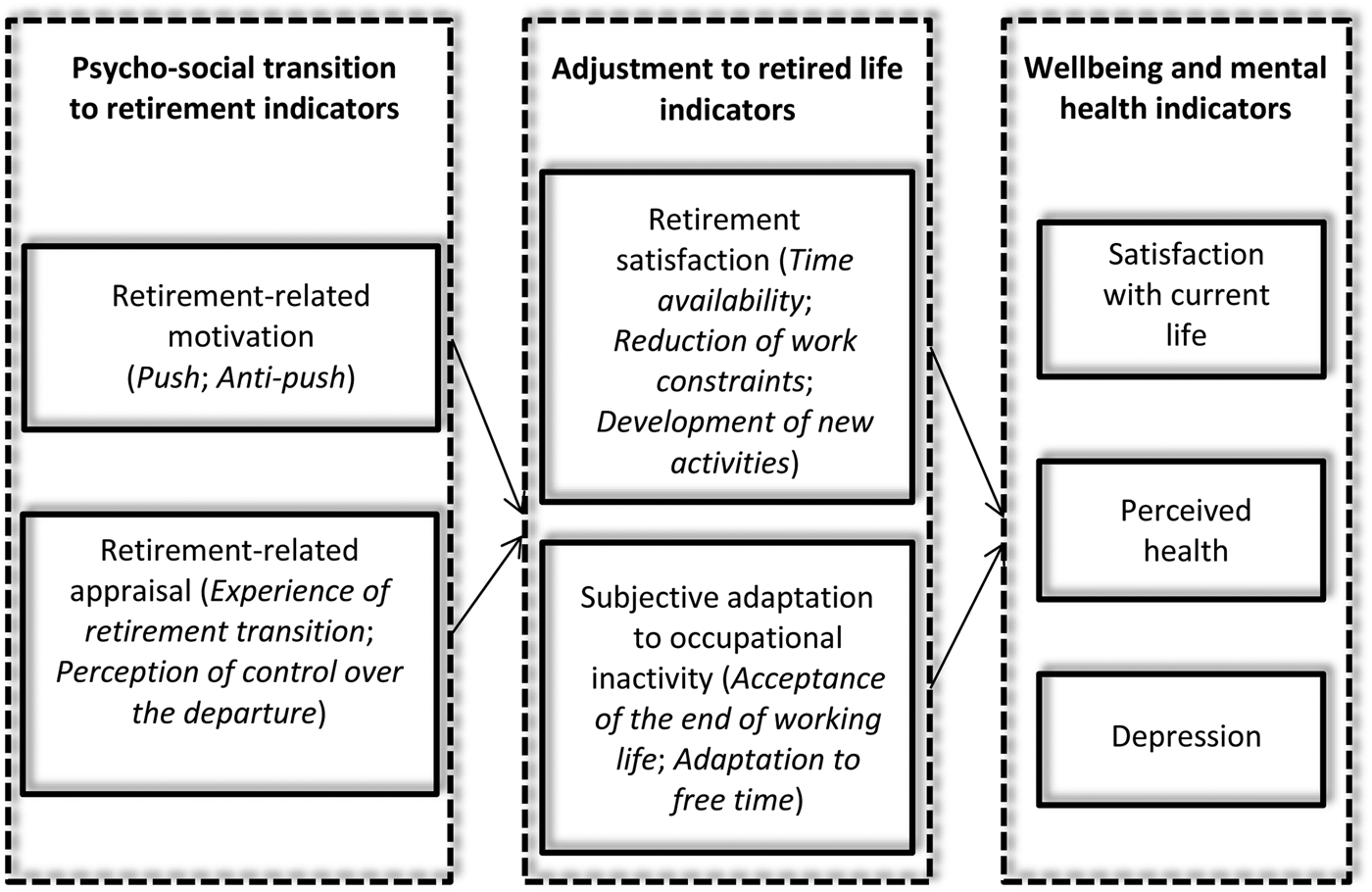
Therefore, the aim of the present study was to examine the indirect effects of the psycho-social transition to retirement on the wellbeing and mental health of retired farmers through indicators of the adjustment to retired life. We relied on multiple mediator models that involved simultaneous mediation by multiple variables (Preacher and Hayes Reference Preacher and Hayes2008a). As shown in the theoretical model proposed in Figure 1, we expected that:
• Hypothesis 1: The less individuals declare attachment regarding their previous professional activity (Anti-push motivations), and the more they report rejection about it (Push motivations) and evaluate optimistically their experience of retirement transition and perceive their control over their departure, the better their retirement satisfaction and their subjective adaptation to occupational inactivity will be.
• Hypothesis 2: Satisfaction and subjective adaptation to occupational inactivity are positively related to (a) satisfaction with current life and (b) perceived health, and negatively related to (c) depression.
• Hypothesis 3: Retirement satisfaction and subjective adaptation to occupational inactivity mediate the relationship between retirement-related motivation and appraisal and (a) satisfaction with current life, (b) perceived health and (c) depression.
Theoretical model.

Method
Participants and procedure
Our sample was taken from the French AMI (Integrated Multidisciplinary Approach) cohort study. Details regarding sampling procedures and baseline characteristics of participants are described elsewhere (Pérès et al. Reference Pérès, Matharan, Allard, Amieva, Baldi, Barberger-Gateau, Bergua, Bourdel-Marchasson, Delcourt, Foubert-Samier, Fourrier-Réglat, Gaimard, Laberon, Maubaret, Postal, Chantal, Rainfray, Rascle and Dartigues2012). In brief, the AMI study aimed to examine the health and ageing of retired farmers. It included 1,002 volunteers at baseline randomly selected from the Farmer Health Insurance rolls, living in rural areas of Gironde (south-western France), being retired from the agricultural sector after at least 20 years of activity and being affiliated to the Health Insurance under their own name. Informed written consent was obtained for all participants. The data involved in the present study were collected through standardised questionnaires completed by psychologists in an interview conducted at home at first visit.
The sample in the present study included exclusion criteria: prevalent cases of dementia (125 excluded); having missing values for questions related to retirement (287 excluded); giving unreliable answers according to the psychologist interviewer (14 excluded) and being retired for 21 years and over (46 excluded).
The final sample consisted of 530 subjects (62.5% men). The average age was 73 years (range: 61–85 years) and 77.2 per cent of subjects did not have any educational diploma or had simply completed the first French Diploma. They had been retired for an average of 12 years at the time of data collection (range: 0.20–20.89 years). Participants had retired at an average age of 61 years (62.3% had retired at 60), the youngest at 50 years and the oldest at 75 years. For the vast majority (85%) of the sample, retirement was immediate and 86 per cent had not performed any professional activity at the time of data collection.
Measures
Psycho-social transition to retirement and adjustment to retired life measurements
To collect data as part of a broad inter-disciplinary prospective study, we used short scales, in particular to interview the elderly so as to maintain their cognitive resources and obtain reliable answers. To this end, we constructed a 23-item questionnaire. It includes two sections of questions used to assess their psycho-social transition to retirement (with measurements of their retirement-related motivation and appraisal) and their adjustment to retired life (with measurements of their retirement satisfaction and their adaptation to occupational inactivity). For each item, respondents were asked to indicate the extent to which they agreed with it on a five-point Likert-type scale (from 1 = not agree at all to 5 = totally agree). These items, based on theoretical sources and validated in French samples, were adapted to the specific situation of retired farmers. They were first tested in a pilot study by a one-hour interview with nine retired farmers (59–79 years old). All the items were submitted to these farmers to check their understanding, in order to improve and adjust them to this specific population.
Reliability and validity of measures were assessed using standard psychometric methods with the SPSS software and AMOS 20.0 for Windows. Internal consistency reliability was assessed using Cronbach's alpha (⩾0.70; Cohen Reference Cohen1988; DeVellis Reference DeVellis2003) and the corrected correlation (⩾0.35). The guidelines for validations of psychometric scales indicate carrying out an exploratory factorial analysis (EFA) then confirming the structure obtained by a confirmatory factorial analysis (CFA) on separate samples (Flora and Flake Reference Flora and Flake2017). So our data-set was randomly divided into two halves. We used EFA on half of the sample (N = 267) to examine the factorial structure of each measure. The Kaiser–Meyer–Olkin statistic (KMO > 0.5) and the Bartlett test of sphericity (significant) were performed to test an underlying structure to the data. We used principal axis factoring as the extraction method, factor loadings ⩾0.40 as a criterion to define a ‘salient’ factor loading (Nunnally and Bernstein Reference Nunnally and Bernstein1994) and the Promax rotation procedure. Then CFA on the other half of the sample (N = 263) was conducted to confirm the structure of the measure. The ‘unweighted least squares’ method of extraction was used with four fit indices: the chi-square test (relative chi-square; Kline Reference Kline1998), the Root Mean Square Residual (RMR; Browne and Cudeck Reference Browne, Cudeck, Bollen and Long1993; Hu and Bentler Reference Hu and Bentler1998; MacCallum, Browne and Sugawara Reference MacCallum, Browne and Sugawara1996; Steiger Reference Steiger1990), the Goodness of Fit Index (GFI; Byrne Reference Byrne1994) and the Adjusted Goodness of Fit Index (AGFI).
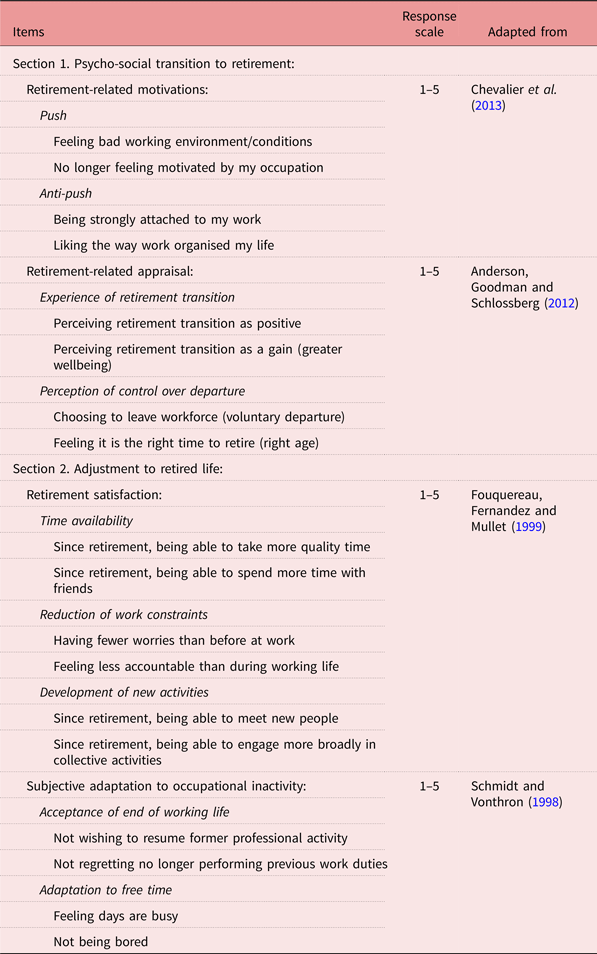
The validation procedure led to the retention of 18 items among the 23 of the initial questionnaire (see Table 1) in order to operationalise the measurements of the following nine continuous variables.
Items, response scales and sources

Concerning the retirement-related motivation, items were adapted from the Retirement Decisional Process Scale and the Development of the Reasons for Entrepreneurs’ Retirement Decision Inventory (Chevalier et al. Reference Chevalier, Fouquereau, Gillet and Demulier2013). Two variables were considered: Push (two items) correspond to negative (rejection) and Anti-push (two items) to positive (attachment) considerations of the situation of professional activity previously experienced.
Concerning the retirement-related appraisal, items were selected in reference to Schlossberg's ‘4S System’. Two variables were considered: Experience of retirement transition (two items) refers to the way individuals evaluate the event optimistically or pessimistically (gain or loss and positive or negative event) and Perception of control over the departure (two items) corresponding to the nature (forced or chosen) of the transition and how comfortable they feel with their own retirement age (right or wrong age according to them). The first variable corresponds to the affective appraisal and the second to the socio-cognitive appraisal of the transitional situation.
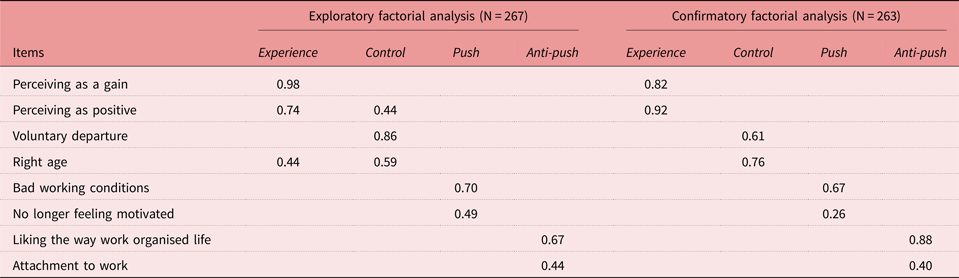
The validation of retirement-related motivation and appraisal measures (see Table 2) demonstrates a four-factor structure. The EFA solution indicated a four-factor model that accounted for 52 per cent of the variance. With a four-factor model, the CFA demonstrated a high goodness of fit (df = 36; χ2 = 50,043.0; RMR = 0.037; GFI = 0.997; AGFI = 0.993) and confirmed the relevance of the four measures.
Factor analyses of psycho-social transition to retirement measurement

Note: Saturations >0.40 are presented.
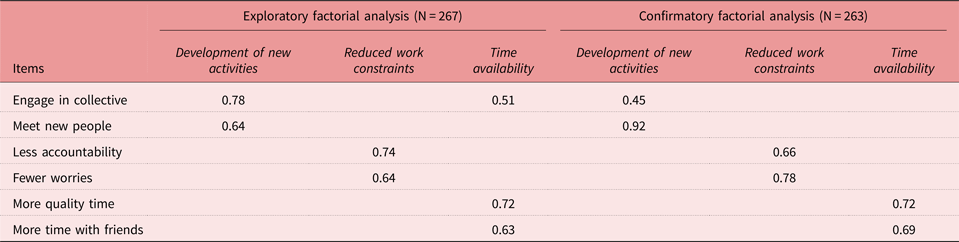
Concerning retirement satisfaction, items were adapted from the ‘source of enjoyment’ section of the RSI of Floyd et al. (Reference Floyd, Haynes, Doll, Winemiller, Lemsky, Burgy, Werle and Heilman1992) in its French version (RSI-F) adapted by Fouquereau, Fernandez and Mullet Reference Fouquereau, Fernandez and Mullet1999 (Reference Fouquereau, Fernandez and Mullet1999). Sources of enjoyment are composed of three factors related to the appropriation of retirement benefits. Three variables were considered: T ime availability (two items) deals with how retirees enjoy their free time, Reduction of work constraints (two items) corresponds to how they take advantage of reduced stress/responsibilities and Development of new activities (two items) concerns their development of social activities. The EFA solution with these six items indicated a three-factor model that still accounted for 50 per cent of the variance. The CFA with the three-factor model demonstrated a high goodness of fit (df = 21; χ2 = 1,0234.6; RMR = 0.051; GFI = 0.998; AGFI = 0.992) and confirmed the relevance of the three measures (see Table 3).
Factor analyses of retirement satisfaction measurement

Note: Saturations >0.40 are presented.
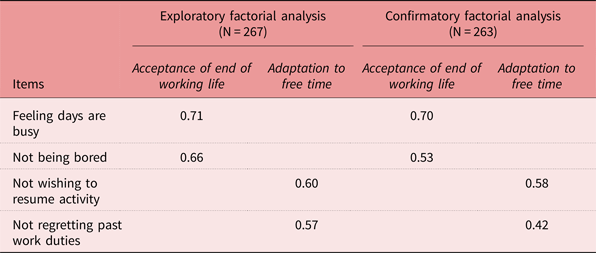
Concerning the subjective adaptation to occupational inactivity, items from the study by Schmidt and Vonthron (Reference Schmidt and Vonthron1998) were used. Two variables were considered: Acceptance of the end of working life (two items) corresponds to not missing it and having no regrets about it and Adaptation to free time (two items) corresponds to the positive investment of free time, feeling active and avoiding boredom. As expected, for the validation of subjective adaptation to the occupational inactivity tool (see Table 4), the EFA solution indicated a two-factor model that accounted for 41 per cent of the variance. The CFA used a two-factor model and demonstrated an acceptable fit (df = 10; χ2 = 1,3209.8; RMR = 0.079; GFI = 0.994; AGFI = 0.970).
Factor analyses of subjective adaptation to occupational inactivity measurement

Note: Saturations >0.40 are presented.
Wellbeing and mental health measurements
The operationalisation of the variables corresponding to the outcomes was carried out as follows. Three indicators were considered:
• Concerning the indicator of Satisfaction with current life, a self-evaluation of life satisfaction was requested by the interviewer with a single question: ‘On the whole, are you satisfied with your current life?’ with a Likert-type scale ranging from 1 (not at all) to 7 (entirely), in line with existing research (e.g. Blais et al. Reference Blais, Vallerand, Pelletier and Brière1989).
• Concerning the indicator of Perceived health, a self-evaluation of health was requested by the interviewer with a single question: ‘How do you rate your current health?’ with a Likert-type scale ranging from 1 (very poor) to 5 (excellent), in line with existing research (e.g. DeSalvo et al. Reference DeSalvo, Bloser, Reynolds, He and Muntner2006).
• Concerning the indicator of Depression, depressive symptomatology was assessed with the Center for Epidemiological Studies Depression Scale (CES-D) by Radloff (Reference Radloff1977) in its French version, validated by Führer and Rouillon (Reference Führer and Rouillon1989). This scale consists of 20 items with a frequency scale from 0 (rarely or none of the time) to 3 (all of the time). According to these authors, a threshold value (of the total score) of 17 in men and 23 in women indicates depression.
Covariates
Questions about socio-biographic and retirement characteristics were added and operationalised as follows: gender (male/female), age (in number of years), educational level (three-level variable: no diploma, primary diploma, secondary diploma or more), duration of retirement (in number of years: age at the time of data collection minus age at retirement). These variables were considered as potential confounders to control for in statistical analyses.
Data preparation and analysis
Given the good fit of each measurement model, we created composite scores for each latent variable: (1) Push motivation, (2) Anti-push motivation, (3) Experience of retirement transition, (4) Perception of control over departure, (5) Time availability, (6) Reduction of work constraints, (7) Development of new activities, (8) Acceptance of end of working life and (9) Adaptation to free time. We used these nine composites and the three scores of the dependent variables (Satisfaction with current life, Perceived health, Depression) to test our hypotheses. We first examined Pearson's r correlations between all measures to refine the models and to consider the pursuit of our hypotheses. Given the size of our sample, we chose not to consider the weakest correlations (<0.15). Three multiple mediator models were thus adopted and tested by the bootstrapping method of Preacher and Hayes (Reference Preacher and Hayes2008a). This method is suitable for assessing several effects such as the total effect of independent variables on the dependent variable (path c), the direct effects of independent variables on the mediators (paths a), the direct effects of the mediators on the dependent variable (paths b), the direct effect of independent variables on the dependent variable (path c′) and the indirect effects of independent variables on the dependent variable through the mediators (paths ab). A p value of 0.05 was set as a critical level for statistical significance. Bootstrap results (based on 5,000 bootstrap samples) using 95 per cent bias-corrected and accelerated confidence intervals (BCa 95% CI) were also used to compare the indirect effects. Analyses were performed with the SPSS 20.0 Macro for Multiple Mediation (Preacher and Hayes Reference Preacher and Hayes2008b) for Windows, using Z-scores to minimise collinearity.
Results
How did the respondents feel about their transition to retirement, their wellbeing and mental health?
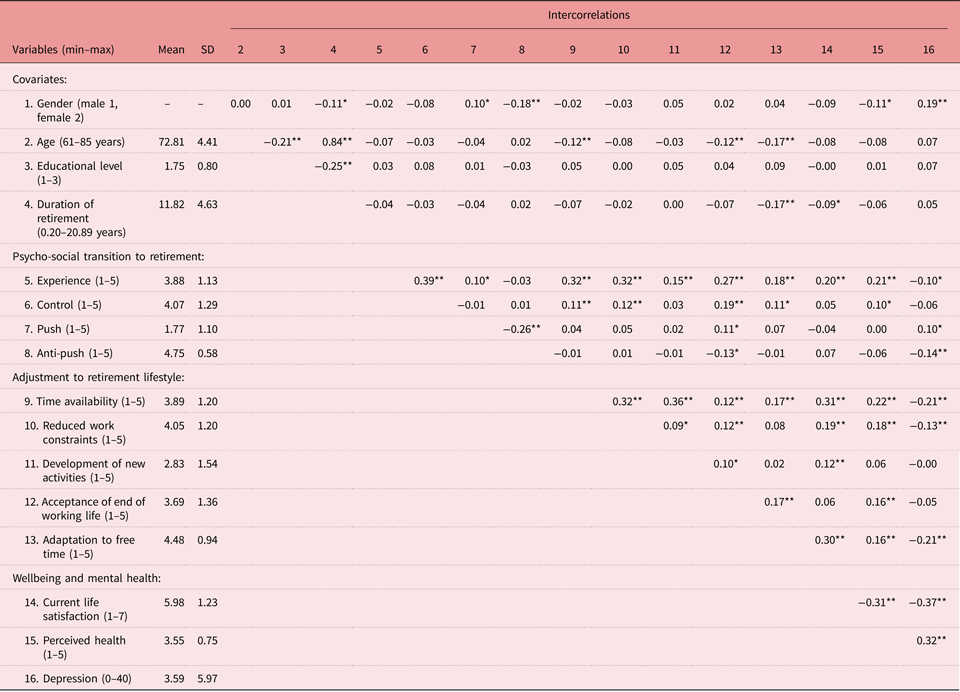
Descriptive results (means and standard deviations) of study variables are presented in Table 5.
Means, standard deviations (SD) and intercorrelations between study variables

Notes: min–max: minimum to maximum.
Significance levels: * p < 0.05, ** p < 0.01.
Psycho-social transition to retirement indicators
Respondents did not feel any strong reasons to leave the professional world and they mostly felt retained by it. The transition to retirement was mainly associated with positive affect and gain, with the feeling of being able to control the situation and to have chosen to retire at the right age.
Adjustment to retirement life indicators
Participants tended to appropriate the benefits of retired life. They primarily attributed these benefits to a reduction in work constraints and to an increase in free time. They mainly accepted the end of their working life (i.e. they did not regret their former work) and enjoyed their free time (i.e. they felt they had busy days).
Wellbeing and mental health indicators
Participants were mainly satisfied with their current life and felt that their health was quite good. The results also indicated a low mean level of depression in the sample.
What links between the variables?
Regarding the covariates (see Table 5), educational level exhibited weak correlations (<0.15) with all measures, so we chose to exclude it as a covariate in the final analyses. Owing to the very high correlation between age and duration of retirement (r = 0.84), we also excluded age as a covariate. In the end, two socio-demographic variables were taken into account in further analysis (gender and duration of retirement).
Regarding wellbeing and mental health variables: Satisfaction with current life exhibited a significant correlation (>0.15) with Experience of retirement transition, Time availability, Reduced work constraints and Adaptation to free time; Perceived health exhibited a significant correlation with Experience of retirement transition, Time availability, Reduced work constraints, Acceptance of the end of working life and Adaptation to free time; and Depression exhibited a significant correlation with Experience of retirement transition, Time availability and Adaptation to free time.
Perception of control over the departure, Push and Anti-push motivations, and Development of new activities exhibited very weak correlations (<0.15) with the other variables, so they were excluded from the subsequent models.
Three multiple mediator models were thus specified and tested (multiple mediators and covariates were entered simultaneously).
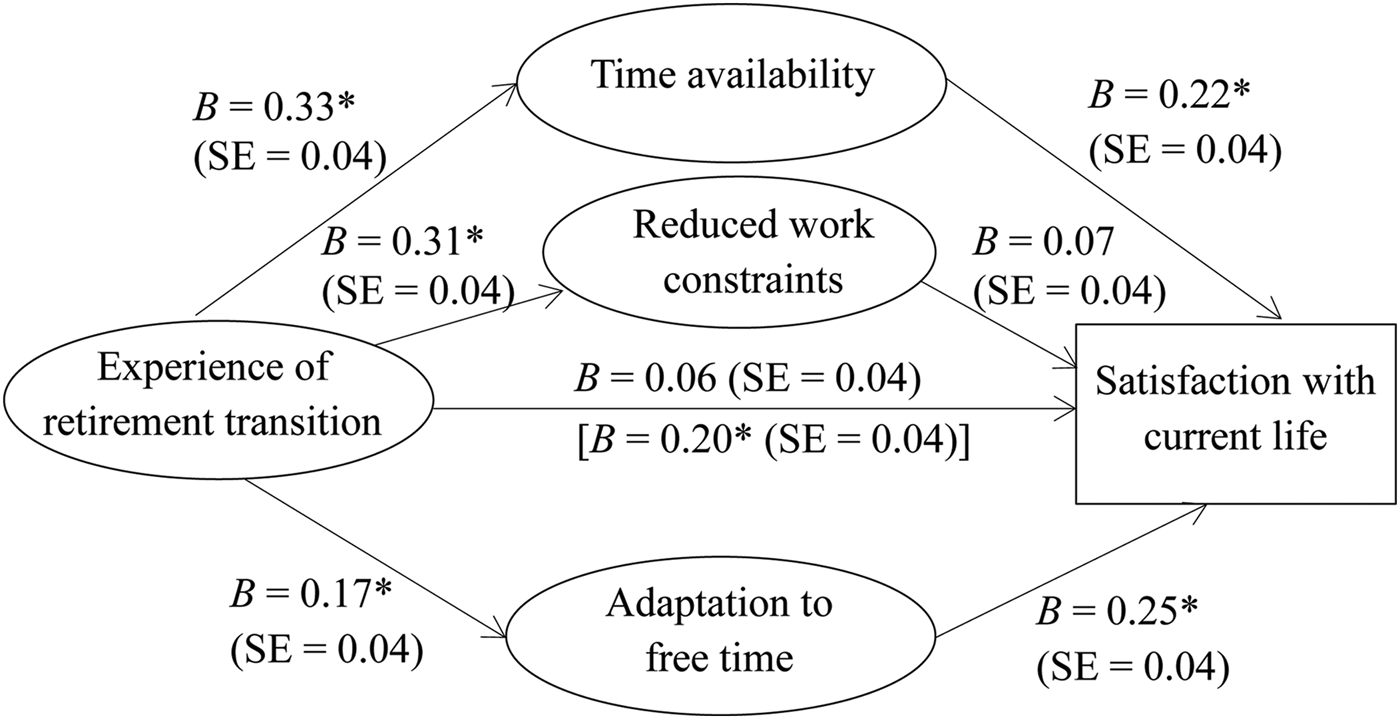
(a) Explanatory model of Satisfaction with current life: effects of Experience of retirement transition on Satisfaction with current life through Time availability, Reduced work constraints and Adaptation to free time (N respondents = 505; missing data = 25).
The results support the multiple mediator model of Satisfaction with current life (see Figure 2). After controlling for gender (t = −2.32, p = 0.021; B = −0.20, standard error (SE) = 0.08) and duration of retirement (t = −0.89, p = 0.373, not significant (ns); B = −0.04, SE = 0.04), the score of Experience of retirement transition was positively associated with Time availability (t = 7.77, p < 0.001; B = 0.33, SE = 0.04), Reduced work constraints (t = 7.25, p < 0.001; B = 0.31, SE = 0.04) and Adaptation to free time (t = 3.91, p < 0.001; B = 0.17, SE = 0.04). Both the Time availability score (t = 5.00, p < 0.001; B = 0.22, SE = 0.04) and the Adaptation to free time score (t = 5.93, p < 0.001; B = 0.25, SE = 0.04) are associated with the Satisfaction with current life score in the model, but the reduced work constraints score was not significantly associated with the Satisfaction with current life score (t = 1.64, p = 0.102, ns; B = 0.07, SE = 0.04). The previously significant association between the scores on Experience of retirement transition and Satisfaction with current life (t = 4.57, p < 0.001; B = 0.20, SE = 0.04) became non-significant after the inclusion of Time availability, Reduced work constraints and Adaptation to free time scores (t = 1.37, p = 0.171, ns; B = 0.06, SE = 0.04). This final multiple mediator model was significant (R 2 = 0.183; F (6, 498) = 18.62, p < 0.001). The total indirect effect through the mediators, with a point estimate of 0.138 and a BCa 95% CI [0.093, 0.196], showed that the difference between the total effect and the direct effect of Experience of retirement transition on Satisfaction with current life was different from zero. The specific indirect effects indicated that only Time availability (BCa 95% CI [0.041, 0.118]) and Adaptation to free time (BCa 95% CI [0.017, 0.085]) were mediators. The indirect effect of the Reduced work constraints score was not significant (BCa 95% CI [−0.003, 0.057]). A pairwise contrast of the indirect effects showed that the size of the specific indirect effect through Time availability and the size of the specific indirect effect through Adaptation to free time were not significantly different (BCa 95% CI [−0.020, 0.082]).
Results of multiple mediation analysis regarding the Satisfaction with current life model.

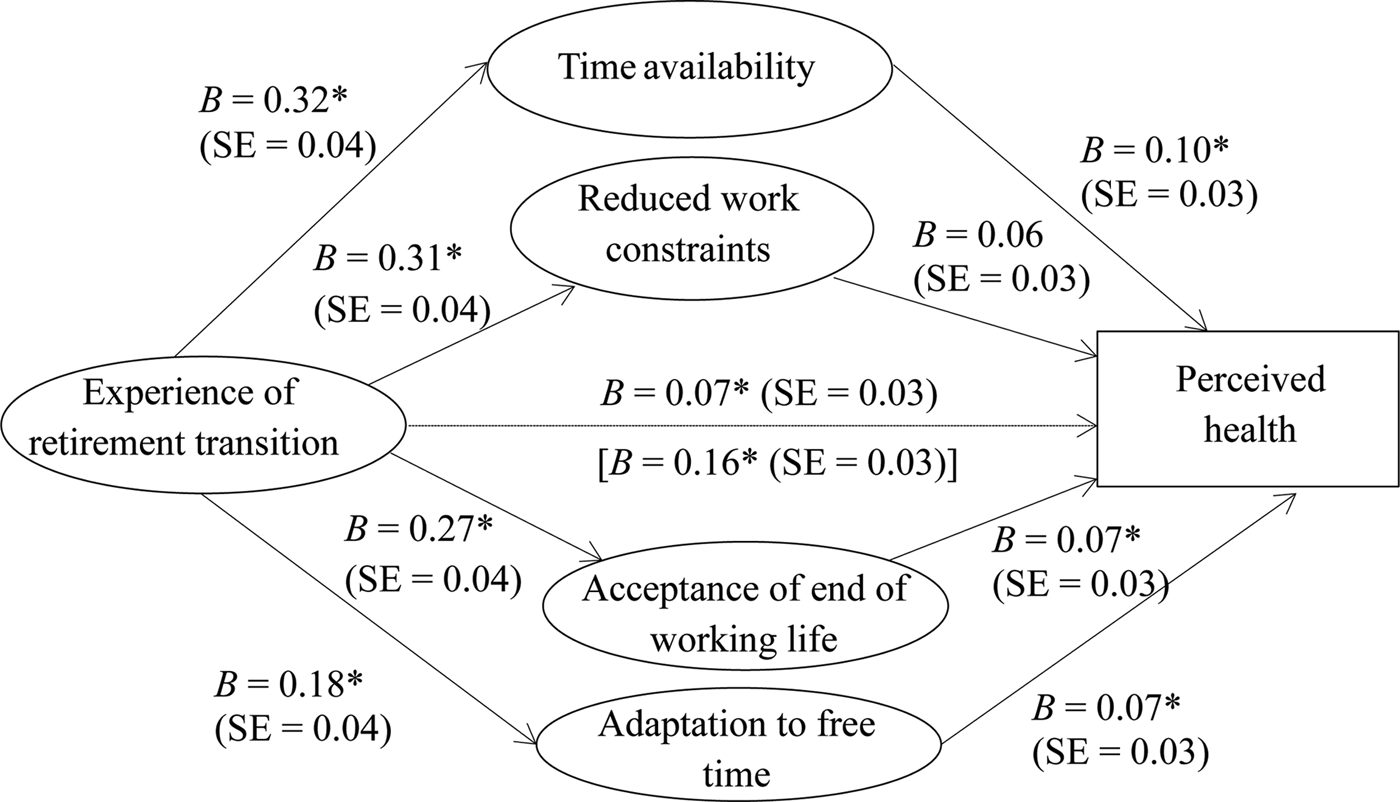
(b) Explanatory model of Perceived health: effects of Experience of retirement transition on Perceived health through Time availability, Reduced work constraints, Acceptance of the end of working life and Adaptation to free time (N respondents = 528; missing data = 2).
The results partially support the multiple mediator model of Perceived health (see Figure 3). After controlling for gender (t = −2.67, p = 0.008; B = −0.17, SE = 0.07) and duration of retirement (t = −0.80, p = 0.424, ns; B = −0.03, SE = 0.03), the Experience of retirement transition score was positively associated with Time availability (t = 7.77, p < 0.001; B = 0.32, SE = 0.04), Reduced work constraints (t = 7.58, p < 0.001; B = 0.31, SE = 0.04), Acceptance of the end of working life (t = 6.44, p < 0.001; B = 0.27, SE = 0.04) and Adaptation to free time (t = 4.34, p < 0.001; B = 0.18, SE = 0.04). The Time availability score (t = 2.93, p = 0.004; B = 0.10, SE = 0.03), the Acceptance of the end of working life score (t = 2.00, p = 0.046; B = 0.07, SE = 0.03) and the Adaptation to free time score (t = 2.20, p = 0.029; B = 0.07, SE = 0.03) are associated with the Perceived health score in the model, but the Reduced work constraints score was not significantly associated with the Perceived health score (t = 1.88, p = 0.060, ns; B = 0.06, SE = 0.03). The previously significant association between the Experience of retirement transition and Perceived health scores (t = 4.87, p < 0.001; B = 0.16, SE = 0.03) was still significant after the inclusion of Time availability, Reduced work constraints, Acceptance of the end of working life and Adaptation to free time scores, but the B value decreased (t = 2.06, p = 0.040; B = 0.07, SE = 0.04), indicating a partial mediation rather than a total one. This final multiple mediator model was significant (R 2 = 0.108; F (7, 520) = 8.97, p < 0.001). The total indirect effect through the mediators, with a point estimate of 0.083 and a BCa 95% CI [0.050, 0.122], showed that the difference between the total effect and the direct effect of Experience of retirement transition on Perceived health was different from zero. The specific indirect effects indicated that only Time availability (BCa 95% CI [0.010, 0.059]), Acceptance of the end of working life (BCa 95% CI [0.001, 0.040]) and Adaptation to free time (BCa 95% CI [0.002, 0.031]) were mediators. The indirect effect of reduced work constraints score was not significant (BCa 95% CI [−0.002, 0.047]). Pairwise contrasts of the indirect effects showed that the sizes of the specific indirect effect through Time availability, Acceptance of the end of working life and Adaptation to free time were not significantly different (BCa 95% CI (time availability versus acceptance of the end of working) [−0.015, 0.046]; BCa 95% CI (time availability versus adaptation to free time) [−0.011, 0.049]; BCa 95% CI (acceptance of the end of working versus adaptation to free time) [−0.030, 0.020]).
Results of multiple mediation analysis regarding the P erceived health model.

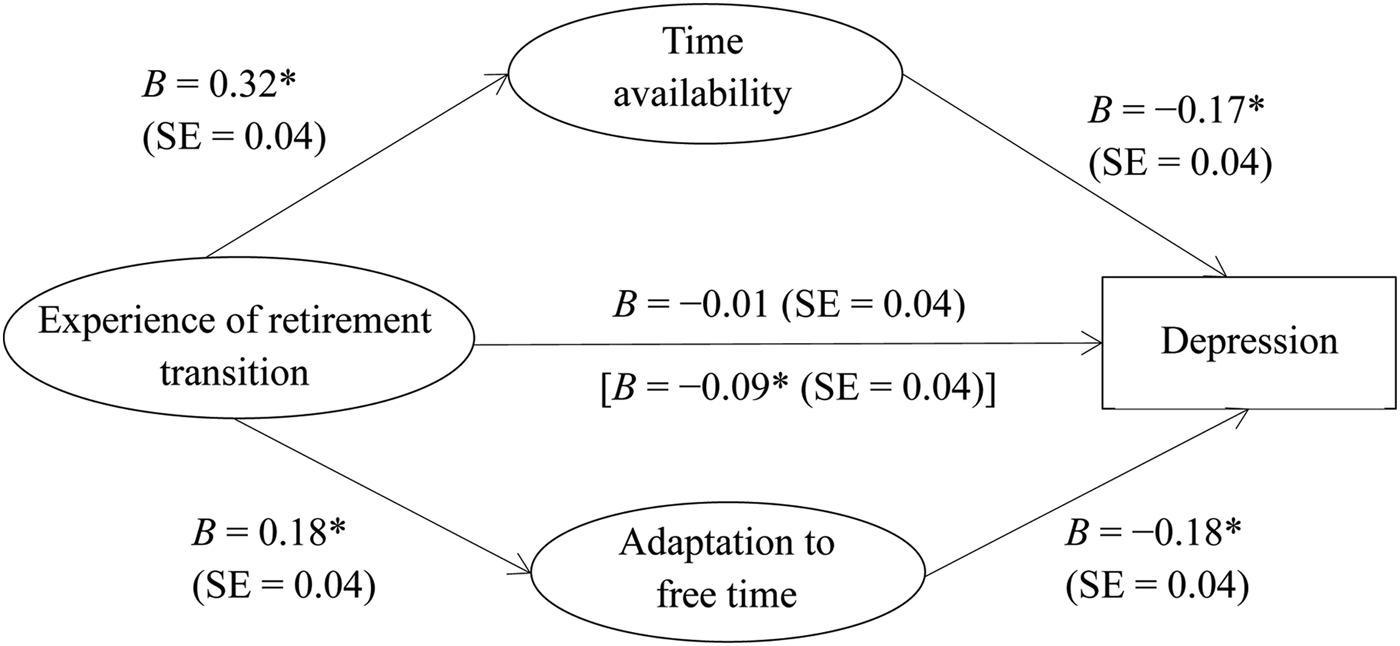
(c) Explanatory model of Depression: effects of Experience of retirement transition on Depression through Time availability and Adaptation to free time (N respondents = 517; missing data = 13).
The results support the multiple mediator model of Depression (see Figure 4). After controlling for gender (t = 4.74, p < 0.001; B = 0.41, SE = 0.09) and duration of retirement (t = 0.58, p = 0.564, ns; B = 0.02, SE = 0.04), the Experience of retirement transition score was positively associated with Time availability (t = 7.67, p < 0.001; B = 0.32, SE = 0.04) and Adaptation to free time (t = 4.24, p < 0.001; B = 0.18, SE = 0.04). Both the Time availability score (t = −3.85, p < 0.001; B = −0.17, SE = 0.04) and the Adaptation to free time score (t = −4.26, p < 0.001; B = −0.18, SE = 0.04) are associated with the Depression score in the model. The previously significant association between the Experience of retirement transition and Depression scores (t = −2.20, p = 0.028; B = −0.09, SE = 0.04) became non-significant after the inclusion of the Time availability and Adaptation to free time scores (t = −0.15, p = 0.879, ns; B = −0.01, SE = 0.04). This final multiple mediator model was significant (R 2 = 0.114; F (5, 511) = 13.18, p < 0.001). The total indirect effect through the mediators, with a point estimate of −0.088 and a BCa 95% CI [−0.151, −0.048], showed that the difference between the total effect and the direct effect of Experience of retirement transition on Depression was different from zero. The specific indirect effects confirmed that Time availability (BCa 95% CI [−0.096, −0.027]) and Adaptation to free time (BCa 95% CI [−0.076, −0.012]) were mediators. A pairwise contrast of the indirect effects showed that the size of the specific indirect effect through Time availability and the size of the specific indirect effect through Adaptation to free time were not significantly different (BCa 95% CI [−0.062, 0.019]).
Results of multiple mediation analysis regarding the D epression model.

Discussion
Psycho-social transition to retirement, adjustment to retired life, wellbeing and mental health of the retired farmers’ sample
As shown by previous research (Evans Reference Evans2009; Therrien and Desrosiers Reference Therrien and Desrosiers2010), descriptive results highlight that retirees of the sample feel good about their transition to retirement. They mostly consider this transition as a gain, a positive event even if they felt retained by their job and did not feel any strong reasons to leave it. They mainly accepted the end of their working life and enjoy the benefits of retired life. They demonstrate a good level of wellbeing and mental health. These latter indicators could have been expected to be low because of the advances in age and the financial, social and psychological repercussions of the cessation of professional activity. However, as shown by the European Union Statistics on Income and Living Conditions (EU-SILC 2013), the average wellbeing of retired people in France is almost equal to that of the population as a whole. Other benefits of retirement play a positive role, such as the benefits of having more free time and no more work-related constraints.
Psycho-social transition to retirement: a differential impact of affective and socio-cognitive dimensions
Our results also show that the Experience of retirement transition (positive or negative appraisal regarding the departure) is the key variable of the psycho-social transition to retirement indicators because it impacts the three outcomes of wellbeing and mental health (Satisfaction with current life, Perceived health and Depression). In addition, this impact is mediated by variables of Adjustment to retired life. Moreover, we found this effect to be independent of the duration of retirement (ranging from less than one year to 20 years). Our results support what has already been underlined in studies conducted in other populations: the positive and negative representations associated with the retirement transition have an impact on the adjustment to this event and have long-term effects on the development of the health and wellbeing of retirees (Schlossberg Reference Schlossberg2004; Schlossberg, Waters and Goodman Reference Schlossberg, Waters and Goodman1995; Shultz and Wang Reference Shultz and Wang2011; Van Solinge Reference Van Solinge2007; Van Solinge and Henkens Reference Van Solinge and Henkens2008).
The perception of control over the moment of departure has been identified by some authors (Anderson, Goodman and Schlossberg Reference Anderson, Goodman and Schlossberg2012; Schlossberg Reference Schlossberg2011; Van Solinge Reference Van Solinge2007; Van Solinge and Henkens Reference Van Solinge and Henkens2008) as one of the key variables of a successful transition. However, it did not have a sufficiently strong link in our study to be considered in any of the three multiple mediator models. In this regard, it would seem to be the affective rather than the socio-cognitive relation to the transition that prevails in explaining the adjustment to retirement and the wellbeing and mental health of retired farmers.
In addition, retirement-related motivations (Push and Anti-push dimensions) had no significant influence on the variables to be explained, whereas some studies (Wang Reference Wang2007; Westerlund et al. Reference Westerlund, Kivimaki, Singh-Manoux, Melchior, Ferrie, Pentti, Jokela, Leineweber, Goldberg, Zins and Vahtera2009) have demonstrated their impact on adjustment, wellbeing and mental health variables during the transition to retirement. Like the Perception of control over the departure, these Push and Anti-push motivations are socio-cognitive dimensions of the psycho-social transition to retirement.
It thus seems that it is the affective anchoring of the event that has repercussions on the adjustment to retirement, which in turn affects the wellbeing and mental health of retired farmers. These results support previous studies by showing the importance of positive affects to cope with potentially negative life events (Lyubomirsky, King and Diener Reference Lyubomirsky, King and Diener2005; Ong et al. Reference Ong, Bergeman, Bisconti and Wallace2006). They have an important role in implementing and managing resources and moderate the response to this event (Tugade, Fredrickson and Barrett Reference Tugade, Fredrickson and Barrett2004). The individual in interaction with his or her environment could then regulate his or her emotional responses to negotiate the transition, to adapt to it (Mallet and Gaudron Reference Mallet and Gaudron2005).
Mediator effects of adjustment to retirement lifestyle: the impact of adjustment to a new temporality and to the end of the working life
The results also partially support our hypotheses regarding the multiple mediator effects of adjustment to retired life indicators on these relationships. Time availability and Adaptation to free time mediate the links between Experience of retirement transition and Satisfaction with current life, Perceived health and Depression. These multiple mediations prove to be total for the Satisfaction with current life and Depression models and the pairwise contrasts (bootstraps) show that the size of the effects of these mediators is not significantly different. These results underline the importance for retirees to adapt successfully to the new temporality induced by their retirement life. This adaptation can be considered as an adjustment or a capacity to cope with this newly available time resource (having fun, seeing relatives and friends) and to feelings related to free time (feeling of having busy days and not being bored). Moreover, the level of this adjustment is associated with the way their transition to retirement is experienced (more or less positively). Finally, the more retirees consider retirement as a positive event, the better they adapt to the new temporality of their retirement life and the more they feel satisfied with their current life, healthy and less depressed. In addition, the Acceptance of the end of working life is also involved in the Perceived health multiple mediator model, even though this mediation is only partial. This variable refers to the way the retiree accepts the break in the continuity of his or her roles and activities induced by the end of work (not wishing to resume former professional activity and not regretting it).
These results support the theoretical perspective of continuity (continuity theory) in life habits and activities (Atchley Reference Atchley1989). The positive feelings associated with the transition to retirement have a favourable impact on Satisfaction with current life, Perceived health and Depression thanks to proper adjustment to the new temporality induced by retirement and, to a lesser extent, to the end of one's professional life. Our research thus reveals a set of theoretical models of the appraisal of life events (notably based on the ‘4S System’ developed by Anderson, Goodman and Schlossberg Reference Anderson, Goodman and Schlossberg2012; Schlossberg Reference Schlossberg2011; Schlossberg, Waters and Goodman Reference Schlossberg, Waters and Goodman1995) and continuity in transitions (Atchley Reference Atchley1989), which explain how retirees cope with retirement and its impact on their wellbeing and mental health. Obviously, many other factors have to be considered when explaining these indicators in ageing adults. However, our results show that the psycho-social transition to retirement and the significant mediators tested are relevant when attempting to understand the evolution of the health and wellbeing of retirees.
Limitations and outlook
Some methodological limitations need to be emphasised. The single-item measures that we used for Satisfaction with current life and for Perceived health might underestimate their relationship with the other variables. Multiple indicators or established scale measures would provide more accurate estimates. However, short survey protocols are suitable when studying older adults who are poorly educated or easily tired, and help to reduce missing values. Moreover, since all participants were already retired at the time of enrolment in the study, psycho-social transition to retirement measurements refer to an event ranging from a few months to two decades. Nevertheless, our results show no significant links between some of the retrospective data (Retirement-related motivation and Perception of control over the departure) and data on the current retired life. This could contradict the existence of a cognitive reconstruction bias of the past event of retirement due to the influence of current variables. However, a longitudinal study would be interesting to conduct by evaluating individuals before, during and after the retirement transition.
These findings cannot be generalised as they were limited by the inclusion criteria. To ensure the reliability of the collected data, only participants with no major health problems were included. Our study thus highlights the adjustment processes of retirees and the maintenance of health unaffected by the serious damage of ageing. Furthermore, the AMI cohort has specific socio-demographic characteristics related to the farming sector with low levels of education and income. Finally, French cohorts of retirees differ from those in other countries in socio-political terms. Retirement is a legal requirement for French citizens and provides access to an income that avoids having to take on bridge jobs. The type of retirement transition studied here therefore refers to an abrupt and complete break with professional life and an exit from the workforce. Different transitional forms of retirement are now common in countries with no age requirement for retirement. They are more progressive and often include a period of bridge employment between the end of one's career and the complete cessation of work. The study of their characteristics has become a new area of research (Beehr and Bennett Reference Beehr and Bennett2015). It would be interesting to apply the theoretical model described in the present study to other European countries as well as to the United States of America or Canada, taking into account the psycho-social transition process towards the end of working life experienced by workers within their specific socio-political context.
Conclusion
In a context where the number of people aged 60 is increasing significantly, the elderly represent almost one-third of the population in France. The current life expectancy and retirement of the baby-boomers has resulted in a significant rise in the time spent in retirement. As a result, public policies for the elderly aim to ensure that they remain healthy and limit economic impacts. Most are oriented towards the identification of the objective pathogenic factors related to the end of the professional activity (retirement living conditions) in order to identify the priority action lines in terms of promoting the health of retirees (prevention and support). The results of the present study show that the subjective dimensions of retirement, whether recent or of longer standing, are also important for understanding the more or less successful adjustment to retirement and its impact on the mental health and wellbeing of retirees. These same dimensions have also shown their impact on cognitive functioning of the same cohort (Grotz et al. Reference Grotz, Matharan, Amieva, Pérès, Laberon, Vonthron, Dartigues, Adam and Letenneur2017). From this better understanding of the psychological and adjustment processes underpinning the transition to retirement, policy implications might arise. Promoting existing support systems and refining it by taking into account the affective dimension associated with the transition to retirement and the adjustment to retired life seems to be a promising perspective. It provides food for thought for gerontology practitioners, particularly in creating better support regarding the future adaptation of retirees to their new life at the different stages of this transition, i.e. their adaptation to the new temporality and to their acceptance of the end of working life.
Funding
The AMI project was funded by AGRICA (CAMARCA, CRCCA, CCPMA PREVOYANCE, CPCEA, AGRI PREVOYANCE), the Mutualité Sociale Agricole (MSA) of Gironde, the Caisse Centrale de la Mutualité Sociale Agricole (CCMSA) and the CNSA (Caisse Nationale de Solidarité et d'Autonomie). At the time of the paper, Catherine Grotz's PhD was supported by the Fund for Scientific Research (F.R.S.–FNRS), Belgium (www.frs-fnrs.be).
Conflicts of interest
The authors declare no relevant conflict of interest.
Ethical approval
The research procedures were reviewed and approved by the Ethics Committee of the University Hospital of Bordeaux according to the principles embodied in the Declaration of Helsinki. Informed and written consent was obtained at the beginning of the visit for all participants.