Scholars have traditionally linked transitional justice mechanisms to processes of democratization after an identifiable transition (Kritz Reference Kritz1995; Snyder and Vinjamuri Reference Snyder and Vinjamuri2003; Teitel Reference Teitel2003). This is particularly the case with scholarship addressing domestic human rights trials (Sikkink and Booth Walling 2007; Sikkink Reference Sikkink2011; Michel and Sikkink Reference Michel and Sikkink2013; Kim Reference Kim2010, Reference Kim2012; see also Budak Reference Budak2015). This framework has influenced not only scholarship but also the formation of the transitional justice movement since the late 1980s (Arthur Reference Arthur2009), to the extent that transitional justice is often conceptualized within the bounds of this “paradigmatic transition” framework (Ní Aoláin and Campbell Reference Ní Aoláin and Campbell2005). Early scholarship recognized the challenges posed by this assumption for theorizing justice processes (Aeyal Gross Reference Aeyal2004; Bilsky 2004), but subsequently this precaution has been neglected by much of the dominant literature, which focuses on cases with more clear trajectories toward democracy.
In this article I demonstrate some of the reasons why this assumption is still problematic for the literature on transitional justice through the analysis of an original case study. A cascade of more than a dozen domestic human rights trials emerged in Turkey between 2008 and 2015, prosecuting current and former members of the military for human rights abuses committed against Kurdish citizens in the 1990s. These trials have continued at the same time that Turkish democracy has deteriorated in multiple arenas. The Turkish case demonstrates the inconsistent, unpredictable, and haphazard nature of political progress, in which shifts on multiple fronts can occur simultaneously, sometimes in opposite directions. Through analysis of the Turkish case this article highlights the importance of power redistribution for explanations of domestic trials for human rights abuses.Footnote 1
In place of the linear transition paradigm, I understand democratization (and de-democratization) as a handful of processes and constituent mechanisms, progressing and regressing sometimes without obvious relation to each other (see Tilly Reference Tilly2007, 23). To explain paradoxical cases such as Turkey, we need a multidimensional understanding of political progress through which improvements in accountability can take place without much improvement in other aspects of democracy.
Although Turkey is considered to have transitioned to democracy between 1945 and 1950 (Zürcher Reference Zürcher2004, 218), over the last decade and a half the country has again experienced political change. The gradual coming to power of a new political party, the Justice and Development Party (Adalet ve Kalkınma Partisi, AKP) signaled an important shift in Turkish politics as it promoted a party platform inspired by Islamist reformism in a staunchly secular state (Dagi Reference Dagi2008; Tezcür Reference Tezcür2010). Martial law defined life in much of the southeastern region of Turkey since 1987, but was lifted in 2002. Under this OHAL policy (Olağanüstü Hâl Bölge Valiliği, meaning Governorship of Region in State of Emergency), the Turkish armed forces (Türk Silahlı Kuvvetleri, TSK) carried out human rights abuses against Kurdish populations (Human Rights Watch 2014; Alpkaya et al. Reference Alpkaya, Altıntaş, Sevdiren and Sevimli2013; Göral, Isik, and Kaya Reference Göral, Işık and Kaya2013; Bozkurt and Kaya 2014).
While the military's influence over the executive and judicial branches of government has substantially decreased in the first decade and a half of the new millennium, the executive has more recently increased its control over the other branches of government. Freedom of the press and protection of civil liberties improved between 2003 and 2012 although civil liberties scores began to worsen again starting in 2013 (Freedom House, Turkey). The situation has become increasingly dramatic since the later half of 2015, particularly for minority groups and those criticizing the current President, Recep Tayyip Erdogan (Amnesty International, 2015/2016 Annual Report; Freedom House 2016; Human Rights Watch 2016, 580). In 2014 and early 2015, the progressive establishment of police violence toward protestors in large urban manifestations as well as against civilian discontent in the Kurdish region, and increasing legal justification for violent police behavior, were added to allegations of high-level corruption. Scholars have begun to argue that Turkey is now becoming a competitive authoritarian regime (Özbudun Reference Özbudun2015).
The resumption of violence between the TSK and the Kurdistan Workers' Party (Partiya Karkerên Kurdistanê, PKK)Footnote 2 in mid-2015 has led to large-scale military action in the southeast region of the country, characterized by twenty-four-hour martial lockdowns, that have in some instances lasted for months.Footnote 3 Human rights violations specifically targeting the Kurdish population had decreased substantially after the 1990s, with the government even participating in a peace negotiation phase with the PKK leadership between 2013 and mid-2015. However, in the summer of 2015, violence once again engulfed areas of the southeastern region of the country and the so-called Kurdish problem is quickly regaining its highly taboo status with accompanying grave repercussions for freedom of speech and assembly.Footnote 4
Within this context of uneven democratic improvement and subsequent stagnation (even deterioration), Turkey witnessed the indictments and a dozen subsequent trials between 2008 and 2015 against current and former members of the military for human rights abuses carried out during the campaign against the PKK in the 1990s. These trials focus on the individual criminal accountability of members of the military for enforced disappearances and extrajudicial killings from that period. At the end of 2015, half these trials were ongoing, and three additional cases were being considered by the Constitutional Court.
Traditional understandings of democratization that rely on a “paradigmatic transition” point do not address the complexity of political phenomena outlined above (Ní Aoláin and Campbell Reference Ní Aoláin and Campbell2005; see also Huntington Reference Huntington1991; Kritz Reference Kritz1995). What does explain the ongoing nature of these trials during a time of democratic stagnation, or even authoritarian regress? In the absence of clear democratic progress how can we understand prosecution, since 2008, of former and current military officials for human rights violations?
One explanation would be that the trials are actually more akin to show trials, in which protection for the rights of defendants are minimal and political revenge (rather than a genuine investigation into rights violations) motivates the makeshift proceedings. Rather than thinking of these trials as real investigations into abuses by military officials, one could dismiss them as political wrangling between government factions. Upon close examination this does not explain the litigation activity since 2008 targeting human rights violations. Conflict between political elites is an essential aspect of the process that ushered in these trials. However, these proceedings should not be confused with political show trials. Defendants' rights have been generally protected, even privileged, throughout the hearings.Footnote 5 Those being prosecuted are considered by a range of participating actors to be on trial, not because of a conflict of interest with other political elites, but because it was no longer possible to shield them from the reality that they have committed wide-ranging human rights abuses. Furthermore, unlike show trials, in which “the element of risk (the uncertainty of outcome) has all but disappeared,” these human rights trials “retain[ed] the element of risk” (Bilsky 2004, 10, quoting Kerschheimer 1961), as there has been ongoing uncertainty about the fate of the defendants.
To explain the presence of these trials in Turkey today, I argue that redistribution of power among elite actors resulted in changes to the political opportunity structure available to prosecutors, and created a window of political opportunity for the advancement of justice-seeking litigation by rights groups (Tilly and Tarrow Reference Tilly and Tarrow2011). I also build on arguments made in the literature on power distribution theory—the claim that policy decisions regarding justice are determined mainly by domestic political power switches from previous authoritarian elites to a new government seeking policies to address justice (Zalaquett Reference Zalaquett1992; Pion-Berlin Reference Pion‐Berlin1994; Huyse Reference Huyse1995; Nino Reference Nino1996; Skaar Reference Skaar1999). I contend that changes in power distribution can alter the former rules of the game (such as de facto impunity for military officials), rendering them ambiguous for prosecutors and judges and ultimately allowing for individual activity that was previously high risk, such as the filing of indictments against military officials for human rights crimes.
The trials discussed in this article began to emerge at the height of the consolidation of power that had shifted from the military to new Islamist actors (a coalition of the ruling AKP and followers of the Gülen movement, between 2002 and 2008).Footnote 6 I contend that these trials did not come about through an overt policy effort by the executive; rather, they were opened individually, by prosecutors responding to victim-initiated claims, in six different geographical jurisdictions around the country.
Second, I argue that, thanks to this redistribution of elite power, legal mobilization was able to penetrate the domestic judicial arena in new ways. Legal mobilization is the process of connecting victimized or disenfranchised citizen populations to legal resources, allowing them to advocate for their rights through legal means (Zemans Reference Zemans1983; Epp Reference Epp1996; Moustafa Reference Moustafa2003, Reference Moustafa2007, 201). Sustained activity of this kind by human rights activists and legal professionals has been ongoing since the early 1990s, but only resulted in domestic trials once the balance of power among elite actors had been altered in 2008. Contrary to power distribution theory, the recent appearance of domestic trials for human rights abuses is not a coordinated policy decision by elite actors seeking new policies that legitimize the protection of human rights. The ongoing nature of these trials seems to be an unintentional result of the haphazard processes set into motion when elite power, formerly monopolized by the military-Republican alliance, was contested and diffused to a greater number of actors between 2002 and 2008.
The remainder of this article is divided into five parts: first, an overview of the political events in Turkey that surrounded the occurrence of human rights trials; next, a brief explanation of the fieldwork conducted in Turkey, based on in-depth semi-structured interviews with human rights activists, legal professionals, and victims of human rights abuses; third, a review of the literature that proposes current explanations for domestic human rights trials, and their applicability to the Turkish case; fourth, an outline of the theory of redistribution of elite power and its impact on opportunities to pursue justice between 2008 and 2015. In conclusion, I address the insights generated in the previous discussion and their contribution to the study of transitional justice and human rights more broadly in cases of democratic stagnation and deterioration.
Political Context in Turkey Leading to Human Rights Trials
The Turkish military (Türk Silahlı Kuvvetleri, TSK) has played a central role in the establishment and development of the Republic since 1923 under Atatürk (Harris Reference Harris, Heper and Evin1988; Hale Reference Hale1994; Jenkins Reference Jenkins2007). Turkey has not experienced a “paradigmatic transition” to democracy (Ní Aoláin and Campbell Reference Ní Aoláin and Campbell2005) with an easily identified break with the authoritarian past, as is the case in many Latin American countries that often inform the extant debate (O'Donnel and Schmitter Reference O'Donnell and Schmitter1986; Lutz and Sikkink Reference Lutz and Sikkink2001; Snyder and Vinjamuri 2003; Sikkink Reference Sikkink2011; Michel and Sikkink Reference Michel and Sikkink2013). While Turkey became an electoral democracy between 1945 and 1950 (Zürcher Reference Zürcher2004, 218), the TSK has remained heavily involved in politics, staging interventions in 1960, 1971, 1980, and more recently the military publicly threatened interference in the 2007 presidential elections (Yilmaz 2009, 125). The 1960 and 1980 coups particularly reinforced the dominance of the military in political affairs (Avsar, Özdil, and Kirmizidag Reference Avsar, Özdil and Kirmizidag2013, 5).
Turkey's approach to dealing with the Kurdish population since the 1980s has led some scholars to qualify it as a “conflicted democracy” (Ní Aoláin and Campbell Reference Ní Aoláin and Campbell2005; Budak Reference Budak2015). This refers to a democratic regime with “a deep seated and sharp division in the body politic, whether on ethnic, racial, religious, class, or ideological grounds,” resulting in substantial actual or “threaten[ed] political violence” (Ní Aoláin and Campbell Reference Ní Aoláin and Campbell2005, 176). Often, this political violence is isolated to one region characterized by “dysfunctional democracy” (Ní Aoláin and Campbell Reference Ní Aoláin and Campbell2005, 212), in this case, the southeastern region of the country.
Since 2002, civil-military relations have been dramatically altered to fit the criteria for accession to the European Union, based on (among other things) civilian control of the armed forces (Tokas and Kurt 2010). Under the executive leadership of the Justice and Development Party (Adalet ve Kalkınma Partisi, AKP), the military's role has been significantly reduced through multiple institutional changes affecting the National Security Council (Milli Güvenlik Kurulu, MGK), the military's participation in education and broadcasting, the use of military courts, and the military's influence on the judiciary (through the Supreme Council of Judges and Prosecutors, HSYK, and the Constitutional Court) (Avsar, Özdil, and Kirmizidag Reference Avsar, Özdil and Kirmizidag2013, 8). The EU accession process has acted as a powerful external factor in line with the internal agenda of the AKP to dismantle the military tutelage regime (Tokas and Kurt 2010; Karakaya and Özhabes Reference Karakaya and Özhabes2013, 5). Some scholars argue that Turkish civil-military relations have entered a new “post-guardianship stage” under the AKP-led government (Sarigil Reference Sarigil2014, 168). This change in civil-military relations has meant that alongside its status as a contested democracy with a region of dysfunctional governance, Turkey reached a democratic high point in 2010. The country has since experienced a period of democratic stagnation and even deterioration, outlined above.
The pinnacle of the campaign by the AKP to delegitimize the military came between 2008 and 2012, when indictments were issued for top military officials on charges for crimes against the state: the Ergenekon trial, the September 12 (1980) Coup trial, and the Balyoz trial. These trials were subject to extensive Turkish and international media coverage.Footnote 7 I will refer to these trials as the coup trials. Then, from 2008 to 2014, public prosecutors began to initiate indictments driven by civil society litigation regarding human rights crimes that were referred to in the Ergenekon and Balyoz case files (Avshar, Özdil, and Kirmizidag Reference Avsar, Özdil and Kirmizidag2013). These trials, less well known than the coup trials, are the main focus of this article. I will refer to this second set of trials as the human rights trials.
The crimes examined in the human rights cases occurred within the larger context of the military confrontation with the PKK. The OHAL policy created the legal context for massive forced migration from villages, burning of entire residential districts, and obstruction of family relocation back to villages of origin, as well as extensive prohibition of cultural rights such as the teaching and use of the Kurdish language (Yildiz and Muller Reference Yildiz and Muller2008). In this context a series of activities increasingly considered illegal even under the OHAL system were also carried out by a covert organization known today as JITEM (Jandarma İstihbarat ve Terörle Mücadele, Gendarmerie, Intelligence and Counter-Terrorism Unit), including systematic enforced disappearances and extrajudicial killings of people thought to be supporting or sympathetic to the PKK (Göral, Isik, and Kaya Reference Göral, Işık and Kaya2013).Footnote 8 Each human rights case tackles the disappearances or executions of multiple individuals, connecting each trial to multiple families.
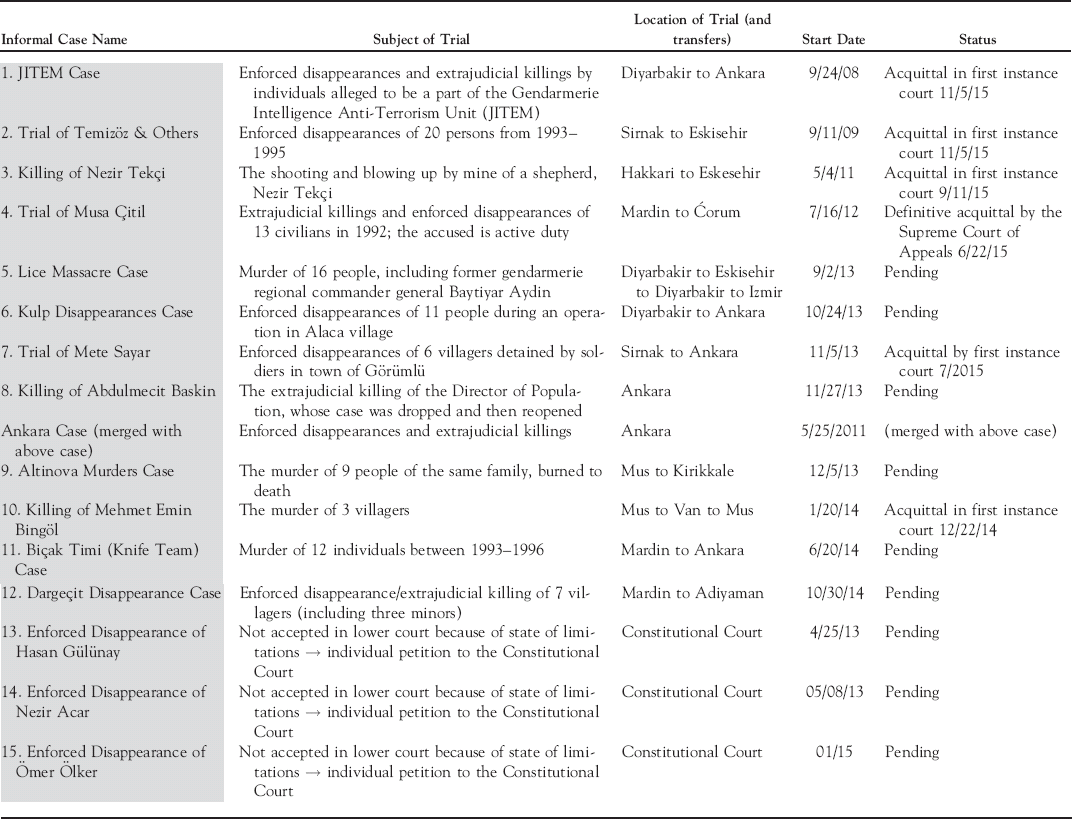
The trials are at various stages within the Turkish judicial system. At the end of 2015, nine trials have ongoing proceedings, five have resulted in acquittal at the lowest level in the court system and are moving toward appeals, and one has resulted in a definitive acquittal in the highest court of appeals. Additionally, three of the nine cases that are ongoing are currently being considered by the Consititutional Court (Anayasa Mahkemesi) to determine whether the passed statute of limitations should apply to these crimes.Footnote 9 See Table 1 for details of the trials.
Human Rights Trials in Turkey 2008–2015

| Informal Case Name | Subject of Trial | Location of Trial (and transfers) | Start Date | Status |
|---|---|---|---|---|
| 1. JITEM Case | Enforced disappearances and extrajudicial killings by individuals alleged to be a part of the Gendarmerie Intelligence Anti-Terrorism Unit (JITEM) | Diyarbakir to Ankara | 9/24/08 | Acquittal in first instance court 11/5/15 |
| 2. Trial of Temizöz & Others | Enforced disappearances of 20 persons from 1993–1995 | Sirnak to Eskisehir | 9/11/09 | Acquittal in first instance court 11/5/15 |
| 3. Killing of Nezir Tekçi | The shooting and blowing up by mine of a shepherd, Nezir Tekçi | Hakkari to Eskesehir | 5/4/11 | Acquittal in first instance court 9/11/15 |
| 4. Trial of Musa Çitil | Extrajudicial killings and enforced disappearances of 13 civilians in 1992; the accused is active duty | Mardin to Ćorum | 7/16/12 | Definitive acquittal by the Supreme Court of Appeals 6/22/15 |
| 5. Lice Massacre Case | Murder of 16 people, including former gendarmerie regional commander general Baytiyar Aydin | Diyarbakir to Eskisehir to Diyarbakir to Izmir | 9/2/13 | Pending |
| 6. Kulp Disappearances Case | Enforced disappearances of 11 people during an operation in Alaca village | Diyarbakir to Ankara | 10/24/13 | Pending |
| 7. Trial of Mete Sayar | Enforced disappearances of 6 villagers detained by soldiers in town of Görümlü | Sirnak to Ankara | 11/5/13 | Acquittal by first instance court 7/2015 |
| 8. Killing of Abdulmecit Baskin | The extrajudicial killing of the Director of Population, whose case was dropped and then reopened | Ankara | 11/27/13 | Pending |
| Ankara Case (merged with above case) | Enforced disappearances and extrajudicial killings | Ankara | 5/25/2011 | (merged with above case) |
| 9. Altinova Murders Case | The murder of 9 people of the same family, burned to death | Mus to Kirikkale | 12/5/13 | Pending |
| 10. Killing of Mehmet Emin Bingöl | The murder of 3 villagers | Mus to Van to Mus | 1/20/14 | Acquittal in first instance court 12/22/14 |
| 11. Biçak Timi (Knife Team) Case | Murder of 12 individuals between 1993–1996 | Mardin to Ankara | 6/20/14 | Pending |
| 12. Dargeçit Disappearance Case | Enforced disappearance/extrajudicial killing of 7 villagers (including three minors) | Mardin to Adiyaman | 10/30/14 | Pending |
| 13. Enforced Disappearance of Hasan Gülünay | Not accepted in lower court because of state of limitations → individual petition to the Constitutional Court | Constitutional Court | 4/25/13 | Pending |
| 14. Enforced Disappearance of Nezir Acar | Not accepted in lower court because of state of limitations → individual petition to the Constitutional Court | Constitutional Court | 05/08/13 | Pending |
| 15. Enforced Disappearance of Ömer Ölker | Not accepted in lower court because of state of limitations → individual petition to the Constitutional Court | Constitutional Court | 01/15 | Pending |
Methods and Data Collection
To examine the paradox outlined above, I present data from fieldwork conducted in Turkey from November 2014 to January 2015. I aim to pinpoint processes and the interpretation of those processes held by key participants in these recent events. Previous literature regarding human rights trials in transitioning regimes points to the role of advocacy networks and civil society groups as fundamental to the pursuit of domestic legal remedies for human rights abuses (Finnemore and Sikkink Reference Finnemore and Sikkink1998; Keck and Sikkink Reference Keck and Sikkink1998; Roht-Arriaza Reference Roht‐Arriaza2002). Building on this literature, my main data source involves twenty-one in-depth semi-structured interviews with twenty human rights activists and legal professionals associated with organizations working in relation to the ongoing trials.Footnote 10 I carried out an additional set of twenty-three interviews with relatives of victims of enforced disappearance, with whom these organizations work (some of whom participated in trials domestically or in the European Court of Human Rights, others who had not been able to or did not attempt to). These interviews served as a window into the perspective of victims regarding the impact of these trials on accountability.
The individuals I interviewed were associated with multiple local nongovernmental organizations, such as Truth Justice Memory Center (Hakikat Adalet Hafiza Merkezi), Human Rights Association (İnsan Hakları Derneği, İHD), Human Rights Foundation of Turkey (Türkiye İnsan Hakları Vakfı, TİHV), Mazlumder, Yakayder, Peace Mothers, the Saturday Mothers, the Turkish Economic and Social Studies Foundation (Türkiye Ekonomik ve Sosyal Etüdler Vakfı, TESEV), and the Diyarbakir Bar Association.Footnote 11 The interview data are supplemented by analysis of primary and secondary source documents that shed light on the context of human rights in contemporary Turkey.Footnote 12
Human Rights Trials: Causes and Dynamics
In this section, I review the literature suggesting causal dynamics of domestic human rights trials, and discuss how this literature informs my own analysis of the Turkish case. Earlier scholarship referring to domestic human rights trials in the context of processes of democratization was often pessimistic of their impact on stability (O'Donnell and Schmitter Reference O'Donnell and Schmitter1986, 30; Huntington Reference Huntington1991, 228; Zalaquett Reference Zalaquett1992, 128–29). Scholars in the international relations literature have more recently argued that trials risk the sustainability of democratization because they can provoke powerful actors threatened by prosecution who seek to halt the democratic process to avoid litigation (Snyder and Vinjamuri Reference Snyder and Vinjamuri2003, 26). These scholars would be skeptical of the value and efficacy of domestic human rights trials, especially during periods of instability or democratic regress. Within this literature, trials were never theorized as possibly ongoing in an increasingly authoritarian political context, but rather within the context of transitions moving toward democracy.
More recent scholarly work has suggested a variety of explanatory variables for the increasing number of domestic prosecutions around the globe. In the following section I review this literature and address each of the main causal factors linked to the emergence of trials: transnational advocacy networks, international linkages, and the diffusion of norms; private prosecution; judicial independence; and legal mobilization. I then demonstrate that although some of these factors prove insightful for the ongoing dynamics in the Turkish case, on their own they provide an incomplete explanation for the dynamics that have occurred recently in Turkey.
Transnational Advocacy Networks, International Linkages, and the ICA Norm
The first factor used to explain the increase in domestic human rights trials is the role of transnational advocacy networks (TANs)—“committed and knowledgeable actors who work on specialized issues and promote causes and principled ideas and norms,” such as international and domestic NGOs (Diamond Reference Diamond1995; Keck and Sikkink, Reference Keck and Sikkink1998: 8–9; Carothers Reference Carothers1999; Risse, Ropp, and Sikkink Reference Risse, Ropp and Sikkink1999). These groups serve to “‘amplify’ the demands of domestic groups, pry open space for new issues, and then echo these demands back into the domestic arena”—a process called “the boomerang effect,” most common in human rights campaigns (Keck and Sikkink 1999, 99). Other literature has pointed to similar dynamics, emphasizing the role of additional forms of international linkage, that can create pressure on authoritarian regimes and hook states into the larger processes of the boomerang effect, which are beyond their control (Levitsky and Way Reference Levitsky and Way2006, 382; Reference Levitsky and Way2010).
In a series of landmark works, Kathryn Sikkink builds on the TANs/linkages literature and develops a comprehensive theory about the increasing frequency and impact of domestic, international, and foreign human rights trials in relation to international normative change (Lutz and Sikkink Reference Lutz and Sikkink2001; Sikkink Reference Sikkink2011). This normative change (which has occurred through TANs) represents a shift in conceptions of justice for human rights abuses from sole emphasis on state responsibility to a growing emphasis on individual criminal accountability (ICA) (Lutz and Sikkink Reference Lutz and Sikkink2001; Sikkink Reference Sikkink2011). Through networks, normative ideas are spread and collective action is facilitated between the domestic, international, and foreign levels. This has allowed for the diffusion of the ICA norm.Footnote 13
More recent studies of this phenomenon, which Sikkinnk calls the “justice cascade,” use large-N data analysis to test the impact of trials (Sikkink and Booth Walling 2007; Kim and Sikkink 2010, 96; Olsen, Payne, and Reiter Reference Olsen, Payne and Reiter2010; Sikkink and Kim Reference Sikkink and Kim2013). The assumption that human rights trials follow democratic transition is strong in this literature as well (Sikkink and Booth Walling 2007; Kim and Sikkink 2010, 96; Olsen, Payne, and Reiter Reference Olsen, Payne and Reiter2010; Sikkink and Kim Reference Sikkink and Kim2013), consistent with the previous scholarship (see Carothers Reference Carothers2002, 7). The frequent usage of the term “after transition” projects an image of an unambiguous process of democratization. In sum, this literature points to normative change at the international level to explain the presence of human rights trials domestically, and continues to frame trials as a function of movement toward democracy.
Private Prosecution
A third causal mechanism identified in the literature conducive to human rights trials is the right to private prosecution (Michel and Sikkink Reference Michel and Sikkink2013). Private prosecution occurs in countries that provide victims and NGOs the ability to advocate for victims' rights actively throughout court proceedings—mirroring public prosecutor advocacy of the state. This right was a major driving force in Latin American human rights trials of military officials, especially in Chile and Argentina, which have experienced a comparatively high number of prosecutions for human rights crimes (Michel and Sikkink Reference Michel and Sikkink2013). Michel and Sikkink demonstrate that this right was a key causal mechanism for two reasons: it has been used to introduce new arguments regarding international and regional human rights law, which were eventually relied on in Supreme Court decisions (2013, 898); and second, private prosecution allowed victims, and NGOs representing them, to keep court cases open, even in the absence of political will to examine accusations against state actors (889). The authors argue that private prosecution is fundamental because it provides a mechanism through which civil society actors can use the law to advocate for victims' rights.
Judicial Independence
Increases in judicial independence have also been linked to the opening of human rights trials. Skaar (Reference Skaar2007, Reference Skaar2011) has argued that the extent of domestic trials in a given country is directly related to the level of independence of the judiciary from the executive branch, in particular from the president. In her study comparing Uruguay with Argentina and Chile (2007), Skaar contends that lack of judicial reform strengthening the judiciary in relation to the executive means that judges are strongly influenced by the power of executive actors over their professional destiny, and unlikely to challenge the military's version of events through prosecutions. Judicial reform resulting in greater independence of judges can facilitate human rights trials as it increases protections for judicial actors interested in pursuing prosecutions based on victims' complaints against state actors.
Legal Mobilization
Legal mobilization, first introduced by Zemans (Reference Zemans1983), has also been noted as an important contributing factor in the establishment of human rights trials. Legal mobilization is the notion that when victims have access to a variety of legal resources, they are able to advocate for and establish their rights as citizens through legal means (see also Burstein Reference Burstein1991; Epp Reference Epp1996; McAdam, Tarrow, and Tilly 2001; McCarthy and Zald Reference McCarthy and Zald1977). Legal mobilization occurs when “civil society activists, with professional help from legal specialists, mobilize law on behalf of disadvantaged citizens and challenge discriminatory practices” (Tezcür Reference Tezcür2009, 213; on the MENA region, see also Moustafa Reference Moustafa2003, Reference Moustafa2007; El-Ghobashy Reference El‐Ghobashy2008). Legal mobilization has played an important role in the facilitation of domestic trials in Latin America (Michel and Sikkink Reference Michel and Sikkink2013), and in Turkey (Tezcür Reference Tezcür2009).
Current Explanations of Human Rights Trials and the Turkish Case
The current literature explaining the presence of human rights trials is a useful starting point for analysis of the Turkish case. There is no doubt that the role played by TANs has been important in Turkey in helping to establish international and domestic legal mobilization. Turkey has high levels of linkage (including through local NGOs), with democratizing pressure from Western governments and multilateral institutions slightly mitigated by the country's strong economy and geostrategic military position, particularly in the post-Arab uprising period (Levitsky and Way Reference Levitsky and Way2006, 388). These two literatures are pertinent to the Turkish case because of the important role played by direct linkage to the Council of Europe, and more broadly the European Union, through Turkish citizens' recourse to the European Court of Human Rights (ECtHR) (Alpkaya et al. Reference Alpkaya, Altıntaş, Sevdiren and Sevimli2013, 108). As a member of the Council of Europe since 1949, Turkish citizens have had the right to petition the ECtHR since the adoption of the European Convention on Human Rights (1953).
The ECtHR has served as an extensive and effective international venue that has revealed the extent of human rights abuses in Turkey, and allowed particularly for the review of violations carried out in the southeastern region of the country. The international linkage with the court, in conjunction with the (albeit uneven) EU accession process, explains the increasing pressure on the Turkish government to address these crimes in ways that contribute to judicial and legal reform (on which accession progress is largely based). Yet, neither these linkages, nor the ongoing work by transnational advocacy networks, can explain the timing of the boomerang, in which domestic cases began to be opened in 2008. Data from my interviews indicate that there is strong support for the ICA norm among the population affected by these crimes. However, it has likely been present among relatives, human rights activists and legal professionals since the mid 1990s (the height of abuses), when complaints were first logged in Turkey's domestic courts. These explanatory variables had been active for decades in Turkey before the emergence of domestic trials for human rights violations against Kurds in the 1990s.Footnote 14
Private prosecution (in the form of individual petition rights) can explain the presence of three of the human rights cases discussed here. More specifically, three cases have been brought before the Constitutional Court since a constitutional amendment was passed in 2010 creating citizens' right to individual petition before that court.Footnote 15 However, individual petition does not apply to other Turkish courts and therefore cannot explain the full wave of trials addressed here. Similarly, judicial independence has played a facilitating role in the Turkish cases but cannot account for the timing of the full set of trials, and changes in judicial dependence on the executive in the last five years are themselves further clarified through the analysis included in this article—based on attention to shifts in distribution of power among elite actors.
Finally, legal mobilization has played an essential role in the opening of human rights trials between 2008 and 2014. The mobilization of the law on behalf of the Kurdish population took place when families filed complaints in the domestic court system starting in 1994. These cases were systematically dismissed in domestic courts for ostensible lack of evidence for indictment, or because of a passed statute of limitations, until as recently as 2008 (Amicus Curiae Brief 2014). This demonstrates the almost ubiquitous view of prosecutors and judges who, in the words of one jurist, “do not view the victims' testimony as reliable evidence, despite its importance in view of the lapse of time since the crimes occurred and [the additional] reality that these offences were committed by state actors and [therefore,] the strong possibility of spoliation of evidence.”Footnote 16 As domestic legal remedies had been exhausted, human rights associations and domestic legal professionals submitted cases with relatives of the disappeared to the ECtHR.
The impact of these cases should not be underestimated. The ECtHR cases facilitated domestic prosecution in the long term for human rights crimes by providing investigation capacities above and beyond the capabilities of domestic legal professionals (Çali Reference Çali2010). As explained in the amicus curiae brief submitted by a collection of Turkish organizations to the Turkish Constitutional Court in November 2014, the court has found Turkey in violation of the European Convention on Human Rights in a total of 78 percent of the applications (ibid.). In 9 percent, Turkey resolved the cases before a decision was issued through a friendly settlement—indicating “responsibility of the Republic of Turkey is determinable in 87 percent of enforced disappearance cases” (ibid.). Judgments of the court cited violations regarding the right to life, the prohibition on torture, the right not to be arbitrarily detained, and the right to access to domestic remedies. This process of supranational litigation has also had implications for individual criminal accountability because, although the institution determines state responsibility, ECtHR rulings often determine fault of individual military or government officials in the process (although they do not rule on punishments at the individual level).Footnote 17
The ECtHR proceedings were incredibly valuable in the process of legal mobilization also because the court documented all of its findings, which became available to both the state and civil society actors as well as to families. This created a more complete record of what had occurred in the 1990s, and served as recognition by a credible regional actor of state responsibility. The mobilization of law started at the domestic level and then branched off to also target the supranational level when domestic remedies were systematically exhausted (without trial) on a case-by-case basis between 1994 and 2008. Although this legal mobilization targeting the court enriched the ability of local actors to continue to mobilize domestically, the ECtHR cases do not explain why prosecutors and judges began to be open cases domestically for the first time in 2008.
To summarize, the above discussion demonstrates that domestic legal mobilization, utilizing international linkages through TANs, has been a consistently important element in Turkish sociolegal processes since the 1990s. This work has also been facilitated since the 2010 constitutional amendment through the introduction of private prosecution rights (before the Constitutional Court), and a brief period of increased judicial independence. However, none of these factors on their own, or in combination, can fully explain the set of human rights trials that were opened between 2008 and 2014 in the Turkish domestic legal system. I contend that to explain the timing of these trials one must look to the redistribution of power among elite actors, which ultimately created a window of opportunity for domestic prosecutions to take place in the Turkish legal arena. The next section outlines the details of this argument.
Impact of Elite Conflict on the Judiciary
Recent scholarship on Turkish politics has pointed to unlikely political phenomena facilitating the advancement of protection for human rights. In a study of high court behavior, Belge (Reference Belge2006) argues that temporary conflict within the TSK-Republican alliance in the 1970s and again in the early 1990s explains selective support of rights and liberties by the Turkish Constitutional Court during those periods. In the later period, this short-term elite rift resulted in the Republican-left briefly aligning with Kurdish politicians. This encouraged the court (which Belge argues has traditionally been beholden to military elites) to strike down certain parts of the antiterror law and other illiberal military policies affecting Kurdish populations (Belge Reference Belge2006, 68). Tezcür takes up this subject in greater detail in his analysis of lower court activity. Through comparison of the 2005 Semdinli incident (in which members of the TSK and an ex-PKK militant were caught attempting to bomb a bookstore), and other recent cases within the lower courts targeting the TSK, Tezcür found that lower courts were more capable of prosecuting members of the military when they had significant backing from the civilian government and public support from key civil society actors (2009, 331). This research indicates that when power is dispersed between multiple actors within the elite political establishment (in this case between the TSK and the AKP), legal action becomes more possible for judges able to count on the protection of certain power centers against others. However, at the time of the Semdinli case (2005), the military was still strong enough to counter its opponents. Through influence in the High Court of Prosecutors and Judges (HSYK), the military was able to expel the public prosecutor who had brought the case, claiming that he did not have the authority to investigate military personnel (Atilgan and Isik Reference Atılgan and Işık2012).
In 2008 the lower courts again began to facilitate prosecution of TSK members, accepting and initiating two types of trials: those for crimes against the state (coup trials) (Budak Reference Budak2015; Bakiner Reference Bakiner2016); and those for individual criminal responsibility for human rights crimes, initiated by civil society litigation based on victim complaints (human rights trials). In July 2008, the first indictments were issued that were associated with what became known as the Ergenekon trial. From 2008 to 2012, 275 defendants, including many military officials, were tried (with more than fifty held in detention during trial) for membership and activity in an armed terrorist organization, Ergenekon, and an attempt to overthrow the government. The Ergenekon trials came to a close and a verdict was announced in August 2013, condemning General Veli Küçük, Captain Muzaffer Tekin, and Alparslan Arslan (the shooter in the 2006 Council of State attack) to consecutive life sentences. Other military officials were sentenced to aggravated life imprisonment. However, as reported in the Hurriet Daily News in March 2014, the parliament passed a law abolishing the specially authorized courts in which the Ergenekon cases were being appealed, which led to the release from prison of multiple high-profile individuals charged in the trial (“Ergenekon Suspects Released …” 3/10/2014).
Meanwhile, in 2010, indictments were issued in the September 12 (1980) Coup case for General Kenan Evran and General Tahsin Şahinkaya for their role in the 1980 military coup. They were each convicted and sentenced to life imprisonment in 2012, and demoted to the rank of private. The Constitutional Court unanimously rejected an appeal of the verdict (Armutçu 2014) and ex-general Evran died in May 2015.
Additionally, a third case, known as the Balyoz (Sledgehammer) case was opened in 2010 regarding a military plan ostensibly started in 2003 to overthrow the AKP-led government. The Balyoz trial included the indictment and sentencing of 236 serving or retired military members, and was consistently criticized for questionable procedural elements until the Constitutional Court overturned the decision, calling for a retrial in June 2014, citing violations of the rights of the accused. All suspects were subsequently acquitted on March 31, 2015, when the court announced its determination that a substantial amount of the evidence was forged and inadmissible (Hurriyet Daily News 2015).
Although the three coup trials occurred during the same period, they have each left a distinct legacy and impacted trust in the judicial process in varying ways. Public opinion has largely turned against the 1980 coup in recent years, and the trial against the coup leaders was widely considered to be legitimate. The Balyoz trial revealed tampering with evidence and forging of official documents by members of the executive AKP and its allies associated with the Gülen movement, therefore drawing greater criticism than the 1980 coup trial. The Ergenekon trials have also received increasingly stronger criticism for misuses of power by the judiciary and police forces in charge of investigations and proceedings (Jenkins Reference Jenkins2015). They were, however, considered legitimate within the human rights community to the extent that they included accusations of multiple high-profile unsolved murders, attributed to security forces—the first time these accusations has been heard in a public state venue.Footnote 18 The three coup trials were similar in that they were initiated by government investigations, garnered massive public attention (domestically and internationally), and targeted high-level officials in the military and former power holders. In these three ways they were qualitatively different than the human rights trials to which we will now turn.
Human Rights Trials
Ergenekon dramatically impacted the work of human rights activists because of the extensive testimony and evidence submitted and heard substantiating individual responsibility for human rights crimes (Avsar, Özdil, and Kirmizidag Reference Avsar, Özdil and Kirmizidag2013). Furthermore, two months after the Ergenekon trial was opened, the first human rights trial, examining crimes carried out by the covert JITEM unit, began in September 2008.
The Ergenekon coup trial was the first time that the wider legal community was exposed to evidence of human rights crimes by security forces from the conflict with the PKK in the 1990s. NGOs worked with families to submit evidence regarding these crimes, although, ultimately, the court decided to strictly focus on crimes against the state, and returned case files to lawyers representing families of victims.Footnote 19 Activists and families I spoke with saw the Ergenekon trial as a major missed opportunity because, as one individual explained, “there were clear connections between the military and civilian government and human rights crimes committed, and evidence provided.”Footnote 20 However, there was also a widespread sentiment among those interviewed that the Ergenekon trial facilitated the series of subsequent trials that were to begin in 2008, investigating individual criminal responsibility for human rights crimes (see Avsar, Özdil, and Kirmizidag Reference Avsar, Özdil and Kirmizidag2013). Media reports support this idea, indicating that at the end of the Ergenekon trial, over 9,500 files concerning enforced disappearances and extrajudicial killings were distributed to nine different prosecutors (Zaman 2013).
Echoing an interpretation expressed by many of those interviewed, one jurist from a human rights association explained, “the Ergenekon and Balyoz trials triggered the following human rights trials … [by showing] that military members could also be tried.”Footnote 21 In contrast to the coup trials, which focused exclusively on crimes against the state, the human rights trials were initiated by civil society litigation based on victim complaints. They have also been low profile in comparison to the coup cases. These trials have been progressively opened since 2008 and, in contrast to the coup trials, more than half of them are ongoing at the time of writing.
These trials are an exceptional example of domestic litigation for human rights abuses in the Middle East North Africa region (MENA), and to my knowledge have not to this point been examined in scholarly work.Footnote 22 To explain this phenomenon, I draw on literature citing power distribution theory—the claim that policy decisions regarding justice are determined mainly by domestic political power switches from previous authoritarian elites to a new government seeking policies to address justice (Zalaquett Reference Zalaquett1992; Pion-Berlin Reference Pion‐Berlin1994; Huyse Reference Huyse1995; Nino Reference Nino1996; Skaar Reference Skaar1999). I move away from the assumptions (inherited from the transitions literature) of a clear transition point, unilateral movement toward democracy, or even a general evolutionary trajectory of democracy over the long term. Furthermore, although the change of power in Turkey brought to the fore new actors (the AKP and their alliance of Islamist elites, particularly with the Gülen movement) who were previously victimized by the TSK, their desire to prosecute the TSK in the coup trials seems to have been motivated by self-interest rather than commitment to human rights norms, as is evidenced by their mounting human rights violations in multiple arenas since gaining power.Footnote 23
Furthermore, I argue that the trials for human rights abuses were not driven by these elites, as was the case in the coup trials outlined above. Rather, the changes in elite power (clearly demonstrated through the trials of military officials for crimes against the state) called into question the previous status quo assumption of immunity for TSK officials among prosecutors and judges. The political opportunity structure facing lower-level judicial actors shifted, creating a period in which trials, this time driven by ongoing legal mobilization of civil society actors, started to be accepted for indictment and proceedings. Simply put, I suggest that changes in distribution of power between elite actors facilitated opportunities for legal mobilization by civil society to take root, and can explain the timing of these trials. My research indicates that the conflict between the military, old-guard establishment and the AKP identified by Tezcür (Reference Tezcür2009) (see also Turkmen 2008) allowed for the introduction of these indictments and preliminary court proceedings.
Domestic Trials For Individual Criminial Responsibility For Human Rights Crimes
By the end of 2015 there were eleven cases pending at various levels in the hierarchy of domestic Turkish courts. These cases are different than the hundreds of files that had been dismissed by prosecutors up until 2008 (and since) in a number of ways, one of which being that they have surpassed the usual hurdles set up by the judicial system: the prosecutor has accepted the file and opened an indictment, carried out investigation on the alleged crimes, filed the indictment with a court, and court hearings have begun. Many of the cases have also had multiple court hearings.Footnote 24 Three of the eleven cases are currently before the Constitutional Court.Footnote 25 Despite inconsistency in hearings and the substantial problems faced by victims' families during proceedings,Footnote 26 these trials have achieved progress in a number of key ways. The trials have resulted in (1) the introduction of the first legally recognized witness testimony in domestic courts against former military officials detailing human rights violations and included in indictments; (2) extensive investigation of crimes (usually by lawyers for the victims) revealing mechanisms of impunity contributing to human rights violations as well as the identity of previously protected alleged perpetrators; (3) the ordering by multiple courts of exhumations and identification of human remains (a frequent goal of families); and (4) the detention of some former and current military officials in relation to human rights crimes (Truth, Justice and Memory Center 2015).
As a result of these achievements, the trials have substantially challenged the official narrative espoused by the government, which frames violence from this period exclusively within the context of the ongoing TSK-PKK conflict, and civilian deaths as collateral damage, or simply as increases in the terrorist body count. These trials have instead provided a venue in which the possibility of human rights violations by the TSK is advanced, and evidence is provided of civilian suffering through systematic enforced disappearances and extrajudicial killings. They represent a legal context not previously afforded to victims of these crimes in domestic courts. This makes these cases categorically different than the cases for which the ECtHR has condemned Turkey because the cases discussed here have resulted in domestic hearings through which contestation of the regime discourse regarding these crimes has now been officially introduced into the domestic legal arena. The introduction of counternarratives has been recognized as an important element for transitional justice processes (Lessa Reference Lessa2013) in processes of truth recovery for reconciliation after massive human rights violations (Kovras Reference Kovras2014), and also in conflicted democracies dealing with ongoing human rights abuses (Bilsky 2004). For these reasons these court proceedings merit attention.
The Mechanism—Redistribution of Elite Power
Through my interviews it became apparent that many of the people I spoke with believed the coup trials came about because, in 2007–2008, an alliance that had been consolidating for decades between Islamist factions (AKP and what is known as the Gülen movement) was at its height. The AKP-Gülen alliance combined the power of the executive (held by the AKP) and the extensive networks and authority of the Gülen movement, which at the time had strong support within the judiciary and police forces (Ozbüdun 2015). As one Turkish legal scholar explained, the AKP and Gülen alliance “allowed for greater independence and movement by prosecutors.”Footnote 27 A former military judge with whom I spoke agreed that the alliance facilitated the indictments and initial prosecution stages, since these events “were not achievable only through legal means … cases were opened … because of this unification, and power of the Gülen movement in the judiciary …” added to the strength of the executive.Footnote 28
The AKP and the Gülen movement worked hand in hand through the coup trials to reduce the alliance between the TSK and the judiciary, which had for decades targeted and repressed Islamist political actors, including current members of both groups. In the words of a legal academic working on the impact of the Ergenekon files in human rights prosecutions: “Without the … power conflict between AKP and Gülen versus the old guard tutelage it would not have been possible for human rights activity to break through.”Footnote 29 When political power shifted to the AKP-Gülen alliance these new actors pursued their own political vendettas, targeting the military through the coup trials. In contrast, interview data indicate that the human rights trials were not a case of direct political vengeance where elites in the executive targeted military actors through the judiciary, as seems to be the case in the Balyoz trial and, to some extent, in the Ergenekon trials.Footnote 30
Interviews with relatives also support this theory that the coup trials originated under different circumstances than the human rights prosecutions. Many individuals stated that they had filed complaints (to initiate trials) out of a desire for legal justice and appropriate jail sentences, not vengeance and the death penalty. In the words of the wife of a victim of enforced disappearance, “those responsible should be imprisoned. We are not like them, we don't want them killed.”Footnote 31 The daughter of a man forcibly disappeared from the region of Sirnak echoed this sentiment expressed by many relatives: “we don't think like them. We don't want a reprisal, or retaliation … we want prison and an apology.”Footnote 32 These statements reveal the fact that victims' families filing domestic cases perceive a personal interest in upholding the rule of law and adhering to regulations protecting defendants' rights, particularly as a method of differentiating themselves from their aggressors. These quotes represent a theme repeated by additional relatives that lends further support to my interpretation of the difference between these human rights trials and the coup trials. The human rights trials referred to here originated in rights claims and were not initiated through executive investigations (like the coup trials) (Jenkins Reference Jenkins2009, 37).
Interview data from legal professionals and human rights activists indicate that these human rights prosecutions seem to have come about through a lifting of pressure on members of the judiciary (prosecutors and judges) to ignore human rights abuses committed, or to protect military officials from litigation attempts.Footnote 33 This characterization of the emergence of the trials is further supported by the haphazard timing and location of the trials: proceedings were not initiated all at once as if by a centralized decision, but progressively and with decreasing time between the most recent cases (although no new trials have been initiated since October 2014). As can been seen in Table 1, one trial was initiated each year in 2008, 2009, 2011, and 2012. Five trials were initiated in 2013, and three trials in 2014, indicating a cascade of progressively more trials in the most recent years up until 2014. Additionally, the locations of trial initiation are geographically dispersed around the southeast, with trials initiated in Diyarbakir, Sirnak, Hakkari, Mardin, Ankara, and Mus. It was not until 2013 that a trial was opened for the second time in one of these locations, indicating that different public prosecutors initiated the first four trials.
Redistribution of Power vs. Judicial Independence
In 2010 a landmark constitutional amendment was proposed by the executive and ratified by popular referendum. The amendment enacted a number of changes to the Turkish government, three of which are related to our topic and require us to examine whether the introduction of trials for human rights crimes was actually a result of greater independence of the judiciary from the executive (as Skaar suggests, 2007, 2011), and not a result of the redistribution of elite power. First, the amendment annulled legislation that had previously forbidden prosecution of the leaders of the 1980 military coup (leading the way for the opening of the 1980 coup trial in 2012). Second, the 2010 constitutional amendment created a mechanism by which individuals could, for the first time, petition the highest court in Turkey, the Constitutional Court (Anayasa Mahkemesi). This mechanism serves the purpose pinpointed by Michel and Sikkink (Reference Michel and Sikkink2013), similar to private prosecution in Latin America, because it allows individuals and their lawyers to keep a case open, through review by the Constitutional Court, even in the face of opposition from within the lower levels of the judiciary. This new mechanism is responsible for the three cases that are currently before the Constitutional Court. However, this mechanism is available only for appeal through the Constitutional Court and cannot explain the cascade of trials in the lower domestic courts. Furthermore, to the extent that the proposal of the constitutional amendment of 2010 occurred because of the strength of the Islamist alliance in the executive vis-à-vis the TSK, the right to individually petition before the high court can also be understood as a result of the changing power dynamics within the regime.
Finally, the amendment made changes to the High Council of Judges and Prosecutors (Hâkimler ve Savcılar Yüksek Kurulu, HSYK), temporarily increasing its independence from the executive. Although the executive still participated during this time in the activities of the Council, it had a more symbolic role (Özbudun Reference Özbudun2015, 45). To identify the most convincing explanation for the appearance of human rights trials in this period, a closer examination of the recent series of events is necessary.
Up until 2002, the military had been strong in the executive and judiciary because of its longtime alliance with the Republican old-guard parties. Although there were a few exceptions to this alliance (Belge Reference Belge2006), for the most part it has been strongly in place since the 1980 coup. Civilianization of the government began to occur in 2002 with the coming to power of the AKP through parliamentary elections and through the passage of multiple judicial reform packages in line with the EU accession process since that time. However, the civilianization process was still rather weak before the redistribution of power solidified in 2007–2008. This is clearly demonstrated by the Semdinli case in 2005, in which the judiciary continued to side with the military, maintaining impunity for members of the armed forces (Tezcür Reference Tezcür2009; Saglam Reference Saglam2013).
The power shift that began in 2002 with the legislative elections that brought the AKP to power was strengthened in 2007–2008 by a series of events: Abdullah Gul (a member of the AKP) was elected as president against the publicly stated wishes of the military, the AKP benefited from a second successful parliamentary election (2007), investigations were opened leading to the Ergenekon trial that implicated the military (2007), and the military was unsuccessful in its attempt to close AKP through the courts between March and July 2008. The failed closure case was a resounding victory for the AKP, although, as was reported in the local press, it did lose 50 percent of its state funding) (Güncelleme Reference Güncelleme2008). After these events the executive and judiciary were able to move forward confidently with the Ergenekon trial, actively opposing the military.
The 2010 constitutional amendment strengthened the civilian government's hand by opening the door to legal pursuit of the 1980 coup generals. To this point we see the executive and judiciary working hand in hand against the military, explained by the shift in power favoring the Islamists. Multiple interviewees from a variety of backgrounds within the legal field suggested that more recent conflict between the AKP and Gülen likely contributed to the successful appeal (and eventual dismissal of charges) of the Balyoz trial.Footnote 34 As Kadri Gursel reported in Al-Monitor on April 6, 2015, since December 2013 when family members of high-level AKP officials were accused of extensive corruption, conflict between the AKP and the Gülen movement has gone public, and likely contributed to the recent acquittal in the Balyoz trial.
Although seven of the human rights trials were opened during the period of greater judicial independence from the executive (September 2010–February 2014), the first trial that dealt prominently with human rights abuses was initiated in 2008 (the JITEM case). This case was the culmination of longstanding government-initiated investigations resulting from the Susurluk and Semdinli incidents, which had uncovered information regarding human rights abuses attributed to JITEM. The case itself examined indictments for crimes against the state and the crime of murder of multiple persons, and can be understood as a sort of bridge between the coup trials (dealing exclusively with crimes against the state) and human rights trials (dealing exclusively with crimes against individuals). A second indictment and trial was also opened in 2009, before the increase in judicial independence from the executive. Additionally, since February 2014, the executive has curtailed the independence of the judiciary to a greater extent than even before the constitutional amendment of 2010. However, in this most recent period of high risk for prosecutors and judges, two final trials were nonetheless opened (in June and October 2014).
In sum, judicial independence cannot explain the four trials opened before or after the roughly three years of increased judicial autonomy from the executive, nor the ongoing proceedings (at the time of writing) in nine out of the fifteen trials accepted in lower-level courts at the end of 2015. Judicial independence from the executive seems to have encouraged a phenomenon that had started pre-2010, and that continued after sanctions for this type of judicial activity were again increased in February 2014. Although judicial independence from the executive is part of the story, it cannot account for the set of cases as a whole. Additionally, the Turkish case points to the importance of independence not just from the executive, but independence from the military. The fluctuations in dependence on the executive have been minimal in comparison to the general trend in which the judiciary has become significantly less dependent on the military in the most recent period.
Redistribution of Elite Power: Key to Changing Judicial Independence
Finally, redistribution of elite power should be considered as an important explanatory factor because it also clarifies the complex and changing relations between the judiciary and executive between 2010 and 2014. Before the 2010 constitutional amendment, the Islamist alliance in the executive and judiciary was strong. The AKP could count on its allies in the judiciary as they were working together to prosecute the former coup leaders. Accordingly, in order to move forward with the EU accession negotiations, the AKP government proposed the constitutional amendment, which met certain criteria previously requested through multiple European institutions.Footnote 35 However, when the split between the AKP and Gülen resulted in an open power struggle in December 2013, the AKP quickly moved to regain executive control over the judiciary and police by passing laws that allowed it access to the investigation of corruption in which it was implicated.Footnote 36 By February 2014, the executive had reversed the changes enacted through the constitutional amendment (which had created temporarily greater judicial independence), through Law 6524. Before the Constitutional Court could render a decision on the constitutionality of these executive actions, the AKP-led government also fired the Secretary General, Assistant Secretaries General, the Chairman of the Board of Inspectors and the Vice-Chairmen, Council inspectors, reporting judges, and all administrative personnel of the HSYK (Özbudun Reference Özbudun2015, 47). This constituted a near complete purging of the institution. Although the Constitutional Court subsequently ruled that Law 6524 was unconstitutional, the removal of the HSYK personnel was irreversible since its decisions are not retroactive (Mustafa 2015). This reversal of judicial independence occurred alongside large-scale purging of police officers and reassignment of members of the judiciary suspected to be supportive of the Gülen movement and involved in the corruption investigations.Footnote 37 As noted in a recent report from Human Rights Watch on the situation in Turkey:
The AKP government in 2015 continued efforts to purge the police and judiciary of alleged supporters of the Gülen movement. During 2015, prosecutors, judges, and police officers with perceived links to the Gülen movement were jailed and charged with plotting against the government and membership of a terrorist organization. The main evidence being cited against judges and prosecutors at time of writing was decisions taken in the course of their professional duties rather than any evidence of criminal activity. (Human Rights Watch 2016, 582)
In sum, the fluctuations in judicial independence of the judiciary over the last five years are directly related to the power struggle occurring between factions of the Islamist government. Although the brief increase in judicial independence could be called a sign of democratization, when one takes into account the larger set of events that explains institutional changes over this period, it is obvious that these are not democratizing processes. If anything, the last five years have shown how the Turkish government is still strongly swayed by a powerful and controlling executive. At no point can the judiciary be said to have established real independence from the executive, since the AKP-led executive immediately reined in the judiciary when it began to act autonomously.
It is in the midst of this uncertain and changing political environment that the political opportunity structure available to prosecutors and judges changed because of what had been demonstrated in the coup trials. The status quo of military impunity for human rights crimes (and retribution against judicial actors participating in the cases targeting them) that had been reaffirmed in the 2005 Semdinli case was rendered uncertain as a new set of actors gained power that substantially displacing the former strength of the military.Footnote 38
Finally, it should be noted that, on its own, the redistribution of power is not enough to explain the emergence of domestic prosecutions starting in 2008 because it does not consider what brought litigation to the domestic courts in the first place. Without the tireless efforts of activists and the legal community connecting victims' families to legal resources, these trials would never have been initiated.
In summary, my field research refutes the claim that the human rights trials occurring in Turkey today are simply some sort of political revenge between competing clans. Legal experts from a variety of professional positions, some of whom participated in the trials, confirmed that although there were personal political feuds between the AKP/Gülen and the TSK (which were manifest in the coup trials), the men indicted in these human rights trials were those individuals who had carried out the worst human rights crimes of the 1990s. As stated by one interviewee with intimate knowledge of the trial proceedings, “it was no longer possible [for the military and old guard] to protect them.”Footnote 39
As detailed above, interviews with human rights activists and legal professionals indicated support for the idea that the conflict between the TSK and the AKP facilitated the introduction of domestic prosecutions. Many of the human rights activists and legal professionals interviewed offered this idea as a critical factor for the opening of trials. When individuals disagreed with this analysis, they argued that the advancements in human rights should solely be attributed to the human rights movement of which they are a part.Footnote 40
Implications of the Human Rights Trials in Turkey
One weakness of the human rights paradigm is that it often simplifies political phenomena into a dichotomous characterization of good or bad, progress toward democracy or authoritarian regress. What can we take away from this story that recounts human rights trials during the continuation of widespread human rights abuses? First, the Turkish case indicates the need to make a distinction between the types of trials that are often associated with transitional justice. There are at least two categories: coup trials, which target former leaders and often are predicated on the idea of crimes against the state or the rule of law, and trials involving individual accountability for human rights crimes (see Shamir Reference Shamir1990). Although both sets of cases involve “transitional justice” (to the extent that they are dealing with crimes of the past), they are different in quality and impact. The coup trials exhibited elements similar to show trials (high publicity, targeting former rulers, government initiated), while the human rights trials have not. Furthermore, although the coup trials revealed detailed accounts of human rights abuses, those crimes were set aside by the court in favor of a focus on crimes against the state. On the other hand, the human rights trials are a series of seemingly unrelated indictments, from which individual prosecutors decided to initiate investigation and court proceedings. They have, like the coup trials, provided venues for evidence that runs counter to the state narrative that was (unlike the coup trials) subsequently included in court proceedings.
To the extent that these human rights trials have continued to weather further shifts in power distribution, they can also be differentiated from the coup trials as more resilient and may have longer-lasting legacies, despite their more discrete nature. These trials are similar to the series of trials that have been documented in other cases, such as Argentina, Chile, Guatemala, Peru, and Paraguay. The human rights trials in these countries were also initiated by victims. They were drawn-out affairs accompanied by great uncertainty about the eventual outcome (Sikkink Reference Sikkink2011, 266; Lessa Reference Lessa2013).
A realistic appraisal of the court proceedings necessitates the recognition that the cascade of human rights trials could be closing down. One case was definitively closed with the acquittal of the main defendant (Musa Çitil) by the Supreme Court of Appeals in May 22, 2015 (also known as the Court of Cassation, the Yargitay) (Faili Belli 2016). Five additional trials have recently led to acquittals by lower courts after multiple hearings, at least two of which are moving toward appeal before the Yargitay. According to one of the human rights organizations familiar with these cases, these two trials are likely to end in acquittals of the main defendants as well (Jemal Temizöz and Mete Sayar).Footnote 41 At the time of writing, there are nine cases still pending.
It is also worth noting that the general sentiment among those interviewed was that trials have so far been unsuccessful. Many human rights activists, legal professionals, and relatives were optimistic when indictments were first issued but expressed disappointment with what they perceive as their minimal concrete outcomes.Footnote 42 As one man, whose father, brother, and cousins were forcibly disappeared, explained, “these [trials] are only formality—none of them have concluded [or] led to a proper resolution. None of them ease the peace process or the families' pain.”Footnote 43 This perspective was widespread among relatives and even some human rights activists, demonstrating that at the micro level, these trials have felt very inadequate.
There are two important points in response to these observations. First, had power dynamics not shifted again (ending the alliance between the Gülen movement and the AKP, and reintroducing the military's utility in relation to the ongoing Syrian civil war on Turkey's border), the human rights trials very well could have continued in a more robust fashion, perhaps resulting in convictions.Footnote 44 Second, when looking at the trials as a series of similar phenomena, and thanks to the documentation by NGOs active in the cases, it becomes apparent that some substantial progress has occurred through the domestic trials, particularly in terms of hegemonic narrative contestation.
Recent scholarship has recognized the relationship between counternarratives and transitional justice, particularly because of the use of memory as a political tool, which serves as “an integral and central component of the practices and policies regarding the past” (Jelin Reference Jelin2007, 139, 156; Barahona de Brito, Gonzalez-Enriquez, and Aguilar 2001; Lessa Reference Lessa2013; see also Osiel Reference Osiel1986). The interplay of competing narratives among different societal and state actors has been highlighted as an important element in the processes of historical reckoning with crimes carried out by former military regimes in Latin America (Lessa 2013). In short, the state and social actors compete to define the way violent episodes are understood by the larger national community. The state's version is embedded in institutions and therefore dominant, but the counternarratives promoted by socially marginalized actors can at times “overtly dispute hegemonic (official) perspectives” (Lessa 2013, 21). Despite the fact that these trials have so far been legally unsuccessful, they should not be discounted because they introduced counternarrative into state venues, through judicial institutions, in the form of legally recognized testimony. This is a step forward in terms of narrative contestation.
Perhaps the most promising cases are those before the Constitutional Court (which has since 2013 upheld a number of rights claims against the AKP government). This is particularly important as the Constitutional Court continues to be one of the only government institutions willing to habitually and directly counter the executive (Özbudun Reference Özbudun2015, 53).Footnote 45 Although activists and lawyers were for the most part pessimistic about the drawn-out nature of the ongoing domestic trials,Footnote 46 multiple individuals expressed hope and optimism about the possibility that the Constitutional Court would rule in favor of human rights in the three cases it is currently examining.Footnote 47 These cases are particularly important because of the question that the high court must answer: whether the crimes under scrutiny (enforced disappearance and extrajudicial killings) should be considered human rights abuses, and therefore ineligible for the statute of limitations. This question centers on the contestation of narrative in which the state and military define the events of the 1990s as a patriotic fight against an insurgency, versus activists and victims, who consider the crimes to amount to state terrorism, emphasizing the rights of victims and their families. The Constitutional Court's decision on the three cases that are currently before it will likely legitimize one of these narratives.
The findings presented in this article indicate that in contexts of conflicted democracy, or even democratic stagnation, where political elites are not adopting human-rights-respecting behavior, trials for human rights crimes can occur and affect the ongoing struggle for justice by introducing counternarratives into public venues and institutional spaces. This was not achieved in the international cases seen at the ECtHR (Çali Reference Çali2010, 332). This counternarrative should not be underestimated. The fact that multiple trials have, upon request from defendants' lawyers, been moved to locations far from the scene of the crime and often to areas with strong traditional republican support of the military, indicates that the military officials being targeted are worried about the social effects of that counternarrative.Footnote 48 Recent research on Turkey indicates that the “presence of social and political crises” can enable mobilization of judicial actors in “off-bench” political activities (Bakinar 2016, 142). The findings presented here support the extension of this claim, that moments of political uncertainty can also lead to important judicial activity connected to larger political questions such as responsibility for rights violations.
Finally, my findings add further support to the claim that the coup trials facilitated the human rights trials (Avsar, Özdil, and Kirmizidag Reference Avsar, Özdil and Kirmizidag2013, 10). This indicates that in conflicted democracies or contexts of democratic deterioration such as Turkey, events that begin as political rivalry can at times facilitate more legitimate (less politicized) types of litigation, even targeting physical integrity rights violations.Footnote 49 By challenging the narrative that military action is consistently for the good of the state, these trials created an initial venue for evidence to be displayed regarding military impunity and human rights crimes (i.e., the JITEM and Ergenekon cases). The human rights prosecutions were able to pick up where the coup trials left off, and contributed to the counterdiscourse, arguing not just that the military had at times targeted the state, but that it had systematically violated human rights. These trials were an unintended consequence of the uncertainty created by elite competition as grassroots actors took advantage of opportunities generated by political rivalries.
Conclusion
The literature on domestic trials for human rights crimes typically assumes that these trials go hand in hand with movement toward or consolidation of democracy. The Turkish case demonstrates the problematic nature of these assumptions for theorizing about human rights prosecutions. Human rights trials do not necessarily result in movement toward democratization. They can at times occur in contexts of deteriorating democracy and are important political phenomena because of their ability to introduce counternarratives. These types of discursive challenges to the hegemonic framing of conflict as presented by regimes have been recognized as a key element in larger normative changes over the long term because of their ability to impact legitimacy of the given regime (Lessa Reference Lessa2013).
Scholars offer a variety of causal mechanisms for the presence of trials. The work of transnational advocacy networks and diffusion theories are part of the story leading up to domestic trials in Turkey, but do not explain their breakthrough in the late 2000s. A strong history of recent legal mobilization and international linkages was a necessary but, on its own, insufficient factor to explain the recent indictments and ongoing prosecutions of military officials. Private prosecution has facilitated three cases before the high court, but cannot explain the timing of the full set of cases. Finally, although judicial independence did increase briefly, the flurry of changes in judicial independence in the last five years can itself be explained by shifts in elite power distribution.
The case of Turkey shows that changes in the balance of power among elite actors have been associated with the use of new justice mechanisms. One of the major differences between the findings here and those in previous cases of clear democratic transition is the intent of political elites. In Argentina, for example, the election of Nestor Kirchner was the first time that a member of a victimized group gained substantial political power and this coincided with a dramatic change in the official policy of transitional justice. Nestor was not only a member of the “generation of the Peronist party that had been severely repressed in the 1970s,” but he also identified as “a son of the Madres de Plaza de Mayo” and this drove his choices to back “efforts to prosecute those responsible for state terrorism” (Lessa Reference Lessa2013, 70). Furthermore, his government overtly adopted pro-justice narratives recognizing state responsibility for human rights violations committed under the dictatorship (Lessa Reference Lessa2013, 102). In this respect, the change in power distribution coincided with discursive change at the executive level and a normative change in political will favoring justice and an end to impunity. This has not been the case in Turkey. These findings indicate that changes in power distribution can facilitate advancement in human rights trials even when they introduce actors that are purely self-interested, with no transitional justice agenda.
There are a number of broader implications of the findings presented in this article. First, the Turkish case indicates that certain conditions can lead to a justice cascade in countries that are not democratizing. We can expect similar developments in countries with intense elite rivalries, with robust and active civil society organizations pursuing legal accountability for past crimes, particularly in periods of uncertainty. Second, research on the justice cascade has implicitly, and sometimes explicitly, stated that domestic trial activity will not occur in countries and regions that are not democratizing. Sikkink argues that “[b]ecause the justice cascade has followed the global wave in democratization, it will not extend to regions of the world where democratic transitions have not taken root, for example, in the Middle East, or where democratic reversals are occurring” (2011, 27–28). The series of ongoing cases in Turkey shows that, to the contrary, countries experiencing democratic stagnation or even reversals can also host domestic trials for human rights abuses that are substantively meaningful and contribute to long-term transitional justice goals.
Finally, removing the analysis of human rights prosecutions from the assumptions inherited from the transitions literature has led to a key contribution to transitional justice literature: namely, that changes in distribution of power between elite actors can provide opportunities for legal mobilization to affect judicial actors in ways that are unintended and unexpected by these elites.
Appendix
Details on Methods
Selection of human rights activists and legal professionals for interview was based on those associations most active on these issues. I interviewed individuals in these organizations who were interested in participating in my research, and sometimes those who the organization had decided would be best to represent their work on the cases. I also relied on participants to suggest other colleagues who could speak to my topic of interest and therefore some of my interview subjects came through a snowball sampling technique (Goodman Reference Goodman1961). Interview selection for relatives was conducted through the human rights associations working with victims' families. I relied on the relations already formed between families and these associations and benefited from their previously established rapport. Most of the interviews were conducted individually, although sometimes interviews with relatives occurred in small groups. A set of preliminary questions or themes relating to the trials and transitional justice was prepared for each interview based on the role of the person to be interviewed. Questions were tailored during the conversation, according to answers provided in the course of the discussion. This flexible approach allowed the interview subject to speak at length, at times introducing novel aspects of the topics covered according to his or her own perception of the important aspects of the phenomena discussed.
Data were recorded in handwritten notes during the interview process. Interviews were not recorded via audio because of the risk that identifiable records could have posed to those I was interviewing, or to myself. Given that the content of these interviews (crimes committed by state officials, in the context of ongoing uncertainty about the extent of their continuing impunity for these crimes), this was the safest procedure for myself and my interviewees. Handwritten notes taken during the interview were typed up as soon as possible after the meeting took place (often within two hours of the interview) so as to maintain accuracy and avoid loss of important detail and nuance from the interaction. These interviews took place primarily in Istanbul, with supplemental interviews occurring in Diyarbakir, the largest city in the Kurdish region of Turkey, where many of these human rights violations occurred, and where three trials are ongoing.
Since most human rights activists and legal professionals in Istanbul speak English or French, I conducted those interviews without the assistance of a translator. In Diyarbakir, I conducted interviews with the help of a translator from Kurdish or Turkish to English. Likewise, I conducted interviews with relatives with the aid of a translator. I analyzed these interviews as a window into personal experiences, coding the data through the qualitative data platform, NVivo. The data from interviews are supplemented by a rich collection of primary source documents, including internal documentation and publications regarding the trials and human rights abuses from local human rights NGOs, and journalistic accounts of pertinent political events and updates on cases. I spent three months in the country collecting my data, immersed in the activities of these organizations and the daily developments of the ongoing trials.