Adolescence is a developmental period characterized by significant biological, psychological, and social changes (e.g., Cicchetti & Toth, Reference Cicchetti, Toth, Nolen-Hoeksema and Hilt2009). These complex metamorphoses, which occur more or less simultaneously, provide a developmental context of risk for the emergence of mental health problems, especially in young people with a committed capacity to cope with the many challenges of adolescence (Casey et al., Reference Casey, Jones, Levita, Libby, Pattwell, Ruberry and Somerville2010; Kessler et al., Reference Kessler, Berglund, Demler, Jin, Merikangas and Walters2005).
Research documents striking increases in several forms of psychopathology early in adolescence, including eating disorders (EDs) (e.g., Smink, van Hoeken, & Hoek, Reference Smink, van Hoeken and Hoek2012) and depression (e.g., Hankin et al., Reference Hankin, Young, Abela, Smolen, Jenness, Gulley and Oppenheimer2015). Both disorders have a strong potential to interfere with development, leading to suffering and disability among adolescents (Smink et al., Reference Smink, van Hoeken and Hoek2012; Thapar, Collishaw, Pine, & Thapar, Reference Thapar, Collishaw, Pine and Thapar2012). In addition to diagnosable conditions, many adolescents experience subthreshold or subclinical forms of EDs (i.e., disordered eating such as frequent dieting, weight and shape concerns, and binge eating and/or fasting, vomiting, and laxative use for weight loss; Ackard, Fulkerson, & Neumark-Sztainer, Reference Ackard, Fulkerson and Neumark-Sztainer2011; Chamay-Weber, Narring, & Michaud, Reference Chamay-Weber, Narring and Michaud2005) and depression (Carrellas, Biederman, & Uchida, Reference Carrellas, Biederman and Uchida2017; Wesselhoeft, Sørensen, Heiervang, & Bilenberg, Reference Wesselhoeft, Sørensen, Heiervang and Bilenberg2013) with resulting impairment resembling that stemming from full clinical forms. In the presence of sufficient risk factors, this further increases the risk for later EDs (Chamay-Weber et al., Reference Chamay-Weber, Narring and Michaud2005; Stice, Marti, Shaw, & Jaconis, Reference Stice, Marti, Shaw and Jaconis2009) or major depressive disorder (Lewinsohn, Solomon, Seeley, & Zeiss, Reference Lewinsohn, Solomon, Seeley and Zeiss2000). While the evidence confirms that adolescence is a particularly sensitive stage for the development of these psychopathologies, little is known about the factors responsible for the emergence and maintenance of their symptoms. Ultimately, such knowledge will inform prevention and intervention efforts.
Several scholars have suggested that insecure attachment can operate as a risk factor for EDs and depression in middle childhood and adolescence (Gander, Sevecke, & Buchheim, Reference Gander, Sevecke and Buchheim2015; Jewell et al., Reference Jewell, Collyer, Gardner, Tchanturia, Simic, Fonagy and Eisler2016; Kerns & Brumariu, Reference Kerns, Brumariu, Cassidy and Shaver2016; Madigan, Atkinson, Laurin, & Benoit, Reference Madigan, Atkinson, Laurin and Benoit2013). One of the main premises of attachment theory is that early caregiving experiences form individuals’ representations of themselves and others (Cassidy, Reference Cassidy, Cassidy and Shaver2016). According to Bowlby (Reference Bowlby1969/1982) such representations subsequently influence the development of other relationships throughout the life span. In the context of sensitive and responsive caregiving, children develop secure attachment representations. By contrast, children who have experienced inconsistent and unresponsive caregiving are more likely to develop insecure attachment representations, and, as a consequence, see themselves as unworthy and unlovable and others as unsupportive and unreliable (Bowlby, Reference Bowlby1969/1982). When facing distress, these children use emotion regulation strategies such as a tendency to withdraw from significant others and restrict emotions (avoidant attachment), or to cling to significant others and to become overwhelmed by emotions (anxious attachment), which both are regulation strategies that increase vulnerability to psychopathology (DeKlyen & Greenberg, Reference DeKlyen, Greenberg, Cassidy and Shaver2016; Gentzler, Kerns, & Keener, Reference Gentzler, Kerns and Keener2010).
Evidently, insecure attachment may be only one of the many risk factors for the development of disordered eating (e.g., Faber, Dubé, & Knäuper, Reference Faber, Dubé and Knäuper2018) and depressive symptoms (Malik, Wells, & Wittkowski, Reference Malik, Wells and Wittkowski2015; Morley & Moran, Reference Morley and Moran2011). Contemporary attachment researchers have stressed the importance of thoughtfully reconsidering how and why early insecure attachment could be associated with later development using more incisive methodologies (Thompson, Reference Thompson, Cassidy and Shaver2016). In particular, longitudinal mediational models could help elucidate the mechanisms by which insecure attachment increases the risk of negative developmental outcomes (DeKlyen & Greenberg, Reference DeKlyen, Greenberg, Cassidy and Shaver2016). Although researchers studying the link between attachment and depressive symptoms in adolescents have heeded this call (Cohen et al., Reference Cohen, Hankin, Gibb, Hammen, Hazel, Ma and Abela2013; Gaylord-Harden, Taylor, Campbell, Kesselring, & Grant, Reference Gaylord-Harden, Taylor, Campbell, Kesselring and Grant2009; Lee & Hankin, Reference Lee and Hankin2009), no study has tested a longitudinal attachment-based model including putative factors that may mediate the relation between attachment and disordered eating.
The present study aims to shed light on this by investigating a pathway from insecure attachment via depressive symptoms to disordered eating – and vice versa – covering the often-overlooked transition from middle childhood into the presumed decisive early and middle adolescent years (Bosmans & Kerns, Reference Bosmans and Kerns2015). We first review theories and evidence on the impact of insecure attachment on depressive symptoms, then the importance of depressive symptoms for later disordered eating, before turning to theorizing and findings suggesting a mediational pathway from insecure attachment to disordered eating via increased depressive symptoms.
The relation between insecure attachment and depressive symptoms
The link between insecure attachment and depression has been broadly demonstrated across life span (Dagan, Facompré, & Bernard, Reference Dagan, Facompré and Bernard2018; Stovall-McClough & Dozier, Reference Stovall-McClough, Dozier, Cassidy and Shaver2016). According to Morley and Moran (Reference Morley and Moran2011), negative self-representations rooted in dysfunctional early attachment relationships influence the interpretation and response to future negative events, which is consistent with cognitive theories of vulnerability to depression (Abramson, Seligman, & Teasdale, Reference Abramson, Seligman and Teasdale1978; Beck, Reference Beck1987). Thus, it is assumed that the “negative interpretative lens” makes insecurely attached individuals more prone to depression.
Arguably, the sociocognitive biases of self and others may foster particular ways of relating, either in overly distancing and/or demanding ways (Abela & Hankin, Reference Abela, Hankin, Nolen-Hoeksema and Hilt2009), increasing the risk of experiencing real or perceived negative interpersonal relationships (Dagan et al., Reference Dagan, Facompré and Bernard2018; Hammen, Reference Hammen, Nolen-Hoeksema and Hilt2009; Hankin, Kassel, & Abela, Reference Hankin, Kassel and Abela2005). Such negative interpersonal experiences may disturb the acquisition of necessary social skills to thrive in relationships, and rather foster poor emotion regulation strategies (Malik et al., Reference Malik, Wells and Wittkowski2015; Rudolph, Reference Rudolph, Nolen-Hoeksema and Hilt2009). This is particularly detrimental in the transition to adolescence, when youngsters typically expand the scope of their relationships (Allen & Tan, Reference Allen, Tan, Cassidy and Shaver2016).
Insecurely attached children' negative views of self and others may thus be reinforced into adolescence and increase the risk of depressive symptomatology (Brumariu & Kerns, Reference Brumariu and Kerns2010; Duggal, Carlson, Sroufe, & Egeland, Reference Duggal, Carlson, Sroufe and Egeland2001). Recent meta-analytic evidence has demonstrated the empirical link between attachment and depression in children and adolescents, with an overall significant moderate effect size (r = .31) (Spruit et al., Reference Spruit, Goos, Weenink, Rodenburg, Niemeyer, Stams and Colonnesi2020). There is ample prospective evidence demonstrating that insecure attachment predicts increased depressive symptoms over the course of adolescence (Cortés-García, Wichstrøm, Viddal, & Senra, Reference Cortés-García, Wichstrøm, Viddal and Senra2019; Margolese, Markiewicz, & Doyle, Reference Margolese, Markiewicz and Doyle2005; Sund & Wichstrøm, Reference Sund and Wichstrøm2002) – the first lag in our proposed mediation.
Depressive symptoms and disordered eating
Depressive symptoms and disordered eating co-occur (Puccio, Fuller-Tyszkiewicz, Ong, & Krug, Reference Puccio, Fuller-Tyszkiewicz, Ong and Krug2016), possibly, to some extent, because poor emotion regulation increases the risk of both (Vögele, Lutz, & Gibson, Reference Vögele, Lutz, Gibson, Agras and Robinson2018). Ultimately, emotion dysregulation might be rooted in individuals’ early mental representations (Faber et al., Reference Faber, Dubé and Knäuper2018; Malik et al., Reference Malik, Wells and Wittkowski2015). However, even if depressive symptoms and disordered eating influence each other (Puccio et al., Reference Puccio, Fuller-Tyszkiewicz, Ong and Krug2016), there is robust evidence that eating serves as a strategy to modify emotional states, particularly to reduce depressive symptoms, because of its immediately rewarding nature as well as its distracting elements (Haedt-Matt & Keel, Reference Haedt-Matt and Keel2011; Heatherton & Baumeister, Reference Heatherton and Baumeister1991). As such, overeating is thought to be instigated in order to dampen negative emotions (Vögele et al., Reference Vögele, Lutz, Gibson, Agras and Robinson2018). Similarly, extreme dieting may become rewarding due to social reinforcement originating from weight loss, or, due to a sense of mastery of hunger and weight. These positive effects may alleviate negative mood, including depressive mood, related to the perception of inefficacy and reduced ability to control one's life (Froreich, Vartanian, Grisham, & Touyz, Reference Froreich, Vartanian, Grisham and Touyz2016). Thus, a variety of explanatory models converge in suggesting that negative affect, which is one of the core symptoms of depression, is part of the etiology of EDs (Stice, Reference Stice2001; Stice, Gau, Rohde, & Shaw, Reference Stice, Gau, Rohde and Shaw2017). This is buffered by findings from a range of longitudinal studies demonstrating that depressive symptomatology precedes disordered eating in adolescents (Ferreiro, Wichstrøm, Seoane, & Senra, Reference Ferreiro, Wichstrøm, Seoane and Senra2014; Ferriter, Eberhart, & Hammen, Reference Ferriter, Eberhart and Hammen2010; Hautala et al., Reference Hautala, Helenius, Karukivi, Maunula, Nieminen, Aromaa and Saarijärvi2011). Accordingly, there is substantial support for the second step of our proposed mediational pathway.
Does insecure attachment influence the development of disordered eating via depressive symptoms in adolescence?
Recent reviews have indicated that insecure attachment forecasts disordered eating during the transition to adolescence (Gander et al., Reference Gander, Sevecke and Buchheim2015; Jewell et al., Reference Jewell, Collyer, Gardner, Tchanturia, Simic, Fonagy and Eisler2016). This assertion has been demonstrated in long-term follow-up studies (Cortés-García, Hoffmann, Warschburger, & Senra, Reference Cortés-García, Hoffmann, Warschburger and Senra2019; Le Grange et al., Reference Le Grange, O'Connor, Hughes, Macdonald, Little and Olsson2014; Milan & Acker, Reference Milan and Acker2014). Even though the insecure attachment–EDs link is established, less is known about processes responsible for the association.
In light of the above evidence, some authors have forwarded the idea that increased depressiveness may be a candidate mechanism by which insecure attachment could put adolescents at risk for (Cortés-García, Takkouche, Seoane, & Senra, Reference Cortés-García, Takkouche, Seoane and Senra2019; Jewell et al., Reference Jewell, Collyer, Gardner, Tchanturia, Simic, Fonagy and Eisler2016) or to maintain symptoms of EDs (Tasca, Reference Tasca2018; Tasca & Balfour, Reference Tasca and Balfour2014). Thus far, only one cross-sectional study has tested this proposition in adolescents – albeit in a clinical sample (Brochu et al., Reference Brochu, Meilleur, DiMeglio, Taddeo, Lavoie, Erdstein and Frappier2018), finding that negative mood and low self-esteem were mediators in the association between perceived alienation with the mother and more severe symptoms of EDs. However, as the reverse influence is a distinct possibility, the role of depression as a mediating mechanism needs to be tested prospectively; a task heretofore not undertaken – but which we will address herein.
Although most empirical studies have emphasized insecure attachment as the predictor of psychopathology, reciprocal influences should be taken into account. Previous studies have revealed a mutual influence between attachment relationships with the mother and depressive symptoms in adolescence (e.g., Allen, Porter, McFarland, McElhaney, & Marsh, Reference Allen, Porter, McFarland, McElhaney and Marsh2007; Branje, Hale, Frijns, & Meeus, Reference Branje, Hale, Frijns and Meeus2010). Likewise, the negative influence of disordered eating on attachment, particularly to the mother, has been shown by previous research (e.g., Crespo, Kielpikowski, Jose, & Pryor, Reference Crespo, Kielpikowski, Jose and Pryor2010; Korotana, von Ranson, Wilson, & Iacono, Reference Korotana, von Ranson, Wilson and Iacono2018). Conceivably, when facing difficult situations, insecurely attached children, particularly ambivalently attached, may at times turn excessively to their attachment figures for support (Margolese et al., Reference Margolese, Markiewicz and Doyle2005; Viejo, Monks, Sánchez-Rosa, & Ortega-Ruiz, Reference Viejo, Monks, Sánchez-Rosa and Ortega-Ruiz2019) and these clinging demands of comfort and reassurance may end up deteriorating the parent–child relationship (Allen & Tan, Reference Allen, Tan, Cassidy and Shaver2016). The present study provides the opportunity to identify such potential reverse paths.
The relative importance of attachment to the mother and the father for depressive symptoms and disordered eating
In general, research has underscored the vital role of both parents as primary attachment figures even into young adulthood (Allen & Tan, Reference Allen, Tan, Cassidy and Shaver2016; Brumariu & Kerns, Reference Brumariu and Kerns2010). Although an attachment figure functions as both safe haven when children face threatened situations (i.e., providing emotional comfort and reducing distress) and secure base from which to explore (guaranteeing reassurance, and/or assistance if they encounter difficulties), some authors suggest that parents may adopt somewhat complementary roles during middle childhood and early adolescence (Kerns, Mathews, Koehn, Williams, & Siener-Ciesla, Reference Kerns, Mathews, Koehn, Williams and Siener-Ciesla2015). This statement does not preclude the fact that secure attachment entails both functions and that children could find them in both parents, but it rather indicates the possibility that children may show different preferences to fulfill their attachment needs. As such, whereas mothers tend to be more often sought out for safe haven support, fathers may be preferred for secure base support (Bretherton, Reference Bretherton2010; Kerns et al., Reference Kerns, Mathews, Koehn, Williams and Siener-Ciesla2015; Rosenthal & Kobak, Reference Rosenthal and Kobak2010). Both functions are significant as children enter adolescence and must coregulate their needs for care and autonomy (Kerns & Brumariu, Reference Kerns, Brumariu, Cassidy and Shaver2016). While the literature confirms that the formation of a secure attachment to parents promotes emotion competence, less negative mood, and positive self-views (Thompson, Reference Thompson, Cassidy and Shaver2016), little is known about the differential contribution of insecure attachment to the mother and to the father to the development of disordered eating and depressive symptoms. It should be pointed out that most of the research has either contemplated attachment to the mother exclusively or aggregated mother–child and father–child relationships in attachment measures (Lamb & Lewis, Reference Lamb, Lewis, Bornstein and Lamb2011).
As regards depressive symptoms, the majority of prospective studies including both parents have documented the influence of insecure attachment to the mother across adolescence (Agerup, Lydersen, Wallander, & Sund, Reference Agerup, Lydersen, Wallander and Sund2015; Branje et al., Reference Branje, Hale, Frijns and Meeus2010; Cortés-García, Wichstrøm et al., Reference Cortés-García, Wichstrøm, Viddal and Senra2019; Duchesne & Ratelle, Reference Duchesne and Ratelle2014). The importance of attachment to the father has been less consistently documented. One study found that insecure attachment to the father was associated with increases in depressive symptoms from early to late adolescence only in boys (Branje et al., Reference Branje, Hale, Frijns and Meeus2010); another study reported an insecure attachment–depression link only during pre-adolescence after adjusting by gender (Duchesne & Ratelle, Reference Duchesne and Ratelle2014). Regarding eating symptoms, mostly prospective studies have suggested that disordered eating is more consistently related to attachment toward the mother than the father (Cortés-García, Hoffmann et al. Reference Cortés-García, Hoffmann, Warschburger and Senra2019; Goossens, Braet, Van Durme, Decaluwé, & Bosmans, Reference Goossens, Braet, Van Durme, Decaluwé and Bosmans2012; Korotana et al., Reference Korotana, von Ranson, Wilson and Iacono2018). The evidence on attachment to the father is limited and inconclusive. For instance, whereas some studies report an influence of attachment to the father (along with the mother) in early adolescence, in both boys and girls (Goossens et al., Reference Goossens, Braet, Van Durme, Decaluwé and Bosmans2012), other studies found this influence only in girls (Korotana et al., Reference Korotana, von Ranson, Wilson and Iacono2018; Pace, Cacioppo, & Schimmenti, Reference Pace, Cacioppo and Schimmenti2012).
Collectively, the evidence suggests that insecure attachment to the mother may be particularly influential in the development of depressive and eating symptoms in adolescence, which may indicate that boys and girls do not find reassurance and comfort in times of distress – usually provided by their mothers as safe haven (Markiewicz, Lawford, Doyle, & Haggart, Reference Markiewicz, Lawford, Doyle and Haggart2006; Rosenthal & Kobak, Reference Rosenthal and Kobak2010; Viejo et al., Reference Viejo, Monks, Sánchez-Rosa and Ortega-Ruiz2019). However, the interplay between these factors remains unclear. There is scarce prospective research considering attachment to the father, leading to inconsistent results. Owing to some overlap between attachment to the mother and the father (Boldt, Kochanska, Grekin, & Brock, Reference Boldt, Kochanska, Grekin and Brock2016), to detail the effect of attachment to the father, we need to know the contribution of this relationship to disordered eating (via increased depression) over and beyond that of the mother – and vice versa. Hence, both attachment figures must be included in the same model.
Potential confounders
From a methodological point of view, a range of potential confounders could influence attachment, depressive symptoms, and disordered eating, producing spurious relations between them. This includes common genetics (Berrettini, Reference Berrettini2004; Trace, Baker, Peñas-Lledó, & Bulik, Reference Trace, Baker, Peñas-Lledó and Bulik2013), personality or temperamental factors (e.g., impulsivity and perfectionism; Bardone-Cone et al., Reference Bardone-Cone, Wonderlich, Frost, Bulik, Mitchell, Uppala and Simonich2007; Cassin & von Ranson, Reference Cassin and von Ranson2005), problematic parenting (DeKlyen & Greenberg, Reference DeKlyen, Greenberg, Cassidy and Shaver2016; Striegel-Moore et al., Reference Striegel-Moore, Fairburn, Wilfley, Pike, Dohm and Kraemer2005), and response-style biases (Decaluwé & Braet, Reference Decaluwé and Braet2004) – and even many others that we currently are not aware of. Such, often hard-to-measure, potential third variables make etiological interpretations from observational research uncertain. However, the dynamic panel model (DPM)/fixed effects model (Bollen & Brand, Reference Bollen and Brand2010; Wichstrøm, Belsky, & Steinsbekk, Reference Wichstrøm, Belsky and Steinsbekk2017) is one data-analytical approach that enables one to discount one source of confounding, namely those that do not change their value over time, irrespective of whether they are known or not.
Even though DPM narrows the gap between mere prediction and causation, time-varying factors (e.g., stressful life events or pubertal timing [Jacobi, Hayward, de Zwaan, Kraemer, & Agras, Reference Jacobi, Hayward, de Zwaan, Kraemer and Agras2004; Striegel-Moore et al., Reference Striegel-Moore, Fairburn, Wilfley, Pike, Dohm and Kraemer2005]) could still produce a spurious relation between insecure attachment and disordered eating. Nevertheless, many time-varying factors have also shown stability (e.g., life events [Rudolph, Reference Rudolph, Nolen-Hoeksema and Hilt2009], bullying [Scholte, Engels, Overbeek, de Kemp, & Haselager, Reference Scholte, Engels, Overbeek, de Kemp and Haselager2007]), which can be accounted for in DPM, thus ruling out one obstacle to etiological interpretation. To date, no investigation has applied DPM, or other related methodological approaches, to test a prospective mediational effect of depressive symptoms in the insecure attachment–disordered eating relation; a task we will undertake herein.
The current study
Available research supports the notion that insecure attachment predicts disordered eating in adolescents and there are robust reasons to assume that depressive symptoms could mediate this link. Nevertheless, no prior study has examined this possibility prospectively. Moreover, the relative importance of attachment to mothers and fathers in this mediation remains unexplored. To date, most of the literature concerning disordered eating has relied on female samples and has overlooked its manifestation among boys, despite the fact that they constitute a substantial subset among those suffering from disordered eating (Sweeting et al., Reference Sweeting, Walker, MacLean, Patterson, Räisänen and Hunt2015). We therefore test – for the first time – (a) whether depressive symptoms mediate the predictive effect of insecure attachment on disordered eating, (b) whether attachment to mothers and fathers is equally important in this respect, and (c) whether such effects differ by child's gender, and finally (d) whether reciprocal associations exist; that is, from depressive symptoms and disordered eating to insecure attachment. In line with theory and previous findings, mostly based on attachment to the mother, we predict that depressive symptoms will mediate the effect of quality of attachment to the mother on disordered eating – even when adjusting for attachment to the father, initial levels of depression, disordered eating, attachment to the mother, and all unmeasured time-invariant potential confounders. As theory and previous research did not provide strong evidence, we remain open to the comparative effect of attachment to the father as well as to any differential mediational effects for girls and boys.
Method
Participants
This study is part of a larger project on the development of diverse psychological problems in adolescence (PSI2010-19793). The participating sample was recruited from different public and government-assisted schools randomly selected as representative of coastal and inland areas in the province of A Coruña (Galicia, Spain). Of the 15 schools initially contacted, three declined to participate. Enrollment was open to all students in Grades 5–6 in primary school. At baseline (T1) the sample comprised 904 students (49.4% girls; M age = 10.83; SD = 0.75). These participants were followed-up 2 years later (T2), (n = 880; 49.3% girls; M age = 12.85; SD = 0.77), 4 years later (T3) (n = 738; 50.5% girls; M age = 14.98; SD = 0.84), and 6 years later (T4) (n = 473; 51.6% girls; M age = 16.40; SD = 0.82). Importantly, the recruitment period covered two significant transitions in the Spanish education system – from primary education to compulsory secondary education, which are mandatory (T1 to T2) and from compulsory secondary education to upper secondary education or baccalaureate, which is optional (T3 to T4).
Of the 904 participants included at baseline, self-report data were available for 97.2%, 81.5%, and 51.2% of adolescents at T2, T3, and T4, respectively. Logistic regression analyses showed that at T4 attrition was lower among children reporting more secure attachment with the father at T1 and whose parents had a higher level of education. Attrition was higher at T4 among those reporting more eating symptoms at T3 (see Supplemental Table A1). The comparatively higher dropout in T4 could be due to difficulties in contacting the older participants who, by that time, following the Spanish education system, may have completed compulsory education and therefore left school.
According to the characteristics of the sample at the study entry, the parents’ educational level (measured as the highest educational level attained by either parent) was as follows: 68% primary education, 20% secondary education, and 12% higher education. The ethnic composition of the sample was 98% Caucasian, 1% Arab, and 1% “other,” which is consistent with the relatively homogeneous ethnic breakdown of the population of reference (Instituto Galego de Estatística, 2017).
Measures
Children's Eating Attitudes Test (ChEAT; Maloney, McGuire, & Daniels, Reference Maloney, McGuire and Daniels1988). The ChEAT is a 26-item self-report scale that assesses dysfunctional eating attitudes and behaviors among children and adolescents. Each item is rated on a 6-point scale ranging from 1 (always) to 6 (never) and scored from 0 to 3. Total sum scores range from 0 to 78. The Spanish version of the ChEAT used in this study has shown satisfactory internal consistency and concurrent validity (Senra, Seoane, Vilas, & Sánchez-Cao, Reference Senra, Seoane, Vilas and Sánchez-Cao2007). Items 9 (“I vomit after I have eaten”) and 26 (“I have the urge to vomit after eating”) were not administered at T1 because they were deemed unsuitable for the age group studied. These items were therefore not considered at the remaining time points to maximize measurement equivalence. In the present study, α coefficients ranged from .85 to .90.
Children's Depression Inventory (CDI; Kovacs, Reference Kovacs1992). The CDI is a 27-item self-report measure designed to evaluate depressive symptoms in children and adolescents. Each item has three response options that score 0 (absence of symptomatology), 1 (mild symptomatology), or 2 (severe symptomatology) (i.e., I am sad once in a while, I'm sad many times, I'm sad always). The Spanish version of the CDI used in this study has demonstrated adequate internal consistency, test–retest reliability, and concurrent and convergent validity (Del Barrio, Moreno Rosset, & López-Martínez, Reference Del Barrio, Moreno Rosset and López-Martínez1999). Total scores range from 0 to 54. In the present sample, α coefficients ranged from .84 to .86.
Inventory of Parent and Peer Attachment (IPPA; Armsden & Greenberg, Reference Armsden and Greenberg1987). The IPPA is a self-report measure of adolescents’ perceptions of the quality of attachment towards mother, father, and peers. In the present study, we used the revised version that comprises 25 items for the mother scale, rated on a 5-point scale (from 1 = never to 5 = always). The overall score of attachment is obtained by summing responses of two subscales: degree of mutual trust (e.g., “My mother me as I am”) and quality of communication (e.g., “I like to get my mother's point of view on things I am concerned about”), and by subtracting the score of the subscale of anger and alienation (e.g., “I feel angry with my mother”). Higher scores on trust and communication and lower score on alienation indicate higher attachment security. The Spanish-language version of the IPPA (Pardo, Pineda, Carrillo, & Castro, Reference Pardo, Pineda, Carrillo and Castro2006) used in this study has shown satisfactory internal consistency and concurrent validity. In our sample, α coefficients ranged from .72 to .95.
Procedure
This research received approval from the Bioethics Committee of the University of Santiago de Compostela and the Regional Government of Galicia (Xunta de Galicia, Spain). Permission to carry out the study was obtained from the principals of all schools. Informed consent was obtained from the parents of the students who took part in the study. Participation was rewarded by inclusion in a prize draw for five laptops and four tablet computers at T3 and T4, respectively.
The data were collected in classrooms of 20–25 students. All groups were told that the purpose of the research was to explore a variety of protective and risk behaviors associated with youth wellbeing and they were given standard instructions for filling out the questionnaires. In order to answer any questions and prevent communication between the students, two trained research assistants were present in the classroom throughout the study session. If the schedule data assessment was missed (e.g., owing to illness, truancy), the students were rescheduled for later evaluation in a short time.
Analysis plan
The impact of attachment on eating problems via depression was tested using a DPM approach within a structural equation framework (Allison, Williams, & Moral-Benito, Reference Allison, Williams and Moral-Benito2017; Bollen & Brand, Reference Bollen and Brand2010; Wichstrøm et al., Reference Wichstrøm, Belsky and Steinsbekk2017). The DPM consisted of a traditional autoregressive cross-lagged part and a time-invariant factor part. In the autoregressive cross-lagged part, attachment, disordered eating, and depressive symptoms measured during the last three waves of data collection were regressed on these symptoms 2 years earlier. The error terms of all predictors were allowed to correlate at each time point. The time-invariant factor part consisted of three latent factors loading on the three constructs at the last three time-points, while being correlated with all initial values, which were considered exogenous.
A fixed effects DPM implies that the effects of time-varying predictors (e.g., attachment) are adjusted for the confounding effect of unmeasured time-invariant factors. Thus, in the present inquiry, the relations between attachment, depressive symptoms, and disordered eating are adjusted for unmeasured time-invariant factors causing stability in attachment, depressive, and eating symptoms, respectively. This approach is equivalent to the method of adjusting for confounders in ordinary regression.
A fixed effects DPM only utilizes within-person variation; that is, participants serve as their own control. In contrast, a random effects model uses both within- and between-person information and thus has more statistical power than a fixed effects model. However, predictors are assumed to be uncorrelated with the time-invariant factor(s) in a random effects model. Random effects models are thus appropriate when predictors are proven to be uncorrelated with the time-invariant factor(s) and setting these correlations to 0 does not deteriorate the fit of the model.
Hybrid models consisting of both fixed and random effects are also possible (Firebaugh, Warner, & Massoglia, Reference Firebaugh, Warner, Massoglia and Morgan2013). In hybrid models, some predictors are set to correlate with the time-invariant factor(s), whereas other predictors are not. A hybrid model retains the fixed effects advantage of adjusting for time-invariant factors (when these may influence the results) while being more parsimonious and more statistically powerful that a pure fixed effects model (Allison, Reference Allison2009; Bollen & Brand, Reference Bollen and Brand2010; Firebaugh et al., Reference Firebaugh, Warner, Massoglia and Morgan2013).
To arrive at the best-fitting model, we first examined whether random or fixed effects fit the data best. The Satorra–Bentler scaled Δχ2 test (Satorra, Reference Satorra, Heijmans, Pollock and Satorra2000) is a functional equivalent to the Hausman test (Hausman, Reference Hausman1978), which is used to make a decision. Second, if a hybrid model does not deteriorate fit, this model would be preferred for power and parsimonious reasons.
To investigate mediation, we adjusted for all relevant direct effects; for example, when examining the potential effect of insecure attachment at age 10 on eating problems at age 16 via depression at age 12 and/or 14, we adjusted for the direct effects of depressive symptoms and attachment at age 12 as well as the direct effect of age-10 attachment. Bootstrapped asymmetric confidence intervals with 1000 draws were applied. We investigated whether identified mediations were gender moderated by examining the 95% CIs of differences in mediation parameters between boys and girls with the model constraint procedure in Mplus 8.1 (Muthén & Muthén, Reference Muthén and Muthén1998–2018). A robust maximum likelihood estimator was applied, which does not presuppose multivariate normality, and missingness was handled according to a full information maximum likelihood (FIML) procedure, using all available data.
Results
Preliminary analyses
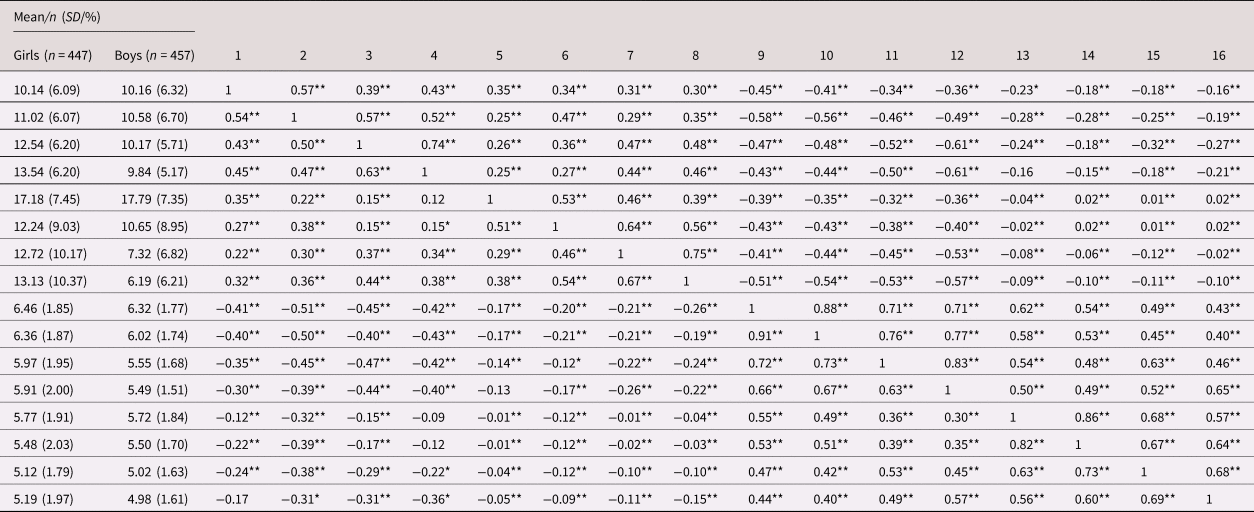
Estimated means, standard deviations, and correlations between all study variables are presented in Table 1. As can be seen, attachment security was negatively correlated with later depressive symptoms and disordered eating at all time points, albeit more so for attachment to the mother than to the father.
Descriptive statistics and bivariate correlations in the study variables (N = 904)

Note. T1/T2/T3/T4 = Time 1/Time 2/Time 3/Time 4. Correlations for girls are represented in shadowed area and for boys are represented in white area.
*p < .05.
**p < .01.
Direct effects
Even though random effects DPM did fit the data fairly well, χ2 = 157.18, df = 38, p < .001, root mean square error of approximation (RMSEA) = .059, 90% Confidence Interval (CI): .050–.069, comparative fit index (CFI) = .977, Tucker–Lewis index (TLI) = .932, a fixed effect model did show a substantially better fit, χ2 = 20.79, df = 22, p = .53, RMSEA = .000, 90% CI: .000–.026, CFI = 1.000, TLI = 1.001, Δ χ2 = 220.62, df = 16, p < .001. However, a hybrid model where nonsignificant correlations were set to 0, did not produce any worse fit, χ2 = 30.55, df = 31, p = .49, RMSEA = .000, 90% CI: .000–.024, CFI = 1.000, TLI = 1.000, Δχ2 = 9.82, df = 9, p = .39) (Supplementary Figure 1). In this hybrid model, some effects regarding attachment to the father did emerge at some time points: more secure attachment at T1 predicted less depression at T2, β = −.08, p = .033, and depression at T1 and T2 predicted diminished attachment 2 years later, at T2, β = −.09, p < .001 and at T3, β = −.09, p = .031, and more disordered eating at T1 did, anomalously, predict more secure attachment at T2, β = −.06, p = .013. Acknowledging the small effects and most p values bordering on significance, we tested whether setting paths to and from attachment to the father to zero did alter the fit of the model compared to freeing these parameters. The results revealed that the model with zero-effects for the father did not prove to have a better fit, Δχ2 = 10.42, df = 6, p = .11. Hence, considering the number of paths involving attachment to the father (and given that we had no prior expectations), the above significant paths could equally well have been zero. In contrast, setting mother parameters to zero resulted in a considerably worse fit than allowing such parameters, Δχ2 = 73.00, df = 6, p < .001.
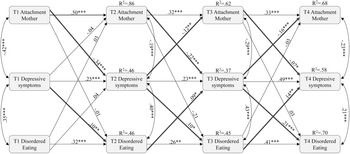
Acknowledging the lack of prediction from attachment to the father, further analyses were conducted with attachment to the mother only. A hybrid model of attachment to the mother where the following parameters were fixed to 0 –between the time-invariant depression factor and the two other time-invariant factors; disordered eating and attachment; and the correlation between the time-invariant depression factor and eating problems at age 10 – did not produce any worse fit than a fixed effects model, χ2 = 12.29, df = 15, p = .66, RMSEA = .000, 90% CI: .000–.026, CFI = 1.000, TLI = 1.003, Δ χ2 = 1.33, df = 3, p = .72, and for power and parsimonious reasons this model was retained (Figure 1). All autoregressive paths reached statistical significance. Cross-lagged paths indicated that higher insecure attachment to the mother predicted more depressive symptoms 2 years later, from T1 to T2 and from T2 to T3. More depressive symptoms at T1, T2, and T3 predicted more disordered eating at each subsequent time period (from T2 to T4). Moreover, more disordered eating at T2 and T3 predicted more depressive symptoms at T3 and T4. Finally, depressive symptoms had also a potentially detrimental effect on attachment security: more depressive symptoms at T2 and T3 predicted higher insecure attachment at T3 and T4, respectively.
Dual path model hybrid examining the association between depressive symptoms, disordered eating, and attachment to the mother among boys and girls. Standardized coefficients are depicted. Thick arrows = significant cross-lag paths. FULL SAMPLE. χ2 = 12.29, df = 15, p = .66, RMSEA = .000, 90%CI:.000–.026, CFI = 1.000, TLI = 1.003, Δ χ2 = 1.33, df = 3, p = .72. T1/T2/T3/T4 = Time 1/Time 2/Time 3/Time 4. *** p < .001, ** p < .01, * p < .05. RMSEA = root mean square error of approximation; CFI = comparative fit index; TLI = Tucker–Lewis index

Indirect effects
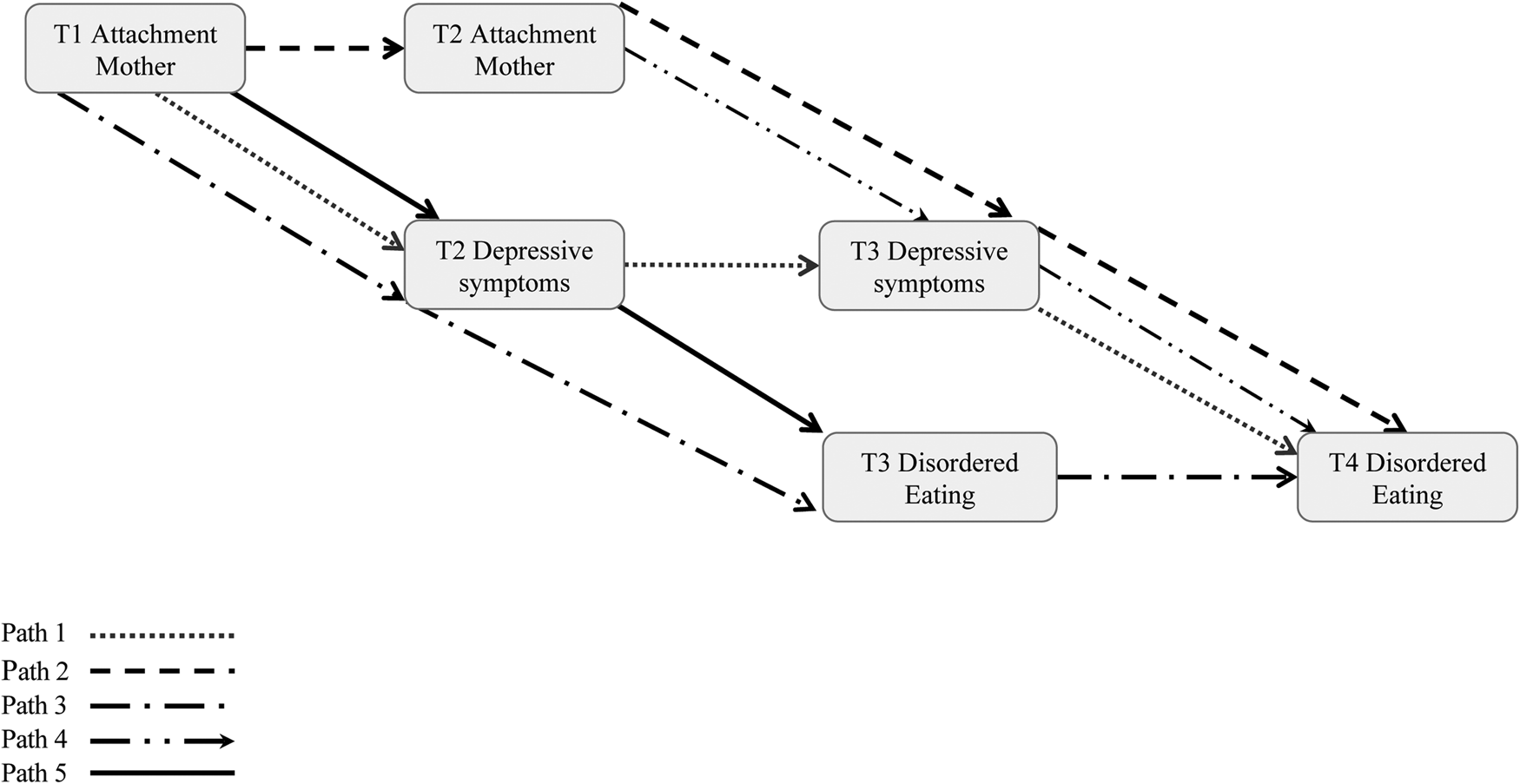
To investigate mediation, we adjusted for all relevant direct effects; for example, when examining the potential effect of insecure attachment at age 10 on eating problems at age 16 via depression at age 12 and/or 14, we adjusted for the direct effects of depressive symptoms and attachment at age 12 as well as the direct effect of age-10 attachment. The fit for the model adjusting for direct effects provided a good fit, χ2 = 8.12, df = 11, p = .70, RMSE = .000, 90% CI: .000–.027, CFI = 1.000, TLI = 1.003. The results are depicted in Figure 2; with each mediational path having its own illustrative pattern (e.g., solid, dashed, dashed-dotted, dotted, lines). Higher insecure attachment to the mother at age 10 predicted more disordered eating at age 16, via increased depressive symptoms at age 12, which in turn predicted continued increased depressive symptoms at age 14, predicting more symptoms of disordered eating at age 16, B = −.10, 95% CI:.01–.21 (Figure 2, path 1). This amounted to 8.2% of the effect of age-10 attachment on age-16 disordered eating. Moreover, insecure attachment at age 10 predicted disordered eating at age 16 via continued insecure attachment at age 12, and then more depressive symptoms at age 14, and in turn increased disordered eating at age 16, B = −.13, 95% CI:.03–.23 (Figure 2, path 2), adding 5% to the share of the explained association.
Mediation model adjusted for direct effects examining the association between depressive symptoms, disordered eating, and attachment to the mother among the whole sample. Standardized coefficients are depicted. χ2 = 8.12, df = 11, p = .70, RMSEA =.000, 90%CI:.000–.027, CFI = 1.000, TLI = 1.003. T1/T2/T3/T4 = Time 1/Time 2/Time 3/Time 4. RMSEA – root mean square error of approximation; CFI = comparative fit index; TLI = Tucker–Lewis index

Further on, there was an effect of insecure attachment at age 10 on increased depressive symptoms at age 12, thereafter disordered eating at age 14, and then on continued disordered eating at age 16, B = 15, 95% CI: 02–.31 (Figure 2, path 3); a 6.8% share of the association between attachment at age 10 and disordered eating at age 16. Insecure attachment at age 12 predicted increased depressive symptoms at age 14, which in turn predicted more disordered eating at age 16, B = −.26, 95% CI:.06–.41 (Figure 2, path 4); amounting to 30.0% of the total effect. The same effect was also seen 2 years earlier, from age 10 insecure attachment to depressive symptoms at age 12, and in turn, more disordered eating age 14, B = .34, 95% CI: 02–.60 (Figure 2, path 5); 21.9% of the total effect.
To be noted, the sum of all indirect effects fully mediated the effects of insecure attachment on later eating pathology, as there were no direct effects of insecure attachment at T1 on eating problems at T3, β = .11, p = .21 or insecure attachment on eating problems at T4, β = .04, p = .83. As indicated in Figure 1, there could be an effect from disordered eating at age 12 to reduced attachment to the mother at age 16 via increased depression at age 14. However, possibly due to the weakness of the disordered eating→depression link (β = .09, p = .05), the mediational effect turned out to be insignificant, B = −.02, 95% CI: −.05, .00, p = .23. No other reverse mediational effects – including from attachment or disordered eating to depression – were significant.
Child's gender-specific effects
Girls scored considerably higher than boys on depressive symptoms and disordered eating; a difference seemingly increasing with age (Table 1). To investigate whether the above indirect effects differed by gender, separate models for girls and boys were computed. Importantly, the differences in magnitude of the mediational effects were not different for the two genders (see Supplemental Table A2), as the 95% CI of the difference between them always included 0.
Discussion
The present study examined, for the first time, whether depressive symptoms serve as a mechanism by which insecure attachment to parents increases disordered eating from middle childhood to adolescence. By following up a large community sample of 10-year-olds with biennial assessments until the age of 16, and by adjusting for initial levels of depressive symptoms, disordered eating, attachment, and invariant-time factors, we found that insecure attachment to the mother at ages 10 and 12 years predicted disordered eating 4 years later via increased depressive symptoms. No effects involving attachment to the father were found. Moreover, our findings did not show any child's gender-specific or reverse (i.e. from depressive symptoms and disordered eating to insecure attachment) effects.
Depressive symptomatology as mediator between insecure attachment to the mother and disordered eating
First, as regards the attachment–depression link, insecurely attached children at age 10 might be more prone to develop depressive symptoms at ages 12 and 14, possibly due to the cognitive–affective representations rooted in early negative experiences with care providers (Brumariu & Kerns, Reference Brumariu and Kerns2010; DeKlyen & Greenberg, Reference DeKlyen, Greenberg, Cassidy and Shaver2016). Adolescents with early negative attachment experiences tend to focus selectively on disappointing aspects of a situation, which may further consolidate their negative self-concept over time (Morley & Moran, Reference Morley and Moran2011). In addition, with the increasing cognitive capacities of early adolescence, youngsters tend to become preoccupied with what others may think of them (Somerville, Reference Somerville2013). Holding a negative self-concept during this developmental period may thus negatively bias the perception of feedback from others more strongly than during earlier or later periods (Hankin et al., Reference Hankin, Kassel and Abela2005; Harter, Reference Harter, Damon and Lerner2006; Rudolph, Reference Rudolph, Nolen-Hoeksema and Hilt2009). Second, with respect to the depressive symptoms–disordered eating link, our results demonstrated that more depressive symptoms at ages 12 and 14, predicted more disordered eating at ages 14 and 16, respectively. These findings support the view that disordered eating may arise as a way to self-regulate or escape from negative emotions (Ferreiro et al., Reference Ferreiro, Wichstrøm, Seoane and Senra2014; Goossens, Braet, Bosmans, & Decaluwé, Reference Goossens, Braet, Bosmans and Decaluwé2011; Haedt-Matt & Keel, Reference Haedt-Matt and Keel2011).
Taken together, the aforementioned results suggest that children insecurely attached to the mother, who presumably perceive themselves negatively and without emotional support of their main attachment figure, may be extra vulnerable in the challenging transition from middle childhood to adolescence (e.g., body changes related to puberty mean they may find themselves moving farther from the Western ideal beauty [Ricciardelli, Reference Ricciardelli and Cash2012; Wertheim & Paxton, Reference Wertheim, Paxton and Cash2011], school transition [Evans, Borriello, & Field, Reference Evans, Borriello and Field2018], negative interpersonal interactions [Rudolph, Reference Rudolph, Nolen-Hoeksema and Hilt2009]), resulting in increased depressive symptoms and may find refuge in abnormal eating practices (Tasca, Reference Tasca2018). For instance, binge eating might reduce negative affect and allow for momentary relief from reality, yet, at the same time, perpetuating this maladaptive cycle through negative reinforcement (Faber et al., Reference Faber, Dubé and Knäuper2018). Similarly, as body image becomes crucial for adolescents’ self-esteem (Ricciardelli, Reference Ricciardelli and Cash2012; Wertheim & Paxton, Reference Wertheim, Paxton and Cash2011), boys and girls may engage in extreme dieting or in other harmful weight-control strategies (e.g., laxative use, excessive exercise) in an effort to achieve an ideal body shape and reduce unpleasant affect related to a negative image of themselves (e.g., Calzo et al., Reference Calzo, Masyn, Corliss, Scherer, Field and Austin2015; Johnson & Wardle, Reference Johnson and Wardle2005).
The present findings substantiate existing literature supporting the role of insecure attachment to the mother as a risk factor in the development of disordered eating (e.g., Cortés-García, Hoffmann et al. Reference Cortés-García, Hoffmann, Warschburger and Senra2019; Goossens et al., Reference Goossens, Braet, Van Durme, Decaluwé and Bosmans2012), yet expands it by indicating that depressive symptoms serve as one intermediate mechanism driving this relation.
Child's gender-specific effects
The present investigation demonstrates that depressive symptoms play a central role in transferring the effect of attachment insecurity to the mother on the development of disordered eating, regardless of child's gender. However, our results run counter to studies showing that these effects are stronger in adolescent girls than in boys for depressive symptoms (Allen et al., Reference Allen, Porter, McFarland, McElhaney and Marsh2007; Lewis et al., Reference Lewis, Kremer, Douglas, Toumborou, Hameed, Patton and Williams2015) as well as for disordered eating (Crespo et al., Reference Crespo, Kielpikowski, Jose and Pryor2010). Conceivably, this discrepancy may partly be because previous studies measured parent–child relationships (e.g., family connectedness, family conflict, lack of emotional closeness to parents) and not attachment quality per se. Moreover, these studies did not explicitly test a mediational model and did not adjust for time-invariant factors.
Nevertheless, the lack of gender-specific effects in our model possibly indicates the importance of attachment to the mother as safe haven in reducing the likelihood of depressive symptoms and disordered eating in girls and boys alike (e.g., Agerup et al., Reference Agerup, Lydersen, Wallander and Sund2015; Goossens et al., Reference Goossens, Braet, Van Durme, Decaluwé and Bosmans2012). Importantly, this result pinpoints that higher risk to develop disordered eating also pertains to boys (Sweeting et al., Reference Sweeting, Walker, MacLean, Patterson, Räisänen and Hunt2015), although their body image concerns and the magnitude of disordered eating are lower (as echoed in our results).
In sum, based on the current findings, insecurely attached boys and girls who hold negative cognitive–affective representations, may think and behave in a manner that fosters disordered eating via an increase in depressive symptoms. Overall, however, the effect sizes reported were small to moderate.
Strengths and limitations
We notice several strengths. First, the use of a multiwave longitudinal design with four measurement points in the transition from middle childhood to adolescence allowed for the examination of the direction of effects and for the prediction of changes in symptoms over time. Second, we included measures of attachment to both the mother and father, which made analyses of their relative importance possible. Third, the sample size made gender-specific analysis feasible. Lastly, the use of a strong analytic approach allowed for ruling out the impact of time-invariant confounding, reducing the risk of capitalizing on spurious relation between the variables.
Despite these assets, the present findings should be interpreted in light of some limitations. First, our sample consisted of Spanish children, predominantly Caucasian. Therefore, extrapolating our results to other countries and cultures should be performed with caution. Second, the study relied solely on self-reports from one source, and the implied common method bias may have inflated associations. However, as the rater did not change over time, any prospective inflation in predictions due to common methods would be adjusted for by the latent time invariant factors we included in our analyses. Third, as we examined attachment dimensionally, we were not able to distinguish specific associations between an organized insecure attachment style (i.e., anxious, avoidant, or even disorganized attachment) and disordered eating. Fourth, we only addressed potential additive effects of attachment to mothers and fathers, but not interactive ones (Dagan & Sagi-Schwartz, Reference Dagan and Sagi-Schwartz2018). Fifth, as with most longitudinal research, attrition occurred during the study (Gustavson, von Soest, Karevold, & Røysamb, Reference Gustavson, von Soest, Karevold and Røysamb2012). The higher dropout at T4 may be because by that time, following the Spanish education system, most adolescents had completed compulsory education and hence had left school. We also acknowledge that attrition at T4 among children whose parents had a higher level of education and children with more eating symptoms at T3, may have affected both the internal and external validity of the research. Although nonrandom attrition affecting the results cannot be ruled out, we applied a full information maximum likelihood procedure, which produces less biased estimates than complete case analysis (Enders & Bandalos, Reference Enders and Bandalos2001). Lastly, potentially relevant variables that may act as confounders (time varying factors such as unexpected life events) were not included and could impact the associations between the observed variables and produce spurious relations.
Implications for research and practice
Future studies should test our suggested mediational model in different populations, such as clinical samples, adults, and participants from diverse ethnic backgrounds. Prospective research should also examine whether the present findings hold for other attachment figures, such as peers since some research indicates that peers may have different effects on the development of depressive symptoms and disordered eating (Gorrese, Reference Gorrese2016; Le Grange et al., Reference Le Grange, O'Connor, Hughes, Macdonald, Little and Olsson2014). Also, future studies would benefit from inclusion of different measures such as clinical interviews and observational attachment measures. That said, a broad systematic review on different measurements of attachment specifically for children and adolescents (Jewell et al., Reference Jewell, Gardner, Susi, Watchorn, Coopey, Simic and Eisler2019), recommends the use of the IPPA (Armsden & Greenberg, Reference Armsden and Greenberg1987) and the Child Attachment Interview (CAI; Shmueli-Goetz, Target, Fonagy, & Datta, Reference Shmueli-Goetz, Target, Fonagy and Datta2008) as they have shown the best psychometric properties among observer-rated and self-report measures, respectively. Further studies could also examine effects of simultaneous attachment to both mothers and fathers on later depressive symptoms and disordered eating. In this regard, a number of attachment researchers have recently called for studies adopting a more integrative, ecologically valid approach assessing attachment patterns to both parents as a unit to better understand individual's development outcomes (Cowan & Cowan, Reference Cowan and Cowan2019; Dagan & Sagi-Schwartz, Reference Dagan and Sagi-Schwartz2018). Lastly, it should be ascertained whether different insecure attachment styles relates differently to disordered eating in adolescents. For instance, some studies have reported associations between avoidant insecure attachment and dietary restriction and between anxious insecure attachment and binge/purging behaviors (Behar, Reference Behar2012; Dias, Soares, Klein, Cunha, & Roisman, Reference Dias, Soares, Klein, Cunha and Roisman2011).
The current study highlights the significant influence that insecure attachment, especially to the mother, exerts on disordered eating via depressive symptoms in adolescence. It is noteworthy to consider the ethical challenges in interpreting direct connections between attachment and eating psychopathology as there is the great risk of “blaming” primary caregivers; instead, family members, particularly the mother, should be seen as a resource and part of the solution (Le Grange, Lock, Loeb, & Nicholls, Reference Le Grange, Lock, Loeb and Nicholls2010; Zachrisson & Skårderud, Reference Zachrisson and Skårderud2010). On a general level, a more detailed understanding of the specific family dynamics involved in the suggested process is needed for effective treatment and prevention. Family wise, prevention programs that enhance interpersonal functioning by promoting better communication, cohesion, and stability in mother–child relationships could be effective in reducing the risk of both depression (Jacka et al., Reference Jacka, Reavley, Jorm, Toumbourou, Lewis and Berk2013; Sander & McCarty, Reference Sander and McCarty2005) and disordered eating (Faber et al., Reference Faber, Dubé and Knäuper2018); attachment wise, interpersonal and attachment-based interventions should address maladaptive cognitions about self and others, which may be rooted in early mental representations that foster the development of negative self-views, emotion dysregulation, and difficult interpersonal functioning in children (Rieger et al., Reference Rieger, Van Buren, Bishop, Tanofsky-Kraff, Welch and Wilfley2010; Stark, Streusand, Arora, & Patel, Reference Stark, Streusand, Arora, Patel and Kendall2012), especially at a time of development when they are still modifiable (Bowlby, Reference Bowlby1973; Pinquart, Feussner, & Ahnert, Reference Pinquart, Feussner and Ahnert2013). This is especially important as such intervention may disrupt the mediational chain by which insecure attachment leads to disordered eating.
Conclusion
The results of this study provide evidence that, regardless of child's gender, an increase in depressive symptoms may be an essential mechanism by which insecure attachment to the mother increases adolescents’ vulnerability to disordered eating prospectively. As such, the promotion of secure attachment relationships, particularly with the mother, during the transition from middle childhood to adolescence in both genders, in conjunction with other intrapersonal and environmental factors, might protect youths against depressive symptoms and the subsequent development of eating problems.
Supplementary Material
The supplementary material for this article can be found at https://doi.org/10.1017/S0954579420001029
Funding Statement
The authors acknowledge the financial support for this project from the Ministry of Science and Innovation (PSI2010-19793) of the Spanish Government.
Conflicts of Interest
None