INTRODUCTION
Egg physical properties deviating from normal values may trigger negative effects in chick embryo development and, consequently, result in declined hatchability. Extreme changes in some egg characteristics may even lead to embryo death during incubation. According to the experimental data obtained by Moiseyeva & Tolokonnikova (Reference Moiseyeva and Tolokonnikova1968) and Tsarenko & Kurova (Reference Tsarenko and Kurova1989), the significance of certain egg parameters measured prior to incubation in successful hatching could be listed in the following order: (a) egg weight, (b) shell properties, (c) egg shape determined as the maximum breadth-to-length ratio and (d) characteristics of egg contents.
There is a certain controversy in the literature as to the advantage of certain egg physical characteristics for incubation. In general, many researchers are in favour of the view that eggs of average weight for the species are usually better for hatching as found for chicken, turkey, duck and ostrich eggs (Rendel Reference Rendel1943; Brunson & Godfrey Reference Brunson and Godfrey1953; Morris et al. Reference Morris, Hessels and Bishop1968; Kumar & Shingari Reference Kumar and Shingari1969; Wilson Reference Wilson1991; Brah et al. Reference Brah, Chaudhary and Sandhu1999; Gonzalez et al. Reference Gonzalez, Satterlee, Moharer and Cadd1999), while the hatchability of heavier eggs was reported to be inferior. Nordskog & Hassan (Reference Nordskog and Hassan1971) found that a 10 g increase in egg weight above the optimum (about 50 g) lowered the hatchability by 10·7%, while a 10 g decrease lowered it by 3·9%. Zglobica & Wezyk (Reference Zglobica and Wezyk1995) reported a decrease of hatchability of the eggs from Isabrown laying hens when their weights exceeded 70 g. The results of incubating ostrich eggs showed a higher proportion of heavier eggs that did not hatch (Deeming Reference Deeming1995). On the other hand, McClung & Smith (Reference McClung and Smith1949), Wiley (Reference Wiley1950), Sergeyeva (Reference Sergeyeva1976a), McNaughton et al. (Reference McNaughton, Deaton, Reece and Haynes1978) and Wyatt et al. (Reference Wyatt, Weaver and Beane1985) showed that mortality was higher among chicks hatched from eggs of smaller weight.
By studying the relationship between egg interior characteristics and hatchability, several authors concluded that hatchability declined when the percentage of liquid content in the egg interior increased (Zlochevskaya Reference Zlochevskaya1962; Moiseyeva & Tolokonnikova Reference Moiseyeva and Tolokonnikova1966; Rolnik Reference Rolnik1968; Tsarenko Reference Tsarenko1969; Shatokhina Reference Shatokhina1975; Kurova Reference Kurova1986; Luykx Reference Luykx1994).
The following metrics of the egg are used to describe its size: weight, volume, surface area, and the maximum length and breadth. To measure them, Narushin (Reference Narushin1997a, Reference Narushinb, Reference Narushin2001a) proposed novel techniques and mathematical models. Importantly, these methods are simple, non-destructive and would be of great practical significance for the poultry industry (Narushin et al. Reference Narushin, Romanov and Bogatyr1998, Reference Narushin, Romanov and Bogatyr2002; Narushin & Romanov Reference Narushin and Romanov2001, Reference Narushin and Romanov2002). One more parameter, egg-specific gravity, has been utilized to characterize shell thickness indirectly (Tyler & Geak Reference Tyler and Geak1961; Frank et al. Reference Frank, Swanson and Burger1964; Sergeyeva Reference Sergeyeva1976b; Voisey & Hamilton Reference Voisey and Hamilton1976). According to Narushin (Reference Narushin2001b), such egg interior traits as weight, volume and density of the contents can be interpreted using three key egg measurements, namely its weight, volume and surface area. As suggested by Romanoff & Romanoff (Reference Romanoff and Romanoff1949) and Tsarenko (Reference Tsarenko1988), one could examine egg hatchability in association not only with egg weight but also with the ratio of egg weight to shell surface area. The latter decreases in larger eggs, which may impede gas exchange in embryos.
In spite of plentiful information related to hatchability and the economic consequence of this trait, Faridi et al. (Reference Faridi, Mottaghitalab, Rezaee and France2011) admitted that ‘no previous model to predict hatchability is available in the literature’. Given the lack of comprehensive and conclusive studies in this area, it would be important to test a variety of physical egg characteristics recorded prior to incubation that would be predictive of improved or declined hatchability. Also, to the best of our knowledge, previous hatchability studies have not discriminated between two main types of commercial eggs, i.e. white v. brown shell, which would be of practical interest as well.
The present study was undertaken to develop a more effective and non-destructive method of pre-incubation selection of chicken eggs and prediction of hatchability based on simple egg measurements and statistics. The specific goal was to explore the association between basic physical properties that can be evaluated before incubation in intact eggs and hatchability of the embryos in the most popular commercial breeder lines of laying hens that produce white eggs (White Leghorn (WL)) and brown ones (Rhode Island White (RIW) and Rhode Island Red (RIR)). For this purpose, the following egg characteristics were examined: egg weight, egg volume, shell surface area, egg-specific gravity, the maximum breadth-to-length ratio (also known as shape index) and ratio of egg weight to shell surface area. Their effect on hatchability was estimated by ranking the values within ‘mean’, ‘< mean’ and ‘> mean’ statistical categories as an innovative approach in this kind of research.
MATERIALS AND METHODS
Experimental design
The experimental protocol and animal care procedure were approved by the Scientific Council of the Poultry Research Institute (PRI), Ukrainian Academy of Agrarian Sciences (now State Poultry Research Station, National Academy of Agrarian Sciences of Ukraine). In all, 505 fertile eggs were selected randomly from the parent layer strains kept on the floor at the PRI Experimental Farm ‘Borky’. These included white egg layers (line 01, WL) and brown egg layers (68, RIW, and 70, RIR). At day 6 of incubation, executed using a standard regime, the eggs were ovoscoped (by candling) and the infertile ones were culled out. Hatchability of fertile eggs was recorded at hatching.
Physical measurements and statistics
Non-destructive physical measurements included egg weight, egg volume, shell surface area, egg-specific gravity, egg length, egg maximum breadth, shape index (or the maximum breadth-to-length ratio) and ratio of egg weight to shell surface area. Prior to incubation, egg weight was measured in 108, 242 and 155 eggs of the lines 01, 68 and 70, respectively, using an electronic balance. Egg length and maximum breadth were determined using a Vernier calliper. Longitudinal circumference of an egg was obtained by applying scotch tape with a millimetre-scale marking. As described by Narushin (Reference Narushin1997b, Reference Narushin2001b), egg volume and shell surface area were computed based on the values of egg length, maximum breadth and longitudinal circumference. Lastly, values for the ratio of egg weight to egg volume were produced to identify egg-specific gravity.
To ascertain the correlation between hatchability and physical egg characteristics, the eggs were ranked within the three statistical categories: ‘mean’, ‘< mean’ and ‘> mean’. Accordingly, the eggs were sorted into three sub-groups that had values: (1) within the mean ± standard deviation (σ); (2) < mean minus σ; and (3) > mean plus σ. Significance tests were conducted following Sokal & Rohlf (Reference Sokal and Rohlf1969).
RESULTS
During the course of incubation, an average of 7·7% of eggs in the three investigated lines combined were found to be infertile. Within the lines, 8·3% of infertile eggs were determined in the WL line 01, 9·5% in the RIW line 68 and 4·5% in the RIR line 70. The mean hatchability of fertile eggs in the three lines combined was 77·7%: specifically, hatchability of the WL eggs was 76·8% that of the RIW eggs 76·7% and that of the RIR eggs 79·7%.
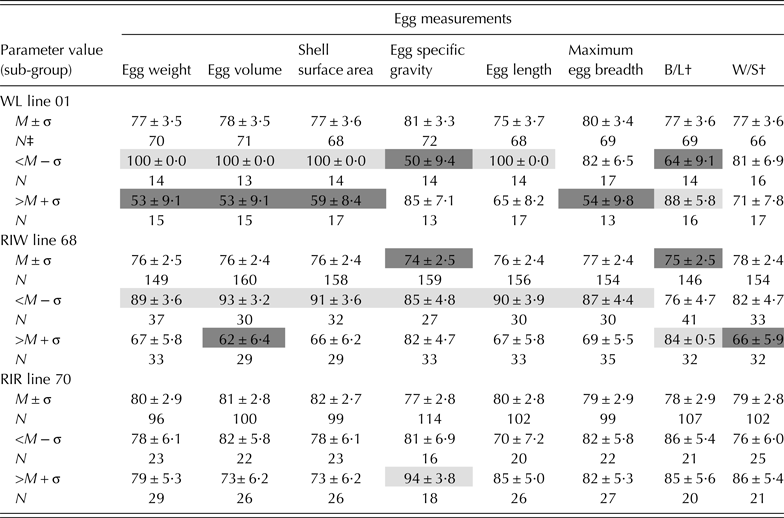
The hatchability values of fertile eggs in each sub-group relative to the physical parameters studied are presented in Table 1. There were no significant differences between the three sub-groups in RIR line 70 except for egg-specific gravity in the third sub-group, which was significantly greater (at 94·4%) than hatchability in the other two sub-groups (77·2 and 81·3%, respectively). In the WL and RIW lines, significant differences were identified between the three sub-groups relative to almost every parameter examined. In these two lines, the ‘bigger’ eggs, whose weight, volume, surface area, length and maximum breadth were in the third sub-group, showed the lowest hatchability: 53–56% in WL line 01 and 62–68% in RIW line 68. The maximum hatchability in these lines was identified in the ‘smaller’ eggs of the second sub-group.
Hatchability (%) * of the fertile eggs from three lines of White Leghorn (WL), Rhode Island White (RIW) and Rhode Island Red (RIR) laying hens subdivided into three subgroups depending on a parameter value of the mean (M) and standard deviation (σ)

* Mean ± standard error of the mean.
† B/L, shape index (maximum breadth to length ratio); W/S, ratio of egg weight to shell surface area. If means within a column for each line differ significantly (with P < 0·05 at least), then they are highlighted with light grey (greater hatchability) or dark grey (lower hatchability).
‡ Number of eggs in each sub-group.
The least hatchability (50%) was observed in the second sub-group of the WL eggs that had specific gravity < mean minus σ (Table 1). On the contrary, for the same physical characteristic, hatchability in the second sub-group of the RIW eggs (85·2%) was higher than that in the first (74·2%) and third (81·8%) sub-groups. In the RIR eggs ranked for specific gravity, hatchability was significantly greater in the third sub-group (94·4%).
The analysis of hatchability as influenced by shape index demonstrated that the more ‘round-shaped’ WL and RIW eggs from the third sub-group had greater hatchability (87·5 and 84·4%) than the ‘normal-shaped’ (76·8 and 75·3%) and ‘sharp-shaped’ eggs (64·3 and 75·6%) (Table 1).
The only significant difference in egg hatchability depending on egg weight to surface area ratio was found in RIW line 68, where the lowest hatchability (65·6%) was observed in RIW eggs of the third sub-group.
Overall, hatchability of smaller (in terms of all the various parameters) and more ‘round-shaped’ WL and RIW eggs seemed to be higher, while that of heavier RIW eggs with a relatively small surface area was lower. There were no other obvious differences in hatchability between the lines or between white and brown egg layers.
DISCUSSION
The current study provides further insight into the association between main egg physical properties measured prior to incubation and hatchability in laying hens. In the course of the experiment, no abnormal deviations were observed in egg fertility or hatchability. The proportion of infertile eggs, 0·045–0·095, was close to average hatchery statistics that are usually about 0·08–0·09 (Edgar Reference Edgar1973; Mauldin Reference Mauldin1985). The current results were also within the range of the egg hatchability requirements for Ukrainian hatcheries, set at a level of 70–80% (Anonymous 1994). Some of the results, e.g. for the influence of egg weight on hatchability of the hens’ eggs, were in accordance with those reported by Zglobica & Wezyk (Reference Zglobica and Wezyk1995); Ulmer-Franco et al. (Reference Ulmer-Franco, Fasenko and O'Dea Christopher2010); Wolc et al. (Reference Wolc, White, Hill and Olori2010) and Cavero et al. (Reference Cavero, Schmutz, Icken and Preisinger2011), while other findings of the present research were not in agreement with the data available elsewhere.
Kumar & Shingari (Reference Kumar and Shingari1969), Tsarenko (Reference Tsarenko1988) and Burtov et al. (Reference Burtov, Goldin and Krivopishin1990) reported that eggs of normal shape hatched more successfully than those with an abnormal shape. The data of Provizen & Lvova (Reference Provizen and Lvova1982) for WL eggs, Zglobica & Wezyk (Reference Zglobica and Wezyk1995) for Isabrown eggs and Harun et al. (Reference Harun, Veeneklaas, Visser and Van Kampen2001) for Muscovy duck eggs also reflected a general tendency towards lower hatchability of eggs with a shape outside the normal range. In addition, the above authors established that eggs with a more rounded shape hatched less successfully than those with a ‘sharper’ shape. Similar data were reported for incubation of quail eggs by Sharma & Vohra (Reference Sharma and Vohra1980) and Senapati et al. (Reference Senapati, Das, Mondal and Chatterjee1996), demonstrating a negative correlation between shape index and hatchability of fertile eggs.
The data on hatchability relative to egg shape reported in the current work were apparently inconsistent with those of the other researchers (Kumar & Shingari Reference Kumar and Shingari1969; Provizen & Lvova Reference Provizen and Lvova1982; Tsarenko Reference Tsarenko1988; Zglobica & Wezyk Reference Zglobica and Wezyk1995; Burtov et al. Reference Burtov, Goldin and Krivopishin1990; Cavero et al. Reference Cavero, Schmutz, Icken and Preisinger2011) who found that more rounded hens’ eggs had lower hatchability. However, the findings of the present study cannot be regarded as a large disparity because the shape index values estimated for the third sub-group (data not shown) varied from 0·76 to 0·80. Such a range is within the interval (0·7,…,0·8) that fits the hatchability requirements (Burtov et al. Reference Burtov, Goldin and Krivopishin1990). So, if the eggs whose shape indices are extremely high (> 0·8), are excluded, one could suggest that eggs with a more oval shape may be advantageous for the embryo. It is known that the avian embryo changes its axial orientation in the egg at later embryo development stages (Ragozina Reference Ragozina1961; Rolnik Reference Rolnik1968). Therefore, a more oval egg might have a certain advantage for rotation of the embryo inside the shell as compared with the other egg shapes within the shape index interval accepted for the incubation. Further experiments are desirable to investigate whether this hypothesis is true.
The current results for the relationship between hatchability and egg weight to surface area ratio observed in RIW line 68 were in agreement with Romanoff & Romanoff (Reference Romanoff and Romanoff1949) and Tsarenko (Reference Tsarenko1988) who suggested that embryos in heavier eggs with a relatively smaller shell surface area could experience problems with normal gas exchange.
Coleman & McDaniel (Reference Coleman and McDaniel1975), McDaniel et al. (Reference McDaniel, Brake and Eckman1981) and Wolc et al. (Reference Wolc, White, Hill and Olori2010) reported a highly significant increase in early embryonic mortality in eggs with lower specific gravity, which was taken as an indicator of shell thickness. Vladimirova & Sergeyeva (Reference Vladimirova and Sergeyeva1969), Kostova (Reference Kostova1974), Shatokhina (Reference Shatokhina1975) and Kurova (Reference Kurova1986) presented data indicating that eggs with extremely thick or thin shells had increased embryonic mortality when compared with those of average thickness. In contrast, an advantage of moderately thick-shelled eggs was shown in some other studies. For instance, Tsarenko (Reference Tsarenko1988) found that hatchability of thick-shelled eggs was 30% higher than that of thin-shelled ones, while Sergeyeva (Reference Sergeyeva1986) found that an increase of shell thickness at 1 µm increments in the range of 0·29–0·35 mm led to an increase in hatchability of about 2%. Sharlanov et al. (Reference Sharlanov, Bachev and Lalev1988), studying turkey eggs, found that when shell thickness increased from 0·44 to 0·5 mm, their hatchability increased from 67 to 85%. Koneva (Reference Koneva1968) found that the contribution of shell thickness of turkey eggs to their hatchability was around 40%. Examining goose eggs, Tsarenko et al. (Reference Tsarenko, Tsarenko and Belko1978) reported an increase in hatchability of 20% for the eggs with thicker shells. However, Andrews (Reference Andrews1972) observed an elevated hatchability of turkey eggs with thinner shells and similar tendencies were found by Gonzalez et al. (Reference Gonzalez, Satterlee, Moharer and Cadd1999) when exploring the incubation of ostrich eggs.
Using the non-destructive approach in the present study, egg-specific gravity was also considered as an indirect factor of shell thickness that could be related to hatchability. Judging from the present data for this egg parameter, its variable effect on embryo viability could depend on different genetic background of the lines studied. This suggestion is also applicable when the effects of other egg parameters are considered and may explain contradictions in the literature cited. No clear-cut effects could be demonstrated when comparing the data for eggs from white v. brown egg layers.
In conclusion, the results of the present study suggested that hatchability of the hens’ eggs is affected by their morphological properties, the most influential among them being egg size, specific gravity, shape index and weight to surface area ratio. Use of the non-destructive egg measurements and ranking of the egg parameters into sub-groups, with values of mean ± σ, < mean minus σ and > mean plus σ, can be useful in similar studies. The smaller WL and RIW eggs with < mean minus σ values of weight, volume, surface area, length and maximum breadth demonstrated a potentially greater hatchability as compared to the bigger eggs. In the more rounded WL and RIW eggs, with a shape index of 0·76–0·80, hatchability seemed to be greater. There was variation in egg-specific gravity as correlated to hatchability in the different laying hen lines. This was presumably because of different genetic backgrounds and this might have been a factor affecting the relationship between hatchability and other egg metrics. The RIW eggs with greater weight and relatively small surface area showed lower hatchability, which could be attributable to poorer gas exchange.
In terms of potential benefits of the findings, the most suitable physical measurement parameters as hatchability predictors could be egg volume, specific gravity and shape index, which may reflect proper microenvironment conditions within the egg for the developing chick embryo and its hatchability.