1. INTRODUCTION
Future Mars exploration missions will include sample return and manned Mars landings, which will require the Mars vehicle to have a pinpoint landing capability (Braun and Manning, Reference Braun and Manning2007; Levesque, Reference Levesque2006; Wells et al., Reference Wells, Lafleur, Verges, Manyapu, Christan, Lewis and Braun2006). Mars Entry, Descent and Landing (EDL) phases are considered to be the most critically significant stages that determine the success or failure of the mission. The Mars entry phase is the most dangerous and longest period of these three phases. The vehicle will experience a complex and diverse environment during Mars entry. The uncertainties in the atmosphere density, aerodynamic characteristics of the vehicle and state estimation errors at the entry point are a big challenge to Mars entry autonomous navigation (Levesque, Reference Levesque2006). Therefore, high precision adaptive autonomous navigation technology for future Mars pinpoint landing is essential (Braun and Manning, Reference Braun and Manning2007; Levesque, Reference Levesque2006; Striepe et al., Reference Striepe, Way, Dwyer and Balaram2006).
The conventional navigation approach during Mars entry is dead reckoning based on an Inertial Measurement Unit (IMU), of which the position and velocity (which are the significant indices) are obtained by integrating the angular velocity and acceleration from the IMU. However, dead reckoning lacks the capability of correcting the initial errors, and navigation errors will accumulate rapidly if the initial state of the vehicle is uncertain or the drifts of the gyro accelerometer are unknown. Thus this method cannot satisfy the accuracy requirement of future Mars pinpoint landing missions (Braun and Manning, Reference Braun and Manning2007; Levesque, Reference Levesque2006; Levesque and Lafontaine, Reference Levesque and Lafontaine2007). One possible solution is to take data from navigation sensors as the external measurements to correct the estimate. Nevertheless, several navigation sensors may fail to work properly due to the heat shield wrapped around the vehicle, thus IMU and radio beacons are the only two available sensors in the Mars entry phase. Zanetti and Bishop (Reference Zanetti and Bishop2007) considered the acceleration from an IMU as the external measurement. However, IMU navigation may not make all the state variables convergent, which restricts its application (Peng, Reference Peng2011). Radio beacon navigation has also been developed by researchers, but ionisation of the atmosphere due to the high speed of the vehicle would lead to radio blackout of the radiometric measurements for a period of time (Morabito, Reference Morabito2002; Levesque and Lafontaine, Reference Levesque and Lafontaine2007; Lightsey et al., Reference Lightsey, Mogensen, Burkhart, Ely and Duncan2008; Pastor et al., Reference Pastor, Gay, Striepe and Bishop2000; Wells et al., Reference Wells, Lafleur, Verges, Manyapu, Christan, Lewis and Braun2006). Recently, IMU/radio beacon integrated navigation has aroused considerable interest (Li and Peng, Reference Li and Peng2011; Peng, Reference Peng2011). Based on the communications between the entry vehicle and the orbiter or surface beacons as well as the IMU, the vehicle can navigate autonomously and gain a more accurate state estimate when compared with IMU navigation.
Kalman filtering techniques (Li and Peng, Reference Li and Peng2011; Pastor et al., Reference Pastor, Gay, Striepe and Bishop2000; Wan and Merwe, Reference Wan and Merwe2000; Julier and Uhlman, Reference Julier and Uhlman2004) have been widely used in real time state estimation of entry vehicles, and require an accurate model of the process dynamics and observation. Therefore, the uncertainties that lie in the atmospheric density and aerodynamic coefficients may degrade its performance. To achieve high navigation accuracy during Mars entry, several navigation filters that involve the parameter uncertainties have been proposed. Levesque and Lafontaine (Reference Levesque and Lafontaine2007) adopted the Extended Kalman Filter (EKF) to estimate the position, velocity, aerodynamic coefficients of the entry vehicle and atmosphere density. Peng (Reference Peng2011) presented an Unscented Kalman Filter (UKF)-based IMU/radio beacon integrated navigation for state and parameter estimation during Mars entry. They estimated the parameters by augmenting the percent deviations of lift-to-drag ratio and the product of ballistic coefficient and atmosphere density as the state vector. However, these algorithms cannot achieve a high navigation accuracy when large parameter uncertainties are taken into consideration. Heyne and Bishop (Reference Heyne and Bishop2006) and Heyne (Reference Heyne2007) proposed the adaptive sigma point Kalman filter bank to achieve a better performance and reduce the adverse effects of the atmosphere density uncertainties. Zanetti and Bishop (Reference Zanetti and Bishop2007) investigated the application of a multiple model adaptive estimation of navigation for the Mars entry phase. In their research, the high atmosphere density uncertainties were addressed with multiple dynamic models comprising an EKF bank, but the work was restricted to the multiple model estimation of the atmosphere density in addition to position and attitude. Subsequently Marschke et al. (Reference Marschke, Crassidis and Lam2008) extended the previous work of Zanetti and Bishop (Reference Zanetti and Bishop2007) with consideration of the sensor biases and scale factors. However, there was excessive competition between the various sub-models in the multiple model adaptive estimation algorithm, thus there may be large estimation errors when one model is closer to reality than the others. To overcome the drawbacks, a modified multiple adaptive estimation methodology with exponential decay terms was proposed (Li et al., Reference Li, Jiang and Liu2014a). This navigation algorithms can effectively reduce the adverse impact of parameter uncertainties and initial state errors. However, the computational cost of multiple model adaptive estimation algorithm increases with the number of models. Li et al. (Reference Li, Jiang and Liu2014b) developed a high-precision integrated navigation algorithm based on a Desensitised EKF (DEKF) (Karlgaard and Shen, Reference Karlgaard and Shen2013) under large atmosphere density uncertainties for Mars entry navigation. Subsequently Wang and Xia (Reference Wang and Xia2015) adopted the DEKF when the uncertainties that lie in the lift-to-drag ratio; ballistic coefficient and atmosphere density were considered in the Mars entry model. The DEKF had similar iterative steps to a standard EKF, but differed in the derivation of the gain matrix. The gain matrix of the EKF was obtained by minimising the trace of the posterior variance matrix, while the DEKF was derived by minimising the cost function that contained the trace of the posterior variance matrix and the weighted norm of the posterior state estimation error sensitivities. A weight matrix was necessary for the DEKF, but the algorithm of the determination of the matrix has not been proposed. The DEKF may have a poor performance when an inappropriate weight matrix is selected.
The Extended Recursive Three-Step Filter (ERTSF) proposed by Hsieh (Reference Hsieh2009) is an optimal filter to estimate the state of linear discrete systems with arbitrary unknown inputs. In this filter, the parameter matrices were determined to satisfy some algebraic constraints according to the unbiasedness condition and obtained by minimising the error covariance matrices. The filter was derived based on the assumption that no prior knowledge about the dynamic evolution of the unknown inputs was available. Hsieh and Liaw (Reference Hsieh and Liaw2011) and Hsieh (Reference Hsieh2012) extended the ERTSF for nonlinear systems by applying an EKF-like nonlinear version. However, this nonlinear version of ERTSF may encounter difficulties in actual applications because it may be difficult or impossible to compute all the Jacobians and Hessians of complex nonlinear equations. Based on the Unscented Kalman Filter (UKF), a general Derivative-free Nonlinear version of NERTSF (DNERTSF) was proposed to avoid the calculations of the model partial derivatives (Hsieh, Reference Hsieh2012).
The dynamic model and measurement output with parameter uncertainties during Mars entry are considered in this paper. Parameter uncertainties may lead to divergence of the conventional filters. A DNERTSF, which can provide accurate state and input estimates for systems with arbitrary unknown inputs, is adopted to reduce the adverse effect of the parameter uncertainties during Mars entry and for state and parameter estimation. The paper is organised as follows. Section 2 demonstrates the traditional simplified Three Degrees of Freedom (3-DOF) Mars entry dynamic model and IMU/radio beacon integrated navigation. Section 3 introduces the DNERTSF. Section 4 gives a numerical simulation and a comparison of the performance between the standard UKF and DNERTSF. Finally, we conclude in Section 5.
2. MARS ENTRY DYNAMIC MODEL AND NAVIGATION SCHEME
2.1. Mars entry dynamic model
The Mars entry phase is defined as the period from when the vehicle enters the Mars atmosphere interface (defined as a radius of 3,552 km from the centre of Mars, and an altitude of 125 km over the surface) to parachute deployment. During the Mars entry process, the entry vehicle will experience a complex and diverse environment. The dynamic model describes the state variables of the entry vehicle, which is required for state prediction. The traditional simplified 3-DOF dynamic model of Mars atmospheric entry is built based on the assumption that the vehicle is regarded as a particle subjected to gravity and aerodynamic forces during the Mars entry phase with the Mars rotation and winds being neglected. Thus, the dynamic model defined with respect to the Mars-centred, Mars-fixed coordinate system (Levesque, Reference Levesque2006) is given by:
 $$\eqalign{&{\dot r} = v \sin \gamma \cr & {\dot \theta } = \displaystyle{{v \cos \gamma \sin \psi} \over {r \cos \lambda}} \cr & {\dot \lambda} = \displaystyle{{v \cos \gamma \cos \psi}\over{r}} \cr & \dot {v} = -D-g(r)\sin \gamma \cr & \dot {\gamma} = \left({\displaystyle{{v}\over{r}}-\displaystyle{{g(r)}\over{v}}}\right) \cos \gamma +\displaystyle{{L}\over{v}}\cos \phi \cr & \dot {\psi } = \displaystyle{{v}\over{r}}\sin \psi \cos \gamma \tan \lambda +\displaystyle{{L}\over{v\cos \gamma}}\sin \phi}$$
where r denotes the distance from the centre of Mars to the centre of mass of the entry vehicle, θ and λ denote the longitude and the latitude, respectively, v is the velocity of the entry vehicle, γ is the flight-path-angle (FPA), ψ is the azimuth angle defined as a clockwise rotation angle starting at due north and ϕ is the bank angle defined as the angle about the velocity vector from the local vertical plane to the lift vector, which is considered as the only control variable. To be convenient for simulation, an inverse square gravitational acceleration is used in the model of Mars entry dynamics
 $$g(r) = \displaystyle{{\mu}\over{r^2}},\quad \mu =42828.29 \times 10^9\,\hbox{m}^3/{\hbox{s}^2}$$
where μ=GM Mars is the Mars gravitational constant. D and L are the aerodynamic drag and lift accelerations, which are defined by:
 $$D=\displaystyle{P{1}\over{2}} \rho v^2\displaystyle{{C_D S}\over{m}} \quad \quad L = \displaystyle{{1}\over{2}} \rho v^2\displaystyle{{C_L S}\over{m}}$$
where CD and CL are the aerodynamic drag and lift coefficients, respectively, which are the functions referring to the angle of attack, the sideslip angle and the Math number, S is the reference surface area, m is the mass of the entry vehicle, L=L/D·D, L/D is the lift-to-drag ratio, B=C D S/m is called the ballistic coefficient,  $\displaystyle{{1}\over{2}}\rho v^{2}$ denotes the dynamic pressure and ρ is the Mars atmospheric density. A simplified exponential Mars atmospheric density model is assumed as:
 $$\rho =\rho_0 \exp \left\{{\displaystyle{{(r_0 -r)}\over{h_s }}}\right\}$$
where ρ0 is the reference density, r 0=3,437·2 km is the reference radius of Mars and h s=7·5 km is the constant atmospheric scale height.
Since the true Mars atmosphere density varies with the seasons and temperature, an accurate Mars atmospheric density is still difficult to determine. Equation (4) is only an approximation of the true atmosphere density. The deviation in this model is believed to follow a normal distribution (Li et al., 2014). Moreover, the uncertainties in the aerodynamic coefficients are also a significant source of Mars entry dispersion. Braun et al. (Reference Braun, Powell, Engelund, Gnoffo, Weilmuenster and Mitcheltree2012) analysed the source of uncertainties that affect the Mars Pathfinder flight model. They illustrated that the lack of knowledge of atmosphere density and the computational uncertainties of the aerodynamics analysis were the source of error; also the uncertainties of the aerodynamic drag coefficient and the atmosphere density were time-varying. Striepe et al. (Reference Striepe, Way, Dwyer and Balaram2006) showed that the parameter variations may follow Gaussian and uniform distribution. In the work of Wang and Xia (Reference Wang and Xia2015), it was assumed that the actual values of the three uncertain parameters were subjected to uniform distribution. When the uncertainties in Mars atmosphere density, ballistic coefficient and lift-to-drag ratio are considered, a navigation filter for reducing the adverse effect of the parameter uncertainties is essential.
2.2. Navigation scheme
As mentioned above, due to the existence of the heat shield, several navigation sensors cannot be used during the Mars entry, only the IMU and radiometric measurement are available, but the accuracy of the IMU and radiometric measurement navigation need to be improved. This paper adopts IMU/radio beacon integrated navigation as the navigation scheme. The IMU has the capacity of measuring the accelerator and rotational angular velocity in real time and gaining the state variables of the target without any additional information, which is the key device to implement autonomous navigation. Communication between the vehicle and the radio beacons can provide some important navigation information for the vehicle. Furthermore, research shows that integrated navigation is completely observable when there are not less than three radio beacons (Wang and Xia, Reference Wang and Xia2015). The measurement equations of the vehicle are given by (Li and Peng, Reference Li and Peng2011)
 $${\bi z}_k = \left[\matrix{{{\bi a}^m} \cr {\bi R}}\right]+{\bi v}_k$$
where vk is the zero-mean, white noise with the covariance Rk, am is the output vector of accelerometer in the Mars-centred, Mars-fixed coordinate system and R is the radial range between the entry vehicle and the orbiters or the surface beacons.
2.2.1. IMU outputs
An IMU consists of an accelerometer that is used for measuring the non-gravitational linear acceleration along three orthogonal axes and a gyroscope for the rotation angular velocity measurement. The IMU coordinate system is assumed to coincide with the body-fixed coordinate system, thus the acceleration measurement in the body-fixed coordinate system can be given by an accelerometer as follows
 $${\tilde{\bi a}}^{b}=\lpar {{\bi I}+{\bi \Gamma}_a}\rpar \lpar {{\bi I}+{\bi S}_a}\rpar \left( {{\bi a}^b +{\bi b}_a +{\bi \xi}_a}\right) $$
 $${\bi \Gamma}_a@\left[{\matrix{ 0 & {\gamma_{xz}} & { - \gamma_{xy}} \cr { - \gamma_{yz}} & 0 & {\gamma_{yx}} \cr {\gamma_{zy}} & { - \gamma_{zx}} & 0 \cr } } \right],\quad {\bi S}_a@\left[ {\matrix{ {S_x} & 0 & 0 \cr 0 & {S_y} & 0 \cr 0 & 0 & {S_z} \cr } }\right]$$
where Γa is the misalignment/non-orthogonal error matrix, γxz, γxy, γyz, γyx, γzy, γzx are the non-orthogonal and axes misalignment errors, Sa is the scale factor error matrix of the accelerometer, S x, S y, S z are the scale factor errors, ab denotes the true acceleration along the body-fixed coordinate system, ba is the unknown acceleration bias and ξa is the accelerator stochastic noise, which is modelled as zero-mean, Gaussian-distributed white noise. When the error matrices are small, the acceleration can be formulated as:
 $${\tilde{\bi a}}^{b} ={\bi a}^b +\lpar {{\bi \Gamma}_a +{\bi S}_a + {\bi \Gamma}_a {\bi S}_a}\rpar {\bi a}^b +\lpar {{\bi I}+{\bi \Gamma}_a}\rpar \lpar {{\bi I}+{\bi S}_a}\rpar {\bi b}_a +\lpar {{\bi I}+{\bi \Gamma}_a}\rpar \lpar {{\bi I}+{\bi S}_a}\rpar {\bi \xi}_a$$
where  ${\bi a}^{b}={\bi T}_{v}^{b} {\bi a}^{v}$,
 ${\bi a}^{v}=\left[\matrix{ {-D,} & {-D\cdot L / D\cdot \sin \phi}, & {D \cdot L/D \cdot \cos \phi}}\right]^{\rm T}$ is the measurement acceleration vector in the velocity coordinate system.
 ${\bi T}_{v}^{b}$ is the coordinate transition matrix for the velocity coordinate system to the body-fixed coordinate system.
To be unified with the dynamic model, it is essential for the measurement vector to transfer from the velocity coordinate system to the Mars-centred, Mars-fixed coordinate system:
 $${\bi a}^m = {\bi T}_p^m {\bi T}_v^p {\bi a}^v$$
where am is the output vector of the accelerometer in the Mars-centred, Mars-fixed coordinate system,  ${\bi T}_{p}^{m}$ is the coordinate transition matrix for the navigation coordinate system to the Mars-centred, Mars-fixed coordinate system, and
 ${\bi T}_{v}^{p}$ is the transition matrix for the velocity coordinate system to the navigation coordinate system, and are given by
 $$\eqalign{ & \, {\bi T}_p^m =\left[{\matrix{{\cos \lambda \cos \theta} & {-\sin \theta} & {-\sin \lambda \cos \theta} \cr {\cos \lambda \sin \theta } & {\cos \theta } & {-\sin \lambda \sin \theta} \cr {\sin \lambda } & 0 & {\cos \lambda}}}\right] \cr &{\bi T}_v^p =\left[{\matrix{{\cos \gamma } & {\sin \gamma} & 0 \cr {-}\sin \gamma \cos \psi & {\cos \gamma \cos \psi } &{-\sin \psi} \cr {-\sin \gamma \sin \psi} & {\cos \gamma \sin \psi } & {\cos \psi } \cr}}\right]}$$
2.2.2. Radio ranging measurement
The vehicle communicates with orbiters or surface beacons via Ultra-High Frequency (UHF) radio. By analysing the range signals, the radial range between the entry vehicle and orbiters or surface beacons can be modelled as follows
 $${\tilde{\bi R}}={\bi R} + {\bi \xi}_R$$
where ξR is zero-mean, Gaussian-distributed white noise.
 $${\bi R} = \sqrt{({\bi r}_l - {\bi r}_b)^{\rm T}({\bi r}_l - {\bi r}_b)}$$
 $$r_l =\left[ \matrix{ r\cos \lambda \cos \theta \cr r\cos \lambda \sin \theta \cr r\sin \lambda } \right]$$
rl denotes the position vector of the entry vehicle, rb denotes the position vector of the orbiter or the surface beacon and both the vectors mentioned above are defined in the Mars centred, Mars-fixed coordinate system.
3. DERIVATIVE-FREE NONLINEAR VERSION OF EXTENDED RECURSIVE THREE-STEP FILTER (DNERTSF)
According to the nonlinear Mars entry dynamical model and measurement equations with parameter uncertainties, the nonlinear systems can be written in the following general form as
 $${\bi x}_{k+1} = {\bi f}_{k} ({\bi x}_k ,{\bi u}_k ,{\bi b}_k)+{\bi w}_k$$
 $${\bi y}_{k} = {\bi h}_{k} ({\bi x}_k ,{\bi u}_k ,{\bi b}_k)+{\bi v}_k$$
where f(·) and h(·) are nonlinear state transformation and nonlinear measurement functions, respectively.  ${\bi x}_{k + 1} \in {\Re}^n$ denotes the state vector,
 ${\bi y}_k \in {\Re}^m$ denotes the observation vector and
 ${\bi b}_k \in {\Re}^p$ is the uncertain parameter vector. The process noise wk and the measurement noise vk are zero-mean white random noises with known covariance matrices, assumed to be mutually uncorrelated. The noise covariance matrices satisfy the following formula
 $$E\left[{\bi w}_k{\bi w}_j^T \right] = {\bi Q}_k\delta_{k,j}, \quad E\left[{\bi v}_k{\bi v}_j^T \right] = {\bi R}_k\delta _{k,j}$$
where δk,j = 0, for k ≠ j; δk,j=1 for k = j. The initial state estimate  ${\hat{\bi x}}_{0}$ is the unbiased mean of the state
 ${\bi x}_{0} $ with covariance of P0, which is independent to the noises wk and vk.
In this method, the parameters should be estimated firstly by identifying the parameter uncertainties of which the matrices’ numerical approximation (Hsieh, Reference Hsieh2012) is given by
 $${\bi F}_k =\left[ {{\bi F}_k^1 \cdots {\bi F}_k^p}\right] ,{\bi F}_k^i = \displaystyle{{{\bi f}_{k} \left( {{\hat{\bi x}}_k ,{\bi u}_k ,{\hat{\bi b}}_k +\Delta_i \times {\bi e}_i^p }\right) -{\bi f}_{k} \left( {{\hat{\bi x}}_k ,{\bi u}_k ,{\hat{\bi b}}_k} \right) }\over{\Delta_i}}$$
 $${\bi G}_k =\lsqb {{\bi G}_k^1 \cdots {\bi G}_k^p } \rsqb ,{\bi G}_k^i =\displaystyle{{{\bi h}_k \left( {\hat{{\bi x}}_k^{-} ,{\bi u}_k ,\hat{{\bi b}}_{k-1} +\Delta_i \times {\bi e}_i^p } \right) -{\bi h}_k \left( {\hat{{\bi x}}_k^{-}, {\bi u}_k ,\hat{{\bi b}}_{k-1} } \right) }\over{\Delta_i}}$$
where Equations (17) and (18) are suitable partial derivative matrices, Δi,1 ≤ i ≤ p is a carefully chosen small value and  $e_{i}^{p}$ is the i-th column of the identity matrix
 $e^p \in {\Re}^p$. Then the nonlinear discrete-time system given by Equations (14) and (15) can be written as
 $${\bi x}_{k + 1} = {\bi f}_k^* \left( {\bi x}_k,{\bi u}_k,{\hat {\bi b}}_k \right) + {\bi F}_k{\bi b}_k + {\bi w}_k$$
 $${\bi y}_{k} = {\bi h}_k^* \left( {\bi x}_k,{\bi u}_k,{\hat {\bi b}}_{k-1} \right) + {\bi G}_k {\bi b}_k + {\bi v}_k$$
where  ${\bi f}_{k}^{\ast} \left( {{\bi x}_{k} ,{\bi u}_{k} ,\hat{{\bi b}}_{k} } \right) \approx {\bi f}_{k} \left( {{\bi x}_{k},{\bi u}_{k} ,\hat{{\bi b}}_{k} } \right) -\,{\bi F}_{k} \hat{{\bi b}}_{k} $, and
 ${\bi h}_{k}^{\ast} \left( {{\bi x}_{k} ,{\bi u}_{k} ,\hat{{\bi b}}_{k-1} } \right) \approx {\bi h}_{k} \left( {{\bi x}_{k} ,{\bi u}_{k} ,\hat{{\bi b}}_{k-1} } \right) - {\bi G}_{k} \hat{{\bi b}}_{k-1}$.
Under the general UKF framework, and by applying the ERTSF (Hsieh, Reference Hsieh2009; Hsieh, Reference Hsieh2012) to Equations (19) and (20), we can obtain the DNERTSF for Mars entry navigation as follows
Initialisation:
 $$\hat{{\bi x}}_0 =E({\bi x}_0), \quad {\bi P}_0 = E\lsqb {({\bi x}_0 -\hat{{\bi x}}_0 )({\bi x}_0 -\hat{{\bi x}}_0)^{\rm T}} \rsqb $$
Time update:
 $${\bi \chi}_{k-1,i} =\left[{{\hat{\bi x}}_{k-1} {\hat{\bi x}}_{k-1} - {\left({\sqrt{(n + \lambda){\bi P}_{k-1}}}\right)_i} {\hat{\bi x}}_{k-1} + {\left({\sqrt{(n +\lambda){\bi P}_{k-1}}}\right)_{i-n}}}\right]$$
 $${\bi {\chi}}_{k/k-1,{\rm i}}^\ast = \left\{{\matrix{{\bi f}_{k-1} \left( {{\chi}_{k-1,i}, {\bi u}_{k-1}, {\hat{\bi b}}_{k-1}}\right) \hfill& i=0,1,2,\cdots 2n,\quad k=1 \cr \hfill {\bi f}_{k-1}^\ast \left( {{\bi{\chi}}_{k-1,i},{\bi u}_{k-1},{\hat{\bi b}}_{k-1}}\right) +{\bi F}_{k-1} {\hat{\bi b}}_{k-1,i} & i=0,1,2,\cdots 2n,\quad k\ge 2}}\right.$$
 $${\hat{\bi x}}_k^{-} = \sum \limits_{i=0}^{2n} \omega_i^{(m)} {\bi \chi}_{k/{k-1},i}^{\ast}$$
 $${\bi P}_k^{-} =\mathop \sum \limits_{i=0}^{2n} \left\{ \omega_i^{\lpar c \rpar } \left[ {\chi}_{k / {k-1,i}}^\ast-\hat{\bi x}_k^{-} \right] \left[ {\chi}_{k/ {k-1,i}}^\ast -\hat{\bi x}_k^{-} \right]^{\rm T} \right\} +{\bi Q}_{k-1}$$
where χk -1,i is the i-th sampling point, n is the dimension of the state vector,  $\left({\sqrt {{\bi P}_{k-1}}} \right)_{i}$ denotes the i-th column of the matrix Pk−1 square root, λ = α2(n + κ)−n is a scaling parameter, α is a constant determining the spread of the sigma points around the mean value, which is usually set to a small positive value, κ is a constant secondary scaling parameter which is usually set to 0 or 3−n and the weights ωi (Wan and Merwe, Reference Wan and Merwe2000) are given by
 $$\eqalign{&{\omega}_0^{(m)} = \lambda/({n+\lambda}),{\omega}_0^{(c)} = \lambda/(n+\lambda)+(1-\alpha^2+\beta), \cr & \omega_i^{(m)} = \omega_i^{(c)} = \lambda/\{2(n+\lambda)\} \quad i=1,2,\cdots 2n}$$
where β is used to incorporate prior knowledge of the distribution of the mean value.
Input estimation and measurement update:
 $${\bi \chi}_{k/k-1,i} = \left[{{\hat{\bi x}}^{-}_k \quad {\hat{\bi x}}^{-}_k - {\left({\sqrt{(n + \lambda){\bi P}_k^{-}}}\right)_i} \quad {\hat{\bi x}}^{-}_k +{\left({\sqrt{(n + \lambda){\bi P}_k^{-}}}\right)}_{i-n}}\right]$$
 $${\bi y}_{k/k-1,i} = {\bi h}_k^{\ast} \lpar {{\bi \chi}_{k/k-1,i}}\rpar \quad i=0,1,\cdots ,2n$$
 $${\hat{\bi y}}_k^{-} = \sum \limits_{i=0}^{2n} \omega_i^{(m)} {\bi y}_{k/k-1,i}$$
 $${\bi P}_{\rm yy} = \sum \limits_{i=0}^{2n} \left\{ {\omega_i^{(c)} \left[ {{\bi y}_{k/k-1,i} - {\hat{\bi y}}^{-}_k }\right] \left[ {{\bi y}_{k/k-1,i} -{\hat{\bi y}}_k^{-}}\right]^{\rm T}} \right\} +{\bi R}_k$$
 $${\bi P}_{{\rm xy}} = \sum\limits_{i = 0}^{2n} {\left\{ {\omega_i^{(c)} \left[ {{\bi \chi}_{k/k - 1,i} - \hat {\bi x}_k^ - } \right] {\left[ {{\bi y}_{k/k - 1,i} - \hat {\bi y}_k^ - } \right] }^{\rm T}} \right\} }$$
 $${\bi {K}}_k ={\bi P}_{{\rm xy}} {\bi P}_{{\rm yy}}^{-1}$$
 $${\bi S}_k =\lsqb {\bi G}_k \quad {\bi {H}}_k {\bi F}_{k-1} \lpar {\bi I}-{\bi G}_{k-1}^+ {\bi G}_{k-1} \rpar \rsqb $$
 $${\bi \Gamma}_k =\lsqb {\bi {0}} \quad {\bi F}_{k-1} \lpar {\bi I}-{\bi G}_{k-1}^+ {\bi G}_{k-1} \rpar \rsqb $$
 $${\bi S}_k^\ast =\left( {{\bi S}_k^{\rm T} {\bi P}_{{\rm yy}}^{-1} {\bi S}_k } \right) ^+{\bi S}_k^{\rm T} {\bi P}_{{\rm yy}}^{-1}$$
 $${\bi {K}}_k^b =\lsqb {{\bi G}_{k-1}^+ {\bi G}_{k-1}} \quad {\bi {0} } \rsqb {\bi S}_k^\ast$$
 $$\hat{{\bi b}}_{k,i} = {\bi {K}}_k^b \lpar {{\bi y}_k -{\bi y}_{k/k-1,i} } \rpar $$
 $$\hat{{\bi b}}_k =\mathop \sum \limits_{i=0}^{2n} \omega _i^{\lpar m\rpar } \hat{{\bi b}}_{k-1,i}$$
 $${\bi {L}}_k ={\bi {K}}_k +\lpar {{\bi \Gamma}_k -{\bi {K}}_k {\bi S}_k } \rpar {\bi S}_k^\ast$$
 $$\hat{{\bi x}}_k =\hat{{\bi x}}_k^{-} +{\bi {L}}_k \lpar {{\bi y}_k -\hat{{\bi y}}^{-}_k } \rpar $$
 $${\bi P}_k ={\bi P}_k^{-} +{\bi {L}}_k {\bi P}_{{\rm yy}} {\bi {L}}_k^{\rm T} -{\bi {L}}_k {\bi P}_{{\rm xy}}^{\rm T} -{\bi P}_{{\rm xy}} {\bi {L}}_k^{\rm T}$$
where Hk is the Jacobian of  ${\bi h}_{k}^{\ast} \left( {{\bi x}_{k} ,{\bi u}_{k} ,\hat{{\bi b}}_{k-1} } \right) ,{\bi {H}}_{k} =\left. {{\partial {\bi h}_{k}^{\ast} \left( {{\bi x}_{k}, {\bi u}_{k}, \hat{{\bi b}}_{k-1} } \right) \over \partial {\bi x}_{k} }} \right|_{{\bi x}_{k} =\hat{{\bi x}}_{k}^{-}} = {\bi P}_{{\rm xy}}^{\rm T} \left( {{\bi P}_{k}^{-}} \right) ^{-1}.$
First, the state estimate  $\hat{{\bi x}}_{k-1} $ and parameters estimate
 $\hat{{\bi b}}_{k-1} $ are assumed to be unbiased, thus the propagated estimate
 $\hat{{\bi x}}_{k}^{-}$ is unbiased as shown in Equation (42). The errors in the propagated state estimate, state estimate and parameter estimate can be written as
 $$\tilde{{\bi x}}_k^{-} ={\bi x}_k -\hat{{\bi x}}_k^{-} ={\bi f}_{\,k-1} \left( {{\bi x}_k ,{\bi u}_k ,\hat{{\bi b}}_k } \right) -\mathop \sum \limits_{i=0}^{2n} \omega _i^{\left( m\right) } {\bi f}_{\,k-1} \left( {\bi {\chi}_{k-1,i} ,{\bi u}_{k-1} ,\hat{{\bi b}}_{k-1} } \right) +\,{\bi F}_{k-1} \tilde{{\bi b}}_{k-1} +{\bi w}_{k-1}$$
 $$\eqalign{ \tilde{{\bi b}}_k &={\bi b}_k -\hat{\bi b}_k ={\bi b}_k -{\bi K}_k^b \left( {\bi y}_k -{\bi y}_k^{-} \right) \cr &=\left( {\bi I}-{\bi K}_k^b {\bi G}_k \right) {\bi b}_k -{\bi K}_k^b \left[ {\bi h}_k^\ast \left( {\bi x}_k ,{\bi u}_k ,\hat{\bi b}_{k-1} \right) +{\bi v}_k -\mathop \sum \limits_{i=0}^{2n} \omega_i^{\left( m \right) } {\bi h}_k^\ast \left( {\chi}_{k/k-1,i}, {\bi u}_k, \hat{\bi b}_{k-1} \right) \right]}$$
 $$\eqalign{ \tilde{{\bi x}}_k &={\bi x}_k -\hat{{\bi x}}_k ={\bi x}_k -\hat{{\bi x}}_k^{-} -{\bi {L}}_k \left( {{\bi y}_k -{\bi y}_{k/k-1} } \right) \cr &=\tilde{{\bi x}}_k^{-} - {\bi {L}}_k \left[ {{\bi h}_k^\ast \left( {{\bi x}_k, {\bi u}_k, \hat{{\bi b}}_{k-1}} \right) -\mathop \sum \limits_{i=0}^{2n} \omega_i^{\left( m \right) } {\bi h}_k^\ast \left( {{\chi}_{k/k-1,i}, {\bi u}_k ,\hat{{\bi b}}_{k-1} } \right) +{\bi {v}}_k +{\bi G}_k {\bi b}_k } \right]}$$
By defining that  ${\bi \Pi}_{k} ={\bi {I}}-{\bi {K}}_{k}^{b} {\bi G}_{k}, {\bi \Xi}_{k} ={\bi {K}}_{k}^{b} {\bi {H}}_{k} {\bi F}_{k-1}$ and
 ${\bi Xi}_{i} {\bi \Pi}_{i-1} ={\bi {0}}$ hold for every k, and substituting the first-order Taylor approximation of Equations (42)–(44) into Equations (43) and (44), we can obtain
 $$\eqalign{ E \lsqb {\tilde{{\bi b}}_k } \rsqb &\approx {\bi \Pi}_k {\bi b}_k - \lpar {\bi \Xi}_k {\bi \Pi}_{k-1} \rpar {\bi b}_{k-1} + {\bi \Xi}_k \lpar {\bi \Xi}_{k-1} {\bi \Pi}_{k-2} \rpar {\bi b}_{k-2} \cr & + \cdots + \lpar {-1} \rpar ^k{\bi \Xi}_k \cdots {\bi \Xi}_2 \lpar {\bi \Xi}_1 {\bi \Pi}_0 \rpar {\bi b}_0 = {\bi \Pi}_k {\bi b}_k}$$
 $$E\lsqb {\tilde{{\bi x}}_k } \rsqb \approx \lpar {\bi I}-{\bi L}_k {\bi H}_k \rpar {\bi F}_{k-1} {\bi \Pi}_{k-1} {\bi b}_{k-1} -{\bi {L}}_k {\bi G}_k {\bi b}_k$$
In order to obtain the unbiased state estimate  $\hat{{\bi x}}_{k-1}$ and the parameter estimate
 $\hat{{\bi b}}_{k-1} $, the following constraint should be satisfied.
 $${\bi K}_k^b \lsqb {\bi G}_k \quad {\bi H}_k {\bi F}_{k-1} {\bi \Pi}_{k-1} \rsqb = \lsqb {\bi I}-{\bi \Pi}_k \quad {\bi 0} \rsqb $$
 $${\bi L}_k \lsqb {\bi G}_k \quad {\bi H}_k {\bi F}_{k-1} {\bi \Pi}_{k-1} \rsqb = \lsqb {\bi 0} \quad {\bi F}_{k-1} {\bi \Pi}_{k-1} \rsqb $$
Then, the estimation error covariance matrices are
 $${\bi P}_k^b = E\left[ \tilde{{\bi b}}_k \tilde{\bi b}_k^{\rm T} \right] = {\bi K}_k^b {\bi P}_{\rm yy} \lpar {\bi K}_k^b \rpar ^{\rm T}$$
 $${\bi P}_k = E \lsqb \tilde{{\bi x}}_k \tilde{\bi x}_k^{\rm T} \rsqb ={\bi P}_k^{-} + {\bi L}_k {\bi P}_{\rm yy} {\bi L}_k^{\rm T} -{\bi L}_k {\bi P}_{\rm xy}^{\rm T} -{\bi P}_{\rm xy} {\bi L}_k^{\rm T}$$
Finally, the gain matrix  ${\bi {K}}_{k}^{b} $ is determined by minimising the trace of estimation error covariance matrix Equation (49) under the constraint Equation (47), and
 ${\bi {L}}_{k} $ is obtained by minimising the trace of estimation error covariance matrix Equation (50) under the constraint Equation (48). Thus, they have the forms of
 $${\bi K}_k^b =\lsqb {\bi G}_{k-1}^+ {\bi G}_{k-1} \quad {\bi 0} \rsqb {\bi S}_k^\ast$$
 $${\bi L}_k ={\bi K}_k +\lpar {\bi \Gamma}_k -{\bi K}_k {\bi S}_k \rpar {\bi S}_k^\ast$$
where  ${\bi S}_{k} =\lsqb {\bi G}_{k} \quad {\bi H}_{k} {\bi F}_{k-1} \lpar {\bi I}-{\bi G}_{k-1}^+ {\bi G}_{k-1} \rpar \rsqb $,
 ${\bi S}_{k}^{\ast} =\left( {\bi S}_{k}^{\rm T} {\bi P}_{\rm yy}^{-1} {\bi S}_{k} \right) ^+{\bi S}_{k}^{\rm T} {\bi P}_{\rm yy}^{-1}$ and
 ${\bi K}_{k} ={\bi P}_{\rm xy} {\bi P}_{\rm yy}^{-1}$.
As shown in Equation (22), a set of carefully chosen sample sigma points are used to represent the state distribution such as in a UKF. These sigma points can completely capture the actual mean and covariance of the state, and when propagating through the nonlinear system, they can also capture the posterior mean and covariance accurately. This is one of the advantages for this method in achieving a more accurate navigation for Mars entry. Another advantage is that the distribution of parameter uncertainties is also represented by these sigma points, which avoids obtaining the uncertainties’ error covariance. Moreover, the Jacobian and Hessian computations are not needed any more, which solves the problem that a NERTSF may encounter in the state estimation of a complex nonlinear system.
4. NUMERICAL SIMULATION AND RESULTS
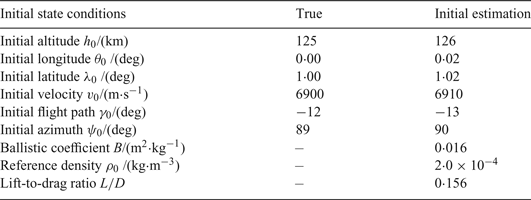
In this section, numerical simulation and analysis of Mars entry navigation using IMU/radio beacon integrated navigation are carried out to illustrate the advantages of the proposed algorithm based on DNERTSF. In the simulation, atmosphere density, ballistic coefficient and lift-to-drag ratio uncertainties are considered. The numerical simulation results are compared with that of UKF. The actual values of the atmosphere density, ballistic coefficient and lift-to-drag ratio come from the investigation of Li et al. (Reference Li, Jiang and Liu2014b) and Wang and Xia (Reference Wang and Xia2015) by assuming that they follow the normal distribution with a standard deviation of 10%. The state variables and nominal values of the parameters are given in Table 1. As mentioned above, three radio beacons are enough to ensure the observability of the system, thus we assume that three surface beacons are available during Mars entry in our simulation. The initial longitudes and latitudes of the surface beacons are given in Table 2. The planned entry span is assumed to be 400 s, which is equal to the period of the vehicle from the atmospheric surface at 125 km to 10km altitude, and the simulation sample step is set to 1 s. The scaling parameters for UKF and DNERTSF are chosen as α = 0.6, β = 2, κ = 3 – n.
Initial state variables and physical parameters of entry vehicle (Fu et al., Reference Fu, Yang, Xiao, Wu and Zhang2015; Levesque, Reference Levesque2006)

Longitudes and latitudes of surface beacons (Fu et al., Reference Fu, Yang, Xiao, Wu and Zhang2015; Levesque, Reference Levesque2006)

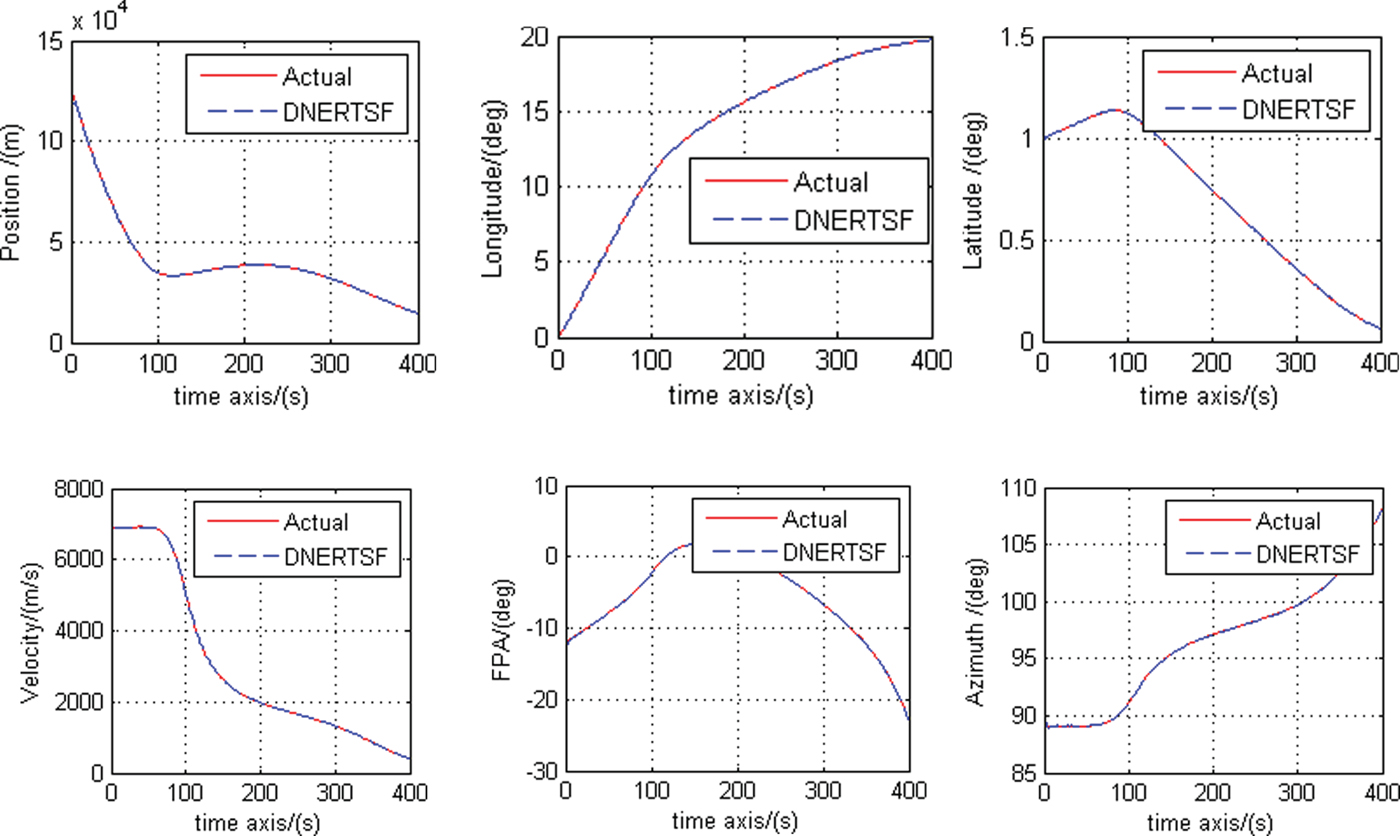
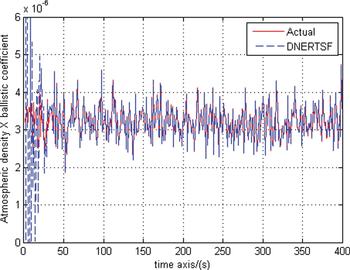
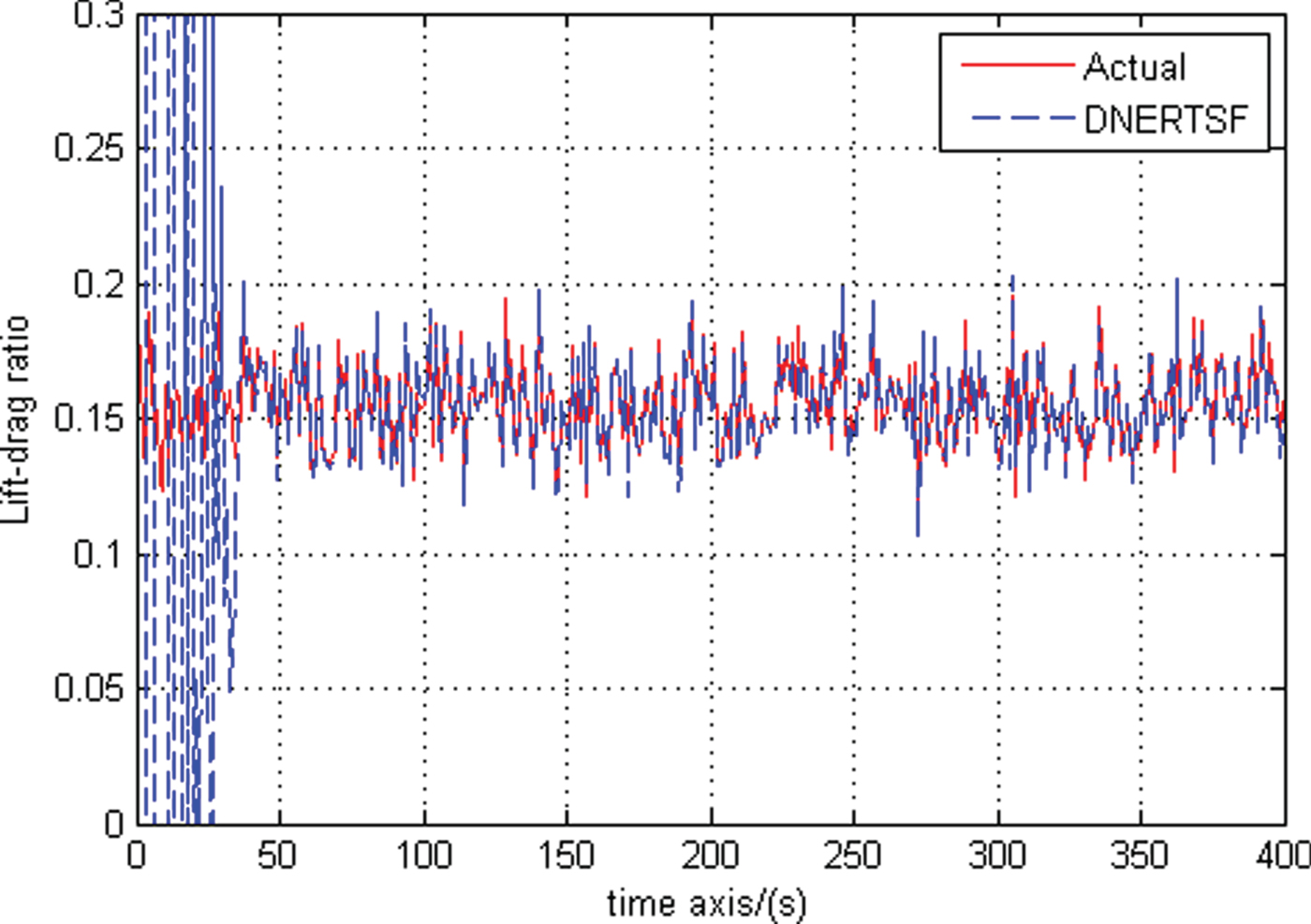
The actual and estimated state variables of the entry vehicle are plotted in Figure 1. The filter is proposed for estimating the state and the parameters of nonlinear stochastic discrete-time varying systems with parameter uncertainties simultaneously. The uncertainties in the atmosphere density, ballistic coefficient and lift-to-drag ratio are considered, while the actual and estimated parameters are shown in Figures 2 and 3. The state variables estimates shown in Figure 1 exhibit good performances as there are almost no differences from the actual values, and Figures 2 and 3 exhibit only a little deviation in the first few seconds, which may be the reason that the algorithm needs time to track the changes of the parameters. Also, the estimate of the product of atmosphere density and ballistic coefficient ρ×B in Figure 2 and the estimate of lift-to-drag ratio L/D in Figure 3 are very close to the actual values after the first 20 second adjustment. Thus, we can conclude that DNERTSF can estimate the state and the parameters accurately.
Actual and estimated state variables of vehicle during Mars entry.

Actual and estimated product of atmosphere density and ballistic coefficient ρ×B.

Actual and estimated lift-to-drag ratio L/D.

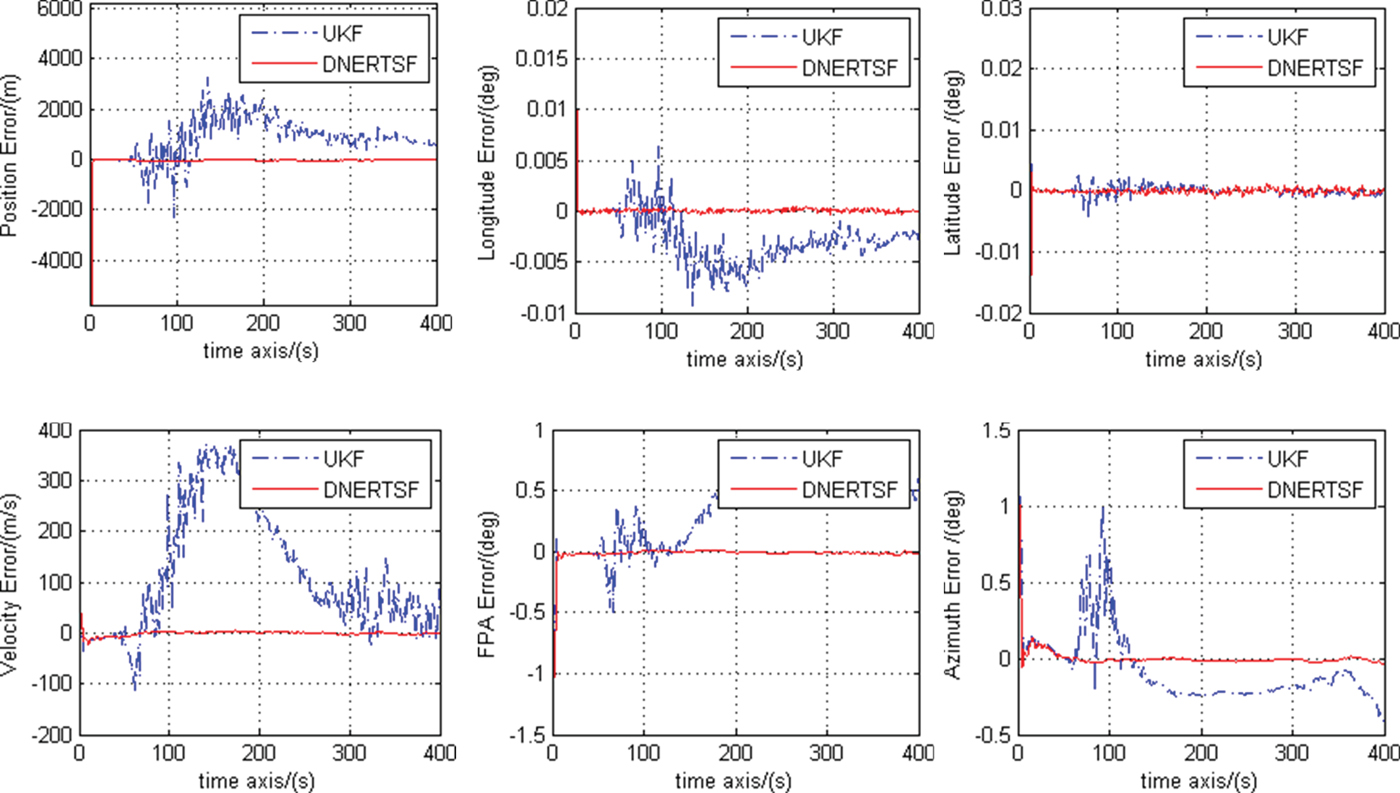
Figure 4 depicts the state variables estimated errors from UKF-based and DNERTSF-based IMU/radio beacon integrated navigation. As shown in Figure 4, the state variables estimated errors of DNERTSF-based IMU/radio beacon integrated navigation are much smaller than those of UKF-based integrated navigation. At the beginning of the simulation, the state estimates of UKF are close to the actual values. Since it lacks the capability of estimating parameters, the state estimates of UKF subsequently deviate sharply from the actual values, resulting in the divergence of the estimates. However, the performance of DNERTSF is better. In the first few seconds as shown in Figure 4, the estimate errors of some state variables are larger than those of UKF as it is adjusting. This phenomenon is consistent with the state estimates of DNERTSF deviating from the actual values over the first 20 seconds. When the high precision parameter and state estimates of DNERTSF are provided, the errors are limited to a very low magnitude until the end of the simulation.
State variables estimated errors from UKF and DNERTSF.

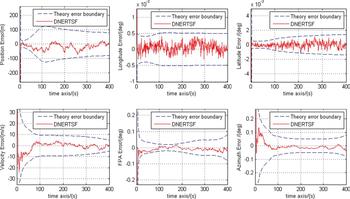
To further investigate the performance of DNERTSF, Figure 5 shows the state variables estimated errors of DNERTSF-based integrated navigation with their 3σ covariance bounds.
State variables estimated errors from DNERTSF.

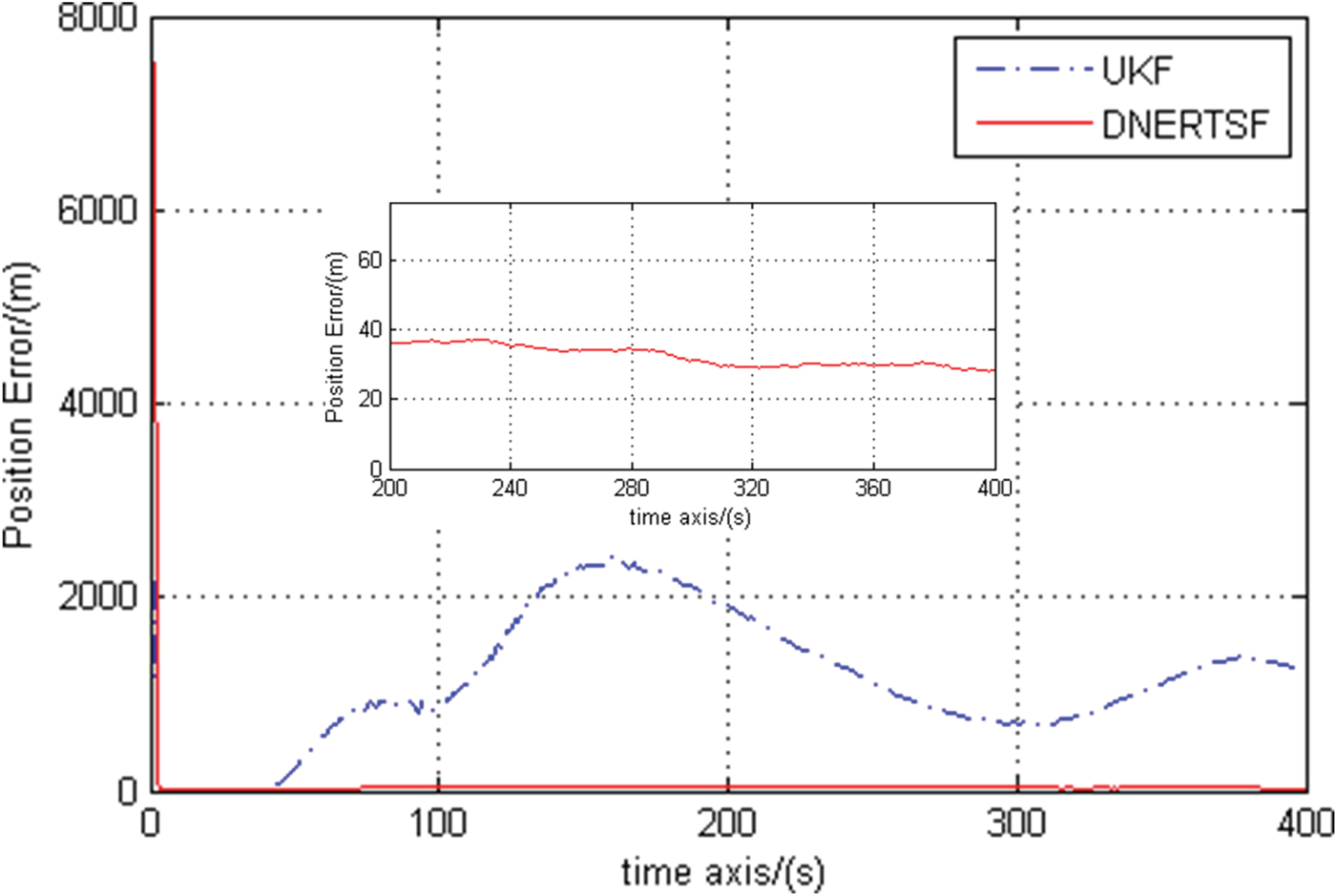
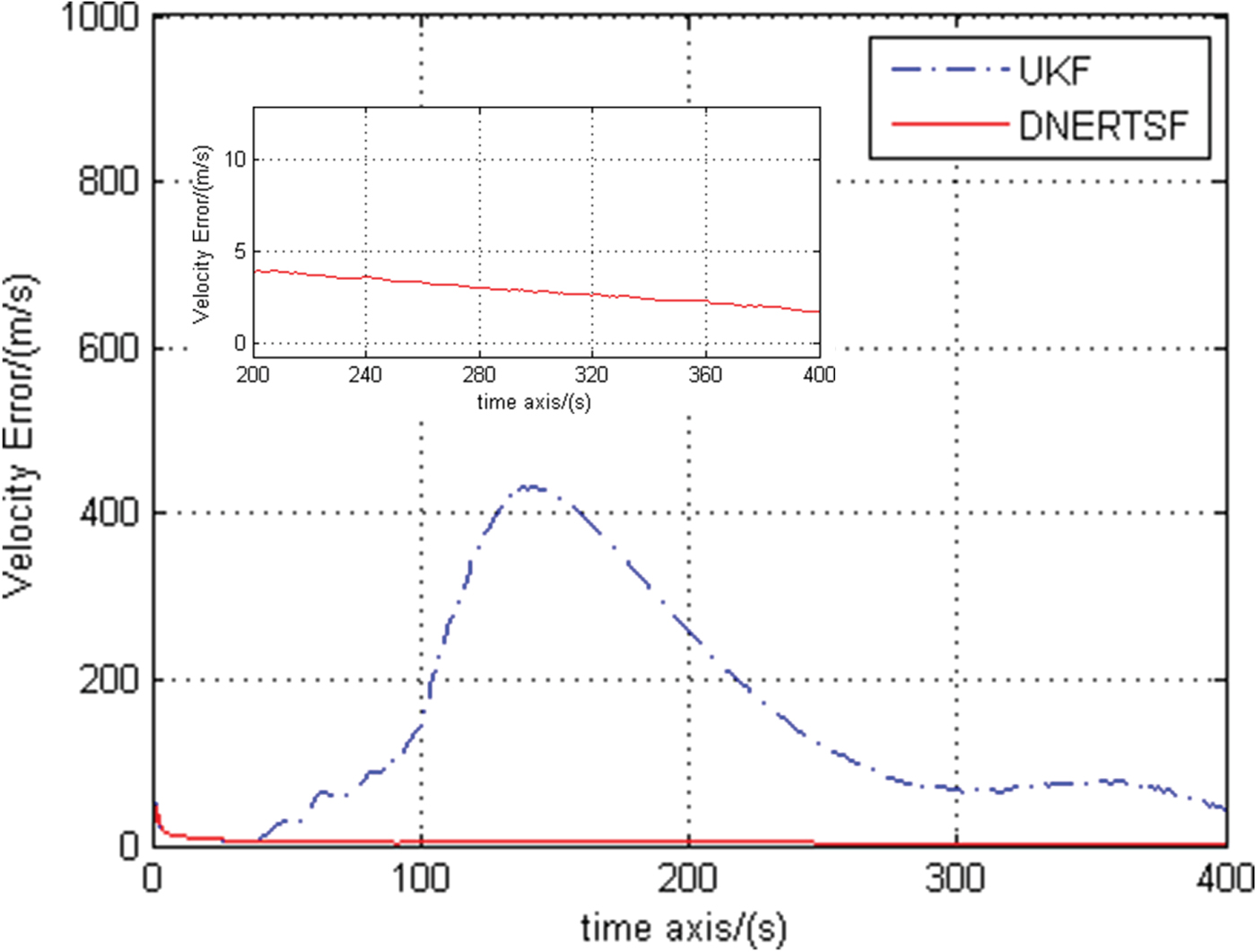
In all the sub-figures of Figure 5, the estimated errors are well captured by the bounds of the covariance of each state to a small magnitude, which shows that the possibility of divergence has been greatly reduced. Finally, 500 Monte Carlo simulations were carried out and the average is represented by Root Mean Square Error (RMSE). The position RMSE and velocity RMSE are depicted in Figures 6 and 7. The subfigures in Figures 6 and 7 show the partially amplified figures of the position RMSE and velocity RMSE of DNERTSF from 200 to 400 seconds. As shown in Figures 6 and 7, the position and velocity RMSE of UKF are much larger than that of DNERTSF. It can be seen from the subfigures that the position and velocity RMSE of DNERTSF are less than 50 m and 5 m/s, respectively, which indicates that this result can fulfil the navigation requirement for future Mars pinpoint landing missions. Even if UKF is adopted for the state estimation with the same simulation condition, it can only approach errors of 1200 m and 50 m/s for position and velocity, respectively. However, the calculation time of DNERTSF is rather greater. In the simulation, UKF only takes 0.7419s but DNERTSF takes 0.9681s. This is because the UKF has not considered the parameter uncertainties and thus saved time in this step of estimation. In all, DNERTSF shows its advantages by improving the accuracy significantly with a small sacrifice in calculation time in dealing with the situation when the system contains parameter uncertainties.
Position RMSE of UKF and DNERTSF.

Velocity RMSE from UKF and DNERTSF.

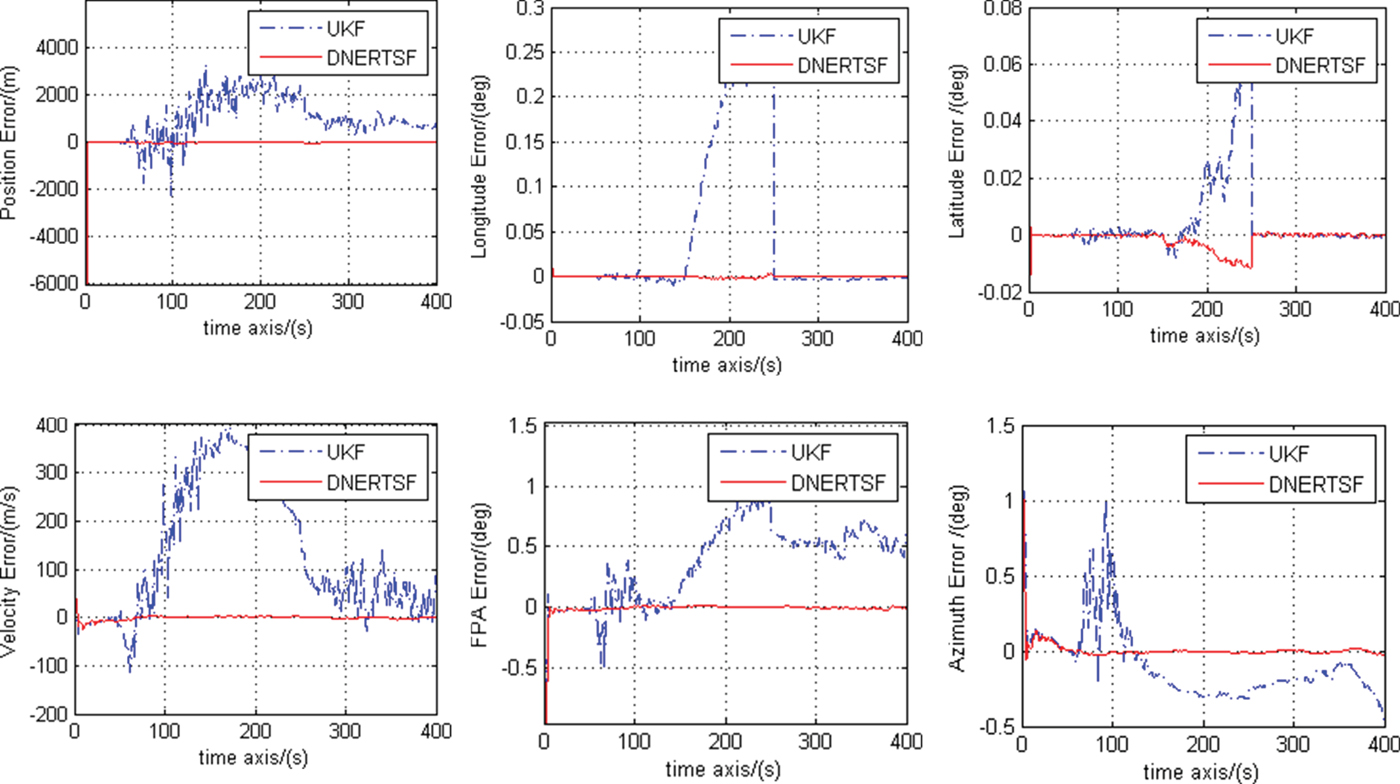
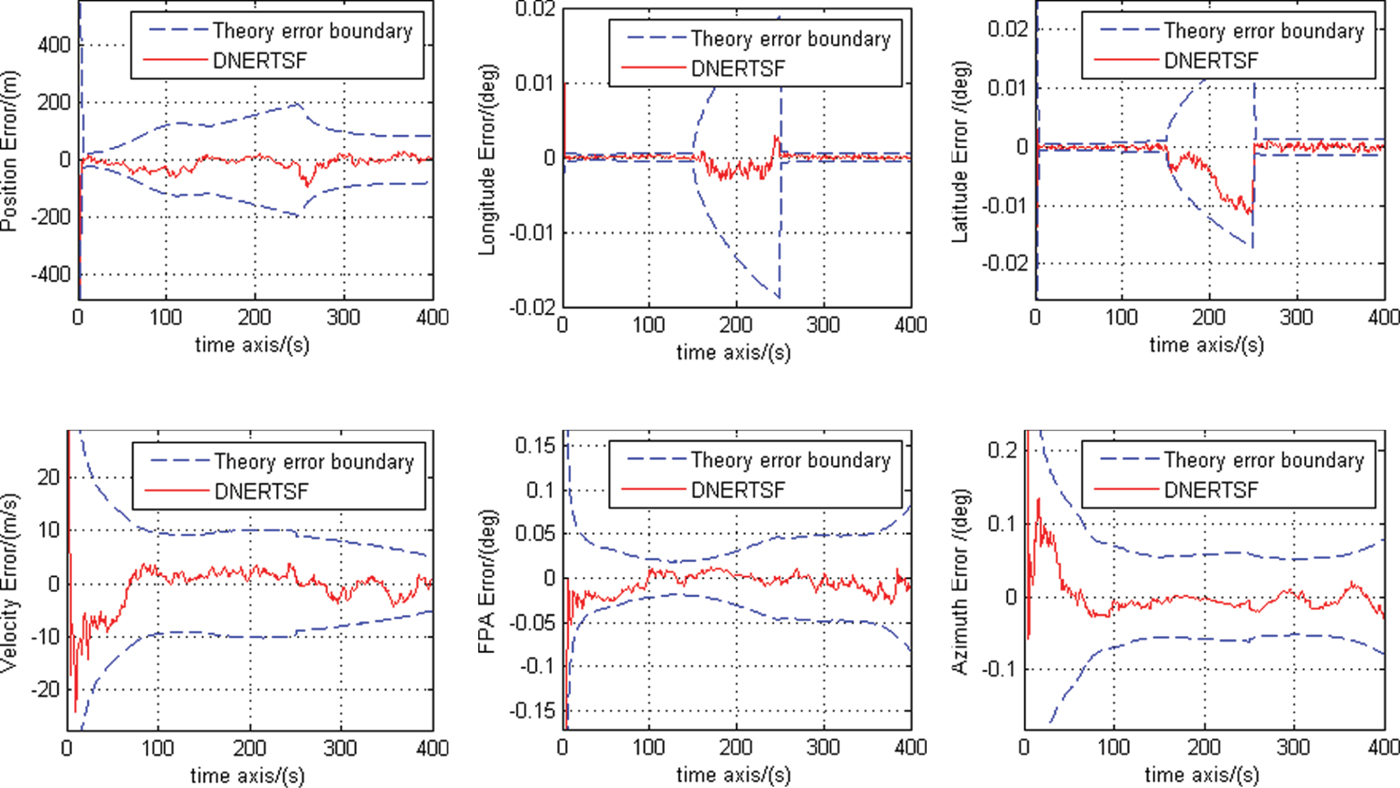
For the entry vehicle, radio blackout typically lasts a couple of dozen seconds during which IMU/radio beacon integrated navigation is taken as the main navigation scheme. Thus, the radio blackout is considered in our simulation. As Mars Science Laboratory (MSL) experienced an approximate 70 s blackout during the Mars entry phase (Morabito et al., Reference Morabito, Schratz, Bruvold, Ilott, Edquist and Cianciolo2014), we assume that radio blackout phenomenon appears from 150 s to 250 s, for a total of 100 s. The state variables estimated errors of UKF-based and DNERTSF-based integrated navigation with 100 s blackout are shown in Figure 8. This shows the same trend as illustrated in Figure 4 (without the radio blackout). UKF still cannot estimate the state variables accurately, while DNERTSF can track these changes well after a short time adjustment at the beginning. After the first 150 seconds, the IMU and radio ranging measurements can provide effective navigation information for the vehicle. The curves of UKF and DNERTSF are compared in Figure 8. UKF maintains an increasing deviation, while DNERTSF tracks these changes well after a short adjustment period at the beginning. When the blackout happens, the state estimates of DNERTSF deviate a little from the actual values, but they are also captured by their 3σ bounds as shown in Figure 9. We can see from Figure 9 that the state variables estimated errors and their 3σ bounds increase gradually when the radio blackout begins, especially the estimated errors of the longitude and latitude. However, the errors and the 3σ bounds will reduce rapidly to normal levels when the radio blackout ends and radiometric measurements can provide effective ranging information for the vehicle again. Therefore, the method proposed in this paper is suitable for Mars entry navigation even with a radio blackout. It can be concluded that the final navigation accuracy is not decreased when a 100 s radio blackout occurs during Mars entry.
State variables estimated errors from UKF and DNERTSF with radio blackout 150–250 s.

State variables estimated errors from DNERTSF with radio blackout 150–250 s.

In all, the DNERTSF algorithm in this paper can reduce the adverse effects of parameter uncertainties for a nonlinear system effectively, and obtain accurate estimates for Mars entry autonomous navigation, showing good prospects for pinpoint landing.
5. CONCLUSIONS
A Derivative-Free Nonlinear version of an Extended Recursive Three-Step Filter (DNERTSF) is investigated to solve the parameters uncertainties in the Mars entry phase. It is an unbiased minimum-variance filter which is good at estimating the state and inputs simultaneously for the nonlinear systems with arbitrary unknown inputs. Moreover, the computation complexity is obviously reduced by avoiding calculations of model derivatives, thus DNERTSF is very suitable for complex nonlinear systems, especially Mars entry phase navigation. In a simulation of Mars entry based on IMU/radio beacon integrated navigation, we demonstrated that the state estimation and parameters estimations can be provided precisely by DNERTSF. With consideration of uncertainties lying in the atmosphere density, ballistic coefficient and lift-to-drag ratio, DNERTSF achieves a superior performance with much lower estimation errors when compared with the standard unscented Kalman filter, and the high accuracy of DNERTSF can meet the navigation requirement of future pinpoint Mars landing missions.
ACKNOWLEDGMENTS
The work described in this paper was supported by National Natural Science Foundation of China (Grant No. 11501022) and National Basic Research Program of China (973 Program) (Grant No. 2012CB720000). The authors fully appreciate the financial support. The authors would like to thank the reviewers and the editor for many suggestions that helped improve this paper.