A disaster is defined as an unforeseen event that causes great damage, destruction, and human suffering that overwhelms local capacity and necessitates a national or international level of assistance.Reference Guha-Sapir, Vos, Below and Ponserre1 Disasters can be classified as natural disasters and manmade or technological disasters.
Both natural and manmade or technological disasters have increased over the past 3 decades. In addition, climate change has been influencing the frequency and intensity of natural disasters.Reference Hill, Wiener and Warner2 According to a report by the United Nations Development Programme, from 1980 to 2000, about 75% of the world’s population was affected at least once by a natural disaster.Reference Mishra, Fuloria and Bisht3 Moreover, natural disasters have been predicted to occur with greater frequency and intensity.Reference Joerin, Shaw, Takeuchi and Krishnamurthy4 Also, the number of reported technological disasters has increased sharply in the past 30 years.5
Disasters severely affect a human’s physical and psychological well-being. Among the health consequences, loss of human life is the most difficult and tragic. In addition, the number of lives lost plays an important role in the public’s perception of the severity of the disaster.Reference Jonkmana, Lentz and Vrijling6 Of the natural disasters, earthquakes are responsible for the majority of the fatalities around the world; they cause approximately 60 000 deaths annually worldwide.Reference Kenny7 Flood events result in a terrible loss of human life worldwide as well. From 1975 to 2001, a total of 1816 freshwater flood events killed greater than 175 000 persons worldwide.Reference Jonkman8
It is understandable that knowing how to save lives is the top priority of disaster relief efforts. The first disaster stage is the most critical for disaster relief. At this stage, speed of response can result in a large reduction in the number of lives lost. However, achieving a rapid professional emergency relief response (eg, rescue operations by fire fighters and paramedics) is difficult to attain for several reasons, including obtaining adequate supplies, finding sufficient shipping capacity, and getting to the disaster site.Reference Day, Melnyk, Larson, Whybark and Davis9 Therefore, immediate self-relief (eg, what to do and how to do it) plays a vital role in the survival of disaster victims.Reference Kobes, Helsloot and de Vries10
Research has demonstrated that in a specific disaster (ie, fire), the higher death and injury rates were caused by a delay of self-relief,Reference Purser and Bensilum11 but many victims actually took no action when facing disasters.Reference Shermana, Peyrot, Magda and Gershon12 For example, after the 2001 terrorist attack on the World Trade Center, only 10.3% of the victims initiated evacuation as a first action, 7.1% adopted active protective actions, and the others took no self-relief measures.Reference McConnell, Boyce and Shields13
When facing a disaster, the self-relief behavior of the victims depends on their physical competencies (eg, strength and speed) and their psychological competencies, which are made up of their attitudes, knowledge and skills, motivation, personal traits, and other characteristics.Reference McClelland14 In disasters, one’s preparedness, especially of disaster knowledge and self-relief skills, is very important. For example, many victims survived the Great East Japan Earthquake and tsunami of 2011. Their lives were saved, in part, because the Japanese have the highest level of disaster preparedness in the world, and have good self-relief skills and habits.Reference Norio, Ye, Kajitani, Shi and Tatano15
In addition, when facing a disaster, it is very important for the victims to control their fear and/or anxiety. Although types of disasters vary, the presence of a threat is more important than whether the threat comes from fire, water, or terrorism.Reference Vorst16 All types of disasters result in severe stress because of the limited time available for decision-making and the physical threat to life.Reference Ozel17 Almost all stresses induced by threat result in extreme emotional arousal that can facilitate rapid decision-making and automatic behavior.Reference Lambourne and Tomporowski18 However, emotional response does more harm than good. It hampers cognitive functions such as narrowed attention field and decreased working memory capacityReference Cai and Lin19, Reference Lupien, Maheu, Tu, Fiocco and Schramek20 and decision-making processes such as the inclination to use intuitive rather than rational decision-making.Reference Coget, Haag and Gibson21, Reference Sayegh, Anthony and Perrewe22 Consequently, disaster victims may make a wrong and irreparable decision in a disaster.
Moreover, the victims’ sense of control over a disaster is important for their self-relief. If victims appraise the specific disaster circumstance as uncontrollable (specifically, if they think survival efforts are futile), they will adopt an emotion-focused coping strategy (eg, prayer) instead of a problem-focused coping strategy (eg, searching for food and water to sustain their life when lost in a forest).Reference Zakowski, Hall, Klein and Baum23 Clearly, it is important to identify these psychological competencies to provide a theoretical foundation for disaster self-relief education for the public. Although a nonacademic report has described the psychological competencies for surviving a disaster,Reference Ripley24 few evidence-based research studies have been conducted, and, to our knowledge, no tools have been developed to assess them.
Therefore, in our empirical research, we aimed to identify the psychological competencies for surviving several types of disasters and develop a self-report questionnaire to assess them. We report herein on the development, finalization, and psychometric validation steps of the Psychological Competencies for Surviving a Disaster Questionnaire (PCSDQ).
METHODS
The study was approved by the Ethics Committee of Shandong University, China. All of the participants enrolled in the study had signed an informed consent form.
Identification of the Psychological Competencies
Because disaster survivors have firsthand and in-depth experience, it was thought that they would be able to provide valuable insights regarding the psychological competencies that primarily contribute to their survival. Based on this assumption, we conducted face-to-face interviews with 16 survivors (10 women and 6 men, aged 18–49 years old) of the 2010 Yushu earthquake in China. These interviews were conducted about 1 year after the earthquake. This time interval was short enough for them to remember their thoughts, emotions, and behaviors related to their self-relief efforts, yet long enough for them to have conducted an introspective examination.
As the main players in emergency disaster relief efforts, fire fighters have professional knowledge and skills about how to survive a disaster. They also have experience in disaster relief and have learned lessons from hundreds of disaster relief cases. Therefore, we conducted face-to-face interviews with 16 male fire fighters (aged 21–36 years) who had at least 5 years of experience in emergency relief work.
To ensure both the efficiency and openness of the interviews, 2 different interview structures were adopted. The interview questions for the survivors focused on their actual thoughts, emotion, and behaviors in the Yushu earthquake and their viewpoints about the indispensable psychological competencies for their survival. The questions for the fire fighters focused on the most frequent thoughts, emotions, and behaviors of the victims they saved and their own views regarding the most important psychological competencies for surviving a disaster.
All interviews were conducted by 2 experienced interviewers and were audiotaped. Then, all of the audio material was transcribed and analyzed using Nvivo software, version 8.0 (QSR International). The qualitative analysis consisted of classifying the interviewees’ quotes into domains. This analysis resulted in the identification of 4 psychological competencies for surviving a disaster. The first is risk perception of a disaster, which refers to one’s attitude (including both cognitive and emotional components) toward a disaster striking him or her. A high degree of risk perception in a disaster accelerates one's self-relief behaviors and further prepares one for the potential disaster. A second competency is disaster knowledge and self-relief skills about a specific type of disaster. This competency provides victims with important information (eg, what to do and how to do it) for their self-relief behaviors. A third is low fear in a disaster. This competency can reduce the negative effect of extreme emotional arousal on the victims’ cognitive function and rational decision-making. Sense of control over a disaster is the fourth competency. It refers to the victims’ belief that their self-relief behaviors will definitely enable them to survive the disaster. This sense of control enables victims to persevere even in desperate disaster situations.
Development of the Questionnaire
Disaster knowledge and self-relief skills about a specific type of disaster consist of general strategies (those also helpful for surviving another type of disaster) and specific ones (those only helpful for surviving a specific type of disaster). Many types of disasters make it impossible to assess specific disaster knowledge and self-relief skills in a questionnaire. However, our purpose was to develop a questionnaire to assess one’s psychological competencies for surviving several types of disasters. Therefore, we assessed general disaster knowledge and self-relief skills. Nevertheless, providing a clear description of general disaster knowledge and self-relief skills and assessing them using a questionnaire were difficult.
Based on the principle that specific attitudes are linked to the specific actions to which such attitudes refer,Reference Friedkin25 those with a favorable attitude toward disaster knowledge and self-relief skills will learn more of them accordingly. Therefore, we assessed the individual’s attitude toward general disaster knowledge and self-relief skills. For example, we used the question “When a new book on how to surviving a disaster is published, the chance you buy the book is?” If one gives a “very high” response, the participant will have more probability of grasping more disaster knowledge and self-relief skills than someone who does not.
A large initial pool of items (75 items) to measure these 4 psychological competencies was developed by referring to the quotes of the interviewees and writing new items. Both the “risk perception of a disaster” (19 items) and the “attitude toward disaster knowledge and self-relief skills” (18 items) were based on realistic questions. However, the “low fear in a disaster” (17 items) and “sense of control over a disaster” (21 items) were based on hypothetical questions because some people may not have experienced a disaster. To make one’s answer to these supposed questions more similar to their true reaction in a disaster, we tried to create a vivid image of a disaster scene using a sentence (eg, please describe the chance of you coming into the following idea or action below if you find a fire in your home at night). All of the responses were recorded on a 4-point scale, ranging from 1 (very low) to 4 (very high).
The Pilot Study
Seven experts (sample 1) from different study areas of medicine and psychology reviewed the initial pool of items to assess the relevance of items, the clarity and conciseness of the sentences, and the format and the order of the responses. Revisions, including a cull of 4 items, were selected based on their feedback.
The 71-item questionnaire was administered to 20 participants (sample 2, comprising mainly college students and teachers), and feedback was given immediately. Further revisions were made to the expression of the questions and the responses, so that all the participants could understand them fully and clearly.
Finalization of the Questionnaire
The 71-item questionnaire was given to 400 college students from 2 universities of Jinan, the capital of Shandong Province, China, and 345 valid questionnaires (sample 3) were returned (65 men, 279 women, 1 with no gender indicated). Thus, the response rate was 86.25%. The mean age of the college students was 20.3 (± 2.5) years.
The interitem correlations of the 71 items were examined as a preliminary evaluation of the instrument structure. The correlation between each item and its own subscale was considered satisfactory if it achieved a value of 0.40 (item convergent validity). Item discriminant validity requires that each of the items have a higher correlation with its own dimension than with other dimensions. As a result, 13 items, whose correlations with their subscale were less than 0.40 were deleted from the item pool.
The remaining 58 items were analyzed by a series of principal component analyses (PCAs) followed by varimax rotation to explore the factor structure of the questionnaire. These analyses resulted in the cull of 31 items, which were distributed on 2 or more dimensions.
Before the PCAs, the data were checked and we obtained the Kaiser-Meyer-Olkin index of sampling adequacy (.82) and conducted the Bartlett test of sphericity (P<.001), which indicated the appropriateness of the PCAs. The size of the eigenvalues and scree test results from the PCAs helped inform the decision regarding the number of factors underlying the PCSDQ items. The final decision about the number of factors in the PCSDQ was based on the size and pattern of the factor loadings. The PCAs were computed using SPSS software, version 18.0 (IBM Corporation).
Validation of the Questionnaire
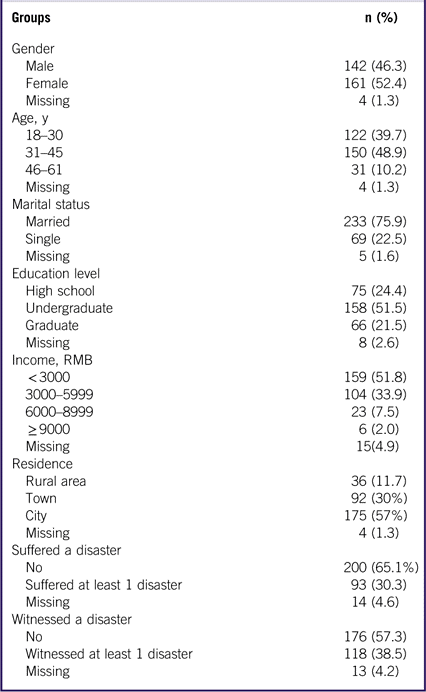
A person’s type of occupation (eg, workers in an oil refinery have an increased chance of experiencing a fire or an explosion) and area of residence (eg, the southern provinces of China have an increased chance of experiencing a flood than the northern provinces) are closely related to their disaster experience, which has an impact on one’s reaction to a disaster.Reference Norris and Murrell26 Thus, another sample of 350 participants was selected to confirm the factor structure of the questionnaire derived from the PCA and assess its internal reliability. A wide variety of occupations and a large area of China (sample 4) were represented by this sample. Of the 350 questionnaires that were sent out, 307 were returned, for a response rate of 87.71% (see Table 1 for the participants’ sociodemographic characteristics).
Sociodemographic Characteristics of Sample for Confirmatory Factor Analysis of the Questionnaire (N=307)

RMB indicates Chinese yuan.
A confirmatory factor analysis (CFA) using AMOS software, version 18.0 (IBM Corporation) was conducted to confirm the factor structure of the 27-item questionnaire. Since the original method to assess model fit (χ2) is sensitive to sample size, an alternative, normed χ2 (χ2/df), was used to assess model fitReference Hooper, Coughlan and Mullen27; a good fit is indicated when (χ2/df) is<3. Several other indices of model fit were used in the analysis. The root mean square error of approximation (RMSEA) considers the error of approximation in the population and estimates the difference between model-implied and actual variances and covariances. An RMSEA of less than.08 is acceptable and an RMSEA less than .05 is excellent. In a well-fitting model, the goodness of fit index (GFI) should be greater than .90. Values greater than .90 for the Tucker Lewis index (TLI) and comparative fit index (CFI) are considered as acceptable fit. Modification indices generated in Amos software were considered to determine revisions to the proposed structure of the PCSDQ.
The internal consistency for each of the PCSDQ subscales was evaluated by computing Cronbach alpha coefficients. The approximate range of optimal alpha values is between .70 and .90, indicating a set of items that are strongly related and capable of supporting a unidimensional scoring structure, but not redundant.Reference Streiner28
RESULTS
The Last PCA Results
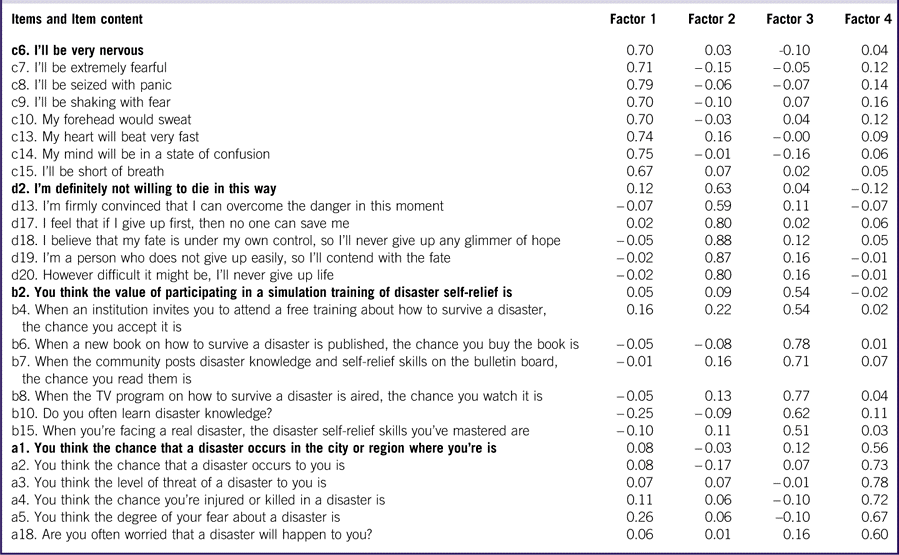
Although the last PCA yielded 7 factors with eigenvalues of greater than 1, accounting for 64.36% of the total variance, the scree test result (see Figure 1) suggested 4 factors, accounting for 52.40% of the total variance. In addition, the 4-factor model (Table 2) had a substantial factor loading for almost every item (>.50), and no items loaded highly on more than 1 factor. Moreover, the groupings of the items into 4 factors fit with the content of the items. Therefore, the 4-factor model was supported by the PCA.
Scree Plot of Last Principal Component Analysis for the Questionnaire.
The Last Principal Component Analysis Rotated Factor Loadings for the Questionnaire (N=345) Footnote a
a Factor 1, low fear in a disaster; factor 2, sense of control over a disaster; factor 3, attitude toward disaster knowledge and self-relief skill; and factor 4, risk perception of a disaster; c6-c15 are reversely scored; c6-c15 are based on the hypothetical question, “If in the night when you’re sleeping, you suddenly find that a fire happens in your home, the chance that you come into the following idea or action is?”; d2-d20 are based on the hypothetical question, “If you unluckily cannot move from under a big stone in an earthquake, the chance you come to the following idea or action is?”
These 4 factors are (1) low fear in a disaster (an eigenvalue of 4.93 explaining 18.24% of the variance); (2) sense of control over a disaster (an eigenvalue of 4.23 explaining 15.67% of the variance); (3) attitude toward disaster knowledge and self-relief skills (an eigenvalue of 2.82 explaining 10.44% of the variance); and (4) risk perception of a disaster (an eigenvalue of 2.17 explaining 8.04% of the variance).
CFA Results
The CFA results for the 4-factor structure of the 27-item questionnaire only showed an acceptable model fit (Table 3). To develop a better-fitting model, post hoc modifications were performed referring to the modification indices, which resulted in the deletion of 3 items. As a result, the 24-item questionnaire was finally formed. The modification steps and corresponding goodness-of-fit statistics of each model are shown in Table 3, which indicates that the final model yielded a good fit of the data to the model.
Goodness-of-Fit Statistics of the Primary Model and the Modified Models for Confirmatory Factor Analysis of the Questionnaire
Abbreviations: GFI, goodness-of-fit index; CFI, comparative fit index; TLI, Tucker Lewis index; and RMSEA, root mean square error of approximation.
The final model with standardized parameter estimates is presented in Figure 2. All of the factor loadings of corresponding indicator variables on low fear in a disaster and sense of control over a disaster are above .59, which indicates that the measures for these 2 factors have good reliability and validity. The factors on risk perception of a disaster and attitude toward disaster knowledge and self-relief skills range from .36 to .85, which indicates that the measure for these 2 factors have an acceptable reliability and validity.
Results of the Confirmatory Factor Analysis for the Questionnaire.
Internal Reliability
The internal reliability coefficients (Cronbach alpha) of the subscale for PCSDQ among the college students (sample 3) and employed people (sample 4) are demonstrated in Table 4. As shown, the Cronbach alpha values range from .75 to .87, which indicates satisfactory internal reliability.
Internal Reliability of the Final Version of the Questionnaire in 2 Samples
a Sample 3 was used for principal component analyses of the questionnaire; sample 4 was used for confirmatory factor analysis of the questionnaire.
DISCUSSION
Based on the interviews with 16 earthquake survivors and 16 fire fighters, we found 4 psychological competencies that play a key role in a person’s disaster survival. Risk perception of a disaster (especially its emotional components such as feelings of worry) had a positive influence on one’s prevention behaviors to cope with disasters; this finding was also supported by a previous study.Reference Miceli, Sotgiu and Settanni29 For example, many people mistakenly believe that disasters are events that happen to others; as a result, they become complacent and are less likely to prepare for disasters.
Among a variety of activities undertaken to prepare for future disasters, obtaining disaster knowledge and self-relief skills are the most important because they can educate the victims about what to do in a disaster and how to do it. Fear is the most common disaster reaction. High fear induces extreme emotion arousal, which decreases the efficiency of cognitive functions and decision-making abilities. Therefore, low fear in a disaster is a critical psychological competency. It should be noted that low fear is not equal to no fear; no fear will make the survivor lose the motivation to engage in life-saving behaviors in disasters.
Uncertainty is very common in a disaster. Uncertainty makes it difficult for the victims to decide whether anything can be done to evade, master, or tolerate the harm or to decide what forms of action are likely to lead to a desired outcome.Reference Lazarus and Folkman30 If a disaster situation is appraised as holding few possibilities for beneficial change, the victim will employ an emotion-focused coping strategy. In contrast, when a situation is appraised as having the potential for amelioration by action, the victim will use a problem-focused coping strategy to alter the situation.Reference Folkman and Lazarus31 The appraisal of a disaster situation concerns one’s sense of control over a disaster. Therefore, a high sense of control over a disaster allows individuals to take effective efforts to survive the disaster, even in a desperate situation.
We developed and validated a questionnaire to assess 4 psychological disaster-surviving competencies. Four samples were used to develop the questionnaire and assess its reliability and validity. The initial questionnaire consisted of 75 items. Of these, 51 items were deleted based on the results of a pilot study, a series of PCAs, and a CFA. The result was a 24-item questionnaire assessing 4 domains: (1) risk perception of a disaster (5 items), (2) attitude toward disaster knowledge and self-relief skills (7 items), (3) low fear in a disaster (6 items), and (4) sense of control over a disaster (6 items). The Cronbach alpha of its subscale ranged from .75 to .87 in 2 samples, which indicates sufficient reliability without redundancy.
Two items had factor loadings on their latent variable below .40 (see Figure 2). We retained item a18 because its latent variable (risk perception of a disaster) had the fewest items (5 items) and its cull would have resulted in a significant decrease in internal reliability. We retained item b8 because its factor loading was .38, a value very near the acceptable criteria (.40). Both of these items had factor loadings (see Table 2) derived from the last PCA of sample 3 that were greater than .60. With regard to the factor-loading differences between sample 3 and sample 4, the decision whether to retain or cull the item should not be arbitrary. Instead, this decision should be based on the results of a future study conducted with a large and heterogeneous sample. In addition, 1 pair of error terms (e16 and e18) was correlated (Figure 2). In general, the correlation of the error terms should be taken with caution. However, it is acceptable when supported by a strong theoretical justification.Reference Hooper, Coughlan and Mullen27 Both item c13 (my heart would beat very fast) and item c15 (I’ll be short of breath) are related to one’s basal metabolic rate, therefore, the correlation of their error terms is theoretically reasonable.
This research is valuable in that it provides the government emergency management department, the education agency, and the public with knowledge and a tool for disaster self-relief education. Specifically, the identification of 4 psychological competencies for surviving a disaster implies that disaster self-relief education for the public can be focused on the improvement of these competencies. Moreover, the PCSDQ can be used to identify a person’s deficiencies in psychological competencies for surviving a disaster, which makes it possible to develop individualized and targeted disaster self-relief education or training programs.
Limitations
The present study had some methodological limitations. First, the 16 disaster survivors experienced only 1 type of disaster (ie, earthquake), and therefore, they have little knowledge about self-relief in other types of disasters. To compensate for this deficiency, 16 fire fighters (participants in emergency rescues of various types of disasters) were also recruited to identify the psychological competencies required for surviving a disaster. Their responses added some valuable but limited insight, as they are not trained to interpret or analyze the complex emotional state of disaster survivors. Hence, current results are more applicable to earthquake survival, and the generalization of the present results to other types of disasters should be undertaken with caution.
In addition, choice-supportive bias, outcome bias, and recall bias may occur when disaster survivors recall their experience of disaster self-relief from 1 year ago. Also, to explore the factor structure of the PCSDQ, the PCAs used a sample that was obtained from undergraduate students in a city in China. To compensate for the homogeneity of that sample and to confirm the factor structure of the PCSDQ, the sample used for the CFA was from people who had a variety of occupations and lived in different cities of China.
The last limitation involves the hypothetical questions in the subscales of low fear in a disaster and sense of control over a disaster. Because a large number of people have not experienced a disaster, it is not possible to assess their fear and sense of control in a real disaster through the use of retrospective questions. Accordingly, hypothetical questions were used to assess the participants’ reactions if they experienced a disaster. Differences may occur between their stated response to a hypothetical disaster and their real response to an actual disaster; this discrepancy is called a hypothetical bias. Although some studies found evidence of hypothetical bias, the findings of other studies support the notion that hypothetical bias is not universal and can be reduced by proper design.Reference Johnston32
In our design of the hypothetical questions, we chose fire and earthquake as the hypothetical disaster situations because most people are familiar with them. We speculated that their responses to these imaginary disaster situations are close to their actual responses to real disaster situations. In view of the limitations of the present exploratory research, future study should be strengthened by adopting a larger sample of respondents, surveying closer to the time of the disaster, and taking different types of disasters into consideration.
CONCLUSIONS
On the basis of 4 psychological competencies for surviving a disaster obtained from interviews with disaster survivors and fire fighters, the PCSDQ was developed through multiple phases using different samples. The resulting questionnaire can be used to assess one’s psychological competencies for surviving a disaster, which makes it possible to develop an individualized and targeted disaster self-relief education and/or training program. We believe that the knowledge of these competencies and the tool to assess them will indirectly contribute to saving more lives in disaster situations.
Funding and Support
The study was supported by the Ministry of Education in China, Project of Humanities and Social Sciences (grant No. 10YJCXLX007), and Shandong Provincial Natural Science Foundation, China (grant No. ZR2010CQ019).