Between 1915 and 1917, the leaders of the Ottoman Empire organized the forced deportation and massacre of the majority of Ottoman Armenians, resulting in an estimated 800,000 to 1.5 million deaths. After the creation of the Republic of Turkey in 1923, these events—which are today known as the Armenian Genocide Footnote 1 —were silenced, but over the past several decades Turkey has experienced sustained pressures to acknowledge the organized and intentional nature of this violence. In response, Turkish officials have consistently rejected accusations of intentional wrongdoing on the part of the Ottoman government. Yet alongside this continuity state representatives have altered whether and how they have dealt with the concept of genocide. Through the late 1970s, the concept was absent from the state’s narrative. While Turkish diplomats lobbied to suppress references to the events, they did not refer to the concept of genocide. In contrast, since the early 1980s, Turkish officials have paid increasing attention to the term genocide. Moreover, the ways in which officials have rejected its applicability have also changed over time, shifting from arguments drawing on scholarly understandings of genocide to arguments grounded in legal interpretations of genocide. And as international expectations about states’ acknowledgement of past crimes grew stronger, Turkish officials moved from arguing that this issue is best left in the past to emphasizing Turkey’s readiness to face the past and engage in dialogue.
This pattern of argumentation—characterized by the changing place of the concept of genocide in the state’s narrative, and increasing rhetorical commitments to dialogue and reconciliation—represents a series of rhetorical adaptations, which I define as a strategy in which actors shape their rhetoric in response to understandings of an international norm in order to avoid charges of norm violation or to resist pressures for compliance. Thus, while the timing and direction of changes in Turkey’s overarching narrative of the “Armenian question” (Ermeni sorunu) Footnote 2 have been largely shaped by international pressures and domestic political considerations, Footnote 3 these factors cannot adequately explain shifts in the state’s references to and arguments against the applicability of the concept of genocide, or the changes in its position on the value of truth-seeking. Instead, these rhetorical patterns are best explained by shifts in the content of international norms—namely, the norm against genocide and the norm of accountability—which help constitute the range and nature of legitimate arguments that can be advanced in relation to those norms.
Examples of rhetorical adaptation abound. In 2008, Russia argued that its invasion of Georgia was not an illegal use of force, but instead represented a humanitarian intervention in response to Georgia’s “genocide” in South Ossetia, and that the invasion was therefore justified under the Responsibility to Protect. In 2012, in response to international calls to stop using violence against anti-regime demonstrators, Bashar al-Assad’s regime argued that those whom outsiders were calling demonstrators, activists, and protestors were, in fact, terrorists. In so doing, the Syrian regime reframed its violence as a type to which international norms against killing civilians did not apply. And in the aftermath of the September 11 attacks, the United States attempted to skirt the norm against torture, arguing that individuals who had been taken into U.S. custody in Afghanistan were not prisoners of war and their treatment was, therefore, not governed by the Geneva Conventions. In these examples, officials drew on the content of particular norms to argue that the state’s actions did not constitute a norm violation.
While examples of rhetorical adaptation can be easily found, the phenomenon remains under-theorized. A handful of scholars has referred in passing to the practice; Footnote 4 and others have theorized related or broader practices, such as “tactical concessions,” “denials,” and “account making.” Footnote 5 Nevertheless, rhetorical adaptation has not been independently conceptualized or analyzed, with the result that both its forms and effects are poorly understood. The lack of attention to this practice is reflective of—and has contributed to—shortcomings in the literatures on norms and compliance. Existing work in these areas has tended to focus on the mechanisms through which norms affect states’ behavior, and on determinants of states’ commitment to and compliance with international norms. While important, these preoccupations have generated a partial understanding of norms’ effects, and have underrepresented states’ agency in relation to international norms.
There are, moreover, compelling reasons to investigate rhetorical justifications, specifically those related to conflict and violence. Rhetorical justifications tend to be key ingredients in nationalist narratives about past violence, which can increase threat perceptions and contribute to renewed conflict between states. Footnote 6 Narratives of past violence also help delineate the boundaries of public discourse and citizenship. Footnote 7 As such, they can engender or strengthen boundaries between “in-groups” and “out-groups” within a domestic sphere, which can lead to persecution, unrest, and rebellion. Better understanding the nature and effects of such rhetoric can thus help policymakers, activists, and analysts more effectively interpret and respond to rhetorical justifications for ongoing and past violence.
I thus conceptualize rhetorical adaptation and introduce a typology of its different forms. I use a plausibility probe to analyze the connections over the past several decades between Turkey’s official narrative of the “Armenian question” and the evolving normative landscape, Footnote 8 testing whether and how the content of international norms influences states’ resistant rhetoric, and analyzing the uses and effects of four types of rhetorical adaptation.
In so doing I advance scholarship in international relations in several ways. First, it expands our understanding of the forms and effects of so-called norm takers’ agency. Second, it extends work on the instrumental uses of norms by delineating some of the ways in which actors rhetorically use norms for instrumental ends, and to what effects. Third, I question the claim that when a state starts to “talk the talk” of norms, it engages in processes of argumentation that can eventually lead to norm internalization and compliance. Rather, by demonstrating that an actor might accept the validity of and even internalize a norm, but not comply with it, I highlight the importance of analytically delinking internalization and compliance.
More generally, I draw on core concerns in political science to address key issues in the interdisciplinary fields of genocide studies, Footnote 9 memory studies, and Turkish studies. By tracing the development of the norm against genocide, the case study historically and theoretically situates this core human-rights norm. Moreover, in contrast to existing conceptualizations of genocide denial, which tend to use the term denial as a catchall for a range of actions and rhetoric, the typology of rhetorical adaptation offers a framework with which to analyze the range of ways in which states seek to rhetorically challenge and avoid the charge of genocide. Finally, the case study reveals crucial misunderstandings among journalists and policymakers about Turkey’s position on the Armenian Genocide.
The article is organized as follows. After exploring key limits of existing scholarship on international norms, the second section conceptualizes and introduces four types of rhetorical adaptation: norm disregard, norm avoidance, norm interpretation, and norm signaling. Turning to a plausibility probe of Turkey’s narrative of the “Armenian question,” the third section traces how themes in the state’s narrative have paralleled changes in the norm against genocide and the norm of accountability. The fourth section draws on the case study to shed light on the uses and effects of rhetorical adaptation. The conclusion outlines how the concept of rhetorical adaptation provides a more dynamic account of changes and continuities over time in Turkey’s narrative, highlights the implications of the conceptualization and typology for interdisciplinary inquiries, and raises questions for future research.
States’ Agency and Responses to International Norms
Norms—defined as “collective expectations for the proper behavior of actors with a given identity” Footnote 10 —are a fundamental part of the structure of the international system. States can adopt (or avoid) particular practices as prescribed (or proscribed) by a norm, reject or deny the relevance or validity of a norm, or contest and resist a norm. In spite of this range of possible responses, existing work has largely overlooked the agency of states that neither promote nor comply with international norms, and has failed to theorize states’ responses to international norms that fall outside the categories of commitment and compliance.
While the agency of non-state actors—such as norm entrepreneurs and activists—has been a central preoccupation in norms scholarship, Footnote 11 “norm takers” —typically, states—have been treated as relatively passive subjects who commit to and comply with norms, or are criticized for violating norms. Footnote 12 An exception is the literature on norm localization, which highlights domestic and regional strategies to make given international norms better “fit” with local norms and conditions. Footnote 13 In addition, scholars from a range of epistemological positions have begun to note the ways in which actors with a variety of aims instrumentally “use” norms. Footnote 14
These exceptions notwithstanding, scholarship has overwhelmingly focused on commitment and compliance, Footnote 15 implying a limited scope for state agency and a relatively narrow and unidirectional set of possible responses to international norms. Even within this constrained set of possible responses, quantitative analyses have tended to focus on easily measurable behavioral aspects of compliance, and both qualitative and quantitative work has tended to conceptualize compliance in dichotomous terms, despite the fact that it is more accurately understood as a continuous variable. Footnote 16 And while some scholars have begun to explore the ways in which states challenge and resist international norms, most maintain the labels of commitment and compliance, even when highlighting the complexities and ambivalence that can be obscured under the label of “compliance.” Footnote 17
Conceptualizing Rhetorical Adaptation
The concept of rhetorical adaptation illuminates the complex and ambivalent ways in which states respond to international norms. Rather than simply rejecting the validity of a norm or outright denying charges of a norm violation, Footnote 18 rhetorical adaptation involves drawing on a norm’s content in order to craft arguments that could diffuse pressures to comply with a norm or minimize perceptions that certain actions are in violation of a norm.
While it is in theory possible for an actor to make any number of arguments in attempting to persuade others that certain actions do not violate a given norm, rhetoric is in practice constrained by the more delimited structure of acceptable discourse at a given point in time. Footnote 19 Hence, just as “the realm of conceivable behavior in a given social structure is normatively determined,” Footnote 20 the content of relevant norms similarly constitutes the range of appropriate discourse. Footnote 21 What is distinctive about the concept of rhetorical adaptation is that it refers to a particular type of actor (one whose actions violate or are perceived to violate an international norm), a particular object to which the rhetoric is being adapted (extant normative expectations), and a particular goal (resistance). It is thus a form of “rhetorical action” Footnote 22 that is a strategic “adaptation” Footnote 23 to normative expectations.
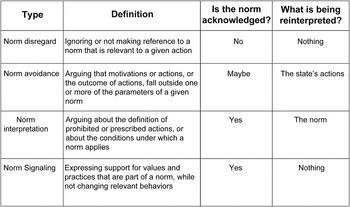
There are four distinct types of rhetorical adaptation: norm disregard, norm avoidance, norm interpretation, and norm signaling. As shown in Figure 1 and as will be discussed, this typology organizes new and existing concepts into a single conceptual framework, and specifies the nature of the relationship between international norms and each type of rhetorical adaptation.
Typology of rhetorical adaptation

The first type of rhetorical adaptation, norm disregard, involves ignoring a norm that is relevant to a given action. With norm disregard, actors are aware of a norm, but choose not to reference it. This strategy is most likely to be employed when a norm is weak, i.e., when there is little consensus on the appropriateness of an idea, when an idea is not well institutionalized, and when the consequences for its violation are weak or rarely applied. Footnote 24
Once a norm is more widely recognized as “appropriate,” simply ignoring it is less likely to succeed in minimizing or avoiding charges of violation or pressures for compliance. Consequently, for norms that are more widely accepted and institutionalized, rhetorical adaptations are likely to engage with some aspect of a norm’s content.
The second type of rhetorical adaptation, norm avoidance, involves arguing that a state’s motivations or actions, or the outcome of its actions, fall outside the parameters of a given norm, and that the norm has, therefore, not been violated. Norm avoidance does not question the validity or the definition of a norm. Rather, norm avoidance captures that which the sociologist Stanley Cohen refers to as “interpretive denial,” which is “to admit the raw facts … but deny the interpretive framework placed on these events.” Footnote 25 An example of norm avoidance comes from the pre-World War II period. As Nazi Germany annexed Austria and the Sudetenland, Hitler rejected characterizations of these actions as violations of the norm of state sovereignty. Instead, he invoked the principle of self-determination, arguing that Germany’s actions were attempts to help German peoples realize their desire for self-determination and should not be seen as violations of sovereignty or acts of aggression. Footnote 26 As this example illustrates, norm avoidance often involves framing actions as acceptable and appropriate with regard to one norm rather than another, and implicit or explicit claims that one norm is hierarchically more important than another. Footnote 27
The third type of rhetorical adaptation is norm interpretation, which is when one or more aspects of a norm’s definition are tweaked or contested. It is an attempt to narrow or limit the interpretation of a norm or the conditions under which a norm applies, in order to exclude an action that might otherwise be seen as a violation of that norm. Such (re-)interpretation can focus on a norm’s prescriptions or proscriptions, or on the conditions under which a norm applies. Footnote 28 Thus, whereas norm avoidance reframes actions, norm interpretation redefines the norm itself. An example of norm interpretation is the U.S. government’s post-9/11 reinterpretation of what constituted torture, which claimed that “enhanced interrogation techniques” such as waterboarding fell outside the boundaries of the norm against torture. Sanders argues that, rather than attempting to “conceal or deny factual information,” the Bush administration “insist[ed] no laws were broken,” typically through novel interpretations of international law. Footnote 29
The final type of rhetorical adaptation is norm signaling, which is when an actor “talks the talk,” but fails to “walk the walk.” Norm signaling involves expressing support for values or practices that are part of a norm, while not changing relevant behaviors. Footnote 30 The Bush administration’s communications about torture offer an example of norm signaling. In December 2004, the Bush administration issued a statement declaring that “torture is abhorrent both to American law and values and to international norms.” Footnote 31 In spite of this assertion, however, the U.S. continued to torture detainees at the military prison in Guantánamo Bay and elsewhere.
Together, these four types capture the ways in which actors rhetorically seek to avoid or resist pressures for norm compliance or charges of norm violation. Moreover, as a norm’s content changes, Footnote 32 different arguments become more (or less) legitimate. Consequently, rhetorical adaptations must draw on prevailing aspects and interpretations of a norm.
Turkey’s Narrative of the Armenian Genocide
All four types of rhetorical adaptation feature in Turkey’s narrative of the Armenian Genocide, which the case study traces in relation to two norms—the norm against genocide and the norm of accountability—over the period from 1950 to 2008. Footnote 33
This case has been selected as a plausibility probe for several reasons. First, the analysis advances an explanation for Turkish officials’ shifting argumentation that allows for a more nuanced and accurate understanding of changes and continuities in Turkey’s narrative about the Armenian Genocide. Second, the case study holds constant a possible determinant of the content of the official narrative. Given that the destruction of Ottoman Armenians occurred about three decades before the term genocide was created and long before the start of this analysis, the facts of the event have thus been fixed throughout the period of analysis. Footnote 34 Third, the case has many observations of the variable of interest—references related to genocide and accountability in the state’s narrative—which makes it a strong choice for a plausibility probe.
The analysis is based on a systematic qualitative analysis of the content of Turkey’s official narrative. I analyzed a variety of primary and secondary sources, including books and articles published by Turkish government agencies; two series of government-approved high school history textbooks; educational curricular announcements issued by the Ministry of National Education; and hundreds of newspaper articles capturing official speeches, statements, and actions related to the state’s narrative. In addition, I conducted more than fifty interviews with current and former Turkish officials, elites, and activists in Istanbul and Ankara. This research captured the range of themes in the official narrative, of which this case study analyzes those that relate to the norm against genocide and the norm of accountability. Footnote 35 Inferences are based on the congruence between the content of the state’s rhetoric and the content of international norms, discrepancies between the state’s rhetoric and practices, and the timing and pattern of rhetorical shifts. An outline of these two norms’ development follows and is discussed in greater detail in the case study.
The norm against genocide was one of the first human-rights norms established in the post-World War II period. The term “genocide” was introduced in 1944 by the legal scholar Raphael Lemkin. Footnote 36 Shortly thereafter, it was included in the indictment of Nazi war criminals by the International Military Tribunal at Nuremberg, although it was not mentioned in the tribunal’s final judgment. In 1948, the United Nations Convention on the Prevention and Punishment of the Crime of Genocide (UNCG) was passed; it came into force in 1951. The UNCG defined genocide as:
any of the following acts committed with the intent to destroy, in whole or in part, a national, ethnical, racial or religious group, as such: (a) Killing members of the group; (b) Causing serious bodily or mental harm to members of the group; (c) Deliberately inflicting on the group conditions of life calculated to bring about its physical destruction in whole or in part; (d) Imposing measures intended to prevent births within the group; (e) Forcibly transferring children of the group to another group. Footnote 37
Like concepts such as terrorism and torture, genocide is both an analytical and a legal term. Over time, both dimensions of the concept have been debated and interpreted by scholars, lawyers, states, courts, and others. In the process, interpretations of its content have shifted, and the norm has gradually been institutionalized.
The norm of accountability refers to a set of ideas about how states that have committed gross human-rights violations should address those aspects of their pasts. Footnote 38 In the wake of World War II, truth- and justice-seeking took prominent form in ad hoc tribunals established in Nuremberg and Tokyo and in top-down truth-telling projects in Allied-occupied Germany and Japan. As the tensions of the Cold War emerged, however, the attention to truth and justice that was central to the so-called “Nuremberg model” was abandoned in favor of factors that were thought to ensure stability and security. Thus, aside from West Germany, other countries that bore responsibility for World War II-related crimes in Europe were not seriously pressured to acknowledge or apologize for their crimes. This started to change in the 1980s, when international expectations began to shift from an acceptance of silencing to an emphasis on the importance of seeking truth and meting out justice for gross human-rights violations. Since then, and especially since the mid-1990s, states have increasingly been called on to look into and acknowledge past crimes, individual perpetrators have been indicted and tried for genocide and other crimes against humanity, and states and firms have been called on to pay reparations and restitution to victims of past crimes. Footnote 39
Over the past several decades, domestic and transnational activists have drawn on these norms to try to pressure Turkey to acknowledge the Armenian Genocide. In response, Turkish officials have advanced an alternative and evolving narrative about the events of 1915–1917. The most significant factors accounting for Turkish officials’ resistance to acknowledging the genocide (as such) have been concerns that acknowledgement would expose the state to claims for compensation and territory, that changing the state’s narrative would undermine the legitimacy of the founding national narrative and of key political institutions in Turkey, and that acknowledgement would damage Turkey’s international image. Footnote 40
Given these concerns, Turkish officials have taken a number of steps to lessen pressures from international actors to recognize the genocide as such, and to maintain the legitimacy of the state’s narrative. These steps have included a series of rhetorical adaptations that reflect—and importantly, parallel—shifts in the content of these norms. Thus, while shifts in the content and strength of these norms have not themselves triggered changes in Turkey’s narrative, Footnote 41 Turkish officials have drawn on their content in shaping and reshaping the state’s rhetoric over time. Turkey’s rhetorical adaptations can be analyzed in four phases, each of which represents a period during which the overall content of the state’s narrative was relatively consistent.
Silencing the Dark Past (1950–1980)
Between 1950 and 1980, Turkey’s narrative largely ignored and, when necessary, silenced the issue of the genocide. This silence and norm disregard were facilitated by the poor quality of Turkey’s democracy and by Cold War politics, which prioritized stability over acknowledgement and accountability.
Despite the flurry of activity attending the Nuremberg trials and the passage of the UNCG in the late 1940s, attention to the issue of genocide quickly faded from international discussions as the Cold War took shape. Given the lack of an international legal infrastructure to investigate and prosecute perpetrators of genocide, the consequences for violating the norm against genocide were primarily limited to the period immediately after a violation. In addition, there was little academic research on genocide in the 1950s and 1960s. As a result of these factors, the United Nations definition constituted the main understanding of genocide. Moreover, until the mid-1970s, the relative weakness of the Armenian diaspora and the Soviet Union’s suppression of Armenian nationalism meant that there were few external calls for Turkey to address the issue.
On those occasions when the issue could not be avoided, Turkish officials did not refer to the concept of genocide. Instead, Turkish officials actively opposed any references to the events or outcome of the genocide throughout the 1950s, 1960s, and 1970s. For example, in 1967 Turkish diplomats lobbied U.S. policymakers to stop a monument to the Armenian Genocide from being erected in Montebello, California. As a result, when the monument was built, it did not make any reference to “the Genocide or the Ottoman Empire.” Despite this significant accommodation, the Turkish government was dissatisfied, complaining to State Department officials that “because the plaque mentioned Armenians, ‘it would be obvious’ that it targeted Turkey.” Footnote 42
Turkish officials further justified their efforts to silence the Armenian issue by arguing that bringing it up “could serve no purpose but harp on distant and bitter chords.” Footnote 43 This was consistent with international expectations in this period, when investigating past human-rights crimes was viewed as destabilizing. In turn, democratizing states in the 1970s opted to suppress and overlook past atrocities, believing that they were “better left buried in the past.” Footnote 44 Reflecting this, in May 1965 the Turkish Press Attaché in Washington argued that “it would serve no practical purpose at this time to revive old and bitter memories on both sides and to attempt to put the blame on somebody for tragic events which took place so many years and so many generations ago.” Instead, he suggested that “the best thing to do now would be to forget them and to strive together for a bright future for all citizens of Turkey in a better world.” Footnote 45 Moreover, when reference was made to the Armenian Genocide in a draft UN report in 1973, the Turkish representative to the UN successfully argued that the reference should not appear in the final report because, among other things, it “would revive flames of hatred.” Footnote 46 Illustrating the concept of norm disregard, these calls appealed to prevailing ideas about the undesirability of delving into dark pasts and ignored the relatively weak norm against genocide.
Responding to International Pressures (1981–early 1990s)
In the 1970s, international attention was brought to the issue of the genocide by Armenian terrorist groups’ attacks on Turkish diplomats, Footnote 47 and by increasing international references to the Armenian Genocide, including in a proposed U.S. Congressional resolution and in a UN report. Footnote 48 However, only in the wake of the September 1980 military coup did Turkish officials respond to this scrutiny and revise the state’s narrative. Footnote 49 Alongside a range of themes in the updated narrative, officials employed norm interpretation, norm avoidance, and norm signaling.
Although many scholars continued to focus on the Holocaust as the prototypical case of genocide, in the late 1970s some scholars began to study genocide comparatively and to develop a more general understanding of the phenomenon. In the context of this incipient shift in scholarship on genocide, Turkey’s narrative began to focus on the concept of genocide. Drawing a line between the Armenian case and the Holocaust, officials argued that “to describe the events as ‘genocide’ is to deprive the term of its meaning,” and “dilutes the moral force that recollection of the Holocaust should generate for us all.” Footnote 50 This norm interpretation involved arguing for a delimited understanding of genocide as synonymous with the Holocaust. For example, in explaining the government’s strong opposition to holding the first international, comparative conference on genocide in 1982, a Turkish Foreign Ministry spokesman stated that “we are not against the conference in Tel Aviv but oppose any linkage of the Holocaust to the Armenian allegations of genocide.” Footnote 51 Several years later, in opposing the U.S. Senate’s passage of a resolution that would have recognized the Armenian Genocide, a Turkish diplomat argued that “Turks were deeply offended by a document that they believe ‘morally equates Turks with Nazis.’” Footnote 52 With these arguments, Turkish officials attempted to narrow the meaning of genocide to the Holocaust, which was an attempt to reinterpret the norm. Elsewhere, however, Turkish officials disregarded their own stated concerns about the need to preserve the sanctity of the term genocide, Footnote 53 which underlines the rhetorical nature of this argument.
Attempting to locate what had happened outside the boundaries of the term genocide, Turkish officials also engaged in norm avoidance. Thus, official statements and school textbooks frequently argued that what had occurred were not massacres of Armenians. Instead, they asserted, what went on was a “civil war” that had been initiated by Armenians’ armed uprising and massacres of Muslims. For example, in a letter to The Washington Post in April 1983, Elekdağ wrote: “The Ottoman state in 1915 was the scene of a civil war within a global war—the civil war stemming from an armed uprising of Armenians seeking to impose by force the establishment of an exclusively Armenian state in an area where the majority population was not Armenians.” Footnote 54
Norm signaling was also employed in this period. Concomitant with the broadening of scholarly interest in genocide was a shift in how states dealt with past wrongs. The initial emergence of the norm of accountability is traceable to the 1980s, when some Latin American countries in the third wave of democratization chose to establish commissions to investigate rather than to repress the crimes of prior regimes. Reflecting this shift away from the conscious silencing and “forgetting” of dark pasts, Turkish officials stopped arguing that the Armenian issue should be left in the past and began to point out that Turkey did not deny that there was suffering at the time. In 1988, Ambassador Elekdağ wrote in a letter to the editor of The New York Times that “Turkey has never denied that Armenians perished.” Footnote 55 Two years later, in a letter to the editor of the Washington Post, his successor asserted: “No one denies that all segments of the Ottoman population suffered during civil war—both Turks and Armenians.” Footnote 56 These new and explicit assertions that Turkey was not denying Armenian suffering indicate that Turkish officials were aware of changing international attitudes toward how states should deal with past wrongs.
Debating Intentionality (1994–2000)
The late 1990s introduced an example of norm avoidance that reflected the deepening institutionalization and shifting content of both norms. In the early to mid-1990s, the occurrence of the Rwandan Genocide and the ethnic cleansing, massacres, and genocide during the break-up of Yugoslavia increased international awareness of genocide. In response, three international courts were created to try individuals for gross human-rights violations: the International Criminal Tribunal for the former Yugoslavia (ICTY) in 1993, the International Criminal Tribunal for Rwanda (ICTR) in 1994, and the International Criminal Court. These developments led to several “firsts” in international prosecutions for the crime of genocide, including the first case brought before the International Court of Justice (ICJ) for the crime of genocide in 1993, the ICJ’s 1996 finding that “states do, in fact, have a legal obligation to prevent genocide,” Footnote 57 and the ICTR’s 1998 convictions of an individual and a head of state for the crime of genocide. Footnote 58 In addition, the principle of universal jurisdiction gained traction, which meant that gross human-rights violators might be tried in countries other than where they had committed crimes. A series of successful civil suits seeking restitution for Holocaust-related losses also expanded the scope for compensation claims. Footnote 59 Together these developments introduced new consequences—namely, the threat of international prosecution and the heightened possibility of compensation claims—for violations of the norm against genocide.
As international tribunals were grappling with definitions of victim groups and intent, Footnote 60 Turkish officials began to shift their arguments from the scholarly understanding of genocide to the legal definition. Whereas Turkey’s narrative had previously implied that an event should be comparable to the Holocaust to be defined as genocide, it now contended that a particular understanding of intent had to be proven in order for an event to qualify as genocide. Thus, Turkish officials stopped arguing that calling the deaths of Armenians “genocide” would devalue the term and instead began to stress that Ottoman authorities had no intention to commit genocide, which is a necessary element of the legal definition of genocide. For example, in May 1998 the Turkish Foreign Ministry stated that “it was a great tragedy but it also affected other populations of the Ottoman empire, including Turks. There never existed any plan for a genocide.” Footnote 61
A retired Turkish ambassador’s September 2000 testimony before a U.S. Congressional committee highlights how Turkish officials were attentive to evolving legal interpretations of genocide. He asserted that
the crucial question is why the Armenians, not content with the word “tragedy” or “catastrophe,” insist on genocide… . I served as ambassador to the UN section in Geneva where questions related to humanitarian law (or the law of war) is also dealt with. In connection with the former Yugoslavia we thoroughly discussed the genocide convention. What determines genocide is not necessarily the number of casualties or the cruelty of the persecution but the “intent to destroy” a group. Historically the “intent to destroy a race” has emerged only as the culmination of racism, as in the case of anti-Semitism and the Shoah. Turks have never harbored any anti-Armenianism. Killing, even of civilians, in a war waged for territory, is not genocide. The victims of genocide must be totally innocent. In other words, they must not fight for something tangible like land, but be killed by the victimizer simply because of their membership in a specific group. Footnote 62
This testimony includes norm avoidance—in the suggestion that there was no intent to destroy Armenians—and norm interpretation—in the argument that genocide only involves “totally innocent” victims who are killed “simply because of their membership in a specific group.” Contrary to the latter claim, the actions of members of a victim group are irrelevant to the determination of whether an event constitutes genocide. In fact, genocide typically occurs in the context of war, civil war, or revolution. What matters in determining whether an event constitutes genocide is that the perpetrator defined victims as a national, ethnic, racial, or religious group, and that the perpetrator intentionally sought to exterminate that group, in whole or in part.
Facing the Past? (2001–Present)
Since 2001, Turkey’s narrative has continued to argue that what happened to Ottoman Armenians was not a genocide, but it has also begun to acknowledge some basic facts about the deportation and deaths of Ottoman Armenians. The rhetorical adaptations in this period have involved a combination of norm avoidance and norm signaling, and reflected attempts to respond to prominent elements of scholarship on the Armenian Genocide, Footnote 63 and to minimize calls to acknowledge the genocide as such.
In the late 1990s and early 2000s, the failure to stop the killing in Rwanda, Srebrenica, and Darfur prompted an international network of scholars, activists, and policymakers to begin to develop early indicators of mass violence and policies to prevent future genocides. At the same time, politicized debates over what to call the killing in Rwanda and Darfur raised awareness of the politics of naming and denial. Footnote 64 These trends brought greater attention to campaigns to recognize past genocides, and contributed to the continued diversification of the field of comparative genocide studies. Footnote 65
In response to these developments, Turkey’s narrative has focused even more on the international legal definition of genocide. This norm avoidance has entailed arguing that there is a lack of legal and historical substantiation to conclude that it was genocide. Whereas earlier the Turkish narrative had indirectly acknowledged the shifting legal landscape, in the early 2000s officials began to more explicitly invoke international law in an attempt to locate the deportations and massacres of Armenians outside the remit of the genocide norm. This shift reflected Turkish officials’ monitoring of international legal decisions related to genocide, and their conviction that genocide is a legal term and that a court should decide on its applicability to the Armenian case. Footnote 66 Notable among the international legal decisions that Turkish officials monitored was the International Court of Justice’s (ICJ) 2007 ruling that Serbia and Montenegro had not committed genocide and were not responsible for the massacre in Srebrenica, but that the event itself was a genocide. Footnote 67 Reflecting this development, in October 2007 then-Prime Minister Erdoğan argued that “if the claim of genocide—the highest of crimes—can stand scrutiny and the facts are as incontestable as Armenian lobbies say, then the question must be asked as to why this issue has never been taken to international adjudication as prescribed by the U.N. Convention on the Prevention and Punishment of Genocide.” Footnote 68
The official narrative has also emphasized Turkey’s desire for dialogue and reconciliation, and its readiness to face the past. This norm signaling reflects the development of the norm of accountability. By the early 1990s, “the normative principle of truth by its own merits” had gained traction. Footnote 69 Since then, transitional justice has been strongly endorsed by the UN, the European Union, and international human-rights organizations, and truth commissions and trials have become standard policies for countries emerging from authoritarian rule and conflict. Against this backdrop, there has been an escalation of calls for states to recognize and apologize for past wrongs, a dramatic increase in public apologies for historic wrongs, and increased attention to issues of memory and accountability. Footnote 70
Since 2006, language reflecting these trends has been a key element of Turkish officials’ statements to international audiences. In September 2007, Şensoy argued that “our ultimate responsibility is to seek out the truth and engender reconciliation. We owe this to our past and future generations.” Footnote 71 Alongside expressed commitments to dialogue and openness, however, Turkish officials have made a number of statements rejecting the possibility of genocide in the nation’s past. In May 2005 Erdoğan declared: “During its history, Turkey has never degraded itself to the vile cruelty of committing genocide. It’s out of the question for us to accept this.” Footnote 72 Officials have also questioned Armenia’s commitments to dialogue, truth, and reconciliation. Thus, in April 2007 Turkey’s Permanent Representative in the Turkish Mission to the UN asserted that “if the Armenian authorities are certain of their accusations, then they should be able to accept Turkey’s proposal to set up a joint historians’ commission, … and to reach a public decision on what really happened. Turkey has nothing to cover up. We are ready and willing to face the history. We expect the same from the Armenian side.” Footnote 73 These assertions underline the strategic nature of this norm signaling. Footnote 74
The Uses and Effects of Rhetorical Adaptation
This section builds on the case study to draw out generalizable insights into the uses and effects of rhetorical adaptation. While there are limits to what can be inferred from a single case, the case study’s long time frame reveals clear patterns that can be tested in the context of other cases and norms. I first highlight key findings about when states are likely to use the different types of rhetorical adaptation. Turning then to the effects of rhetorical adaptation, I demonstrate that the rhetorical adaptations analyzed above have affected perceptions of the event of the genocide, understandings of the phenomenon of genocide, and political support for Turkey’s position on this issue. The discussion outlines several factors that shape the likelihood of these effects and proposes two mechanisms of influence. Finally, I highlight how the case study signals limits to the claim that instrumental engagement with an international norm sows the possibility of socialization and compliance.
Regarding when states are likely to use the different types of rhetorical adaptation, the case study suggests three findings. Against arguments that rhetorical action is most likely to occur in early “stages” of a norm’s development or a state’s socialization, Footnote 75 the analysis demonstrates that resistance and instrumental action can occur at any point in a norm’s development. Footnote 76 Moreover, the case study reveals linkages between norm strength and the type of rhetorical adaptation employed. Norm disregard seems to be primarily used when a principled idea might not yet be a norm or when it might only be a weak norm, while norm signaling appears more likely to be used when a norm is stronger. In addition, multiple types of rhetorical adaptation are often employed at the same time.
Turning to the effects of rhetorical adaptation, Turkey’s rhetorical adaptations have had demonstrable effects on understandings of the Armenian Genocide, on understandings of genocide itself, and on external criticisms of and support for Turkey’s position. Four factors, in particular, seem to increase the likelihood of such effects: when information about a norm or a state’s actions is limited, when freedom of speech is limited, when rhetoric resonates with existing discourse, Footnote 77 and when it is employed by a powerful state. The next two paragraphs review the most prominent effects of Turkey’s rhetorical adaptations at the domestic and international levels.
At the domestic level, where public knowledge about genocide has been limited, strong constraints have existed on freedom of speech, and the official narrative of the “Armenian question” has resonated with other national discourses; the state’s norm interpretation and norm avoidance strategies have shaped the way that many in Turkey think and talk about genocide in general and the Armenian case in particular. Most notably, they have led much of the Turkish public to question whether the destruction of Ottoman Armenians constituted genocide. Illustrating this, Bali notes that, in the period between 1984 and 1993, “there was near unanimity of opinion in Turkey that the term ‘genocide’ should be used solely in regard to the Jewish Holocaust in World War II.” Footnote 78 And more recently, Bakiner observed that “most pundits in the mainstream media [in Turkey] refer to the mass killing of Armenians as a ‘sad event,’ a ‘tragedy,’ or a ‘massacre.’” Footnote 79
At the international level, despite the much richer informational environment, the norm avoidance, norm interpretation, and norm signaling strategies outlined earlier have bolstered support for the state’s position on the “Armenian question.” By advancing arguments that fall within the bounds of acceptable discourse, the norm interpretation and norm avoidance strategies have provided more legitimate arguments in support of the state’s claims, Footnote 80 which has made it less costly for actors to support Turkey’s position. For example, in the late 1970s, a reference to the Armenian Genocide (discussed earlier) was deleted from a UN report in response to lobbying by Turkey and other states. Footnote 81 Reflecting the norm avoidance used at the time, one of the reasons that the Special Rapporteur who prepared the report gave for deleting the reference was that “to delve into the past might re-open old wounds which were now healing.” Footnote 82 Likewise, a later debate over the inclusion of the Armenian Genocide in the planned U.S. Holocaust Memorial Museum mirrored Turkish officials’ norm interpretation, which drew a sharp line between the Holocaust and the destruction of Ottoman Armenians. Illustrating this, in August 1981, the “Museum Committee Chairman Monroe Freedman gave an interview to the Turkish daily Milliyet, in which he explained that the term ‘genocide’ could only be used for the Jews who were massacred by the Nazis, and that the Armenian massacres would therefore not be included in the Holocaust Memorial Museum.” Footnote 83 A few years later, the head of the American Jewish Committee articulated a similar position, explaining that “while there have been many atrocities in history and we should be mindful of all human suffering, the Holocaust is sui generis and its message should not be diluted.” Footnote 84 In addition, by appearing to signal the intention to comply or the beginnings of change, norm signaling arguments have helped reduce criticisms of the state’s position, at least for a time. Footnote 85 Thus, in the late 2000s, Turkey’s norm signaling persuaded some critics—such as the European Parliament and the U.S. Congress—to back off from criticizing Turkey’s position in order to support indications of rapprochement with Armenia.
The case study also points to limits to the argument that “mere lip service” Footnote 86 with an international norm sows the possibility of socialization and compliance. The logic underlying this argument is that, once a state begins to “talk the talk,” it can gradually become “entrapped” or even persuaded by its own rhetoric, however instrumental and insincere that rhetoric might initially have been. Footnote 87 In Turkey’s case, although the state’s narrative has drawn on aspects of the norm against genocide since the early 1980s, Turkish officials continue to reject the label genocide and deny Ottoman responsibility for the events. At the same time, there is evidence that Turkish officials have internalized the stigma against genocide. For example, in May 2005, Erdoğan declared to an audience of AKP politicians that “during its history, Turkey has never degraded itself to the vile cruelty of committing genocide. It’s out of the question for us to accept this.” Footnote 88 And in a 2007 interview, Erdoğan asserted that “our history is not the history of genocides. Our religion would never allow this.” Footnote 89 More recently, the Turkish diplomat Yücel Güçlü argued that a “genocidal country is a shamed country,” and explained that “if the entire world recognized Ottoman relocation policies and the massacres of 1915 as Turkish actions constituting genocide, … it would be construed as character assassination and a violation of Turkish dignity.” Footnote 90 Of course, these statements themselves do not constitute violations of the norm against genocide. If we turn to the norm of accountability, however, these statements—which contrast sharply with Turkish officials’ frequent rhetorical commitments to dialogue, accountability, and truth-seeking—can be read as a lack of compliance, especially when combined with an analysis of other indicators of the state’s narrative. Footnote 91 This pattern, then, suggests that rhetorical adaptations cannot be assumed to lead to (greater) compliance, and further supports calls for delinking socialization and internalization from compliance. Footnote 92
Conclusion
This concluding discussion highlights how the concept of rhetorical adaptation reveals patterns of both change and continuity in Turkish rhetoric, and outlines the broader implications of the concept for scholarship on memory studies, genocide studies, and international relations.
In the Turkish case, rhetorical adaptation accounts for why officials’ arguments against the charge of genocide have changed, despite the fact that the state’s underlying position—the rejection of this charge—has remained unchanged. Moreover, tracing the sequence of rhetorical adaptations in Turkey’s narrative illuminates the ways in which recent changes in Turkey’s official rhetoric are consistent with earlier rhetoric, despite their seemingly conciliatory nature. For example, the international and Turkish media widely interpreted then-Prime Minister Erdoğan’s April 2014 statement about the “events of 1915” as “unprecedented” and “conciliatory.” Footnote 93 His statement was particularly praised for its expression of “condolences” (taziyeler) to the grandchildren of “the Armenians who lost their lives in the context of the early twentieth century.” Footnote 94 In contrast to such assessments, however, analyzing Turkish rhetoric through the lens of rhetorical adaptation reveals that Erdoğan’s statement was largely consistent with recent rhetoric, and thus was neither groundbreaking nor conciliatory.
The concept of rhetorical adaptation uniquely contributes to a growing body of scholarship on Turkey’s denial of the Armenian Genocide. Existing scholarship typically focuses on and emphasizes continuities in Turkey’s denial of the genocide. For example, Zarakol attributes Turkey’s ongoing denial to officials’ persistent concerns about the stigma of being perceived as having committed genocide. Footnote 95 Such an explanation cannot, however, account for the rhetorical changes traced above. In contrast to this and other work on denial, Footnote 96 the concept of rhetorical adaptation facilitates a more dynamic understanding of continuities and changes in the state’s narrative.
The case study also reveals the ways in which recent arguments by non-state actors have both reflected and reinforced Turkey’s position. Footnote 97 In the past few years, some observers have argued that the term genocide should be set aside in relation to the “Armenian question,” because it is such a contentious and politicized concept. For example, in a January 2015 Foreign Affairs piece, the journalist and political analyst Thomas de Waal refers to the term genocide as “a concept that has grown emotionally fraught and overly legalistic.” Footnote 98 Similarly, the journalist Ece Temelkuran has argued that Turks and Armenians “should share our stories before labeling the story, and if labeling the story is an obstacle let’s leave it aside.” Footnote 99 The case study, however, sheds light on the ways in which Turkey’s rhetorical adaptations have sought to create this perception that the “label” genocide is a controversial, politicized obstacle to dialogue and reconciliation. Footnote 100
This article also opens the way for comparisons of rhetorical adaptations in different national narratives within Turkey. For example, the political scientist Bilgin Ayata argues that the Turkish government has taken a “regulatory approach” in dealing with the “Kurdish question,” appearing to tackle long-standing grievances with steps that are primarily superficial and rhetorical. Footnote 101 The concepts introduced here might be employed to fruitfully analyze and compare the types and effects of the rhetorical adaptations used in these two narratives.
In terms of scholarship on international norms, the concepts I introduced draw attention to the facts that states are highly attuned to shifts in the content and strength of relevant international norms, and can and do draw on their readings of the normative landscape to resist pressures to comply with a norm and to minimize perceptions of their actions as being in violation of a norm. In so doing, the analysis highlights the multivalent and ambivalent nature of states’ responses to international norms, and points to the need to take states’ agency and forms of norm resistance seriously on their own terms, rather than from the limited and limiting perspectives of whether and how they might lead to greater degrees of behavioral compliance. In particular, while states can employ rhetorical adaptations in response to diverse norms, the concepts should be particularly useful in analyzing states’ rhetoric regarding violations of human rights norms. For example, scholars of memory studies and transitional justice could use these concepts to analyze the ways in which states resist expectations stemming from the “right to the truth” and the “justice cascade.” Footnote 102
Finally, in addition to testing the propositions about the uses and effects of rhetorical adaptation, further research into the uses of rhetorical adaptation might point the way toward a theory of norm resistance. Key questions include whether there is a tipping point when the costs of resistance become too high, or if there are certain issues and considerations that make resistance a state’s most likely strategy, and whether there is an exogenous hierarchy of norms, such that certain norms are much more likely to be resisted than others. Future research might use the concepts and insights developed here to explore these and other questions.