Introduction
Adapted indigenous animal genetic resources provide sustainable options to smallholder livestock production in developing countries. However, about a third of the recorded animal genetic resources globally are at high risk of loss (FAO, 2007), whereas the genetic potential of these livestock populations for further improvement remains largely unknown. There is therefore an urgent need to characterize these genetic resources, to quantify differentiation and to examine relationships between existing breeds in order to design rational breeding programme for conservation and sustainable utilization.
Ethiopia is believed to be one of the major gateways for domestic sheep migration from Asia into Africa (Devendra and McLeroy, Reference Devendra and McLeroy1982). With 25.5 million sheep (CSA, 2011) and 14 traditional populations (Gizaw et al., Reference Gizaw, Van Arendonk, Komen, Windig and Hanotte2007, 2008), there are highly diversified indigenous sheep types which are parallel to the diversity in ecology (Galal, Reference Galal1983), ethnic communities and production systems in the country. The livestock in general and sheep in particular are valuable genetic resources adapted to the harsh climatic conditions of the country, resistant and/or tolerant to a wide range of parasites and diseases and have the ability to efficiently utilize limited feed resources (Galal, Reference Galal1983; Tibbo, Reference Tibbo2006; Gizaw et al., Reference Gizaw, Van Arendonk, Komen, Windig and Hanotte2007). They support regular income in both tangible and/or intangible manners to a large human population through the sale of live animals and skins (Abebe, Kannan and Goetsch, Reference Abebe, Kannan and Goetsch2010). They are also considered as living bank against the various environmental calamities (crop failure, drought and flooding) and have socio-cultural values for diverse traditional communities (Edea et al., Reference Edea, Haile, Tibbo, Sharma, Assefa, Sölkner and Wurzinger2010). The most important traits of sheep for livestock keepers in most tropical countries including Ethiopia are body size and conformation, fertility and prolificacy, survivability and early maturity.
Sheep types in Ethiopia as observed by Gizaw (Reference Gizaw2008) are highly affiliated to specific ethnic communities. Several traditional sheep types are reared by and named after specific communities. Sheep reared by a community may be isolated from other types because of isolation of communities or traditional cultural barriers. Some communities attach special cultural values to their sheep and exclude the use of breeding stock from other populations, resulting in cultural barrier to gene flow (Gizaw et al., Reference Gizaw, Van Arendonk, Komen, Windig and Hanotte2007).
Information on morphological characteristics is a prerequisite to sustainable breed improvement, utilization and conservation (FAO, 2012). This is also a prelude to community-based breeding strategies which warrant that the breeds have to be well studied beforehand, and traits, which make them unique, be characterized both at phenotypic and genetic levels. The identification and proper use of local sheep types will further contribute to improved food security of the developing countries by reducing the pressure on the environment and provide a long term and sustainable source of income and thereby arresting migration of human population to the urban areas.
Recent studies indicated that the current population/genetic structure in Ethiopian sheep is strongly associated with historical patterns of sheep migration, geographic isolation and interbreeding, whereas morphological diversity follows ecological patterns (Gizaw et al., Reference Gizaw, Van Arendonk, Komen, Windig and Hanotte2007). Southern Nations and Nationalities Regional State of Ethiopia with its approximately 4.5 million sheep population (CSA, 2011) and its great variation in climate and topography as well as multi-ethnic diversity, represents a good reservoir of sheep genotypes.
Information available on Ethiopian sheep types is not only scarce but also limited to already known specific sheep types involving on-station managed flocks with major emphasis on body weight and related measurements. Previous physical and morphological studies were also limited in their scope as they were concentrated only on a few commonly recognized indigenous sheep types such as Horro, Menz, Afar and Bonga and/or are based on few animals (Galal, Reference Galal1983; Awgichew, Reference Awgichew2000; Abegaz et al., Reference Abegaz, Duguma, Negussie, Gelmesa, Terefe and Rege2002; Lemma, Reference Lemma2002; Getachew et al., Reference Getachew, Haile, Tibbo, Sharma, Kifle, Terefe, Wurzinger and Sölkner2010; Edea et al., Reference Edea, Haile, Tibbo, Sharma, Assefa, Sölkner and Wurzinger2010), which hardly represent the sheep types found in the whole country in general and in Southern Nations and Nationalities Regional State of Ethiopia in particular. A more comprehensive morphological and molecular characterization study was conducted by Gizaw et al. (Reference Gizaw, Van Arendonk, Komen, Windig and Hanotte2007, Reference Gizaw, Komen, Hanotte and van Arendonk2008) using 14 sheep populations that were traditionally recognized, phenotypically distinct, and/or geographically/ecologically isolated populations. However, except for the Adilo and Bonga sheep types, the sheep populations from the Southern Nations and Nationalities Regional State of Ethiopia were grossly unrepresented in this particular study. Moreover, very few sheep samples consisting of only ewe populations were used for the quantification of qualitative characters and quantitative morphometrical traits (Gizaw et al., Reference Gizaw, Komen, Hanotte and van Arendonk2008). The present study was thus initiated to bridge the gap left behind from the previous studies and thus describes the physical and morphological characteristics of indigenous sheep types found in eight administrative zones of Southern Nations and Nationalities Regional State of Ethiopia.
Materials and methods
Description of the study areas and sampling procedure
Contrary to previous studies undertaken by various scholars, in the current study we did not target sheep types traditionally recognized by ethnic and/or geographic nomenclatures, rather we included all sheep types from randomly selected districts of densely populated major administrative zones of the Region. The study was conducted from December 2010 to July 2011 in eight administrative zones of Southern Nations, Nationalities and Peoples Regional State of Ethiopia. Among the eight administrative zones, Sidama and Gedeo, Kembata Tembaro and Hadiya as well as Gurage and Silte were clustered into three and described as Sidama-Gedeo (SIG), Kembata Tembaro-Hadiya (KTH) and Gurage-Silte (GUS) zones, respectively. The clustering was based on their closeness in geographical terrain and similarity in social and cultural values of the human population. The other two administrative zones namely Wolaita (WOL) and Gamogofa (GAG) were not clustered together because of the differences in size and diversity of the environment and the vegetation.
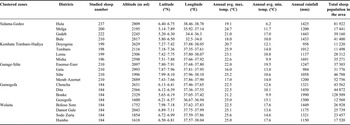
Stepwise purposive selection procedure was carried out in the study area where the districts and the Kebeles (villages) were purposively selected based on the available sheep population in each study zone. This was followed by identification of the households which owned at least four sheep and had prior experience in sheep husbandry. Among the identified households, 180–200 of them were then randomly selected from each zone to obtain the qualitative and quantitative sample data. All the sheep in the sampled households were included in the current study. Information on pertinent environmental variables and sheep types of the studied zones and districts is presented in Table 1.

Data collection procedures
Morphological characterization
Data on the assessment of qualitative characters and quantitative morphometrical traits were obtained from a total of 3966 sheep that were drawn from 928 households. For the assessment of quantitative morphometrical traits, only those aged one year and above were considered for the purpose of uniformed comparison. The FAO (2012) qualitative and quantitative sheep breed descriptor list was followed to characterize the sheep types phenotypically and morphologically.
Qualitative characters: Data on coat colour pattern, coat colour type, hair coat type, tail type, tail form, head profile, ear form, presence and absence of wattle, horn, ruff, and horn shape were observed and recorded for rams and ewes separately.
Quantitative morphometrical characters: They were obtained by a measuring tape calibrated in centimetres (cm) after restraining and holding the animals in an unforced position. All measurements were taken by the same personnel in each zone while sheep were in an up-right plane during measurement. The following linear body measurements were taken: chest girth, height at withers, shoulder width, pelvic width, body length, ear length, head length, horn length, tail length and circumference, scrotum circumference, canon length and canon circumference. The morphometrical measurements were taken using self devised equipments and according to the methods suggested by Macjowski and Zieba (Reference Macjowski and Zieba1982). Body weight was measured using suspended spring balance with 50 kg capacity with ±100 g error margin (for heavier animals) and 25 kg capacity with ±50 g error margin (for lighter ones). The age of animals was estimated using dentition method as suggested by Charray, Humbert and Leif (Reference Charray, Humbert and Leif1992).
Data analysis
Preliminary data analysis such as homogeneity test, normality test and screening of outliers was employed before conducting the main data analysis. Discrete measurements on the form and appearance of the investigated animals were analysed using the frequency procedure of chi-square test.
Body weight and quantitative linear body measurements were analysed using the generalized linear model procedures (SPSS, 2003). Administrative zones were fitted as fixed independent variables, whereas body weight and linear body measurements were fitted as dependent variables. Means were separated using Duncan's multiple range test procedure and values were considered significant at P < 0.05. Hierarchical cluster analysis was conducted and dendrogram constructed based on Euclidean distances between populations derived from morphological variables using the unweighted pair-group method to describe morphological clustering pattern of the investigated sheep types. The major quantitative morphometrical variables included in the hierarchical cluster analysis were body weight, chest girth, body length, height at withers, pelvic width and shoulder length of the rams and ewes, in which the data for individual traits were pooled for both sexes within each of the studied zones.
Results
Qualitative characters
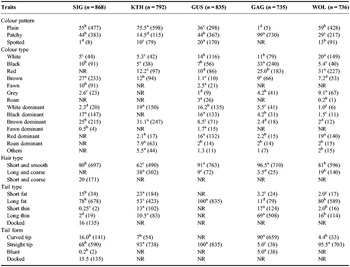
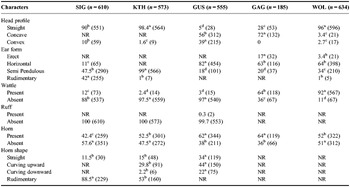
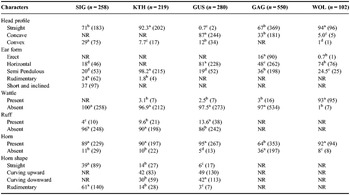
The results relating to the qualitative characters in all sheep raised in the five administrative zones are presented in Tables 2–4. Data presented in Table 2 indicate combined results of the major qualitative characters of both sexes. Plain coat colour pattern was observed in all zones with sheep in KTH having significantly (P < 0.05) higher proportions than those of SIG, GUS and WOL (Table 2). The sheep in GAG were characterized by having significantly (P < 0.05) larger numbers with patchy coat colour pattern than those found in other zones.
Percentage values for some phenotypic qualitative traits observed in sheep populations (N = 3966).

a,b,c,d,e Indicated values among rows for traits significantly differ at χ2 < 0.05.
Values in parenthesis indicate number of observations.
NR = not reported; SIG = Sidama-Gedeo; KTH = Kembata Tembaro-Hadiya; GUS = Gurage-Silte; GAG = Gamogofa; WOL = Wolaita.
Percentage values for some phenotypic qualitative characters observed in ewes (N = 2557).

a,b,c,d,e Indicated values among rows for traits significantly differ at χ2 < 0.05.
Values in parenthesis indicate number of observations.
NR = Not reported; SIG = Sidama-Gedeo; KTH = Kembata Tembaro-Hadiya; GUS = Gurage-Silte; GAG = Gamogofa; WOL = Wolaita.
Percentage values of some qualitative characters in rams (N = 1409).

a,b,c,d,e Indicated values among rows for traits significantly differ at χ2 < 0.05.
Values in parenthesis indicate number of observations.
NR = not reported; SIG = Sidama-Gedeo; KTH = Kembata Tembaro-Hadiya; GUS = Gurage-Silte; GAG = Gamogofa; WOL = Wolaita.
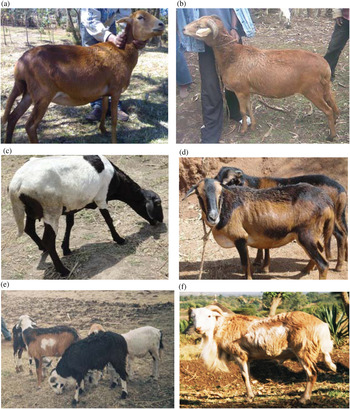
As shown in Table 2 and Figure 1a, the brown coat colour with brown dominant type was commonly observed among the sheep reared in SIG. The word ‘dominance’ indicates that besides the colours mentioned there were patches or spotting of other colours. The most common hair coat colour in KTH sheep was brown dominant followed by white dominant (Figure 1b). The dominant hair coat colour of sheep in GAG was black (33 percent) followed by red (25 percent) (Figure 1c). The red hair coat colour predominates (31 percent) in sheep of WOL (Figure 1d). The commonly observed hair coat colour of sheep in GUS was primarily white followed by red and brown dominant (Figure 1e).
Variations in some qualitative traits of indigenous sheep populations found in southern Regional State of Ethiopia. (a) = Sidama-Gedeo female sheep, polled; (b) = Kembata Tembaro-Hadiya male sheep, horned; (c) = Gamogofa female sheep, polled; (d) = Wolaita female sheep, polled; (e, f) = Gurage-Silte sheep flocks, horned.

Most of (80 percent and above) the sheep in SIG, GUS, GAG and WOL were characterized by possessing short and smooth hair. The hair of most KTH sheep (62 percent) was short and smooth, whereas the rest was long and coarse. As shown in Figures 1a, b, d and e, the most common tail type and form in SIG, KTH, GUS and WOL sheep were of long fat type ending with a straight tip. However, the tail type of sheep in GAG was dominantly long and thin ending with curve tip form (Figure 1c).
The values of some qualitative characters observed in ewes are presented in Table 3. Proportionately the ewes in SIG, KTH and WOL had higher numbers of straight head profiles, whereas those with concave head profile were observed in large numbers in GAG and GUS. The convex type of head profile predominated only in GUS. In ewes, semi pendulous and horizontal ear forms were the most commonly observed type across the zones. However, about 42 percent ewes in SIG were observed with rudimentary ear form. Most of the ewes in SIG, KTH and GUS were devoid of wattles, whereas the reverse was observed in GAG and WOL (Figure 1a–e). Ruff was grossly absent in most of the zones. Over 60 percent of sheep in GUS and GAG were horned, whereas the polled ewes outnumbered the horned ones in SIG. However, similar proportions of horned and polled ewes were observed in KTH and WOL. Rudimentary horn shapes predominated in SIG and KTH, whereas straight and curved types were mostly observed in GUS.
The average values of some qualitative characters observed in rams are presented in Table 4. About 90 percent of male sheep in KTH and WOL were observed with straight head profile followed by SIG (71 percent) and GAG (67 percent), whereas those with concave profile were predominantly found in GUS (87 percent). High proportions of ear forms oriented horizontally were observed in GUS followed by WOL. The rams with semi-pendulous ear form were mostly observed in KTH (98 percent) followed by GAG, whereas short and rudimentary ear forms were mostly observed in those raised in SIG. Large proportions of rams (over 96 percent) in all zones were devoid of wattles except those in WOL. Ruff was mostly absent in SIG, KTH and GUS. Horn was present in most of the rams across all studied zones with variable proportions ranging from 64 percent to 92 percent. However, about 36 percent of male sheep in GAG were polled. About 61 and 39 percent of the rams in SIG had rudimentary and straight horn shapes, respectively. Most of the rams in KTH and GUS had a curving horn shapes with either upward or downward orientations.
Quantitative morphometrical characters
Rams
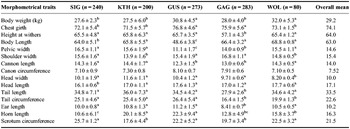
As presented in Table 5, significantly (P < 0.05) high body weight values were found in rams from GUS and WOL. The chest girth of rams from GUS and GAG was significantly (P < 0.05) higher than those from other zones where similar values were observed. The height at withers was similar among rams in SIG, KTH, GUS and WOL, but significantly (P < 0.05) higher than those in GAG. Rams in KTH, GAG and WOL had similar body length values being significantly (P < 0.05) higher than those in SIG and GUS. Rams reared in SIG, KTH and WOL had significantly (P < 0.05) higher pelvic width values than those in GAG and GUS (Table 5). There was also significant (P < 0.05) difference between zones for shoulder width in rams, the highest value being observed in those from GAG but the lowest from sheep KTH.
Average values of quantitative morphometrical traits of rams (means ± SD, cm; N = 1076).

a,b,c Means across rows between zones with different superscript letters are significantly (P < 0.05) different.
SIG = Sidama-Gedeo; KTH = Kembata, Tembaro-Hadiya; GUS = Gurage-Silte; GAG = Gamogofa; WOL = Wolaita.
The values of cannon length indicated significant (P < 0.05) differences among the populations in which rams in SIG, KTH and WOL had higher values than those in GAG and GUS. Although the canon circumference did not differ significantly among zones, it was the highest in rams from GUS and GAG, whereas similar values were observed among other zones.
Similar values in head length were observed in rams reared in KTH, GUS, GAG and WOL being significantly (P < 0.05) higher than those in SIG. Moreover, there were significant variations in head width in which rams reared in SIG, KTH, GUS and GAG had significantly (P < 0.05) higher values than those in WOL.
The tail and ear length values were similar among rams reared in SIG, KTH, GUS and WOL and they were significantly (P < 0.05) higher than those observed in SIG. The tail circumference values were the highest in rams from GUS and the lowest in rams from GAG. However, these values were similar among those rams reared in SIG and KTH. The highest horn length values were observed in rams reared in GUS but the lowest in those from SIG. The scrotal circumference in rams from SIG, GUS and WOL was significantly (P < 0.05) higher than those from other zones.
Ewes
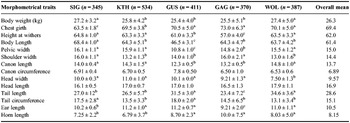
As shown in Table 6, the body weight was significantly (P < 0.05) heavier in ewes from SIG and WOL than those from KTH, GUS and GAG, where similar values were recorded. The chest girth values of ewes in GUS, GAG and WOL were similar, but significantly (P < 0.05) higher than those in SIG and KTH. Ewes from SIG, KTH and WOL had significantly (P < 0.05) higher height at wither values than those from other zones. The highest body length value was obtained from ewes reared in SIG and it was significantly (P < 0.05) higher than those in KTH, GAG and WOL which had similar values. The lowest body length was obtained from ewes reared in GUS. In general, male and female sheep in GUS had the lowest body length values.
Average values of quantitative morphometrical traits of ewes (means ± SD, cm; N = 2047).

a,b,c Means across rows between zones with different superscript letters are significantly (P<0.05) different.
SIG = Sidama-Gedeo; KTH = Kembata, Tembaro-Hadiya; GUS = Gurage-Silte; GAG = Gamogofa; WOL = Wolaita.
Ewes in SIG, KTH and WOL had a significantly (P < 0.05) high pelvic width value as compared with other zones. The lowest pelvic width value was obtained in ewes reared in GUS. The shoulder width values in ewes from SIG and GAG were significantly (P < 0.05) higher than those from KTH, GUS and WOL which exhibited similar values.
The canon length was comparable among ewes in SIG, KTH and WOL, being significantly (P < 0.05) higher than those in GUS and GAG which showed similar values. The canon circumference and head length values did not indicate significant difference in ewes reared across all zones.
Ewes from SIG, KTH, GUS and GAG had significantly (P < 0.05) higher head width values than those from WOL. The tail length was significantly (P < 0.05) higher in ewes raised in GUS and WOL than those in other zones. The values for the tail circumference were significantly (P < 0.05) higher in ewes from SIG and GUS than those from KTH, GAG and WOL which had similar values. Significantly (P < 0.05) high ear length values were observed in ewes from KTH, GUS and WOL as compared with those from SIG and GAG. The study further indicated that the horn length was significantly (P < 0.05) higher in the ewe population raised in GUS, GAG and WOL than those in SIG and KTH.
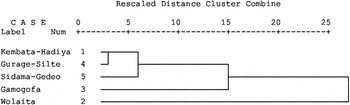
The dendrogram of Figure 2 indicated a close relationship among the sheep reared in KTH, GUS and SIG. However, the sheep in WOL and GAG were distantly associated with those in other three zones.
Unweighted pair group method with arithmetic averaging dendrogram based on between population Euclidean distances derived from morphological variables.

Discussion
Qualitative characters
This study describes the morphology and phenotypes of sheep found in eight administrative zones of Southern Regional State of Ethiopia. It was proposed by Gizaw et al. (Reference Gizaw, Van Arendonk, Komen, Windig and Hanotte2007) to categorize the Adilo sheep of Southern Regional State of Ethiopia with Arsi-Bale sheep. However, Adilo has been long known as a hot spot of sheep market place where livestock from various parts of the region collected, traded and dispatched to different regions of the country; hence it does not necessarily represent a single district of the study region. The dendrogram in the current study clearly indicated that the WOL sheep greatly differentiated from sheep in other zones. Although not obvious, the GAG sheep were also segregated from those closely related sheep found in KTH, GUS and SIG which share geographic proximity and similarities in ecology and communities who own the sheep, thus allowing gene flow among populations.
It is apparent that coat colour patterns can vary between the head, neck, trunk and limbs. In both sexes, the predominant coat colour patterns were plain and patchy with similar proportions of appearance. This is consistent with the reports of Edea et al. (Reference Edea, Haile, Tibbo, Sharma, Assefa, Sölkner and Wurzinger2010) and Tibbo and Ginbar (Reference Tibbo and Ginbar2004) for Bonga and Horro sheep types of Ethiopia.
In both sexes, the proportion of sheep having red and brown coat colour was greater than that of other coat colours. The results are in good agreement with the findings of Galal (Reference Galal1983) for Menz sheep as well as Tibbo et al. (Reference Tibbo, Ayalew, Awgichew, Ermias and Rege2004) and Edea et al. (Reference Edea, Haile, Tibbo, Sharma, Assefa, Sölkner and Wurzinger2010) for Horro and Bonga sheep. The higher proportion of animals with red coat colour could be a reflection of strong selection for animals manifesting red colour to meet the preference of market demand. Most of the sheep studied were characterized by short and smooth hair. According to the findings of Gizaw et al. (Reference Gizaw, Komen, Hanotte and van Arendonk2008), the Adilo sheep were reported to be short-haired, whereas the Arsi-Bale, Bonga and Afar sheep were characterized by hairy fibre hair.
Sheep in SIG, KTH, GUS and WOL had a characteristic long fat tail with a straight tip. These findings are in good agreement with the work of Gizaw et al. (Reference Gizaw, Komen, Hanotte and van Arendonk2008) for Adilo and Arsi-Bale, Getachew et al. (Reference Getachew, Haile, Tibbo, Sharma, Kifle, Terefe, Wurzinger and Sölkner2010) for Horro and Menz and Edea et al. (Reference Edea, Haile, Tibbo, Sharma, Assefa, Sölkner and Wurzinger2010) for Bonga sheep. In other studies conducted by Tibbo et al. (Reference Tibbo, Ayalew, Awgichew, Ermias and Rege2004) and Getachew et al. (Reference Getachew, Haile, Tibbo, Sharma, Kifle, Terefe, Wurzinger and Sölkner2010), the Menz sheep had a characteristic short fat tail, which was curved upward at the tip. However, GAG sheep were characterized by a long thin tail ending with a slight curve tip. These findings are contrary to the results of Gizaw et al. (Reference Gizaw, Komen, Hanotte and van Arendonk2008), who reported Adilo sheep as having a long fat tail. The reason for this discrepancy could be explained by the small sample numbers assessed in the previous studies and also the fact that Adilo is basically a trading place where there are possibilities of genetic admixture among sheep populations coming from the neighbouring regions.
The presence of wattle is comparatively low in rams but high in ewes. These findings are consistent with the reports of Tibbo and Ginbar (Reference Tibbo and Ginbar2004). It was observed that ruff was absent in both ewes and rams. This is in agreement with the reports of Edea et al. (Reference Edea, Haile, Tibbo, Sharma, Assefa, Sölkner and Wurzinger2010) for Bonga and Horro sheep. In agreement with the findings of Getachew et al. (Reference Getachew, Haile, Tibbo, Sharma, Kifle, Terefe, Wurzinger and Sölkner2010), most sheep of both sexes in all zones were characterized by the presence of horns. In contrary, both the rams and ewes among the Bonga sheep were reported to be polled (Gizaw et al., Reference Gizaw, Komen, Hanotte and van Arendonk2008; Edea et al., Reference Edea, Haile, Tibbo, Sharma, Assefa, Sölkner and Wurzinger2010).
Quantitative morphometrical traits
The body weight values of the ewes as obtained from the present study were higher than those reported by Abebe, Kannan and Goetsch (Reference Abebe, Kannan and Goetsch2010) and Tafa, Melaku and Peters (Reference Tafa, Melaku and Peters2010) for yearling Arsi-Bale sheep and Banerjee, Kefelew and Sintayehu (Reference Banerjee, Kefelew and Sintayehu2010) for yearling and ewes aged above 2 years. However, the values were lower than those of other sheep types of Ethiopian origin reported by Galal (Reference Galal1983) for Horro and Menz. The body weight of sheep from GUS and WOL was comparable to that of Bonga sheep, but higher than Horro sheep (Edea et al., Reference Edea, Haile, Tibbo, Sharma, Assefa, Sölkner and Wurzinger2010). However, the body weight in the SIG and KTH sheep were in agreement with that of Horro sheep. The observed differences in body weight might be caused by the age of animals, sheep type and management and/or production environments in which the animals were kept. Generally, live weight of male sheep from GUS and WOL meets the recommended live export body weight of 30 kg at yearling age (Tibbo, Reference Tibbo2006). In agreement with the works of Tibbo et al. (Reference Tibbo, Ayalew, Awgichew, Ermias and Rege2004), rams were consistently heavier and larger in body size than ewes.
Figures for height at withers, chest girth and body length in ewes observed in this study were comparable to those reported by Abegaz (Reference Abegaz2007) for Gumuz sheep and Lemma (Reference Lemma2002) for central highland and north-western highland sheep. The height at withers of ewes was similar to those reported by Baffour-Awuah et al. (Reference Baffour-Awuah, Ampopo and Dodoo2000) from Ghana, Afolayan, Adeyinka and Lakpini (Reference Afolayan, Adeyinka and Lakpini2006) for Yankasa sheep of Nigeria, Traoré et al. (Reference Traoré, Tambouraa, Kaboré, Royo, Fernández, Álvarez, Sangaré, Bouchel, Poivey, Francois, Toguyeni, Sawadogo and Goyache2008) for Burkina Faso sheep, Abegaz, Hegde & Taye (Reference Abegaz, Hegde and Taye2011) for Gumuz ewes and Tibbo et al. (Reference Tibbo, Ayalew, Awgichew, Ermias and Rege2004) for Horro and Menz ewes of Ethiopia. However, these values in the present study were lower than those reported by Galal (Reference Galal1983) for Horro sheep, Taye et al. (Reference Taye, Abebe, Gizaw, Lemma, Mekoya and Tibbo2010) for Washera sheep and Lemma (Reference Lemma2002) for Western highland sheep of Ethiopia, but higher than the Abergelle sheep reared in Tigray region of Ethiopia (Seare et al., Reference Seare, Kebede, Singh and Daud2007). The height at withers of GAG, WOL and KTH sheep was comparable with that of Horro and Bonga sheep under on-station management (Edea et al., Reference Edea, Haile, Tibbo, Sharma, Assefa, Sölkner and Wurzinger2010). Getachew et al. (Reference Getachew, Haile, Tibbo, Sharma, Kifle, Terefe, Wurzinger and Sölkner2010) also reported similar values for Menz and Afar sheep studied under their habitant production environments.
The results in the present study pertaining to rams raised in different zones indicate that the height at wither values find similarities with the observations of Lemma (Reference Lemma2002), Taye et al. (Reference Taye, Abebe, Gizaw, Lemma, Mekoya and Tibbo2010) and Seare et al. (Reference Seare, Kebede, Singh and Daud2007). However, higher values for this trait have been reported by Abdel-Moneim (Reference Abdel-Moneim2009) for Egyptian rams.
The overall chest girth values of ewes obtained from the current study are comparable to those reported by Tibbo et al. (Reference Tibbo, Ayalew, Awgichew, Ermias and Rege2004) for mature female Menz and Horro sheep. However, chest girth values reported by Getachew et al. (Reference Getachew, Haile, Tibbo, Sharma, Kifle, Terefe, Wurzinger and Sölkner2010) for Menz and Afar sheep were lower than those observed in the current study. These variations might be explained by the fact that Menz sheep are characterized by long fleece with coarse wool type having small body size which are known to be more adapted to cold environments (Gizaw et al., Reference Gizaw, Komen, Hanotte and van Arendonk2008; Getachew et al., Reference Getachew, Haile, Tibbo, Sharma, Kifle, Terefe, Wurzinger and Sölkner2010). Similarly, the Afar sheep have been also characterized by small body size and are more suitable to extreme arid and hot environment (Getachew et al., Reference Getachew, Haile, Tibbo, Sharma, Kifle, Terefe, Wurzinger and Sölkner2010).
The overall body length values of ewe populations in the current study are consistent with the findings of Tibbo et al. (Reference Tibbo, Ayalew, Awgichew, Ermias and Rege2004) for Menz and Horro sheep and Getachew et al. (Reference Getachew, Haile, Tibbo, Sharma, Kifle, Terefe, Wurzinger and Sölkner2010) for Afar sheep. The values related to body length of ewes in the present study are also comparable to those of Traoré et al. (Reference Traoré, Tambouraa, Kaboré, Royo, Fernández, Álvarez, Sangaré, Bouchel, Poivey, Francois, Toguyeni, Sawadogo and Goyache2008), Taye et al. (Reference Taye, Abebe, Gizaw, Lemma, Mekoya and Tibbo2010) and Abegaz, Hegde & Taye (Reference Abegaz, Hegde and Taye2011). The body length of the Horro adult ewes as reported by Gizaw et al. (Reference Gizaw, Komen, Hanotte and van Arendonk2008) was comparable to that of ewes reared in SIG.
The result for pelvic width in the present study finds similarity with that of Taye et al. (Reference Taye, Abebe, Gizaw, Lemma, Mekoya and Tibbo2010) for the Washera ewes of Ethiopia. Tibbo et al. (Reference Tibbo, Ayalew, Awgichew, Ermias and Rege2004) reported pelvic width values ranging from 15.9 to 16.9 cm for 2-year-old Menz and Horro ewes, which are in good agreement with current findings of both sexes. However, the pelvic width values observed in the ewes of GUS and GAG were lower than those of the Washera sheep reported by Taye et al. (Reference Taye, Abebe, Gizaw, Lemma, Mekoya and Tibbo2010). Similarly, higher pelvic width values (17.9–20.7 cm) were reported for Menz and Afar sheep (Getachew et al., Reference Getachew, Haile, Tibbo, Sharma, Kifle, Terefe, Wurzinger and Sölkner2010). These variations might be associated with the age, sheep type and sex of investigated sheep types in the present and previous investigations.
The average head width values for rams and ewes in studied locations are lower than those reported by Handiwirawan, Noor, and Sumantri (Reference Handiwirawan, Noor and Sumantri2011) for Indonesian sheep breeds. The overall tail length of sheep obtained from the current study was higher than reported for Afar and Menz sheep (Getachew et al., Reference Getachew, Haile, Tibbo, Sharma, Kifle, Terefe, Wurzinger and Sölkner2010) but comparable to that of Horro sheep (Awgichew, Reference Awgichew2000) as well as Adilo and Arsi-Bale female sheep (Gizaw et al., Reference Gizaw, Komen, Hanotte and van Arendonk2008). The tail length and circumference of rams were generally higher than ewes, which were possibly associated with body size variations. The tail circumference observed in ewes was comparable to those reported for Menz and Horro sheep (Awgichew, Reference Awgichew2000) but higher than those of both sexes of Menz and Afar sheep under field conditions (Getachew et al., Reference Getachew, Haile, Tibbo, Sharma, Kifle, Terefe, Wurzinger and Sölkner2010).
The ear length values of rams find similarity with the observations of Taye et al. (Reference Taye, Abebe, Gizaw, Lemma, Mekoya and Tibbo2010) and Abegaz, Hegde and Taye (Reference Abegaz, Hegde and Taye2011). As observed by Traoré et al. (Reference Traoré, Tambouraa, Kaboré, Royo, Fernández, Álvarez, Sangaré, Bouchel, Poivey, Francois, Toguyeni, Sawadogo and Goyache2008), ear length of ewes of Burkina Faso was lower than those obtained from the present study. Similarly, lower values for ear length have been reported by Taye et al. (Reference Taye, Abebe, Gizaw, Lemma, Mekoya and Tibbo2010) for Washera sheep of both sexes, but the ear length values of the Sudan-Sahel ewes of Burkina Faso sheep reported by Traoré et al. (Reference Traoré, Tambouraa, Kaboré, Royo, Fernández, Álvarez, Sangaré, Bouchel, Poivey, Francois, Toguyeni, Sawadogo and Goyache2008) were comparable with those of the present findings. The ear length values in the present study were longer than those reported for Abergelle ewes (Seare et al., Reference Seare, Kebede, Singh and Daud2007).
The scrotal circumferences as obtained from rams raised in SIG were comparable to that reported by Edea et al. (Reference Edea, Haile, Tibbo, Sharma, Assefa, Sölkner and Wurzinger2010) for Horro sheep, whereas sheep in GUS and WOL had similar values to that of the Bonga rams. The overall values of scrotal circumference were generally comparable to those reported by Getachew et al. (Reference Getachew, Haile, Tibbo, Sharma, Kifle, Terefe, Wurzinger and Sölkner2010) for the rams of Menz, but lower than that of Afar sheep under their production environments. A scrotal circumference is an indirect measure of ram fertility and used to asses breeding soundness of ram with a high heritability (Söderquist and Hulten, Reference Söderquist and Hulten2006).
Conclusions
The present study was initiated to describe the qualitative characters and quantitative morphometrical traits of indigenous sheep types reared in Southern Nations and Nationalities Regional State of Ethiopia. This study revealed the presence of high variability in the observed qualitative and quantitative morphometrical characteristics among the sheep studied in all administrative zones. It is thus concluded that the indigenous sheep in these zones may possess unique adaptive features that are useful in designing sustainable sheep improvement programmes in the region. Moreover, the sheep from the Gamogofa and Wolaita showed some distinctive features that were not observed in other sheep. It is thus recommended to assess the population structure of these indigenous sheep using molecular tools.
Acknowledgments
We sincerely acknowledge the Southern Agricultural Research Institute (SARI) for the reliable budget support throughout the experimental period. We also appreciate the invaluable contribution of Dr Tadelle Dessie (ILRI), Dr Aynalem Haile (ICARDA) and Dr Gebeyehu Ganga (SARI) in drafting the original research proposal of the current study. We express our heartfelt appreciation to all sheep owners in the study zones for allowing us to use their animals for liner body measurements and for devoting their precious time in providing the required information.