


From the thirteenth century to the fifteenth century, parliamentary statutes in medieval England provide a classic example of the inscrutability of the law: recorded in a professional dialect of French, or occasionally Latin, they required special training to interpret even if one could read Anglo-French. Perhaps on account of the ubiquity of statutes in learned languages, however, as yet scholarship has devoted little space to the study of statutes translated into English. This lacuna unfortunately limits scholarly development of a fuller understanding of the complex relationships among language, social power, and status in the fifteenth century, at the very beginning of the Tudor era. In fact, the cultural contexts of the physical evidence for fifteenth-century statute translation suggest that translations were not the result of simple linguistic necessity and that in translating the statutes into and out of English the patrons of these books were making social and political statements deeply situated in the unique political cultures of their eras.
Legally speaking, statute translations suffered from a double disability that has kept them outside of scholarly study: they were copies and in an unofficial language. From a strictly legal standpoint, any copies of statutes, even in the original language, were less than official and had no formal legal force. Nevertheless, local officials were instructed to proclaim statutes to local populations in the vernacular for practical purposes, because in England no one should be surprised by the law. English law in English was useful in that it could convey the law to the common people, even if it was not an official language of the law. Until the print era, then, in a sense statutes were never officially available in English, but they were also always practically available in English. Nevertheless, physical traces of translations remain rare. This makes it particularly noteworthy that three major translations were made between 1442 and 1445 that remain today in both manuscript and print witnesses. Furthermore, these were not the only unofficial translations recorded. Sometime soon after 1496, three patrons of luxury statute collections sought out French copies of Tudor statutes that by then existed officially in English. After 1496, these French statutes were no more official than the English statutes had been in the 1440s.
That translation might be a location of cultural tension, as well as a result of it, is not a radical claim, but this assertion has not been made regarding the medieval statutes. Such a claim challenges the received narrative, such as it is. Generally, when medieval statutes are discussed at all, scholars consider the statutes to have been translated with little controversy in the 1530s.Footnote 1 The enormously significant translation of the Bible occurring in the same period overshadows such legal translations. In this scholarly tradition, the translation of the medieval statutes simply occupied the same cultural moment of translation as the Bible, during which the pillars of English textual culture finally came to be available in English. Instead, the present argument suggests that evidence of statute translation both into and out of English has gone disregarded as evidence for a complicated linguistic, cultural, and legal landscape in fifteenth-century England.
Getting at the cultural weight of statutes in practice, and not just in theory, is an example of what can be gained by pursuing a methodology I will call “prosopography of the book.” In historical study, prosopography offers insight into political and social history through the process of aggregation. In academic prosopography, historians discover and compile as much data as possible, and then they draw inferences from that data. In this way, historians seek to examine lives and actions about which no direct records exist.Footnote 2 For premodernists, such data might include birth and death dates, social status markers like level of nobility or servility, economic status and locations of wealth, levels of education or familiarity with languages, and association with local institutions such as parishes or government offices. While analysis of such details can reveal much about historical elites, prosopography has been used also to develop composite pictures of common life in the premodern world—the daily lives of ordinary people.Footnote 3 This use of case studies based on aggregate data highlights the potential doubleness of prosopography: its results can be common and broadly applicable at the same time as they may also be individual and local.Footnote 4
Like prosopography, book history is a well-known method that specializes in the minutiae of physical objects, especially their historical contexts; in contrast to book history, prosopography of the book fully allows for the transition from manuscript to print. It does this by making use of the widest possible manuscript data sets, because these data sets are large enough to be related to early print data sets. Thanks to its insistence whenever possible on aggregation of both manuscript and print data sets, prosopography of the book requires a broader archival investigation than history of the book. At the same time, a sensitivity for both representative samples and samples that are especially unique provides a researcher focus in the archive. This method emphasizes the necessity of a radical interdisciplinarity, because the more data that can be gathered about the physical codices, as well as their historical contexts and provenances, the better. For example, in the following analysis of manuscripts and printed editions, much time is spent discussing people. In manuscript studies, this examination might be called simply provenance, but here it extends widely, considering the geographic, political, social, and linguistic milieux of the people and places associated with these particular books. This aggregation provides the foundation on which to speculate about the people associated with volumes that once existed but that are no longer extant.
Even when its methods remain similar to those of codicology and book history, practicing prosopography of the book reminds scholars of the constructed nature of historical narrative. Prosopography of the book both emphasizes the care with which scholars craft critical historical narratives and underscores the potential, even the necessity, for fiction in every narrative. After all, the word “prosopography” is closely associated with the Greek prosopopoeia.Footnote 5 While prosopopoeia has a range of meanings, two are crucial here. First, in classical rhetoric, prosopopoeia was a strategy used to develop characterization, and this provided a way to discuss political actors in history. Fictional or historical, any character conveyed in a classical text is a persona, and therefore subject to prosopopoeia.
Second, scholars of Britain study a culture that was especially tuned to the narratives of material culture and prosopopoeia specifically. Anglo-Saxon England is celebrated for developing another valance of prosopopoeia, the notion of the speaking thing. While prosopopoeia had been used to dramatize inanimate or nonhuman objects since classical times, it was the Anglo-Saxons who seized upon this facet of the trope most vigorously, anthropomorphizing swans, onions, and a wide range of animals and objects in their riddles.Footnote 6 Such riddles had to be decoded in order to serve their entertainment or didactic purposes. The physical premodern codices that scholars examine in libraries today are physical riddles, and only by decoding them can we glean the information necessary to understand their position within their cultures.
Certainly historians and codicologists consider books and people, but to be most effective, these combined processes must explore the widest possible groups of manuscripts—listen to the greatest number of things speak—in order to be sensitive to the deviations in the larger pattern. Prosopography must take into account the physical document of the book and make it speak. Likewise, codicology must take into account social and political culture and the lived lives of the people using books. While noteworthy studies have resulted from such methods, fifteenth-century England and its unique books remain underexamined.Footnote 7 Prosopography of the book has not been fully applied to the material culture of England in the era in which the Hundred Years' War ended, printing was introduced, and the first Tudor came to the throne. Simply put, scholars of late medieval and early modern England must begin to practice a prosopography of the book. When we consider the translated statute collections against the backdrop of the mass of statute collections, when we consider them using the prosopography of the book, we are able to speculate about the niche within English society and culture in which they fit, rather than single them out as purely idiosyncratic.
STATUTE LAW AND STATUTE BOOKS
The collections of statutes of the medieval English Parliament in manuscript are an excellent place to begin such prosopography of the book, because more of them exist than almost any other text designed for use in England alone.Footnote 8 Over 450 manuscript copies of the law French medieval statutes remain today, and outside of England, these would have served no purpose.Footnote 9 These manuscript collections date from the very earliest days of statute collecting in the later thirteenth century to the early sixteenth century. In contrast to the mass of learned statutes, the most numerous text in Middle English, the first complete translation of the Bible into English, the Wycliffite Bible, exists in just over 250 copies, dating from the late fourteenth to the early sixteenth century.Footnote 10 Statute collections, then, are our largest textual data set for late medieval England, and they have gone almost without study.Footnote 11 This lack of examination has deprived scholarship of crucial scribal, artistic, and ownership evidence that may link owners of statute collections with networks of book artisans who worked on more storied, and therefore more studied, literary works.Footnote 12
The position of the medieval statutes within English society highlights the complexity of the medieval English legal system, which developed into the Anglo-American legal systems of the modern world.Footnote 13 Everyone was subject to the common law that was derived from precedent determined in the royal courts. However, there were local and manorial courts as well, courts of ecclesiastical law, and a range of special jurisdictions. A few jurisdictions used Latin for their courtroom debate and documentation. Most used a specialized dialect of Anglo-Norman French known today as “law French.” Anyone who has painstakingly read through a modern deed or terms of service knows that, even in English, legal language can be difficult. In Latin or law French, legal texts were entirely outside the abilities of most medieval people, who were as dependent on legal personnel as we are today.
The medieval statutes have a complicated relationship with the common law. The Old Statutes, or statuta vetera, were those predating Edward III's reign. The Old Statutes enshrined foundational decisions that had developed previously under the common law and that rarely changed.Footnote 14 Dating from Edward III's reign onward, the New Statutes, or statuta nova, concentrated on property and trade issues. Unlike the Old Statutes, the New Statutes had their origin in petitions brought by individuals or groups of citizens to Parliament, and therefore they were open to frequent parliamentary revisitation as conditions changed, necessitating reappraisals.
Like most of English law, the statutes themselves were recorded in law French, or sometimes Latin. As is now generally accepted in scholarly circles, late medieval England was multilingual: English, French, and Latin circulated in speech and writing, each in several dialects and forms. Even the most rustic peasant had a good chance of being exposed to all three languages regularly. However, language recognition, reading knowledge, and speaking ability offered different levels of power and authority to the practitioner.Footnote 15 Particularly among legal professionals and those in charge of administration, varying degrees of comprehension of French created social strata that shifted and stressed each other like tectonic plates.Footnote 16
A significant shift in the role of English in law occurred during the troubled administration of Henry VI (1422–61, 1470–71). The political dysfunction characteristic of the minority government and the ensuing civil war, the late period of the Hundred Years' War, the fight against heresy, and the king's periodic insanity should all inflect our understanding of the shifting use of legal language. Evidence exists that beginning with the 1362 Parliament, English was used increasingly, not only among the Commons, but also when the entire Parliament was assembled.Footnote 17 Not long into the fifteenth century, the common petitions in Parliament are recorded increasingly in English. While there were few petitions recorded in English under Henry IV or Henry V, they became common under Henry VI, and the complete parliamentary rolls began to be kept regularly in English after 1450.Footnote 18 The office of the Privy Seal did not employ English until after the 1420s, as the poet and bureaucrat Hoccleve's resolutely learned Formulary bears witness.Footnote 19 The appeals generating business in the Court of Chancery were consistently written in English beginning in the reign of Henry VI.Footnote 20 The fifteenth century, and in particular the reign of Henry VI, marked a growing acceptance of written English for legal purposes. To study such a time of transition, case studies become increasingly important in order to nuance the general data trends. This fact demands that we pay special attention to the handful of extant manuscript statute collections translated from law French into English, and later, after the standardization of printed statutes in English, translated from English into French.
TUDOR ENGLISH LAW
The medieval statutes, that is, those statutes predating the statutes of Henry VII, were not printed in English until the 1530s; however, because the text that was used as the basis of this edition was derived from a fifteenth-century translation, as I demonstrate below, the story of the printing of the medieval statutes in English begins a century earlier, in the 1440s. In this way, the printed English statutes form an important part of the prosopography of medieval statutes in manuscript and must be considered together as part of the same historical narrative. Though contemporary statutes began to be published in English beginning in the reign of Henry VII, the medieval statutes waited some time to be translated and printed. It is generally understood that the printer Robert Redman oversaw the first complete translation of the New Statutes in The Great Boke of the Statutes (1530–33) and the Old Statutes in The Boke of the Magna Carta (1534).Footnote 21 For the bulk of the former, I contend instead that Redman printed a translation made originally in the 1440s, and extant today in London, British Library MS Harley 4999, a manuscript discussed in detail in the final section. The Great Boke was reprinted around 1542, and the potential for profit (both financial and social) from an English translation of the medieval statutes appeared to be clear enough that the king's printer Thomas Berthelet printed an official translation of the medieval statutes in 1543.Footnote 22 The translation in Harley 4999 was made in a culture in which statutes in English were exceptional, but it survived and became the translation set into print in a later era in which statutes in English were standard.
The English Short Title Catalogue claims that the Great Boke was based on William Machlinia's Nova Statuta printed in 1485, and it was likely translated by the future courtier George Ferrers; however, Howard Jay Graham doubted this was the entire story.Footnote 23 One of the few scholars to consider law translation, Graham suspected that manuscript sources had been used in addition to a printed edition of the New Statutes in the preparation of the Great Boke: “[T]he Great Boke translation expands many highly abbreviated forms, titles, places and names in ways unlikely or impossible for one working simply from [a printed law French edition].”Footnote 24 In fact, as the appendices show, the Great Boke's translation varies little from that found in Harley 4999, and it would seem that the one was drawn from the other.Footnote 25
In short, the text of the Great Boke is nearly identical to the translation of Harley 4999, at least up until 1444 (22 Henry VI). Even in areas that show strong contrast between medieval translations, 1 Henry IV c. 2, for example, these two texts remain almost identical (appendix A). Nevertheless, there are differences between the two texts. For example, in translating “cultores” in the Statute of Laborers, the Great Boke's editor updates the Wycliffite “earthtillers” found in Harley 4999 to the more contemporary Tyndalean “ploughmen.”Footnote 26 The Great Boke retains the Latin and law French syntax less religiously than does Harley 4999. The spelling is significantly different, as befits a text appearing ninety years later in a period of rapid linguistic flux. Moreover, while Redman's editor had the statutes in English through 1442 (20 Henry VI) at hand, he still had to translate the statutes from the rest of Henry VI's parliaments, as well as those of Edward IV and Richard III. We cannot know whether this material came from a manuscript translation as did the earlier statutes, but it was clearly drawn from a translation other than that illustrated by Harley 4999, because the formula used in statute introductions is translated differently after 1442.
As demonstrated in the final section below, Harley 4999 has ties to London that may have made this translation available to Redman, although the codex itself lacks printers' marks and shows no signs of being used as the exemplar. Harley 4999 demonstrates that at least one English translation remained in circulation twenty or thirty years after the original translations were made in the 1440s. It seems likely, then, that a similar book, containing the same translation as Harley 4999, spent the intervening ninety years in the same milieu. Such a book might well have been known to lawyers with connections to Redman or to Lincoln's Inn, a law college close to Redman's shop that was the alma mater of two lawyers who owned volumes of translated statutes in the fifteenth century, who we will discuss below.
Another piece of evidence supporting the Great Boke's derivation from a medieval translation is that no translator is listed. Just a few years later, in 1534, the Great Boke's companion volume, the Boke of the Magna Carta, notes in the colophon that its translation was the work of George Ferrers. It is possible that Ferrers may have been the editor of the earlier Great Boke as well, and possibly the translator of the statutes after 1442. Ferrers was a law student admitted to Lincoln's Inn just after the first edition of the Great Boke was printed, and this sort of work might have been attractive to an advanced student preparing to enter one of the Inns of Court.Footnote 27
Thanks to its prologue, more evidence exists in the printed edition for the audiences envisioned for these translations than for the earlier manuscripts. An editor of the Boke of the Magna Carta offered two rationales that we may suspect lay behind the Great Boke as well. Students form part of the anticipated readership, and the prologue assures them that by careful study of the laws “a good student shal soone attayne to a perfyte iudgement.”Footnote 28 However, a larger general audience appears to have been expected also. The broad applicability of the law drove the editor's work “bycause the moste part of [the laws] retayne theyr force, and bynde the kyng & subiectes unto this day, me thought it necessary to set them forth in such sorte as men myghte beste have knowledge of them.”Footnote 29 This knowledge can only be obtained if the law is available in English, a language that a general audience can read: “[F]or this cause I saye was this boke translated into the Englyshe, whiche though percase it shal not satysfye the lerned, yet shall it be a good helpe for the unlerned.”Footnote 30 Here this writer acknowledges the legal insufficiency of the English statutes, while at the same time advertising their necessity for nonspecialist audiences. Even a few decades earlier, the motivation for owning translated statute books had been quite different.
ACCEPTING AND RESISTING HENRY VII'S ENGLISH LEGAL PROGRAM
By the time the medieval statutes came to be printed in English, the rationale for their translation and printing was increased availability for the common reader. This improved accessibility was not always desired by the owners of statute collections, however. Once English became established as the baseline language of all statutes, French or Latin statutes became rare. Thus, their continued existence demands examination. This section explores one case of statutes copied in law French during an era in which the language of the statutes had recently ceased to be French and became English.
The tradition of Henry VII championing English as the legal language of the realm dates back to the fifteenth century, and evidence exists in both manuscript and print for Henry's direct support of English statutes.Footnote 31 The first two parliaments of Henry VII's reign imposed high taxes, and these precipitated a revolt in the north of England in 1489.Footnote 32 Henry led an army to suppress the rebels personally and took a leading role in the campaign.Footnote 33 During these months, Henry consistently used proclamations to communicate his will to the nobles, the rebels, and the general public.Footnote 34 The following year, Henry seems to have experimented with yet another form of mass communication. In 1490, the historic first publication of statutes in English included statutes several years old, statutes that contained the tax increases that were at the heart of the 1489 revolt.Footnote 35 It seems incontrovertible that Henry saw regime security resulting from statutes available in English, especially when they were available inexpensively in print.
As several of Henry's proclamations suggest, statute language proved to be a barometer of political feeling throughout the 1490s. P. R. Cavill shows how the parliament that sat late in 1495 launched Henry's exploitation of the statutes for financial gain into the public arena.Footnote 36 This parliament included “one legal reform—which took as its premise the fact that existing legislation was not being enforced properly” and was called by the chancery clerks “the bill for the execucion of old statutes.”Footnote 37 This reform did not become a new statute, but was referenced in a proclamation titled “the proclamation for the observing of old statutes.”Footnote 38 Cavill claims that “the proclamation stated that Henry did not want to impose penalties without fair warning, but that he was determined that [all statutes] would be fully enforced in the future.”Footnote 39 The reasoning behind this proclamation must be the same as that behind Henry's promotion of the statutes in English. Providing further “fair warning,” Henry issued his last general pardons before his deathbed in the same year, or early in 1496.Footnote 40 The threat was implicit: if you had neglected the statutes in the past, purchase a pardon, or Henry's agents would come to collect. After this, the Crown's agents actively pursued Henry's interests in court.
After 1490, Henry's statutes in French would have had as little legal standing as English translations would have had before 1490, so there is reason to consider three volumes that date to the mid-1490s but include the early Tudor statutes in French.Footnote 41 Originally all of these volumes were designed to extend through 11 Henry VII, a statute printed first in 1496, and they switched from French to English after 3 Henry VII. This means that Henry's early statutes appear in French, despite having been printed in English in 1490.Footnote 42 Therefore, the first several Tudor parliaments are recorded in these volumes in an unofficial language: law French. It seems possible that these three volumes may attest to resistance from the legal profession to Henry's English program, however mild that resistance may seem to us. For example, the statute collection, London, Guildhall MS “Cartae Antiquae,” is blazoned with the arms of the City of London. Given Henry's unpopularity in London, we might see the city's attempt to extend the use of law French as a subtle negative commentary on the king.Footnote 43
For volumes dating after 1496 to include Henry's first parliaments in French, the scribe or patron must have gone out of his way to find copies of the statutes of Henry's first two parliaments still circulating in manuscript in law French.Footnote 44 This the copyists could have accomplished in two ways. First, the scribes could have located law French sessional copies predating the printing of these statutes in English in 1490.Footnote 45 Katherine Pantzer argues that the first two parliaments of Henry VII were recorded in law French and that these statutes were not translated into English until they were printed together with Henry's third parliament's statute around 1490.Footnote 46 The second option is more straightforward and therefore more likely: the scribes could have copied from slightly earlier collections that predated the 1490 translation and printing and included those statutes in French.Footnote 47 Tellingly, there is some evidence of scribal and artistic overlap between volumes predating 1490 and the so-called French volumes, suggesting that the copyists may have had access to such exemplars.Footnote 48
Given the unofficial nature of these statutes in law French in 1496, it would be unwise to assume that the use of nonstandard copy texts was accidental. The patrons of these books must have specifically requested, perhaps even provided, the law French exemplars of the earlier statutes. That they did not do so for the remaining statutes to 1496 offers us a snapshot of the shifting linguistic landscape of the 1490s. The patrons made an effort to be traditional as long as it was practical to do so, but they would not go as far as being obviously reactionary.
These copies of the New Statutes forcibly display the complex, politicized relationship between law French and English, and between script and print in the early Tudor period. Among the highest echelons of the legal profession, the preference for law French appears strong right up until Henry VII set Caxton to printing the statutes in English in 1490, and in a few cases it extended even beyond that. Professional lawyers did not require English statutes, and their books remained true to longstanding linguistic tradition as long as possible. This language choice might signal a preference for traditional legal practice as well: Henry's enforcement of royal rights was popularly seen to be resuscitating Old Statutes and past offenses, and in response, the first statute of Henry VIII included stipulations that limited the window of prosecution on penal statutes to three years.Footnote 49 It is not impossible that Henry's push for English translation was, for a time at least, associated with his strict enforcement of the statutes and that this association temporarily halted momentum toward translation of the medieval statutes. Indeed, the next time a lawyer “Englished” statutes was not until 1519, and he did so with the stated goal of protecting the commons from possible legal penalties, including the kind of legal penalties that Henry VII was so swift to prosecute.Footnote 50 We have already seen that the common good was a goal of the first complete translation of the medieval statutes into English, and this trend appears to have its source in Henry VII's policies. If Henry VII had promoted printed statutes in English in order to highlight the inevitability of his own financial policy, printers working under his son took it upon themselves to prepare and disseminate the medieval statutes in English for both common good and personal profit.
THE MANUSCRIPT EVIDENCE
The translation that Robert Redman used in his self-interested civic-mindedness when he printed the Great Boke was one of three dating to nearly a century earlier. Like the belated law French statute copies, such an unexpected effort to render and disseminate statutes in English in an era in which they had no official purpose begs investigation. The four complete collections of English New Statutes extant today date to Henry VI's reign or later, and they were part of the acceleration of English in official documentary culture throughout the first half of the fifteenth century. The volumes also highlight the level to which scholars have not yet fully explored the interplay of political power and linguistic authority in late medieval England. As in prosopopoeia, once decoded, these volumes allow us to characterize these issues to a greater degree than previously.
The statute collection Cambridge, University Library, MS Ff 3.1 translates most of the statutes from the start of Richard II's reign to midway through Henry VI's reign. It was later owned by the esteemed lawyer Sir James Hobart.Footnote 51 Like the other English statute collections, Ff 3.1 is an enormous folio volume that would have required significant financial outlay simply to procure the copying necessary to its construction. Moreover, the patron of this book chose an apparently continental artist working in the English style, possibly in the provinces, or in one of the liberties within London. Figure 1 exhibits several traits characteristic of this artist's style. The opening of each reign is marked by a spray initial or an illuminated partial bar border, which are common in statute collections. Sprays end frequently in an acanthus leaf twisted around a duck, and the roundels and initials sometimes enclose monochrome human heads. The duck motif appears so frequently that it may be a rebus, but if so, it is not clear to which family the rebus refers. Every individual statute begins with a spray initial, an illuminated initial decorated with sprays of vinework. As in the illustration, sprays feature green lobes and gold ball motifs, as well as twisted acanthus and a range of aroids, the mottled lilylike inflorescence protruding from bracts common to late medieval art across Europe. Border and initial sprays feature acanthus leaves using rows of dots and dramatic self-shading to model three-dimensionality. The leaves lack the hatching used commonly later in the century. Trumpet flowers in the form of cup flowers are prevalent, as are aroids, though not in the larger forms characteristic of midcentury England.
Cambridge, Cambridge University Library MS Ff 3.1, f. 77r. Reproduced by kind permission of the Syndics of Cambridge University Library.

This dense collection of artistic details hints at the identity of the artist and location of production of Ff 3.1. Many of these motifs suggest an artist confident in the English idiom but importing a range of colors and execution not native to England. The spray initials on individual statutes are like champs in that they are gold on a ground covered in filigree; however, these are not the blue and rose grounds with white filigree usual in English champs, or even the jewel-tone monochrome experimentation of the 1440s.Footnote 52 Instead, these initials show a preference for a blue and yellow, or dark red, filigree on a tan ground, or monochrome human heads. Overall, the artwork is characterized by yellows, tan roses, yellow greens, as well as a blue that are striking and entirely uncharacteristic of English work of the era.Footnote 53 The aroids are any color but the yellow with orange stippling usual in England. Frequently, gold ball motifs are inked around with petals to create daisy shapes, a motif that Kathleen L. Scott links with manuscripts produced in Cambridgeshire, Lincoln, and Norfolk, although it could also be a technique unique to the continental artist or his native tradition.Footnote 54
In addition to a foreign artist, the illumination of Ff 3.1 suggests an early Lancastrian affiliation for the original owner. Only Henry IV's reign opens with the historiated initial featuring a king seated in judgment that was standard iconography in statute collections containing illuminated figures. Henry V opens with a partial bar border, but the other regnal openings feature only spray initials, including the opening of the reigning monarch, Henry VI. The choice to highlight the first two Lancastrian kings and to historiate only Henry IV's initial suggests that the patron who bespoke this book was a Lancastrian particularly indebted to Henry IV's administration.
Together with the decorative ranking of reigns, it is worth considering possible connections to the duck rebus and how it may point to a local legal milieu. The heraldric waterbird is often called a “coot,” and we cannot rule out a connection between the rebus in Ff 3.1 and someone named Coote in addition to duck connections. Coots and ducks are different types of waterfowl, but such distinctions do not carry much weight in medieval heraldric iconography; for example, the antelope supporters on Henry VI's arms are usually depicted as ferocious creatures with tusks or fangs and serrated horns. In particular, I wish to consider one Richard Coote, who served first as sheriff's clerk and later sheriff's court attorney, and whose career suggests the sort of milieu out of which Ff 3.1 might have originated.Footnote 55 Richard Coote was a secondary (second clerk) at the Poultry Counter, one of London's two shrieval prisons, from 1439 into the 1450s.Footnote 56 The Counter “was the centre of administrative bureaucracy of the sheriff,” and the secondary headed the bustling clerical staff required to maintain such an office.Footnote 57 The secondary worked for the undersheriff, who from 1433 to 1470 was Thomas Burgoyne, originally from Cambridgeshire.Footnote 58 The undersheriff held the sheriff's court and, like the secondary, was “an experienced civil servant and . . . legal advisor who provided the professional knowledge which the annual and amateur sheriff lacked.”Footnote 59 Burgoyne and Coote would have worked together closely. Caroline Barron emphasizes that because the tenure of sheriffs was short, and because the sheriffs may not have been learned in Latin and law French, sheriffs leaned heavily on their long-serving staff.Footnote 60 A copy of the statutes in English might have suited that office's needs quite well.
In the functioning of the Counter prison and the shrieval courts of London, we see how politics and legal training sometimes overlapped but did not always coincide. They offer an insight into how local conditions balanced power and the experience necessary to support authority. The sheriff held the political power and authority, but Burgoyne and Coote had the legal knowledge necessary to keep the Counter and court functioning. An English copy of the statutes in such a venue may have helped less-learned officials like the sheriffs to save face and keep up with their staff, without requiring years of specialized training in law.
There exist other connections surrounding the Poultry Counter, Burgyone, and Coote that make their milieu a possible origin for Ff 3.1. Burgoyne lived in St. Bartholomew's Hospital, a liberty with property on Duck Lane.Footnote 61 As a liberty, St. Bartholomew's allowed noncitizens to ply their trades, perhaps like the continental artist who worked on Ff 3.1.Footnote 62 In fact, St. Bartholomew's was a center of bookish London in these years. The Chaucerian editor John Shirley was resident in its Duck Lane properties and was heavily involved in the vernacular book trade.Footnote 63 The annual St. Bartholomew's Fair was one of the battlegrounds in the 1430s and 1440s in city politics, a struggle in which written law played an exemplary role.Footnote 64 Burgoyne arbitrated between the hospital and St. Bartholomew's Priory in these years.Footnote 65 Further, one of the two sheriffs in 1444–45 was Stephen Forster, a stockfishmonger who later became mayor. Forster's wife was a prison advocate throughout the period, and this could explain the occasional fish and perhaps even the female heads worked in among the ducks in the border art of Ff 3.1.Footnote 66 Both Agnes Forster and her eldest son, a successful lawyer and servant of the Yorkists, are associated with St. Stephen's, Walbrook, just a few blocks south of the Counter.Footnote 67 Such a confluence of people and offices suggests the sort of situation that might have made a copy of the New Statutes in English attractive and offers one possible explanation for why this particular copy was decorated with ducks.
Although he was not the original owner, an important legal figure of the later fifteenth and early sixteenth centuries, James Hobart signed Ff 3.1 in several places.Footnote 68 A Suffolk man by birth, Hobart was admitted to Lincoln's Inn in 1458 and died in 1517 after a long and full career.Footnote 69 Between these bookends, he served both the Mowbray and Howard dukes of Norfolk, and served as justice of the peace and member of Parliament in the 1460s and 1470s. Despite his connections with Richard III's administration, Hobart served as attorney general for Henry VII from 1486 to 1507, among other achievements in an extraordinarily active and long career. John Baker has suggested that luxuriously decorated collections of the New Statutes might mark a prominent lawyer's rise to bencher in his inn, which would have occurred for Hobart in the 1460s, some time after Ff 3.1 was produced.Footnote 70 Therefore, the volume predates Hobart's professional success, and one wonders at what point in his career he acquired it. Of obvious note is that Hobart did not need to read statutes in English: any lawyer of his capabilities had fluency in Latin and law French. Yet he did not just own a copy of the New Statutes in English but was given or bought a fine (if secondhand) copy of them. It is worth wondering whether these English statutes served Hobart as a social lubricant between those with legal training and those with political power, as they could have at the Poultry Counter.Footnote 71
Owned by an attorney of Henry VI's queen, London, British Library additional manuscript (Add. MS) 81292 contains the New Statutes in English from the reign of Edward III to Henry VI. It may provide another example of English statutes smoothing the way as people from different social ranks interacted with people who had various levels of legal training.Footnote 72 William Coote of Coningsby, Lincolnshire, and London was already a valuable servant of Henry VI's administration in 1439, when he was awarded a lifetime annuity. He regularly served as justice of the peace for Lincoln beginning in 1448.Footnote 73 In a royal attempt at influencing city politics in 1453, Queen Margaret recommended Coote to serve as common serjeant of London, although a city politician and lawyer was selected instead.Footnote 74 More successfully, in 1453, Coote founded a parish guild in Coningsby with Ralph, Lord Cromwell, John, Viscount Beaumont (the queen's Chief Steward), and Bishop William Waynefleet, attesting further to the circles to which he had access.Footnote 75 Coote's willingness to serve as attorney general in Chancery for Margaret in 1459 underscores the risks he was willing to take for the Lancastrians, because the previous queen's attorney had been killed in 1458 in a brawl between Londoners and lawyers, and a worse riot occurred in 1459.Footnote 76 Although his name is not recorded in its register, it is likely that Coote, like Hobart and Ferrers after him, was associated with Lincoln's Inn.Footnote 77
No more than Hobart, a lawyer of William Coote's standing would not have needed a crib text of the statutes. However, like that of Richard Coote and perhaps Hobart, William Coote's work as justice of the peace, and even moreso as attorney to the queen, placed him in difficult positions. He had the necessary legal training, but he was enormously outranked by his client. At social levels well above Richard Coote in the Poultry Counter, William Coote's English statutes may have made the lawyer's tasks easier and less culturally and politically fraught.
The illumination of Add. MS 81292 suggests that Coote directed its decoration and had the book made in London. The style of the art supports a midcentury date for this manuscript, together with a London provenance.Footnote 78 The reign of Henry VI opens with the sole illumination in the volume (fig. 2), featuring a foliate initial at the corner of a partial bar border from which sprays emerge and, unusually, wrap around to a nearly complete border. The palette, limited to gold, blue, rose, and orange, points to a date before 1450. There is no color at all on the squiggles or the lobes of the feathering. The combination of both squiggles (an older form) and lobes (a newer form) suggests the period of transition between these two motifs in the 1440s.Footnote 79 The sprays show good movement, and self-shaded, modeled leaves are used confidently, as are aroids, the presence of which also points to a date in the second quarter of the century. Scott claims that aroids at the midpoint of the bar border are characteristic of the 1440s, and the border here features a prominent aroid at the midpoint.Footnote 80 While pretty and of fine quality, this border is still noticeably lacking in variation, and the range of motifs is limited to acanthus, formless single leaves, aroids, gold balls, clasps, and spikey trefoils. Scott notes that this style of border was common in the London trade beginning in the 1440s.Footnote 81 The bracht on one aroid is striated in white, which Scott suggests became common after 1450, but I have found striation in manuscripts dating as far back as the 1430s.Footnote 82
© British Library Board London, British Library MS Additional 81292, f. 339r.
The third translation of the New Statutes into English suggests a slightly different scenario, in which the owner of the copy was the high-status individual untrained in the law. Dating to somewhere between the late 1460s and mid-1480s, London, British Library MS Harley 4999 was copied by the Hammond scribe, known to scholarship mostly for his copying of Chaucerian texts.Footnote 83 Like Add. MS 81292, Harley 4999 is a London manuscript in every sense. While not inexpensive, being copied onto paper, it is not a deluxe volume either.Footnote 84 Like its London fellow, Add. MS 81292, Harley 4999 begins its translation with the statutes of Edward III, rather than those of Richard II, as do Ff 3.1 and the other volume containing that translation, Oslo and London MS Schøyen 1355.Footnote 85 No illumination decorates Harley 4999, but large seven- to nine-line flourished initials mark the beginning of most reigns, as tradition and practicality dictated.Footnote 86
Only in comparing Harley 4999 to the Great Boke can it be established that this translation originally extended to 1442 like the rest. Unlike the other three manuscripts, Harley 4999 is incomplete, although it still bears its original pricking and catchwords, which argue for the volume's persistence in a relatively untampered state. Yet the text ends abruptly midsentence, and the rubricator left off before the final quire, leaving the text and the volume incomplete with no later attempt made to supply the missing text.Footnote 87 That the Great Boke uses the same translation as Harley 4999 through 1442 (20 Henry VI) demonstrates that other copies existed, because this parliament is missing from Harley 4999. The formula used in statute introductions does not vary in the Great Boke from 1440 (18 Henry VI) to 1442 (20 Henry VI), providing further evidence that this translation originally extended to 1442, as did the other two translations. Nevertheless, the incomplete state of Harley 4999 demands consideration of the apparent rarity of exemplars of these unusual early translations.
Harley 4999 formed a set together with two other volumes also copied by the Hammond scribe, including Cambridge, Trinity College, MS R. 14. 52 and Cambridge, Trinity College, MS O. 3. 11.Footnote 88 These English volumes include material on London and its guilds, and medicine. “Ruled and decorated almost identically,” Linne Mooney calls this set “the Everyman encyclopedia of knowledge for a member of London's fifteenth-century merchant class, in several volumes.”Footnote 89 Aside from a close paraphrase of the Statute of Laborers in O. 3. 11, none of the other volumes includes any parliamentary statutes.Footnote 90 The set seems to have been commissioned by the London merchant and alderman Sir Thomas Cook, who was mayor from 1462 to 1463.Footnote 91 Paper stocks suggest that these manuscripts date to between the late 1460s and the mid-1480s.Footnote 92 Cook died in 1478, however, and it is tempting to read the lack of completion of Harley 4999 as a signal of some sort of disruption, either Cook's death or his financial and political problems of the late 1460s and early 1470s.Footnote 93 Surely such a man would have use for a volume of statutes. Moreover, Cook's widow, herself a daughter of a London mayor, labored in the courts for some time over the settlement of the estate and might also have found a copy of the New Statutes in English useful.Footnote 94 Given their social status, there is reason to believe that Cook and his wife had some facility with French and even Latin, yet without special legal training, the couple might have used the English translation of the statutes as an additional crutch as they handled their elaborate financial business.
The physical volumes and their provenance give us hints about the niche these unusual English translations filled. Two of them were owned by expert lawyers who had no need of an English law translation. Yet these men worked frequently with clients of high status, sometimes the highest, and in such circumstances the ability to quietly provide an English translation may have allowed their clients to save face. Some support for such speculation comes from the Cooks' volume. As had the noble clients employing Coote and Hobart, these politically and legally savvy Londoners had a great deal of experience with the law, but they had no formal legal training in it. Here we find the prosopography of the book highlighting the intersection of politics, class, and legal language.
Regarded as a whole, these few manuscript translations illustrate in a particularly physical way the political weight of language and linguistic change in later medieval and early Tudor England. Only when the mass of statute collections are considered in aggregate as a context for the case studies examined here can these unusual volumes be characterized and understood. The politics of the era and original as well as later owners must also be taken into account. Such prosopography of the book shows how the early translation and printing of the statutes in English was both more and less innovative than formerly thought. These instances of statute translation highlight the role language played in the communication of power, and resistance to that power, in the fifteenth century. The Tudor statute collections in both manuscript and print offer further nuance to studies of Henry VII's and Henry VIII's reigns, and demonstrate the tensions even apparently innocuous changes like law translation could exacerbate. Scholars are still working to ascertain Henry VII's role in developing the Tudor authoritarian style, and these manuscripts and printed editions prove that even early on resistance might be quite subtle. These translations give tantalizing hints of popular resistance to Henry VII and Henry VIII among social groups not usually associated with political activism. When we make these books speak, the evidence suggests that the decision to copy statutes in unofficial languages was often made for political and social reasons, rather than, or in addition to, simple linguistic necessity.
Appendix A: 1 Henry IV c.1-2
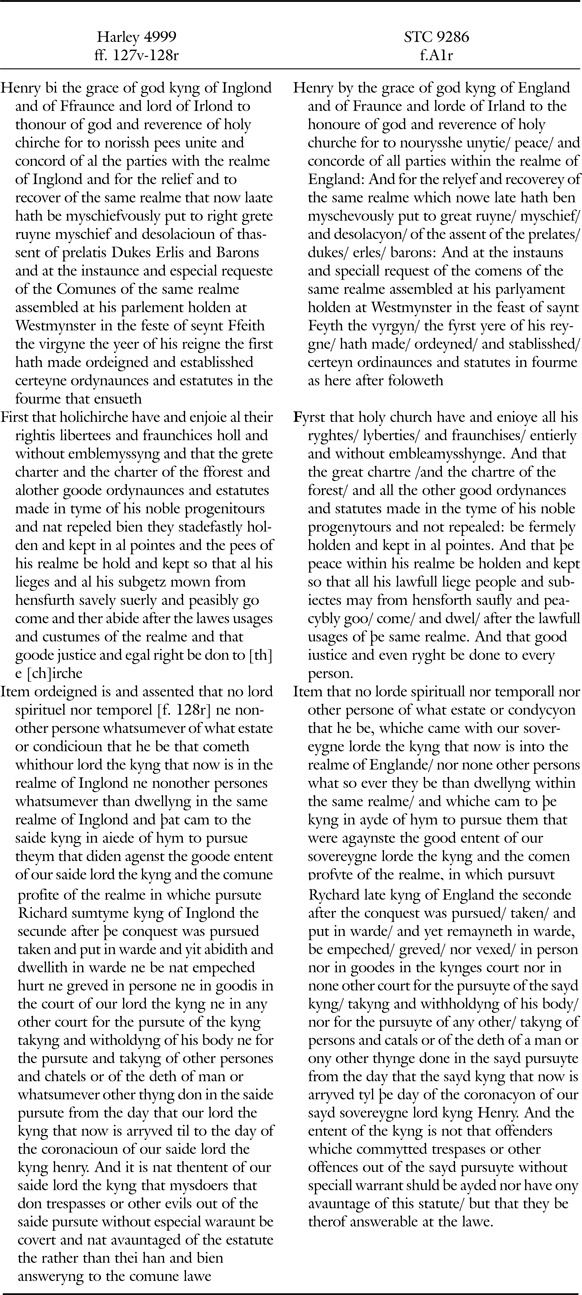
Appendix B: 1 Henry VI-c.1.



